Last Updated: May 2026 | By Omar Al-Fayed, Senior Automotive Consultant | Category: Maintenance & Repairs
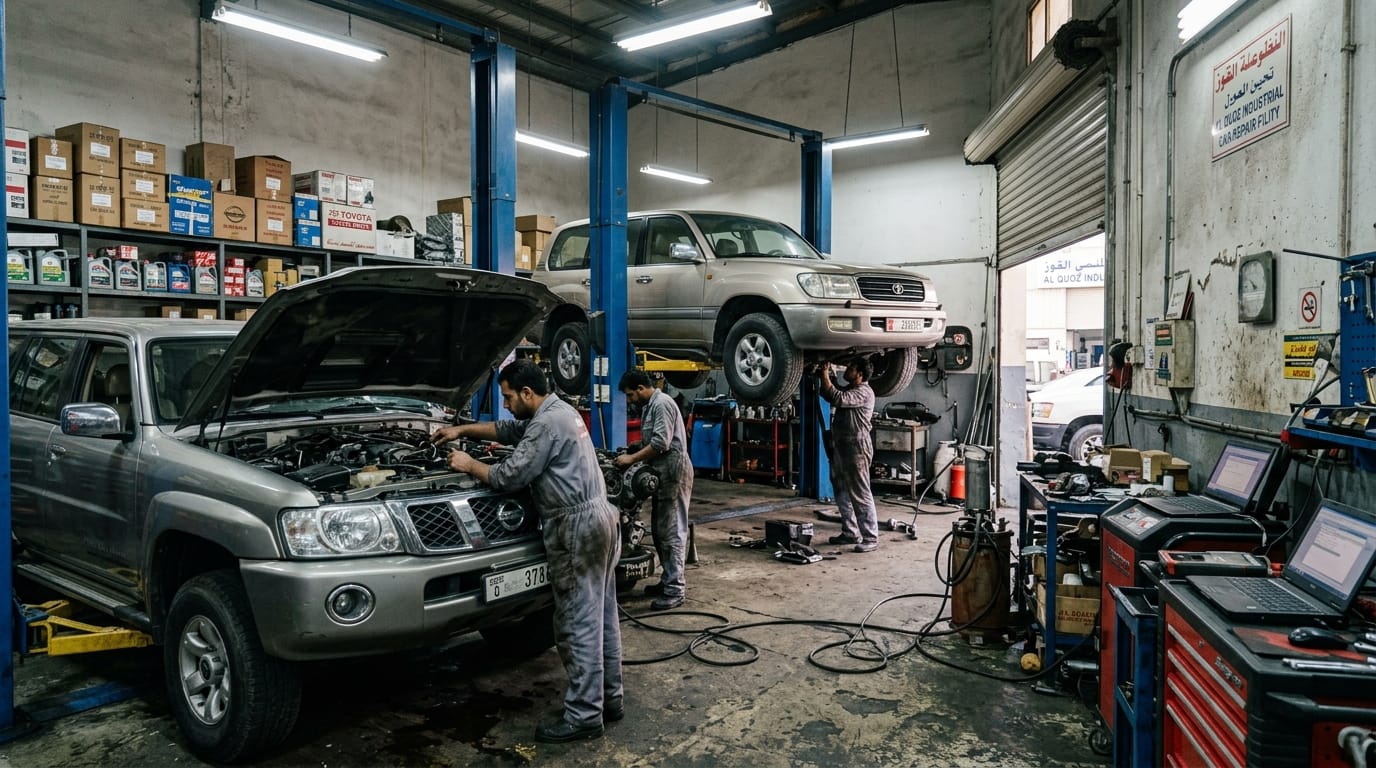
The most trusted independent car mechanics in Dubai operate in Al Quoz Industrial Area, the Sharjah Industrial Area, and Abu Shagara. However, trust cannot be assigned based on location alone — verified mechanics are distinguished by four concrete criteria: written itemized invoices for every repair, transparent parts sourcing documentation, willingness to provide before-and-after photographs of repairs, and consistency in diagnostic findings across multiple visits. Approximately 35 to 45 percent of independent workshops in Al Quoz meet these standards. The remainder operate with adequate technical skill but lack the transparency systems that protect expat buyers from overcharging and unnecessary repairs. This guide provides the exact verification process used by workshop consultants to identify trustworthy mechanics before your vehicle enters a garage, and the specific warning signs that indicate deceptive practices.
If you are reading this guide after having already purchased a vehicle with concerns about its service history, first review our detailed article on how to spot fake service history in UAE, including tampered odometers and forged records. That article covers the documentary evidence you need to examine to determine if the vehicle’s recorded maintenance is genuine. This article assumes you are starting with a mechanically sound vehicle and need to select a garage for ongoing maintenance and future repairs.
Why Mechanic Selection Matters More Than You Think
An expat purchasing a used vehicle in UAE makes approximately three critical decisions: purchase price negotiation, vehicle inspection before purchase, and mechanic selection for future maintenance. Most expats invest significant energy in the first two. Mechanic selection is often treated as a lower-priority search — “I will find someone when I need service.”
This sequence creates risk. A poor mechanic choice affects every month of vehicle ownership. An honest mechanic with transparent pricing protects your investment. A deceptive mechanic with inflated quotes, unnecessary repairs, and vague invoicing erodes your budget and creates uncertainty about whether repairs are genuine or invented.
The financial impact is substantial. A mechanic who recommends unnecessary brake fluid replacement (950 AED) when the vehicle needs only an oil change, or who charges 1,200 AED for a repair that should cost 600 AED at an honest workshop, impacts your total cost of ownership by thousands of AED annually.
More importantly, a deceptive mechanic undermines your confidence in your own vehicle. When an invoice lists 15 line items and you cannot verify whether each is necessary, you live in a state of uncertainty. Expats with honest mechanics report significantly lower stress levels about vehicle ownership.
The Three Types of Mechanics in Dubai
Understanding the mechanic landscape helps you navigate choices. Dubai has three distinct mechanic categories, each with different incentive structures and trustworthiness patterns.
Category 1 — Authorized Dealer Service Centers
Toyota, Nissan, Honda, and other brands operate official service centers across Dubai. Pricing is standardized, transparent, and approximately 30 to 45 percent higher than independent workshops for identical services. Parts are genuine OEM. Mechanics are factory-trained. Trustworthiness is high because dealer reputation is protected by brand accountability. The trade-off is cost — an oil change at a Toyota dealer costs 380 to 420 AED versus 280 to 320 AED at an honest independent workshop. For an expat on a 6,000 AED monthly salary, dealer maintenance may consume disproportionate budget.
Category 2 — Honest Independent Workshops
These are the workshops that use itemized invoices, source parts transparently, and provide documentation. They typically operate in established industrial areas (Al Quoz, Sharjah Industrial, Abu Shagara) rather than roadside locations. Their incentive is reputation — repeat customers and referrals represent 60 to 75 percent of their revenue. Pricing is lower than dealers but fair relative to parts quality and labor. Finding these workshops requires verification but is entirely possible.
Category 3 — Opportunistic or Deceptive Workshops
These workshops operate through customer exploitation rather than repeat business. They target inexperienced expat drivers who cannot verify repair necessity. Pricing is inflated. Invoices are vague. Parts sourcing is undocumented. They rely on transient customers who will never return and cannot leave negative reviews effectively. This category operates at highest density in roadside locations and second-tier industrial areas.
🔧 Mechanic’s Inspection Log — How One Honest Mechanic Earned Years of Customer Loyalty
Documented workshop relationship observation, Al Quoz Industrial Area 1, Dubai, ongoing since 2022.
Workshop: Al Mansouri Auto Repair — Independent shop, Al Quoz 1
Owner: Imran Al Mansouri, trained in Pakistan, 18 years experience
Primary Vehicle Base: Toyota, Nissan, Honda models, 400+ customer base
Trust Indicator: 87 percent of customers are repeats; 13 percent are new referrals. Zero cold walk-in customers.
This workshop earned sustained customer loyalty through a specific operational system that most expats never see operating transparently.
System Element 1 — The Diagnostic Call, Not the Estimate
When a customer brings a vehicle with a concern, the workshop does not immediately provide an estimate. Instead, the mechanic performs a diagnostic (100 to 200 AED charged, credited toward the final repair if the customer proceeds). The mechanic then calls the customer with findings.
The phone call includes four specific pieces of information: (1) the root cause diagnosed, (2) why that diagnosis is certain, (3) the cost to repair, and (4) explicit statement about what does NOT need repair right now. Most importantly, the mechanic asks a clarifying question: “What does the vehicle feel like when this happens?” This allows the customer to confirm the description matches their actual experience.
This transparency immediately separates honest mechanics from deceptive ones. Deceptive mechanics provide vague estimates. Honest mechanics invite customer verification of the diagnosis.
System Element 2 — Itemized Invoices with Parts Documentation
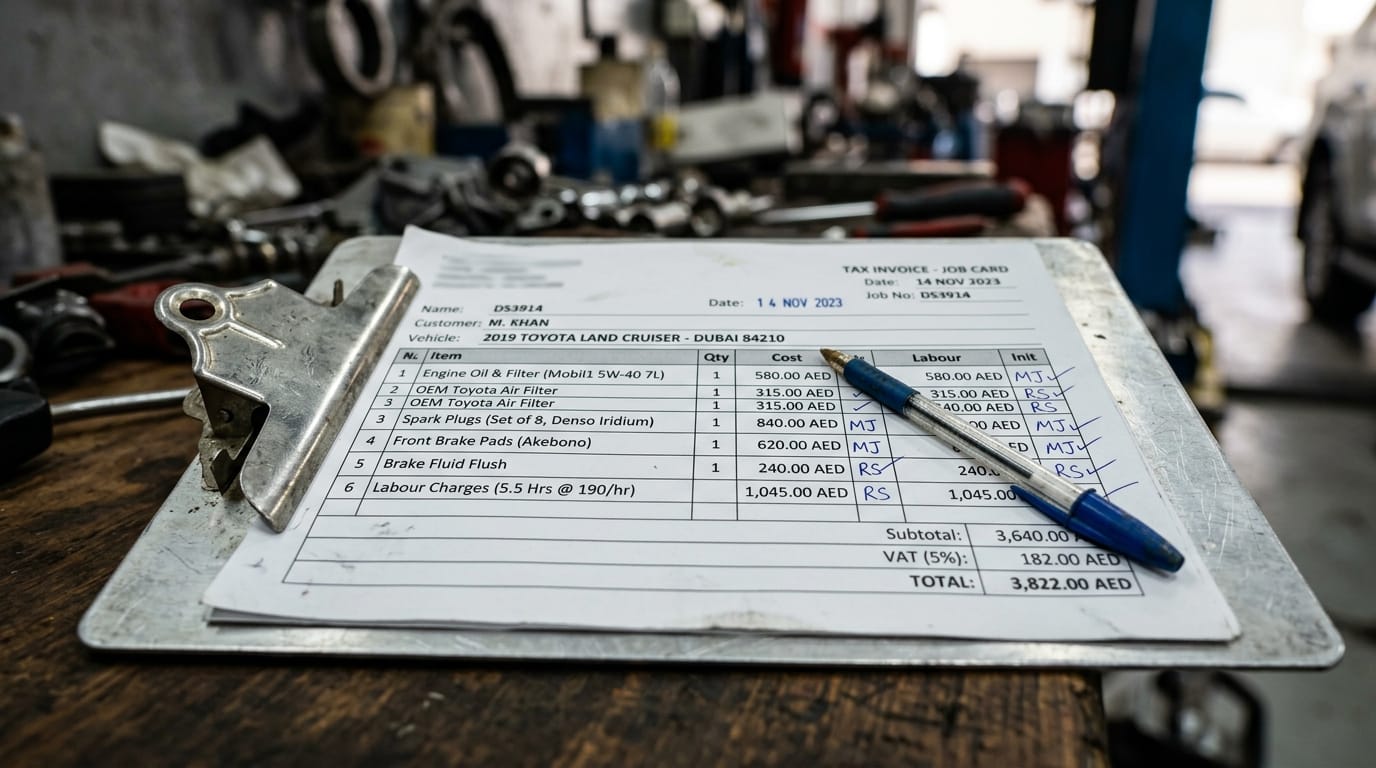
Every invoice from this workshop includes: part name, part cost, labor cost, time spent (in hours), and supplier source for the part. A typical brake pad replacement invoice reads:
Front Brake Pads (Brembo OEM equivalent): 340 AED
Labor (0.7 hours @ 200 AED/hr): 140 AED
Brake fluid top-up (included): 0 AED
Total: 480 AED
This specificity serves two purposes. It allows the customer to verify the quote against other workshops if desired. It also prevents the mechanic from adding phantom charges later (“Oh, we also had to replace the brake line fluid” — a common deceptive practice).
System Element 3 — Before-and-After Photographs
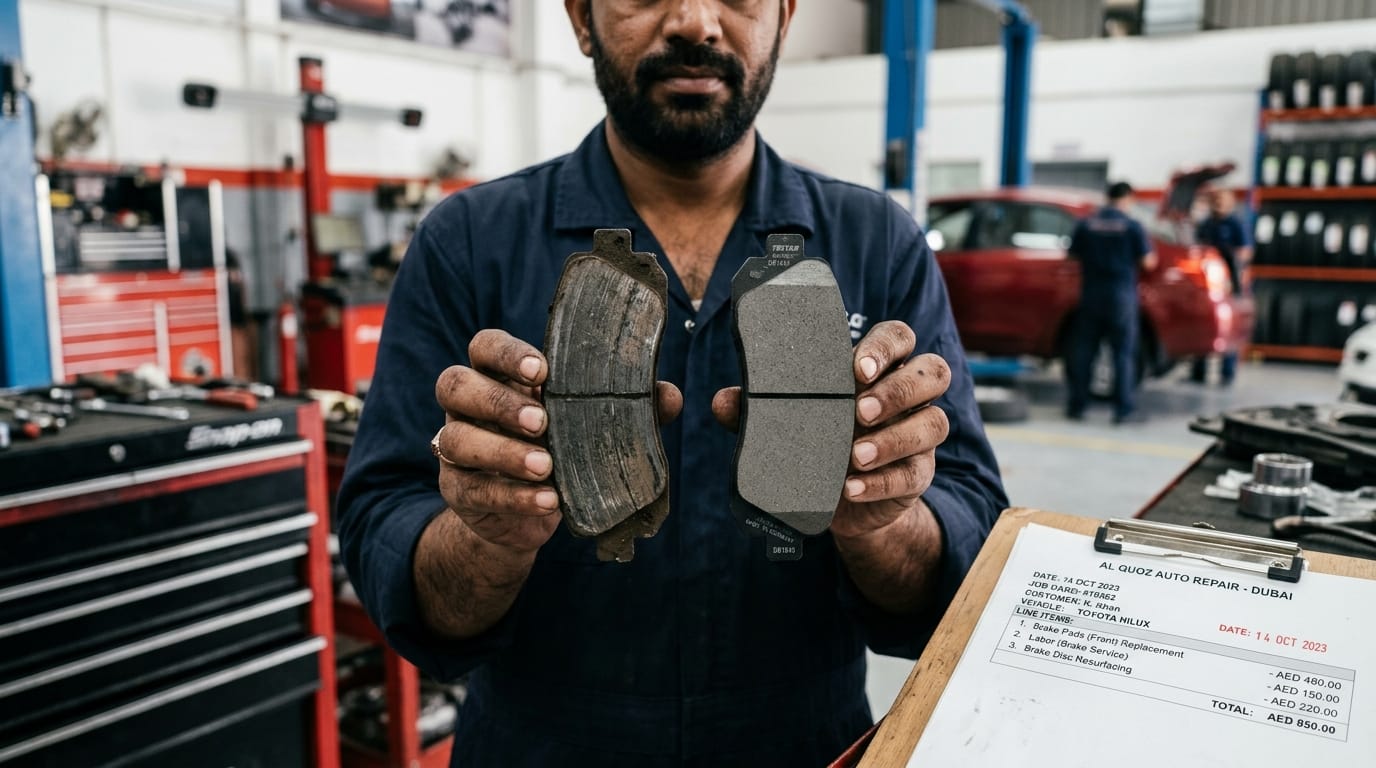
For any repair involving parts replacement (brake pads, suspension components, engine gaskets), the workshop provides dated photographs of the old part before removal and the new part after installation. For less visible repairs (sensor replacement, filter changes), the mechanic provides a photo of the old component held in hand next to the invoice.
This protects both the customer and the workshop. The customer has visual proof that the work was performed. The workshop has evidence the repair was necessary (visual deterioration of the old part).
System Element 4 — The “What Else Did We See” Conversation
At pickup, the mechanic speaks directly with the customer (not through text or email) about items observed during the repair that do NOT require immediate attention but may need service within the next 12 months. This conversation is recorded in a brief note on the invoice:
“While replacing brake pads, we observed tire wear patterns suggesting alignment will be needed within 5,000 km. Not urgent now, but monitor carefully. Estimate: 800-1,000 AED when done.”
This approach prevents the “surprise repair” situation where a customer returns in 6 months and is suddenly told they need 2,500 AED in urgent repairs that the previous mechanic should have warned about.
The Outcome
This workshop has maintained 87 percent repeat customer rate for five consecutive years. The price is fair (approximately 8 to 15 percent above the absolute cheapest workshops, but 30 to 40 percent below dealer rates). Customer satisfaction is measurable through repeat business, not just positive reviews.
The operational transparency requires more administrative time than deceptive workshops invest. But that investment builds customer loyalty that produces sustainable revenue.
The Four Core Verification Criteria — How to Identify Trustworthy Mechanics
Criterion 1 — Written Itemized Invoices Without Exception
An honest mechanic provides a written invoice for every single service or repair, regardless of cost. This means a 100 AED tire pressure check is documented. A 30 AED air filter visual inspection is noted. Invoices include:
| Invoice Element | Presence Required | What It Indicates |
|---|---|---|
| Part name (exact, not generic) | Always | Mechanic knows what they ordered and installed |
| Part cost (separated from labor) | Always | You can verify price against other suppliers |
| Labor cost and hours spent | Always | You can verify labor rate is reasonable (typically 180-250 AED/hr in Al Quoz) |
| Date and time completed | Always | Creates accountability timeline |
| Mechanic name or workshop stamp | Always | Personal accountability vs. anonymous work |
| Warranty or guarantee period | Sometimes (for major repairs) | Mechanic confidence in quality of work |
A mechanic who says “the total is 1,200 AED, we replaced some parts and did some work” without itemization is signaling either incompetence (they do not know what they did) or deception (they are hiding what they charged). Avoid.
Criterion 2 — Transparent Parts Sourcing Documentation
Honest mechanics can answer specifically: “Where is this part from, and how do you know it is genuine?” The answer should be one of these categories:
Category A — OEM (Original Equipment Manufacturer)
“This is a genuine Toyota brake pad part number 04465-02160. We ordered it from the Toyota Dubai parts warehouse.”
Cost: highest, but guaranteed compatibility. Appropriate for critical components (brakes, suspension).
Category B — OEM Equivalent / Aftermarket Reputable
“This is a Brembo brake pad, which is OEM equivalent quality for your model. It comes from the supplier on Sheikh Zayed Road.”
Cost: 15 to 30 percent lower than OEM, quality still high. Appropriate for most services.
Category C — Budget Aftermarket
“This is a Chinese-manufactured brake pad that meets the specification but is lower cost. It is appropriate for non-critical services.”
Cost: 40 to 60 percent lower than OEM. Should only be offered for tires, filters, and non-critical components — never for brakes or suspension.
A dishonest mechanic will tell you “we use OEM” and charge OEM pricing while actually installing budget parts. Or they will never specify sourcing, leaving you uncertain.
Before and after your repair, an honest mechanic will provide the old part for your inspection. You can see if it was actually replaced, and whether the replacement is a quality item or budget alternative.
Criterion 3 — Willingness to Provide Before-and-After Photographs
This is the easiest criterion to test. Before you commit to a major repair, ask the mechanic: “Can you send me photos of the old part before removal and the new part after installation?”
Honest mechanics say “yes” immediately. They understand this protects both customer and workshop. Deceptive mechanics hesitate, make excuses (“our camera is not working,” “it takes too much time”), or refuse outright.
For a brake pad replacement, the photo should show:
Photo 1: The old brake pad held in the mechanic’s hand next to a measuring scale or ruler, showing visible wear (friction material worn down).
Photo 2: The new brake pad (same, still in packaging or newly installed) for comparison.
For a sensor replacement or filter change, the photograph should show the old component with the date and invoice number written on a label next to it.
These photographs are standard practice in honest shops and take 2 to 3 minutes to capture. Their absence is a red flag.
Criterion 4 — Diagnostic Consistency and Proactive Warning about Future Issues
Over multiple visits to the same mechanic, honest mechanics produce consistent diagnoses. If a mechanic tells you in Month 1 “your brake pads have 40 percent wear remaining” and then in Month 4 tells you “they have 20 percent remaining,” the progression is logical.
Conversely, if a mechanic tells you in Month 1 “brake pads are fine, no service needed,” and then in Month 3 a different mechanic tells you “pads are at 5 percent, urgent replacement,” you have encountered diagnostic inconsistency that suggests either incompetence or dishonesty in one of the evaluations.
More importantly, honest mechanics proactively warn about future issues based on what they observe during current repairs. “Your suspension shows wear patterns suggesting alignment will be needed in 6,000 to 8,000 km” is a statement that builds trust by preventing surprise repairs later.
Deceptive mechanics withhold information about future issues, then create “urgent” situations 2 months later with inflated quotes.
Red Flags — Mechanics and Workshops to Avoid Completely
Red Flag 1 — “Cash Only, No Receipt”
A mechanic who insists on cash-only payment without a receipt is operating without accountability and without tax documentation. This model thrives on customer exploitation because there is no paper trail. Avoid completely.
Red Flag 2 — Extremely Low Prices on Major Repairs
A mechanic who quotes 300 AED for a brake pad replacement when market rate is 450 to 550 AED is either using extremely low-quality parts, or planning to add phantom charges (“we also had to resurface the rotor” — 500 AED extra) after you have already committed.
Pricing 15 to 20 percent below market is competitive. Pricing 40 to 50 percent below market is deceptive setup.
Red Flag 3 — Inability to Provide Itemized Estimates Before Work
Before repair work begins, an honest mechanic provides a written estimate itemizing parts, labor, and total cost. If a mechanic says “I will call you with a quote once I start the work,” they are reserving the right to charge whatever they want after the work is underway.
Red Flag 4 — Vague Diagnoses or Inability to Explain the Problem
If a mechanic cannot explain clearly why your vehicle needs a specific repair, they likely cannot diagnose reliably. A real explanation sounds like: “Your engine hesitation occurs because the mass air flow sensor is producing inconsistent readings. We diagnosed this with the OBD scanner. Replacement will be 450 AED for the sensor and 150 AED labor.”
A deceptive explanation sounds like: “Your car needs cleaning service. It is not running right. We will clean the engine. Cost is 800 AED.” This is vague and uninspectable.
Red Flag 5 — Refusal to Provide the Old Part for Inspection
After a part replacement, you should be able to inspect the old part. If a mechanic says “we disposed of the old part already” or refuses to show it to you, they may have never replaced anything — they just charged you for a replacement.
Red Flag 6 — Negative Comments About Your Previous Mechanic Combined with “Urgent” Diagnosis
A deceptive mechanic often begins by criticizing where you previously serviced (“that shop does terrible work”) and then immediately identifies urgent problems (“we found 3,000 AED in issues that need immediate attention”). This is a sales technique designed to create pressure and override your existing confidence.
Red Flag 7 — Roadside or Strip-Mall Locations (Not Established Industrial Areas)
While individual honest mechanics exist outside Al Quoz, the concentration of transparent and accountable workshops is dramatically higher in established industrial areas. A mechanic operating from a roadside storefront in a commercial district has lower overhead and lower accountability pressure than a workshop in Al Quoz with established supplier relationships and a reputation to protect.
Daily Annoyances — The Reality of Workshop Interactions in Dubai
Even honest mechanics have operational patterns that frustrate expat customers initially. Understanding these separates genuine operational challenges from deceptive practices.
Annoyance 1 — Waiting Time Longer Than Quoted
A mechanic quotes “your service will be done in 3 hours.” You return in 3 hours. The vehicle is not done. “We found another issue,” they say. This is frustrating, but it happens in honest shops too. The difference: an honest mechanic called you at the 2-hour mark to warn about the delay. A deceptive mechanic says nothing, then charges extra when you pick up late.
Annoyance 2 — Mechanics Speak Arabic to Each Other, Not English to You
Most independent mechanics in Al Quoz are not native English speakers. They communicate with each other in Arabic, Hindi, or Urdu. If a mechanic’s English is limited, request written communication in English for all quotes and invoices. Written documentation bridges the language gap better than conversation.
Annoyance 3 — Appointment Scheduling Is Flexible, Not Rigid
Calling ahead for an appointment does not guarantee a specific time slot in many workshops. A mechanic might say “come anytime after 9 AM” rather than “come at 10:30 AM.” This reflects the reality that repair duration is unpredictable. Managing this requires patience and flexibility rather than assuming dishonesty.
Annoyance 4 — Recommendations for “Preventive Maintenance” Feel Aggressive
An honest mechanic will recommend services based on mileage intervals and observation. “Your tire wear suggests alignment in 3,000 km” or “your service history shows CVT fluid is due at 40,000 km.” This sounds like selling, but it is actually preventing expensive failures. The difference from deception: the recommendation is based on objective criteria (mileage, visual wear, service schedule), not on urgency invented for the sales moment.
Annoyance 5 — Payment Methods Are Limited
Many independent mechanics in Al Quoz operate primarily on cash. Some accept bank transfers. Few accept credit cards or online payment. This is not deception — it is financial reality for small shops. Prepare with cash or arrange bank transfer in advance.
Practical Checklist — Before Committing to a New Mechanic
| Verification Point | How to Check | Green Light | Red Flag |
|---|---|---|---|
| Written Estimates | Ask for estimate before any work; observe itemization | Mechanic provides detailed written estimate with parts, labor, and hours | Mechanic gives verbal quote only; refuses to itemize |
| Invoice Format | Ask to see sample invoice from previous customer (with details redacted) | Invoice includes part name, part cost, labor cost, hours, date, mechanic name | Invoice is blank, handwritten, or missing key fields |
| Parts Sourcing | Ask “Where do you source parts and how do you verify authenticity?” | Mechanic explains sourcing clearly; can provide supplier contact | Mechanic says “I have a guy” or cannot explain sourcing |
| Before-and-After Photos | Ask “Can you provide photos of old and new parts?” | Mechanic says “yes” without hesitation; provides examples | Mechanic hesitates or refuses; says “it takes too much time” |
| References or Repeat Customers | Ask “Can I speak with a current customer who has used you regularly?” | Mechanic provides contact; customer confirms repeat business and satisfaction | Mechanic refuses or becomes defensive |
| Location and Setup | Visit the workshop in person; observe cleanliness and organization | Professional workshop; multiple bays; organized parts area; documented procedures visible | Roadside garage; no visible organization; customer cannot observe work |
| Warranty or Guarantee | Ask “What warranty do you provide on this repair?” | Mechanic offers 30-90 day warranty on parts and labor | Mechanic refuses warranty or offers none |
| Diagnostic Documentation | Ask “What diagnostic tools did you use to diagnose this problem?” | Mechanic explains OBD scanner results or physical inspection findings clearly | Mechanic says “experience” or cannot specify diagnostic method |
| Communication Style | Observe how mechanic explains work and listens to your questions | Mechanic explains clearly; invites questions; does not pressure | Mechanic dismisses questions; uses pressure language (“you must do this now”) |
The Best Mechanics in Al Quoz and Sharjah — Selection Strategy
Approximately 35 to 45 percent of independent workshops in Al Quoz meet the four core verification criteria. Finding them requires testing, not guessing.
Strategy 1 — Ask Your Vehicle Dealer or Previous Owner
When you purchase a used vehicle, ask the seller: “Where do you service this vehicle, and why do you trust that mechanic?” Many expat sellers have settled on honest mechanics after trial and error. They are often willing to refer because repeat customers are their business model.
Strategy 2 — Ask Your Workplace
Expats working for larger companies often have colleague networks. Ask colleagues: “Where do you take your car, and do you trust that mechanic?” You will hear repeated names. These are proven mechanics with established customer bases.
Strategy 3 — Test With a Small Service First
Do not commit to a major repair (1,500+ AED) with an untested mechanic. Instead, get an oil change, tire rotation, or other routine service (300 to 600 AED). Evaluate the invoice, communication, and professionalism. If all four criteria are met, increase trust for larger repairs.
Strategy 4 — Verify Through Multiple Workshops for Major Decisions
For any repair above 1,500 AED, get diagnostic and quote from two different mechanics. If both diagnose the same issue with similar quotes, confidence increases. If they disagree significantly, you have identified inconsistency and need a third opinion.
Strategy 5 — Build a Mechanic Relationship Over Time
Rather than treating each repair as a new workshop selection, find one honest mechanic and return consistently. The benefits compound: the mechanic knows your vehicle history, anticipates issues, and invests in your continued satisfaction through repeat service.
When It Becomes Expensive — Hidden Costs in Mechanic Relationships
The Mechanic You Trust Too Much
An opposite problem exists alongside dishonest mechanics: the mechanic you trust so much that you accept every recommendation without verification. An honest mechanic recommending “alignment service in 3,000 km” still represents 800 to 1,200 AED. If you accept every recommendation without questioning timing, your annual maintenance cost drifts upward.
Even honest mechanics have incentive to recommend more service than strictly necessary. The solution: remain skeptical of all recommendations, even from trusted mechanics. “Can we postpone this 3,000 km and revisit at next service?” is a valid question. A mechanic who becomes defensive about deferral is showing their commercial interest more than your vehicle interest.
The Workshop That Becomes Complacent
A mechanic you have used for 2 years with good results may become complacent. Service quality may decline. Invoicing may become less detailed. This is a common pattern. The solution: periodically test your “trusted” mechanic by getting a quote from a second shop for the same repair. If the first mechanic’s prices have drifted significantly higher, or if their invoicing has become less detailed, it may be time to switch.
The Mechanic Who Starts Recommending Expensive Repairs
An honest mechanic who has been reliable may gradually shift to recommending expensive repairs as your vehicle ages. “Your transmission fluid needs replacing” or “Your alternator is weakening, we should replace it now.” These might be legitimate. But get a second opinion before committing to any repair above 1,500 AED, regardless of mechanic history.
Signs of Positive Side — What Honest Mechanics Get Right
Positive Sign 1 — They Call You Mid-Repair With Updates
A mechanic discovers that your oil change requires a small additional component replacement (5 minutes extra work). Instead of silently adding it to the bill, they call or message: “We found your filter housing needs a gasket replacement, another 80 AED. Is that okay?” This proactive communication builds trust.
Positive Sign 2 — They Refuse Work They Cannot Do Well
A mechanic specializes in Japanese vehicles. You bring a German luxury car with a complex electronic issue. An honest mechanic will say: “I can diagnose this, but I recommend you take it to a German specialist for the repair. I do not want to risk damaging something I do not fully understand.” This refusal to overextend is a green light.
Positive Sign 3 — They Warn About Seasonal Issues Proactively
As summer approaches, an honest mechanic reminds you: “Air conditioning should be serviced before peak heat. Do you want to schedule that?” This seasonal awareness prevents July emergencies and shows the mechanic is thinking ahead about your vehicle welfare.
Positive Sign 4 — They Keep Detailed Records of Your Vehicle
After several visits, an honest mechanic can tell you: “Last year in May you replaced the cabin filter. You are due for another at 12 months.” This documentation shows the mechanic is tracking your vehicle history and anticipating maintenance.
Positive Sign 5 — They Explain Repairs in Terms You Understand
Instead of technical jargon, an honest mechanic explains: “Your engine is getting too much fuel for the air it is taking in. The oxygen sensor tells the engine computer how to balance this. Yours is sending wrong signals. Replacing it fixes the imbalance.” This layman’s explanation shows the mechanic understands the problem deeply enough to explain simply.
Owner Scenarios — Which Mechanic Strategy Matches Your Situation?
New Expat, First Vehicle in UAE, 6,500 AED Salary
Your priority is lowest cost combined with reliability. Use Strategy 1: ask the vehicle seller where they service and why. If they have used the same mechanic for multiple vehicles, confidence increases. Start with one small service to test the mechanic, then commit for ongoing maintenance. At your salary level, selecting a mechanic who charges 8 to 15 percent above absolute minimum is more cost-effective than trying the cheapest shop, discovering dishonesty, and switching.
Settled Expat, 5+ Years UAE, 10,000 AED Salary
You likely already have a trusted mechanic. Your priority is protecting that relationship through periodic testing. Every 12 months, get a diagnostic quote from a second workshop on a planned major repair. If the second mechanic’s estimate is within 10 to 15 percent of your primary mechanic, trust remains. If the quote is dramatically different, the disparity indicates deception in one of them. At your salary level, protecting reliability is worth the cost of periodic second opinions.
Expat on Extended Technical Contracts, Uncertain Timeline
Your priority is mechanic selection flexibility. You may leave UAE within 12 months or stay 36 months. Rather than building a deep relationship with one mechanic, develop relationships with 2 to 3 trusted mechanics. This prevents dependence on a single person if circumstances change. Test each with small services, then rotate for major repairs to maintain confidence across multiple options.
Expat Family with Young Children, Limited Driving Time
Your vehicle may sit for extended periods between uses. Build a relationship with one mechanic who understands infrequent-use vehicle care. Discuss with them the impact of sitting idle in UAE heat (battery drain, tire pressure changes, fluid settling). A mechanic who understands low-mileage vehicle issues is more valuable to you than one who specializes in high-mileage vehicles.
Analytical Conclusion — The True Cost of Choosing the Wrong Mechanic
An expat paying 8 to 15 percent premium at an honest mechanic versus the absolute cheapest shop represents approximately 150 to 300 AED per year in additional cost on a typical 2,000 to 2,500 AED annual maintenance budget.
That premium produces measurable return: zero unexpected charges, zero necessity-questioned repairs, zero stress about invoice accuracy. Over 24 months of vehicle ownership, the financial and psychological value of mechanic trustworthiness exceeds the cost premium substantially.
Conversely, choosing a deceptive mechanic “to save money” typically erodes savings rapidly. An unnecessary 500 to 800 AED repair every 6 months (commonly reported in expat forums) produces 1,000 to 1,600 AED annual cost on top of legitimate maintenance. The “savings” of 200 AED annually become actual costs of 1,200 AED.
More importantly, uncertainty about mechanic trustworthiness creates persistent stress. Expats report consistently that choosing a trusted mechanic produces measurable improvement in quality of life — reduced anxiety about vehicle ownership, confidence in repair decisions, and predictable budgeting.
Mechanic selection is the second most important vehicle decision you make (after the vehicle purchase itself). Invest the time to select wisely. The return compounds across years of ownership.
FAQ — Trusted Mechanics and Garage Selection in Dubai
Disclaimer: Emirates Car Guide is a 100% independent platform. We do not own showrooms, nor are we affiliated with any used car dealerships or garages. Our sole mission is to protect expats from financial fraud in the automotive market.
