Last Updated: May 2026 | By Omar Al-Fayed, Senior Automotive Consultant | Category: Buying & Selling
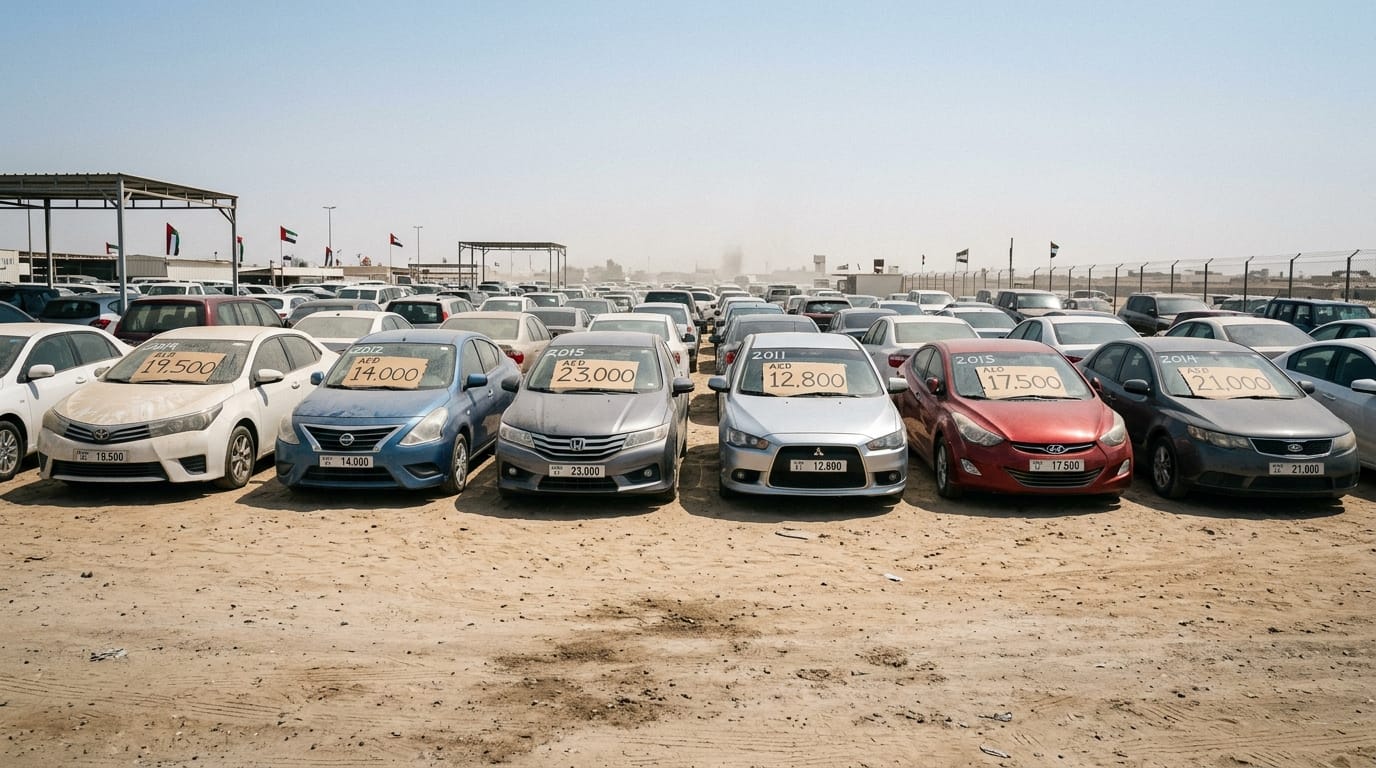
Dishonest dealers in Dubai’s used car market rely on the same playbook — and it works because most expat buyers do not know what to look for. Based on observations from consulting work across Al Aweer, Abu Shagara, and the Deira showroom strip throughout 2024 and 2025, the most damaging tricks are not dramatic scams. They are small, systematic acts of omission that cost buyers an average of 4,000 to 9,000 AED in the first year of ownership. This guide documents the ten most frequently observed dealer tricks, the exact red flags that signal each one, and how to respond in the moment.
If you came from our guide comparing the Honda City versus the Toyota Yaris for expat value retention in UAE, you already know that vehicle choice is important. This guide covers something that matters just as much: recognizing when the seller of that vehicle is not being straight with you.
Why These Tricks Work on Expat Buyers
Most expats arriving in the UAE face the same situation: they need a car quickly, they do not know the local market prices well, and they are unfamiliar with UAE automotive regulations. Dealers in high-volume used car markets encounter this pattern daily.
Three structural factors create the environment where these tactics operate:
- Information asymmetry: The seller has handled the vehicle for weeks. The buyer has one afternoon and a test drive.
- No mandatory disclosure: UAE private vehicle sales have no legal requirement to disclose accident history, mechanical faults, or service gaps. The seller volunteers only what helps the sale.
- Time pressure on the buyer: A new expat who needs transport for work in three days makes different decisions than someone with a month to research.
The tricks documented here are not random. They are predictable responses to these conditions — which means they are recognizable once you know what to look for.
🔧 Mechanic’s Inspection Log — The Fully Reconditioned Car That Was Not
Documented consultation, January 2026, independent workshop, Al Quoz Industrial Area 1, Dubai.
Vehicle: 2019 Hyundai Sonata 2.4L GCC, 68,000 km
Showroom: Mid-size showroom, Al Rashidiya, Dubai
Asking price: 36,500 AED
Seller’s description: “Fully reconditioned, engine checked, ready to drive, no issues”
The buyer — a finance analyst from Mumbai working in DIFC on 13,000 AED monthly — called me after seeing the listing. The car looked immaculate. New floor mats, professional cleaning, and a printed “inspection checklist” the showroom had produced themselves.
Their self-inspection checklist had 22 items, all marked “Pass.” It was produced on their own letterhead and signed by their own technician.
The independent workshop inspection at Al Quoz found the following within 75 minutes:
- OBD scan: stored P0420 (catalytic converter efficiency below threshold) — cleared approximately 1,100 km before our visit. Freeze-frame data showed the code had been active for 2,800 km before clearing. Catalytic converter replacement on the Sonata 2.4L: 1,600 to 2,200 AED.
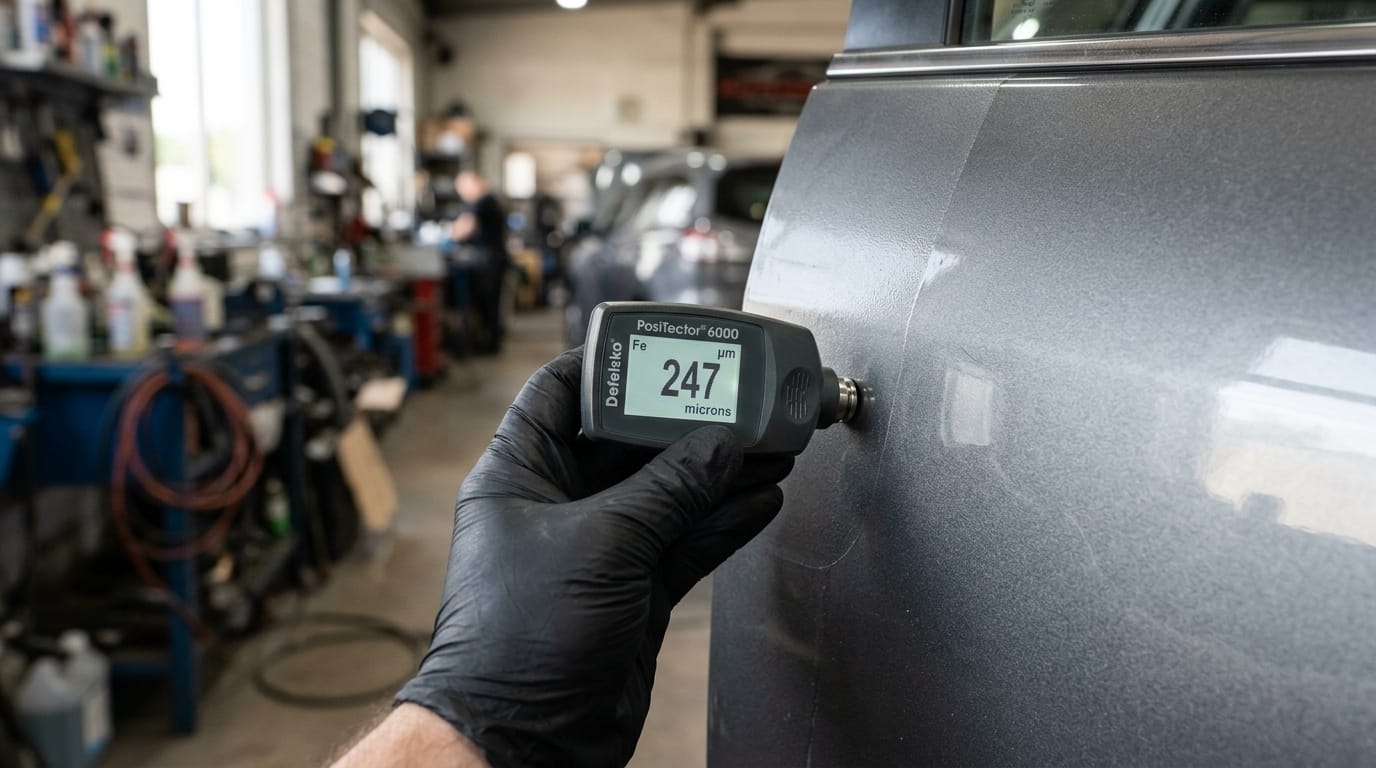
- Paint thickness gauge — rear quarter panel (passenger side): 267 microns. Factory standard for this panel: 90 to 130 microns. Full rear-right panel respray over repaired metal. The “no accidents” claim did not hold.
- Transmission fluid: dark brown with a faint burnt smell. CVT service needed immediately: 700 to 900 AED. Extended neglect of the CVT fluid on this transmission would lead to progressive internal wear.
- The showroom’s self-inspection checklist had not detected any of these three items.
Negotiated reduction: 2,800 AED. Final price: 33,700 AED. The buyer also scheduled immediate CVT service and catalytic converter replacement — knowing the costs in advance rather than discovering them in month three.
The 10 Dealer Tricks — With Exact Red Flags and Responses
Trick 1 — The Reconditioning Markup
Before listing, most showrooms spend 800 to 2,500 AED on cosmetic preparation: professional deep clean, paint touch-up on minor scratches, new floor mats, an air freshener, and sometimes a tire shine product to make rubber look newer than it is.
The vehicle is then described as “fully reconditioned” or “showroom condition” — and priced 3,000 to 6,000 AED above comparable undressed listings for the same model and mileage.
Red flag: The car looks noticeably cleaner and newer than the mileage would suggest. The interior smells strongly of air freshener rather than a neutral lived-in smell. The tires have an unnaturally dark, shiny appearance.
Your response: “Reconditioning tells me what it looks like, not what it runs like. I want to take it for an independent inspection before discussing price.” Use the price premium as a starting point for negotiation reduction rather than as a reason to pay more.
Trick 2 — The Self-Issued Inspection Certificate
As documented in the Inspection Log above, some showrooms produce their own “inspection checklist” on branded letterhead. These documents have 15 to 25 items, all marked as passing. They carry no independent verification.
Red flag: Any inspection document issued by the same showroom selling the vehicle. Any checklist signed by a technician employed by the seller.
Your response: “I appreciate you having it checked. I’d like to take it to my own mechanic before agreeing on price. Which workshop of my choosing can we go to right now?”
Trick 3 — Cleared OBD Codes and the Tasjeel Trick
This is among the more financially damaging tactics because it specifically targets the documents most expats trust. Before listing, a vehicle’s OBD fault codes are cleared using a simple handheld scanner. The vehicle then passes a standard OBD check and a Tasjeel inspection — because both check current codes, not historical fault patterns.
The freeze-frame history in the OBD system still records when codes were previously active and for how long. A standard OBD reader does not access this. A scanner with freeze-frame capability does.
Red flag: A seller who mentions the Tasjeel pass as primary evidence of mechanical health. Any seller who specifically says “it just passed the Tasjeel test” in the first sentences of description.
Your response: “I understand it passed Tasjeel. I want to run my own OBD scan with freeze-frame data to check the fault history, not just current codes. Is the car available to take to a workshop today?”
Trick 4 — The Urgency Manufacture
“Another buyer is coming this afternoon.” “This price is only valid until tonight.” “The owner is leaving UAE next week and needs to sell urgently.”
These phrases are scripted. They appear in showrooms across Al Aweer, Abu Shagara, and the Al Qusais strip with nearly identical wording — because they work. They prevent the buyer from taking the 24 to 48 hours needed for an independent inspection and market price comparison.
In observations from cases consulted on in 2024 and 2025, cars described as “almost sold” or “another buyer arriving today” were consistently still available when the buyer returned the following morning.
Red flag: Any combination of urgency phrases. A seller who cannot give you 24 hours to complete due diligence on a transaction of 20,000 AED or more.
Your response: “I need 24 hours to arrange an independent inspection. If another buyer takes it in that time, I will find another car.” Walk out. Return the following morning if you are still interested.
Trick 5 — The Verbal Service History
“The previous owner serviced it regularly at a trusted garage.” “I know the previous owner personally — he looked after the car very well.” “It was serviced every 5,000 km, I just don’t have the receipts.”
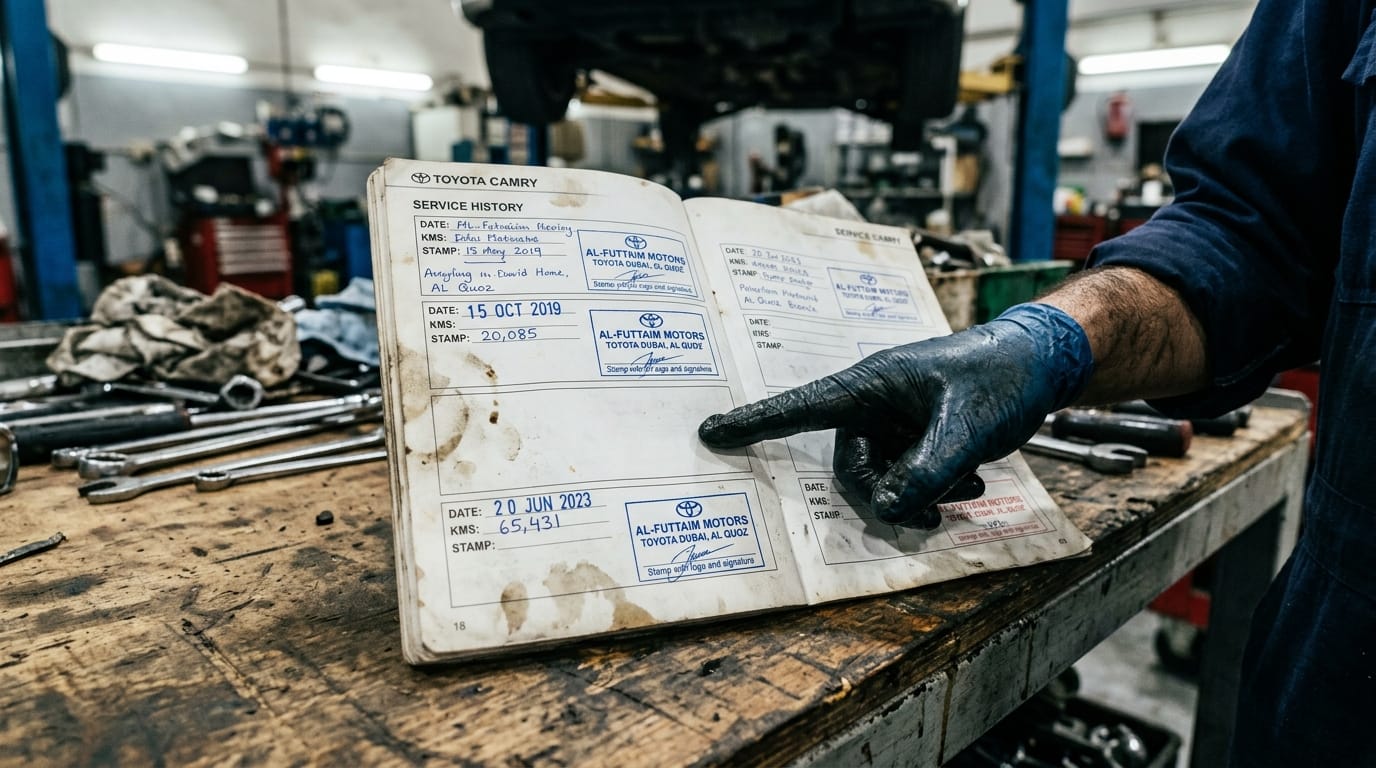
Without a stamped service booklet or original workshop receipts with dates and odometer readings, a verbal service history is not a service history. It is a conversation.
In UAE summer conditions, a vehicle serviced at 10,000 km intervals rather than 5,000 km intervals experiences meaningfully different engine wear on its timing chain, VVT system, and turbocharger (if equipped). This wear is not visible on inspection but shows up in repair bills within the first 20,000 km of new ownership.
Red flag: Any service history claim not backed by stamped booklets or dated receipts. Service history described as “private garage, receipts unavailable” or “the owner kept a record but I don’t have it.”
Your response: “I can only verify the service history I can read. If there are no receipts, I need to price the unknown service gap into my offer.” Deduct 2,000 to 4,000 AED from your offer for any gap above 20,000 km without documentation.
Trick 6 — The “Full Agency Service History” Exaggeration
This is a more specific version of the verbal history trick. A seller presents a service booklet with three or four agency stamps, then describes the car as having “full agency service history.” The booklet shows the first delivery service at 1,000 km and services at 10,000 and 28,000 km. The odometer reads 74,000 km. That leaves 46,000 km across three documented intervals — which is not full history.
Red flag: Count the stamps and calculate the covered mileage before accepting any service history claim. If stamps cover less than 80 percent of the total odometer reading, the remaining mileage is undocumented.
Your response: Physically count the stamps, calculate the gap, and name it specifically: “The booklet covers up to 28,000 km. The car now shows 74,000 km. That is 46,000 km without documentation. I want to reflect that in the price.”
Trick 7 — The Mandatory Extras Bundle
After price agreement, a showroom adds items to the final invoice that were not discussed: a warranty package (150 to 500 AED, typically with significant exclusions), an insurance arrangement fee (200 to 400 AED for connecting you to an insurer), a registration fee above the actual RTA cost (typically 350 AED — sellers charge 500 to 1,200 AED), and sometimes a “document processing fee” with no explanation.
These extras are presented after emotional commitment has been established — after the test drive, after the price is agreed, while the paperwork is being prepared. The buyer is in a position where walking away feels difficult.
Red flag: Any items added to the invoice after the vehicle price was agreed. Any fees described vaguely as “processing,” “arrangement,” or “handling.”
Your response: Before the test drive, establish a rule: “I want a written itemized quote of every cost beyond the vehicle price before we discuss anything else.” An itemized quote requested before commitment removes the post-agreement pressure entirely.
Trick 8 — The Cosmetic Accident Concealment
Minor to moderate accident repairs — a repainted door, a replaced front bumper, a repaired rear quarter panel — are cosmetically concealed before listing. The vehicle looks clean on a visual inspection. The seller describes it as “accident free.”
A paint thickness gauge test takes 30 seconds per panel and immediately identifies any panel with body filler or respray over repaired metal. Factory paint thickness on most Japanese and Korean GCC sedans is 90 to 130 microns. Any reading above 180 microns indicates repainting. Above 220 microns indicates body filler beneath the paint.
Red flag: A seller who objects to a paint thickness test, or who becomes noticeably uncomfortable when you produce a gauge at the viewing.
Your response: Bring a paint thickness gauge to every viewing above 20,000 AED. A basic digital gauge costs 80 to 150 AED to purchase. Use it on all six main panels (hood, front bumper, all four door panels, rear bumper) before the test drive.
Trick 9 — The Finance Convenience Trap
After price agreement, the seller offers to arrange financing “at a very competitive rate” — typically presented as a monthly installment amount rather than an effective annual interest rate. “Only 650 AED per month” sounds manageable. The effective annual interest rate behind that number may be 5.5 to 8 percent — compared to 3.5 to 4.5 percent available directly from a UAE retail bank for the same buyer profile.
On a 28,000 AED loan over 36 months: the difference between 4 percent and 7 percent effective rate is approximately 2,100 AED in additional interest over the loan term.
Red flag: Any financing offer presented as a monthly installment amount rather than an effective annual percentage rate. Any offer to arrange financing without showing the full interest cost calculation.
Your response: Get a pre-approval letter from your bank before visiting any showroom. When the seller offers financing, present the bank pre-approval: “I already have financing arranged directly. What is the final vehicle price for a cash transfer?”
Trick 10 — The Flood Damage Concealment
Following the April 2024 UAE rainfall event, a documented supply of flood-damaged vehicles entered the used car market through professional reconditioning — new carpet, ozone treatment for odor, electrical connector partial drying, and OBD code clearing. These vehicles can pass a Tasjeel test, pass a visual inspection, and feel acceptable on a short test drive.
The failures emerge over 4 to 16 weeks as residual moisture works through the electrical system — the Body Control Module (BCM), the ABS module, power window regulators, and AC system components.
Red flag: A strong air freshener smell that seems designed to mask something. A seller who does not allow you to lift the front carpet edge at the door sill. Any vehicle purchased between May and December 2024 that has not had a flood-specific inspection.
Your response: Request a flood-specific inspection add-on (80 to 150 AED above a standard inspection) for any vehicle in the 35,000 to 70,000 AED range purchased in this period. Specific checks: fuse box terminal oxidation, carpet underlayer watermarks, rear seat base mould, and module connector corrosion.
The Honest Side — What Transparent Dealers Actually Do
Not every used car showroom in Dubai operates through the tricks above. In observations from consulting work throughout 2024 and 2025, approximately 25 to 35 percent of showrooms encountered operated with genuine transparency.
A transparent seller does these things without being asked:
- Shows the Mulkiya before you ask for it — because they have nothing to hide in the ownership history
- Agrees to a workshop inspection immediately — because the vehicle will pass it
- Provides the VIN on first contact — because the evg.ae check will come back clean
- Shows the service booklet with an honest explanation of any gaps — because they bought it with that gap and priced it accordingly
- Does not mention other buyers or urgency — because the price is already fair and they do not need pressure tactics to sell it
A seller who does all five of these things unprompted is giving you strong evidence of a vehicle worth looking at seriously.
Buyer Mistakes That Make These Tricks Work
| Mistake | Why It Happens | How to Avoid It |
|---|---|---|
| Visiting showrooms without a market price reference | No Dubizzle research done before the viewing | Search the specific model and mileage on Dubizzle before every viewing — note the three lowest prices for documented units |
| Accepting the Tasjeel certificate as mechanical clearance | Not understanding what Tasjeel checks | Treat Tasjeel as a legal requirement — arrange an independent inspection separately for mechanical verification |
| Deciding same-day on emotional attachment | The car looks good, the drive felt fine | Establish a personal rule: no decision without an overnight wait and an independent inspection result |
| Not reading the invoice before payment | Trust and time pressure combined | Request an itemized invoice in writing before discussing any number — review every line before agreeing |
| Accepting verbal service history | The seller is confident and persuasive | If it is not on paper with a stamp or signature, price it as undocumented — not as confirmed |
Evidence Checklist — What to Collect Before and After Any Viewing
| Document or Evidence | When to Collect | Why It Matters |
|---|---|---|
| Screenshot of original listing | Before viewing | Records seller’s exact claims — useful in any post-sale dispute |
| Photo of seller’s Emirates ID | At viewing | Confirms identity and links to registered owner name |
| Photo of Mulkiya front and back | At viewing | Contains VIN, registration history, and owner name for evg.ae verification |
| Independent inspection report | Before price agreement | Documented evidence of vehicle condition — supports negotiation and any future claim |
| WhatsApp conversation with seller | Throughout process | Written record of all verbal claims made during negotiation |
| Itemized invoice from showroom | Before payment | Documents exactly what was agreed and what each line item covers |
| evg.ae chassis history printout | Before payment | Official UAE government record of registration and fines status |
Decision Framework — Which Situation Calls for What Response
| Seller Behavior | What It Likely Means | Recommended Response |
|---|---|---|
| Immediately offers independent inspection | Seller confident in vehicle condition | Proceed — this is a positive signal worth investigating further |
| Objects to paint gauge test | Bodywork has been concealed | Do not proceed without the test — the objection itself is a finding |
| Refuses OBD scan access | Cleared codes likely present | Walk away — no transaction without OBD freeze-frame access |
| Cannot show service documents | Service history is undocumented | Deduct 2,000 to 4,000 AED per 20,000 km of undocumented mileage from your offer |
| Applies same-day price urgency | Preventing inspection and comparison | Leave — return the next morning if still interested; the car will likely still be there |
| Adds invoice items post-agreement | Mandatory extras bundling | Request full itemized invoice before any agreement is confirmed |
Analytical Conclusion — The Pattern Behind the Tricks
Every trick documented in this guide shares the same underlying structure: the seller controls the information, the timeline, or the emotional state of the buyer — and uses that control to prevent the verification that would reveal problems.
The consistent finding across cases reviewed in 2024 and 2025 is that buyers who followed a structured process — market research before viewing, chassis check before visiting, independent inspection before price agreement, itemized invoice before payment — consistently identified problems before purchase rather than after it.
The structured process costs approximately 150 to 350 AED in inspection fees and 3 to 5 days in time. In cases where problems were identified, the negotiated price reductions consistently exceeded 2,000 AED — with several cases producing reductions of 3,000 to 5,000 AED. In cases where no problems were found, the buyer had confirmed the vehicle was worth the asking price.
Neither outcome involves loss. Both involve the same process.
FAQ — Dealer Tricks and Red Flags in Dubai Used Car Market
Disclaimer: Emirates Car Guide is a 100% independent platform. We do not own showrooms, nor are we affiliated with any used car dealerships or garages. Our sole mission is to protect expats from financial fraud in the automotive market.
Once you can identify how a seller misrepresents a vehicle’s condition, the next layer of protection is understanding how the paperwork itself can be falsified. Read the complete guide: Fake Service History UAE: How to Spot a Tampered Odometer and Forged Records
