Last Updated: May 2026 | By Omar Al-Fayed, Senior Automotive Consultant | Category: UAE Market News
The short answer is yes — but the path is narrower and more expensive than standard bank finance. Expats without a salary certificate can still buy a car on installment in the UAE through dealer in-house finance, Islamic finance products, or showroom payment plans that bypass traditional bank requirements. Expect a higher down payment — typically between 30% and 50% of the vehicle price. This guide explains exactly what is available, what it costs, and where the genuine risks are. full monthly ownership costs are covered separately if you are still weighing whether buying makes sense versus other options.
Quick Answer: What You Need to Know in 60 Seconds
| Question | Answer |
|---|---|
| Can expats buy a car without a salary certificate? | Yes — through dealer installment or Islamic finance |
| Minimum down payment without salary certificate | 30% to 50% of vehicle price in most cases |
| Best formal route for freelancers | Islamic finance with alternative income documentation |
| Highest risk route | Unregulated dealer installment (unlicensed finance company) |
| Cheapest total-cost option | Cash purchase — no interest, no repossession risk |
| Is it legal in UAE? | Yes — when conducted through licensed entities |
| Typical extra cost vs standard bank finance | Commonly between 1,500 and 5,000 AED over full repayment term |
How We Estimated Costs in This Guide
All rate ranges and cost figures in this article are estimates based on commonly observed UAE dealer quotations, published bank rate ranges, and market pricing observed during 2025–2026. They are intended as planning benchmarks, not guaranteed offers.
Actual rates, down payment requirements, and total repayment amounts vary by provider, applicant profile, vehicle age, financing structure, and market conditions at the time of application. Always request a written total repayment quotation — not just the monthly payment — directly from the finance provider before making any commitment.
Why Banks Require a Salary Certificate in the First Place
UAE banks treat the salary certificate as the foundation of credit risk assessment for expats. Unlike citizens, expats have no long-term residency guarantee — the visa is tied to employment or sponsorship. A salary certificate proves stable income, employer identity, and the likelihood that the borrower will remain in the country long enough to repay the loan.
Without it, a bank has no standardized way to verify income, assess job stability, or confirm residency continuity. Most conventional bank auto loans in the UAE require a salary certificate, a minimum salary — typically 5,000 to 8,000 AED per month depending on the bank — and a salary transfer to the lending bank’s account.
Understanding this logic helps you approach the alternatives more effectively. The goal of any alternative financing route is to give a lender equivalent confidence through different means — larger deposits, shorter terms, or institutional relationships that reduce perceived risk. where expats commonly encounter problems is worth reading alongside this guide if you are still identifying your vehicle source.
Is Buying a Car on Installment Without a Salary Certificate Legal in UAE?
Yes — with an important distinction. The legality and your level of protection depend entirely on the type of entity providing the finance.
Bank-Regulated Finance
Auto loans issued by UAE-licensed banks and finance companies fall under Central Bank of UAE regulation. These products have clear disclosure requirements, defined consumer rights, and structured complaint channels. Salary certificates are typically required here — but when alternative documentation products exist at these institutions, they carry the strongest legal protections.
Islamic Auto Finance
Murabaha-based auto finance products from UAE Islamic banks are regulated by the Central Bank of UAE. They are fully legal, Sharia-compliant, and carry similar consumer protections to conventional bank products. Some accept alternative income documentation. This is often one of the more structured and consumer-protected routes for expats without a salary certificate.
Licensed Dealer Finance Companies
Showrooms that operate installment plans through a separately licensed finance company — registered with the UAE Central Bank or the relevant emirate’s Department of Economic Development — are operating legally. Your contract is with a regulated entity, which means formal complaint channels exist if disputes arise.
Informal Dealer Installment Arrangements
Some showrooms operate installment plans themselves without a separately licensed finance company. These arrangements fall outside the regulatory framework that protects bank and licensed finance customers. Your recourse in a dispute is primarily through civil courts rather than financial regulators. This is the highest-risk category and requires the most careful contract review.
Who Actually Falls Into the “No Salary Certificate” Category?
Freelancers and Self-Employed Residents
Holders of UAE freelance visas or trade licenses who do not draw a fixed monthly salary from an employer cannot produce a standard salary certificate. Income may be irregular, project-based, or deposited from multiple sources. This is an increasingly common profile in Dubai as the freelance visa has expanded in recent years.
New Employees in Probation Period
Many UAE employment contracts include a probation period of one to six months during which most banks do not consider employment fully confirmed. Several banks require at least three to six months of confirmed employment history before approving auto finance, making this group temporarily ineligible even if their income is strong.
Business Owners Drawing Dividends
A UAE business owner who pays themselves through profit distributions rather than a fixed salary will have trade license documents and bank statements but no salary transfer record. Several specialized products exist specifically for this profile.
Cash-Paid Employees
Some industries — particularly construction, hospitality, and domestic services — pay workers in cash or through irregular bank transfers that do not fit the salary certificate format. These workers may have genuine income but no document a standard bank will accept.
Expats Between Jobs
A resident between employment contracts on a grace visa or investor visa has no current employer to issue a salary certificate. Their financial situation may be entirely stable, but the standard bank finance route is closed to them during this period. handling UAE documentation emergencies follows a similar principle — knowing your options before the situation arises makes a material difference to the outcome.
How Your UAE Credit Score (AECB) Affects Approval
The Al Etihad Credit Bureau (AECB) maintains credit records for residents in the UAE. Your AECB credit score is increasingly consulted by finance companies — including dealer-affiliated finance providers — even when a salary certificate is not required.
What AECB Covers
Your AECB credit file includes UAE credit card payment history, existing loan repayment records, and any reported defaults or bounced cheques. It may also include telecom payment history where reported by the relevant provider. A positive credit history — even without a formal salary certificate — meaningfully improves approval prospects and can reduce the down payment requirement in some dealer finance arrangements.
How to Check and Improve Your AECB Score
| Action | Impact on Approval | Timeframe |
|---|---|---|
| Check your AECB report before applying | Identifies issues before lender sees them | Immediate — available at aecb.gov.ae |
| Consistent credit card payments (no missed payments) | High positive impact | 3 to 6 months of clean history |
| No bounced cheques | Critical — bounced cheque is a serious flag | Ongoing |
| Closed old loans cleanly | Medium positive impact | Reflected within 30 to 60 days of closure |
| Existing UAE bank account with consistent activity | Medium positive — confirms resident stability | 3+ months of account history |
Expats who have been in the UAE for more than one year and have used UAE banking services or credit cards will have an AECB record worth reviewing before approaching any finance provider. A clean or positive file can be the difference between approval and rejection at the same dealer with the same income documentation.
What Minimum Income Is Typically Expected?
Finance without a salary certificate does not mean finance without income requirements. Each route has its own informal income thresholds based on deposit size, monthly payment, and vehicle value. The figures below are general observations based on commonly published UAE bank requirements and dealer market observations — individual lenders vary, and all thresholds should be verified directly with the provider.
| Finance Route | Typical Monthly Income Expectation | Verification Method |
|---|---|---|
| Standard bank auto loan (with salary cert) | 5,000 – 8,000 AED minimum (varies by bank) | Salary certificate + salary transfer |
| Islamic finance (alternative docs) | 6,000 – 10,000 AED consistent monthly deposits | Bank statements 6 to 12 months |
| Dealer in-house installment | Flexible — commonly assessed via deposit size | Bank statements 3 months + down payment amount |
| Personal loan (redirected) | Varies by bank — typically 5,000+ AED | Bank relationship + account history |
| Cash purchase | No income verification required | Funds available at point of purchase |
The practical floor for dealer installment arrangements is determined more by the deposit than by income verification. A buyer who can put down 40% to 50% on a 25,000 AED vehicle — meaning 10,000 to 12,500 AED upfront — typically faces fewer documentation hurdles than one offering a minimal deposit regardless of stated income.
Can You Buy Without Any Down Payment?
For expats without a salary certificate, a zero down payment car purchase is not a realistic expectation through any of the main available routes. Standard bank auto loans that occasionally offer low or zero deposit products require a salary certificate and strong credit history.
The practical minimum across dealer and Islamic finance routes is typically 25% to 30% for applicants with strong alternative income documentation. For applicants with weaker documentation or shorter UAE banking history, 40% to 50% is more commonly required before approval proceeds.
Some buyers reduce the effective deposit by negotiating a lower purchase price first. A car purchased at 22,000 AED rather than 26,000 AED requires a smaller absolute deposit at the same percentage. Negotiating the vehicle price before discussing finance terms is worth doing before any deposit calculation begins.
New Car vs Used Car: How Financing Differs
The type of vehicle you are financing affects which routes are available and what the terms look like. Most financing arrangements discussed in this guide apply primarily to used cars, which make up the majority of purchases by expats without salary certificates.
| Factor | New Car | Used Car |
|---|---|---|
| Finance availability without salary cert | Limited — most new car finance routes require salary cert | Broader — dealer installment more common |
| Typical down payment required | 20% to 30% | 30% to 50% |
| Finance term available | Up to 60 months at some dealers | Typically 12 to 36 months |
| Effective interest rate | Generally lower — vehicle is collateral with clear value | Generally higher — depreciation risk to lender |
| Islamic finance availability | Available at major Islamic banks | Available under certain age and mileage thresholds |
| Repossession risk if payments missed | Standard — lender holds title until paid | Higher — dealer installment contracts often act faster |
For used cars specifically: Islamic banks typically restrict financing to vehicles under 5 to 7 years old or with fewer than 100,000 to 120,000 km. This limits Islamic finance availability to relatively recent used cars, which tends to push older or higher-mileage vehicles into the dealer installment category.
Documents That Improve Your Approval Chances
The strength of your application without a salary certificate depends on the quality and consistency of the alternative documentation you can provide.
| Document | Impact on Approval | Who It Helps Most |
|---|---|---|
| UAE bank statements (6 to 12 months, consistent deposits) | Very high | All non-salary profiles |
| Trade license (valid, current) | High | Business owners, self-employed |
| Freelance visa (DMCC, TECOM, or equivalent free zone) | High | Freelancers, consultants |
| Existing UAE credit card with clean payment history | Medium-high | Anyone with AECB credit history |
| Tenancy contract (Ejari registered) | Medium | Demonstrates residency stability |
| UAE utility bills in your name | Medium | All profiles — confirms stable UAE presence |
| Client invoices or payment confirmations | Medium | Freelancers, project-based workers |
| Existing UAE loan repaid cleanly | Medium-high | Anyone with prior UAE credit history |
| Investment account or property ownership documentation | Medium | Higher-net-worth profiles |
Option 1: Dealer In-House Finance — The Most Accessible Route
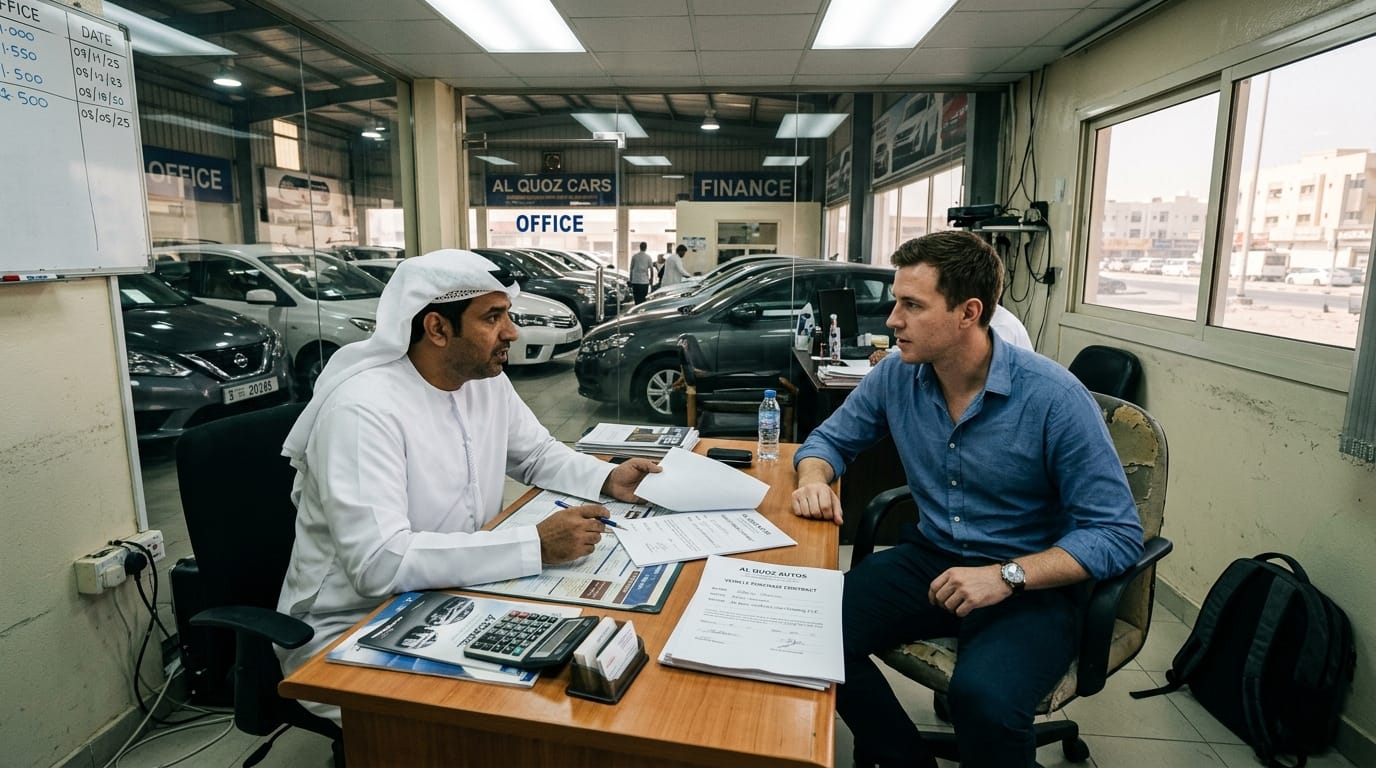
Many used car showrooms in Dubai and Sharjah operate their own in-house installment arrangements, either directly or through affiliated finance companies. These arrangements do not go through a UAE bank and do not require a salary certificate as the primary approval document.
How It Typically Works
The showroom holds the vehicle registration in the dealer’s name — or in the name of an affiliated finance company — until the full amount is paid. You make monthly payments directly to the dealer or finance company. Once the final payment clears, ownership transfers to you through a standard RTA process.
This is not the same as a bank loan. There is no formal loan agreement with consumer lending protections. The arrangement is governed by the contract terms the dealer sets, which vary significantly between providers.
Typical Cost Structure
| Element | Commonly Observed Range | Notes |
|---|---|---|
| Down payment required | 30% to 50% of vehicle price | Higher than standard bank finance |
| Effective annual rate | Commonly observed between 12% and 22% | Always request written total repayment — not monthly figure only |
| Term length | 12 to 36 months | Shorter than bank loans — 60 months uncommon |
| Documents typically required | Emirates ID, Visa, 3 months bank statements | Some require utility bill or tenancy contract |
| Late payment penalties | Varies widely — read contract carefully | Some contracts include vehicle repossession clause |
Where to Find These Arrangements
Showrooms in Al Quoz Industrial Area, Al Aweer used car market, and Abu Shagara in Sharjah commonly advertise installment plans without bank requirements. When asking, use the phrase “in-house installment” or “direct finance.” Always compare at least two providers before committing.
Option 2: Islamic Finance Products — A More Structured Alternative
Several UAE Islamic banks offer Murabaha-based auto finance products with different income verification requirements compared to conventional bank loans. Under a Murabaha structure, the bank purchases the vehicle and sells it to you at a disclosed markup, with repayment in installments over an agreed term.
Some Islamic finance products accept alternative income documentation — trade license plus 6 months of bank statements, for example. This is not a blanket policy across all Islamic banks or all applicant profiles. Some applicants report success at institutions such as Emirates Islamic, Dubai Islamic Bank, and Abu Dhabi Islamic Bank — but approval criteria change frequently. Always confirm current requirements directly with the institution before preparing your application.
What Alternative Documentation They May Accept
| Document Type | Who It Helps | Typical Requirement |
|---|---|---|
| Trade license + bank statements | Business owners, self-employed | 6 to 12 months statements showing consistent turnover |
| Freelance visa + invoices | Freelancers with documented client payments | 3 to 6 months of payment history to UAE accounts |
| Rental income documentation | Property owners with tenancy contracts | Ejari-registered tenancy contract + 3 months deposit records |
| Investment account statements | Higher-net-worth expats without salary income | Portfolio statements from recognized institutions |
The approval process for these alternative documentation routes typically takes longer than standard applications — in many cases between 5 and 15 business days — and approval is not guaranteed. Having an existing relationship with the bank beforehand, such as a current account with consistent transaction history, meaningfully improves outcomes.

Option 3: Personal Loan Redirected to Car Purchase
Some expats without salary certificates who have strong bank relationships use personal loans — rather than auto loans — to fund a car purchase. Personal loans in UAE have different approval criteria at some banks and do not require the vehicle as collateral in the same way auto loans do.
The effective cost is typically higher than a dedicated auto loan. Personal loan rates in the UAE commonly range between 8% and 20% annually depending on the bank and applicant profile — rates vary significantly and change frequently, so always request a written rate quotation before committing.
As an illustrative example: a 25,000 AED personal loan at 15% annually over 24 months would add approximately 4,000 AED to the total cost of the vehicle beyond the principal — though your actual rate will differ. insurance costs add to this further and should be budgeted before committing.
Option 4: Cash Purchase With Installment to Family or Employer
A practical route used by many expats who cannot access formal finance: a family member, friend, or employer advances the full cash purchase price, which the expat repays informally over an agreed period.
This carries no formal consumer protection, but it also carries no interest and no approval hurdle. For expats with a trusted network willing to support this arrangement, it is often the lowest total-cost option.
Some employers in UAE — particularly in hospitality, construction management, and healthcare — offer staff car advance programs as an employment benefit. The arrangement typically appears as a monthly salary deduction, which itself creates a salary certificate opportunity for future formal finance.
The True Cost Comparison — Illustrative Estimates by Route
The table below uses a 28,000 AED used car as the base example. All figures are illustrative estimates only, based on commonly observed UAE market rates during 2025–2026. They are not guaranteed offers. Always request the total repayment amount in writing before signing anything.
| Finance Route | Illustrative Down Payment | Estimated Monthly | Term | Estimated Total | Approx. Premium vs Cash |
|---|---|---|---|---|---|
| Islamic finance (alternative docs) | 8,400 AED (30%) | ~730 AED | 30 months | ~30,300 AED | ~2,300 AED |
| Dealer in-house installment | 11,200 AED (40%) | ~750 AED | 24 months | ~29,200 AED | ~1,200 AED |
| Personal loan (redirected) | 0 AED | ~1,050 AED | 30 months | ~31,500 AED | ~3,500 AED |
| Cash purchase | 28,000 AED | — | — | 28,000 AED | — |
xychart-beta
  title "Total Cost by Finance Route (AED) — 28,000 AED Vehicle"
  x-axis ["Islamic Finance", "Dealer Installment", "Personal Loan", "Cash Purchase"]
  y-axis "Total Cost (AED)" 25000 --> 33000
  bar [30300, 29200, 31500, 28000]
Note: Standard bank auto loan figures are excluded from this comparison as they require a salary certificate. All figures above are estimates for planning purposes only.
Step-by-Step: How to Buy a Car on Installment Without a Salary Certificate
This sequence applies whether you are using dealer installment or Islamic finance. Each step reduces the risk of the most commonly reported problems in UAE consumer cases.
| Step | Action | Key Output |
|---|---|---|
| Step 1 | Check your AECB credit report at aecb.gov.ae and resolve any outstanding issues | Clean credit file before lender sees it |
| Step 2 | Prepare 6 to 12 months of UAE bank statements — highlight consistent, identifiable deposits | Core income evidence for any route |
| Step 3 | Gather supporting documents: trade license, freelance visa, tenancy contract, invoices as applicable | Complete alternative income documentation package |
| Step 4 | Compare at least two finance options — get written total repayment figures, not monthly payment only | True cost comparison before committing |
| Step 5 | Arrange an independent pre-purchase inspection from a mechanic in Al Quoz Industrial Area or Abu Shagara | Documented vehicle condition — negotiation leverage and protection |
| Step 6 | Review the full contract — verify finance company license, total repayment, registration transfer terms, and repossession clause | No hidden terms before signing |
| Step 7 | Confirm comprehensive insurance in your name — get policy active before taking delivery | Contract compliance from day one |
| Step 8 | Photograph vehicle at handover (full exterior, interior, odometer) and send to yourself by email with date | Documented condition at handover point |
| Step 9 | Keep every payment receipt organized — physical or digital — from first to last payment | Proof of repayment timeline for any dispute |
| Step 10 | Follow up on registration transfer in writing within the timeline stated in your contract | Full ownership completed without delay |
flowchart TD
  A["Check AECB Credit Report"] --> B["Prepare Bank Statements 6–12 months"]
  B --> C["Gather Supporting Documents"]
  C --> D["Compare at Least 2 Finance Options"]
  D --> E["Independent Pre-Purchase Inspection"]
  E --> F["Review Full Contract"]
  F --> G["Confirm Comprehensive Insurance"]
  G --> H["Photograph Vehicle at Handover"]
  H --> I["Keep Every Payment Receipt"]
  I --> J["Follow Up on Registration Transfer"]
Red Flags in Dealer Installment Contracts
Before signing any dealer installment contract, run through this checklist. Each item represents a pattern commonly reported in UAE consumer cases involving installment car purchases.
| Contract Element | Red Flag | What to Do |
|---|---|---|
| Total repayment amount | Not stated — only monthly payment shown | Refuse to sign until total amount is written clearly |
| Blank fields | Any field left empty in a signed contract | Draw a line through all blank fields before signing |
| Registration transfer clause | Missing or vague — “will transfer when paid” | Require specific timeline and process in writing |
| Payment method | Cash only — no receipt process documented | Request bank transfer option and receipt for every payment |
| Finance company identity | No separate finance company — dealer self-financing without license | Ask for company trade license and finance authorization |
| Repossession terms | Immediate repossession on first missed payment | Negotiate a cure period (7 to 14 days) before repossession |
| “As-is” clause | Broad disclaimer removing all dealer liability post-sale | Ensure pre-purchase inspection findings are annexed to contract |
| Early repayment terms | Penalty for paying off early | Confirm early repayment terms before signing |
For a broader look at the tactics used in UAE car sales, how to respond to misleading dealer claims gives you language that works in real situations.
Buyer Mistakes in No-Salary-Certificate Car Finance
Focusing on Monthly Payment Rather Than Total Cost
A dealer offering “only 700 AED per month” on a 24-month plan for a 22,000 AED vehicle is charging 16,800 AED in payments — already close to the cash price — before you consider that you put down a 9,000 AED deposit. Total outlay: approximately 25,800 AED on a 22,000 AED car. That is a 17% premium. Knowing the math before you sign prevents this.
Accepting Verbal Promises About Registration Transfer
One of the most commonly reported complaints in dealer installment cases involves the registration transfer being delayed, complicated, or disputed after final payment. Get the transfer commitment — including the specific process and timeline — written into the contract before paying any deposit.
Not Checking Whether the Finance Company Is Licensed
The UAE Central Bank maintains a register of licensed finance companies at centralbank.ae. A dealer who is self-financing without a licensed finance company registration is operating outside the regulatory framework, which limits your options if disputes arise.
Overextending on Monthly Payments Relative to Income
A common pattern: an expat secures an installment plan they can manage when working, then faces payment difficulty during a job change. Unlike a bank loan, dealer installment contracts often include faster repossession terms. Recovery of the vehicle can happen more quickly than most buyers expect, and reversing it requires legal intervention that can carry significant cost in fees and time.
Ignoring Insurance Requirement During the Installment Period
Most dealer installment contracts require comprehensive insurance for the duration of the plan. Comprehensive insurance on a used car in the 25,000 to 30,000 AED range typically costs between 2,800 and 4,500 AED annually — though rates vary. Get a quote before finalizing your budget. hidden charges in insurance renewal is worth reviewing before choosing a policy.
Mechanic’s Inspection Log: What Changes When You Finance Without a Bank
An independent inspection becomes significantly more important when financing through a dealer’s own arrangement — because your recourse if problems emerge is more limited than with bank-financed purchases.
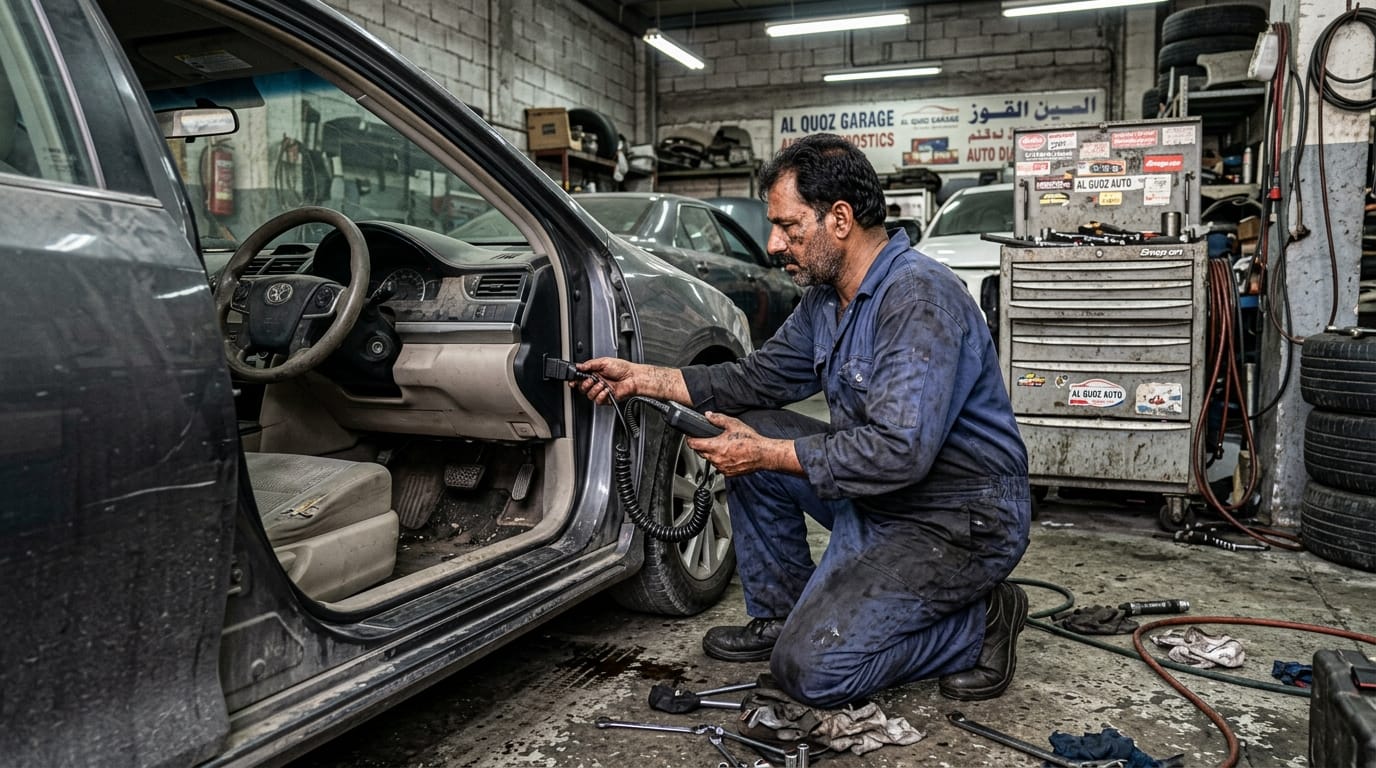
The following is a representative case study based on a workshop review in Al Quoz Industrial Area 3, reviewed by Emirates Car Guide. Details have been generalized for illustration, reflecting patterns commonly observed in similar cases across UAE dealer networks.
An expat buyer financed a 2016 Honda City through a small showroom’s in-house plan, paying 35% down and agreeing to 24 monthly installments. No pre-purchase inspection was done. At around 8,000 km into ownership, an OBD scan returned P0341 — camshaft position sensor circuit range — along with evidence of a recent ECU reset, suggesting the code had been cleared before sale. The repair cost was approximately 1,400 AED. The contract’s “as-is” clause — which the buyer had not read carefully — limited the dealer’s liability, and the buyer absorbed the full cost.
A pre-purchase inspection from a qualified independent mechanic in Al Quoz Industrial Area 3 or Abu Shagara, costing between 300 and 550 AED, would have surfaced this before any money changed hands. In dealer installment purchases particularly, this step is not optional.
Signs That a Dealer Installment Offer Is Reasonable
| Positive Indicator | What It Signals |
|---|---|
| Finance company has separate trade license from dealer | Regulated entity — better consumer protection |
| Full written contract provided before any deposit requested | Professional operation — not informal arrangement |
| Total repayment amount stated clearly in contract | Transparency — not hiding effective rate in monthly figure |
| Registration transfer process documented with specific timeline | Seller confident in their ability to deliver ownership |
| Dealer has been operating at same location for 3+ years | Lower risk of business closure before your final payment |
Owner Scenarios: How the Right Option Changes by Situation
If you are a freelancer with 8 months of consistent UAE bank deposits: Islamic finance is your strongest formal route. Prepare 6 to 12 months of clean bank statements showing regular, identifiable income deposits. A vehicle price of 25,000 to 35,000 AED at 30% down is a realistic approval target at Islamic banks that accept alternative documentation. Budget 4 to 6 weeks for the process.
If you are three months into a new job and still in probation: Wait if you can. Three to six months of confirmed employment history unlocks standard bank auto finance at significantly better rates. If you cannot wait, a dealer installment with 40% down is the realistic near-term option — keep the term short (18 to 24 months) to minimize total extra cost.
If you own a UAE business and draw dividends: Your trade license plus 12 months of clean business account statements is a viable documentation package at Islamic banks. Ask specifically for “business owner auto finance” rather than applying through the standard retail channel.
If you are between jobs on a grace visa: Formal finance of any kind is very difficult during this window. A cash purchase from savings, or an informal arrangement with a trusted contact, is the practical option.
If you are paid in cash and have no formal bank history in UAE: Opening a UAE bank account and depositing consistently for three to six months before applying for any finance is the foundational step. Without a UAE bank statement trail, no formal finance route has a basis for approval.
If your UAE stay ends within 12 months: Installment finance of any type carries significant risk if you may leave before the repayment period completes. A cash purchase of a reliable GCC-spec Toyota or Nissan — maintaining strong resale value — and sold through Dubizzle before departure is the most financially sound approach. maximising your car’s value before leaving walks through the exact steps to recover the most from a resale.
The Safe Alternative: When Cash Makes More Sense
For expats in the 18,000 to 28,000 AED vehicle range, the total premium paid through dealer installment finance often ranges between 2,000 and 5,000 AED over the repayment term. If you have savings that are not generating meaningful returns, paying cash for a reliable GCC-spec Nissan Sunny or Toyota Yaris and avoiding all finance complexity is frequently the better financial outcome.
A GCC-spec 2019 Nissan Sunny in the 22,000 to 25,000 AED range, purchased for cash from a verified private seller through Dubizzle with an independent inspection from a mechanic in Al Quoz or Sharjah Industrial Area, gives you full ownership from day one, no repossession risk, and no contract to navigate if your employment situation changes.
Finance Options: Pros and Cons Summary
| Route | Main Advantages | Main Disadvantages |
|---|---|---|
| Islamic Finance (alt. docs) | Regulated, Sharia-compliant, commonly lower rate than dealer | Slower approval, income documentation threshold, vehicle age limits |
| Dealer In-House Installment | Accessible, faster approval, flexible documentation | Higher effective rate, registration held by dealer, limited regulatory protection |
| Personal Loan (redirected) | No vehicle collateral requirement, flexible use | Often highest effective rate, requires existing bank relationship |
| Employer/Family Advance | Zero interest, no approval process | No formal protection, depends on relationship availability |
| Cash Purchase | Lowest total cost, full ownership, no repossession risk | Requires available capital upfront |
Legal and Administrative Context: What You Can Do if Things Go Wrong
If a dealer installment arrangement goes wrong — disputed payments, refusal to transfer registration, vehicle recovery you believe was unjustified — buyers may have legal remedies depending on the evidence available and the specific circumstances of the transaction. Outcomes vary significantly based on the documentation that exists and how the transaction was conducted.
The steps that most consistently support a buyer’s position:
- Keep all payment receipts — physical or digital — organized and dated
- Save all WhatsApp and SMS communication with the dealer or finance company
- Retain a copy of the signed contract including all annexes
- Document any verbal promises in a follow-up message: “As discussed today, you confirmed that registration transfers within 30 days of final payment”
- For formal complaints, the UAE Consumer Protection department and the UAE Central Bank consumer complaints channel are appropriate starting points
Evidence Checklist for Dealer Installment Purchases
| Document | When to Collect | Why It Matters |
|---|---|---|
| Signed installment contract (all pages) | Before any payment | Foundation of all legal recourse |
| Finance company trade license copy | Before signing | Confirms regulated entity |
| Vehicle inspection report (independent) | Before signing | Documents pre-existing issues |
| Receipt for every payment made | Immediately after each payment | Proof of repayment timeline |
| Vehicle photos (full exterior and interior) | Day of purchase | Documents condition at handover |
| Mulkiya copy showing current registration | Day of purchase | Confirms vehicle’s legal status and owner of record |
| Screenshot of original listing with price | Before viewing | Documents advertised terms |
Total Ownership Cost: What the Full Picture Looks Like
Many expats calculate affordability based only on the monthly installment. The full cost of car ownership in Dubai involves several additional components. Figures below are illustrative estimates based on commonly observed Dubai market costs — your actual costs will vary.
| Cost Element | Monthly Estimate (AED) | Notes |
|---|---|---|
| Installment payment (28,000 AED vehicle, dealer finance) | 750 – 900 | Varies by down payment, term, and provider |
| Comprehensive insurance | 280 – 380 | Required by most installment contracts — get quote before budgeting |
| Fuel (average Dubai commute ~1,200 km/month) | 180 – 280 | Depends on engine size and driving pattern |
| Maintenance (annual averaged monthly) | 120 – 200 | Lower for Toyota/Nissan GCC spec — parts widely available in Al Quoz and Sharjah Industrial Area |
| Registration renewal (annual averaged monthly) | 50 – 80 | Includes Tasjeel test fee — varies by vehicle type |
| Salik and parking (Dubai) | 80 – 200 | Highly dependent on route and work location |
| Estimated Total Monthly | 1,460 – 2,040 AED | Full picture — not just installment. Verify each component independently. |
pie title Monthly Ownership Cost Breakdown — Illustrative (AED)
  "Installment Payment" : 825
  "Comprehensive Insurance" : 330
  "Fuel" : 230
  "Maintenance" : 160
  "Registration (monthly)" : 65
  "Salik and Parking" : 140
Decision Framework Table: Matching Your Situation to the Right Route
| Your Situation | Recommended Route | Key Condition |
|---|---|---|
| Freelancer with 6+ months UAE bank deposits | Islamic finance — alternative docs route | Clean, consistent monthly deposits to UAE account |
| Business owner with trade license | Islamic finance or SME banking channel | 12 months business statements showing turnover |
| New employee in probation (3 months or less) | Dealer installment or wait for salary cert | 40%+ down if proceeding now; wait 3 to 6 months if possible |
| Between jobs on grace visa | Cash purchase or informal arrangement | No formal finance route reliably available during this window |
| Cash-paid worker with no bank history | Build bank history first (3 to 6 months) | Consistent UAE deposits are prerequisite for any route |
| Expat leaving UAE within 12 months | Cash purchase — highest resale Toyota/Nissan | Avoid installment: exit before term ends complicates ownership transfer |
Data Sources Used
- Central Bank of the UAE — licensed finance company register, consumer complaint channels
- Al Etihad Credit Bureau (AECB) — credit report access and score information
- Dubai Department of Economy and Tourism — trade license verification
- Roads and Transport Authority (RTA) Dubai — vehicle registration and transfer guidelines
- UAE Consumer Protection — complaint filing for commercial disputes
- Dubai Municipality — vehicle and consumer regulatory guidance
- Securities and Commodities Authority UAE — finance company licensing reference
- UAE Ministry of Economy — commercial licensing and consumer protection framework
Analytical Conclusion: The Real Calculation
For most expats in the “no salary certificate” category, the decision reduces to a straightforward cost-risk analysis. Dealer in-house installment is accessible but carries higher effective rates and structural risk around the registration transfer process. Islamic finance with alternative documentation is more formal and better protected, but requires a documented income trail that not every applicant has. Cash purchase removes all financing risk at the cost of requiring available savings.
The additional cost of accessing finance without a salary certificate — compared to a standard bank loan — commonly falls between 1,500 and 5,000 AED over a repayment term on a mid-range used vehicle. That premium buys access to a vehicle before you have formal employment documentation. Whether it is worth paying depends on your individual timeline, income stability, and the availability of a suitable vehicle for cash purchase within your budget.
For most new expats in their first year in the UAE, the most financially conservative sequence is: buy the cheapest reliable cash-purchase vehicle available — a GCC-spec Nissan Sunny or Toyota Yaris in the 18,000 to 22,000 AED range from a verified Dubizzle seller with independent inspection — build your UAE banking and employment history, then upgrade with formal bank finance once a salary certificate is available. The total extra cost of this sequence, compared to stretching into dealer installment finance from day one, is often negative — meaning the conservative route actually saves money. For more on avoiding common errors at the point of purchase, red flags when buying a used car in Dubai covers what expats most frequently miss before signing.
FAQ
Q: Can I buy a car in UAE on installment without a salary certificate?
Q: What documents do I need instead of a salary certificate for expat car finance UAE?
Q: Can I get car finance in UAE without salary transfer?
Q: Can a self-employed expat get car finance in UAE?
Q: Is dealer installment finance safe in Dubai?
Q: What happens if I leave UAE before finishing my installment payments?
Q: Which UAE banks accept alternative income documents for car finance?
Q: Can I get car finance in UAE on a freelance visa?
Q: Can I buy a car without a down payment if I have no salary certificate?
Q: How much extra does it cost to finance without a salary certificate?
Q: Can I get car finance during my probation period in UAE?
Q: Can I transfer the car to my name before completing payments?
Q: Is Islamic finance cheaper than dealer installment in UAE?
Disclaimer: Emirates Car Guide is a 100% independent platform. We do not own showrooms, nor are we affiliated with any used car dealerships or garages. Our sole mission is to protect expats from financial fraud in the automotive market.
