Last Updated: May 2026 | By Omar Al-Fayed, Senior Automotive Consultant | Category: UAE Market News
In Dubai’s used car market, the listed price is rarely the final price. Most sellers — whether private or showroom — build in a negotiation margin of between 5% and 15%. On a 30,000 AED car, that means 1,500 to 4,500 AED is sitting on the table before you say anything. This guide gives you the exact phrases that experienced buyers use, the timing that makes them land, and the numbers that give you real leverage across Dubai and Sharjah. Before visiting any showroom, run through our complete expat buying checklist to avoid the most common first-purchase mistakes.
Why Negotiation Works Differently in Dubai Than You Expect
Many expats arrive in Dubai with negotiation habits from their home country — either overly aggressive or overly polite. Neither approach tends to work well here. The Dubai used car market runs on a specific rhythm: the seller expects a counter-offer, but they also expect you to have done your homework.
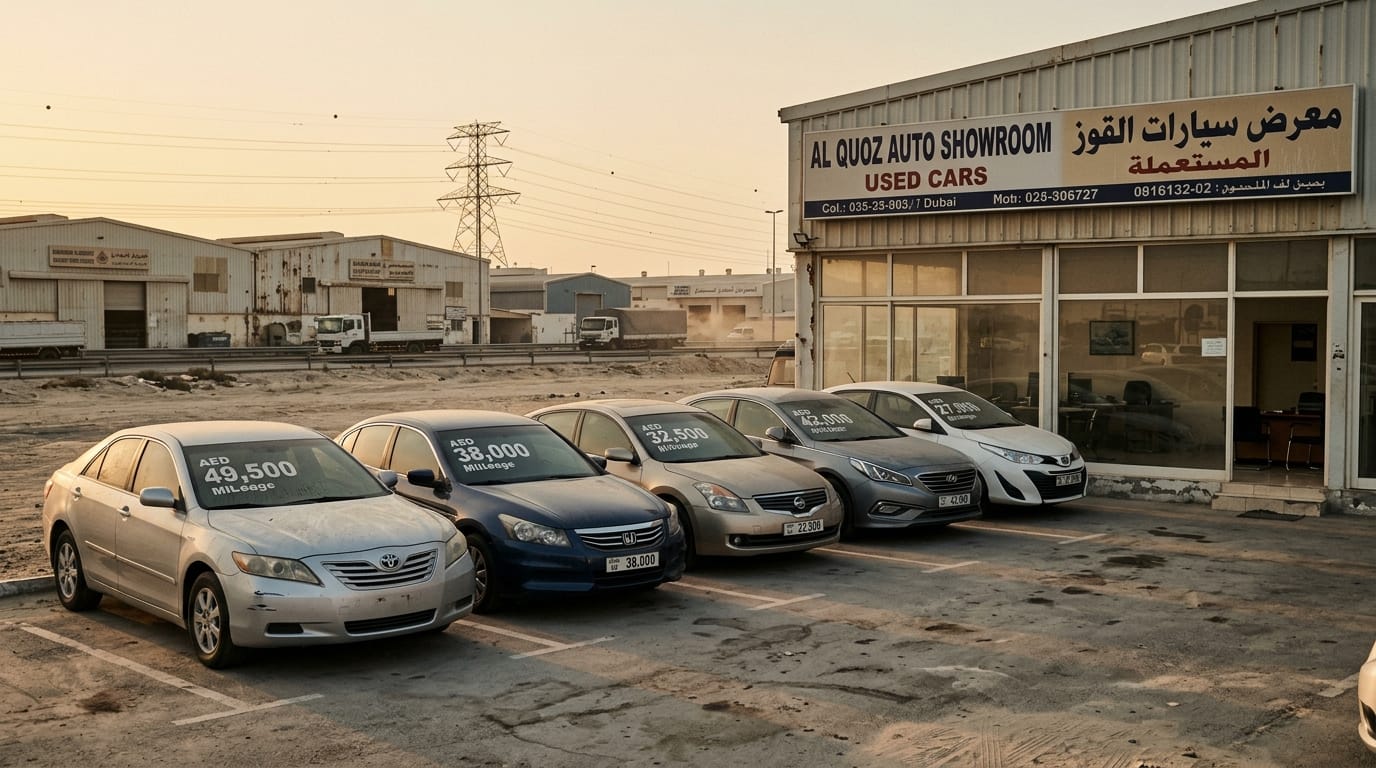
Sellers at places like Abu Shagara in Sharjah or along the dealer strip in Al Quoz Industrial Area 4 see dozens of buyers each week. They identify an unprepared buyer within the first two minutes of conversation. An unprepared buyer almost always pays closer to the asking price.
What changes the dynamic is walking in with specific numbers, a clear understanding of comparable listings, and a calm tone that signals you are not emotionally attached to this particular vehicle. Seven pricing traps that catch unprepared expats are covered in detail in our Dubai market report — worth reading before your first showroom visit.
The Standard Margin by Seller Type
| Seller Type | Typical Asking Premium | Realistic Discount Range | Best Negotiation Window |
|---|---|---|---|
| Private Dubizzle Seller | 5% to 10% above market | 3% to 8% | After first viewing, before second visit |
| Small Independent Showroom | 10% to 18% above market | 7% to 15% | End of month, slow weekday afternoon |
| Large Used Car Dealer | 12% to 20% above market | 5% to 12% plus free service | When they have held the car 45+ days |
| Al Aweer Auction Exit Dealers | 8% to 14% above auction price | 6% to 10% | Late afternoon, walk-away moment |
xychart-beta
title "Negotiation Room by Seller Type (%)"
x-axis ["Private Seller", "Small Showroom", "Large Dealer", "Al Aweer Exit"]
y-axis "Discount Range %" 0 --> 20
bar [5.5, 11, 8.5, 8]
How Dealers Actually Price Used Cars in Dubai
Understanding what the seller paid helps you understand where their real floor is. Most showrooms and independent dealers in Al Aweer and Al Quoz source their vehicles through three channels: private purchase from individuals, internal auction networks, or transfer from rental and fleet companies.
A typical small showroom buying a 2019 Toyota Corolla at Al Aweer auction pays somewhere between 22,000 and 25,000 AED depending on condition and mileage. That same car then appears on Dubizzle at 31,000 to 34,000 AED. Their target margin generally falls between 15% and 25% of purchase cost. They can absorb a 10% to 12% discount from their asking price and still meet their margin target.
Fleet and rental transfers — often from companies retiring vehicles at 80,000 to 120,000 km — carry lower acquisition costs but sometimes higher preparation costs. Dealers who purchased a vehicle for refurbishment may be less flexible on price but more flexible on included extras like service, tires, or registration.
Private sellers typically have no acquisition cost calculation. Their floor price is usually emotional — what they paid, what they feel the car is worth, or what they need to cover their next purchase. This requires a different approach than dealing with a commercial seller. Common dealer tactics and how to identify them are documented in our red flags guide.
Preparation: The Work You Do Before You Say a Single Word
The most effective negotiation in Dubai happens before you arrive at the car. Sellers respond to specifics. A buyer who says “I saw the same year Corolla for 27,500 on Dubizzle last week” carries far more weight than one who says “can you do better on the price?”
How to Build Your Price Reference in 20 Minutes
Open Dubizzle and search for the exact model, year, and approximate mileage you are looking at. Note the lowest three prices and the average of the middle ten listings. This range becomes your reference point throughout the conversation.
Also check whether the vehicle you are viewing has GCC specification or a US or Japanese import. Parts availability for GCC-spec Toyota and Nissan models is notably better across Al Quoz Industrial Area and Sharjah Industrial Area, which genuinely affects long-term cost. This is a fact you can use in negotiation — it is not just a talking point.
Check the Tasjeel or ADNOC inspection history if available. A clean inspection record is worth something to a seller too — they may resist discounting if they have one. But a missing or interrupted service record is a legitimate reason to reduce your offer.
Your First Offer: A Practical Starting Point by Price Range
| Asking Price (AED) | Strong First Offer (AED) | Realistic Final Deal Range (AED) | Notes |
|---|---|---|---|
| 18,000 – 22,000 | 16,000 – 19,500 | 17,000 – 20,500 | Budget segment — sellers often firm, but longer listings bend |
| 23,000 – 28,000 | 20,500 – 25,000 | 21,500 – 26,500 | Most flexible zone — high volume, many alternatives |
| 30,000 – 36,000 | 27,000 – 32,000 | 28,000 – 33,500 | Mid-range — inspection findings carry real weight here |
| 38,000 – 45,000 | 34,000 – 40,000 | 35,500 – 42,000 | Upper mid — documented service history justifies resistance |
| 50,000 – 65,000 | 44,000 – 57,000 | 46,000 – 60,000 | Higher margins available — use competing listings actively |
Negotiation Checklist Before You Visit the Car
| Step | What to Do | Why It Matters |
|---|---|---|
| Compare 8 to 10 listings | Same model, year, and approximate mileage on Dubizzle and YallaMotor | Gives you a defensible price range in conversation |
| Note listing age | Screenshot the listing date — check if relisted | Listings over 30 days signal market resistance |
| Check VIN in advance | Ask seller for VIN before visit — run basic check | Mismatched VIN is a walk-away signal immediately |
| Estimate insurance cost | Get a rough quote for your age and the vehicle year | Total ownership cost affects your real budget ceiling |
| Identify your walk-away number | Decide your maximum before you see the car — not during | Emotional decisions during viewing cost money |
| Arrange inspection in advance | Identify an independent mechanic in Al Quoz or Abu Shagara area | Having a mechanic ready removes one seller delay tactic |
The 8 Phrases — With Context and Timing for Each
These are not scripts. They are structured observations that redirect the conversation toward evidence-based pricing. Use them calmly, without rushing to fill the silence that follows.
Phrase 1: “I’ve seen three similar listings this week between X and Y AED”
This is the foundation phrase. It signals preparation without aggression. You are not saying their price is wrong — you are providing market context.
Use it early, within the first five minutes of viewing the car. Example: “I’ve been looking at this model for about two weeks. I’ve seen three similar listings this week — same year, similar mileage — ranging between 26,500 and 28,000 AED. So I’m trying to understand what’s different about this one at 31,000.”
The seller now has to either justify their premium or acknowledge the gap. Either way, you have set the price conversation around real data rather than emotion.
Phrase 2: “What’s included if I pay today?”
This phrase accomplishes two things. It signals genuine buying intent — which relaxes the seller — and it opens the door for value-adds that are easier for a seller to give than a cash discount.
Sellers, especially showrooms, often have more flexibility on extras than on the sticker price. Free registration, one service, a new battery, or four tires can represent 800 to 2,000 AED in real value without the seller reducing their headline number. Ask for it explicitly rather than hoping it gets offered.
Phrase 3: “The service history has a gap from [year] to [year] — that’s a concern for me”
A gap in service records is one of the most justifiable reasons to reduce an offer, and sellers know it. When you point it out specifically — not as an accusation, but as a documented concern — it shifts the burden of explanation to them.
If they cannot explain the gap, follow with: “That gap makes it harder for me to commit at this price. I’d feel more comfortable at [lower number].” Keep your tone neutral. You are describing a financial risk, not questioning their honesty.
Phrase 4: “I have cash ready today — what’s your best number?”
Cash buyers in Dubai receive genuine preference from private sellers and small showrooms. Finance arrangements involve delays, paperwork, and sometimes third-party approval. A cash buyer closing same-day removes all of that friction.
This phrase works best after you have already viewed the car, expressed interest, and done your initial price discussion. Deploying it too early reduces its impact. Use it when the seller believes you are a serious buyer — typically after 15 to 20 minutes of genuine conversation.
Phrase 5: “I’ll need to budget for [specific known issue] — that affects what I can offer”
This requires you to have done a basic inspection or at minimum noticed something during your walk-around. It could be worn tires, a slightly vibrating steering wheel, faded headlights, or a soft brake pedal. You are not fabricating problems — you are putting a real cost on something you genuinely observed.
Example: “The tires are at about 3 to 4mm — they’ll need replacing within the next 10,000 km. Four mid-range tires for this size run about 1,200 to 1,600 AED in Al Quoz. I’d need to account for that in my offer.” Our inspection guide covers exactly what to look for during a basic walk-around before involving a mechanic.
Phrase 6: “I’m looking at one other car this afternoon — can I have your final number before I go?”
This creates mild, honest urgency without fabrication. If you are a serious buyer, you likely are considering more than one option. Saying so is not a bluff — it is a natural statement of how most buyers approach a purchase.
The seller now faces a simple calculation: give you a number that keeps you interested, or watch you leave toward a competitor. Most experienced sellers will give a better offer at this point than they would if you expressed no alternatives.
Do not threaten to leave dramatically. Simply state the situation calmly and wait. Silence after this phrase often produces more movement than any additional argument.
Phrase 7: “Would you consider [specific number] if I handle the transfer paperwork today?”
RTA transfer is straightforward but involves time and a specific process. Offering to handle the transfer yourself — or to have it completed same day through one of the approved typing centers near Al Aweer — removes a task from the seller’s list.
Private sellers especially respond to this. Many have sold cars before and remember the process of waiting for a buyer to organize paperwork. Removing that friction has real value to them, and it costs you nothing beyond the standard transfer fee of approximately 350 to 500 AED depending on vehicle type.
Phrase 8: “I appreciate your time — I’ll think about it and come back tomorrow if I don’t find something closer to my budget”
The walk-away phrase. It is not a threat and should never sound like one. It is simply the truth — you have a budget, you have seen the car, and you are going to think carefully before committing thousands of dirhams.
Use this phrase when negotiations have stalled and the seller is not moving. Genuine willingness to leave is the most powerful signal in any negotiation. It only works if you actually mean it.
In many documented cases in Dubai’s used car market, sellers message within 12 to 24 hours of a walk-away with a revised price. If you have provided your number to the seller, this window often closes the deal at a figure meaningfully closer to your target.
What Sellers Say — And How to Respond
Experienced sellers in Al Aweer and Al Quoz use a consistent set of phrases designed to reduce negotiation pressure. Knowing what they mean in practice helps you respond without being deflected.
| What the Seller Says | What It Usually Means | Effective Response |
|---|---|---|
| “Last price, no discount” | Opening position, not a final position in most cases | “Understood — what’s included at that price?” |
| “I have another buyer coming today” | A common pressure tactic — may or may not be accurate | “Makes sense. Give me your final number and I’ll decide now.” |
| “This price is already below market” | Invites you to accept without comparing | “Which listings are you comparing to? I’ve been tracking this model.” |
| “Agency maintained — no problems” | May be accurate or may be selective history presentation | “Great — can I see the full service record? I’d like to check continuity.” |
| “Just a minor accident — fully repaired” | Accident history that deserves independent verification | “I’ll need an independent inspection to assess the repair quality before I decide.” |
| “First owner, lady driven” | Common claim — verifiable partially through Mulkiya history | “Can I see the Mulkiya to check the ownership history?” |
| “Price will go up soon — market is rising” | Creates time pressure without evidence | “I’ll check the listings again today. If it’s moving, I’ll see it.” |
For a full breakdown of dishonest seller phrases and how they operate, our dealer tactics guide covers ten of the most frequently used lines with documented counter-responses.
Mechanic’s Inspection Log: What Changes When You Bring Independent Evidence
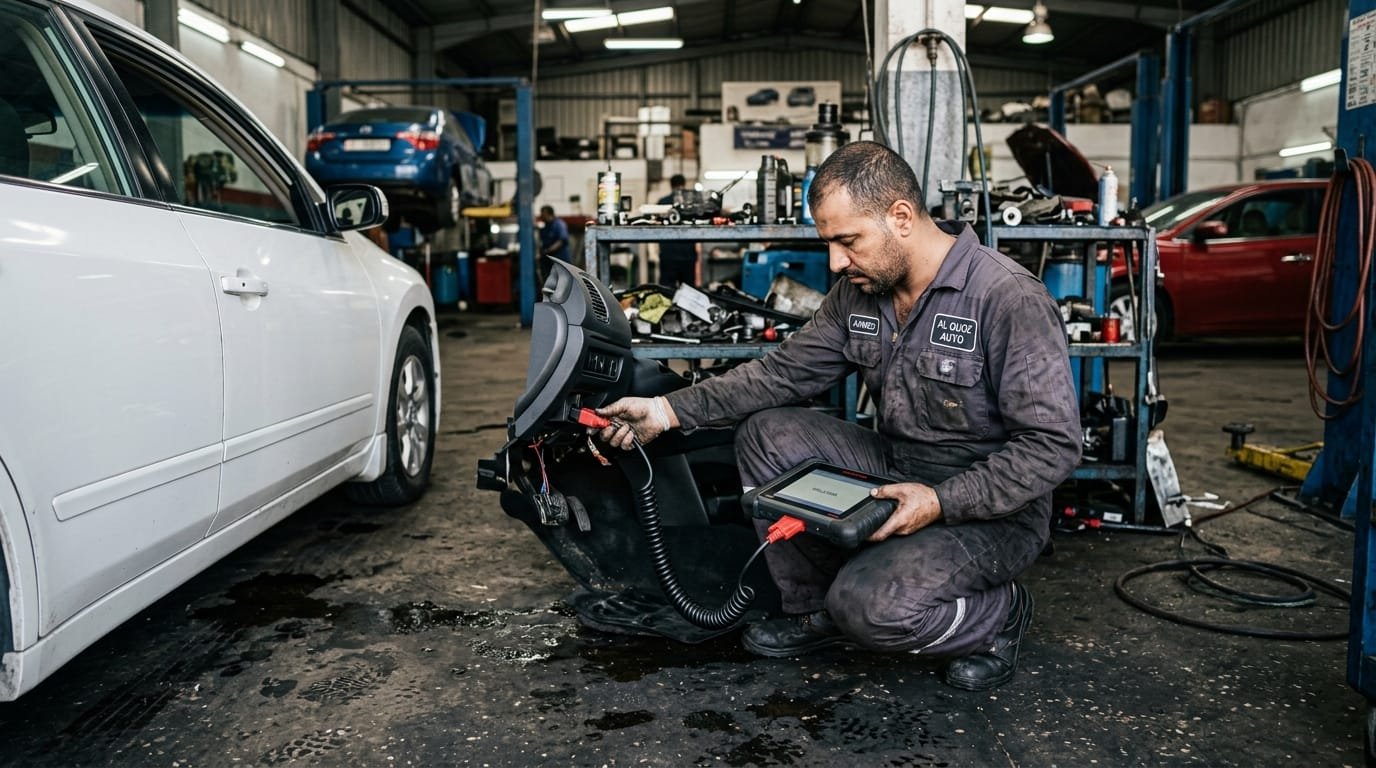
One of the most effective negotiation tools available in Dubai costs between 300 and 600 AED and takes about 45 minutes: a pre-purchase inspection from an independent mechanic.
A workshop in Al Quoz Industrial Area 3 ran an inspection on a 2017 Nissan Altima listed at 34,500 AED. The OBD scan returned a P0420 code — catalyst efficiency below threshold. The mechanic noted the catalytic converter was likely to need attention within 15,000 to 20,000 km, with replacement cost in the 1,800 to 2,800 AED range at independent garages. The seller, when presented with a printed report, agreed to 31,500 AED.
The inspection paid for itself more than ten times over. More importantly, it moved the conversation from opinion to documentation — which is where real leverage lives. Workshop records from Al Quoz specialists suggest that in many cases, pre-purchase inspections identify at least one documented issue on vehicles that were presented as problem-free.
Real Negotiation Case Study: From 36,000 AED to 31,200 AED
The following is an example scenario based on recurring patterns observed across UAE workshop inspections and buyer consultations. Details represent a composite of similar documented cases.
A 2019 Honda Accord 2.0T was listed on Dubizzle at 36,000 AED by a small independent showroom in Al Quoz Industrial Area 4. The listing had been active for approximately five weeks with no sold status update.
Before the visit: The buyer checked nine comparable 2019 Accord listings across Dubizzle and YallaMotor. The range was 31,500 to 37,000 AED, with an average around 33,800 AED. The listing was approximately 2,200 AED above average for the mileage range.
During inspection: The buyer noticed the front tires had uneven wear — suggesting alignment had not been maintained. The rear left door had a slightly different paint shade under direct light — consistent with previous repair. The service record showed a gap of approximately 14 months with no documented service.
Independent inspection: A mechanic from Abu Shagara area conducted a full check. OBD scan returned no active codes. The front suspension showed minor wear within acceptable range. The mechanic estimated tire replacement within 8,000 km at approximately 1,400 to 1,800 AED and noted the paint discrepancy on the rear door.
Negotiation: The buyer presented the inspection report and referenced the comparable listings. The specific points raised: the 14-month service gap, the estimated tire cost, and the market average of 33,800 AED for this mileage bracket. The buyer offered 31,000 AED.
Outcome: After one back-and-forth, the deal closed at 31,200 AED with the seller agreeing to cover registration renewal. Total saving from asking price: approximately 4,800 AED. Inspection cost: 450 AED. Net saving after inspection cost: approximately 4,350 AED.
Psychological Factors That Influence the Outcome
The behavioral side of negotiation is often more influential than the phrases themselves. Several consistent patterns appear in how successful expat buyers conduct themselves across workshop observations in Al Quoz and Abu Shagara.
Silence After an Offer
When you make an offer or ask for a better price, stop talking. The next number should come from the seller. In many cases, buyers inadvertently negotiate against themselves by filling silence with justifications, apologies, or upward revisions. The person who speaks first after an offer is made typically moves toward the other party’s position.
Sitting Down During Price Discussion
This seems minor but has a documented effect in sales contexts. Standing during price negotiation — especially in a showroom — places you in a visitor posture. Sitting signals you are comfortable, not in a hurry, and prepared to stay until a fair number is reached. Many experienced buyers in Al Aweer instinctively do this.
Late Afternoon Is Different from Morning
A seller who has had a slow day by 4pm is in a different mental state than the same seller at 10am with a full day ahead. Late afternoon — particularly on slower weekdays — produces more flexibility on price in showroom environments. The calculus shifts: one confirmed sale before closing is worth more than the hope of a better offer tomorrow morning.
Showing Interest Without Showing Attachment
Asking genuine questions about the car’s history, how the seller acquired it, and what they know about its use history is useful research — and it signals that you are a thoughtful buyer worth engaging with. But verbal signals like “this is perfect” or “I’ve been searching for exactly this” shift leverage toward the seller. Stay curious, not enthusiastic.
Anchoring with a Specific Number
Saying “I’d like a better price” gives the seller control over the next number. Saying “I can do 28,500 AED” gives you control. The first offer anchors the range of the negotiation. Starting with a specific, justifiable number — even if it is not where you expect to land — sets the frame more effectively than a general request for a discount.
Red Flags — When You Should Walk Away
| Red Flag | What It May Indicate | Recommended Action |
|---|---|---|
| Seller refuses independent inspection | Concern about what inspection would reveal | Walk away — no exceptions |
| VIN on dash does not match Mulkiya | Potential documentation irregularity | Do not proceed without full clarification |
| Seller will not provide service records | Maintenance history unknown or irregular | Request records in writing before committing |
| Price is notably below all comparable listings | May indicate undisclosed accident, flood, or mechanical issues | Proceed only with full independent inspection |
| Seller insists on same-day transfer without cooling period | Pressure to prevent discovery of issues | Slow the process — urgency from the seller is a signal |
| Seller’s name does not match Mulkiya owner | Power of attorney situation — requires verification | Request full documentation before any payment |
| Unusual water marks inside door panels or under seats | Possible flood exposure — may not be disclosed | Specialist inspection before any further discussion |
| Seller will not allow cold-start test | Possible engine issue that disappears when warm | Cold start is a basic right for any buyer — insist or leave |
Timing: When to Negotiate and When to Wait
Best Days and Times
End of month is consistently the best negotiating window for showrooms. Sales staff in many dealerships across Dubai work on monthly targets. A buyer arriving on the 27th or 28th of the month — especially at a showroom that has held a car for 40 or more days — has structural leverage that a buyer on the 2nd of the month simply does not.
Slow weekday afternoons — typically Sunday through Tuesday between 2pm and 5pm — are better than busy weekend mornings. A seller with no other active prospects is a more flexible seller.
Cars That Have Been Listed Too Long
Any listing on Dubizzle that has been active for more than 30 days without a sold status is showing market resistance. The seller has not found a buyer at their price. That is objective evidence that their price is above where the market is willing to transact.
Mentioning this specifically — “I noticed this listing has been up since [date]” — is not aggressive. It is a market observation. It frames your lower offer as correcting a price discovery problem, not as underbidding.
Dubai vs Sharjah — Where Negotiation Is Easier
| Area | Typical Price vs Dubai | Negotiation Flexibility | Stock Profile | Key Consideration |
|---|---|---|---|---|
| Al Aweer (Dubai) | Market benchmark | Moderate — competitive buyer pool | High variety, frequent stock rotation | Preparation essential in competitive environment |
| Al Quoz Industrial (Dubai) | 5% to 10% above Al Aweer | Moderate — fixed showroom costs | Mid to upper range, better prepared vehicles | Many independent mechanics nearby — good for inspections |
| Abu Shagara (Sharjah) | 8% to 15% below Dubai average | Higher — lower overhead costs | Budget to mid range, older stock common | Verify Tasjeel status carefully — some vehicles have lapsed inspection |
| Sharjah Industrial Area | 10% to 18% below Dubai average | High — slower buyer traffic | Older models, higher mileage common | Parts availability strong for Japanese models — practical for budget buyers |
A buyer willing to travel to Abu Shagara and spend 30 minutes in transit can frequently find the same model at 2,000 to 4,000 AED less than the equivalent Dubai listing, with comparable or better negotiation flexibility. The practical trade-off is that RTA transfer and registration may require an additional coordination step depending on emirate of registration.
Negotiation Margin by Car Brand
| Brand | Typical Negotiation Room | Why | Best Leverage Point |
|---|---|---|---|
| Toyota | Low — 4% to 8% | High demand, fast turnover, strong resale | Service history gaps, tire condition |
| Nissan | Low to moderate — 5% to 10% | Solid demand, wide parts availability | Mileage, CVT service history |
| Hyundai / Kia | Moderate — 8% to 13% | Korean brands have softer resale than Japanese | Comparable Japanese alternative listings |
| Mitsubishi | Moderate to high — 10% to 15% | Softer demand, slower resale in UAE market | Age, mileage, and limited buyer pool |
| Honda | Moderate — 8% to 12% | Good reputation but service costs above 100,000 km | High mileage, V6 models, service record gaps |
| BMW / Mercedes | High — 12% to 20% | Higher maintenance costs reduce buyer pool | Out-of-warranty age, service history, import spec |
| American Brands (Chevrolet, Ford) | High — 12% to 18% | Fuel costs and parts pricing affect demand | Running costs, parts availability outside main dealers |
| Chinese Brands (Chery, Geely, BYD) | Very high — 15% to 25% | Higher depreciation, uncertain resale, newer to market | Resale value comparison, limited independent service |
xychart-beta
title "Max Negotiation Room by Brand (%)"
x-axis ["Toyota", "Nissan", "Hyundai/Kia", "Honda", "Mitsubishi", "German", "American", "Chinese"]
y-axis "Upper Discount %" 0 --> 28
bar [8, 10, 13, 12, 15, 20, 18, 25]
Common Negotiation Mistakes — What to Avoid
Starting Too Low
Opening with an offer that is 25% or more below asking price in most UAE contexts does not create room for negotiation — it signals either that you have not done your research or that you are not a serious buyer. Either impression weakens your position for the rest of the conversation.
A first offer of 8% to 12% below asking — backed by specific market comparisons — is typically the most productive starting position.
Showing Too Much Enthusiasm Before the Price Conversation
Many buyers fall in love with a car during the test drive and show it. Phrases like “this is exactly what I’ve been looking for” signal to the seller that you are emotionally attached. An emotionally attached buyer pays more. Keep your verbal responses during the inspection phase neutral and observational.
Negotiating Against Yourself
If you make an offer and the seller is silent, do not immediately offer more. Silence is a sales technique. Wait. The next number should come from them, not from you increasing your own bid.
Skipping the Insurance Cost in Your Budget
Many expat buyers negotiate hard on the purchase price and then discover that insurance for their age bracket, vehicle year, and driving history adds 3,000 to 5,500 AED per year to ownership cost. Factor it in before you finalize any number. Hidden charges in UAE car insurance renewals are documented in a separate guide — worth reviewing before you commit to any purchase.
Signs a Deal Is Worth Taking
| Indicator | What It Suggests |
|---|---|
| Price within 3% of average comparable listings | Market-fair — additional discount unlikely without specific fault |
| Clean Tasjeel history with no lapses | Genuine maintenance reduces future repair risk |
| Seller provides independent inspection willingly | Low risk of hidden issues — confidence in vehicle condition |
| GCC spec with original books and keys | Parts widely available in Al Quoz, Sharjah Industrial — lower ownership cost |
| Seller patient with questions and not evasive | Behavioral signal consistent with an honest transaction |
Market Comparison: What You Are Negotiating Against
| Model (2018–2020 GCC, ~80,000 km) | Typical Range AED | Avg Negotiation Room | Maintenance Profile |
|---|---|---|---|
| Toyota Corolla | 28,000 – 34,000 | 1,500 – 3,000 | Low — parts widely stocked Al Quoz same day |
| Nissan Sunny | 22,000 – 27,000 | 1,000 – 2,500 | Low — simple engine, affordable service |
| Hyundai Elantra | 25,000 – 31,000 | 1,500 – 3,500 | Moderate — Korean parts available, slightly longer lead time |
| Honda Accord | 35,000 – 44,000 | 2,000 – 5,000 | Moderate-high — V6 service costs notable above 100,000 km |
| Mitsubishi Lancer | 18,000 – 24,000 | 1,000 – 2,000 | Low-moderate — good parts availability in Sharjah Industrial |
Owner Scenarios: How Budget and Situation Change Your Approach
If you are a new expat buying your first UAE car: Prioritize reliability and parts availability over getting the maximum discount. A 500 AED better deal on a car with a difficult service history is not a win. Toyota and Nissan GCC-spec vehicles in the 25,000 to 35,000 AED range offer the lowest risk profile for buyers still learning the market.
If your contract ends in 12 to 18 months: Resale value matters more than any other factor. A car that costs 500 AED more to buy but retains 3,000 AED more at resale is the better financial decision. Toyota models consistently outperform Korean alternatives in UAE resale across Dubizzle data.
If you drive 200+ km per day for work: Fuel and tire costs will likely exceed your annual maintenance cost. A 1,500cc hybrid or efficient 1.6L petrol saving 400 AED per month in fuel is worth paying 2,000 to 3,000 AED more at purchase.
If you are buying with finance: The interest cost on a 30,000 AED vehicle over 36 months at typical UAE personal loan rates adds approximately 4,000 to 6,000 AED to total cost. Negotiating 2,000 AED off the purchase price while paying full finance rate is not as significant a win as it appears on paper.
User Type Recommendation Table
| If You Are… | Negotiation Priority | Best Model Range |
|---|---|---|
| New expat, first UAE car | Clean history over maximum discount | Toyota Corolla / Nissan Sunny GCC |
| Leaving UAE in 12 months | Resale value — Toyota holds best | Corolla, Camry — negotiate on condition |
| Daily long-distance commuter | Fuel cost plus reliability | Corolla hybrid or Altima 2.5 |
| Very tight budget under 22,000 AED | Avoid high-mileage CVT — walk away easily | Nissan Sunny / Mitsubishi Lancer manual |
| Family of four, school runs | Safety record plus AC reliability | Corolla or Elantra 2019–2021 |
What Happens After You Agree: Protecting the Deal
Negotiation does not end when the seller says yes. Several common situations can erode your agreed terms between handshake and transfer.
If a seller asks for a deposit to “hold the car” before any paperwork is signed, get a written receipt that clearly states the deposit is refundable if the deal does not proceed. Verbal agreements about deposits carry limited weight in consumer disputes.
Confirm all agreed extras — registration, service, tires — in writing before you pay. Small showrooms occasionally overlook verbal extras once the sale is confirmed.
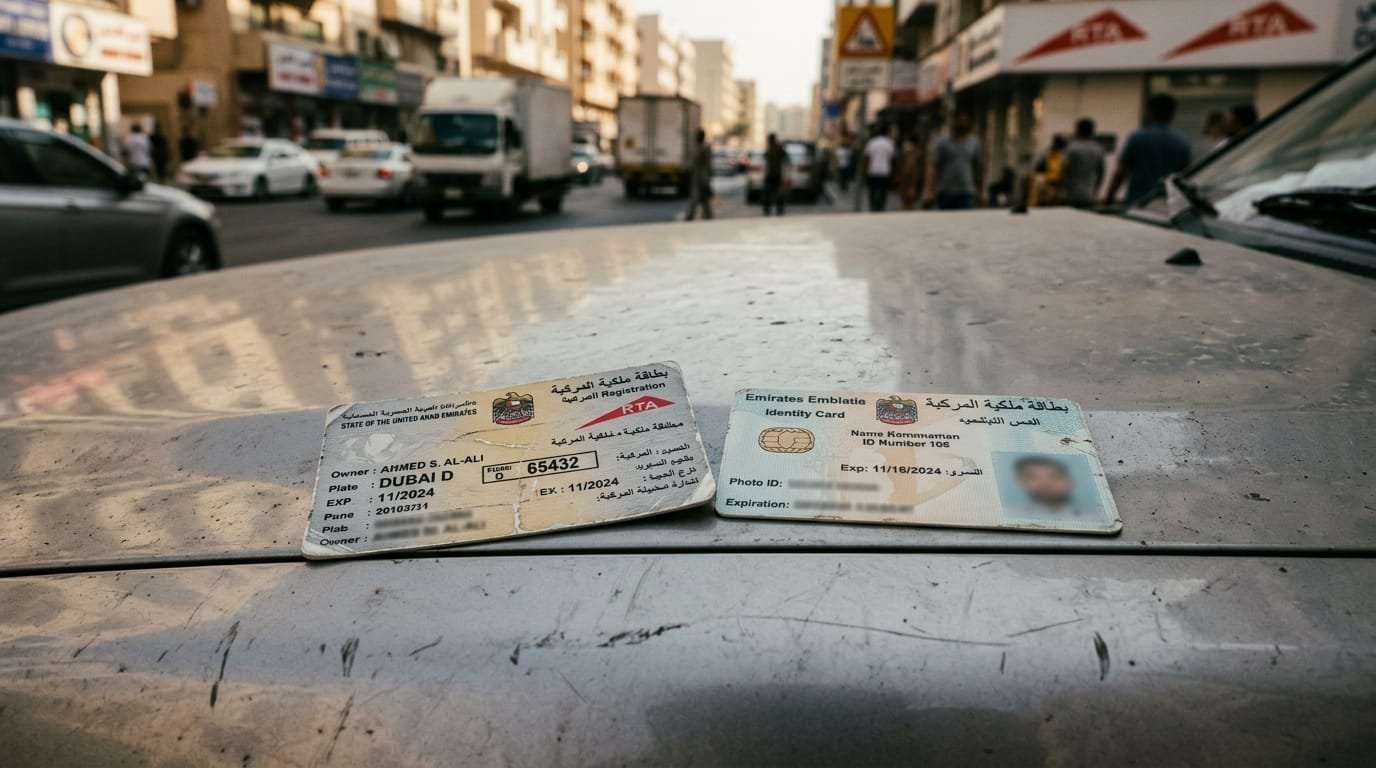
For the RTA transfer, you will typically need the seller’s Emirates ID, the Mulkiya, a valid insurance policy in your name, and passing Tasjeel inspection if the vehicle is due. Transfer fees generally range between 350 and 500 AED depending on vehicle type. Process at an RTA-approved typing center listed on the RTA website — locations near Al Aweer are familiar with this process and typically efficient.
For insurance after transfer, the UAE Insurance Authority consumer portal lists licensed providers and your rights under a standard policy.
Decision Framework: Your Next Move
| Where You Are Now | Recommended Next Step |
|---|---|
| Still researching which car to buy | Read our guide to best used cars under 30,000 AED for expats |
| Found a car, ready to inspect | Review our pre-purchase inspection guide before visiting |
| Deal agreed, ready to transfer | Follow UAE car registration steps for expats to avoid delays |
| Transferred, need insurance | Read our used car insurance guide for expats |
Analytical Conclusion
Across the mid-range used car market in Dubai — vehicles priced between 20,000 and 45,000 AED — prepared buyers who enter negotiations with specific comparable prices and documented concerns typically achieve discounts of between 4% and 11% from initial asking price. On a 32,000 AED vehicle, that range is 1,280 to 3,520 AED.
The 300 to 600 AED spent on an independent pre-purchase inspection from a qualified mechanic in Al Quoz or Abu Shagara area routinely produces leverage worth five to ten times its cost in either discount or risk avoided. It is the single highest-return action a buyer can take before any negotiation begins.
Compared to paying a monthly lease on the equivalent vehicle — typically 1,800 to 2,800 AED per month for this segment — even a modest negotiation saving of 2,000 AED represents nearly a full month of equivalent lease cost. The time spent preparing and negotiating is well worth the outcome for most expat buyers making this level of purchase. For context on total annual cost beyond the purchase price, our full monthly cost breakdown covers insurance, fuel, maintenance, and depreciation across the most common expat models.
Data Sources Used
- RTA Vehicle Registration and Transfer — Official Portal
- Dubizzle Motors UAE — Used Car Listings and Pricing Reference
- YallaMotor UAE — Used Car Market Listings
- UAE Insurance Authority — Consumer Rights and Licensed Providers
- Tasjeel Vehicle Inspection Services — UAE
- UAE Consumer Protection — Rights and Complaint Filing
- Dubai Municipality — Consumer Protection Department
Frequently Asked Questions
Q: Is it normal to negotiate used car prices in Dubai?
Q: How much can I realistically negotiate off a used car in UAE?
Q: Does paying cash give me a better used car price in Dubai?
Q: Should I get an independent inspection before negotiating?
Q: What is the best time to buy a used car in Dubai for negotiation?
Q: How do I handle it when the seller says the price is fixed?
Disclaimer: Emirates Car Guide is a 100% independent platform. We do not own showrooms, nor are we affiliated with any used car dealerships or garages. Our sole mission is to protect expats from financial fraud in the automotive market.
