
Last Updated: May 2026 | By Omar Al-Fayed, Senior Automotive Consultant | Category: Buying & Selling
Short Answer First:
A mid-range sedan financed at 80,000 AED over 48 months will cost the average Dubai expat approximately 3,400 to 4,200 AED per month in total ownership costs — including loan repayment, insurance, fuel, registration, maintenance, and parking. If you are buying with cash, the honest monthly running cost sits between 1,200 and 1,800 AED. Most expats budget for fuel and insurance, then discover five other cost lines they never anticipated. This guide breaks down every single expense to reveal your true financial exposure.
Before we get into numbers, it is worth noting that a proper pre-purchase inspection is the first step toward avoiding expensive surprises. Our detailed look at used car inspection services in Dubai covers exactly what those checks include and what they typically cost — reading it before you commit to a vehicle can save you several months of unexpected repair bills.
Calculate Your Dubai Car Cost (Personal Matrix)
Most cost guides provide generic averages. To understand your exact financial exposure, you need to map your own variables. Use the visual framework below to calculate your personal baseline. Gathering these inputs before visiting a dealership prevents you from committing to a vehicle that exceeds your true budget.
| Input Category | Your Data / Estimate | Monthly Impact Example (AED) |
|---|---|---|
| Car Price & Loan Term | e.g., 80,000 AED over 48 months | 1,550 |
| Down Payment | e.g., 20% (16,000 AED) | (Reduces monthly loan cost) |
| Monthly KM Driven | e.g., 1,500 km | (Drives fuel and service frequency) |
| Fuel Type & Efficiency | e.g., Petrol / 12 km/L | 400 |
| Salik Crossings (Per Day) | e.g., 4 crossings (24 AED/day) | 520 |
| Monthly Parking Cost | e.g., Paid zone near office | 250 |
| Insurance Estimate (Annual ÷ 12) | e.g., 3,600 AED annually | 300 |
| Calculated Output | Formula Result | Example Total (AED) |
| Monthly Running Total | Loan + Ins + Fuel + Salik + Park + Reg | 3,020 / month |
| Annual Total | Monthly Total × 12 | 36,240 / year |
| 3-Year Total (Including Depreciation) | (Annual × 3) + 3-Year Value Loss | 132,720 / 3 years |
One-Time Purchase Costs — The Hidden Entry Fee
Most expat cost guides begin at the monthly level. This one begins earlier — at the point of purchase — because first-time buyers in Dubai frequently absorb 2,500 to 5,800 AED in fees before they make a single monthly payment. These are not optional costs. Most are embedded in the transaction whether the buyer is aware of them or not.
| One-Time Cost Item | Typical Range (AED) | Notes |
|---|---|---|
| Ownership Transfer Fee (RTA) | 350 – 520 | Paid at Tasjeel or RTA service centre |
| Pre-Purchase Inspection | 250 – 500 | Independent workshop; non-negotiable for used vehicles |
| Bank Processing / Loan Setup Fee | 500 – 1,500 | Varies by bank; some waive for existing customers |
| Comprehensive Insurance (First Year Upfront) | 2,800 – 5,500 | Many insurers require annual payment; monthly options carry a surcharge |
| Vehicle Registration (New to Your Name) | 620 – 1,050 | Includes technical inspection and plate issuance |
| Window Tinting (if not already done) | 350 – 900 | Practically necessary in UAE summer conditions |
| Salik Tag Activation | 100 | 50 AED tag + 50 AED initial balance; required for most Dubai routes |
| Grand Total — One-Time Entry Costs | 4,970 – 10,070 | Before a single monthly payment is made |
Cost Line 1 — Monthly Loan Repayment
Most expats finance through UAE banks or dealership partnerships. Standard terms run between 36 and 60 months. Interest rates typically range from 2.49% to 3.99% flat, which translates to an effective rate closer to 4.5% to 7.2% annually — figures consistent with published rates from major UAE retail banks.
On a vehicle priced at 80,000 AED with a 20% down payment (16,000 AED), the financed amount is 64,000 AED. At a flat rate of 2.99% over 48 months, monthly repayment sits around 1,490 to 1,560 AED.
On 120,000 AED vehicles financed at similar terms, repayments frequently reach 2,200 to 2,400 AED monthly. Some drivers in the market are paying more on their car than on shared accommodation — a pattern that repeats more often than most would admit.
Cost Line 2 — Comprehensive Insurance
Third-party insurance is the legal minimum in the UAE, but it covers virtually nothing on your own vehicle. Comprehensive insurance is effectively mandatory for any expat who cannot absorb a 30,000 AED repair bill.
Premiums for a mid-range sedan typically range from 2,800 to 5,500 AED annually — or 233 to 458 AED per month. Factors that push costs upward include being under 30, having fewer than 3 years of UAE-based driving history, and driving a luxury or performance variant.
Expats frequently discover their home-country no-claims bonus does not transfer automatically. The process of getting it recognised varies by insurer and can take time. In many documented expat cases, buyers paid a full premium for the first year before any discount was applied.
Insurance Premiums by Driver Profile
Age and UAE driving history have a measurable and documented effect on annual premiums. The table below reflects typical observed premium ranges for a mid-range sedan (70,000 to 90,000 AED value) with comprehensive coverage and no prior UAE claims history.
| Driver Profile | Annual Premium (Estimated) | Monthly Equivalent | Key Factor |
|---|---|---|---|
| 24 years old, new to UAE | 4,500 – 5,800 AED | 375 – 483 AED | Age + zero UAE history |
| 28 years old, 1 year UAE history | 3,800 – 4,600 AED | 317 – 383 AED | Age still a premium factor |
| 32 years old, 2 years UAE history | 3,000 – 3,800 AED | 250 – 317 AED | Discount begins to apply |
| 38 years old, 3+ years, no claims | 2,400 – 3,200 AED | 200 – 267 AED | No-claims bonus active |
| 45 years old, 5+ years, no claims | 2,200 – 2,800 AED | 183 – 233 AED | Maximum typical discount tier |
The practical implication: an expat who arrives at 24 and stays for 5 years may reduce their annual insurance bill by 1,800 to 2,600 AED through accumulated UAE driving history alone — without changing their vehicle.
Cost Line 3 — Fuel
UAE fuel prices are adjusted monthly. Based on observed patterns across typical driving distances, a commuter covering 1,200 to 1,800 km per month in a 1.6L to 2.0L engine vehicle typically spends between 350 and 650 AED per month on fuel.
Larger SUVs and V6 or V8 engines push that figure considerably higher — frequently to 900 AED or beyond for drivers covering similar distances. The Dubai summer also has a measurable effect, as extended idling for air conditioning increases consumption noticeably.
Cost Line 4 — Salik and Parking
Salik, Dubai’s road toll system, charges 6 AED per gate crossing. For a typical expat commuting from areas like Al Barsha, Jumeirah Village, or Sports City toward Downtown, DIFC, or Deira, two crossings each way adds up to 24 AED per working day.
Over a standard working month, that frequently totals 480 to 600 AED in Salik alone. Drivers who adjust their routes or shift commute times can reduce this, but many simply absorb it as a fixed cost.
Monthly parking subscriptions in residential areas typically range from 0 AED (many communities include it) to 350 AED. For Dubai residents working in paid-parking areas, budgeting 150 to 400 AED monthly is a reasonable range.
Cost Line 5 — Annual Registration and Renewal
Vehicle registration in Dubai involves several components: the technical inspection fee, the registration fee itself, and any applicable traffic fine clearance.
For a standard passenger vehicle with no outstanding fines, annual registration typically costs between 620 and 1,050 AED depending on vehicle age and engine size. Divided across 12 months, that is approximately 52 to 87 AED per month.
If the vehicle has accumulated uncleared fines, the renewal cannot proceed until those are settled. Some expats discover this with 1,500 to 4,000 AED in outstanding fines at renewal time.

Cost Line 6 — Routine Maintenance
This is where budgets frequently diverge between informed and uninformed buyers. Routine maintenance covers oil changes, filters, brake pads, fluid flushes, and tyre rotations. On a well-maintained Japanese sedan (Toyota Corolla, Mitsubishi Lancer, Honda Civic), annual routine costs typically range from 1,800 to 3,200 AED.
European vehicles — including popular choices like Volkswagen Passat, BMW 3 Series, and Mercedes C-Class — frequently double or triple that figure. Based on internal observations across UAE workshops, German brand owners in the used market commonly report routine annual maintenance running 4,500 to 8,000 AED even without major mechanical work.
Tyre replacement is a separate but related cost. Dubai’s heat accelerates tyre wear noticeably. A set of four replacement tyres for a mid-range sedan ranges from 900 to 2,400 AED depending on brand and size, and many drivers replace them every 30,000 to 45,000 km.
Cost Line 7 — Depreciation (The Invisible Monthly Cost)
Depreciation is consistently the largest single cost of car ownership — and the one most completely absent from expat budgets. Unlike fuel or Salik, it does not require a payment. It simply reduces what the vehicle is worth, silently, every month.
In the UAE market, depreciation is accelerated by high ambient temperatures degrading interiors, mileage accumulating quickly on inter-emirate commutes, and a constantly high market supply of used vehicles.
| Vehicle | Purchase Price | Estimated Value After 3 Years | Total Value Lost | Monthly Depreciation Cost |
|---|---|---|---|---|
| Toyota Corolla (1.6L GCC) | 80,000 AED | 55,000 – 58,000 AED | 22,000 – 25,000 AED | 611 – 694 AED |
| Mitsubishi Lancer (2.0L GCC) | 75,000 AED | 50,000 – 54,000 AED | 21,000 – 25,000 AED | 583 – 694 AED |
| Hyundai Sonata (2.4L GCC) | 85,000 AED | 54,000 – 58,000 AED | 27,000 – 31,000 AED | 750 – 861 AED |
| BMW 3 Series (Used, 2.0L) | 80,000 AED | 40,000 – 46,000 AED | 34,000 – 40,000 AED | 944 – 1,111 AED |
| Chevrolet Malibu (2.0T US Spec) | 65,000 AED | 30,000 – 36,000 AED | 29,000 – 35,000 AED | 806 – 972 AED |
| Nissan Patrol (4.0L V6 GCC) | 130,000 AED | 90,000 – 98,000 AED | 32,000 – 40,000 AED | 889 – 1,111 AED |
Worst-Case Repair Scenarios — What to Reserve For
Routine maintenance budgets cover the expected. The table below covers the unexpected — failures that occur without warning and that workshop patterns across Al Quoz and Abu Shagara confirm are not rare. These figures are based on observed repair costs at independent UAE workshops, not agency service centres.
| Unexpected Repair Event | Typical Cost Range (AED) | Vehicles Most Commonly Affected | Risk Level (Used Market) |
|---|---|---|---|
| AC Compressor Replacement | 1,200 – 2,800 | All brands; accelerated by UAE heat cycles | Medium |
| CVT Transmission Repair | 3,500 – 9,000 | Nissan, Mitsubishi (CVT variants), some Hyundai | Medium–High on high mileage units |
| Turbocharger Replacement | 3,000 – 8,000 | European turbo engines, US-spec imports | High on deferred maintenance vehicles |
| Catalytic Converter Replacement | 1,800 – 3,200 | Petrol vehicles over 100,000 km | Medium |
| Engine Timing Chain / Belt Service | 1,500 – 4,500 | Vehicles with deferred 100,000 km service | Medium |
| Radiator Replacement | 800 – 2,200 | All vehicles; accelerated by Dubai summer heat | Low–Medium |
| Suspension Components (Full Refresh) | 1,200 – 3,800 | High-mileage vehicles; common after speed bumps | Medium |
| Insurance Excess Per Claim | 500 – 2,000 | All vehicles; per policy terms | Variable |
| Accident Repair (Moderate Damage) | 4,000 – 18,000 | All vehicles; dependent on panel and part costs | Variable |
Car vs Metro vs Lease vs Taxi — The Full Comparison
For many expats, the most useful framing is not “how much does a car cost” but rather “how much does a car cost compared to the alternatives.” This section maps all four transport modes against each other for a typical Dubai commuter profile (25 km each way, 5 days a week).
| Transport Option | Monthly Cost Estimate | Annual Cost Estimate | Key Advantage | Key Limitation |
|---|---|---|---|---|
| Dubai Metro + Feeder Bus | 350 – 600 AED | 4,200 – 7,200 AED | Lowest cost; no ownership burden | Route coverage gaps; no flexibility |
| Metro + Occasional Taxi | 700 – 1,200 AED | 8,400 – 14,400 AED | Flexible for off-route needs | Weekend and late-night gaps persist |
| Ride-Hailing Only (Careem / Uber) | 1,500 – 2,800 AED | 18,000 – 33,600 AED | No ownership; door-to-door | Surge pricing; accumulates quickly for families |
| Short-Term Car Lease (Monthly) | 1,700 – 2,800 AED | 20,400 – 33,600 AED | Flexibility; exit without asset risk | No equity build; restrictions on mileage |
| Owned Used Car (Cash, GCC Spec) | 1,245 – 2,000 AED | 14,940 – 24,000 AED | Lowest monthly after purchase; equity retained | Capital outlay upfront; repair exposure |
| Owned Financed Sedan (Mid-Range) | 3,375 – 4,650 AED | 40,500 – 55,800 AED | Modern vehicle; spread capital cost | Highest total cost; exit complications |
Cost Breakdown by Emirate
Running costs vary noticeably across Dubai, Sharjah, and Abu Dhabi. The table below reflects typical cost differences for the same vehicle and commuter profile in each emirate.
| Cost Category | Dubai | Sharjah | Abu Dhabi |
|---|---|---|---|
| Road Tolls (Monthly) | 320 – 600 AED (Salik) | 0 – 80 AED (minimal tolls) | 0 – 200 AED (Darb system) |
| Parking (Monthly) | 0 – 400 AED (varies widely) | 0 – 120 AED (generally low) | 100 – 350 AED (Mawaqif zones) |
| Fuel (Monthly — Higher Sharjah Commute) | 380 – 580 AED | 500 – 750 AED (longer commutes) | 350 – 550 AED |
| Registration (Annual) | 620 – 1,050 AED | 500 – 850 AED | 550 – 950 AED |
| Insurance (Annual) | 2,800 – 5,500 AED | 2,600 – 5,000 AED | 2,700 – 5,200 AED |
| Estimated Monthly Running Total | 1,245 – 4,910 AED | 1,050 – 3,800 AED | 1,100 – 4,200 AED |
Sharjah-based expats commuting daily into Dubai face an additional cost dynamic: the distance typically adds 30 to 50 minutes per commute each way, increases fuel consumption by 20 to 35 percent above average, and accelerates tyre wear cycles. The lower cost of accommodation in Sharjah is frequently offset by the car running costs the commute generates.
🔧 Mechanic’s Inspection Log — A Real-World Case
Case Reference: UAE-AL-2026-014 | Names and identifying details modified for privacy.
A client came to me after purchasing a used 2019 Nissan Altima from a private seller in Abu Shagara, Sharjah. Price agreed: 38,000 AED. He skipped the pre-purchase inspection.
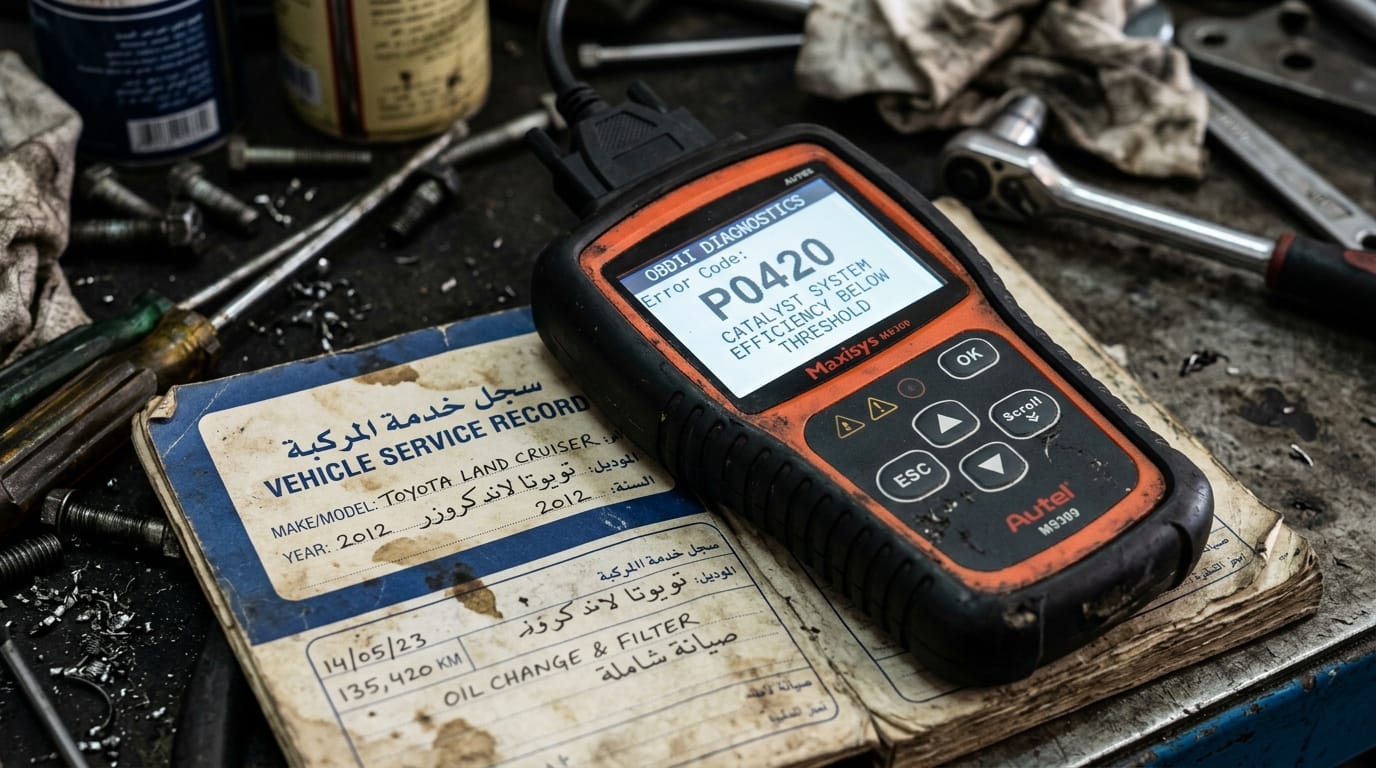
During our inspection at a trusted workshop in Al Quoz Industrial Area, the OBD scanner returned code P0420 (Catalyst System Efficiency Below Threshold). The catalytic converter was degraded, likely due to a history of running slightly rich on fuel mixture. Replacement cost from a reputable supplier: 2,200 to 2,800 AED. We also found rear brake pads at 15 percent remaining (380 AED to replace), and a slow transmission fluid leak from a degraded seal (650 to 900 AED for a workshop fix).
Total undisclosed repair cost: approximately 3,400 to 4,080 AED. The seller dropped the price by 1,200 AED when presented with the documented report. The buyer absorbed the remainder — a common outcome in private sales when an inspection is done too late.
Owner Scenarios — What Your Monthly Total Actually Looks Like
Scenario A — Budget Commuter (50,000 AED used Japanese sedan, no financing):
Insurance: 280 AED | Fuel: 380 AED | Salik: 320 AED | Maintenance reserve: 200 AED | Registration (monthly equivalent): 65 AED
Estimated Monthly Total: 1,245 AED
Scenario B — Mid-Range Financed Sedan (80,000 AED, 48-month loan):
Loan repayment: 1,520 AED | Insurance: 370 AED | Fuel: 480 AED | Salik: 480 AED | Parking: 180 AED | Maintenance reserve: 270 AED | Registration equivalent: 75 AED
Estimated Monthly Total: 3,375 AED
Scenario C — Financed SUV (120,000 AED, 60-month loan, V6):
Loan repayment: 2,280 AED | Insurance: 480 AED | Fuel: 900 AED | Salik: 540 AED | Parking: 220 AED | Maintenance reserve: 400 AED | Registration equivalent: 90 AED
Estimated Monthly Total: 4,910 AED
Summary Cost Table — Monthly Ownership Breakdown
| Cost Category | Budget (Used, No Loan) | Mid-Range (Financed) | SUV (Financed, V6) |
|---|---|---|---|
| Loan Repayment | 0 AED | 1,520 AED | 2,280 AED |
| Insurance | 280 AED | 370 AED | 480 AED |
| Fuel | 380 AED | 480 AED | 900 AED |
| Salik / Tolls | 320 AED | 480 AED | 540 AED |
| Parking | 0 AED | 180 AED | 220 AED |
| Maintenance Reserve | 200 AED | 270 AED | 400 AED |
| Registration (Monthly Avg) | 65 AED | 75 AED | 90 AED |
| Depreciation (Monthly Est.) | 520 AED | 720 AED | 980 AED |
| Grand Total (Monthly — With Depreciation) | 1,765 AED | 4,095 AED | 5,890 AED |
When It Becomes Expensive — Hidden Triggers
Traffic accidents with partial coverage gaps: Comprehensive policies often carry excess clauses of 500 to 2,000 AED per claim. Expats with multiple minor incidents in one year frequently face non-renewal or premium increases of 30 to 60 percent at renewal time.
Out-of-warranty repairs on non-Japanese vehicles: A transmission service on a European vehicle in a non-agency workshop in Al Quoz typically runs 1,800 to 3,500 AED. At an agency service centre, the same job commonly reaches 4,500 to 7,000 AED.
Visa-exit scenarios: Expats who cancel their residence visa while still carrying a car loan face a complex sequence involving early settlement penalties (typically 1 to 3 percent of outstanding balance), deregistration fees, and potential export procedures. In many documented cases, the total exit cost for a mid-range financed vehicle ranges from 2,500 to 6,000 AED beyond the loan balance.
Signs of the Positive Side — When Car Ownership Makes Sense
- Public transport gaps remain real. Dubai Metro is excellent for its routes, but a significant portion of residential communities — particularly in areas like Al Barsha South, Mirdif, and Jumeirah Village Circle — are not within practical walking distance of stations.
- Inter-emirate travel becomes far more economical. Frequent Abu Dhabi or Sharjah commuters who use a personal vehicle often spend significantly less per trip compared to taxis or intercity buses when accounting for time and convenience.
- GCC-spec Japanese vehicles hold value remarkably well. A well-maintained Toyota Camry or Corolla in GCC specification typically depreciates at a slower rate than most European alternatives in the UAE market.
- The Dubizzle market offers genuine value windows. Expat relocation sales — particularly from Al Aweer Auto Market and private listings from verified sellers — do present vehicles priced 10 to 18 percent below typical dealer margin.
Daily Annoyances & Buyer Mistakes
Some costs are not monetary but affect the real-world ownership experience. Some drivers spend 10 to 15 minutes per week managing Salik top-ups, parking meter extensions, and RTA app interactions. These compound into a low-level time overhead most expats do not anticipate. Cabin temperatures in a parked car can reach levels that require a 3 to 5 minute cool-down before the vehicle is comfortable to drive.
Mistake 1 — Skipping the pre-purchase inspection: A 250 to 500 AED inspection can surface 3,000 to 8,000 AED in required repairs. The maths are straightforward, yet a notable share of private sale buyers skip this step.
Mistake 2 — Financing based on monthly payment alone: Comparing offers by monthly repayment without examining the total cost of finance leads many buyers to accept 60-month terms that significantly increase total outlay.
The Safe Alternative — What Holds Up in the UAE Market
A GCC-specification Toyota Corolla or Mitsubishi Lancer in the 35,000 to 55,000 AED range, purchased from a verifiable history seller with a documented service record, remains the most commonly referenced benchmark for low total ownership cost in Dubai’s used market. Running costs are predictable. Parts are available at multiple price points across Al Quoz. Resale is reliable. Insurance premiums are among the lowest in the mid-size sedan category.
User Type Recommendation — Decision Framework
| User Profile | Recommended Approach | Estimated Monthly Cost | Key Risk to Manage |
|---|---|---|---|
| Single expat, 1–2 year contract, Metro accessible | Lease or avoid ownership; use rideshare and car rental | 1,200 – 1,800 AED | Exit cost, short tenure |
| Single expat, 3+ year contract, non-Metro area | Used GCC Japanese sedan, cash or short-term finance | 1,400 – 2,200 AED | Pre-purchase inspection non-negotiable |
| Family expat, school runs, multiple uses | Used GCC MPV or mid-size SUV, comprehensive insurance | 2,800 – 4,200 AED | Tyre wear, AC system maintenance |
| Senior professional, luxury expectation | New or certified pre-owned, agency-serviced only | 4,500 – 7,000 AED | Depreciation on premium imports |
| Inter-emirate commuter (daily Sharjah–Dubai) | Fuel-efficient sedan, GCC spec, Salik optimised routes | 2,000 – 3,200 AED | Accelerated mileage, tyre cycles |
Data Sources Used in This Guide
- RTA official fee structure for vehicle licensing, technical inspections, and ownership transfers.
- Salik toll gate official tariffs and active gate locations across Dubai.
- UAE Fuel Price Committee (ADNOC) for historical and current monthly petrol pricing trends.
- UAE Central Bank retail auto loan benchmarks and retail banking rate disclosures (2024-2026).
- Workshop observations, diagnostic logs, and repair invoices from independent garages across Dubai and Sharjah (2024–2026).
Analytical Conclusion — What the Numbers Actually Mean
The median Dubai expat in a financed mid-range sedan scenario is spending approximately 4,095 AED per month in total vehicle ownership costs when depreciation is included. To contextualise that figure: in many residential zones across Dubai, a shared apartment room costs between 1,800 and 3,000 AED monthly.
Financial planners generally suggest keeping total vehicle expenses below 15 to 20 percent of monthly income. At 4,095 AED per month, that implies a gross salary of at least 20,000 to 27,000 AED before a mid-range financed vehicle sits within a prudent budget threshold. For expats earning 10,000 to 14,000 AED, a used cash-purchase vehicle — with a total monthly cost closer to 1,245 to 1,765 AED — is the more financially stable choice.
The expats who manage this cost most effectively purchased GCC-specification Japanese vehicles, completed a pre-purchase inspection, took comprehensive coverage from the first day, and built both a maintenance and depreciation reserve into their monthly budget.
For expats navigating the used market specifically, understanding which vehicles carry the lowest long-term risk is the next logical step. Our detailed comparison of Mitsubishi versus Chevrolet in Dubai’s used market examines exactly why the brand choice at the point of purchase tends to have a disproportionate effect on everything that comes after — including the monthly cost totals outlined in this guide.
FAQ
Disclaimer: Emirates Car Guide is a 100% independent platform. We do not own showrooms, nor are we affiliated with any used car dealerships or garages. Our sole mission is to protect expats from financial fraud in the automotive market.
