Last Updated: May 2026 | By Omar Al-Fayed, Senior Automotive Consultant | Category: Used Car Buying
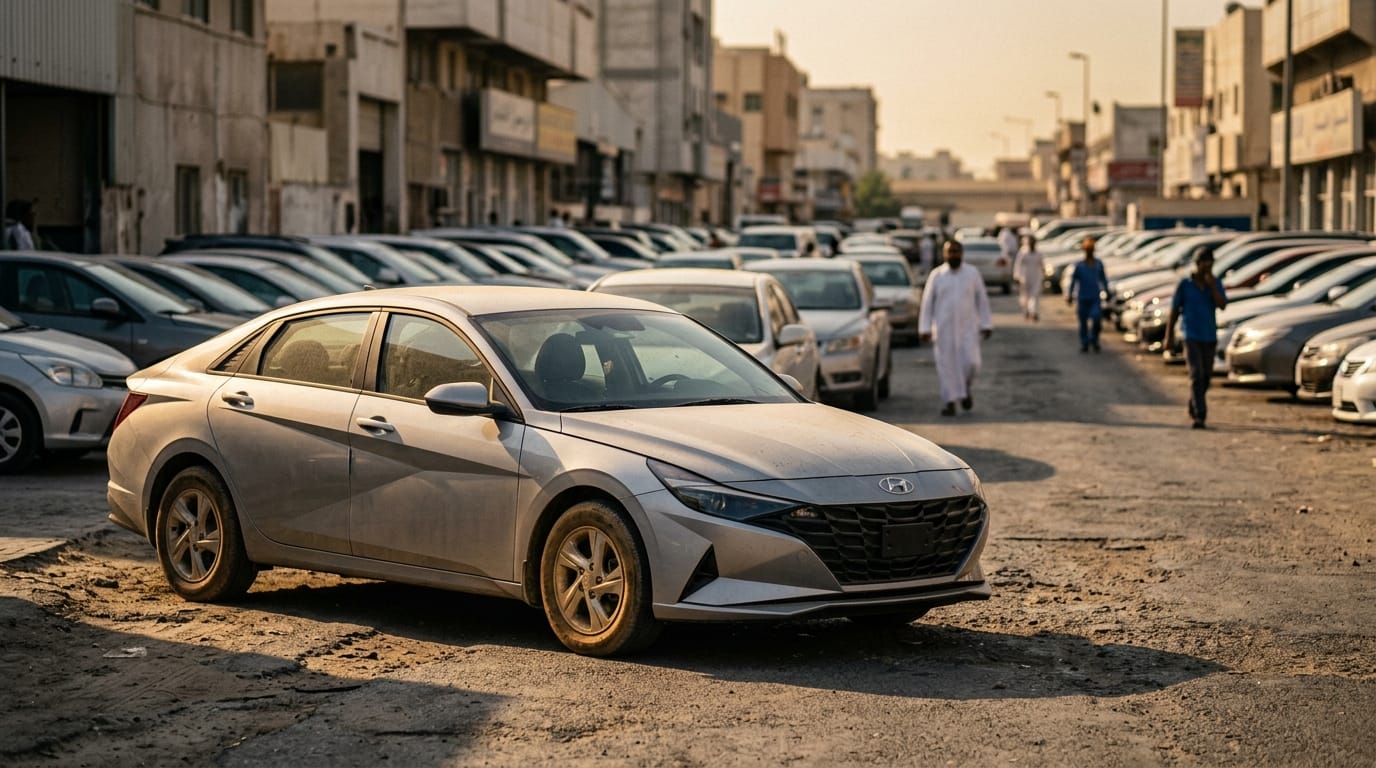
A used Hyundai Elantra in the UAE can be purchased for between 18,000 and 38,000 AED depending on year, mileage, and specification — and it is one of the most frequently listed sedans on Dubizzle and CarSwitch in 2026. The risk is not the price. The risk is the pattern of faults that appear consistently in UAE-registered Elantras above 80,000 km, and the absence of a structured pre-purchase inspection process that protects buyers from inheriting those faults.
Based on pre-purchase inspection records and ownership cost observations from Dubai and Sharjah between 2024 and 2026, Elantra buyers who skipped a professional inspection paid an average of 3,800 to 7,200 AED in first-year repair costs above their initial estimate. Buyers who completed a structured inspection before purchase negotiated an average discount of 2,000 to 4,500 AED or identified vehicles they correctly chose not to buy. This guide documents every check, in the order that protects your purchase decision.
If you have recently dealt with a warning light on your current vehicle and are now evaluating whether to repair or replace, the decision framework is relevant to your situation: read Engine Warning Light On in UAE: Expat Step-by-Step Guide Without Getting Overcharged — including the documented case where a second diagnostic opinion saved 1,200 AED on a Camry repair that appeared straightforward.
Why the Elantra Dominates the UAE Used Car Market at This Price Point
The Hyundai Elantra has been sold in GCC markets in large volumes since the AD generation (2011 onwards). By 2026, the used market in the UAE contains a dense concentration of AD (2011–2016), MD facelifted (2016–2019), and CN7 (2021–2024) units — creating unusually broad choice within a narrow price band.
This volume is an advantage and a risk simultaneously.
The advantage: parts availability across independent workshops in Al Quoz, Sharjah Industrial Area, and Abu Shagara is higher for the Elantra than for most Korean competitors. Labour familiarity is equally high. This keeps routine maintenance costs at the lower end of the sedan segment.
The risk: high volume means the UAE used market contains Elantras with widely varying histories — daily rental fleet units, high-mileage airport transfer vehicles, and well-maintained private-ownership cars all listed at similar prices, frequently without the documentation that distinguishes them.
UAE Elantra Market Data — May 2026
| Generation | Years | Typical UAE Listing Price (AED) | Common Mileage Range (km) | Key Risk Factors |
|---|---|---|---|---|
| AD / MD (Pre-facelift) | 2011–2016 | 18,000 – 26,000 | 110,000 – 180,000 | Transmission wear, underbody surface rust, original battery long replaced |
| MD Facelift | 2016–2019 | 24,000 – 34,000 | 70,000 – 140,000 | DCT gearbox shudder on 1.4T units, VVT oil control valve wear on 2.0L |
| CN7 | 2021–2024 | 32,000 – 52,000 | 30,000 – 90,000 | Electronic parking brake faults, ABS module codes in high-heat conditions |
🔧 Pre-Purchase Inspection Log — The Elantra That Looked Correct and Wasn’t
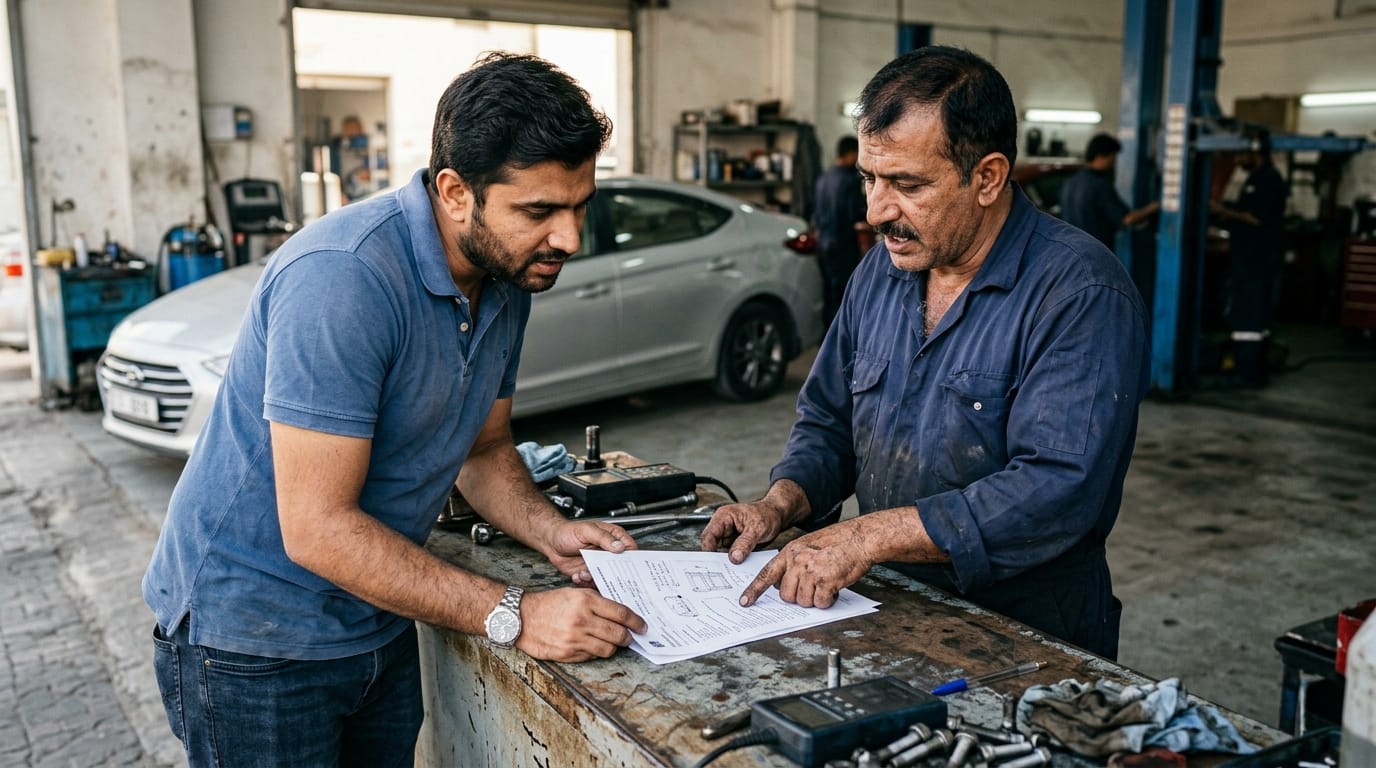
Documented pre-purchase inspection case, February 2026, independent inspection workshop, Sharjah Industrial Area 10.
Vehicle: 2018 Hyundai Elantra 2.0L GCC, 88,000 km
Listing Price: 30,500 AED (Dubizzle private seller)
Buyer Profile: Filipino expat, 4 years in UAE, healthcare sector, first used car purchase in UAE
Visual Condition: Clean exterior, no visible accident damage, service book with 5 Hyundai dealer stamps
Inspection Workshop: Independent specialist, Sharjah Industrial Area 10
Inspection Cost: 350 AED
The buyer contacted the seller after seeing the listing for three days. The car appeared well-maintained. The service book showed regular dealer servicing. The exterior had no visible damage. The seller was a second owner who had used the car for 3 years of personal commuting.
The inspection workshop lifted the vehicle and performed a full underbody inspection alongside an OBD diagnostic scan and a road test.
Findings:
- OBD scan: P0011 active (Camshaft Position A — Timing Over-Advanced, Bank 1). The code had been cleared recently — the code clear count in the freeze-frame data indicated a manual reset within the previous 500 km. This is a documented indicator that a seller or workshop is aware of the fault and has cleared it to delay detection.
- Engine oil: Black and slightly viscous despite being stamped as changed 8,000 km ago at a Hyundai dealer. Viscosity consistent with oil that had been used significantly longer than the stamp indicated.
- Underbody: Minor surface rust on rear subframe mounting points — consistent with a vehicle that had been parked in a humid coastal area or had water intrusion. Structural integrity was unaffected but the rust indicated a history not reflected in the listing description.
- Front struts: Both showed oil seepage at the shock absorber seal — not a failure, but a condition requiring replacement within 15,000 to 25,000 km. Replacement cost: 1,400 to 1,900 AED for both front struts at an independent workshop.
- Brake pads front: 3mm remaining — below the replacement threshold of 4mm for UAE highway driving conditions. Replacement cost: 600 to 900 AED.
Inspection workshop assessment: P0011 on this engine (Nu 2.0L GCC) is frequently caused by a failing oil control valve (OCV) or degraded oil quality causing VVT system deposits. Given the evidence of oil mismanagement in the service history and the manual code-clear event, the workshop assessed the P0011 as likely requiring OCV replacement and a full oil system flush at minimum — with a risk of camshaft timing chain wear if the fault had been running for extended mileage.
Estimated repair costs to address identified faults:
- P0011 diagnosis and OCV replacement: 900 – 1,400 AED
- Oil system flush and full oil change: 300 – 450 AED
- Front struts (both): 1,400 – 1,900 AED
- Front brake pads: 600 – 900 AED
- Total estimated immediate repair liability: 3,200 – 4,650 AED
The buyer renegotiated the price to 26,500 AED — a reduction of 4,000 AED — based on the written inspection report. The seller accepted. The buyer proceeded with purchase at the revised price and addressed the struts and brakes immediately. The P0011 fault was monitored and resolved with an OCV replacement costing 1,100 AED at a Sharjah independent workshop two weeks after purchase.
Total effective purchase cost including immediate repairs: 29,100 AED. The 350 AED inspection had returned 4,000 AED in negotiated reduction plus identified 4,650 AED in repair liability that was factored into the purchase decision.
The Five Fault Categories That Appear Consistently in UAE Elantra Inspections
Pre-purchase inspection records from Sharjah and Dubai workshops between 2024 and 2026 show a consistent pattern of fault categories in used Elantras above 70,000 km. These are not random individual faults — they are predictable outcomes of UAE operating conditions combined with the known wear profile of Elantra mechanical components.
1. VVT System and Camshaft Timing Codes (P0011, P0014, P0021, P0024)
The Nu 1.6L and 2.0L GCC engines used in 2015–2020 Elantras have a documented sensitivity to oil quality degradation in UAE heat conditions. The variable valve timing system relies on oil pressure and cleanliness to actuate correctly. Extended oil change intervals — common in the UAE where many owners follow calendar-based rather than condition-based change intervals — accelerate VVT component wear and deposit formation.
When to suspect this: P001x or P002x codes on scan. Engine sometimes produces a brief rattling noise on cold start that disappears after 30 seconds of running.
Repair cost range at independent UAE workshop: 800 to 2,200 AED depending on whether the fault is in the oil control valve (lower cost) or has progressed to timing chain and tensioner wear (higher cost).
2. Dual Clutch Transmission (DCT) Hesitation and Shudder — 2017–2019 1.4T Units
The 1.4-litre turbocharged Elantra introduced in the 2017 model year uses a 7-speed dry DCT gearbox. This transmission has a documented behaviour pattern in low-speed urban conditions: hesitation and shudder below 30 km/h, particularly in stop-start traffic. In UAE conditions — where stop-start city driving at high ambient temperatures is the daily norm — this behaviour appears more frequently and more pronounced than in markets where this transmission was originally calibrated.
This is a known characteristic, not always a defect. However, severe shudder and hesitation that persists after a TCM software update indicates clutch pack wear that requires replacement. Clutch pack replacement on the DCT at an authorised Hyundai dealer: 4,500 to 8,000 AED. Independent workshop with OEM-compatible parts: 3,200 to 5,500 AED.
Avoid any 2017–2019 1.4T Elantra that exhibits DCT shudder without being able to confirm the TCM software version has been updated to the latest Hyundai bulletin. Ask the seller for the last Hyundai dealer service record specifically referencing a TCM update.
3. Air Conditioning Compressor Failure
UAE heat conditions place the Elantra’s air conditioning system under sustained high-load operation for 7 to 9 months of the year. Compressor bearing wear, refrigerant leaks from ageing O-rings, and evaporator coil fouling are the three most common AC faults in Elantras above 100,000 km.
Signs to check during inspection: AC output temperature at the centre vent should reach 8 to 12 degrees Celsius within 3 minutes of operation at idle in ambient temperatures above 35°C. Anything above 15 degrees Celsius at the centre vent after 5 minutes indicates a system issue that warrants investigation before purchase.
Repair cost range: refrigerant recharge and O-ring replacement: 350 to 700 AED. Compressor replacement with OEM-equivalent part: 1,800 to 3,200 AED.
4. Underbody Rust and Subframe Condition
GCC-specification Elantras are not built with the same underbody rust protection standards applied to models sold in salt-road markets. In a coastal UAE environment — Abu Dhabi island, Sharjah coastal districts, Ras Al Khaimah — vehicles accumulate surface rust on subframe mounting points, exhaust hangers, and brake line brackets within 5 to 8 years. This is surface rust in most observed cases, not structural rust. However, it requires identification before purchase because it affects the long-term repair accessibility and cost for suspension and exhaust work.
Any pre-purchase inspection should include a lift inspection of the full underbody. A visual walkround is not a substitute.
5. Electronic Parking Brake and ABS Module Faults — CN7 Generation
The 2021–2024 CN7 Elantra introduced an electronic parking brake and a revised ABS and stability control system. In UAE service records from 2023 to 2026, a pattern of C12xx and C14xx fault codes has appeared in CN7 units operated in high-heat, high-dust conditions — consistent with sensor contamination and electronic module thermal stress.
These are not high-frequency faults, but they are disproportionately expensive when they occur: ABS module replacement at an authorised dealer is 2,800 to 5,500 AED. Independent workshops with compatible diagnostic tools and modules charge 1,800 to 3,200 AED.
If purchasing a CN7 Elantra, request an OBD scan that includes ABS and chassis module codes — not just powertrain codes. A basic OBD reader shows only P codes. A full-system scan is required to identify C and U codes, and costs 150 to 250 AED at a workshop with multi-system diagnostic capability.

Step-by-Step Pre-Purchase Inspection Process
Step 1 — Verify the Specification and History Before Viewing
Before arranging to view any Elantra listing, confirm three things from the seller remotely.
GCC specification confirmation: Ask for the VIN (Vehicle Identification Number) and check the format. GCC-specification Elantras have VINs beginning with KMHD or KMHL in most years. If the VIN begins with KMH followed by a US or European market identifier, the car was not originally sold in GCC markets.
Ownership and registration history: Request a copy of the Mulkiya (vehicle registration card). This confirms the registered emirate, the number of ownership transfers, and the registration date. A 2017 Elantra with 4 ownership transfers in 7 years warrants more scrutiny than the same car with 2 transfers. In the UAE, ownership transfer records are accessible through the RTA Dubai app or the Abu Dhabi DMT portal — the seller cannot alter this record.
Service history documentation: Ask whether there is a service book with stamps, or digital service records. A complete Hyundai dealer service history through the first 60,000 km, followed by a documented gap, is common — and tells a different story than a history with consistent independent workshop receipts. Both are acceptable; neither is better without cross-referencing against the OBD freeze-frame data.
Step 2 — The Physical Inspection (Perform This Yourself, Before the Workshop)
This step is done at the meeting with the seller. It takes 20 to 30 minutes. Its purpose is not to replace the professional inspection — it is to identify any immediate disqualifying conditions before you invest 350 AED in a workshop inspection.
Exterior walkround:
- Panel gap consistency: stand at the front corner of the car and look down the side. Panel gaps between doors, fenders, and bumpers should be consistent in width. Inconsistent gaps indicate post-accident bodywork. Minor inconsistency is common in used cars; significant variation requires explanation.
- Paint depth and texture: run your palm across multiple body panels. Original factory paint has a consistent texture. Repainted panels often feel smoother or have a slightly different surface character. A paint thickness meter — available for 150 to 300 AED — provides objective measurement. Original factory paint is typically 90 to 130 microns; repainted panels are often 150 to 400 microns.
- Windshield and glass: chips and cracks are common in UAE conditions and are not automatically disqualifying, but they affect registration renewal and should be factored into the price negotiation. A windshield replacement on an Elantra: 700 to 1,400 AED depending on the unit and supplier.
- Tyre condition and age: check the tyre sidewall for the DOT date code (last 4 digits indicate the week and year of manufacture). Tyres above 5 years old in UAE conditions — where UV degradation and heat cycling accelerate ageing — should be budgeted for replacement regardless of tread depth. A full set of entry-level GCC-spec tyres for the Elantra: 900 to 1,400 AED fitted.
Interior inspection:
- Smell test: enter the car and close the door. A musty or damp smell is the primary indicator of water ingress — either from a flood event or a sustained leak. This smell is difficult to eliminate fully regardless of cleaning. A car with this smell requires investigation of the carpets, boot floor, and door sill drainage channels before any purchase consideration.
- Carpet and boot floor: lift the boot floor mat and press down on the foam insulation layer. Damp foam compresses unevenly and has a discoloured or grey appearance compared to dry foam. Check the front footwell corners where water typically pools first.
- Electronic functions: test every button, switch, and screen systematically — infotainment system, all four window switches, climate control at all settings, parking sensors, and rear camera if fitted. Electronic faults in used cars become negotiation leverage if documented; they become expensive surprises if missed.
Engine bay:
- Oil condition: remove the dipstick and assess the oil. Dark brown oil in a car with a recent service stamp is a minor inconsistency worth noting. Black, thick, or low-level oil on a car with documentation of recent servicing indicates the service was not performed as documented.
- Coolant level and condition: the coolant reservoir on the Elantra is clearly visible in the engine bay. Level should be between MIN and MAX marks. Pink or red coolant (Hyundai HOAT specification) should be clear and not cloudy or brown. Cloudy coolant indicates either water contamination or coolant degradation requiring a full flush.
- Radiator fins: inspect from the front of the car with the bonnet open. Bent or clogged radiator fins reduce cooling efficiency significantly in UAE summer conditions. Minor fin bending is common from road debris; significant blockage is a negotiation point.
Step 3 — The Workshop Inspection (Non-Negotiable for Any Purchase Above 20,000 AED)
This is not optional. A pre-purchase inspection on a used Elantra costs 300 to 450 AED at independent specialists in Sharjah and Al Quoz. The inspection should cover:
Full OBD diagnostic scan including all modules: P codes (powertrain), B codes (body), C codes (chassis), U codes (network). Request freeze-frame data for any active or pending code. Confirm whether any codes have been manually cleared recently.
Lift inspection of underbody: subframe condition, suspension component wear, exhaust system integrity, brake line condition, fluid leaks from engine, gearbox, and differential.
Brake system measurement: front and rear pad thickness in millimetres — not a visual estimate. Disc surface measurement for wear grooves and runout. UAE highway conditions and emergency braking in heat accelerate brake wear faster than moderate-climate markets.
Suspension components: front strut condition — oil seepage is an early failure indicator — lower control arm bushings (a worn bushing produces a knock over speed bumps, which are frequent on UAE roads), and steering rack boots for cracks or leaks.
Compression test (recommended for vehicles above 90,000 km): a cylinder compression test takes 15 to 20 minutes and costs an additional 150 to 250 AED. It identifies compression variance between cylinders that may indicate ring wear or valve seat erosion — issues that do not always produce fault codes but indicate engine work ahead.
Cost Structure — What Elantra Ownership Actually Costs in the UAE
The purchase price is the number that appears in the listing. The ownership cost is the number that matters.
Routine Annual Maintenance (Well-Maintained Unit, 60,000–100,000 km)
| Service Item | Independent Workshop (AED) | Hyundai Authorised Dealer (AED) |
|---|---|---|
| Engine oil and filter (5W-30 semi-synthetic, GCC spec) | 180 – 280 | 320 – 480 |
| Air filter replacement | 80 – 140 | 140 – 220 |
| Cabin air filter | 60 – 100 | 120 – 180 |
| Spark plug set (4 plugs, NGK or OEM) | 200 – 380 | 380 – 580 |
| Brake fluid change (every 2 years) | 120 – 200 | 200 – 320 |
| Annual diagnostic scan and health check | 150 – 250 | 250 – 400 |
| Annual routine maintenance total (estimate) | 790 – 1,350 | 1,410 – 2,180 |
Predictable Component Replacements by Mileage (GCC Elantra, UAE Conditions)
| Component | Typical UAE Replacement Mileage (km) | Independent Workshop Cost (AED) |
|---|---|---|
| Battery (UAE heat degradation) | 50,000 – 80,000 or 3–5 years | 280 – 450 |
| Front brake pads | 40,000 – 65,000 | 300 – 500 |
| Rear brake pads | 60,000 – 90,000 | 280 – 450 |
| Front brake discs (pair) | 80,000 – 120,000 | 500 – 900 |
| Front struts (pair) | 90,000 – 130,000 | 1,200 – 2,000 |
| Lower control arm bushings | 80,000 – 120,000 | 600 – 1,100 |
| AC compressor | 100,000 – 150,000 | 1,800 – 3,200 |
| Timing chain and tensioner (2.0L Nu engine) | 120,000 – 160,000 if VVT faults present | 2,800 – 5,200 |
Price Negotiation — How to Use Inspection Data to Reduce the Purchase Price
The correct approach to price negotiation on a used Elantra in the UAE is to establish the fair market price before inspection, complete the inspection, and then reduce the asking price by the documented repair cost of identified faults.
Establishing the Fair Market Price
Search current Dubizzle listings for the same year, same engine, same specification, and similar mileage. Remove the top 10 percent (outlier high prices) and the bottom 10 percent — which indicate problem vehicles. The midpoint of the remaining range is the current market fair value.
For a 2018 Elantra 2.0L GCC with 80,000 to 90,000 km in clean condition in May 2026, fair market value is approximately 28,000 to 32,000 AED. A listing significantly below 27,000 AED for this specification requires an explanation.
Negotiation Based on Documented Faults
Every fault identified in the inspection report is a documented negotiation point. Present the inspection report to the seller. State the repair costs as confirmed by the inspection workshop. Request a price reduction equal to the documented repair cost.
The framework used by experienced buyers in UAE used car transactions:
- Safety-critical fault (brakes, tyres, structural suspension): request full repair cost reduction or walk away. These faults cannot be deferred.
- Mechanical fault requiring prompt repair (P0011 OCV, AC compressor): request 80 to 100 percent of repair cost as reduction. The timing is your problem to manage, but the cost should not be yours to absorb.
- Cosmetic or deferred maintenance item (surface rust, minor panel imperfection): request 50 to 70 percent of repair cost as reduction. These are negotiation points, not deal-breakers.
A seller who refuses any price adjustment based on documented inspection findings is not negotiating in good faith. In this case the buyer has two rational choices: accept the price as-is with a clear understanding of the repair liability, or walk away. There is no third option that benefits the buyer.
Red Flags That Should End the Negotiation Immediately
| Red Flag | What It Indicates | Recommended Action |
|---|---|---|
| Seller refuses independent inspection | Awareness of undisclosed fault | Walk away — no exceptions |
| OBD scan shows recently cleared active fault codes | Deliberate fault concealment | Walk away unless seller discloses fully and adjusts price |
| Service book stamps present but oil condition inconsistent | Fraudulent or incomplete service records | Treat as zero service history — price accordingly or walk away |
| Musty smell inside that seller explains as cleaning products | Possible water ingress history | Require full water ingress inspection before proceeding |
| Mileage significantly below market for year (e.g. 2016 with 45,000 km) | Possible odometer rollback | Request Al Ameen report and full OBD freeze-frame before proceeding |
| Seller creates urgency (“another buyer is coming today”) | Pressure tactic to prevent proper inspection | Do not respond to urgency — a car that requires a rushed purchase is a car worth walking away from |
Owner Scenarios — How the Purchase Decision Changes Based on Your Situation
If You Are Buying Your First Used Car in the UAE
The UAE used car market differs from European and North American private sale environments in two significant ways: the absence of mandatory pre-sale disclosure requirements for private sellers, and the concentration of former rental and fleet vehicles in the private listing market without clear disclosure.
For a first-time buyer in the UAE, the CN7 Elantra (2021–2024) represents a better risk profile than older generations despite the higher price — the fault pattern is more predictable, the dealer network is more engaged with recent units, and the documentation trail is easier to verify. If budget constrains you to an earlier generation, budget explicitly for the pre-purchase inspection and a first-year maintenance reserve of 2,500 to 4,000 AED above routine servicing costs.
If You Are Relocating Within 18 to 24 Months
A used Elantra purchased at 28,000 to 32,000 AED in good documented condition should retain a resale value of 22,000 to 26,000 AED after 18 months of normal use, assuming no major faults develop. The depreciation on a clean, documented Elantra in this price range is lower than comparable Korean sedans because the parts availability and broad buyer familiarity support resale value.
An Elantra purchased with undisclosed faults that surface in the first 12 months will not retain this value. The investment in pre-purchase inspection is directly correlated with resale outcome 18 months later.
If Your Monthly Budget for Car Ownership Is 1,500 to 2,200 AED
This budget covers insurance, fuel, and routine maintenance on a well-maintained Elantra with no major faults. It does not absorb a timing chain replacement, a DCT clutch pack, or an AC compressor replacement in the same year as purchase.
If you are working within this budget range, the pre-purchase inspection is not an optional cost — it is the mechanism that determines whether the Elantra you are considering fits within this budget or represents a financial risk that falls outside it. A 350 AED inspection that confirms the car is structurally and mechanically sound is a 350 AED investment in financial certainty for the following 24 months.
Market Comparison — Where the Elantra Sits Against Comparable UAE Used Sedans
| Vehicle | Typical UAE Used Price (AED) | Parts Availability | Known UAE Fault Pattern | Independent Workshop Familiarity |
|---|---|---|---|---|
| Hyundai Elantra 2.0L GCC | 24,000 – 34,000 | Medium-High | VVT/OCV above 80,000 km, AC compressor wear, DCT on 1.4T | High |
| Toyota Corolla 1.6L GCC | 28,000 – 42,000 | Very High | Minimal documented fault pattern at equivalent mileage | Very High |
| Honda Civic 1.5T GCC | 30,000 – 46,000 | High | Oil dilution on 1.5T in extended idle conditions | High |
| Nissan Sunny 1.6L GCC | 18,000 – 28,000 | High | CVT wear above 90,000 km, minor suspension wear | Medium-High |
| Kia Cerato 1.6L GCC | 22,000 – 33,000 | Medium-High | Shared fault pattern with Elantra, fewer UAE-specific dealer service records | High |
The Toyota Corolla commands a premium in the UAE used market that is partly justified by lower fault frequency at equivalent mileage and superior parts availability. For buyers whose primary objective is minimising maintenance risk, the Corolla premium of 4,000 to 8,000 AED over an equivalent Elantra has a documented financial justification in UAE ownership records.
The Elantra’s advantage is price-per-specification: for buyers who complete a structured pre-purchase inspection and understand the predictable fault points, the Elantra delivers comparable features and acceptable reliability at a lower acquisition cost.
Analytical Conclusion — The Elantra Decision Is a Process Decision, Not a Price Decision
The data from pre-purchase inspection records and ownership cost observations in the UAE between 2024 and 2026 is consistent: buyers who approach a used Elantra purchase as a process — verify specification, inspect physically, complete a professional workshop inspection, negotiate based on documented findings — achieve first-year ownership costs close to their initial estimate.
Buyers who approach the decision based primarily on listing price and visual condition inherit the repair costs that were not disclosed in the listing.
The average undisclosed repair liability identified in professional pre-purchase inspections of Elantras listed above 22,000 AED in UAE private market transactions between 2024 and 2026 was 2,800 to 5,500 AED. The inspection that identifies this liability costs 300 to 450 AED.
The Elantra is not a hidden money trap. The process of buying one without inspection is.
A 350 AED inspection and a willingness to walk away from any seller who refuses it are the two decisions that determine whether your Elantra purchase is a financially rational one.
For a documented case of what happens when a UAE used car purchase proceeds without these protections — and the full financial consequences of inheriting a vehicle with concealed damage history — read: I Bought a Flood-Damaged Car in Dubai Without Knowing — Full Story and Losses
Disclaimer: Emirates Car Guide is a 100% independent platform. We do not own showrooms, nor are we affiliated with any used car dealerships or garages. Our sole mission is to protect expats from financial fraud in the automotive market.
FAQ — Used Hyundai Elantra UAE
