Last Updated: May 2026 | By Omar Al-Fayed, Senior Automotive Consultant | Category: Car Maintenance
An engine warning light in the UAE does not mean your car is about to stop. In most cases, it means a sensor has logged a fault code that requires a diagnostic scan — which costs between 80 and 220 AED at an independent workshop.
The risk is not the warning light itself. The risk is what happens next: taking the car to the wrong workshop or agreeing to repairs before you understand the fault code. Based on observations from inspection and diagnostic cases across Dubai and Sharjah workshops from 2023 to 2026, the average unnecessary repair bill generated by an unverified engine warning light diagnosis was between 1,200 and 3,400 AED. This guide walks through every step — in the order that protects your money.
If you want a reference point for how ownership costs accumulate on a specific vehicle, read the full 20-month ownership account of a 2018 Toyota Camry purchased in Dubai for 42,000 AED — including one engine warning light episode that is documented in detail.
What the Engine Warning Light Actually Means in UAE Conditions
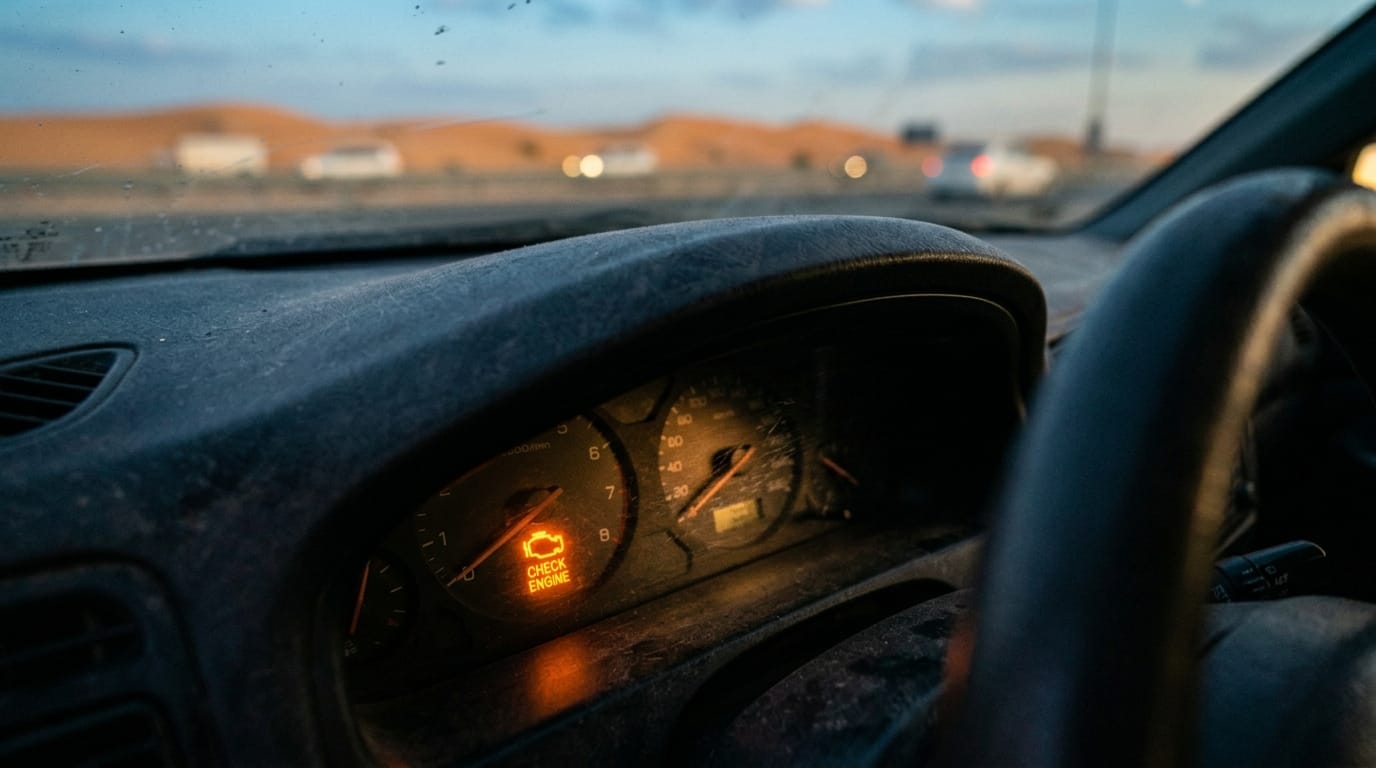
The engine warning light — also called the check engine light or MIL (malfunction indicator lamp) — is a signal from your car’s ECU (engine control unit) that a sensor reading is outside its expected range.
That is all it means.
It does not mean the engine is damaged. It does not mean you need to stop immediately. It does not mean you are facing an expensive repair. It means a fault code has been stored and needs to be read.
Steady Light vs Flashing Light — Critical Difference
This distinction matters more than any other in the first few minutes after the light comes on.
A steady engine warning light: drive normally to a workshop at your earliest opportunity. No urgency to stop immediately unless you notice abnormal temperature, noise, or power loss.
A flashing engine warning light: reduce speed, turn off unnecessary electrical loads, and get to a workshop within the same day. A flashing MIL typically indicates an active engine misfire severe enough to damage the catalytic converter if left running. This is a different category of urgency.
Many expats treat both the same way — either ignoring both or panicking at both. Neither response is correct.
UAE Conditions That Trigger Warning Lights More Frequently
Certain fault codes appear more commonly in the UAE than in European or Asian markets due to specific conditions:
- Heat-related oxygen sensor drift: Extreme ambient temperatures cause oxygen sensor readings to drift outside normal parameters, triggering P013x and P014x codes. The sensor may be functioning within acceptable wear limits — the UAE heat is simply exposing the reduced operating margin earlier.
- Fuel quality variation: Variable fuel quality across different petrol stations in the UAE is documented in workshop records. Lean combustion codes (P0171, P0174) sometimes appear after refuelling at unfamiliar stations and clear within a few fill-ups.
- Evaporative system faults in heat: UAE summer temperatures cause expansion and minor leaks in fuel evaporative systems that would not occur in cooler climates. These generate P0440 to P0458 codes — in most cases, these are not expensive repairs.
- Battery stress: UAE heat degrades vehicle batteries faster than most markets. A battery struggling to hold charge causes a range of secondary fault codes across multiple systems, all of which clear once the battery is replaced. A 150 to 350 AED battery replacement clears codes that might otherwise lead a workshop to diagnose thousands of dirhams in electrical faults.
🔧 Mechanic’s Inspection Log — The Warning Light That Cost 2,800 AED in the Wrong Hands
Documented diagnostic case, September 2025, independent workshop, Al Quoz Industrial Area 3, Dubai.
Vehicle: 2017 Toyota Camry 2.5L GCC, 94,000 km
Owner: South Asian expat, 7 years in Dubai, financial services sector
Light Status: Steady orange MIL, no other symptoms
First Workshop Visited: Small workshop near Al Barsha
First Diagnosis Quote: 2,800 AED — “oxygen sensors and throttle body cleaning”
Second Opinion Workshop: Independent specialist, Al Quoz Industrial Area 3
Diagnostic Scan Cost: 150 AED
The owner had gone to the first workshop based on proximity. The mechanic connected an OBD reader, read two codes, and without showing the codes to the owner, quoted 2,800 AED for oxygen sensor replacement and throttle body cleaning.
The owner asked for a second opinion.
Al Quoz workshop scan: P0138 (downstream oxygen sensor signal high, Bank 1 Sensor 2) and P0420 (catalytic converter efficiency below threshold). Both codes were active — not cleared and re-lit.
The P0138 code on this Camry at 94,000 km indicated the downstream sensor was producing a high voltage signal. The first diagnostic step is to check whether the sensor itself is faulty or whether the catalytic converter is the cause — because a degraded catalytic converter produces abnormal downstream oxygen readings as a secondary effect.
The Al Quoz workshop performed a warm idle test with live data monitoring. The downstream O2 sensor signal was oscillating irregularly — consistent with a converter that has lost efficiency, not a faulty sensor alone.
Replacing only the oxygen sensor on this vehicle would have produced a temporary clearing of the P0138 code followed by a return of both codes within 200 to 400 km. This is what the 2,800 AED first quote was likely to result in: a repair that did not fix the underlying cause.
Actual repair costs at Al Quoz workshop:
- Diagnostic scan: 150 AED
- OEM-equivalent catalytic converter (Bank 1): 1,100 AED
- Labour for converter replacement: 350 AED
- Post-repair scan to confirm codes cleared: included
- Total: 1,600 AED
Saving compared to first quote: 1,200 AED. The second diagnostic cost 150 AED. The net saving was 1,050 AED and a repair that actually addressed the fault.
Step 1 — Read the Code Before Anyone Else Does
The single most important action after an engine warning light appears is to get the fault code read — and to see the code yourself — before any repair discussion begins.
Many expats hand the car to a workshop and ask them to “fix the engine light.” This inverts the correct process entirely.
The correct process: get the code read, write it down, then research what it means before discussing repairs.
Where to Get a Diagnostic Scan in UAE
OBD-II scanners read fault codes from any car built after 2000. In the UAE, you have several options:
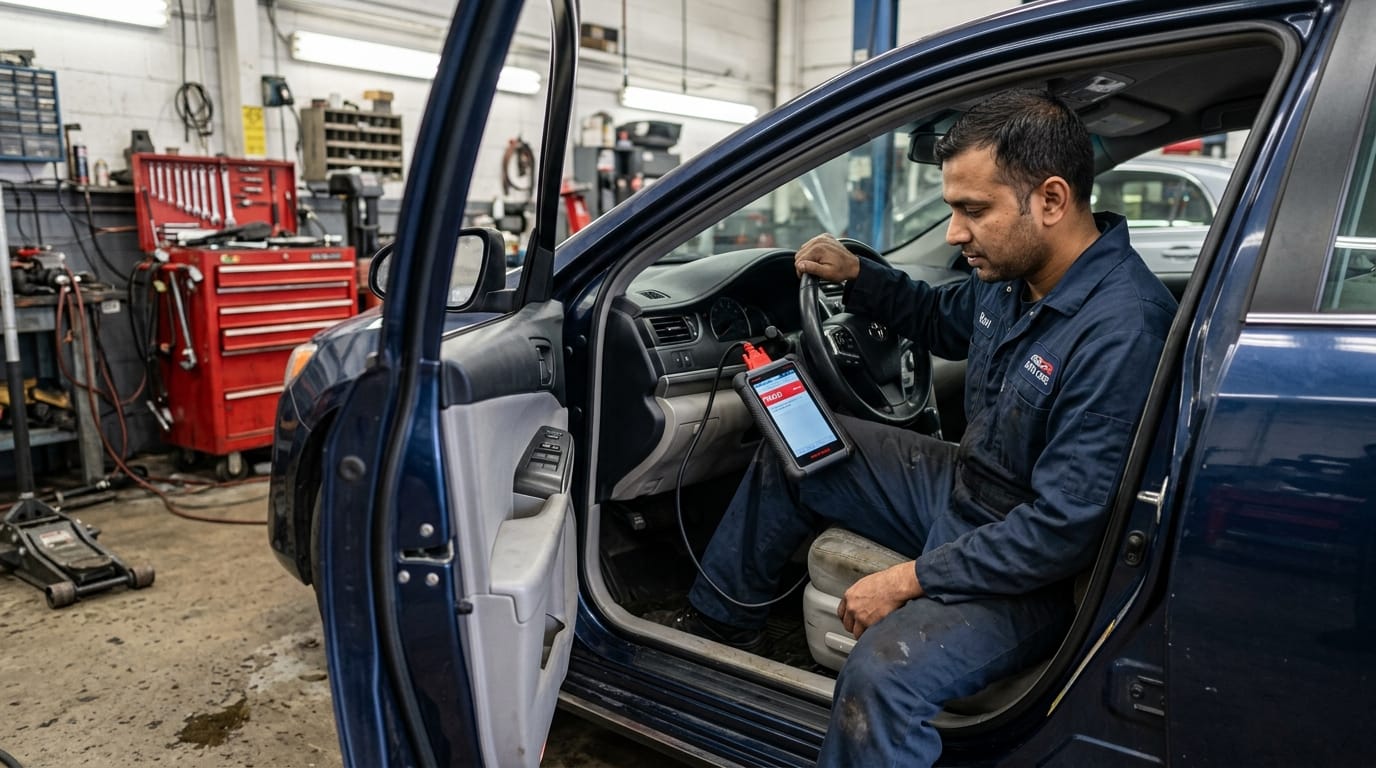
Independent workshops in Al Quoz (Dubai), Industrial Area (Sharjah), and Abu Shagara (Sharjah) offer diagnostic scans for 80 to 220 AED. The scan takes 10 to 15 minutes. You should be present and see the codes on the screen.
Tasjeel service centres across Dubai perform basic emissions-related OBD checks as part of registration renewal — but these are not comprehensive diagnostic scans and do not provide a printout of all stored codes.
Authorised dealer service centres (Toyota, Honda, Hyundai, Kia, Nissan) charge 200 to 350 AED for a diagnostic scan. The advantage is manufacturer-specific software that reads more detailed fault codes than generic OBD readers. The disadvantage is that the diagnosis and repair quote come from the same source — there is less separation between the reading and the recommendation.
Step 2 — Understand the Code Category Before Spending Money
OBD-II fault codes follow a standard structure. Understanding the first character tells you which system is involved — which tells you how urgent the repair is and which specialist to consult.
| Code Prefix | System | Urgency Level | Typical UAE Repair Cost Range (AED) |
|---|---|---|---|
| P0 / P1 | Powertrain (engine and transmission) | Medium to High | 150 – 8,000+ depending on fault |
| P0100–P0199 | Air/fuel metering | Low to Medium | 200 – 1,500 |
| P0300–P0399 | Ignition / misfire | Medium (High if flashing) | 150 – 4,000 |
| P0400–P0499 | Emission controls | Low to Medium | 300 – 2,500 |
| P0700–P0799 | Transmission control | Medium to High | 500 – 12,000 |
| B codes | Body (non-engine systems) | Low | 100 – 2,000 |
| C codes | Chassis (ABS, traction) | Medium | 300 – 3,500 |
| U codes | Network / communication | Low to Medium | 200 – 2,500 |
The Most Common Engine Warning Light Codes in UAE Workshop Records
Based on diagnostic observations from Al Quoz and Sharjah Industrial Area workshops from 2024 to 2026, these codes appear most frequently in expat-owned used cars:
P0420 — Catalytic Converter Efficiency Below Threshold: The most common code on vehicles above 80,000 km. May indicate a failing converter, an oxygen sensor issue, or an exhaust leak. Diagnosis before repair is essential. Cost if it is only a sensor: 350 to 700 AED. Cost if the converter needs replacement: 900 to 2,800 AED depending on vehicle.
P0300–P030x — Random / Specific Cylinder Misfire: Range of causes from a 150 AED spark plug to a 6,000 AED fuel injector issue. The code number (P0301 = cylinder 1, P0302 = cylinder 2, etc.) narrows the investigation significantly. Start with spark plugs and ignition coils before moving to fuel system diagnostics.
P0171 / P0174 — System Lean, Bank 1 / Bank 2: Common in UAE conditions. Causes include a dirty mass airflow sensor (cleaning cost: 150 to 250 AED), a small vacuum leak (repair: 200 to 500 AED), or a failing oxygen sensor. Do not replace oxygen sensors based solely on this code — diagnose the lean condition cause first.
P0340 / P0345 — Camshaft Position Sensor Circuit: More common in UAE heat conditions. Sensor replacement cost: 250 to 600 AED. If ignored, this code can cause intermittent starting failures and, in some cases, the vehicle will not start after a hot soak in summer temperatures.
P0440 / P0442 / P0455 — Evaporative Emission System: Often caused by a loose or worn fuel filler cap. Start by checking and tightening the filler cap. If the code clears after two or three drive cycles, the cap was the cause. A new fuel cap costs 40 to 120 AED. Verify before authorising any evaporative system testing or component replacement.
Step 3 — The Workshop Selection Process in UAE
Where you take the car after reading the code is the second decision that determines your final repair cost.
The UAE has three workshop categories with meaningful differences in how they handle engine warning light diagnostics.
Authorised Dealer Service Centres
Toyota dealers (Al-Futtaim), Honda dealers (Trading Enterprises), Nissan, Hyundai, and Kia all operate authorised service centres across Dubai, Sharjah, and Abu Dhabi.
Advantages: manufacturer-specific diagnostic software, access to technical service bulletins, warranty-valid repairs, and parts that are guaranteed OEM.
Disadvantages: diagnostic fees of 200 to 350 AED (often applied to the repair total if you proceed), parts costs that run 40 to 70 percent higher than independent workshop alternatives for the same component, and service advisors who work within a system that has service revenue targets.
For vehicles under warranty or with a service contract, authorised dealers are the correct choice.
For out-of-warranty vehicles, they are one option — not the only option.
Specialist Independent Workshops — Al Quoz and Industrial Areas
Al Quoz Industrial Area in Dubai and the industrial areas of Sharjah (Industrial Area 1, 10, and 17 in particular) contain independent workshops that specialise in specific makes: Toyota specialists, Japanese vehicle specialists, Korean car specialists.
These workshops typically employ mechanics with 10 to 20 years of experience on specific models. Their diagnostic equipment is often the same Autel, Launch, or Snap-on systems used by dealers. Labour rates run 30 to 50 percent lower than dealer centres. Parts sourcing is more flexible — OEM, OEM-equivalent, and reputable aftermarket options are presented with cost differences explained.
The variable is quality control. There is no single standard across independent workshops. Reputation is the primary filter — ask expat communities on Facebook groups and forums specific to your car make for Al Quoz or Sharjah specialist recommendations.
Generic Roadside Workshops
Small workshops near residential areas, in older commercial areas of Deira, Karama, Abu Shagara, or along major routes in Sharjah and Ajman.
These are appropriate for straightforward work: oil changes, tire rotation, battery replacement, air filter changes, and brake pad replacement where diagnosis is simple.
They are not appropriate for engine warning light diagnosis. Generic OBD readers in these workshops often read only the most basic codes and miss freeze-frame data, pending codes, and manufacturer-specific codes. The diagnostic quality does not match the repair quotes that follow.
Step 4 — How to Have the Repair Conversation Without Overpaying
Once you have the fault code and you are at a workshop that has confirmed the diagnosis, the conversation moves to authorising the repair. This is where expats most commonly pay more than necessary.
Questions to Ask Before Authorising Any Repair
These are direct questions. A competent workshop answers them without hesitation.
“What is the root cause of this fault code — not just which component triggered it?”
“Is this repair required immediately for safety, or can I drive the car for a few more days while I get a second quote?”
“Can you show me the live data or freeze-frame data that confirms this diagnosis?”
“What happens if I replace only this component and the code returns — what would that indicate?”
“Are you using OEM, OEM-equivalent, or aftermarket parts? What is the cost difference?”
The answers to these questions determine whether you are dealing with a workshop that is diagnosing the problem or one that is selling you a repair.
The Second Quote Rule
For any engine warning light repair quoted above 800 AED, get a second quote.
The process: tell the first workshop you need to discuss the cost and will confirm within 24 hours. Go to a second workshop with the fault code written down. Ask them to perform their own diagnostic scan (80 to 150 AED) and quote for the repair independently.
The comparison between two independent diagnostic results and two repair quotes gives you a reliable picture of what the repair should cost. In many documented expat cases, the second quote is 25 to 45 percent lower than the first, with an equivalent diagnosis.
Cost Breakdown — Engine Warning Light Diagnostics and Common Repairs in UAE
| Service / Repair | Independent Workshop (AED) | Authorised Dealer (AED) |
|---|---|---|
| OBD-II diagnostic scan | 80 – 220 | 200 – 350 |
| Spark plug replacement (4-cylinder) | 150 – 350 | 350 – 600 |
| Ignition coil replacement (single) | 250 – 500 | 450 – 850 |
| Oxygen sensor replacement (single) | 300 – 650 | 600 – 1,100 |
| Mass airflow sensor cleaning | 150 – 250 | 200 – 400 |
| Mass airflow sensor replacement | 400 – 900 | 800 – 1,500 |
| Catalytic converter replacement | 900 – 2,200 | 2,000 – 4,500 |
| Fuel injector cleaning (all cylinders) | 350 – 600 | 600 – 1,000 |
| EGR valve cleaning / replacement | 400 – 1,200 | 900 – 2,200 |
| Throttle body cleaning | 200 – 400 | 400 – 700 |
| Fuel filler cap replacement (P0440 fix) | 40 – 120 | 80 – 180 |
| Battery replacement (P codes from low voltage) | 150 – 350 | 300 – 600 |
| Grand Total — Typical P0420 scenario (converter + scan) | 1,050 – 2,420 | 2,200 – 4,850 |
Signs of a Workshop Diagnosing Honestly
The majority of workshops in the UAE’s industrial areas operate transparently. These are the observable signs that the workshop you are dealing with is one of them.
- They show you the scanner screen: The fault code is visible to you, not just described. The mechanic points to the code and explains what it means in plain language.
- They distinguish between the code and the cause: “This code means the catalytic converter efficiency is below threshold — but let me check the oxygen sensor data first before we confirm the converter is the problem.”
- They tell you what they cannot confirm without further testing: “I can see it’s a misfire on cylinder 3 — I’ll need to swap the coil from cylinder 1 to cylinder 3 to confirm whether the coil is the issue or whether it’s the injector.”
- They do not pressure for same-day repair authorisation: A legitimate workshop is confident in their diagnosis. They do not need you to authorise the repair within the hour.
- They have the car on a lift for visual inspection: Many engine warning light causes have physical evidence — exhaust leaks, cracked vacuum lines, visible sensor damage. A workshop that only reads codes without putting the car on a lift is working with partial information.
Owner Scenarios — How the Process Changes Based on Your Situation
If You Drive 20 to 40 km Daily in Dubai Stop-Start Traffic
High daily mileage in UAE city conditions accelerates oxygen sensor wear and increases the likelihood of P0420 and P013x codes appearing between 70,000 and 100,000 km. Budget 800 to 1,800 AED for oxygen sensor or catalytic converter work in this mileage range and incorporate it into your annual maintenance estimate. If your car is in this bracket, an annual diagnostic scan — not just when the light comes on — is a reasonable 150 AED investment.
If Your Contract Ends in 12 to 18 Months
A steady engine warning light from an emissions-related code (P042x, P044x, P017x) does not affect the car’s drivability but will affect its resale value and potentially its next Mulkiya renewal. If you are selling the car in 6 to 12 months, address the fault — even if driving feels normal. An unresolved engine warning light on a used car in the UAE typically reduces the Dubizzle listing price by 1,500 to 3,000 AED below market or extends the sale period by 20 to 35 days as buyers factor in the unknown repair cost.
If You Are on a 4,500 to 6,500 AED Monthly Salary
An unexpected engine warning light repair of 1,500 to 2,500 AED represents a meaningful financial event on this salary bracket. The second-quote process in this guide is not optional — it is the mechanism that keeps this expense within a manageable range. Prioritise code-reading first. Do not agree to any repair above 500 AED on the same visit as the diagnostic scan unless the workshop can explain clearly why immediate action is required for safety.
If You Bought the Car Recently — Under 3 Months Ago
An engine warning light on a recently purchased used car in the UAE warrants additional attention beyond the standard diagnostic process. Run an OBD scan and specifically ask for freeze-frame data — this shows the conditions (speed, RPM, temperature, load) at the moment the fault was originally logged. If the freeze-frame data shows the fault was logged at high mileage before your purchase and the code was cleared manually (you can tell by a high code-clear count in the freeze-frame data), the previous owner or dealer was aware of the fault.
This is relevant for any negotiation or complaint process, and relevant for RTA / Tasjeel documentation if the fault affects emissions compliance.
Market Comparison — What Engine Fault Repair Costs Look Like Across Common Expat Cars in UAE
| Vehicle | P0420 Repair Cost at Independent Workshop (AED) | Full Spark Plug Set Cost (AED) | O2 Sensor (single) Cost (AED) | Parts Availability in UAE |
|---|---|---|---|---|
| Toyota Camry 2.5L GCC | 1,000 – 1,800 | 200 – 350 | 300 – 550 | Very High — widely stocked |
| Toyota Corolla 1.6L GCC | 800 – 1,500 | 150 – 280 | 280 – 500 | Very High — widely stocked |
| Honda Accord 2.4L GCC | 1,200 – 2,200 | 300 – 500 | 400 – 700 | High — Honda-specific stockists |
| Nissan Altima 2.5L GCC | 900 – 1,700 | 200 – 380 | 320 – 580 | High — widely available |
| Kia Cerato 1.6L GCC | 1,100 – 2,000 | 220 – 400 | 350 – 650 | Medium — Kia stockists required |
| Hyundai Elantra 1.6L GCC | 1,000 – 1,900 | 210 – 380 | 330 – 620 | Medium-High — shared parts with Kia |
Toyota vehicles have a noted advantage in this comparison: parts availability across independent workshops in UAE is broader, stockists are more numerous, and wait times for uncommon parts are shorter. For non-Toyota brands, the repair timeline for specific components can extend to 3 to 7 working days while parts are sourced, which adds indirect cost if the car is needed for daily commuting.
What to Do If the Light Comes On While Driving on a UAE Highway
This scenario deserves its own section because highway conditions in the UAE add context that changes the immediate response.
A steady engine warning light that appears during a Dubai–Abu Dhabi highway journey or on Sheikh Zayed Road: move to the slower lane, reduce speed to 100 km/h, monitor the temperature gauge and listen for any unusual engine sounds. If both remain normal, continue to your destination or the nearest service area. Do not stop on the hard shoulder of a UAE highway unless you have a safety concern beyond the warning light — stopping on the hard shoulder carries its own serious risks.
A flashing engine warning light on a highway: reduce speed to 90 to 100 km/h, turn off the AC to reduce engine load, and take the nearest exit. Find a petrol station or safe parking area. Call a recovery service if needed. Recovery services in Dubai (RTA-affiliated, Al Futtaim Motors roadside, and private providers) charge 150 to 400 AED for a standard roadside recovery within Dubai. Sharjah and other emirates have comparable services.
The Safe Alternative — When to Consider a Different Vehicle
If the engine warning light on your current vehicle is the latest in a series of recurring faults — codes that have been repaired and returned, or multiple simultaneous fault categories — this is the moment to calculate whether continued ownership is financially rational.
The threshold used by experienced workshop mechanics in Al Quoz and Sharjah: if the total repair cost in any 12-month period exceeds 15 percent of the vehicle’s current market value, the ownership case for that specific vehicle requires re-evaluation.
For a car with a current market value of 25,000 AED, this threshold is 3,750 AED per year in repairs. For a 40,000 AED car, it is 6,000 AED per year.
If your engine warning light repair history is approaching or has crossed this threshold, a pre-purchase inspection on a replacement vehicle — starting with documented GCC-specification Toyotas or Hyundais in the 28,000 to 42,000 AED bracket — is a more productive use of your next diagnostic appointment than another repair on a vehicle with an established fault pattern.
Analytical Conclusion — The Engine Warning Light Is an Information Event, Not a Financial Event
The data from diagnostic observations across UAE workshops between 2024 and 2026 is consistent: expats who approach an engine warning light as a process — read the code, research the code, get a second quote above 800 AED — spend significantly less on the resulting repair than owners who approach it as an emergency.
The average unnecessary spend on engine warning light repairs in documented expat cases is 1,200 to 3,400 AED above the actual repair cost. This figure comes from three sources: incorrect diagnosis that replaces the triggered component without addressing the root cause, parts marked up at workshops where the owner did not get a second quote, and same-day authorisation of repairs that were not time-critical.
The light is a sensor event. The cost is a process event.
A 150 AED diagnostic scan and a 24-hour hold before authorising any repair above 800 AED are the two actions that keep the financial outcome proportional to the technical problem. Neither requires mechanical knowledge. Both require the same thing: not treating the warning light as an emergency when it is not one.
For an in-depth look at what consistent car ownership — including maintenance costs and one documented engine warning light episode — looks like over a longer period, read the full report: Used Hyundai Elantra UAE 2026: Cheapest Reliable Option or Hidden Money Trap?
Disclaimer: Emirates Car Guide is a 100% independent platform. We do not own showrooms, nor are we affiliated with any used car dealerships or garages. Our sole mission is to protect expats from financial fraud in the automotive market.
FAQ — Engine Warning Light in UAE
