Last Updated: May 2026 | By Omar Al-Fayed, Senior Automotive Consultant | Category: Car Reviews
A full breakdown on Sheikh Zayed Road in a Nissan Sunny costs more than the repair itself.
Between the RTA-authorized tow, the workshop diagnosis, the parts, and the hidden fees most drivers do not expect, the total bill came to 3,480 AED for what started as an overheating warning light.
This article documents every step, every cost, and every decision point — so you know exactly what to do if the same thing happens to you.
Before diving into the breakdown account, if you recently read our guide on 5 things mechanics check first on any used Honda Accord in UAE, you already know how fast a missed inspection finding becomes an expensive repair.
The Nissan Sunny is a different class of vehicle — simpler engine, lower purchase price — but when it fails on a busy highway, the response process is the same for every driver in the UAE.
What Happened — The Timeline
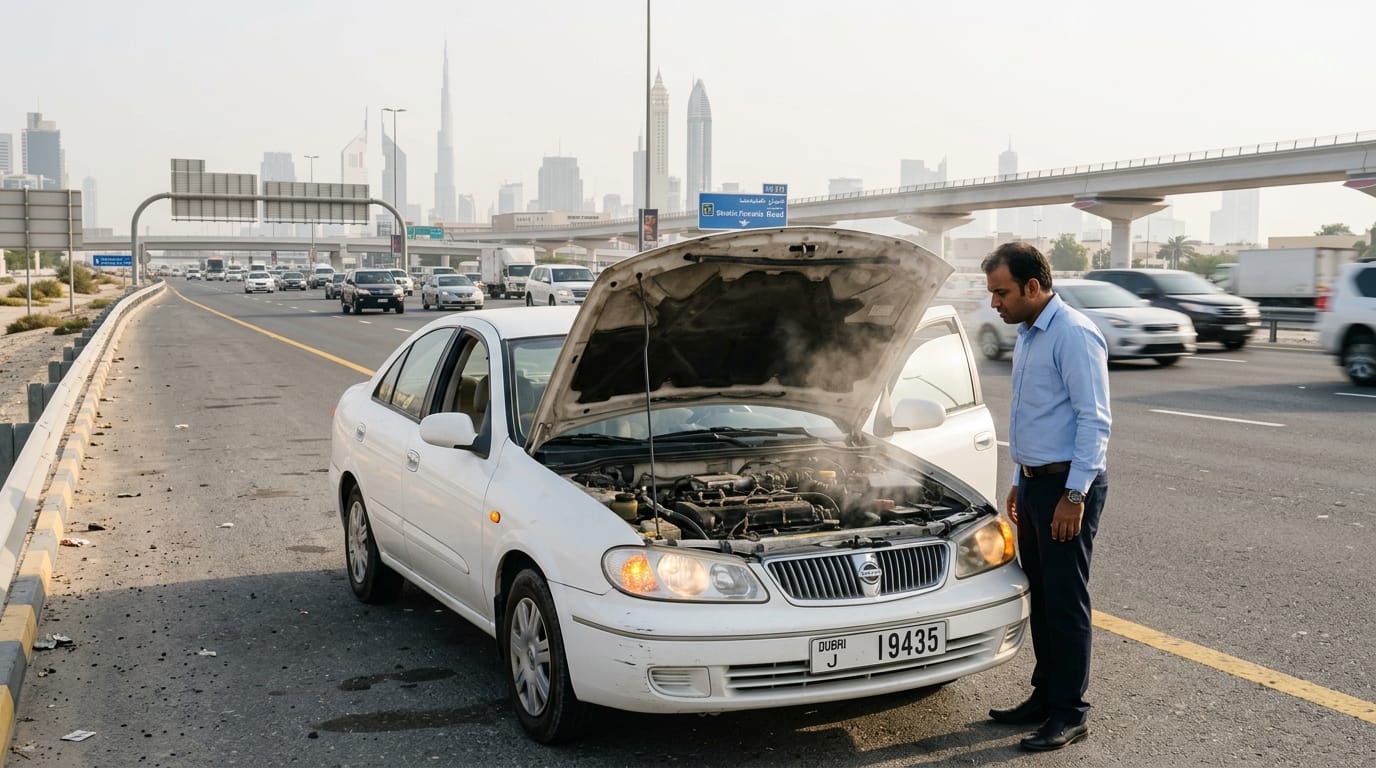
It was a Tuesday morning, around 8:15 AM, between the Mall of the Emirates and the Onpassive Metro Station exits.
Traffic was moderate. The temperature gauge on my 2017 Nissan Sunny 1.5L started climbing past the midpoint — something it had never done in the previous 14 months I had owned it.
I did not wait for the red zone. I moved immediately to the hard shoulder, turned on the hazard lights, and stopped the engine.
That decision — stopping the engine before the temperature hit the red — is probably what kept this from becoming a much larger repair bill.
From the moment I pulled over to the moment the car was back in my building’s parking with a completed repair, the process took four days and involved four separate service providers.
Here is what each stage cost.
🔧 Mechanic’s Inspection Log — Overheat Diagnosis After a Highway Stop
Documented repair case, February 2026, independent Nissan specialist workshop, Abu Shagara Industrial Area, Sharjah.
Vehicle: 2017 Nissan Sunny 1.5L HR15DE, 81,000 km
Previous service: Last oil change at 77,500 km, independent workshop, Al Quoz
Insurance type: Third-party only
Tow arranged through: RTA Dubai Roads Emergency Line
OBD scan on arrival at the workshop: Code P0128 — coolant temperature below thermostat regulating temperature.
Secondary code: P0217 — engine coolant overtemperature condition.
These two codes together pointed in the same direction: the thermostat had likely been running in a partially open position for some time — causing the engine to overcool during short trips and then overheat under sustained highway load when the cooling system could not compensate correctly.
Further inspection with the hood open confirmed:
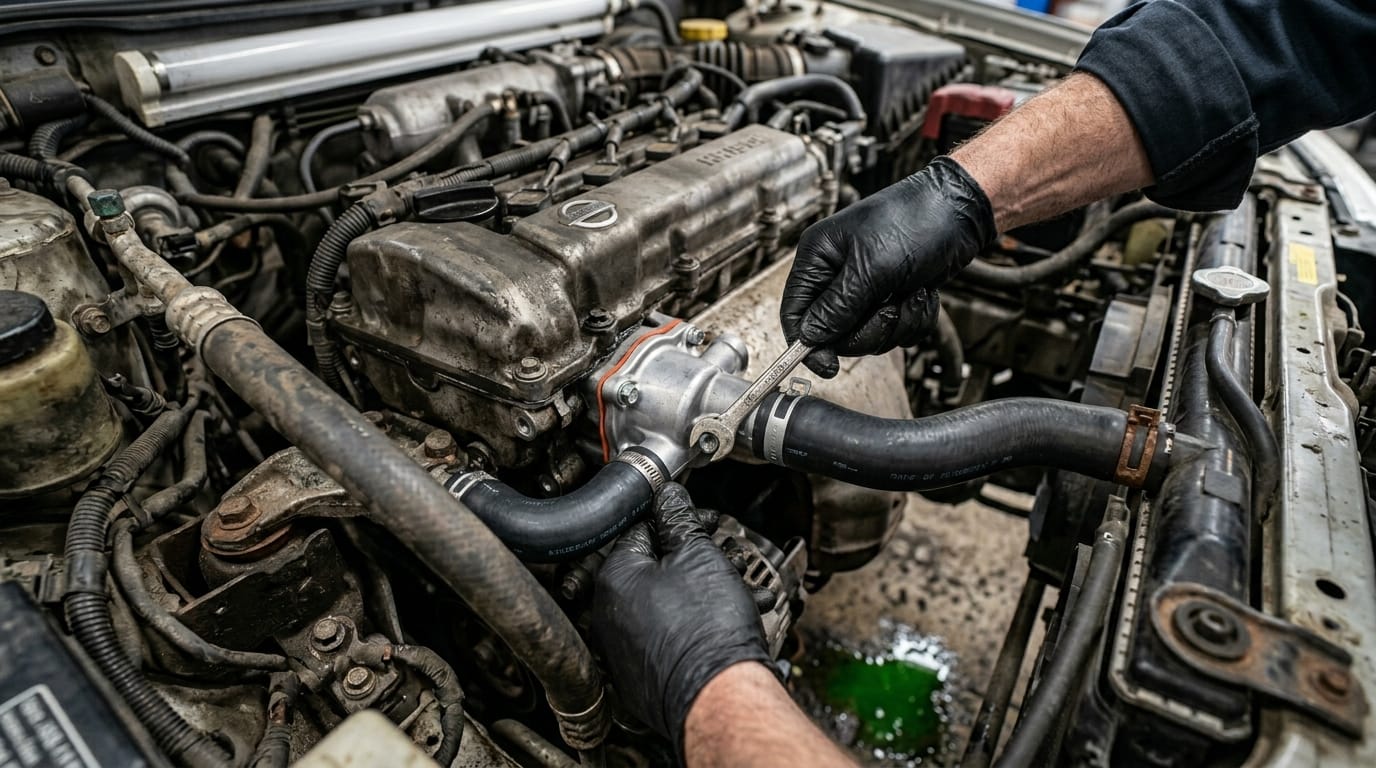
- Thermostat housing: visible coolant residue around the housing seal — indicating a slow weep that had been present for some time before the full failure.
- Coolant reservoir: below minimum. Approximately 300ml low.
- Upper radiator hose: soft and slightly spongy — indicating the hose had not been replaced since original fit and was approaching the end of serviceable life.
- Radiator: small accumulation of road debris on the front face — reducing airflow by an estimated 15 to 20 percent at idle.
- Water pump: no visible leak, bearing rotation smooth — within serviceable condition at 81,000 km.
Cause of breakdown: thermostat failure combined with gradual coolant loss from the housing seal.
The system had been running marginal for several weeks. The sustained 35-minute highway run at highway speeds pushed the degraded cooling system past the point where it could maintain safe temperature.
Repair recommendation: thermostat and housing replacement, upper and lower radiator hose replacement, radiator flush and refill, radiator cleaning.
A Nissan Sunny HR15DE engine that runs in the red zone for more than 60 to 90 seconds risks head gasket damage — a repair that starts at 2,800 AED and can reach 5,500 AED depending on whether the head requires skimming.
Stopping immediately when the gauge starts climbing is not an overreaction.
It is the correct response that protects the repair bill.
Stage One — The Tow from Sheikh Zayed Road
What RTA Requires on Sheikh Zayed Road
Sheikh Zayed Road is classified as a federal highway in Dubai.
You cannot arrange an informal tow from a street contact while stopped on the hard shoulder.
Dubai Police and RTA require that towing on this road be handled through the official breakdown system.
The process after I stopped:
- Called Dubai Police non-emergency line: 901
- A patrol car arrived in approximately 18 minutes
- The officer confirmed the vehicle was not drivable and issued a breakdown clearance
- RTA-authorized tow truck arrived approximately 35 minutes after the police
Total time on the hard shoulder: approximately 55 minutes.
Tow Cost — What I Paid
| Service | Cost (AED) |
|---|---|
| RTA-authorized tow — Sheikh Zayed Road to Sharjah | 380 |
| Hard shoulder waiting time supplement | 0 (included) |
| Drop-off at workshop gate | 0 (included) |
| Stage 1 Total | 380 AED |
Towing within Dubai is typically 200 to 250 AED for standard distances.
Crossing into Sharjah adds a 100 to 150 AED cross-emirate supplement in most cases.
If you have a preferred workshop in Sharjah and you break down in Dubai, expect 350 to 420 AED for the combined tow.
Always confirm the final destination price before the tow truck moves.
Stage Two — Workshop Diagnosis and Parts
Diagnosis Cost
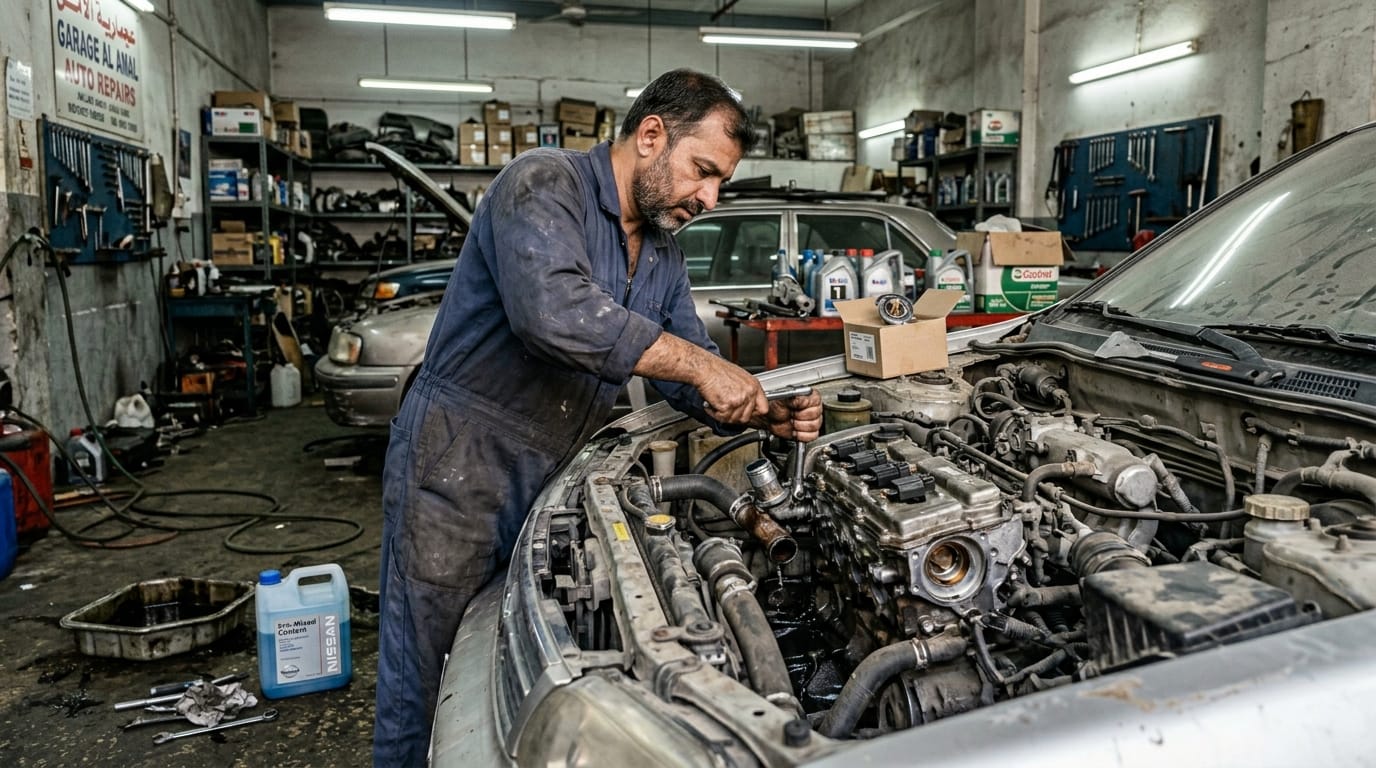
The Abu Shagara workshop charges a flat 120 AED diagnostic fee for any vehicle brought in non-running.
This covers OBD scan, visual inspection, and written repair recommendation.
The 120 AED is credited against the final repair bill if you proceed with the work.
In practice, this means the diagnostic cost is effectively zero if you repair at the same workshop.
Parts and Labor Breakdown
| Item | Parts (AED) | Labor (AED) | Total (AED) |
|---|---|---|---|
| Thermostat + housing + seal | 210 | 120 | 330 |
| Upper radiator hose | 65 | 40 | 105 |
| Lower radiator hose | 75 | 40 | 115 |
| Radiator flush + refill (coolant) | 45 | 60 | 105 |
| Radiator air-clean (compressed) | 0 | 35 | 35 |
| Diagnostic fee (credited) | — | 120 | 0 |
| Stage 2 Total | 395 | 295 | 690 AED |
Parts used were Nissan-compatible aftermarket — not OEM Nissan agency parts.
Agency parts for the thermostat housing alone would have added approximately 180 to 220 AED to the parts cost.
The workshop used a reputable regional aftermarket supplier and the thermostat carries a 12-month warranty.
What They Recommended But I Declined
The workshop also flagged two additional items during the inspection:
- Engine air filter: 85 AED parts + 20 AED labor. I declined — I had replaced this myself three months prior.
- Spark plugs: 180 AED parts + 80 AED labor for all four. At 81,000 km with the original plugs, this was not an unreasonable recommendation. I scheduled this for the next service rather than adding it to this bill.
The workshop did not pressure me on either item.
They documented both recommendations on the job card and let me decide.
Stage Three — Return Transport and Recovery Day
Getting Back to Dubai
The car stayed at the workshop for two days.
I needed to get from Abu Shagara to my apartment in Al Nahda Dubai the evening of the breakdown.
| Transport | Cost (AED) |
|---|---|
| Uber from Abu Shagara to Al Nahda Dubai | 42 |
| Metro Day Pass (next day, Al Nahda to work) | 22 |
| Uber from workplace to collect car (Day 3) | 38 |
| Stage 3 Total | 102 AED |
These costs are easy to forget when calculating a breakdown total.
They are real costs that every driver absorbs.
Lost Productivity
I work as an accounts supervisor at a trading company in JAFZA.
The breakdown happened on a Tuesday. I was 40 minutes late to the office that day.
No formal consequence — but worth noting that a breakdown at 8 AM on a work day is not a neutral event.
If you work in delivery, logistics, or any role where being present on time has a direct income consequence, a breakdown day has a financial cost beyond the repair bill.
Full Cost Summary Table
| Category | Cost (AED) |
|---|---|
| RTA tow — Sheikh Zayed Road to Sharjah | 380 |
| Thermostat + housing + seal | 330 |
| Upper radiator hose | 105 |
| Lower radiator hose | 115 |
| Radiator flush + refill | 105 |
| Radiator air-clean | 35 |
| Return transport (3 trips) | 102 |
| Grand Total | 1,172 AED |
The key factor was stopping the engine immediately when the gauge began rising, which avoided head gasket involvement.
The tow was more expensive than some drivers expect because of the cross-emirate distance.
The repair itself was straightforward.
What the Nissan Sunny Cooling System Actually Needs — Preventive Cost
The Maintenance That Would Have Prevented This
Looking back at the service history on the vehicle, coolant had not been flushed or tested in the previous 40,000 km.
The thermostat housing seal was original. The radiator hoses were original.
All three of these items have a service life in UAE conditions.
Workshop records from Nissan specialists in Sharjah and Al Quoz suggest that approximately 60 to 70 percent of Sunny cooling system failures in the 70,000 to 100,000 km range involve thermostats or hoses that were never proactively replaced — components that are inexpensive to replace preventively and expensive to deal with after a highway stop.
Preventive Cooling System Service — What It Costs
| Item | Cost if Done Preventively (AED) |
|---|---|
| Coolant flush + refill (at any service) | 80 – 120 |
| Thermostat replacement (scheduled) | 200 – 280 |
| Upper + lower hose replacement | 180 – 240 |
| Preventive Total | 460 – 640 AED |
Doing this work at a scheduled service appointment when the car is already in the workshop costs 460 to 640 AED and takes approximately 90 minutes.
Dealing with the same items after a highway breakdown cost 1,172 AED and four days.
The difference is not just money — it is control over when and where the car stops working.
Owner Scenarios — How the Cost Changes for Different Drivers
If You Drive More Than 100 km Daily
Delivery drivers, logistics staff, and drivers commuting between emirates put sustained thermal load on cooling systems every day.
For a Sunny above 60,000 km in this usage pattern, a cooling system inspection — thermostat, hoses, coolant condition — every 20,000 km rather than the standard 40,000 km interval is worth considering.
The component cost is the same. The consequence of failure changes significantly when your income depends on the vehicle being operational.
If Your Visa Contract Ends in 12 to 18 Months
Many expat drivers in the UAE are running vehicles on a mental countdown — planning to sell before leaving or renewing.
A 1,172 AED breakdown repair on a Nissan Sunny that you plan to sell for 14,000 to 17,000 AED in 14 months does not change the financial equation dramatically.
The repair maintains the vehicle value and prevents a larger failure.
The more relevant calculation: a vehicle with a documented cooling system repair and fresh hoses will typically support a 500 to 1,000 AED higher Dubizzle asking price than one with visible deferred maintenance.
If You Have Comprehensive vs Third-Party Insurance
My vehicle carried third-party only insurance. Every dirham above came from my own pocket.
Comprehensive insurance with roadside assistance — available from approximately 1,800 to 2,800 AED annually for a 2017 Sunny — would have covered the tow (380 AED) and potentially provided a temporary replacement vehicle for the recovery days.
The calculation on comprehensive vs third-party for a vehicle in the 14,000 to 18,000 AED range depends on individual risk appetite.
Worth noting that the tow alone (380 AED) represents a meaningful portion of the annual premium difference.
Daily Annoyances — What Owning a Nissan Sunny in UAE Actually Feels Like
The breakdown was not the only thing I noticed about this car over 14 months of ownership in Dubai.
These observations come from daily use — not a test drive.
- Cabin noise at highway speed: The Sunny’s road and wind noise at 120 km/h is noticeable compared to the Honda City or Toyota Yaris at equivalent age and mileage.
On Sheikh Zayed Road, sustained conversation without raising your voice requires some adjustment. - AC performance under prolonged idle: In stop-and-go traffic in summer — Karama to Business Bay at 4:30 PM — the cabin temperature rises visibly when the vehicle is stationary for more than 10 minutes.
The 1.5L engine is not generating enough RPM at idle to maintain maximum compressor output.
This is normal for the class, but it is something first-time UAE drivers notice. - CVT hesitation feel: The Xtronic CVT in the Sunny has a characteristic rubber-band feel when accelerating from low speed — especially pulling into traffic on a main road.
It is not a fault. It is the nature of this transmission type.
Drivers coming from a conventional automatic often find it takes two to three weeks to feel natural. - Plastic interior wear points: The door card armrest fabric on the driver’s side showed noticeable wear by 65,000 km.
The center console lid hinge became loose at 72,000 km.
These are not mechanical issues, but they affect the cabin feel of a vehicle you sit in for 60 to 90 minutes a day. - Resale drag for non-GCC spec: Any Sunny brought in as a personal import rather than GCC-spec takes a meaningful hit on Dubizzle.
In the Al Aweer used car market, a non-GCC Sunny in otherwise identical condition sells for 1,500 to 2,500 AED less than the GCC equivalent.
Always verify the spec before purchase.
Engine Variants — Nissan Sunny UAE
HR15DE — 1.5L Naturally Aspirated (Most Common)
This is the engine in approximately 85 to 90 percent of Sunnys on the UAE market.
Simple, well-understood, serviced at almost every independent workshop in Dubai and Sharjah without specialist equipment. Parts are widely available.
Key known issue above 70,000 km: cooling system components (thermostat, hoses, coolant condition) and CVT fluid degradation if fluid changes have been extended beyond 40,000 km intervals.
CVT fluid flush on the HR15DE: 280 to 350 AED at a specialist.
A Sunny that has never had a CVT fluid change above 60,000 km is a documented risk point for transmission behavior.
HR16DE — 1.6L Naturally Aspirated (Less Common)
The 1.6L variant is less frequently seen on the UAE used market.
It shares the same cooling system architecture as the 1.5L but generates slightly higher sustained heat load under the same driving conditions.
The same preventive maintenance logic applies — thermostat and hose replacement at 60,000 to 70,000 km is cost-effective.
GCC Spec vs Non-GCC Spec — What Changes
GCC-spec Sunnys are tuned for higher ambient temperatures and carry a reinforced cooling capacity compared to European or North American market equivalents.
Non-GCC units brought in as personal imports have been noted by Abu Shagara and Al Quoz specialists to show cooling system stress indicators earlier — typically by 55,000 to 65,000 km rather than 70,000 to 80,000 km.
If you are buying a used Sunny, confirming GCC spec via the vehicle identification plate before purchase is not a minor detail
Signs of Positive Side — What the Sunny Gets Right
After documenting everything that went wrong, it is worth being accurate about what this car does well.
These are genuine observations from 14 months of daily use in Dubai.
- Repair cost accessibility: Almost every independent workshop in the UAE stocks HR15DE parts.
I did not need a specialist appointment, a wait time for imported parts, or agency pricing.
The 690 AED repair bill reflects how genuinely low the parts and labor costs are on this platform. - Fuel economy under normal use: Averaging approximately 11.5 to 12.5 km/L in mixed Dubai driving — city commute plus occasional highway.
At current fuel prices in the UAE, this translates to a monthly fuel cost of approximately 280 to 330 AED for a typical 1,200 km monthly usage pattern.
Lower than most comparably priced alternatives. - Insurance cost: Third-party insurance on a 2017 Sunny runs 900 to 1,200 AED annually in the UAE.
This is among the lower brackets for any passenger sedan in this market. - Parking clearance: The Sunny’s relatively compact dimensions make it practical in older building carparks in Deira, Bur Dubai, and Abu Shagara where tighter bays are common.
A practical consideration that mid-size sedan owners frequently underestimate. - Tasjeel renewal straightforwardness: GCC-spec Sunnys in good condition consistently pass the Tasjeel technical inspection without issues.
Workshop records across Al Quoz and Abu Shagara suggest a first-attempt pass rate that is above average for this vehicle class when maintained at standard service intervals.
Market Comparison — Nissan Sunny vs Alternatives in the Same Price Range
| Model | Typical Used Price (AED) | Cooling System Risk | CVT Risk | Parts Availability | Resale Speed |
|---|---|---|---|---|---|
| Nissan Sunny 1.5L | 13,000 – 18,000 | Medium (preventable) | Medium (fluid-sensitive) | High | Moderate |
| Toyota Yaris 1.5L | 15,000 – 21,000 | Low | Low | High | Fast |
| Mitsubishi Attrage 1.2L | 12,000 – 16,500 | Low–Medium | Low | Medium | Moderate |
| Hyundai Accent 1.4L | 11,500 – 16,000 | Low–Medium | Low | Medium | Moderate |
| Honda City 1.5L | 16,000 – 22,000 | Low | Medium | High | Fast |
The Sunny sits in the middle of this group on most metrics.
It is not the lowest-risk option — the Toyota Yaris has a more widely documented reliability track record in the UAE.
It is not the lowest-price option — the Hyundai Accent and Mitsubishi Attrage frequently undercut it.
What the Sunny offers is a combination of space, parts availability, and running cost that makes it a practical choice for expat drivers in the 13,000 to 18,000 AED budget range — provided cooling system maintenance is treated as a priority rather than an optional item.
If your priority is lowest possible repair risk and fastest resale at exit, the Yaris premium is often justified.
If your priority is lowest total cost of ownership across a 24-month ownership period with attentive maintenance, the Sunny is competitive.
The choice depends on which variable you weight more heavily.
The Safe Alternative
If the breakdown account above has shifted your thinking and you are currently considering a Nissan Sunny purchase, the most direct comparable alternative in the UAE used market is the Toyota Yaris 1.5L (2016–2020 generation).
The Yaris shares similar running costs, broadly similar fuel economy, and has a stronger documented service history culture among UAE private sellers.
It tends to be serviced more frequently at agency level.
Workshop familiarity across Dubai and Sharjah is equivalent to the Sunny.
At Al Aweer used car market, a comparable 2017 Yaris runs approximately 1,500 to 2,500 AED more than a 2017 Sunny with similar mileage.
Over a 24-month ownership period, that premium is frequently offset by lower unplanned repair frequency based on workshop observations across the Al Quoz and Abu Shagara markets.
If budget is the primary constraint and the Sunny is the correct financial decision, the preventive cooling system service — 460 to 640 AED — done at the point of purchase rather than deferred, substantially reduces the probability of repeating the experience documented in this article.
Conclusion — What the Numbers Actually Mean
The 1,172 AED total for this breakdown sits at the lower end of what a highway breakdown in the UAE costs.
The repair was straightforward because the failure mode was caught early and the engine was not run past its thermal limit.
The more relevant number is 460 to 640 AED — the cost of the preventive service that would have avoided this outcome entirely.
For a vehicle in the 14,000 to 17,000 AED range, spending 600 AED on cooling system components at 70,000 km is a rational calculation.
It is not excessive maintenance spending. It is the difference between a scheduled workshop visit and a Tuesday morning on the hard shoulder of Sheikh Zayed Road.
The Nissan Sunny is a functional, affordable commuter car for UAE expat life.
It is not a vehicle that forgives deferred maintenance on heat-sensitive systems.
In a country where ambient temperatures regularly reach 42 to 46°C between June and September, the cooling system is not a background item.
It is a primary ownership concern.
If you are currently evaluating a longer-term ownership decision on a Sunny or considering what to buy next, our next article covers a used Mitsubishi Lancer after 22 months and 41,000 km of real UAE ownership — including how a different budget segment handles the same daily conditions.
Disclaimer: Emirates Car Guide is a 100% independent platform. We do not own showrooms, nor are we affiliated with any used car dealerships or garages.
Our sole mission is to protect expats from financial fraud in the automotive market.
FAQ
Turn on your hazard lights. Call Dubai Police on 901. Do not attempt to open the radiator cap while the engine is hot.
An RTA-authorized tow truck will be dispatched. Trying to drive to the next exit risks converting a cooling system repair of 500 to 900 AED into a head gasket job starting at 2,800 AED.
Cross-emirate tows — Dubai to Sharjah or Dubai to Ajman — typically run 320 to 450 AED depending on the destination workshop.
If you have comprehensive insurance with roadside assistance, verify whether towing is covered before calling an independent operator, as insurance-arranged tows are often at zero additional cost to the policyholder.
At a Nissan agency using OEM parts: 380 to 520 AED.
The aftermarket option is appropriate for most cases as long as the workshop uses a reputable regional supplier.
Ask to see the parts box before work begins and confirm the warranty period — typically 6 to 12 months for aftermarket thermostats in this price range.
The standard global interval assumes moderate ambient temperatures. UAE summer heat accelerates coolant degradation, and old coolant loses its anti-corrosion properties before it loses its heat transfer capacity, meaning the damage happens before you see a temperature warning.
Units where the CVT fluid has never been changed above 60,000 km begin showing shift hesitation and occasional CVT warning behavior.
A CVT fluid flush at a Nissan specialist costs 280 to 350 AED and substantially reduces the risk profile.
CVT replacement on the Sunny, if required, starts at 5,500 AED — making the 300 AED fluid service a straightforward preventive measure.
The Toyota Yaris typically commands 1,500 to 2,500 AED more on Dubizzle for comparable year and mileage, and resells faster.
Workshop observations suggest lower unplanned repair frequency on the Yaris over a 24-month ownership window.
The Sunny has lower entry cost and equivalent parts availability.
For expats planning to own for 18 to 24 months with attentive maintenance, the Sunny is financially competitive.
For those prioritizing easiest possible exit and lowest repair uncertainty, the Yaris premium is typically justified.
