Last Updated: May 2026 | By Omar Al-Fayed, Senior Automotive Consultant | Category: Buying & Selling
Buying a used car in Dubai as an expat without getting cheated comes down to four steps done in the right order: set a total budget (not just a purchase price), identify GCC-spec vehicles only, run an independent inspection before any payment, and verify ownership transfer at a Tasjeel centre on the same day as payment.
Expats who skip any one of these steps are the ones who end up with unexpected repair bills ranging from 3,000 to 25,000 AED within the first six months of ownership. This guide walks through each step in practical detail — including what sellers commonly say, what it usually means, and what you should do instead.
Before you start searching for a vehicle, it helps to know what running it will actually cost you monthly. Our guide on the cheapest cars to maintain in UAE by salary range gives you the annual running cost figures for seven commonly purchased used cars — so you can filter by affordability before you even visit a showroom or reply to a Dubizzle listing.
Step 1 — Set Your Total Budget Before You Search for a Car
Most expats start with a purchase price in mind. This is the wrong starting point.
The purchase price is one payment. Ownership is a monthly cost that continues until you sell the vehicle. An expat who spends 35,000 AED on a vehicle that costs 1,100 AED per month to run is in a different financial position than one who spends 35,000 AED on a vehicle that costs 700 AED per month to run — even though the purchase price is identical.
Before searching for a car, establish two numbers: your maximum purchase price and your maximum acceptable monthly running cost. Monthly running cost includes insurance, maintenance, fuel, and annual Tasjeel registration — not just the loan installment if you are financing.
The 15 Percent Rule for Expat Buyers
A practical guideline used across Al Quoz and Abu Shagara used car markets among experienced buyers: total monthly vehicle running cost — excluding any loan installment — should not exceed 15 percent of monthly salary. Add a loan installment, and the combined total should not exceed 20 to 22 percent of monthly salary.
An expat earning 6,000 AED monthly should target a vehicle with monthly running costs below 900 AED. A Toyota Corolla 1.6L GCC in the 30,000 to 36,000 AED range fits this budget. A Nissan Altima at the same purchase price does not — its higher running costs push the monthly figure above the threshold.
Step 2 — Where to Search and What to Filter For
Platforms Used by Expat Buyers in Dubai
The two primary platforms for used car listings in UAE are Dubizzle Motors and YallaMotor. Dubizzle has the highest volume of private seller listings. YallaMotor carries more dealer inventory with structured pricing. Both are useful — but require the same due diligence regardless of whether the seller is private or a dealer.
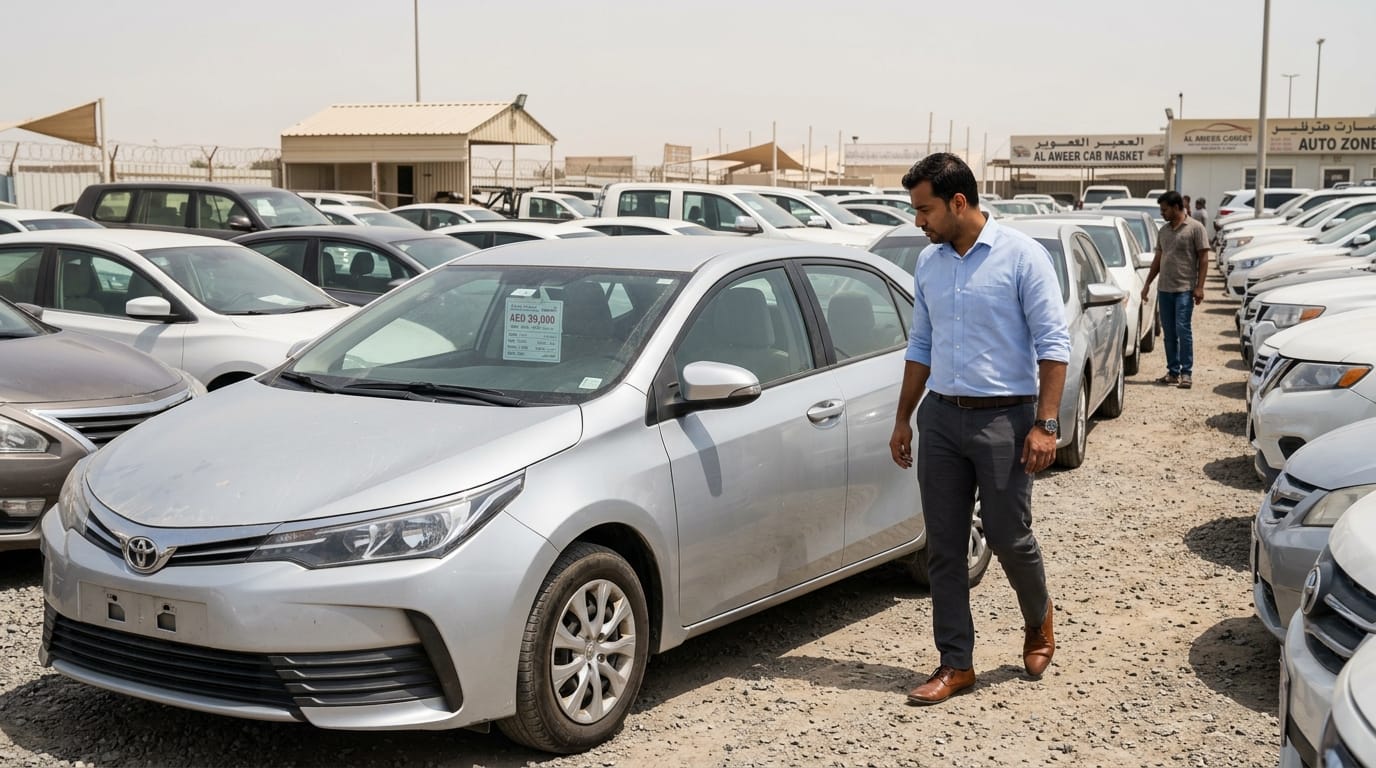
Al Aweer car market in Dubai and the Abu Shagara secondhand market in Sharjah are the two main physical locations for used car browsing. Al Aweer is larger and has more variety. Abu Shagara typically has lower prices for equivalent vehicles — partly because the buyer pool is different and negotiation is more common.
The GCC-Spec Filter — Apply It Before Everything Else
GCC-specification vehicles were manufactured for Gulf climate: the cooling systems handle sustained temperatures above 45 degrees Celsius, the suspension is calibrated for UAE road surfaces, and the parts are stocked across UAE independent workshops. Non-GCC vehicles — US-spec, European-spec, or grey-market imports — were not built to these standards and frequently have higher maintenance costs and lower resale values in UAE.
Before contacting any seller, confirm GCC spec in the listing. If the listing does not specify, ask the seller directly before visiting. A seller who is uncertain or evasive about GCC spec is a seller whose vehicle may not be GCC-spec.
Mileage and Age — Reasonable Ranges for Used Car Buyers
In UAE conditions, workshop observations from Al Quoz and the Sharjah Industrial Area suggest the following as reasonable mileage ranges for a used vehicle purchase:
| Vehicle Age | Acceptable Mileage Range (km) | Flag for Further Inspection |
|---|---|---|
| 2 to 3 years | 25,000 – 55,000 | Below 20,000 or above 65,000 |
| 4 to 5 years | 45,000 – 85,000 | Below 30,000 or above 100,000 |
| 6 to 8 years | 70,000 – 130,000 | Below 50,000 or above 150,000 |
| 8 to 10 years | 100,000 – 170,000 | Below 70,000 or above 200,000 |
Very low mileage for the vehicle’s age — a 2019 vehicle with 18,000 km, for example — is not automatically a positive sign. It may indicate long periods of parking in outdoor UAE heat without engine operation, which accelerates rubber component degradation and battery discharge without producing any mileage on the odometer.
🔧 Mechanic’s Inspection Log — The Listing That Changed Three Times
Documented pre-purchase consultation, September 2025, independent inspection workshop, Al Qusais Road, Dubai.
Vehicle: 2019 Nissan Sunny 1.5L, listed at 21,000 AED, stated 48,000 km
Buyer: Filipino nurse from Mandaluyong, based in Deira, Dubai, monthly salary 5,200 AED
Seller: Private seller from Abu Dhabi, vehicle viewed in a Deira parking structure
Example scenario based on recurring UAE buyer experiences.
The buyer had found the listing on Dubizzle. The original listing stated 48,000 km. When she messaged the seller to arrange a viewing, he mentioned the car had “around 52,000 km — I forgot to update the listing.” When she arrived, the odometer showed 56,400 km.
She brought the vehicle to an independent workshop on Al Qusais Road for a pre-purchase inspection before making any payment commitment.
The workshop found: front left wheel bearing showing early wear — not yet failed, but producing a low hum above 80 km/h. Estimated replacement: 450 to 600 AED. Rear brake pads at approximately 25 percent remaining. Replacement: 280 to 350 AED. The cabin air filter had not been changed in an extended period — not a significant issue but indicating the vehicle’s service history was inconsistent. AC condenser showed minor stone chips — no current leak detected but worth monitoring. Engine oil was dark and past a reasonable change interval.
OBD scan: no stored fault codes. Transmission shift response was smooth. Engine compression consistent across all four cylinders.
Total estimated near-term repair and service: 900 to 1,100 AED. The buyer used this figure to negotiate the purchase price from 21,000 AED to 19,600 AED. The seller accepted.
The inspection cost 200 AED. It saved her approximately 1,400 AED and gave her factual information about the vehicle’s actual condition before she committed any funds.
Step 3 — The Pre-Purchase Inspection
Why This Step Is Non-Negotiable
A used car inspection by an independent qualified workshop is the single most important step in the UAE used car purchase process. It is also the step most commonly skipped — often because the seller creates time pressure, or because the buyer feels confident after a test drive.
A test drive tells you how the vehicle feels at low speed in traffic. It does not tell you the condition of the brake pads, the suspension bushings, the wheel bearings, the AC compressor, the transmission fluid, or the cooling system. These are the components whose replacement costs 1,500 to 15,000 AED in the first year of ownership when they fail.
What a Pre-Purchase Inspection Covers
| Component | What to Check | Risk Signal |
|---|---|---|
| Engine | Oil condition, compression, leaks, belt condition | Dark oil, coolant in oil, belt cracking |
| Transmission | Fluid condition, shift response, CVT temperature | Burnt fluid smell, hesitation, slipping |
| Brakes | Pad thickness, rotor condition, brake fluid color | Below 30% pad remaining, scored rotors |
| Suspension | Bushings, ball joints, shock absorbers, wheel bearings | Knocking, uneven tire wear, vibration |
| Cooling System | Coolant level, hose condition, thermostat function | Low coolant, hose softness, overheating history |
| AC System | Cooling performance, compressor noise, condenser condition | Weak cooling, unusual compressor sound |
| Electricals | OBD scan for fault codes, battery load test, lights | Stored fault codes, weak battery |
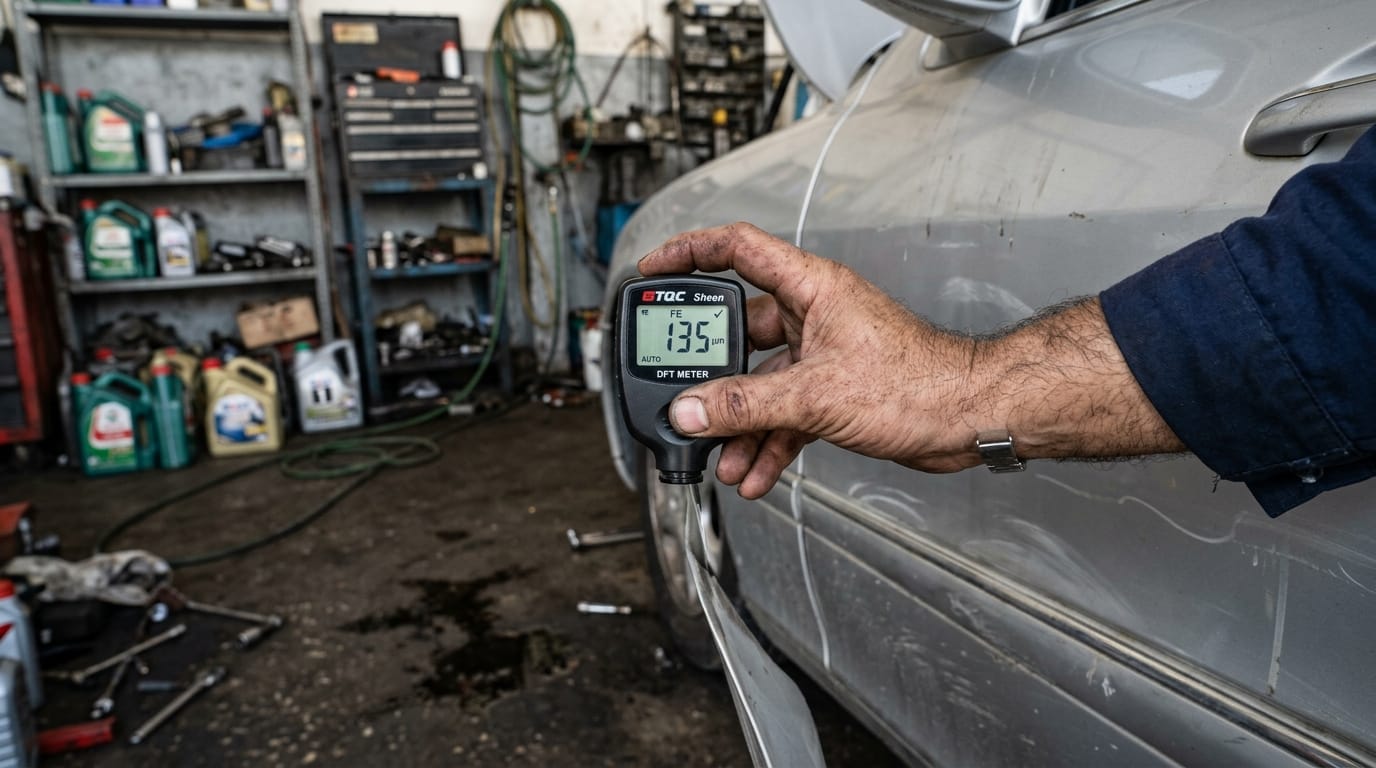
| Body and Paint | Paint thickness meter, panel gaps, underbody rust | Paint thickness above 200 microns on any panel |
| Tires | Tread depth, sidewall condition, age markings | Below 3mm tread, sidewall cracking, over 5 years old |
| Chassis | Underbody inspection for accident damage or repairs | Welding marks, bent rails, fresh undercoating |
Where to Get an Independent Inspection in Dubai
Independent pre-purchase inspections are available from qualified workshops throughout Al Quoz and the Al Qusais Road area in Dubai, and from the Sharjah Industrial Area. The typical cost for a full pre-purchase inspection at an independent workshop ranges from 150 to 300 AED.
Tasjeel centres also offer a basic vehicle inspection as part of the registration process — but this inspection is a roadworthiness check, not a pre-purchase condition assessment. The Tasjeel inspection will catch brake failures and obvious safety deficiencies. It will not identify a transmission at 60 percent wear or an AC compressor that will fail in four months. These require a dedicated pre-purchase inspection at a qualified workshop.
Step 4 — Verifying Ownership and Avoiding Common Documentation Issues
What Documents You Need Before Paying
Before making any payment — including a deposit — verify the following:
The vehicle registration card (Mulkiya) should be in the seller’s name. If it is in someone else’s name, the seller is either a middleman or the original owner has not yet transferred the vehicle. In either case, the transfer process becomes more complicated and you have fewer protections if a dispute arises.
The Emirates ID of the seller should match the name on the Mulkiya exactly. Ask to see the original — not a photo of it. A seller who presents only a phone photo of their Emirates ID without the original present is a situation that warrants caution.
The vehicle should have a valid Tasjeel certificate with no outstanding fines. Outstanding traffic fines remain attached to the vehicle in UAE — not to the previous owner. An expat who purchases a vehicle with 2,400 AED in outstanding fines against it inherits those fines at the point of transfer. Check the fine status at the RTA portal before any payment.
The Transfer Process — Do It the Same Day as Payment
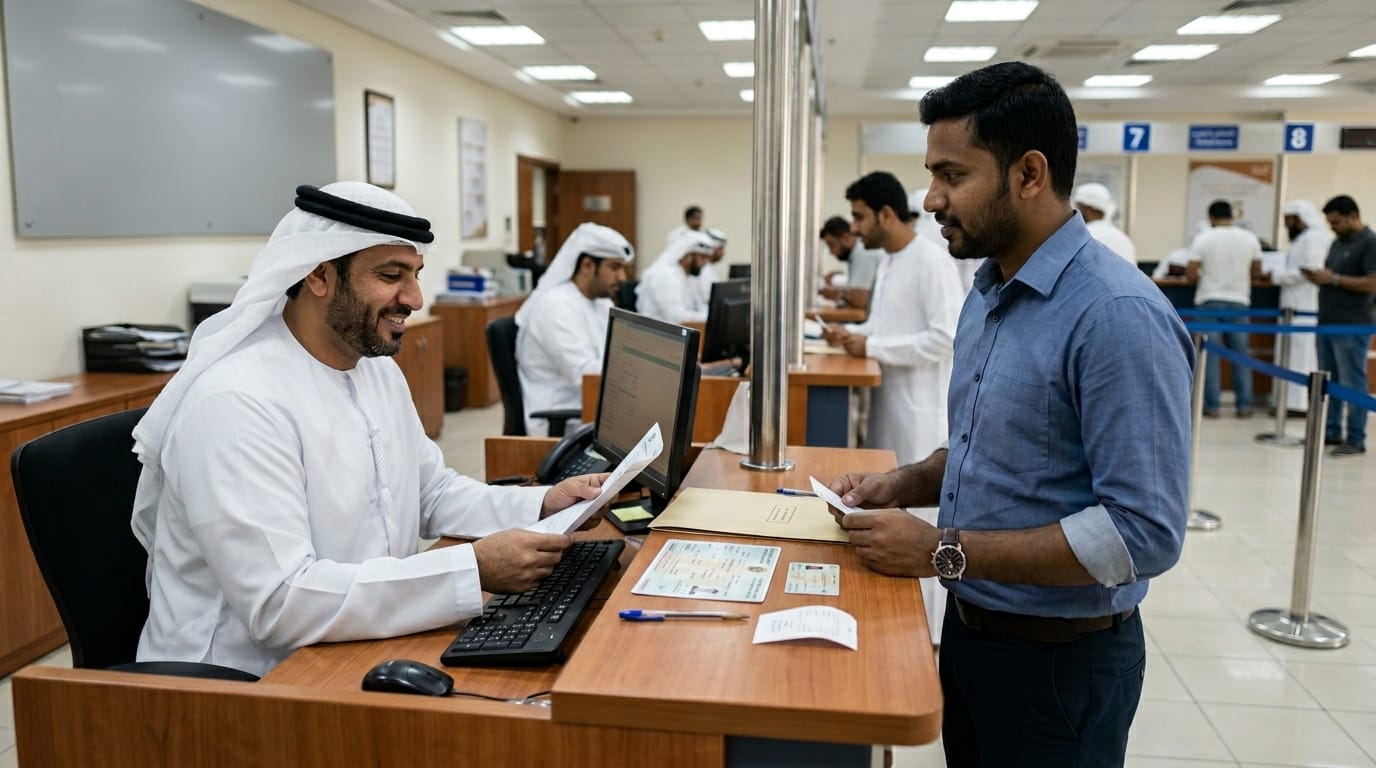
Vehicle ownership transfer in Dubai is processed at a Tasjeel centre. The process requires both the buyer and seller to be present with original documents. It takes approximately 30 to 60 minutes and costs approximately 420 to 500 AED in transfer fees, paid by the buyer in most cases.
Do not pay the full purchase price before the transfer is completed at Tasjeel. The safest sequence: meet the seller at the Tasjeel centre, complete the inspection of documents at the counter, pay the transfer fees, receive confirmation that the vehicle is now registered in your name — then pay the seller the agreed purchase price.
Sellers who resist completing the transfer on the same day as payment, or who request full payment before visiting Tasjeel, are introducing a risk window between when you lose your money and when the vehicle is legally yours. Keep this window as small as possible — ideally zero.
Negotiation — What Is Realistic in the Dubai Used Car Market
Typical Negotiation Margins by Platform
Based on observations across Dubizzle listings and Al Aweer market transactions in 2024 and 2025, the following negotiation margins are common:
| Platform / Source | Typical Asking Price Buffer | Realistic Negotiation Range |
|---|---|---|
| Dubizzle — Private Seller | 5 – 12% above market | 3 – 8% reduction achievable |
| Al Aweer / Abu Shagara — Dealer | 8 – 18% above market | 5 – 12% reduction achievable |
| YallaMotor — Dealer Listings | 5 – 10% above market | 3 – 7% reduction achievable |
| Workplace / Social Group — Private | 0 – 5% above market | 2 – 5% reduction achievable |
The most reliable negotiation leverage in UAE used car transactions is a documented inspection report showing specific issues and their estimated repair costs. A buyer who says “your car is overpriced” achieves limited results. A buyer who presents a workshop inspection report showing 1,200 AED in near-term required repairs, and asks for a price reduction equivalent to those repairs, achieves more consistent results.
What Sellers Commonly Say — and What It Typically Means
“Single owner, agency maintained.” This is frequently accurate and a genuine positive signal — but ask for the service records. An agency-maintained vehicle should have a service book with dated entries. If the seller cannot produce service records for an “agency maintained” vehicle, the claim is unverified.
“The car is perfect, no issues.” No used car is issue-free. This phrase is a seller’s confidence statement, not a technical assessment. The independent inspection is what tells you the vehicle’s actual condition.
“I have another buyer coming tonight.” This is the most common urgency technique in UAE used car transactions. It may occasionally be true. In many cases, it is a negotiation tool. The correct response is: “If the other buyer purchases it, that is fine — I will complete my inspection first and contact you afterward if I am still interested.” A vehicle worth buying today is worth buying after an inspection tomorrow.
“No accidents, clean history.” In UAE, there is no centrally accessible vehicle accident history database equivalent to a Carfax report. A seller’s statement about accident history is self-reported. A paint thickness meter test during the inspection — which measures paint depth across body panels — is the most reliable way to identify repaired panel damage. Panels that have been repainted after an accident typically show paint thickness readings above 180 to 200 microns compared to factory panels at 100 to 140 microns.
Insurance — What You Need Before Driving Away
In UAE, a vehicle cannot legally be driven without active insurance. You cannot complete the Tasjeel transfer without valid insurance in the buyer’s name. Plan for this before the day of transfer.
Comprehensive insurance for a used vehicle is available from UAE insurers directly and through comparison platforms. For an expat with 1 year of UAE no-claims history on a 2018 to 2021 Japanese GCC sedan, comprehensive insurance typically costs 1,200 to 2,200 AED annually depending on the insurer, vehicle value, and driver profile.
Third-party-only insurance is legal in UAE and costs approximately 650 to 900 AED annually for the same vehicle profile. It does not cover damage to your own vehicle — only damage you cause to others. For a vehicle purchased above 20,000 AED, comprehensive is the more financially protective choice.
Arrange insurance before the Tasjeel appointment. Most UAE insurers issue a policy within 24 hours of application. Some issue it on the same day. Bring the insurance certificate to the Tasjeel centre — it is a required document for transfer.
Signs You Are Looking at a Good Unit
The majority of pre-purchase guide content focuses on warning signs. It is equally useful to know what a genuinely well-maintained used vehicle looks like in the UAE market — because they exist in meaningful numbers and are worth recognizing when you find one.
A well-maintained used vehicle in UAE typically shows: consistent service records from either an agency or a documented independent workshop, with service dates correlating to mileage at regular intervals. The engine bay is clean but not detail-cleaned — a recently pressure-washed engine bay on an older vehicle is sometimes used to conceal oil leaks. The cabin shows wear consistent with the stated mileage — not heavily worn for low stated mileage, and not pristine for high stated mileage. Tires are from a recognizable brand, have matching age codes across all four wheels, and show even wear across the tread width. The seller can answer specific questions about the vehicle’s service history without hesitation or contradiction.
In Dubizzle listings from Abu Shagara and Deira, a well-documented vehicle with service records in an appropriate mileage range typically sells within 7 to 14 days of listing at or near the asking price. This is the market telling you that well-documented vehicles have consistent buyer demand — which also means they support stronger resale when you eventually sell.
What to Do If You Discover a Problem After Purchase
UAE does not have a statutory lemon law equivalent to those in the United States or European markets. Once a used vehicle transfer is completed at Tasjeel, the transaction is legally concluded in most circumstances.
However, there are practical steps available to expat buyers who discover significant undisclosed issues after purchase:
Preserve all documentation from the transaction: WhatsApp conversation history with the seller, any photos or videos taken at viewing, the original listing screenshots if saved, and all workshop invoices from after the purchase. If the seller made specific representations about the vehicle’s condition — “no accidents,” “engine perfect,” “gearbox just serviced” — and the post-purchase inspection contradicts these claims with documented evidence, there is a basis for a consumer complaint.
The Consumer Protection department under the UAE Ministry of Economy handles complaints about misrepresentation in commercial transactions. For private seller transactions, the Dubai Police economic crimes line handles complaints involving documented fraud. These routes require documented evidence — which is why preserving the full transaction record from the beginning matters.
For significant undisclosed defects — hidden accident damage, rolled-back odometer, or major mechanical failure that was clearly present at the time of sale — a formal complaint supported by a dated inspection report and transaction records gives you a documented position. Resolution is not guaranteed, but documentation significantly strengthens any complaint process.
Market Comparison — Buying Private vs Dealer in Dubai
| Factor | Private Seller (Dubizzle) | Used Car Dealer (Al Aweer / Abu Shagara) |
|---|---|---|
| Price | Typically 5 – 12% below dealer | Higher asking price; more negotiation buffer |
| Documentation | Varies — may be incomplete | Usually complete; dealer handles transfer paperwork |
| Inspection Access | Flexible — seller usually accommodates | Flexible for reputable dealers; some resist |
| Warranty | None | Some dealers offer 30-day limited warranty |
| Negotiation | More flexible; personal motivation to sell | Structured; price reduction harder past a point |
| Risk of Undisclosed Issues | Higher — no professional accountability | Lower — dealer reputation at stake |
| Speed of Transaction | Slower — coordination with private individual | Faster — dealer handles Tasjeel paperwork |
Neither route is categorically better. Private sellers offer lower prices with more flexibility. Dealers offer more structured transactions with some degree of accountability. The inspection requirement is identical regardless of which route you take.
Owner Scenarios — Matching the Process to Your Situation
New Arrival, First Month in Dubai, 5,000 AED Salary
Do not rush this purchase. Spend the first two to three weeks using public transport or ride-hailing while you identify vehicles and run inspections. A purchase made in the first week of arrival under time pressure is a purchase made with incomplete market knowledge. The car market in Dubai has consistent inventory — a good unit that passes inspection today will be replaced by another good unit next week if that one sells.
Expat with 18 Months Remaining on Contract, 8,500 AED Salary
Factor your exit into the purchase. A vehicle with high Dubizzle resale demand — Toyota Corolla GCC, Nissan Sunny GCC — will sell in 10 to 20 days when you are ready to leave. A vehicle with lower demand — American-spec, less common models — may take 45 to 90 days to sell. If your departure date is fixed, resale speed matters as much as purchase price.
Expat Buying with Finance, 7,000 AED Salary
Confirm the loan installment, insurance, and running costs together before finalizing the vehicle choice. A 600 AED monthly installment on a Corolla plus 800 AED in monthly running costs equals 1,400 AED per month — 20 percent of a 7,000 AED salary. This is at the upper boundary of the recommended range. It is manageable with discipline but leaves limited margin for unexpected expenses.
Family Buyer, Two Adults, Combined 14,000 AED Salary
Prioritize cabin size and AC performance over lowest purchase price. UAE summer conditions with two adults in a small cabin without strong AC produces a daily experience that affects quality of life. A Honda City or Toyota Corolla at the top of your budget range, in well-maintained condition with documented service history, is a more practical choice than a Yaris at the bottom of the range.
Analytical Conclusion — The Cost of Doing It Right vs the Cost of Skipping Steps
A pre-purchase inspection costs 150 to 300 AED. A Tasjeel transfer check takes 30 to 60 minutes. Verifying insurance takes 24 hours. These steps add approximately 72 hours and 300 AED to the purchase process.
The workshop records reviewed for this guide show that expats who skip the pre-purchase inspection report first-year repair costs ranging from 1,800 to 14,000 AED on vehicles that passed a casual visual inspection but had documented mechanical issues that a qualified inspection would have identified.
The median first-year repair cost for vehicles purchased without a pre-purchase inspection, based on workshop observations across Al Quoz and the Sharjah Industrial Area, is approximately 3,200 AED — roughly ten times the cost of the inspection itself.
The process outlined in this guide is not complicated. It requires patience, a 200 to 300 AED inspection fee, and the willingness to walk away from any unit that does not pass the inspection cleanly or whose seller resists the process. These are the three inputs that separate expat buyers who have straightforward ownership experiences from those who discover expensive problems in the first six months.
FAQ — Buying a Used Car in Dubai as an Expat
Disclaimer: Emirates Car Guide is a 100% independent platform. We do not own showrooms, nor are we affiliated with any used car dealerships or garages. Our sole mission is to protect expats from financial fraud in the automotive market.
Even when the purchase process is followed correctly, some vehicles carry undisclosed problems that only become apparent after transfer. Understanding what options are available when a buyer discovers significant issues after purchase — and what the typical costs and outcomes look like — is the next practical step for any expat navigating the UAE used car market. Read the full breakdown: what happens when a buyer discovers flood damage after purchase.
