Last Updated: May 2026 | By Omar Al-Fayed, Senior Automotive Consultant | Category: Buying & Selling
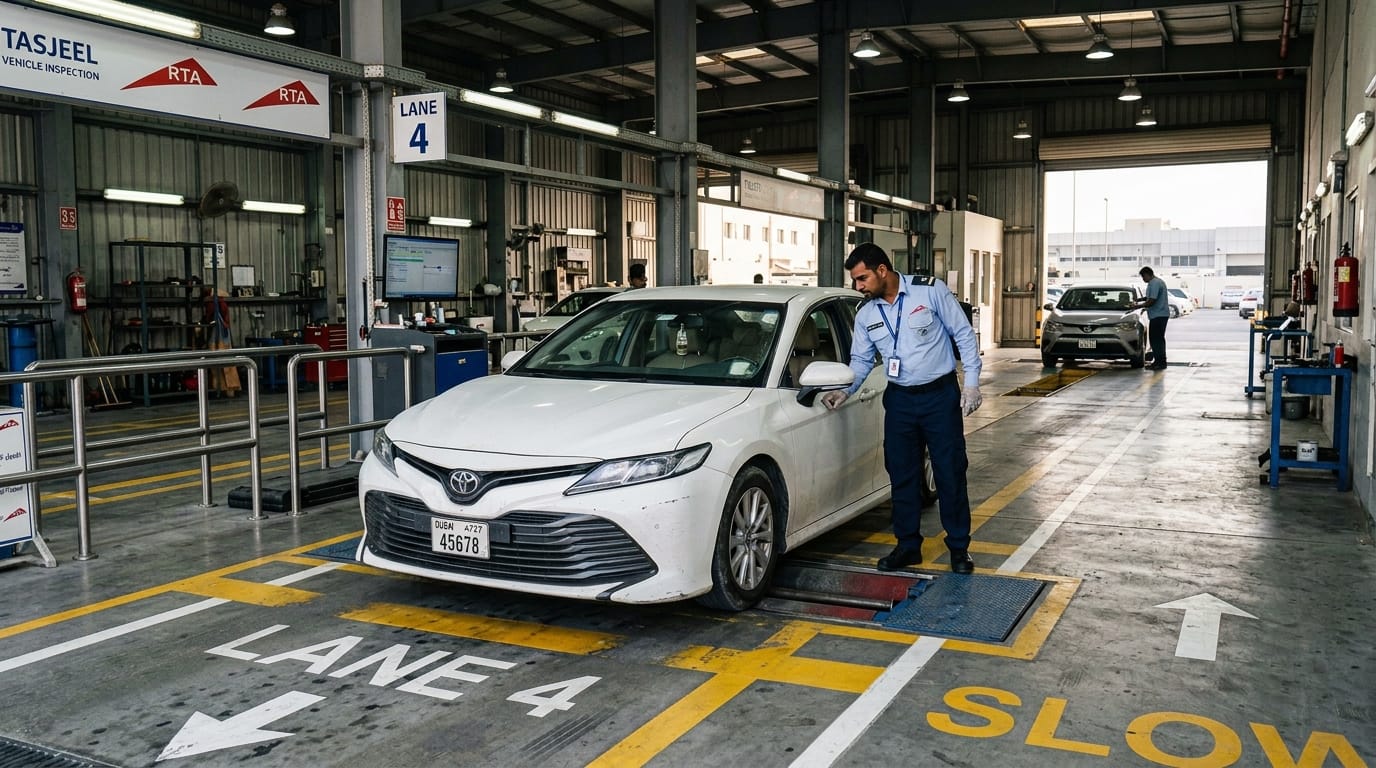
The RTA car test in Dubai — commonly called the Tasjeel inspection — is a mandatory annual roadworthiness check that costs between 150 and 220 AED and checks approximately 18 to 22 safety parameters on the day of testing. It does not check engine health, transmission condition, OBD fault history, flood damage indicators, or any of the mechanical issues that produce large post-purchase repair bills.
A used car with a valid Tasjeel certificate can still carry 5,000 to 15,000 AED in required repairs. This guide explains exactly what the RTA test checks, what it does not check, and how to use this knowledge to protect your money before buying any used vehicle in Dubai.
If you came from our guide on what happens when a buyer discovers flood damage after purchase, you already understand that standard verification steps often miss the most expensive problems. The RTA test is the most commonly misunderstood of those steps — and the most frequently cited by sellers as proof of a vehicle’s condition when it proves no such thing.
What the RTA Tasjeel Test Actually Checks
The Tasjeel inspection is a standardized roadworthiness test. Its purpose is to verify that a vehicle is safe to operate on UAE public roads on the day of testing. It is not a mechanical health assessment, a maintenance history verification, or a quality certification.
Understanding this distinction matters because sellers across Al Aweer, Abu Shagara, and the Deira showroom strip regularly present a passing Tasjeel certificate as evidence that a vehicle is “in good condition” or “fully checked.” This framing is not accurate, and accepting it at face value is one of the more costly mistakes an expat buyer can make.
What Tasjeel Does Check
| Inspection Item | What Is Measured | Pass Threshold |
|---|---|---|
| Brake system performance | Braking force on all four wheels via brake tester rollers | Minimum braking force per axle; balanced left-to-right |
| Tire tread depth | Visual and gauge check on all four tires | Minimum 1.6mm tread remaining |
| Exterior lighting | All headlights, indicators, brake lights, reverse lights | All functioning and aligned within specification |
| Emissions | Exhaust gas analysis at idle | CO, HC, and NOx within UAE limits |
| Horn function | Audible at required decibel level | Functional |
| Windshield and wipers | Visual check for cracks, wiper function test | No cracks in driver’s field of view; wipers functional |
| Chassis integrity | Visual undercarriage check for structural damage | No visible major structural compromise |
| Steering play | Measured steering wheel free play | Within specification for vehicle type |
| Fuel and coolant leaks | Visual inspection under the vehicle | No active fluid leaks visible |
| Window tinting | Light transmission measurement | Minimum 30% light transmission for front windows |
What Tasjeel Does NOT Check
| Item Not Checked | Why It Matters | Potential Cost if Found Post-Purchase |
|---|---|---|
| OBD fault code history | Cleared codes remain in freeze-frame — invisible to Tasjeel | 500 – 6,500 AED depending on fault |
| Transmission fluid condition | Degraded CVT or automatic fluid causes internal wear | 700 – 22,000 AED for CVT replacement |
| Engine oil condition | Extended intervals cause timing chain and VVT wear | 1,800 – 5,500 AED for timing system |
| Suspension bushing wear | Worn bushings are not a safety fail unless severe | 800 – 3,500 AED for full replacement |
| Flood damage indicators | Fuse terminal oxidation and watermarks are not inspected | 8,000 – 40,000 AED in extreme cases |
| AC compressor condition | AC performance is not tested | 1,800 – 4,500 AED for compressor |
| Engine mount condition | Mounts are not tested for vibration or rubber condition | 350 – 1,650 AED for replacement |
| Battery health | Battery is not load-tested | 380 – 650 AED for replacement |
| Bodywork repair history | Paint thickness is not measured | Resale value impact: 5,000 – 15,000 AED |
| Service history verification | Tasjeel does not access or verify maintenance records | N/A — but affects all future repair costs |
🔧 Mechanic’s Inspection Log — Passed Tasjeel, Failed Everything That Mattered
Documented consultation, October 2025, independent workshop, Industrial Area 6, Sharjah.
Vehicle: 2018 Nissan X-Trail 2.5L GCC, 74,000 km
Seller’s claim: “Just passed Tasjeel last month — fully checked and roadworthy”
Asking price: 44,500 AED
Buyer: IT project manager from Kerala, working in Sharjah, salary 9,500 AED monthly
Independent inspection cost: 250 AED
The Tasjeel certificate was genuine and current — passed 31 days before our inspection. The seller had presented it prominently and repeatedly as evidence of the vehicle’s condition.
The independent workshop inspection found the following within 90 minutes:
OBD scan with freeze-frame data:
- P0420 (catalytic converter efficiency below threshold) — cleared 1,400 km ago, had been active for approximately 3,800 km before clearing
- P0507 (idle control RPM high) — cleared 600 km ago, suggested throttle body carbon buildup or vacuum leak
The P0420 code on the X-Trail 2.5L typically indicates the catalytic converter is approaching or past end of useful life. Replacement cost: 1,800 to 2,600 AED. The Tasjeel emissions test had passed because the code had been cleared before the test and the converter was still functioning within test parameters at idle — even though it was clearly degraded over the full OBD history.
Transmission fluid: Dark brown, well past service condition. CVT service on the X-Trail at an independent workshop: 750 to 1,000 AED. If the CVT had been neglected to internal damage, replacement cost in UAE: 12,000 to 20,000 AED.
Front brake pads: 2mm remaining — below Tasjeel’s minimum threshold of 1.6mm for tires, but the Tasjeel inspection uses a visual brake system check with roller testing, not a pad thickness measurement tool. The pads passed because the braking force was still adequate, not because the pads were in good condition. Replacement needed immediately: 380 AED.
Engine mount (front left): Rubber isolator cracked and hardened. Engine movement visible at idle in Drive. Not a safety issue at current condition, but a comfort and progressive wear concern. Replacement: 450 AED.
Total immediate repair cost on a vehicle that passed Tasjeel 31 days earlier: 3,380 to 5,030 AED minimum, with potential CVT exposure of up to 20,000 AED if the fluid neglect had caused internal wear.
Negotiated reduction: 3,000 AED. Final price: 41,500 AED. The buyer entered the transaction knowing the specific repairs needed and their costs.
The Tasjeel Test Process — What Actually Happens
Where to Find Tasjeel Centers in Dubai
Tasjeel operates multiple vehicle testing centers across Dubai. The main facilities are located in:
- Al Barsha
- Al Rashidiya
- Umm Ramool
- Al Quoz
- Jebel Ali
In Sharjah, the equivalent inspection is conducted through the Sharjah Roads and Transport Authority (SRTA) facilities. In Abu Dhabi, the ADNOC Distribution vehicle inspection centers handle the equivalent process.
The test is conducted on the vehicle — the owner or an authorized representative drives the vehicle through the inspection lane. Appointment booking is available through the Dubai Drive app or the RTA website. Walk-in inspections are also accepted at most centers during operating hours.
Operating Hours and Fees
| Day | Hours |
|---|---|
| Sunday to Thursday | 7:30 AM – 8:00 PM |
| Friday | 7:30 AM – 12:00 PM |
| Saturday | 7:30 AM – 6:00 PM |
| Vehicle Category | Inspection Fee (AED) |
|---|---|
| Private vehicle under 10 years old | 150 – 170 |
| Private vehicle 10 years old or above | 170 – 220 |
| Re-test after initial failure | 50 – 80 |
Common Reasons for Tasjeel Failure
Understanding what commonly fails the Tasjeel test helps you prepare if you are renewing registration on a vehicle you own — and helps you assess whether a vehicle on sale has had issues addressed or concealed.
- Tire tread below minimum (most common): Tires with less than 1.6mm of tread, uneven wear, or visible sidewall damage. Cost to resolve: 550 to 900 AED for two tires (budget brand, fitted).
- Brake imbalance: When braking force is significantly different between left and right on an axle. Often caused by a seized caliper or uneven pad wear. Cost: 600 to 1,400 AED.
- Lighting failures: A blown indicator, headlight alignment outside specification, or non-functional brake light. Cost: 50 to 400 AED depending on component.
- Emissions failure: Typically indicates a fault with the catalytic converter, oxygen sensors, or EGR system. Cost: 800 to 3,000 AED depending on the specific cause.
- Window tinting too dark: Common on vehicles brought from other emirates where tinting regulations differ. Cost to resolve: 200 to 600 AED for removal and re-tinting at compliant level.
- Steering play above specification: Excessive steering wheel free play. Cost: 400 to 2,000 AED depending on whether it is a tie rod, ball joint, or rack issue.
How to Use the Tasjeel Test in Your Buying Decision
What a Valid Certificate Tells You
A current Tasjeel certificate confirms three things:
- The vehicle’s brakes produced adequate stopping force on the test day
- The tires had at least 1.6mm of tread on the test day
- The emissions output was within UAE limits on the test day
Nothing more.
What a Failing Certificate Tells You
A vehicle being sold with an expired or recently failed Tasjeel certificate is worth examining more carefully — not because the failure necessarily indicates major problems, but because:
- The seller knows the vehicle failed but did not address the issues before listing
- The buyer bears the cost of bringing the vehicle to pass standard
- The failure items may indicate deferred maintenance on a broader pattern
An expired Tasjeel certificate should produce a price reduction discussion — not an automatic walk-away. A tire replacement to pass Tasjeel costs 550 to 900 AED. That cost belongs in the negotiation, not in the buyer’s first post-purchase expense.
The Right Way to Use the Certificate in Negotiation
If a vehicle has a current Tasjeel certificate: use it to confirm the vehicle is drivable and legally registered. Then proceed with the independent inspection as planned.
If a vehicle has an expired certificate: request a 500 to 1,000 AED reduction to cover the inspection and any likely minor remediation. If the seller refuses, this tells you something about their negotiating approach.
If the seller has not yet obtained a Tasjeel pass: ask why, and request the vehicle only after a pass is obtained — or factor the cost of bringing it to pass into your offer.
[IMAGE PLACEHOLDER 2 — MID ARTICLE]
Alt Text: Close-up of a Tasjeel passing certificate document on a car dashboard with UAE inspection stamps and the vehicle plate number visible in a Dubai parking area
Title: tasjeel-passing-certificate-document-dubai-car-inspection
File name before upload: tasjeel-passing-certificate-document-dubai-car-inspection
The Independent Inspection vs Tasjeel — A Direct Comparison
| Feature | Tasjeel RTA Test | Independent Pre-Purchase Inspection |
|---|---|---|
| Purpose | Legal roadworthiness certification | Mechanical health assessment for buyer |
| Cost | 150 – 220 AED | 150 – 350 AED |
| Duration | 20 – 40 minutes | 60 – 120 minutes |
| OBD scan with freeze-frame | No | Yes — full fault history |
| Flood damage detection | No | Yes — fuse terminals, carpet, module connectors |
| Paint thickness measurement | No | Yes — all 6 body panels |
| Transmission fluid assessment | No | Yes — color, condition, smell |
| AC system check | No | Yes — temperature output and compressor cycling |
| Engine mount condition | No | Yes — vibration test and visual inspection |
| Who conducts it | RTA-certified technician | Independent mechanic of your choice |
| Protects the buyer? | Partially — road safety only | Yes — identifies all significant mechanical issues |
Both are needed. The Tasjeel certificate is required for registration. The independent inspection is required for financial protection.
What to Do if a Used Car Fails the Tasjeel Test During Your Ownership
If you already own a vehicle and receive a Tasjeel failure, the process is straightforward:
Step 1 — Understand What Failed
The Tasjeel technician produces a failure report itemizing specific failure points. Read it carefully. Not every failure is expensive — a blown indicator bulb is a 20 AED fix. Emissions failure may require a 2,500 AED catalytic converter replacement.
Step 2 — Get Independent Repair Quotes
Do not take the failure report directly to a Tasjeel-affiliated workshop without first getting quotes from independent workshops in Al Quoz or the Sharjah Industrial Area. Tasjeel-affiliated repairs are convenient but typically priced 20 to 40 percent above equivalent independent workshop rates for the same repairs.
Step 3 — Complete the Repair and Retest
After repairs are completed, return to any Tasjeel center for a retest. The retest fee is 50 to 80 AED. You do not need to return to the same center where the original failure occurred.
Step 4 — Complete Registration Renewal
Once the Tasjeel pass is confirmed, proceed with the annual registration renewal through the RTA Dubai app, the Tasjeel service center, or the RTA website. Renewal fees vary by vehicle age and type — typically 620 to 900 AED annually for standard private vehicles in Dubai.
Practical Checklist — What to Bring for a Tasjeel Inspection
| Item | Required? | Note |
|---|---|---|
| Original Mulkiya (registration card) | Yes | Must match the vehicle being tested |
| Emirates ID of the registered owner | Yes | Or an authorized driver with owner’s ID copy |
| Valid insurance certificate | Yes | Minimum third-party liability |
| Vehicle with all lights functional | Yes — bring spare bulbs | A blown indicator causes an immediate retest |
| Tires with minimum 1.6mm tread | Yes | Check before arriving — saves a wasted trip |
| Window tint at legal compliance | Yes | Minimum 30% light transmission for front windows |
Buyer Mistakes Related to the Tasjeel Test
Mistake 1 — Treating a Passing Certificate as Mechanical Clearance
This is the most common and most expensive mistake. A passing Tasjeel certificate means the vehicle was safe to drive on the test date. It does not mean the vehicle is mechanically sound, well-maintained, or free from expensive upcoming repairs. Every vehicle that produced a large repair bill documented in our previous guides had a valid Tasjeel certificate at time of sale.
Mistake 2 — Not Checking Certificate Date
A Tasjeel certificate dated 11 months ago is technically current — but any issues that developed in the past 11 months are not reflected in it. Always note the certificate date and ask what, if anything, has changed mechanically since the test. For vehicles with certificates more than 6 months old, an independent inspection becomes more important, not less.
Mistake 3 — Assuming Tasjeel Pass Means Emissions Are Fine
As documented in the Mechanic’s Inspection Log, a catalytic converter that is degrading can pass the Tasjeel emissions test because the test is conducted at idle with no load. The same vehicle will show a P0420 OBD code under normal driving conditions. Emissions test pass at Tasjeel does not mean the emissions system is healthy — it means it was within limits at idle on the test date.
Mistake 4 — Not Verifying the Certificate Is Genuine
Tasjeel certificates can be verified through the RTA official portal at rta.ae using the vehicle plate number. A seller who objects to this verification while in front of you is providing useful information about their confidence in the certificate’s authenticity.
The Positive Side — What the Tasjeel System Does Well
The Tasjeel inspection system has improved meaningfully over the past five years and serves genuine road safety functions that benefit all UAE road users.
The brake roller test catches vehicles with significantly worn or malfunctioning brake systems before they create road hazards. Vehicles with brakes in genuinely dangerous condition — seized calipers, deeply worn rotors with inadequate stopping force — are removed from the road through the failure and retest process.
The tire tread requirement prevents vehicles with dangerously worn tires from remaining in regular use. In UAE summer conditions, where road surface temperatures routinely exceed 60 degrees, tire integrity is a meaningful safety factor at highway speeds.
The emissions testing, while limited in scope, prevents heavily polluting vehicles from remaining in regular use without attention. In a city with Dubai’s traffic density, this has cumulative air quality value.
For expats who are new to the UAE, the Tasjeel system provides a clear, government-operated process for ensuring a baseline of vehicle safety — at a reasonable cost and with transparent criteria.
Owner Scenarios — When the Tasjeel Test Matters Most to You
If You Are Buying a Used Vehicle
Verify the Tasjeel certificate date and confirm it is genuine through the RTA portal. Then arrange an independent inspection regardless of the certificate’s status. The Tasjeel pass tells you the vehicle is drivable. The independent inspection tells you what it will cost over the next 12 months.
If You Are Renewing Registration on Your Own Vehicle
Check your Tasjeel certificate expiry 45 days before the date. Book an appointment through the Dubai Drive app to avoid queues. Bring spare indicator bulbs — the most common single-item failure cause. Get tire tread checked at any petrol station in advance if you are unsure of tread depth.
If Your Vehicle Fails the Test
Obtain three quotes for the specific repair from independent workshops in Al Quoz before committing to any repair center. The failure is specific and itemized — use the itemization to get targeted repair quotes rather than general service packages.
If You Are Selling a Vehicle
A current Tasjeel certificate is a legitimate selling asset — it confirms the vehicle meets road safety minimums and removes that concern from the buyer. Obtain it before listing, not after a buyer appears. A vehicle listed without a current Tasjeel certificate invites an immediate price reduction request from any informed buyer.
Market Comparison — Tasjeel vs Equivalent Systems in Other Expat Destinations
| Aspect | UAE (Tasjeel) | UK (MOT) | Singapore (LTA) | Saudi Arabia |
|---|---|---|---|---|
| Inspection frequency | Annual | Annual (vehicles 3+ years) | Annual (vehicles 3+ years) | Annual |
| OBD scan included | No | Yes (from 2018) | Partial | No |
| Cost equivalent | 150 – 220 AED | ~250 AED equivalent | ~180 AED equivalent | ~100 AED equivalent |
| Online booking | Yes — RTA/Dubai Drive app | Yes | Yes | Partial |
| Failure rate approx. | 15 – 20% first attempt | ~30% first attempt | ~12% first attempt | ~20% first attempt |
The UK MOT’s inclusion of OBD scanning since 2018 is a notable difference — it means certain fault codes produce automatic MOT failures in the UK. The UAE Tasjeel system does not yet include OBD scanning in its standard process, which is why the independent inspection remains essential for buyers rather than optional.
Analytical Conclusion — The Real Role of the RTA Test
After reviewing documentation from dozens of pre-purchase inspections across Dubai and Sharjah in 2024 and 2025, a consistent pattern emerges: the RTA Tasjeel test and the independent pre-purchase inspection catch almost entirely different problems.
Tasjeel catches: brake failure, dangerously worn tires, lighting defects, emissions above limit, illegal tinting.
Independent inspection catches: OBD fault history, flood damage, transmission fluid neglect, timing chain wear, AC compressor condition, body repair history.
The overlap between these two lists is minimal. This means both are needed — not as alternatives, but as complements.
An expat buyer who uses only the Tasjeel certificate as verification has the equivalent of a vehicle that has been confirmed safe on the motorway but has not been checked for anything that will produce a large workshop bill in the next 12 months.
The 150 to 350 AED spent on an independent inspection is the difference between knowing and not knowing. In the cases documented across this guide series, the cost of not knowing has consistently been 3,000 to 40,000 AED.
FAQ — RTA Tasjeel Test Dubai for Expats
Disclaimer: Emirates Car Guide is a 100% independent platform. We do not own showrooms, nor are we affiliated with any used car dealerships or garages. Our sole mission is to protect expats from financial fraud in the automotive market.
Once you understand what the RTA test covers and what it does not, the next financial decision is your insurance policy — where most expats pay more than necessary without realizing it. Read the complete guide: Used Car Insurance Dubai for Expats: Cheapest Options Without Losing Coverage
