Last Updated: May 2026 | By Omar Al-Fayed, Senior Automotive Consultant | Category: Buying & Selling
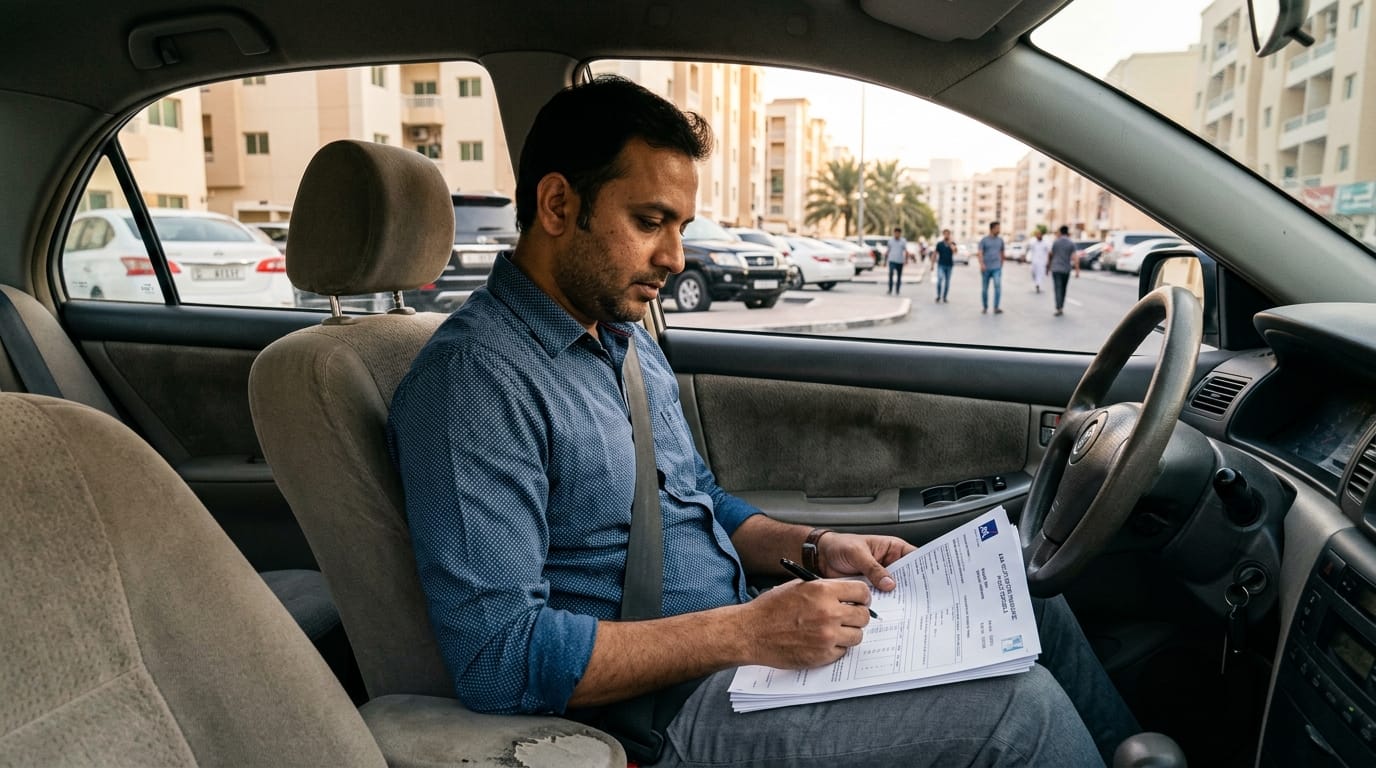
Third-party insurance for a used Japanese GCC sedan in Dubai typically costs between 1,100 and 1,800 AED annually for an expat driver with one year of UAE driving history. Comprehensive cover for the same vehicle runs approximately 2,200 to 3,600 AED annually depending on the insurer, the vehicle age, and your no-claims discount status.
This guide breaks down the real insurance options available to expats in Dubai — which policy types make sense for which salary range, which providers consistently quote lower, and where most expat buyers make decisions that cost them significantly more than necessary. If you have already read our guide on RTA Car Test Dubai: What Expats Must Know Before Buying Any Used Car, you have already handled the inspection side of the equation. Insurance is the next mandatory step before you drive the vehicle legally in Dubai.
Why Most Expats Overpay for Car Insurance in Dubai
The most common mistake expat buyers make is purchasing insurance through the car dealer or showroom at the point of sale. Dealer-arranged insurance is almost always priced 20 to 40 percent above what the same policy would cost through a direct insurer or comparison platform. The convenience is real. The markup is also real.
The second most common mistake is renewing with the same insurer every year without comparing. UAE insurance pricing is not static. An insurer that was competitive in your first year may be 30 to 45 percent above market rate by your third renewal — and they will not tell you.
The third mistake is choosing between “cheapest” and “best coverage” as if they are opposites. For a used vehicle in the 18,000 to 45,000 AED range, the difference between the cheapest reasonable comprehensive policy and an overpriced one is often 800 to 1,400 AED annually — not a trivial amount for an expat on a mid-range salary. That difference buys the same coverage from a different provider.
This guide gives you the framework to find the lowest reasonable price for the coverage you actually need — organized by vehicle value range and salary bracket.
The Legal Minimum vs What You Actually Need
In Dubai and across the UAE, third-party liability insurance is the legal minimum for any vehicle on public roads. This covers damage or injury your vehicle causes to other people or their property. It does not cover any damage to your own vehicle — from accidents, fire, theft, or weather events.
Comprehensive insurance covers both third-party liability and damage to your own vehicle. It typically also includes fire and theft cover, and depending on the policy, may include roadside assistance, agency repair access, and personal accident cover.
The decision between third-party and comprehensive is not always obvious. The vehicle’s current market value is the primary factor.
🔧 Mechanic’s Inspection Log — The Corolla That Cost 4,800 AED to Insure
Documented insurance consultation case, February 2026, Al Barsha, Dubai.
Vehicle: 2019 Toyota Corolla 1.6L GCC, 58,000 km
Owner: Administrative assistant from the Philippines, Dubai, monthly salary 5,200 AED
Purchase Price: 36,500 AED
Situation: Insurance purchased through the dealer at point of sale
The buyer had completed the purchase efficiently. She had checked the Tasjeel certificate, verified the VIN, and confirmed the service history. The dealer offered to arrange comprehensive insurance on the spot. She agreed because it was convenient — one less thing to organize separately.
The annual premium: 4,820 AED. Comprehensive cover, agency repair, one year.
When she mentioned this figure during a workshop visit four months later for a routine oil change, the mechanic — who arranges group insurance for several of his regular customers — ran a quick comparison. The same coverage on the same vehicle profile from three other insurers: 2,650 AED, 2,980 AED, and 3,100 AED.
She had paid 1,820 to 2,170 AED more than necessary for identical coverage. That premium gap, annualized, is roughly 35 to 45 percent above market rate for her vehicle and profile — absorbed entirely by the dealer’s insurance margin.
The policy was non-cancelable mid-term without a fee. She made a note to compare independently at renewal.
Third-Party vs Comprehensive — Which One Is Right for Your Vehicle
When Third-Party Makes Financial Sense
Third-party insurance is financially rational when the vehicle’s current market value is low enough that a total loss — from accident damage or theft — would not create a meaningful financial crisis for you.
As a practical guideline based on workshop observations across UAE: if your vehicle’s current market value is below approximately 18,000 to 22,000 AED, the annual premium difference between third-party and comprehensive cover (typically 900 to 1,600 AED annually) may not justify the comprehensive option when weighed against the statistical likelihood of a total loss claim being needed.
If your vehicle is worth 15,000 AED and comprehensive cover costs 1,400 AED more per year than third-party, you would need a total loss within approximately 11 years of premiums to break even on the premium difference — and older, lower-value vehicles are more frequently written off rather than repaired by insurers anyway.
Third-party insurance is also the practical default for vehicles approaching or past 10 years of age. Many UAE insurers will not offer comprehensive cover on vehicles over 7 to 8 years old, or will price it at rates that make it financially unreasonable.
When Comprehensive Is Worth It
For vehicles with a current market value above approximately 25,000 to 30,000 AED, comprehensive cover is generally the more rational choice. A total loss on a 38,000 AED vehicle without comprehensive cover — whether from an at-fault accident or theft — produces a financial gap that is difficult to absorb on a mid-range expat salary.
Comprehensive cover also provides agency repair access on newer policies — meaning your vehicle is repaired at an authorized dealer workshop rather than an independent one. For GCC-specification Japanese vehicles under 5 years old that are still within the original service history, agency repair preserves service records in a way that independent workshop repair does not. This matters for resale value.
| Vehicle Market Value | Recommended Cover Type | Annual Premium Range (AED) | Reason |
|---|---|---|---|
| Below 18,000 AED | Third-party only | 1,100 – 1,600 | Comprehensive premium cost vs vehicle value ratio makes it less rational |
| 18,000 – 25,000 AED | Third-party or basic comprehensive | 1,400 – 2,400 | Borderline — decision depends on individual risk tolerance and savings reserve |
| 25,000 – 45,000 AED | Comprehensive | 2,200 – 3,800 | Total loss risk justifies comprehensive premium at this vehicle value |
| Above 45,000 AED | Comprehensive with agency repair | 3,200 – 5,500 | Vehicle value and resale maintenance both require comprehensive + agency repair |
What Drives Insurance Pricing in UAE — The Factors Insurers Use
Factors You Can Control
No-claims discount (NCD) is the most significant controllable factor. Each year without a claim earns a premium discount with most UAE insurers — typically 10 to 15 percent per year, capped at 30 to 50 percent depending on the insurer. Expats who arrive with a no-claims history from their home country can sometimes transfer this record — but the process requires an official NCD letter from the home insurer, and not all UAE providers accept international NCD at full value.
Voluntary excess selection also affects the premium meaningfully. Choosing a higher voluntary excess — the amount you pay first in any claim before the insurer covers the rest — reduces the annual premium. A voluntary excess of 1,000 AED typically reduces the annual premium by 150 to 300 AED depending on the vehicle. A voluntary excess of 2,500 AED may reduce it by 400 to 600 AED. This makes sense if your savings can absorb the excess amount without creating financial stress.
Excluding add-ons that do not fit your situation removes cost from the premium. Personal accident cover for passengers, roadside assistance (which is available through other channels), and windscreen cover (which may duplicate your excess cost) are commonly included by default but not always needed. Review each add-on individually.
Factors That Are Fixed But Worth Understanding
Vehicle age reduces the insurer’s willingness to offer agency repair and increases the likelihood that a damaged vehicle is written off rather than repaired. A 2016 vehicle is treated differently from a 2021 vehicle even if both carry similar market values — the older vehicle’s parts availability, depreciation trajectory, and repair cost relative to value all affect the insurer’s pricing.
Driver profile — age, license tenure, UAE driving history — affects pricing significantly for younger drivers. An expat with a valid UAE license for 2 years and no recorded incidents is priced more favorably than an expat in their first 12 months with a converted foreign license.
Parking location matters. Vehicles registered to Abu Shagara, Al Quoz, or Deira addresses may be priced differently from vehicles in Jumeirah or Dubai Marina — though this effect is modest compared to vehicle age and NCD status.
Insurance Cost Breakdown by Vehicle Type — Real UAE Numbers
| Vehicle | Market Value (AED) | Third-Party Annual (AED) | Comprehensive Annual (AED) | Comprehensive + Agency Repair (AED) |
|---|---|---|---|---|
| Toyota Yaris 1.3L GCC (2017–2019) | 16,000 – 22,000 | 1,100 – 1,500 | 1,900 – 2,600 | 2,400 – 3,200 |
| Nissan Sunny 1.5L GCC (2018–2021) | 18,000 – 26,000 | 1,200 – 1,600 | 2,000 – 2,800 | 2,500 – 3,400 |
| Toyota Corolla 1.6L GCC (2018–2021) | 28,000 – 42,000 | 1,400 – 1,900 | 2,400 – 3,400 | 3,000 – 4,200 |
| Honda City 1.5L GCC (2018–2021) | 24,000 – 36,000 | 1,300 – 1,800 | 2,200 – 3,200 | 2,800 – 3,900 |
| Nissan Altima 2.5L GCC (2018–2020) | 34,000 – 48,000 | 1,600 – 2,100 | 2,800 – 4,000 | 3,500 – 5,000 |
| Toyota Camry 2.5L GCC (2018–2021) | 42,000 – 65,000 | 1,800 – 2,400 | 3,200 – 5,000 | 4,000 – 6,200 |
Note: These figures represent independently sourced comparison quotes for expat drivers with 1 to 3 years UAE NCD. Actual quotes vary by insurer, driver age, and specific vehicle history. Use these as benchmarks for identifying whether a quote you receive is within the reasonable range.
Where to Get the Cheapest Legitimate Insurance in Dubai
Comparison Platforms — First Step Always
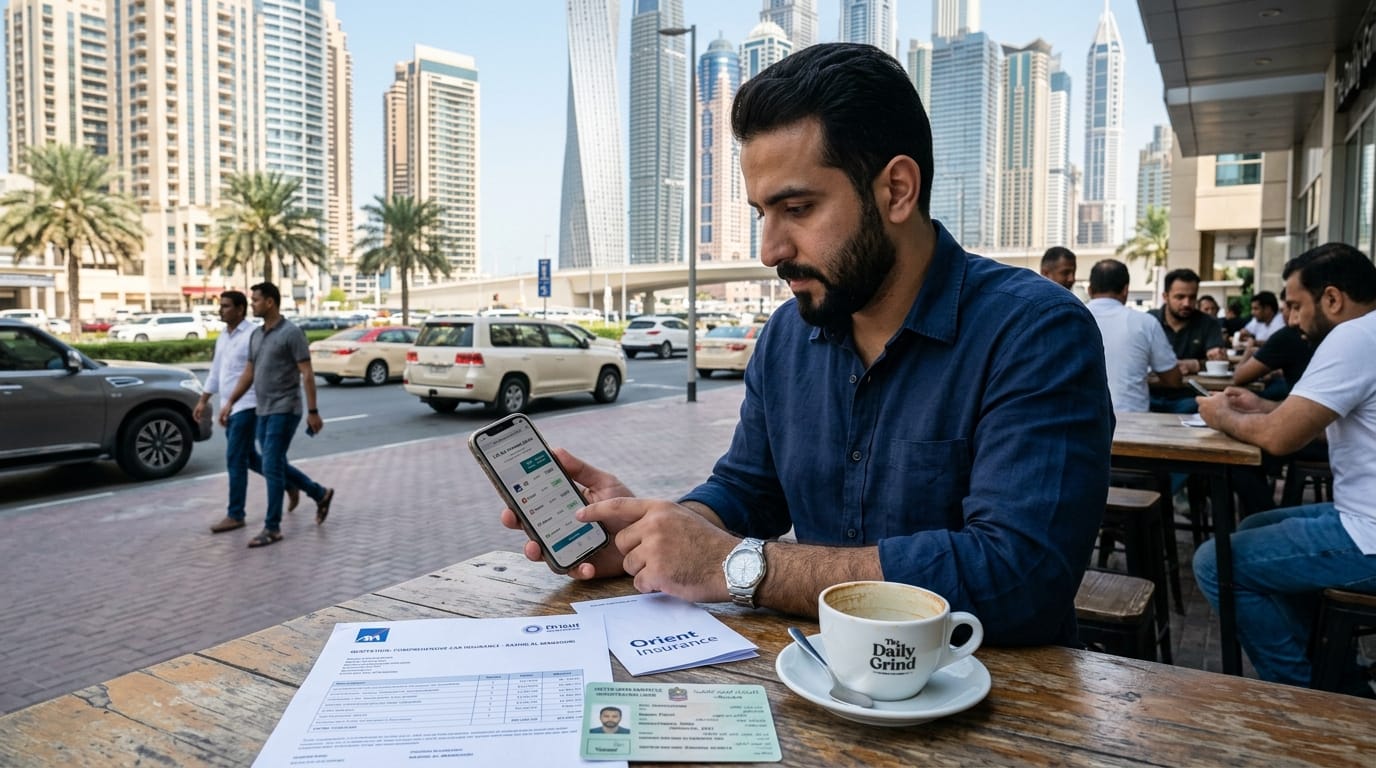
Dubai-based insurance comparison platforms are the fastest way to generate multiple quotes from licensed insurers simultaneously. Platforms operating in UAE allow you to enter vehicle details, driver profile, and coverage preferences and receive quotes from 10 to 20 insurers within minutes. The variance between the cheapest and most expensive quote for identical coverage on the same vehicle is frequently 30 to 50 percent — which makes comparison essential rather than optional.
Commonly used platforms for UAE insurance comparison allow direct policy purchase or callback from the insurer. Reading the policy document — specifically the exclusions and excess structure — before purchasing is worth the 15 to 20 minutes it requires.
Direct Insurer Quotes — Worth the Extra Step
Some UAE insurers offer lower premiums when you approach them directly rather than through a comparison platform — because the platform charges the insurer a referral fee that may be passed into the premium. For long-term policyholders with established NCD, contacting major insurers directly and asking for a retention quote at renewal frequently produces a figure below what comparison platforms show.
Bank-Arranged Insurance — Check Before Assuming
If you purchased your vehicle with a car loan, your bank will require you to carry comprehensive insurance and typically has an approved list of insurers. Some banks also offer their own insurance products — occasionally at competitive rates for their loan customers. Others simply add a margin. Ask for the premium from two or three of the bank’s approved insurers before accepting the first option presented.
Insurance by Salary Range — What to Buy at Each Level
Salary 3,500 to 5,000 AED Monthly
At this salary level, insurance should be kept as low as possible without creating serious financial exposure. Third-party insurance on a vehicle valued below 20,000 AED is the financially rational choice. The key is keeping the vehicle value below the threshold where a total loss would create a genuinely difficult financial situation.
Recommended approach: Third-party policy on a Toyota Yaris or Nissan Sunny valued at 15,000 to 20,000 AED. Annual insurance cost: 1,100 to 1,500 AED. Monthly insurance cost absorbed into running budget: approximately 92 to 125 AED per month.
Salary 5,000 to 8,000 AED Monthly
Comprehensive cover becomes rational at this salary level for vehicles in the 25,000 to 38,000 AED range. A Toyota Corolla at 32,000 to 36,000 AED with comprehensive cover (excluding agency repair) costs approximately 2,400 to 3,200 AED annually.
At 7,000 AED monthly salary, 267 AED in monthly insurance represents 3.8 percent of income. This is very manageable alongside a 500 to 600 AED monthly loan installment and regular fuel costs.
Recommended approach: Comprehensive cover without agency repair on a Japanese GCC sedan. Compare on at least two platforms before purchasing. Accept a voluntary excess of 1,000 AED to reduce the annual premium by 150 to 250 AED.
Salary 8,000 to 12,000 AED Monthly
At this salary range, comprehensive cover with agency repair on vehicles up to 45,000 to 50,000 AED is affordable and makes sense for resale value maintenance. Agency repair preserves the service history in a way that keeps the vehicle’s documented condition cleaner for eventual sale.
Recommended approach: Comprehensive cover with agency repair. Compare directly with established providers alongside comparison platform quotes. Negotiate your NCD if you have two or more claim-free years.
Salary 12,000 AED and Above
Full comprehensive cover with agency repair and a modest voluntary excess. At this salary level, the monthly insurance cost on even a Camry or Accord — 330 to 520 AED monthly — represents less than 4 to 5 percent of income. Choose the insurer with the best claims reputation rather than the lowest premium.
What the Insurance Certificate Does Not Protect You From
Pre-Existing Damage
Insurance covers damage that occurs after the policy inception date. Any pre-existing damage visible at the time of purchase — or worse, concealed damage that surfaces later — is not a valid insurance claim. If you insure a vehicle with hidden flood damage or structural repair history and the issue surfaces after purchase, you are carrying both the repair cost and the depreciation loss without insurance recourse.
The Tasjeel Certificate as Insurance Proxy
A valid Tasjeel (vehicle registration) certificate confirms that the vehicle passed the road-worthiness test. It is not a mechanical certification. It does not mean the vehicle has no known or developing mechanical issues. It does not serve as a substitute for an independent pre-purchase inspection.
Claims Rejection Scenarios
UAE insurance claims are rejected or reduced more frequently than most expat buyers expect. Common reasons based on documented case patterns include: driving without a valid UAE license at the time of the incident, incidents during off-road driving (if not explicitly covered), vehicle modifications not disclosed to the insurer (including excessive tinting), and using a personally insured vehicle for commercial delivery or ride-hailing purposes.
Insurance vs Legal Action — Understanding the Difference
| Channel | What It Covers | Who You Deal With | Timeline | Outcome |
|---|---|---|---|---|
| Insurance Claim | Damage or loss as defined in your policy document | Your insurer | Days to weeks | Payment or repair per policy terms |
| Legal Action Against Seller | Misrepresentation, undisclosed defects, fraud | Court system or consumer protection | Weeks to months | Varies significantly based on evidence |
Insurance claims do not resolve disputes with a previous seller. If you purchased a vehicle with concealed damage and the insurer declines to cover pre-existing conditions, your recourse is through legal action against the seller, not through the insurer. These are parallel systems.
Evidence Checklist — What to Keep from Every Insurance Transaction
| Document | Why It Matters | Where to Store |
|---|---|---|
| Insurance policy document (full PDF) | Contains exclusions, excess structure, named drivers | Phone cloud + printed copy in vehicle |
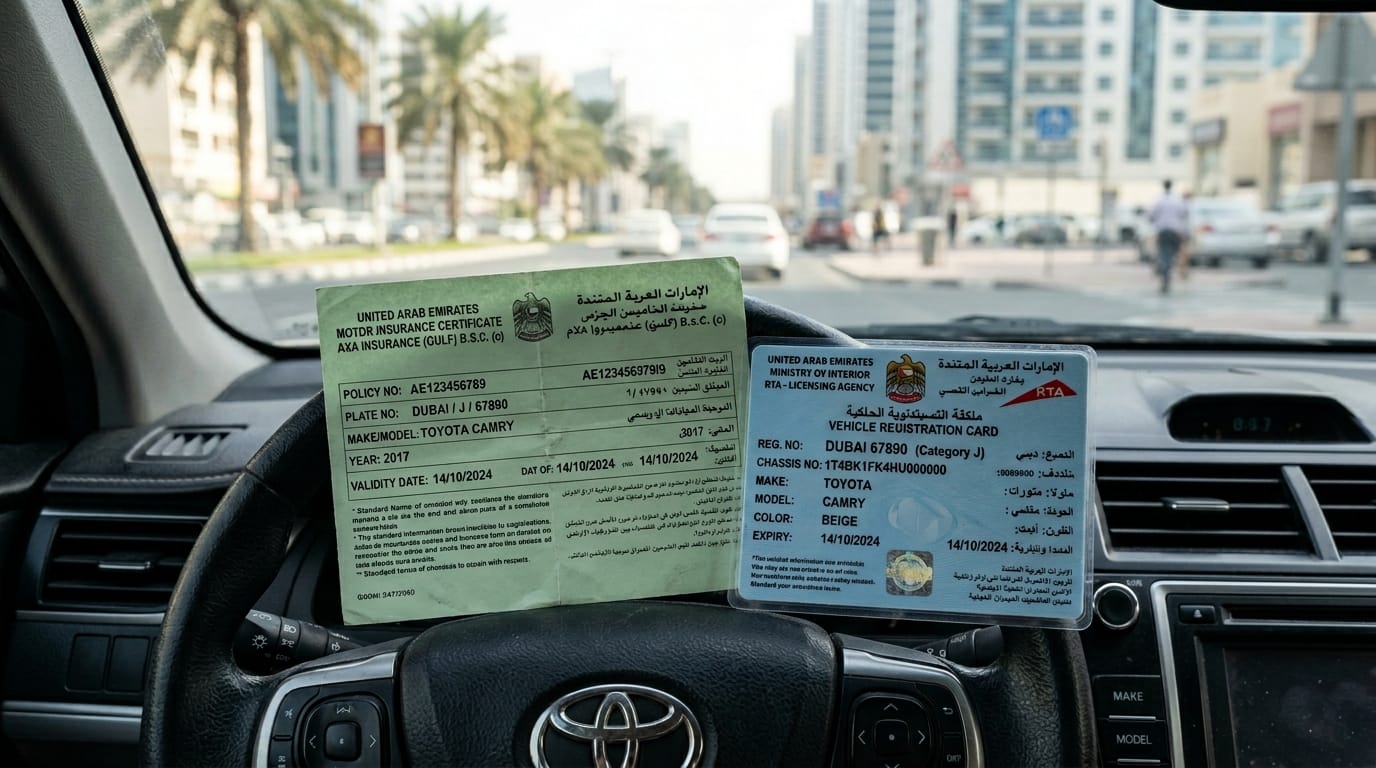
| Insurance certificate | Legal document required in vehicle at all times | Physical copy in vehicle glovebox |
| Premium payment receipt | Confirms transaction and inception date | Phone photos + email |
| Vehicle purchase contract or receipt | Establishes ownership transfer date relative to policy start | Physical + phone photo |
| Pre-purchase inspection report | Protects against disputed pre-existing damage claims | Physical + cloud |
| Comparison quotes printed or saved | Reference for renewal — proves market rate at last comparison | Email or phone screenshot |
Analytical Conclusion — The True Cost of Getting Insurance Wrong
The annual difference between the cheapest reasonable comprehensive policy for a mid-range used sedan in Dubai (approximately 2,400 AED) and the most expensive comparable policy from a dealer or non-competitive insurer (approximately 4,800 AED) is 2,400 AED — paid every year for as long as you own the vehicle.
Over a 3-year ownership period, that is 7,200 AED in excess premium for identical coverage. At an expat salary of 6,000 AED monthly, that is 1.2 months of gross salary absorbed by an insurance pricing decision made in 5 minutes at a dealership.
The comparison takes 20 to 30 minutes on a platform. It is the highest-return 30 minutes most expat buyers can invest in their vehicle ownership cost. Insurance is not where most expats expect to find significant savings — which is precisely why those savings remain available.
For the next step in managing your vehicle’s financial profile in UAE — understanding which vehicle holds its value best and costs least to own over 2 to 3 years — read our detailed analysis: Honda City vs Toyota Yaris Used UAE: Which Expat Car Holds Value Better?
Disclaimer: Emirates Car Guide is a 100% independent platform. We do not own showrooms, nor are we affiliated with any used car dealerships or garages. Our sole mission is to protect expats from financial fraud in the automotive market.
FAQ — Used Car Insurance Dubai for Expats
