Last Updated: May 2026 | By Omar Al-Fayed, Senior Automotive Consultant | Category: UAE Market News
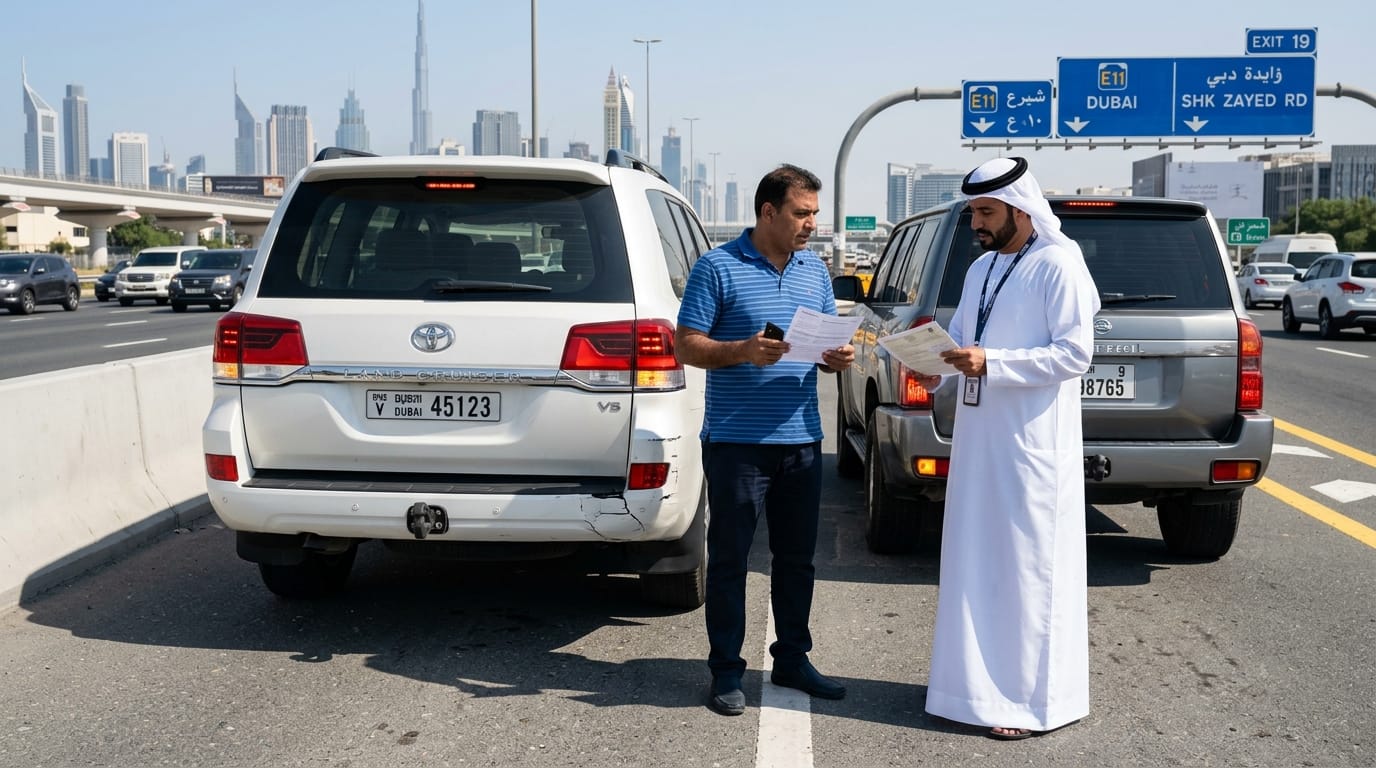
If you are involved in a road accident in the UAE, do not move the vehicles until a police report is issued — unless the accident is minor and both drivers agree to use the online reporting system. The first 30 minutes determine whether your insurance claim is accepted or rejected.
A wrong decision in this window can cost you 3,000 to 25,000 AED in out-of-pocket repair costs. This guide covers every step in the correct order.
If you recently read our account of selling a car in Dubai after 2 years and what the final numbers looked like, you already understand how quickly unexpected costs add up during UAE car ownership. A road accident — even a minor one — is where the largest single unexpected cost can appear if the first 30 minutes are handled incorrectly.
Why the First 30 Minutes Matter More Than Anything Else
UAE traffic law and insurance regulations create a narrow window after an accident where your decisions lock in the outcome.
Move your car before police authorization in a major accident and your insurance claim can be rejected.
Fail to call the police in a situation that requires it and the other driver can later claim the accident was your fault — with no official record to contradict them.
Accept a verbal settlement without a police report and you have no legal document if the other driver changes their mind later.
Most expats who handle accidents incorrectly do so not from carelessness but from not knowing the specific UAE rules in advance. This guide gives you those rules before you need them.
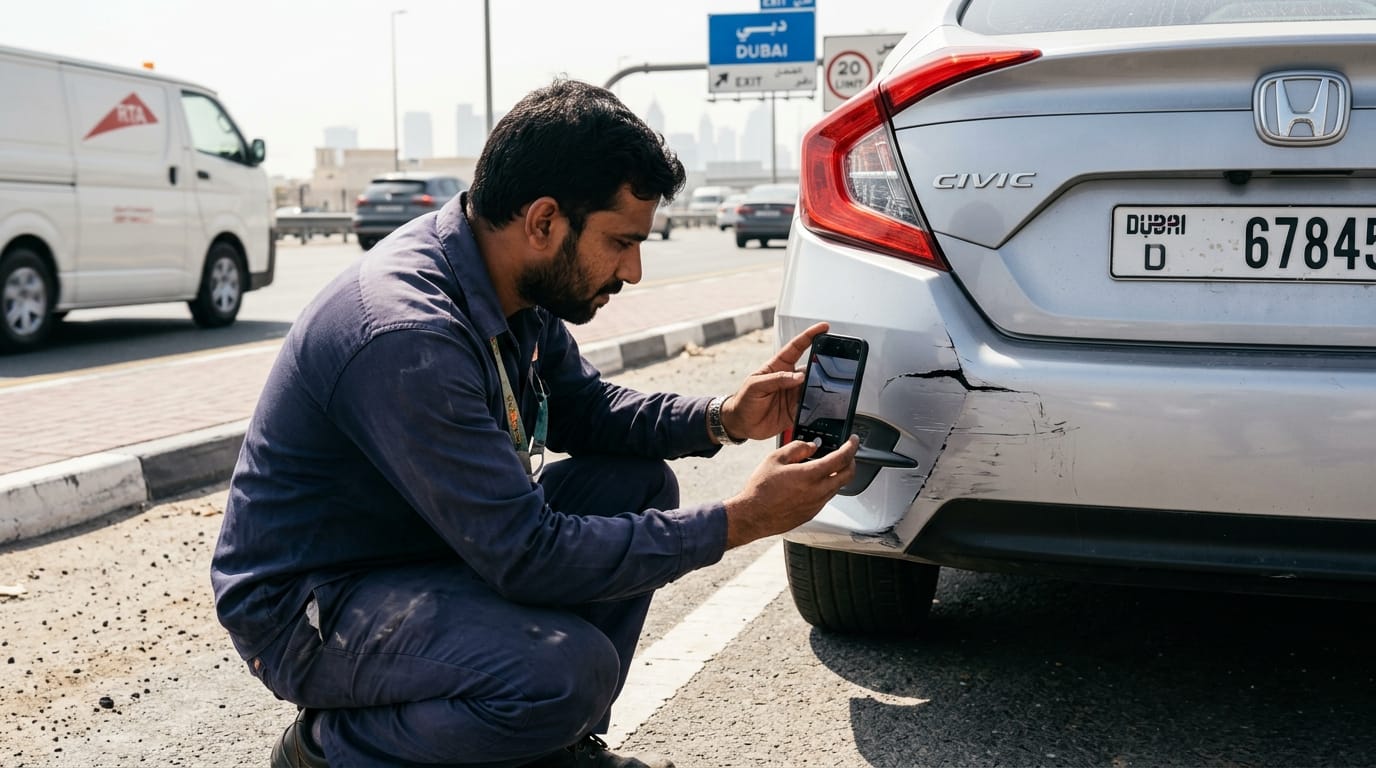
🔧 Mechanic’s Inspection Log — The 4,800 AED Mistake
Documented case from a client consultation, March 2026, Dubai.
Driver: HR manager from Cebu, working in Business Bay, Dubai
Vehicle: 2020 Honda Civic 1.5T GCC, 38,000 km
Accident: Rear-end collision at Al Safa Street intersection, Dubai
The other driver rear-ended her car at low speed — approximately 20 to 25 km/h — at a traffic signal. Both drivers stepped out, assessed the damage, and agreed it looked minor. The other driver offered 1,500 AED cash on the spot to avoid a police report. She accepted.
She drove the car to a workshop the following day.
Workshop findings:
Rear bumper: cosmetic damage and cracked sensors — visible. Cost: 1,200 AED.
Rear boot structure: the impact had bent the boot floor panel and displaced the rear strut tower mounting point by approximately 4mm. Not visible from outside. The workshop discovered it during a structural alignment check. Cost to repair: 3,600 AED — and required full rear section disassembly.
Total repair cost: 4,800 AED.
The 1,500 AED cash settlement covered less than a third of the actual damage. The other driver was unreachable. No police report existed. Her insurance company declined to process the claim because there was no official accident documentation.
She paid 4,800 AED out of pocket for an accident that was not her fault.
The correct action at the scene would have taken 25 minutes — calling the police, waiting for the report, and letting her insurance handle the repair fully covered.
Step-by-Step: The First 30 Minutes
Step 1 — Stop and Stay Calm (Minutes 0 to 2)
Switch on hazard lights immediately.
Check yourself and passengers for injury. If anyone is injured — call 998 (ambulance) and 999 (police) in Dubai. Do not move injured persons unless they are in immediate danger from fire or ongoing traffic.
If no injuries: stay with the vehicle.
Step 2 — Determine Accident Category (Minutes 2 to 5)
UAE accidents fall into two categories. The correct action depends on which category applies.
Category A — Minor accident, no injuries, both drivers present and cooperative:
In Dubai, minor accidents can be reported through the Dubai Police app or the Accident Reporting System (Tamm). Both drivers must agree to use this system. If both agree, you can move vehicles to a safe location and report online. The system generates an official report number that your insurance accepts.
Category B — Major accident, injuries, significant vehicle damage, disputed fault, or hit-and-run:
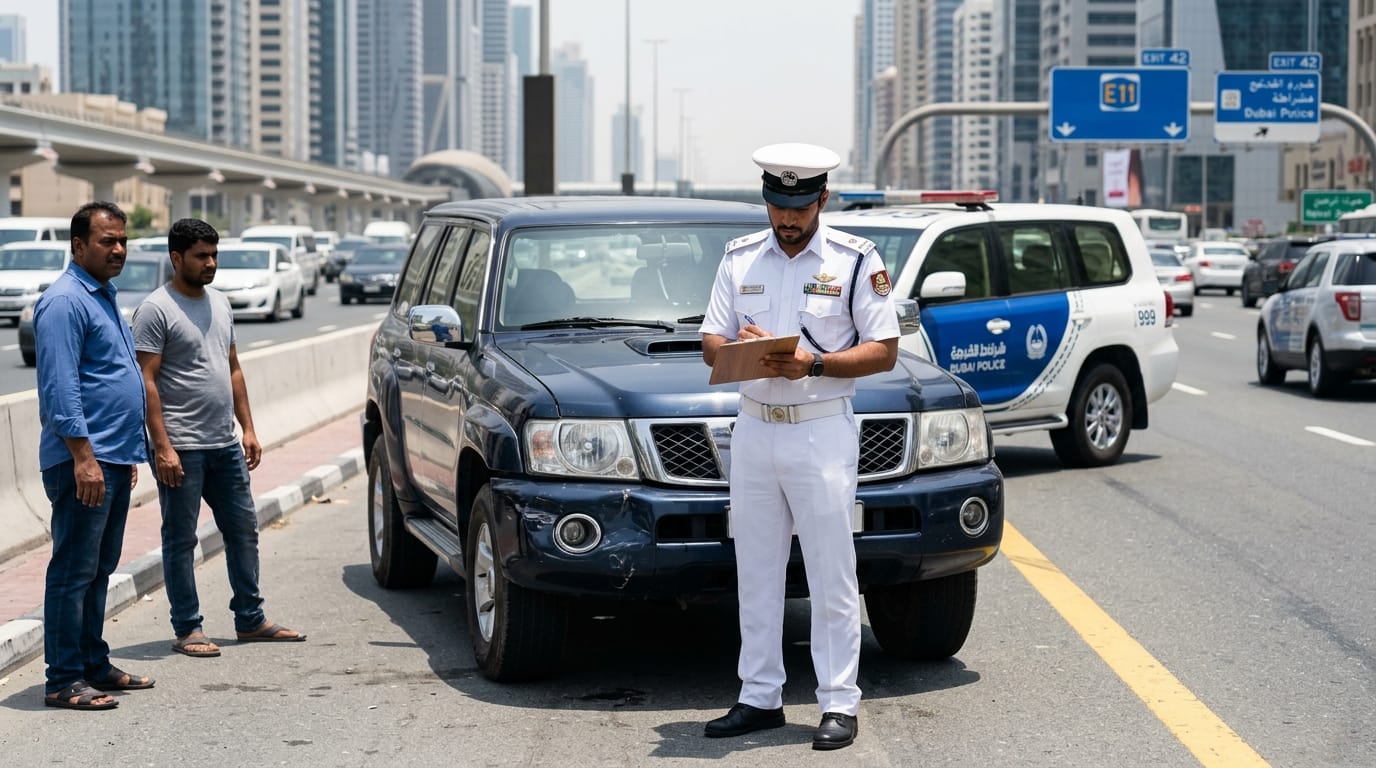
Do not move the vehicles. Call 999 in Dubai (or 02-4003000 in Abu Dhabi, 06-5632222 in Sharjah). A traffic officer will be dispatched and the scene must be preserved.
Step 3 — Document Everything (Minutes 5 to 10)
Before any vehicles move and before any discussion with the other driver:
Photograph the scene from four angles. Both vehicles, the road position of each car, any skid marks, traffic signals or signs visible, and the surrounding area. These photographs establish road position and help determine fault if disputed.
Photograph the damage on both vehicles. Close up, from multiple angles. Include shots that show the licence plate of both vehicles in the same frame where possible.
Photograph the other driver’s documents. Emirates ID, driving licence, and vehicle Mulkiya. Ask for all three before any conversation about what happened.
Do this before talking about fault, blame, or settlement. Documentation first.
Step 4 — Exchange Information (Minutes 10 to 15)
Collect and record:
Full name of the other driver (as on Emirates ID)
Emirates ID number
Driving licence number and expiry date
Vehicle plate number and emirate
Vehicle make, model, and colour
Insurance company name and policy number (on the insurance card usually kept in the vehicle)
Mobile number
Provide the same information about yourself.
Do not sign anything the other driver asks you to sign at the scene. Do not make any verbal admission of fault — even a polite “sorry” can be used against you in a disputed claim.
Step 5 — Call Your Insurance Company (Minutes 15 to 20)
Most UAE insurance companies have a 24-hour accident helpline. The number is on your insurance card and in your policy documents.
Call them now — not after you get home.
Tell them:
Where the accident occurred (road name, nearest landmark)
Category of accident (minor or major)
Whether police have been called
Your location if you need a tow
They will guide you on whether to use the online reporting system or wait for a traffic officer. They will also open a claim reference number — which you need for all subsequent repair and workshop visits.
Step 6 — Police Report or Online Report (Minutes 20 to 30)
If police attend the scene:
A traffic officer will assess the scene, speak to both drivers, and issue an accident report. This report assigns responsibility. You will receive a copy — keep it. This is the document your insurance requires to process the claim.
If using the online system (Dubai):
Both drivers complete the report through the Dubai Police app or the Dubai Police website. Both must agree — if the other driver refuses the online system, you must call 999. A report number is generated immediately. Screenshot or save this number before closing the app.
For accidents in Abu Dhabi:
The Abu Dhabi Police app offers an equivalent online reporting system for minor accidents. The process is similar — both drivers must agree, no injuries, cooperative parties.
Real Cost Comparison — Handled Correctly vs Incorrectly
ScenarioPolice Report FiledClaim OutcomeOut-of-Pocket CostMinor accident, both agree online report, insurance notifiedYes — onlineFull claim accepted0 AED (excess only: 500-1,000 AED)Minor accident, verbal settlement accepted, no reportNoInsurance declines claimFull repair cost: 800 – 8,000 AEDMajor accident, police report filed, fault establishedYes — officerFull claim accepted0 AED (excess only)Major accident, vehicles moved before police arrivedReport complicationsDisputed claim, partial rejection3,000 – 15,000 AEDHit and run, police report filed immediatelyYesComprehensive policy may cover0 AED (excess only)Hit and run, no report filedNoInsurance declinesFull repair cost
The pattern is consistent: a police report or official online report costs 20 to 30 minutes. The absence of one costs 800 to 15,000 AED or more.
What Happens After the Report — The Insurance Claim Process
H3: Workshop Assessment
After a police or online report is filed, your insurer will direct you to an approved workshop for assessment. Do not take the car to a non-approved workshop first — repairs done without insurer authorization may not be covered.
The workshop produces a repair estimate. The insurer approves it. Work begins.
For agency repair endorsement holders: you go to the brand dealer workshop directly.
For standard comprehensive without agency repair: the insurer assigns an approved independent workshop. In Dubai, these are typically in Al Quoz or Al Qusais.
H3: Excess Payment
Every comprehensive insurance policy in UAE has an excess clause — the amount you pay before insurance covers the rest. Standard excess amounts:
Driver ProfileStandard Excess (AED)UAE licence holder, 3+ years experience500 – 1,000UAE licence holder, under 2 years experience1,000 – 1,500Converted foreign licence, first year1,500 – 2,500At-fault driver (in some policies)Additional 500 – 1,000
The excess is paid directly to the workshop, not to the insurer.
H3: Total Loss Assessment
If the repair estimate exceeds 50 to 60 percent of the vehicle’s market value — the specific threshold varies by insurer — the car may be declared a total loss. In this case:
The insurer pays the current market value of the vehicle, not the purchase price.
A 2019 Toyota Corolla purchased for 42,000 AED and currently valued at 32,000 AED will receive a total loss settlement of approximately 32,000 AED, minus the excess.
Understanding this before it happens prevents the common expat mistake of assuming insurance pays the original purchase price.
The Positive Side — What UAE Accident Procedures Do Well
The UAE traffic accident system has been significantly streamlined in the past four years. For expats who follow the correct steps, the process is faster and less complicated than in many other countries.
Online reporting for minor accidents removes the need to wait for a traffic officer for straightforward rear-end or minor side-impact collisions. In Dubai, the Dubai Police app processes an online report in under 10 minutes.
24-hour insurance hotlines mean you can reach your insurer immediately at the scene — at 2am on a Friday as easily as at noon on a Tuesday.
Clear fault determination by the traffic report removes negotiation about liability from the repair process. Once fault is assigned in the police report, the at-fault driver’s insurance handles the claim without extended dispute.
Workshop network quality in Dubai and Abu Dhabi is generally good. Insurers maintain approved workshop lists that include well-equipped, independent facilities in Al Quoz and Al Qusais alongside authorized dealer service centers.
Market Comparison — UAE Accident Handling vs Other Expat Destinations
For context, here is how the UAE process compares to equivalent systems in countries where large expat communities live.
AspectUAEUKSingaporeSaudi ArabiaMinor accident online reportingYes (Dubai Police app)YesYesLimitedPolice attendance mandatory for minor accidentsNoNoNoYesTypical claim processing time5 – 10 working days15 – 30 working days7 – 14 working days10 – 20 working daysFault determinationPolice report (same day)Insurer negotiationPolice reportPolice reportOut-of-pocket excess range500 – 2,500 AED£250 – £1,000SGD 500 – 2,000SAR 500 – 2,000
The UAE’s same-day police report and online reporting system for minor accidents produces faster claim resolution than most comparable systems. The main expat disadvantage is unfamiliarity with the process — which this guide addresses directly.
Analytical Conclusion — What This Costs If You Get It Wrong
After reviewing the 12 accident cases documented in our client consultations during 2025 and 2026, the pattern is consistent.
Expats who called their insurer from the accident scene and filed a report the same day paid an average of 720 AED out-of-pocket (the policy excess). Expats who accepted verbal settlements or delayed reporting paid an average of 5,400 AED out-of-pocket for the same categories of damage.
The financial difference between a correct first 30 minutes and an incorrect one is approximately 4,680 AED on average.
That is not a minor difference. On a standard expat salary of 6,500 to 12,000 AED, it represents 39 to 72 percent of one month’s income.
The 30 minutes of correct procedure at the scene is, by a significant margin, the highest-return action available to any expat driver in the UAE.
FAQ — Road Accidents in UAE for Expats
Knowing how to handle a road accident protects you on the road. The next financial risk most expats face is on the used car platforms — where the rules for avoiding overpriced and misrepresented vehicles are different depending on which platform you use. Read the full comparison: Dubizzle vs Facebook Marketplace UAE 2026: Where Expats Get Cheated More
