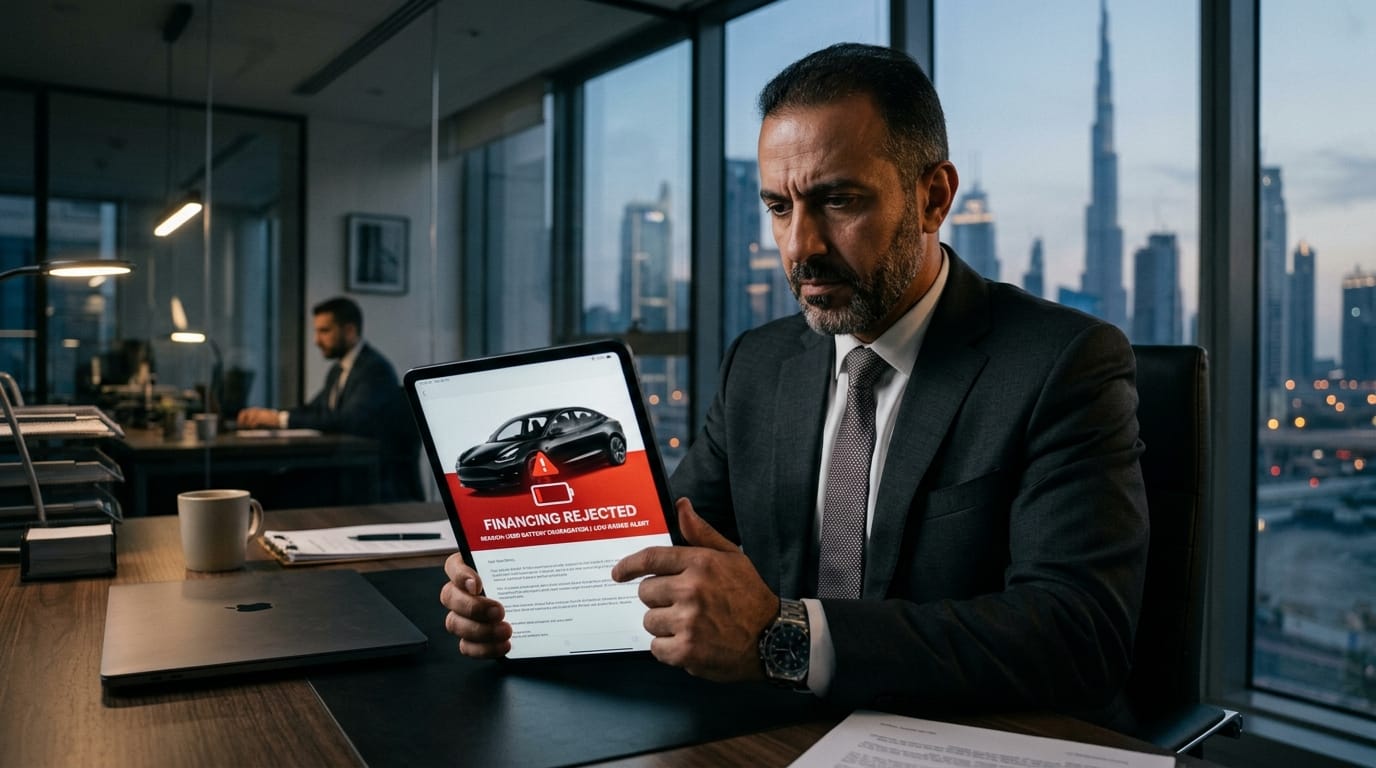
Tesla used battery finance rejections often completely destroy an expat’s plan to switch to electric driving in the UAE. You assume that buying a green vehicle guarantees instant banking approval and heavily subsidized interest rates.
This is a dangerous financial misconception. Banks do not view a five-year-old electric car through the same lens as a traditional petrol vehicle. You must understand the exact fears driving these underwriters before applying, especially after you clean your credit file and learn from past mistakes via.
The Core of the Banking Fear
The underlying banking risk shifts entirely from mechanical engine depreciation to chemical battery degradation. A traditional internal combustion engine loses its market value predictably over a ten-year cycle. Banks know exactly how much a used Nissan Patrol or Toyota Camry will sell for at a public auction if the original owner defaults on the loan.
Electric batteries act identically to giant smartphone batteries.
They lose their maximum charge capacity with every passing year, and the intense UAE summer heat accelerates this chemical decay. If you default, the bank is left with an unsellable asset. Nobody wants to buy a repossessed used Tesla at auction if it requires a 60,000 AED battery replacement out of pocket. This terrifying depreciation curve is exactly why major financial institutions flag older electric vehicles as high-risk investments.
Warranty Limitations and Absolute Expirations
Tesla officially offers a standard eight-year battery and drive unit warranty across their global fleet. This sounds incredibly reassuring on paper, but banks calculate the exact remaining coverage down to the specific month. If you apply for a five-year auto loan on a four-year-old Model 3, the official manufacturer’s warranty will expire long before your loan finishes.
This creates an uninsurable risk zone for the underwriter.
Most underwriters will flatly refuse to finance any electric vehicle if the requested loan tenure outlasts the official warranty. They demand that the collateral remains fully protected by the agency for the entire duration of your financial contract.
Verify federal transport guidelines at.

Overcoming Tesla Used Battery Finance Rejections
You cannot argue emotionally with the underwriter’s automated risk matrix or their computer algorithms. You must actively prove the vehicle’s exact chemical health to bypass their internal systemic restrictions. Do not submit a generic passing certificate from the standard RTA testing center, as this only checks basic road safety components like brakes and tires.
You must provide a comprehensive digital diagnostic report directly from the official agency.
Schedule an appointment at the main service center and request a deep battery health degradation scan. If this official printed report proves the battery retains above 90 percent of its original factory charge capacity, the bank’s risk department will reconsider the application. Attach this specific data to your initial loan file.
Strategic Down Payments for EV Loans
If the vehicle is older and the factory warranty is rapidly fading, your only remaining leverage against the bank is hard cash. You must drastically reduce the bank’s financial exposure by offering a massive initial deposit. A standard 20 percent down payment is frequently rejected for older electric cars.
Offer thirty to forty percent upfront to force an approval.
When you drastically reduce the requested loan amount, the bank is no longer terrified of the battery dying prematurely. The vehicle’s scrap metal and parts value alone would comfortably cover the remaining minor loan balance. This heavy-cash strategy forces the approval through the system, successfully bypassing the standard Tesla used battery finance rejections that trap average, unprepared buyers.
Alternative Dealership Financing Options
If traditional high-street banks continuously reject your application despite a clean AECB score, you must pivot your strategy. Some specialized used EV dealerships in Dubai have established direct relationships with secondary, high-risk finance houses. These private lenders understand the electric vehicle market better than conservative banks.
However, this alternative route comes with a severe financial penalty.
These secondary lenders offset their increased risk by charging significantly higher profit rates. Your monthly installment will be noticeably larger compared to a standard bank loan. Never accept an interest rate above flat 5 percent for a used vehicle. Always demand a transparent amortization schedule from the dealership’s internal finance broker.
The Transition to Premium Insurance Coverage
Securing the loan approval is only the first major hurdle in your electric driving journey across Dubai. Banks will absolutely force you to purchase premium comprehensive insurance before they finalize and release the manager’s cheque to the seller. Standard third-party coverage is never legally allowed for financed electric vehicles due to their massive structural repair costs and specialized parts.
Navigating this new financial landscape requires securing comprehensive agency data before approaching any bank teller. Prove the battery health with official data, negotiate the massive down payment, and secure your green ride safely. Once you drive it off the showroom lot, you must immediately protect your investment from catastrophic repair bills and learn how to maintain premium coverage via Force Agency Repair Car Insurance UAE.
