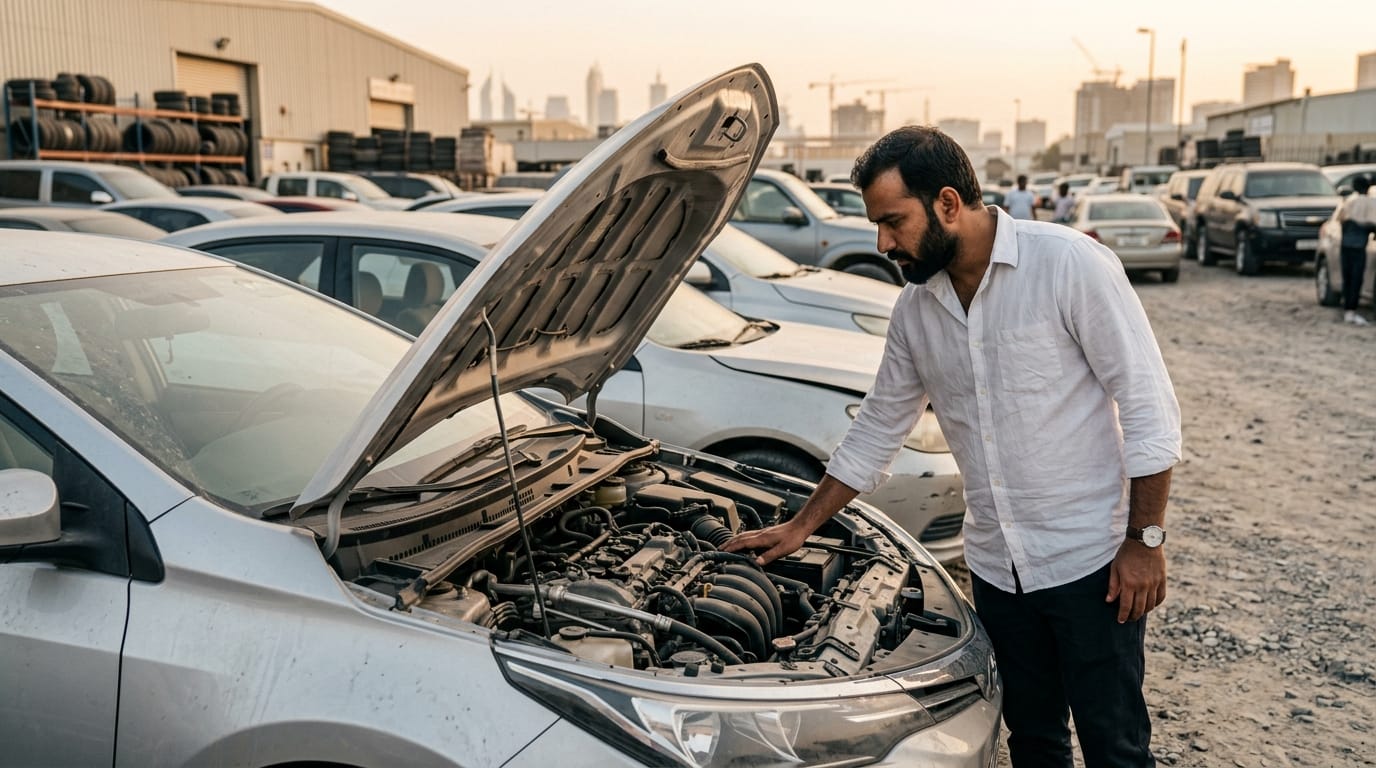
Last Updated: June 2026 | By Omar Al-Fayed, Senior Automotive Consultant | Category: Buying & Selling
A structured 20-minute test drive in the UAE can help you avoid repair costs ranging from 3,000 to 25,000 AED on a used vehicle. Most expat buyers spend more time reviewing a car’s color than its mechanical condition — and that is exactly what sellers count on. This guide gives you a full inspection framework used by professional vehicle inspectors across Dubai, Sharjah, and Abu Dhabi. Whether you are a first-time buyer navigating UAE platforms or someone who has bought before but wants a more systematic approach, these checks apply to every purchase.
The used car test drive checklist UAE buyers need covers far more than transmission feel and brake response — it includes risk scoring, brand-specific concerns, and a printable pass/fail worksheet you can carry to any showroom.
Quick Verdict: The inspection framework in this guide follows the same sequence used at independent pre-purchase centers in Al Quoz and Abu Shagara. It will not replace a full OBD diagnostic, but it will surface the majority of costly mechanical problems before you commit. Estimated risk exposure covered: up to 62,000 AED.
UAE Used Car Risks Buyers Often Miss
The UAE used car market moves fast. Sellers in Sharjah, Ajman, and Deira wholesale lots typically list vehicles for under 10 days before the next wave of buyers arrives. This speed creates pressure that causes buyers to overlook risks that are well understood by experienced local inspectors.
Six risk categories account for the majority of post-purchase complaints documented at Dubai Consumer Protection and through independent workshop records in Al Quoz over recent years.
Accident Damage
Undisclosed accident repair is among the most frequently encountered issues in the UAE used car market. Panel overspray, inconsistent panel gaps, and paint thickness variations (measurable with a paint depth gauge) are the primary indicators. Private sellers in the UAE are not legally required to disclose past accidents in many private transaction circumstances — meaning the buyer carries the burden of discovery. Structural repair on mid-size sedans commonly runs between 4,000 and 15,000 AED depending on the extent. Vehicles with frame straightening that was not documented carry ongoing resale risk regardless of repair quality.
Odometer Rollback
Odometer manipulation has been documented in the UAE market, particularly on vehicles sourced from auctions or resold through multiple dealers before reaching the final buyer. A vehicle appearing to show 65,000 km that has actually covered 130,000 km represents a significant difference in expected maintenance costs and component life. Cross-referencing the stated mileage against service records, RTA inspection history, and physical wear on the steering wheel, pedals, and seat bolster provides partial protection. Independent inspection centers in Al Quoz and Sharjah Industrial Area can also check for signs inconsistent with declared mileage.
Flood Damage
Flood-damaged vehicles do enter the UAE market, primarily as insurance write-offs imported from other markets or as vehicles affected by localized flooding events. Signs include musty smell from AC vents, water stain marks inside door panels, corrosion on electrical connectors under the dashboard, and rust patterns on underbody components inconsistent with the vehicle’s stated age. The financial exposure from undisclosed flood damage commonly runs between 8,000 and 40,000 AED in remediation costs — and many flood-affected vehicles cannot be economically repaired.
Ex-Rental Vehicles
Vehicles that served in rental fleets — operated by regional fleet operators and major rental companies — typically show accelerated wear on interior contact surfaces, transmission components, and suspension from frequent driver changes. Ex-rental vehicles are not automatically poor purchases if maintenance was performed under manufacturer service contracts. The risk lies in the post-contract period: what happened between the end of the rental contract and the vehicle’s arrival at the showroom.
Ex-Taxi Vehicles
Ex-taxi vehicles — primarily Toyota Camry, Nissan Sunny, and Mitsubishi Lancer units from Dubai Taxi Corporation and Abu Dhabi Taxi — typically carry mileage between 250,000 and 400,000 km. Pricing may appear attractive at first review, but near-term maintenance should be budgeted regardless of test drive outcome. Transmission condition, suspension wear, and AC performance under extended idle are the priority inspection areas.
Neglected Maintenance
Vehicles operated by short-term rotation workers — employees on 2-year visas who drove high daily mileage and deferred service — are common in the UAE used market. Signs include dark, degraded engine oil beyond the service window, transmission fluid that has not been changed at manufacturer-specified intervals (particularly on CVT-equipped vehicles), and wear items such as brake pads and filters that are well beyond replacement thresholds. A vehicle showing 70,000 km with no documented oil changes after 50,000 km carries meaningfully higher risk than a vehicle with consistent service history.
Before the Test Drive: What to Collect First
Before starting the engine, request four documents: the Mulkiya (vehicle registration card), the last service invoice, the RTA inspection history, and dealership service records where applicable. Cross-check the VIN on the dashboard against the Mulkiya. Ask the seller directly: “Was this vehicle in any accident?” and “Is this a GCC-spec vehicle?” Note the response — it establishes a record of what was claimed.
The Best Time and Route for a UAE Test Drive
Test drive between 8:00 AM and 10:00 AM before peak temperatures. A cold engine starting from overnight rest reveals more than a pre-warmed one. If the seller meets you with the engine already running, ask to turn it off and wait 10 minutes.
| Route Segment | Speed Range | What It Tests | Minimum Time |
|---|---|---|---|
| Urban / stop-go | 0–60 km/h | Transmission engagement, AC idle performance, suspension over bumps | 5 minutes |
| Secondary road | 60–100 km/h | Acceleration linearity, steering tracking, brake response | 7 minutes |
| Highway or fast road | 100–120 km/h | High-speed stability, wind noise, vibration, engine strain | 5 minutes |
| Post-drive inspection | Stationary | Fluid leaks, burning smells, cooling fan operation | 3 minutes |
The 15-Point Test Drive Checklist
Check 1: Cold Start Performance
Turn the key and observe the first five seconds. A healthy engine starts within one to two seconds, idles smoothly, and settles to a steady RPM between 700 and 900. Rough idle persisting beyond one minute warrants investigation. White exhaust smoke during cold start is relatively normal but should clear within 60 seconds — persistent smoke may indicate coolant entering the combustion chamber, with repair costs commonly between 2,500 and 7,000 AED.
Check 2: Dashboard Warning Lights
All warning lights should illuminate briefly during the self-check sequence, then extinguish. Any light remaining on after the engine starts requires explanation. Common lights that sellers occasionally clear temporarily using an OBD reader include the Check Engine (CEL), ABS warning, and TPMS light.
| Warning Light | What It May Indicate | Risk Level | Approximate Repair Range |
|---|---|---|---|
| Check Engine (CEL) | Sensor fault, emission issue, misfires | Medium–High | 300–4,000 AED |
| ABS Light | ABS sensor or module fault | Medium | 400–2,000 AED |
| Airbag / SRS Light | Airbag system fault, deployed airbag not replaced | High | 1,500–8,000 AED |
| Battery / Charging | Alternator wear, battery age | Low–Medium | 200–900 AED |
| Transmission Warning | CVT or automatic transmission issue | High | 2,000–18,000 AED |
| Oil Pressure | Low oil, oil pump wear | High — do not drive | 500–6,000 AED |
Check 3: Engine Noise Evaluation
With the engine running and the hood open, listen for three categories: regular ticking from the valve area (often a valve clearance adjustment need, 300–600 AED); rhythmic knocking from the lower engine at idle under load (may indicate bearing wear, more costly); and belt-related squealing (tensioner or idler pulley wear, 200–500 AED). A timing chain rattle — a metallic sound during the first seconds of cold start that fades as oil pressure builds — has been observed frequently on higher-mileage Nissan MR20 and HR15 engines.
Check 4: Exhaust Smoke Inspection
Observe exhaust during cold start and again under acceleration after warmup. White smoke clearing within 60 seconds is acceptable. Persistent white smoke after warmup may suggest coolant burning. Blue smoke during acceleration typically points to oil consumption through worn valve seals or piston rings — observed on higher-mileage Mitsubishi 4G engines and certain Hyundai Nu engines. Black smoke under hard acceleration often indicates a fuel system issue.
Check 5: Air Conditioning Performance
Turn AC to maximum on startup. In a well-functioning system, noticeably cool air should arrive within 60–90 seconds. A system that cools adequately while moving but loses effectiveness at idle often indicates a weak compressor or low refrigerant charge — recharge costs run 150–350 AED, but compressor replacement ranges from 1,200 to 3,500 AED.
Check 6: Transmission Operation
For automatic transmissions, acceleration from a standstill should feel smooth and linear. For CVT-equipped vehicles — very common in the UAE market: Nissan Sunny, X-Trail, Sentra, Tiida; Honda City; Mitsubishi Attrage — press the accelerator moderately from a complete stop. The RPM should rise gradually with a corresponding smooth increase in speed. If RPM rises sharply but the car hesitates before moving (the “rubber band” sensation), this indicates CVT belt or pulley wear. Advanced CVT wear approaching 100,000 km without documented fluid changes may require repairs from 4,000 to 18,000 AED.
CVT Warning: On Nissan Sunny, Tiida, and Sentra models with the JF015/RE0F11A CVT, the “rubber band” hesitation sensation is one of the most consistently reported pre-failure indicators observed at workshops in Al Quoz and Sharjah. If present, request a CVT fluid condition check and service history review before proceeding.
Check 7: Acceleration Response
During your secondary road segment, perform a moderate acceleration from 40 to 80 km/h. Power delivery should feel consistent without hesitation or stumbling. Hesitation under load often corresponds to spark plug wear, dirty fuel injectors, or a throttle position sensor issue — typically manageable at 200–800 AED.
Check 8: Steering System Evaluation
On a flat straight road, briefly release light pressure on the steering wheel for two to three seconds. The vehicle should track straight with minimal drift. A consistent pull to one side may indicate alignment issues (150–250 AED) or, if accompanied by uneven tire wear, a deeper suspension geometry problem. Steering vibration at highway speed often indicates wheel balance issues (60–120 AED) but may also point to wheel bearing wear.
Check 9: Brake System Check
Perform two brake applications: one moderate from 80 km/h, and one firm from 60 km/h. The pedal should feel firm and consistent throughout. A pedal that slowly sinks under sustained pressure may indicate a master cylinder issue. Vibration through the pedal typically indicates warped brake rotors — rotor replacement costs commonly run 400–1,200 AED per axle. A pulling sensation during braking often points to a seized brake caliper.
Check 10: Suspension Inspection During Driving
Drive over at least two speed breakers during your urban segment. A vehicle that continues bouncing after a speed breaker (two or more oscillations) suggests worn shock absorbers. A clunking sound over bumps often indicates worn suspension bushings or strut top mounts — components that deteriorate faster in UAE heat conditions. Suspension work on mid-range sedans commonly runs 800–3,000 AED depending on what needs replacing.
Check 11: Tire Condition Analysis
Observe tire wear before and after the test drive. Uneven wear on the inside or outside edge of front tires typically indicates alignment or suspension geometry issues. Check the tire manufacturing date (DOT code on the sidewall: first two digits = week, last two = year). Tires older than five years in the UAE may show sidewall micro-cracking from UV and heat exposure regardless of tread depth. Full set replacement runs 900–2,400 AED for common UAE sedans.
Check 12: Highway Stability Test
At 110–120 km/h, the vehicle should feel planted, quiet, and directionally stable. Excessive vibration at this speed often points to wheel balance issues or worn wheel bearings. A pronounced droning sound that increases with vehicle speed (not engine speed) is a common indicator of wheel bearing wear — repair runs 400–1,200 AED per bearing. Sharjah Industrial Area workshops have been observed offering competitive pricing on this repair for Japanese makes.
Highway Test Note: Many test drives in the UAE happen within showroom areas and never reach highway speed. Insist on a route that reaches at least 100 km/h. Issues that appear only at higher speeds are among the most frequently missed by buyers who conduct short, slow test drives.
Check 13: Interior Electronics Check
While driving, cycle through: all power windows (full up and down), both exterior mirrors, infotainment system (Bluetooth, backup camera, screen response), and all AC vents. Faulty parking sensors are common on vehicles that have experienced minor rear impacts — a useful indicator of undisclosed accident history. Individual sensor replacement runs 80–200 AED; full camera replacement on older systems commonly runs 300–800 AED.
Check 14: Parking and Low-Speed Maneuvers
In a parking area, perform a full lock-to-lock steering cycle at low speed in both directions. A clicking or popping sound during full lock turning — particularly in front-wheel-drive vehicles — typically indicates worn CV joint boots or CV joints. CV joint replacement on common UAE sedans runs 400–1,200 AED per side. This sound is frequently noted on higher-mileage Nissan Sunny, Honda City, and Toyota Corolla models.
Check 15: Post-Drive Inspection
After returning to the seller’s location, turn off the engine and wait two minutes. Then check beneath the vehicle for any fluid on the ground. Engine oil appears dark brown to black; coolant appears green, pink, or orange; transmission fluid appears red to dark brown. Any visible dripping indicates an active leak requiring identification before purchase. A burning plastic or rubber smell may indicate oil dripping onto a hot exhaust component.
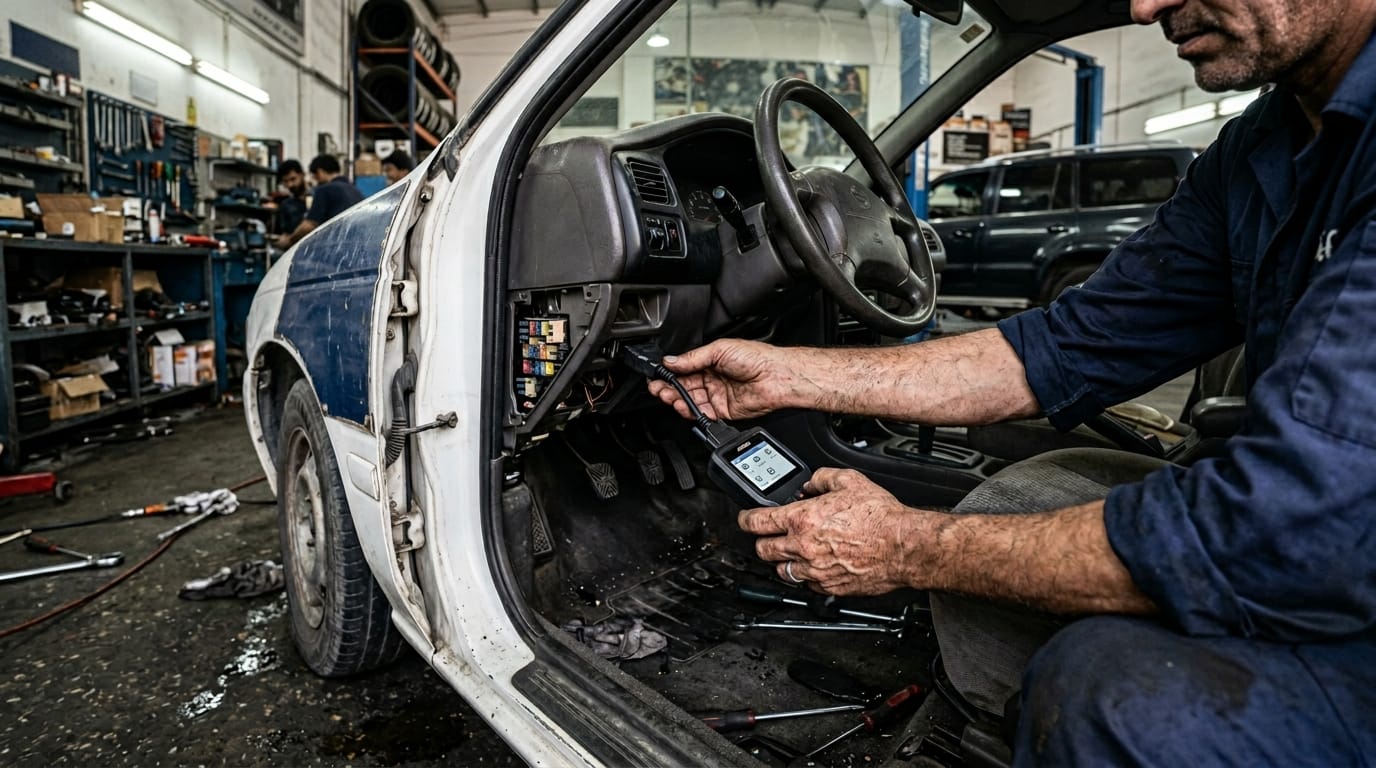
Repair Cost Risk Matrix
Not every test drive finding carries the same financial weight. This matrix classifies faults by cost tier so buyers can calibrate their negotiation response appropriately.
| Fault | Low Cost (under 800 AED) | Medium Cost (800–3,500 AED) | High Cost (3,500 AED+) |
|---|---|---|---|
| Transmission (CVT) | Fluid change only | Partial repair / rebuild component | Full rebuild or replacement: 4,000–18,000 |
| Engine coolant system | Hose or thermostat only | Water pump or radiator | Head gasket: 2,500–7,000 |
| Air conditioning | Refrigerant recharge: 150–350 | Evaporator or condenser | Compressor replacement: 1,200–3,500 |
| Airbag / SRS system | Sensor fault reset | Clock spring or module | Deployed airbag + module: 3,000–8,000 |
| Engine (lower end) | Oil service catch-up | Valve or timing component | Bearing wear or rebuild: 5,000–12,000+ |
| Suspension | Alignment only: 150–250 | Bushings or struts: 800–2,000 | Full suspension overhaul: 2,500–4,500 |
| Brakes | Pads only: 300–600 | Rotors + pads: 800–1,500 | Caliper + rotors + pads: 1,500–2,500 |
| Wheel bearings | Single bearing: 300–500 | Both front: 600–1,200 | All four: 1,200–2,400 |
| CV joints | Boot only: 200–400 | Single joint: 400–800 | Both sides: 800–1,500 |
| Tires | Two tires: 450–900 | Four tires mid-range: 900–1,600 | Premium full set: 1,600–2,400 |
| Electrical / warning lights | Sensor reset: 50–150 | Module or sensor: 300–1,200 | ECU or complex fault: 1,500–4,000 |
Low-Risk Findings: What You Can Negotiate On
Not every issue found during a test drive is a reason to walk away. Several common findings represent legitimate negotiation opportunities rather than purchase disqualifiers. Understanding this distinction prevents buyers from either overpaying for a vehicle with manageable issues or walking away from reasonable purchases unnecessarily.
Cosmetic Issues That Do Not Affect Function
Minor surface scratches, stone chips on the front bumper, interior plastic wear on high-touch surfaces (gear knob, door handles), and small upholstery scuffs are normal in the UAE market given heat and sand exposure. These items are useful negotiation points — quote the cost of a touch-up service in Al Quoz (typically 200–600 AED for minor scratch correction) and request a corresponding price reduction. They are not mechanical concerns.
Easy Repairs With Known Costs
A vehicle that needs a refrigerant recharge (150–300 AED), a brake pad replacement on one axle (300–500 AED), a full wheel balance and alignment (200–350 AED), or a cabin air filter change (80–150 AED) is not a troubled vehicle. It is a negotiation vehicle. Arrive at the showroom with a pre-quoted repair cost from a nearby workshop, present it to the seller, and request the full amount deducted from the asking price. This approach has been observed to succeed in the majority of cases across Dubai and Sharjah showroom transactions.
Negotiation Opportunities by Finding
| Finding | Negotiation Approach | Suggested Discount Range (AED) | Recommendation |
|---|---|---|---|
| Minor tire wear | Document and request reduction | 500–1,200 | Buy with discount |
| AC needs recharge | Quote from workshop, deduct | 200–400 | Buy with discount |
| Brake rotor vibration | Workshop quote, deduct full amount | 600–1,200 | Buy with discount |
| Suspension bush noise | Request independent inspection first | 1,000–2,500 | Inspect then decide |
| CVT hesitation present | Request fluid check, full inspection | 2,000–4,000 minimum | Inspect before deciding |
| SRS light on | Walk away unless full documentation | N/A | Walk away |
| Persistent white smoke (warm engine) | Walk away or full engine inspection | N/A | Strong caution |
| Blue smoke on acceleration | Walk away for budget buyers | N/A | Walk away |
Vehicle Type Specific Advice
Different vehicle categories carry different test drive priorities in the UAE market. A uniform 15-point checklist applies to all of them, but knowing where each category is most vulnerable allows more efficient use of the 20-minute window.
Economy Cars (Nissan Sunny, Toyota Yaris, Mitsubishi Attrage)
The primary risk in this category is CVT condition and AC compressor health. Economy vehicles are frequently operated as daily commuters by rotation workers covering 60–100 km per day in stop-start Sharjah-Dubai traffic. This usage pattern places significant strain on CVT fluid life and compressor cycling. Focus the majority of your inspection time on Checks 6 and 5. Parts availability for Toyota and Nissan economy models is strong across Al Quoz and Sharjah Industrial Area — same-day availability for most wear items.
Mid-Size Sedans (Toyota Corolla, Hyundai Elantra, Kia Cerato, Honda City)
The most common segment in the UAE used market. Risks are broadly distributed across all 15 checks. Pay particular attention to service history documentation — this segment attracts the highest volume of vehicles with undisclosed service gaps. Toyota Corolla ownership costs over 18 months show that buyers who identified and negotiated on test-drive findings spent an average of 2,000–4,000 AED less in first-year repairs than those who purchased without structured inspection.
Full-Size Sedans and SUVs (Toyota Camry, Nissan Altima, Hyundai Tucson, Kia Sportage)
These vehicles frequently served as ex-taxis or ex-rental fleet units before reaching the retail market. Mileage tends to be higher than in the economy segment. Transmission condition, suspension wear under the heavier body weight, and AC performance under extended idle are priority areas. For turbocharged SUV variants (some Tucson and Sportage trims), the boost consistency test in Check 7 becomes particularly important.
Pickup Trucks (Nissan Navara, Toyota Hilux, Mitsubishi L200)
Pickup trucks in the UAE frequently served construction, delivery, or off-road roles. Inspect the load area and underbody for stress damage beyond cosmetic wear. Four-wheel-drive engagement (if equipped) should be tested specifically — engage 4H on a low-speed turn and listen for transfer case hesitation or grinding. Rear leaf spring condition is a priority inspection point; replacement per side commonly runs 600–1,500 AED at Al Quoz truck workshops.
Hybrid Vehicles (Toyota Camry Hybrid, Toyota Corolla Hybrid)
Hybrid battery health cannot be reliably assessed during a standard test drive. Request a State of Health (SOH) reading from a workshop with Toyota-compatible diagnostic equipment before purchasing any hybrid with mileage above 80,000 km. A hybrid battery replacement on the Camry Hybrid runs between 8,000 and 18,000 AED depending on whether OEM or refurbished packs are used. Hybrid-specific workshops in Al Quoz and Dubai Industrial City (DIC) can provide SOH reports for approximately 150–300 AED. The test drive itself should confirm that the EV mode engages at low speed and that the regenerative braking feel is consistent.
Electric Vehicles (BYD, MG, Tesla)
EV test drives require different criteria. Battery range display should be checked against the manufacturer specification for that model and year — a significant deviation from rated range at moderate charge level may indicate battery degradation. Charge port function (test charging connectivity if possible), regenerative braking consistency, and all DC fast-charging compatibility documentation should be verified. EV resale values in the UAE are still establishing themselves, and insurance availability for some EV models remains limited compared to established Japanese brands.
Luxury Vehicles (Mercedes, BMW, Audi, Lexus)
A 20-minute test drive is not sufficient protection for luxury vehicle purchases. Complex electronic systems may present cleanly during the drive while carrying unresolved fault codes. A full OBD diagnostic and independent pre-purchase inspection at a specialist workshop in Al Quoz is essential for any German luxury vehicle below market value. Budget 350–700 AED for a comprehensive pre-purchase inspection. The test drive serves as a screening tool to confirm the vehicle is worth pursuing for full inspection — not as the primary assessment method. Full 20-month reports on mid-tier vehicles reveal patterns that also apply to luxury segment assessments.
Brand-Specific Test Drive Focus Areas
Toyota (Corolla, Camry, Yaris, Land Cruiser, RAV4)
Toyota vehicles remain among the most reliable in the UAE used market, with parts widely stocked across Al Quoz Industrial Area and Sharjah Industrial Area — typically available same day without ordering. Focus on: transmission smoothness on higher-mileage Camry 2.5L models (torque converter shudder has been reported), AC performance on high-mileage Corolla (evaporator clogging is commonly observed), and electric power steering rack condition on Corolla models from 2013 onward.
Nissan (Sunny, Altima, X-Trail, Patrol, Sentra)
The CVT transmission behavior is the primary focus for any Nissan test drive. Beyond CVT performance, check for: timing chain rattle on cold start (MR20 and HR15 engines), AC compressor noise on high-mileage Sunny, and rear suspension bush condition on X-Trail models. Nissan parts availability in the UAE is strong, with suppliers concentrated in Al Quoz and Deira wholesale markets.
Nissan CVT Dedicated Checklist
The Nissan CVT warrants its own inspection sequence given how frequently it determines the purchase decision on UAE market Nissans. Perform these five tests in order:
Test 1 — Cold engagement: from a cold start (engine under 60°C), press the accelerator gently from stationary. Note how quickly the vehicle begins to move versus how quickly the engine RPM rises. A gap of more than 1.5 seconds between RPM rise and vehicle movement is a concern. Test 2 — Rubber band check: from 30 km/h, accelerate to 80 km/h moderately. The transition should be seamless. Any sensation of RPM floating without proportional speed increase requires investigation. Test 3 — Reverse engagement: from stationary, engage reverse and release the brake without pressing the accelerator. The vehicle should creep backward smoothly within one second. Test 4 — High-speed cruise: at 100 km/h on a flat road, hold steady throttle. RPM should be stable and relatively low (typically 1,800–2,200 for most Nissan economy models). Hunting or fluctuating RPM at steady speed indicates CVT wear. Test 5 — Fluid color check: request the seller allow a CVT fluid dipstick check (where accessible) or arrange a workshop drain inspection. Healthy CVT fluid is light pink to pale amber. Dark brown or black fluid with a burnt smell indicates neglected maintenance.
Nissan CVT Decision Rule: If the vehicle fails two or more of the five CVT tests above, a purchase at market price is not recommended without a full workshop inspection and a price adjustment that accounts for potential repair costs between 4,000 and 18,000 AED.
Toyota Used Car Test Drive Checklist
Toyota vehicles have strong baseline reliability, but specific model-year combinations carry known issues that the test drive should target. For Toyota Corolla (2014–2019): check electric power steering for hesitation or groaning at low speed, particularly in hot weather immediately after startup. For Toyota Camry (2.5L, 2015–2019): listen for torque converter shudder — a light vibration at light throttle between 60 and 80 km/h that feels similar to driving over fine corrugations. For Toyota Yaris (1.3L and 1.5L, pre-2019): note the AC performance specifically; smaller cabin paired with a smaller compressor means AC degradation is felt earlier. For Toyota Land Cruiser (older GX models): front differential engagement, transfer case noise, and rear suspension sag under load are priority checks. Parts availability across Al Quoz for all Toyota models is reliably strong — this is the primary practical advantage of Toyota in the UAE used market.
Honda (City, Accord, CR-V)
Honda City models with CVT warrant the same engagement hesitation test as Nissan. On Accord models, focus on: transmission smoothness through gear changes (6-speed automatic on 2.4L), engine oil level and color after the drive (Honda 2.4L engines have a reported oil consumption tendency at higher mileage in UAE heat conditions), and steering feel for play or vagueness. Honda CR-V models above 80,000 km should have the AC performance tested specifically at idle — condenser fouling from desert dust is more common on this model’s intake configuration.
Hyundai and Kia Dedicated Checklist
For Hyundai Elantra and Kia Cerato: focus on the Nu 1.6L and Gamma 1.4L engine valve train noise at idle, which has been noted at higher mileage. For DCT-equipped variants (some post-2017 Elantra and Cerato): perform a low-speed crawl test — from stationary, release the brake gently in drive without pressing the accelerator on a flat surface. DCT engagement should be smooth and immediate. A shudder or jerk during low-speed engagement on a cold DCT may indicate clutch pack wear, which carries repair costs between 3,000 and 7,000 AED. For Hyundai Tucson and Kia Sportage with turbocharged engines: confirm boost consistency during the acceleration test and listen for any boost leak hiss under hard acceleration. Parts availability for Hyundai and Kia has improved significantly in the UAE, with Sharjah Industrial Area offering competitive pricing on common wear items. Full Elantra UAE review with real ownership data covers the specific failure patterns observed across the Emirates.
Mitsubishi (Lancer, Attrage, Eclipse Cross, L200)
Lancer models, including ex-taxi units, benefit from extra attention on oil consumption (blue smoke test during warm-up), CVT hesitation on Attrage models, and AC performance — the Attrage’s smaller compressor occasionally struggles during prolonged urban idle in UAE summer conditions. For Eclipse Cross: the turbocharged 1.5L engine should be checked for intercooler connection integrity and consistent boost delivery. Parts for Mitsubishi in the UAE are available primarily through Sharjah Industrial Area and specialized suppliers in Deira — less immediate availability than Toyota or Nissan, but generally manageable within 24–48 hours for common items.
Mazda (Mazda3, Mazda6, CX-5)
Mazda vehicles in the UAE used market are less common than Japanese-brand competitors, which affects parts availability. Al Quoz has a smaller concentration of Mazda-specialist workshops compared to Toyota or Nissan. For the Mazda3 and Mazda6 with SkyActiv engines: engine noise under hard acceleration (known SkyActiv piston noise characteristics at higher mileage), and oil consumption on GCC-spec variants above 80,000 km are priority areas. CX-5 models should have the AWD system engaged during the test drive if equipped — transfer case engagement noise is a reported concern on higher-mileage units.
Ford (Focus, Fusion, Explorer, EcoSport)
Ford vehicles — particularly US-spec imports — are common in the UAE used market. The PowerShift dual-clutch transmission on Focus and Fusion models (2011–2016) has well-documented hesitation and shudder characteristics in hot weather conditions. This is a specific test drive priority for any Ford with this transmission. The EcoBoost turbo engines should be evaluated for consistent boost delivery and any oil consumption signs. Parts availability for Ford in the UAE is adequate through authorized dealers but more limited at independent workshops compared to Japanese brands, which typically means higher workshop labor rates.
Chevrolet (Malibu, Captiva, Tahoe, Spark)
American-specification Chevrolet models frequently require GCC conversion work for optimal UAE performance, primarily around AC system capacity and cooling system tuning. Chevrolet Malibu and Captiva in the UAE market carry a mixed ownership cost reputation — comparative expat reviews consistently show higher maintenance frequency than Japanese equivalents in the same price range. The Captiva’s timing chain and engine mount wear at higher mileage are known inspection points. Chevrolet Spark economy models are simpler mechanically and carry lower repair risk, though resale values are below Japanese equivalents.
MG (MG5, MG6, ZS, HS)
MG has grown its UAE presence significantly. MG5 and ZS models are now common in the sub-30,000 AED used segment. Key test drive observations: DCT transmission smoothness on MG5 and HS models (low-speed engagement is the primary test), AC performance under full-sun parking conditions, and infotainment system responsiveness (software lag has been reported on some model years). Parts availability for MG has improved but remains more dependent on authorized dealer supply chains compared to established brands — factor this into ownership risk assessment, particularly for post-warranty vehicles.
Geely (Emgrand, Coolray, Atlas)
Geely models are relatively recent entrants to the UAE used market. Test drive focus areas: DCT engagement smoothness on Coolray and Atlas (the same low-speed crawl test used for Hyundai DCT variants applies), NVH (noise, vibration, harshness) at highway speed — Geely models have shown variable cabin insulation quality across model years, and engine oil consumption at higher mileage. Parts availability for Geely in the UAE is primarily through authorized service centers, with limited aftermarket coverage — this is a meaningful ownership risk factor for vehicles beyond the initial warranty period.
Used SUV Test Drive Checklist
SUVs require additional test drive checks beyond the standard 15-point framework due to their weight, driving dynamics, and the common UAE use pattern of off-road or desert driving.
First, test the ride height and body roll on a secondary road with lane changes at 60–70 km/h. Excessive body roll indicates worn anti-roll bar bushings or weak shock absorbers — common on high-mileage SUVs in the UAE heat. The SUV’s heavier body amplifies the cost of suspension neglect compared to sedans. Second, for 4WD-equipped SUVs: engage 4H mode and drive at 30 km/h for approximately two minutes. Any grinding, hesitation, or warning light during engagement warrants investigation of the transfer case and front differential. Third, test the hill descent control or hill hold assist if equipped — these systems are frequently disabled or faulted on ex-off-road vehicles. Fourth, inspect the underbody after the drive for signs of rock or kerb impact damage — a common finding on UAE SUVs that were used in desert areas around Sharjah and Fujairah.
| SUV-Specific Check | What It Detects | Typical Repair Range (AED) |
|---|---|---|
| Body roll test (lane change at 60 km/h) | Anti-roll bar bushings, shock absorber condition | 800–3,000 |
| 4WD engagement test | Transfer case, front differential | 1,500–6,000 |
| Hill hold / descent control | ABS module, electronic system faults | 500–3,000 |
| Underbody inspection | Rock damage, rust, off-road impact | Varies widely |
| Third-row seats (7-seat models) | Track condition, folding mechanism | 200–800 |
| Tow hitch / tow package condition | Frame stress from towing use | Structural inspection required |
Imported Vehicle Checklist
Not all vehicles in the UAE used market were sold new in the GCC. US-spec imports are relatively common, particularly for American and Japanese models. Japanese domestic market (JDM) imports are less common but present. Korean domestic market (KDM) vehicles occasionally appear in the Sharjah and Ajman market.
US Import Specific Checks
US-spec vehicles were calibrated for American temperature ranges, fuel quality, and emissions standards. In the UAE, the primary practical differences are: AC capacity (US-spec compressors and condensers may be undersized for sustained UAE summer use), emissions sensor behavior (US-spec OBD codes may behave differently than GCC-spec equivalents), and rust patterns from humid climate exposure before export. Inspect the vehicle’s VIN against import documentation — a legitimate US import should have clear import customs paperwork. Workshops in Al Quoz that specialize in US-spec conversions note that properly converted vehicles can perform adequately, but undisclosed imports with no conversion records carry higher ownership risk. US-spec vehicles also typically carry lower resale values in the UAE market than equivalent GCC-spec units.
Japanese Import Specific Checks
Japanese domestic market imports, where they appear in the UAE market, may carry right-hand-drive configuration, Japanese-language infotainment, and different safety equipment specifications than GCC-spec equivalents. Confirm that the vehicle has been legally imported and that the RTA transfer is clear. Speedometer calibration in km/h should be verified. On the positive side, JDM vehicles often carry documented full service histories from Japanese workshops — physically inspect any presented service booklets for dealer stamps and dates consistent with the stated mileage.
Korean Import Specific Checks
Korean domestic market vehicles are less common in the UAE but present in the economy segment. The key check is specification alignment — KDM vehicles may have different safety equipment, airbag configurations, and engine tuning compared to GCC-spec Hyundai and Kia equivalents. Check that the VIN confirms GCC specification via the manufacturer’s VIN decoder, which identifies production market. KDM imports below market price should be approached with additional caution around specification verification.
Most Common Problems Detected During Test Drives in the UAE
| Problem | Test Drive Warning Sign | Repair Urgency | Estimated Cost (AED) |
|---|---|---|---|
| CVT wear (Nissan, Honda) | Rubber-band hesitation, RPM surge | High | 4,000–18,000 |
| AC compressor wear | Weak cooling at idle, warm air on low speed | Medium–High | 1,200–3,500 |
| Warped brake rotors | Pedal vibration during braking | Medium | 400–1,200 |
| Worn shock absorbers | Multi-bounce over speed breakers | Medium | 800–2,500 |
| Wheel bearing wear | Droning noise increasing with vehicle speed | Medium–High | 400–1,200 |
| CV joint wear | Clicking on full lock low-speed turns | Medium | 400–1,200 |
| Engine oil consumption | Blue smoke on acceleration | High | 500–6,000+ |
| Coolant system leak | Persistent white smoke, sweet smell | High | 300–7,000 |
| Wheel alignment / suspension geometry | Vehicle pull, uneven tire wear | Low–Medium | 150–2,500 |
| Airbag system fault | SRS light on | High (safety) | 1,500–8,000 |
GCC Spec vs Imported Vehicle: Test Drive Differences
GCC-specification vehicles were manufactured with the UAE climate in mind. Imported vehicles — particularly US-spec models — were not built for these conditions and may show AC underperformance, premature coolant system wear, and different emissions sensor behavior.
During the test drive, an imported US-spec vehicle may perform acceptably in cooler months but show AC stress during summer. Checking the AC on a day when temperatures exceed 38°C is the most reliable test.
Test Driving Ex-Rental Vehicles
Ex-rental vehicles from fleet operators typically show accelerated wear on interior contact surfaces, transmission components, and suspension. The test drive should place extra attention on CVT hesitation, suspension noise over bumps, and AC performance under extended idle. Ex-rental vehicles are not automatically poor purchases. The key question is: what happened to the vehicle’s maintenance schedule after the rental contract ended.
Test Driving Ex-Taxi Vehicles
Ex-taxi vehicles — primarily Toyota Camry, Nissan Sunny, and Mitsubishi Lancer from Dubai Taxi Corporation and Abu Dhabi Taxi — typically carry mileage between 250,000 and 400,000 km. The test drive focus areas are: transmission health, engine oil condition after warmup, suspension wear at low speed over bumps, and AC performance at idle. Many ex-taxi vehicles are sold through mid-tier Sharjah and Ajman showrooms at prices appearing attractive against market rates — budget for near-term maintenance regardless of the test drive outcome.
Real Case Studies: Workshop and Market Logs
Case Study 1 — Indian IT Professional, Dubai (Nissan Sunny, 67,000 km)
Ahmed, based in Dubai Internet City, was viewing a 2019 Nissan Sunny with 67,000 km at a Sharjah showroom priced at 26,000 AED. Using the CVT engagement test in Check 6, he noticed a 1.5-second hesitation from standstill. He requested an independent CVT fluid check at a nearby Al Quoz workshop (cost: 80 AED for the diagnostic). The fluid showed dark, degraded condition — indicating a likely missed service interval. He negotiated 3,500 AED off the asking price to cover the fluid change and a workshop inspection, resulting in a purchase at 22,500 AED with a documented starting point for maintenance. Example scenario based on recurring UAE market patterns observed in workshops.
Case Study 2 — Filipino Healthcare Worker, Abu Dhabi (Toyota Corolla, 89,000 km)
Maria, a nurse in Abu Dhabi, was considering a 2017 Toyota Corolla with 89,000 km priced at 31,000 AED. The Check 9 brake test revealed moderate pedal vibration during firm braking from 60 km/h. An independent pre-purchase inspection at an Abu Dhabi Industrial City workshop (cost: 350 AED) confirmed warped front rotors. She negotiated 1,800 AED off the price to cover rotor and pad replacement, completing the purchase at 29,200 AED with a known and manageable repair need already costed. Example scenario based on recurring UAE market patterns observed in workshops.
Case Study 3 — Pakistani Engineering Technician, Sharjah (Honda City, 112,000 km)
Khalid, working in Sharjah’s industrial sector, was evaluating a 2016 Honda City with 112,000 km priced at 19,500 AED. Check 4 (exhaust smoke) revealed faint but persistent blue smoke during hard acceleration on the highway segment. He walked away from this vehicle without negotiating — blue smoke on a 112,000 km Honda City at this price point represented engine oil consumption risk that the purchase price did not adequately account for. He subsequently purchased a 2018 Mitsubishi Attrage with 58,000 km at a similar price point, which passed all 15 checks without issue. Documented case, details changed for privacy.
Buyer Risk Scorecard
Complete this scorecard during or immediately after the test drive. Total the scores to determine your overall risk assessment before making any purchase decision.
| Category | Item Checked | Pass (0 pts) | Caution (1 pt) | Fail (3 pts) | Your Score |
|---|---|---|---|---|---|
| Mechanical | Cold start and idle | Clean start, smooth idle | Rough idle clearing within 60s | Rough idle persisting, smoke | ___ |
| Transmission behavior | Smooth, linear response | Minor hesitation, clears at speed | Rubber-band sensation, RPM surge | ___ | |
| Engine noise and smoke | Quiet, no smoke after warmup | Minor ticking, clears | Knocking, persistent smoke | ___ | |
| Cosmetic | Exterior condition | Minor stone chips only | Panel repair visible, consistent color | Significant panel misalignment, overspray | ___ |
| Interior condition | Normal wear for age/mileage | Significant wear on contact surfaces | Damage inconsistent with stated history | ___ | |
| Documentation | VIN match | Dashboard, Mulkiya match | — | Mismatch detected | ___ |
| Service history | Documented, no gaps above 15,000 km | Partial records, some gaps | No records, unverifiable history | ___ | |
| Accident disclosure | Clean, confirmed verbally | Minor disclosed, documented repair | Undisclosed evidence found | ___ | |
| Driving | Brakes and suspension | Firm pedal, clean suspension | Minor vibration or noise | Pedal sink, significant bounce or clunk | ___ |
| AC and electronics | Cools within 90s, all functions work | Mild lag, one minor fault | Poor cooling, multiple faults | ___ | |
| Overall Risk Total | ___ | ||||
Score 0–2: Low risk. Proceed to price negotiation based on cosmetic findings. Score 3–6: Moderate risk. Request independent inspection before purchase. Score 7+: Elevated risk. Walk away or require full inspection at buyer’s choice of workshop at seller’s cost before proceeding.
Scam Prevention: What Dishonest Sellers Do Before You Arrive
Most Common Scam — Pre-Warmed Engine: A seller who meets you with the engine already running has eliminated your ability to conduct Checks 1, 3, and 4 reliably. Cold-start issues — rough idle, blue or white smoke, unusual sounds — are the most commonly concealed faults in the UAE used car market. Always insist on returning when the engine is cold, or request a 10-minute cool-down before starting the test. Any seller who actively resists this request is providing you with significant information about what they are trying to conceal.
Other common preparation tactics used by some sellers to manage test drive impressions include: temporary OBD code clearing to extinguish warning lights (codes typically return within one to three drive cycles — ask for a 24-hour right of inspection before purchase), refrigerant top-up shortly before the test drive to mask AC deficiency that would otherwise appear at idle, and wheel balancing performed immediately before sale to mask bearing noise that re-emerges after one to two weeks of normal driving.
The safest response to any of these tactics is the same: an independent pre-purchase inspection by a workshop of your choice, conducted at your timing. Sellers who object to independent inspection have limited justification for doing so if the vehicle is represented as being in the condition claimed.
For a broader understanding of how sellers position vehicles in the market, the full guide on what dishonest UAE car dealers say covers verbal tactics in detail.
Should You Buy, Negotiate, or Walk Away
The test drive findings, combined with your Risk Scorecard total, determine your recommended action. This framework is designed to be used immediately after completing the 20-minute inspection, before any negotiation conversation begins.
| Scorecard Result | Key Findings | Recommended Action | Rationale |
|---|---|---|---|
| 0–2 (Low Risk) | No mechanical concerns, good documentation | Safe Buy — negotiate on cosmetics only | Vehicle meets baseline criteria; focus on price |
| 3–4 (Moderate Risk) | Minor mechanical items, partial service history | Negotiate — deduct workshop quote from price | Known issues are manageable; cost the repair first |
| 5–6 (Elevated Risk) | CVT hesitation, suspension noise, documentation gaps | Inspect First — independent check at your workshop | Risk is real but purchase may still be reasonable at revised price |
| 7–9 (High Risk) | Multiple mechanical concerns, undisclosed evidence | Walk Away unless seller covers inspection cost | Multiple unknown costs; price discount unlikely to compensate |
| 10+ (Very High Risk) | Safety lights, smoke, structural concerns | Walk Away | Risk exposure likely exceeds vehicle value in this price range |
First-Time Expat Buyer Guide: After the Test Drive
Finding a vehicle that passes the test drive is the beginning of the purchase process, not the end. First-time expat buyers frequently encounter friction in the administrative steps that follow. This section covers the four key post-test-drive requirements.
Registration Transfer
Vehicle ownership transfer in the UAE requires both buyer and seller to be present at a Tasjeel or Emirates Post vehicle licensing center. Required documents include: seller’s Emirates ID, buyer’s Emirates ID, Mulkiya, and a passing RTA test certificate (if the vehicle’s current test has expired or is within 30 days of expiry). The transfer fee typically ranges from 350 to 600 AED depending on emirate and vehicle type. Processing is usually completed within one to two hours. The full UAE car registration guide for expats covers the step-by-step process in detail including what frequently causes first-time delays.
Insurance Requirement
A valid UAE insurance policy is required before the vehicle can be registered in your name. Third-party insurance (the minimum legal requirement) typically runs between 1,200 and 2,500 AED annually for common used vehicles. Comprehensive insurance with a declared value consistent with your purchase price is generally recommended for vehicles above 25,000 AED. Insurance can be arranged online through comparison platforms or directly with insurers — the process typically takes under 24 hours once vehicle details are confirmed.
Ownership Transfer Process
Private sales require the seller to clear any outstanding Salik (road toll) balance and any unpaid traffic fines before transfer. Ask the seller to confirm a zero balance on the RTA app before proceeding. Some sellers present vehicles with outstanding fines that become the buyer’s problem after transfer if not caught beforehand. The ownership transfer does not automatically clear outstanding fines on the vehicle — it is the buyer’s responsibility to confirm a clean record prior to signing.
Inspection Centers for Independent Pre-Purchase Assessment
Three independent inspection service clusters are reliably accessible to UAE buyers: Al Quoz Industrial Area 1 and 3 (Dubai), Abu Shagara Industrial Area (Sharjah), and Abu Dhabi Industrial City (Abu Dhabi). Service typically includes a visual inspection, OBD diagnostic scan, and written report. Cost ranges between 250 and 600 AED depending on the depth of inspection. For luxury vehicles or vehicles above 40,000 AED, manufacturer-authorized pre-purchase inspections at main dealer workshops are available at comparable or slightly higher cost but include brand-specific diagnostic capability.
Buyer Mistakes During Test Drives
| Mistake | Why It Happens | What It Costs |
|---|---|---|
| Accepting pre-warmed engine | Seller runs engine before arrival to mask cold-start issues | Misses Checks 1, 3, 4 |
| Skipping highway segment | Showroom location, time pressure | Misses Check 12 — wheel bearings, vibration, stability |
| Ignoring AC performance at idle | AC feels fine while moving | Compressor issue undetected — 1,200–3,500 AED |
| Not checking under vehicle after drive | Feels intrusive to do at seller’s location | Active oil or coolant leaks undetected |
| Trusting Tasjeel as a mechanical certificate | RTA test checks compliance, not component wear | Passes vehicles with significant wear within legal limits |
| Rushing due to seller pressure | “Another buyer is coming today” | All 15 checks incomplete — highest single risk factor |
| Focusing only on purchase price | Budget pressure causes tunnel vision | Ignores total cost of ownership including near-term maintenance |
| Skipping independent inspection on luxury vehicles | Test drive felt smooth, assumed good condition | Complex electronic faults cost 2,000–8,000 AED after purchase |
High-Risk Walk-Away Situations
Certain findings during a test drive are serious enough that most experienced inspectors recommend walking away without further negotiation, unless the seller agrees to a full independent inspection at buyer’s choice of workshop at the seller’s cost.
An active airbag warning light that the seller cannot explain with documentation represents a safety concern with uncertain repair cost. A transmission showing severe hesitation, slipping, or unusual noises at multiple points during the test drive — particularly in CVT-equipped vehicles — may require full replacement rather than service. An engine producing persistent white smoke at full operating temperature, combined with any coolant level irregularity, represents the highest single ownership risk in the UAE used car market.
User Type Recommendation: Who Needs Which Checks Most
| If You Are… | Your Highest Priority Checks | Why |
|---|---|---|
| New UAE resident, first used car | Checks 1, 2, 6, 15 | Cold start, warning lights, CVT, post-drive leaks — highest-cost failures |
| Daily commuter (30+ km) | Checks 5, 6, 12, 10 | AC, CVT, highway stability, and suspension — daily wear factors |
| Budget buyer under 20,000 AED | Checks 2, 6, 9, 11 | Warning lights, CVT, brakes, tires — biggest value-killers in this range |
| Family with children | Checks 2, 9, 13 | Airbag system, brakes, and all safety electronics are priority |
| Worker planning to leave in 12 months | Checks 6, 10, 11 | Transmission, suspension, and tires affect resale value most significantly |
| Buying ex-rental or ex-taxi | Checks 1, 6, 7, 10 | Cold start, CVT, acceleration, and suspension are most frequently affected |
Owner Scenarios: Different Budgets, Different Priorities
If you drive 20 km daily within Dubai on a two-year visa, your primary concern is avoiding a major mechanical failure creating an unexpected repair above 3,000 AED. The CVT test (Check 6) and post-drive inspection (Check 15) are your highest-value investments of time.
If you drive 80 km daily between Sharjah and Dubai on a three-year contract, AC performance (Check 5) and highway stability (Check 12) directly affect daily quality of life and safety. A vehicle with marginal AC that performs adequately in April may become a serious comfort issue by July.
If you are buying on a limited budget with cash in the 15,000–20,000 AED range, the brake system (Check 9) and warning lights (Check 2) require the most attention. If you are buying for a family with children, do not compromise on the airbag warning light check regardless of budget pressure.
Prevention Framework: Maintenance Schedule After Purchase
| Item | Interval | Cost Range (AED) | Where in UAE |
|---|---|---|---|
| Tire pressure check | Weekly (more in summer) | Free at most petrol stations | ENOC, ADNOC stations |
| Wheel balance | Every 10,000 km or after any pothole impact | 60–120 | Any reputable workshop |
| Wheel alignment | Every 10,000–15,000 km | 120–250 | Al Quoz, Sharjah Industrial Area |
| Tire rotation | Every 10,000 km | 60–100 | Most workshops |
| Tire replacement | Every 40,000–60,000 km, or 4–5 years regardless of tread | 900–2,400 (full set) | Tyre Plus, Al Quoz tire shops |
| CVT fluid change (if equipped) | Every 30,000–40,000 km | 300–600 | Nissan/Honda specialist workshops |
| AC refrigerant check | Every 2 years or if cooling weakens | 150–350 | Any AC workshop |
| Shock absorber inspection | Every 30,000 km | 50–100 inspection | Any suspension specialist |

Summary Cost Table: Repair Risks a Test Drive Protects Against
| Risk Item | Detected By | Low-End Cost (AED) | High-End Cost (AED) |
|---|---|---|---|
| CVT transmission rebuild/replace | Check 6, Nissan CVT Checklist | 4,000 | 18,000 |
| Engine coolant system (head gasket) | Checks 1, 4, 15 | 2,500 | 7,000 |
| AC compressor replacement | Check 5 | 1,200 | 3,500 |
| Airbag system repair | Check 2 | 1,500 | 8,000 |
| Engine lower end (bearings) | Check 3 | 3,000 | 12,000+ |
| Suspension system (full) | Check 10, SUV checklist | 1,500 | 4,500 |
| Brake rotors + pads (all four) | Check 9 | 800 | 2,500 |
| Wheel bearings (pair) | Check 12 | 600 | 2,000 |
| CV joints (pair) | Check 14 | 600 | 2,000 |
| Tire replacement (full set) | Check 11 | 900 | 2,400 |
| Hybrid battery (hybrid models only) | Hybrid-specific check | 8,000 | 18,000 |
| Total potential exposure | All checks | — | Up to 82,000 AED |
Evidence-Based Verdict
Vehicles that pass all 15 checks with a Risk Scorecard score of 0–2 represent legitimate purchase candidates at appropriate market pricing. The test drive framework surfaces the majority of costly post-purchase surprises that expat buyers document through workshop and Consumer Protection records. Based on inspection case patterns observed across Al Quoz, Abu Shagara, and Abu Dhabi Industrial City, the most consistently reliable purchase profile in the UAE used market is: a GCC-specification Japanese sedan with documented service history showing no gaps above 15,000 km, mileage between 50,000 and 90,000 km, with a purchase price within 10% of the Dubizzle market median for its year and trim.
Vehicles that partially pass — with one or two manageable findings and a score of 3–4 — often represent the best value in the market, because they carry documented, costed repair needs that justify a meaningful price reduction while remaining mechanically sound in all critical areas. Experienced buyers in the UAE market systematically target this profile: the full red flags checklist covers the full range of issues that fall outside what a test drive alone can detect.
The single most consistent finding across inspection records is that buyers who insisted on a cold start — and walked away from sellers who refused or pre-warmed the engine — experienced significantly fewer expensive post-purchase surprises than those who did not. This one behavioral commitment costs nothing and protects against the most expensive category of hidden fault in the UAE used car market.
Final Buyer Decision Dashboard
Complete this dashboard after finishing the test drive and reviewing all documentation. Each dimension is scored independently to give you a composite view of the purchase.
| Dimension | Strong (3 pts) | Acceptable (2 pts) | Weak (1 pt) | Fail (0 pts) | Your Score |
|---|---|---|---|---|---|
| Mechanical Confidence | All 15 checks pass cleanly | 1–2 minor findings only | 3–4 findings, some medium-cost | Any high-cost finding (CVT, engine, airbag) | ___ |
| Financial Risk | Price at or below market median | Slightly above median, justified by condition | Above median, condition does not support it | Significantly above median with issues found | ___ |
| Ownership Risk | GCC-spec, full documented history | GCC-spec, partial history with explanation | Imported or unclear spec, partial history | No history, unclear spec, or undisclosed accident | ___ |
| Negotiation Opportunity | 2–3 documented items for price reduction | 1 minor item found | No items found but price above median | Major item found — decision point, not negotiation | ___ |
| UAE Suitability | GCC-spec, known market, strong parts network | GCC-spec, adequate parts availability | Import, converted, parts availability uncertain | Non-GCC, unconverted, limited workshop coverage | ___ |
| Purchase Confidence Score (out of 15) | ___ | ||||
Score 13–15: High confidence. Proceed to purchase. Score 10–12: Reasonable confidence. Negotiate on identified items, then proceed. Score 7–9: Proceed with independent inspection first. Score below 7: Review alternatives before committing.
Final Printable Checklist
Print or save this checklist and carry it to the test drive. Record Pass, Fail, or Needs Inspection for each item.
| Check | Item | What to Observe | Result: Pass / Fail / Needs Inspection |
|---|---|---|---|
| 1 | Cold Start | Starts within 2s, smooth idle within 60s, no persistent smoke | ___ |
| 2 | Warning Lights | All extinguish after startup — none remain on | ___ |
| 3 | Engine Noise | No knocking, no persistent rattles | ___ |
| 4 | Exhaust Smoke | No blue smoke, no persistent white smoke after warmup | ___ |
| 5 | AC Performance | Cool air within 90s, maintains at idle | ___ |
| 6 | CVT / Transmission | No rubber-band hesitation, smooth engagement | ___ |
| 7 | Acceleration | Linear, no stumbling or flat spots | ___ |
| 8 | Steering | Straight tracking, no pull, no vibration | ___ |
| 9 | Brakes | Firm pedal, no vibration, no pull | ___ |
| 10 | Suspension | Single bounce over speed breakers, no clunks | ___ |
| 11 | Tires | Even wear, DOT date within 5 years | ___ |
| 12 | Highway Stability | Planted at 110 km/h, no droning noise | ___ |
| 13 | Interior Electronics | All windows, mirrors, cameras functional | ___ |
| 14 | CV Joints | No clicking on full lock turns | ___ |
| 15 | Post-Drive Leaks | No fluid under vehicle, no burning smell | ___ |
| — | VIN Match | Dashboard VIN matches Mulkiya | ___ |
| — | Service History | Records present, no gaps above 15,000 km | ___ |
| — | GCC Specification | Confirmed GCC-spec on Mulkiya or VIN | ___ |
| — | Outstanding Fines/Salik | Confirmed zero balance on RTA app | ___ |
The Bottom Line Decision Framework
| If You Are… | Recommended Vehicle Type | Recommended Action |
|---|---|---|
| New UAE expat, first car, under 25,000 AED | Nissan Sunny or Toyota Yaris, GCC-spec | Use full 15-check framework, insist on cold start, budget 300 AED for independent OBD scan |
| Family buyer, 25,000–40,000 AED | Toyota Corolla or Hyundai Elantra, post-2016 | Complete all 15 checks plus Toyota or Hyundai/Kia dedicated checklist. Independent inspection recommended. |
| Daily commuter, high mileage, up to 35,000 AED | Nissan Altima or Toyota Camry, GCC-spec | Prioritize CVT, AC, and highway stability checks. Budget pre-purchase inspection before committing. |
| Short-stay expat (under 18 months), resale priority | Toyota (any model) — highest resale consistency | Focus test drive on items that affect resale: transmission, tires, no warning lights. Avoid imports. |
| Budget buyer, cash under 18,000 AED | Toyota Yaris or Mitsubishi Attrage | Use the full Risk Scorecard. Walk away from any vehicle scoring 7+ regardless of price appeal. |
| Buying SUV for family or off-road use | Toyota RAV4 or Nissan X-Trail, GCC-spec | Apply SUV-specific checklist plus all 15 standard checks. Independent inspection mandatory above 40,000 AED. |
Safe Buy Profile: A GCC-specification Japanese or Korean sedan, mileage 50,000–90,000 km, with documented service history showing no gaps above 15,000 km, priced within 10% of Dubizzle market median for its year and trim, passing all 15 checks with a Risk Scorecard score of 0–2. These vehicles exist across the UAE market — the framework in this guide helps you identify them systematically.
Who Should Not Rely on a Test Drive Alone
For luxury vehicles (Mercedes, BMW, Audi, Lexus) with complex electronic systems, a full OBD diagnostic and independent pre-purchase inspection at a specialist workshop in Al Quoz is essential for any German luxury vehicle below market value. Vehicles with disclosed or suspected accident history require structural inspection beyond what a test drive can reveal. For hybrids above 80,000 km, a dedicated battery State of Health test is necessary. In all these cases, the test drive serves as a screening tool — not the primary assessment method.
Analytical Conclusion
The 20-minute structured test drive described in this guide does not require mechanical expertise. It requires systematic attention and approximately 20 minutes of focused observation. Based on inspection case patterns at independent pre-purchase workshops across Al Quoz, Abu Shagara, and Abu Dhabi Industrial City, the majority of costly post-purchase surprises that expat buyers report could have been surfaced — or at minimum flagged — by a properly conducted test drive.
For buyers in the 15,000–30,000 AED segment, where the risk-to-price ratio is highest, a structured test drive followed by a 250–400 AED independent pre-purchase inspection at a reputable workshop remains the most practical protection available. The total cost of this protection — your time and the inspection fee — is typically recovered within the first negotiation conversation when documented findings justify a price reduction.
If you are preparing for a specific purchase, reviewing the red flags checklist for specific models alongside this test drive guide provides the most complete pre-purchase coverage available. For the broader market context that shapes pricing and availability, the full Dubai used car market guide covers the current pricing environment in detail. And if you want to understand the total cost of ownership before you buy, the cheapest cars to maintain in UAE ranked by real costs provides the forward-looking financial picture that a test drive alone cannot give you.
The used car market in Dubai, Sharjah, and Ajman is competitive. Sellers understand the information gap. Closing that gap with 20 minutes of structured observation is the simplest and most accessible tool available to any buyer, regardless of budget.
Data Sources and Methodology
The cost ranges in this guide are derived from inspection case observations across independent workshops in Al Quoz Industrial Area 1 and 3 (Dubai), Abu Shagara Industrial Area (Sharjah), and Abu Dhabi Industrial City. Mileage-specific observations are drawn from documented pre-purchase inspection reports at UAE independent inspection centers. Brand-specific reliability patterns are based on workshop technician observations reported across the Emirates for vehicles between model years 2014 and 2023. Government fee ranges are sourced from publicly available RTA and Tasjeel information.
Official UAE automotive regulatory information is available from: Roads and Transport Authority — Vehicle Services, TAMM Abu Dhabi — Vehicle Ownership, Dubai Government — Vehicle Registration Services.
Market Volatility Notice: All repair cost ranges, inspection fees, and market pricing data in this guide reflect observations from recent UAE workshop and market records and are subject to change based on parts availability, labor market conditions, and supply chain factors. Cost estimates should be verified with current workshop quotes before making purchase decisions. The UAE used car market is dynamic — prices and availability shift based on seasonal demand, fleet disposal cycles, and import volumes. Always obtain current market pricing through platforms such as Dubizzle, YallaMotor, and direct workshop quotes before finalizing any negotiation position.
Frequently Asked Questions
Q: Can I do a test drive on a used car in the UAE without my own driving license?
Q: Is a 20-minute test drive enough, or should I take longer?
Q: What is the cost of an independent pre-purchase inspection in UAE?
Q: What should I do if the seller refuses to let me test drive the car?
Q: Does an RTA Tasjeel test mean the car is in good mechanical condition?
Q: How do I check if a used car in UAE has flood damage?
Q: Should I buy a US-spec import in the UAE?
Disclaimer: Emirates Car Guide is a 100% independent platform. We do not own showrooms, nor are we affiliated with any used car dealerships or garages. Our sole mission is to protect expats from financial fraud in the automotive market.
