Last Updated: June 2026 | By Omar Al-Fayed, Senior Automotive Consultant | Category: Car Reviews
Every year, thousands of expatriates in the UAE arrive at a Tasjeel center unprepared — and leave with a fail notice, a repair bill, and a wasted afternoon. Passing the UAE Tasjeel car inspection on the first attempt is achievable for any vehicle if you know exactly what to check beforehand. This guide gives you a complete, step-by-step checklist covering documents, dashboard lights, tyre age, and what actually happens inside the inspection lane. Whether you drive a 5-year-old Toyota Corolla or a 12-year-old Nissan Sunny, the preparation process is the same — and it typically costs between 50 and 300 AED to fix the most common failure points before you arrive. Before you book your slot, the price traps in Dubai’s used car market are worth reviewing — several of them connect directly to inspection readiness issues sellers deliberately conceal.
What Is Tasjeel and Why Does It Matter?
Tasjeel is the UAE’s official vehicle inspection and registration service, operating under the Roads and Transport Authority (RTA) in Dubai. In Abu Dhabi, the equivalent service runs through ADNOC distribution centers. In Sharjah, inspection centers operate under the Sharjah Traffic Police authority.
The inspection exists for a clear reason: vehicles on UAE roads must meet minimum safety standards. With summer temperatures regularly reaching 45°C and highway speeds commonly at 120 km/h, a vehicle with worn tyres, faulty brakes, or non-functioning lights represents a real hazard to other road users.
Passing inspection is not optional. A vehicle that has not passed its annual test cannot be registered. An unregistered vehicle cannot be legally driven. Driving an unregistered vehicle in the UAE results in fines that typically range between 500 and 1,000 AED, and in some cases, vehicle impoundment. This guide is reviewed periodically as Dubai Police procedures evolve.
Who Needs a UAE Vehicle Inspection?
Most expatriates encounter the inspection requirement in one of five situations:
Registration Renewal: Every registered vehicle in the UAE must pass inspection before its annual registration (Mulkiya) can be renewed. Dubai requires this annually. Abu Dhabi follows a similar schedule for vehicles over a certain age.
Ownership Transfer: When buying or selling a used vehicle, the vehicle must pass inspection before the transfer of ownership can be completed at an RTA service center. This is the most commonly overlooked requirement among expats buying their first UAE car. The full used car buying process covers how to make inspection-pass a condition of sale before you pay.
Imported Vehicles: Vehicles brought into the UAE from outside — whether from GCC countries or internationally — must pass a specific import inspection before they can be registered locally.
Export Procedures: Vehicles being exported from the UAE require an export clearance inspection.
Special Circumstances: Vehicles modified after original registration, taxis, school buses, and heavy commercial vehicles have their own specialized inspection schedules.
Tasjeel vs Other UAE Inspection Centers
| Center | Emirate | Operator | Typical Wait | Online Booking |
|---|---|---|---|---|
| Tasjeel | Dubai | Emarat / RTA | 15–45 min | Yes |
| ADNOC Inspection | Abu Dhabi | ADNOC / DoT | 20–60 min | Yes |
| Shamil | Dubai | Private/RTA | 10–30 min | Yes |
| Wasel | Dubai | Private/RTA | 10–25 min | Yes |
| Sharjah Testing Centers | Sharjah | Sharjah Police | 20–50 min | Limited |
The main practical difference for expats is location and queue length. Tasjeel has multiple Dubai locations including Al Quoz, Umm Ramool, and Al Barsha. If you live in Sharjah or Ajman, you may find it faster to use a Sharjah inspection center rather than crossing into Dubai.
Inspection Costs in 2026
| Service | Approximate Cost (AED) | Notes |
|---|---|---|
| Standard Registration Renewal Inspection | 150 – 200 | Varies by vehicle category |
| Transfer of Ownership Inspection | 150 – 200 | Required before ownership transfer |
| Reinspection (after fail) | 100 – 150 | Within allowed reinspection window |
| Additional Service Charges | 10 – 50 | Typing, processing, optional extras |
| Registration Renewal (on pass) | 290 – 420 | Separate from inspection fee |
These are approximate ranges. Fees are set by the RTA and ADNOC and are subject to periodic revision. Always verify current fees on the RTA official website or the Abu Dhabi Department of Transport website before visiting.
Required Documents Checklist
Warning: Arriving without the correct documents means your vehicle cannot be inspected, regardless of its condition. You will leave without a result and need to return. This wastes the inspection fee in some centers, or at minimum wastes your time. Verify your documents the evening before your appointment.
Bring the following to every inspection appointment:
| Document | Required For | Notes |
|---|---|---|
| Emirates ID (original) | All inspections | Must be valid — expired ID causes delays |
| Vehicle Registration Card (Mulkiya) | All inspections | Original required, photocopy not accepted |
| Valid Insurance Certificate | Registration renewal | Third-party minimum; comprehensive preferred |
| Driving Licence | All inspections | UAE licence required to drive vehicle to center |
| Bank NOC (if financed) | Ownership transfers | Clearance letter from financing bank |
| Previous Owner’s Documents | Transfer inspection | Seller’s ID copy + signed transfer papers |
Insurance and inspection deadlines often coincide. Some expats allow their policy to lapse while arranging renewal, then find they cannot proceed at the inspection center. The hidden charges in UAE car insurance renewal explains the most common errors in the insurance-to-inspection workflow and how to avoid them.
Booking an Inspection Appointment
Online booking is available through the RTA website and the RTA Dubai app. Walk-in inspections are also accepted at most Tasjeel centers, but wait times during peak periods can reach 90 minutes or more.
Peak periods to avoid where possible: Sunday mornings (first working day of the week), the last two weeks of any month (registration expiry clustering), and the period immediately before and after public holidays.
Best visit windows based on observed patterns: Tuesday to Thursday, between 9:00 AM and 11:00 AM, or after 2:00 PM on weekdays. Saturday mornings can be busy due to working schedules among service-sector expats.
The 20-Minute Pre-Inspection Checklist
Run this check the day before your inspection appointment. Most of these items take under two minutes each to verify. The goal is to identify any obvious failure point before you drive to the center.
| Check Item | What to Look For | Pass Condition |
|---|---|---|
| All external lights | Headlights, taillights, indicators, brake lights, reverse lights | All functioning, no yellow/cracked covers |
| Dashboard warning lights | Any illuminated warning symbols after engine starts | All lights off after warm-up (except indicators in use) |
| Tyre condition | Tread depth, sidewall cracks, age markings | Minimum 1.6mm tread, no visible cracks, not older than 5 years |
| Windscreen | Cracks, chips in driver’s line of sight | No cracks longer than 2cm in driver’s view |
| Wiper blades | Streaking, skipping, torn rubber | Clean, even wipe across full arc |
| Horn | Audible, functional | Loud and clear single tone |
| Seatbelts | All belts retract and click correctly | All seats — front and rear — functional |
| Number plates | Secure, clean, fully readable | Both plates present, not damaged or dirty |
| Engine oil level | Dipstick reading | Between min and max marks |
| Coolant level | Reservoir level | Between min and max marks |
| Brake fluid level | Reservoir level | At or above minimum line |
| Visible oil leaks | Check beneath vehicle after it has sat overnight | No fresh oil stains on parking surface |
Exterior Inspection: What Inspectors Check
The exterior walk-around takes approximately 2–3 minutes. Inspectors check for structural damage, lighting compliance, and visible safety concerns.
Lighting
All lights must function. This includes headlights (low and high beam), taillights, brake lights, front and rear indicators, hazard lights, reverse lights, and license plate lights. A single blown bulb in a brake light or indicator is one of the most common single-item failures. Bulbs cost between 5 and 30 AED at any petrol station or auto parts shop. Replace them before arriving.
Windscreen and Glass
Cracks or chips in the driver’s direct line of sight are grounds for failure. Small chips in the periphery may be noted as advisories rather than failures, depending on the inspector’s assessment. If your windscreen has any visible crack that has spread from a chip, address it before inspection — windscreen replacement in UAE workshops typically ranges from 400 to 1,500 AED depending on vehicle model.
Number Plates
Both plates must be present, securely mounted, and readable. Bent, faded, or partially obscured plates are a common minor failure point that expats overlook because they see the plate every day and stop noticing its condition.
Mirrors
Both side mirrors and the rearview mirror must be present and adjustable. Cracked mirror glass or missing mirror housings will result in failure.
Tyre Inspection: The Most Common Failure Point
Note: In many documented inspection cases in UAE workshops, tyre-related issues account for a significant share of first-time failures. This is partly because tyre wear accelerates in UAE heat, and partly because many expats buying used cars inherit tyres that were already near their service limit.
Tread Depth
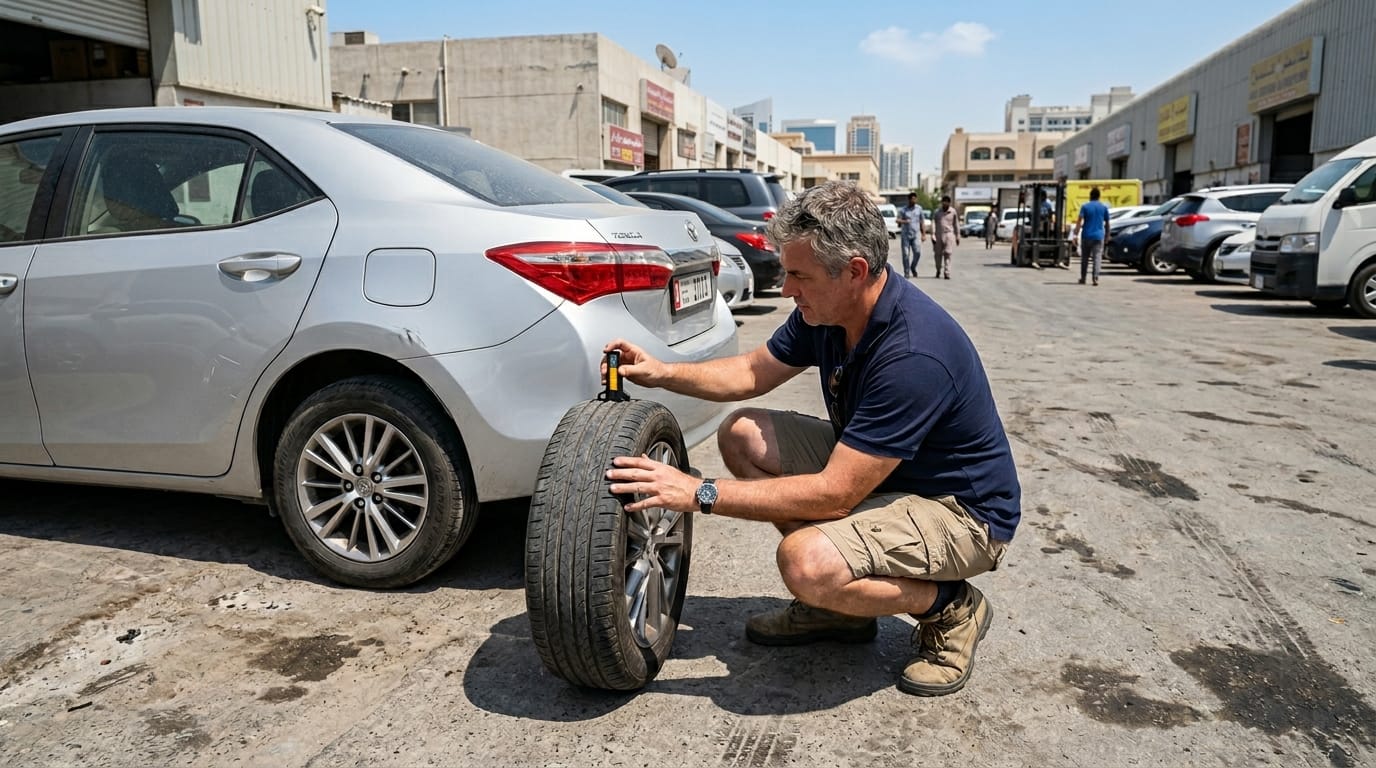
The UAE legal minimum tread depth is 1.6mm. Use a tread depth gauge (available for around 10 AED at auto parts stores) or insert a 1-dirham coin into the tread groove. If the gold rim of the coin is visible, your tread is near or below the minimum. Inspectors use electronic tread depth gauges and will measure all four tyres.
Tyre Age
Tyres older than five years are commonly flagged during UAE Tasjeel car inspection regardless of remaining tread depth. The manufacturing date is printed on the sidewall as a four-digit code (week and year). For example, “2519” means the 25th week of 2019. In the UAE climate, prolonged heat exposure accelerates tyre compound degradation even on low-mileage vehicles.
Sidewall Condition
Bulges, cuts, or significant cracking on the sidewall are automatic failures. A bulge indicates internal structural separation and represents a real safety concern at highway speed.
Tyre Replacement Costs
Budget tyre options for common vehicles (Corolla, Sunny, Yaris) typically range from 180 to 280 AED per tyre fitted and balanced, using brands like Hankook, Sailun, or Westlake at workshops across Al Quoz Industrial Area and the Sharjah Industrial Zone. Mid-range options (Bridgestone, Goodyear) run 280 to 450 AED per tyre. The Elantra UAE review documents similar tyre sizing and replacement costs for that model specifically.
Brake Inspection
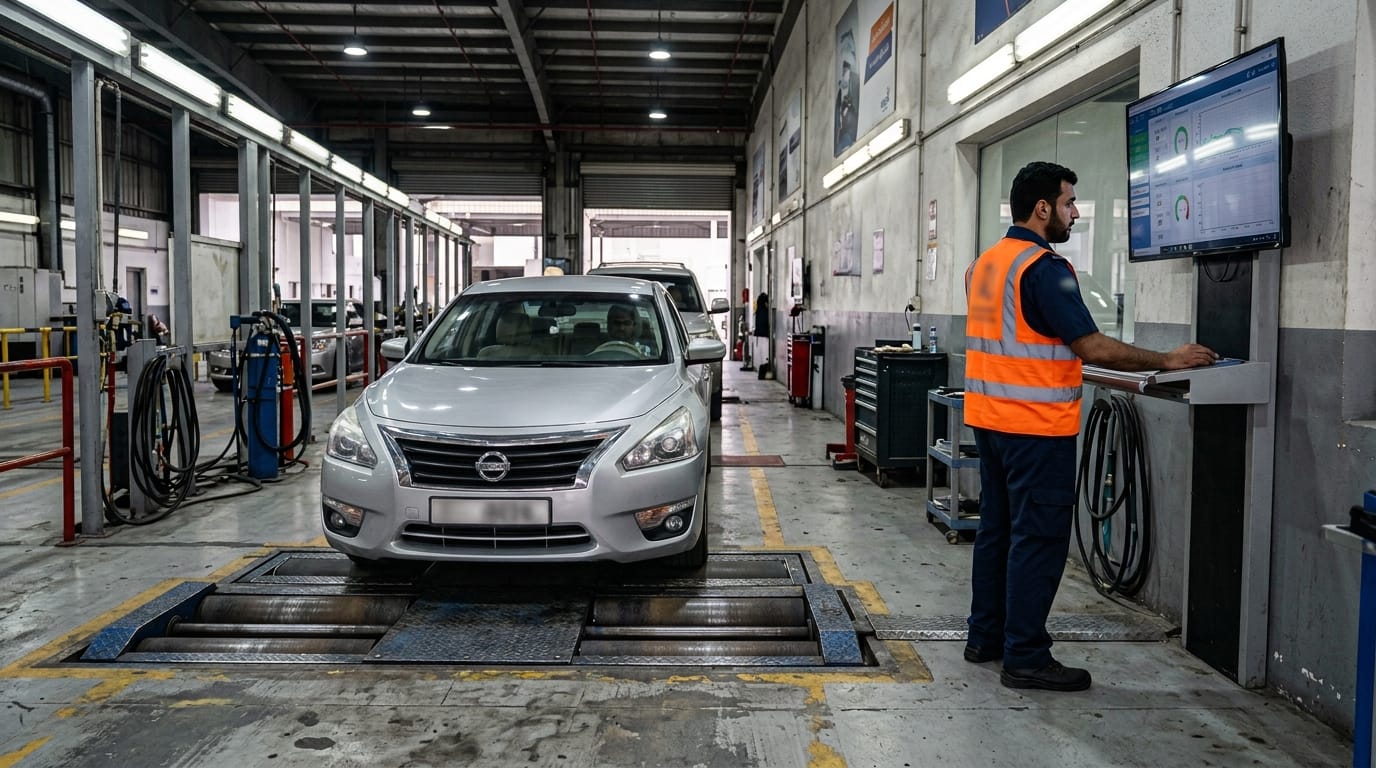
The inspection includes a dynamic brake test on a brake test roller. Each wheel’s braking force is measured individually. Significant imbalance between left and right wheels, or inadequate total braking force, results in failure.
What to Check Before Inspection
If your vehicle pulls to one side when braking, makes a grinding or squealing sound during braking, or if the brake pedal feels soft or spongy, address these before inspection. Brake pad replacement at honest workshops in Al Quoz typically costs between 150 and 350 AED per axle for common Japanese and Korean vehicles.
Brake Fluid
Low brake fluid is not typically a direct failure point in itself, but it may indicate worn pads or a leak — both of which are. Check the reservoir under the bonnet and top up if below the minimum line. Brake fluid (DOT 4) costs around 25–40 AED per bottle.
Suspension and Steering Inspection
Suspension
The inspection includes a suspension check on a shaker plate that vibrates each wheel independently. Worn shock absorbers, broken springs, or deteriorated suspension bushes will show up. Signs to watch for before inspection: excessive bouncing after hitting a speed bump, vehicle sitting lower on one corner, knocking sounds over rough surfaces.
Steering
Excessive free play in the steering wheel (more than approximately 2cm of movement before the wheels respond), vibration in the wheel at highway speed, or pulling to one side may indicate alignment or steering component issues. A wheel alignment check at UAE workshops typically costs between 60 and 120 AED.
Engine and Fluids Inspection
Engine Bay Check
Inspectors look for obvious fluid leaks, particularly engine oil and coolant. A vehicle that is actively dripping oil or coolant at the inspection center is unlikely to pass. Check beneath your vehicle after it has been parked overnight — fresh stains on the ground indicate an active leak.
Smoke Emissions
The inspection includes an emissions test. Vehicles emitting visible black smoke (excessive fuel richness), white smoke (possible coolant burning), or heavy blue smoke (oil burning) will fail the emissions component. A healthy vehicle should produce no visible exhaust smoke at normal operating temperature.
Dashboard Warning Lights: What Each One Means for Your Inspection
Critical Rule: If any warning light is illuminated on your dashboard when you arrive at the inspection center, the vehicle will not pass. There are no exceptions. A warning light is the vehicle’s own indication that something is not functioning correctly. Address all warning lights before your inspection appointment.
| Warning Light | Common Cause | Typical UAE Repair Cost | Inspection Impact |
|---|---|---|---|
| Check Engine (CEL) | O2 sensor, catalytic converter, fuel system | 200 – 1,500 AED (diagnosis + repair) | Automatic fail |
| ABS Warning | Wheel speed sensor, ABS module | 150 – 800 AED | Automatic fail |
| Airbag / SRS Warning | Sensor fault, clock spring, module | 200 – 2,000 AED | Automatic fail |
| TPMS Warning | Low tyre pressure, sensor fault | 10 – 300 AED | Commonly causes fail |
| Battery Warning | Alternator, battery, belt | 200 – 600 AED | Likely fail |
| Oil Pressure Warning | Low oil, pump failure, sensor | 50 – 1,500 AED | Automatic fail |
OBD Scanning Before Inspection
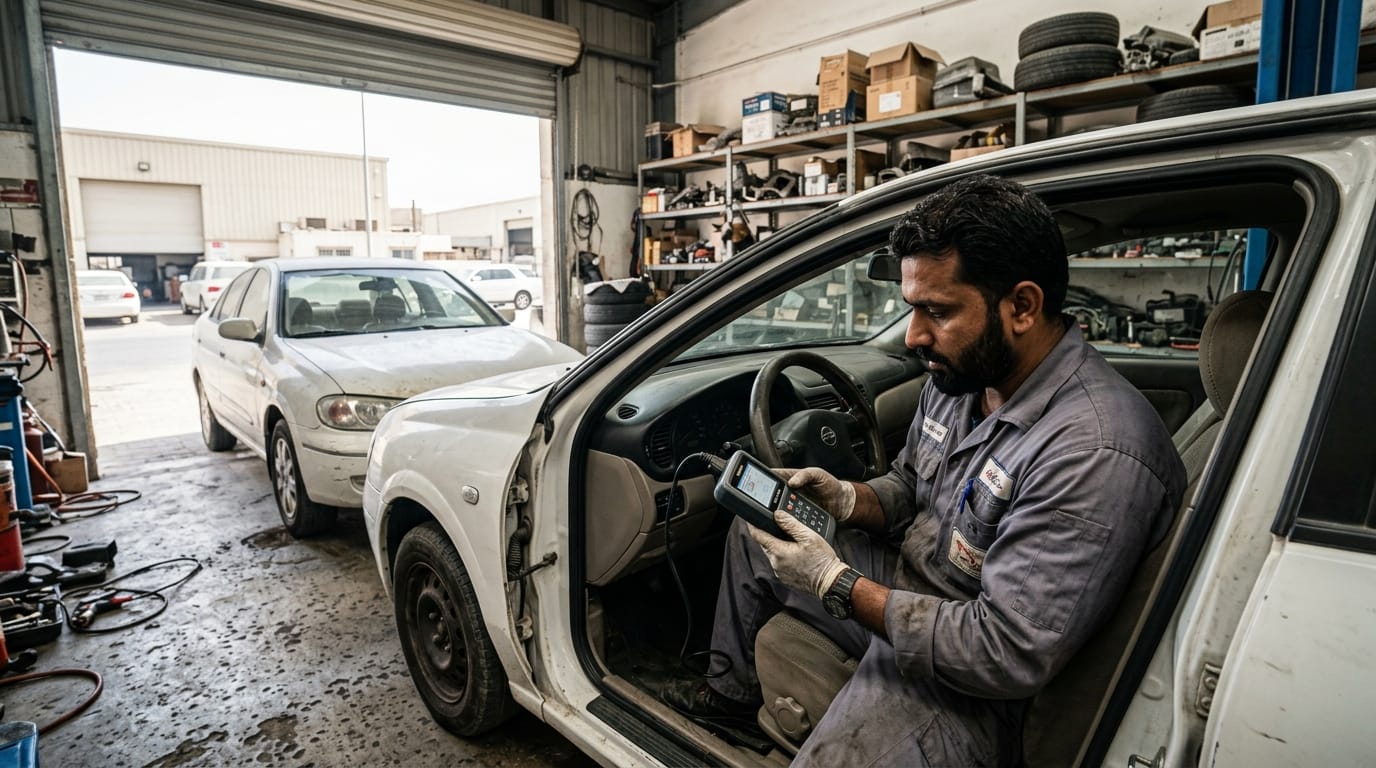
A basic OBD-II scan at any honest workshop in UAE costs between 30 and 80 AED and takes under 10 minutes. The scan identifies active fault codes causing the check engine light. Workshop records from Al Quoz specialists suggest that a significant portion of check engine light activations relate to oxygen sensors, which are among the more accessible repairs for budget vehicles. An OBD scan before your inspection appointment helps you understand what you are dealing with before paying inspection fees. The engine warning light guide covers every common OBD code UAE expats encounter and what each typically costs to fix.
Common Reasons Cars Fail UAE Inspection
%%{init: {'theme': 'base', 'themeVariables': {'background': '#f8f9fa', 'textColor': '#1a1a1a', 'primaryColor': '#2c3e50', 'secondaryColor': '#c0392b', 'lineColor': '#1a1a1a'}}}%%
pie title Most Common UAE Inspection Failure Reasons
  "Worn or Aged Tyres" : 28
  "Dashboard Warning Lights" : 24
  "Blown Bulbs (lights)" : 16
  "Windscreen Cracks" : 12
  "Emissions Failure" : 10
  "Brake Issues" : 6
  "Suspension Wear" : 4
| Failure Reason | Frequency | Typical Fix Cost (AED) | DIY or Workshop |
|---|---|---|---|
| Worn or aged tyres | Very common | 180 – 450 per tyre | Workshop |
| Warning light (CEL, ABS, airbag) | Very common | 50 – 2,000+ | Workshop (diagnosis first) |
| Blown bulb (brake/indicator) | Common | 5 – 30 | DIY or workshop |
| Windscreen crack in driver’s view | Common | 400 – 1,500 | Workshop |
| Failed emissions (smoke) | Common in older vehicles | 150 – 600 | Workshop |
| Brake imbalance / low pads | Moderate | 150 – 350 per axle | Workshop |
| Suspension component wear | Moderate | 200 – 800 | Workshop |
| Wiper blade failure | Moderate | 30 – 80 | DIY |
| Expired/missing number plate | Less common | 50 – 100 | RTA typing center |
| Steering play excessive | Less common | 200 – 1,200 | Workshop |
What Actually Happens During the Inspection
Understanding the process removes much of the anxiety for first-time visitors.
Process Timeline
| Stage | Duration | What Happens |
|---|---|---|
| Arrival and document check | 2 – 5 min | Staff verify Emirates ID, Mulkiya, insurance |
| Queue for inspection bay | 10 – 30 min | Vehicle waiting in lane; walk-in may be longer |
| Lane entry — exterior check | 2 – 3 min | Inspector walks around vehicle, checks lights |
| Roller tests (brakes, suspension) | 5 – 8 min | Vehicle driven onto rollers; measurements taken |
| Emissions test | 2 – 3 min | Probe inserted in exhaust; readings recorded |
| OBD scan | 1 – 2 min | Scanner connected to vehicle OBD port |
| Result issued | 1 – 2 min | Pass or fail certificate printed |
| Registration completion (if pass) | 5 – 10 min | New Mulkiya issued (renewal) or transfer processed |
The driver remains in the vehicle throughout most of the inspection process. Follow the inspector’s instructions — they may ask you to press the brake, activate lights, or sound the horn at specific points. Cooperate without rushing.
Understanding Your Inspection Report
The inspection result is printed and handed to you before you leave the bay area.
Pass: Your vehicle meets all required standards. For registration renewal, the new Mulkiya is issued on the same visit. For ownership transfers, the pass certificate is required to complete the transfer at the RTA service counter.
Fail: The report lists specific failure items with codes. Each failed item explains what was found. Common fail notations include brake imbalance percentage, tyre condition notes, and active OBD fault codes. The report also specifies the deadline for reinspection.
Advisory Notes: Some items may be recorded as observations without causing a fail — for example, minor windscreen chips outside the driver’s direct view, or mildly worn but still legal tyre tread. These are not mandatory repairs but are worth noting.
What to Do If Your Car Fails
Immediate Steps
Do not panic and do not sign anything at the inspection center other than the fail report acknowledgment. Read the fail report carefully. Most failures involve one to three specific items, not wholesale mechanical failure.
If you are unfamiliar with UAE workshops, the most reliable approach is to take the fail report to an established workshop in Al Quoz Industrial Area or the Abu Shagara area in Sharjah. Show the inspector’s fail report directly to the workshop — a legitimate workshop will quote on the specific items listed, not invent additional repairs.
Common pattern to watch for: Some workshops near inspection centers quote significantly higher prices when they see a fail report, knowing that the driver is under time pressure. In many documented expat cases, driving a few kilometers to Al Quoz or Sharjah Industrial Area workshops produces quotes between 30 and 50 percent lower for the same repairs. The guide to finding honest mechanics in Al Quoz helps you identify which workshops consistently give fair pricing.
Reinspection Rules and Costs
After a fail, vehicles are typically allowed reinspection within a specified window, after which the fail report expires and a full new inspection is required.
| Item | Detail |
|---|---|
| Reinspection window | Generally 30 days from fail date (verify with center) |
| Reinspection fee | Generally between 100 and 150 AED |
| Number of reinspection attempts | Typically 2 attempts within the window |
| What is retested | Failed items only, not a full reinspection in most cases |
Always verify current reinspection rules at the specific center where you failed. Rules may differ slightly between Tasjeel, ADNOC, and Sharjah centers. The UAE car registration guide covers the full Mulkiya renewal process including what happens if your registration expires while you are awaiting reinspection. This guide is reviewed periodically as Dubai Police procedures evolve.
Inspection Strategy by Vehicle Age
Under 5 Years Old
Newer vehicles in good condition typically have minimal preparation requirements. Focus on the basics: verify all lights work, confirm no warning lights, check tyre condition. A pre-inspection tyre check and a quick wash before the appointment is often sufficient.
5–10 Years Old
This is the most common category among expat buyers of used cars in the 20,000 to 45,000 AED range. At this age, the most likely failure points are: worn brake pads, tyre age (most tyres on 8–10 year old vehicles are approaching replacement regardless of tread), and oxygen sensor or emissions-related check engine lights. Budget approximately 300–800 AED for proactive servicing before inspection at this vehicle age.
Over 10 Years Old
Vehicles over 10 years old require the most thorough pre-inspection review. Suspension components, ball joints, and tie rod ends have often reached their service limits. Brake hydraulic components may show wear. A full pre-inspection service at a trusted Al Quoz workshop — covering brake pads, fluid checks, tyre assessment, OBD scan, and light verification — typically costs between 200 and 500 AED and significantly reduces the risk of unexpected fail points.
Inspection Strategy by Mileage
| Mileage Range | Key Concerns | Pre-Inspection Budget |
|---|---|---|
| Under 100,000 km | Lights, tyres, basic fluids | 50 – 200 AED |
| 100,000 – 150,000 km | Brake pads, OBD scan, suspension check | 200 – 500 AED |
| 150,000 – 200,000 km | Full pre-inspection service, suspension, emissions | 400 – 900 AED |
| Above 200,000 km | Comprehensive workshop assessment recommended before inspection | 600 – 1,500+ AED |
Scam Prevention: Protecting Expats at Inspection Centers
Most Common Scam Near Inspection Centers: Informal “helpers” near Tasjeel entrances offer to process your paperwork, translate, or expedite your inspection for a cash fee of 50 to 200 AED. These individuals have no official role. All legitimate Tasjeel services are conducted inside the center by uniformed staff. Do not hand your documents, vehicle keys, or cash to anyone outside the official inspection lanes. Report individuals soliciting outside the official entrance to center security.
Workshop Overcharging After Fail
Workshops positioned within 500 meters of inspection centers often quote significantly higher prices than workshops in Al Quoz or Sharjah Industrial Area for identical repairs. This pattern is particularly noted for tyre replacement and brake work. Before agreeing to any repair at a workshop near the inspection center, call one or two Al Quoz workshops for a comparison quote. The 10-minute phone call frequently saves between 150 and 400 AED.
Fake Pre-Inspection Certificates
Some used car sellers present unofficial “pre-inspection certificates” from non-official workshops as evidence that a vehicle will pass Tasjeel. These certificates have no official status. Only the Tasjeel, ADNOC, or official inspection center result matters. Do not factor unofficial pre-inspection reports into your purchase decision as evidence of inspection readiness.
Clearing OBD Codes Without Repair
A vehicle presented with a cleared check engine light that has not been repaired will typically show a “not ready” status on the OBD monitor at the inspection center, which is treated equivalently to an active fault. If a seller claims the warning light “just cleared itself,” request an independent OBD scan before purchase. Workshop records from Al Quoz specialists suggest this pattern — selling a vehicle with recently cleared but unrepaired fault codes — is observed with notable regularity in private sales. The fake service history guide covers related patterns including odometer tampering and forged records in detail.
Fake Transfer Receipts and Deposit Fraud
A less-discussed but documented pattern: sellers on Dubizzle or WhatsApp request a “holding deposit” of 1,000 to 3,000 AED to “reserve” the vehicle before inspection, claiming it prevents others from buying. Once the deposit is paid via bank transfer, the seller becomes unresponsive. Legitimate private sellers do not require upfront deposits to hold a car. If a seller requests any payment before you have physically inspected the vehicle and confirmed inspection readiness, treat this as a significant warning. Buyers may have legal remedies depending on evidence and the specific circumstances of the transaction. Outcomes vary significantly based on available documentation and how the payment was made.
Real Case Studies: Workshop and Market Logs
Case Study 1 — Indian Expat, Nissan Sunny, Al Quoz
A delivery driver from Kerala bought a 2014 Nissan Sunny for 18,500 AED from a private seller on Dubizzle. He drove directly to Tasjeel Umm Ramool for the transfer inspection without preparation. The vehicle failed on two items: a check engine light (P0420 catalytic converter code) and rear tyres aged 2017 — nine years old at time of inspection. He returned to the seller, who declined responsibility. Subsequent OBD diagnosis at a Sharjah Industrial Area workshop identified the catalytic converter issue. Total repair cost: approximately 680 AED for rear tyre pair replacement and 420 AED for catalytic converter repair — around 1,100 AED total. He passed on reinspection.
The lesson: the seller almost certainly knew about the warning light. An independent pre-purchase inspection would have revealed both issues before money changed hands. Scenarios like this are documented in the Nissan Sunny breakdown cost report with comparable ownership patterns from other expat drivers.
Case Study 2 — British Expat, Toyota Camry 2016, Dubai
A finance professional bought a 2016 Camry with 112,000 km for 42,000 AED from a Dubai showroom. He booked a Tasjeel inspection for the ownership transfer. The vehicle passed on first attempt. His preparation: an independent pre-purchase inspection at a reputable Al Quoz workshop (cost: 350 AED), which confirmed brake pad wear (replaced proactively for 280 AED) and noted that front tyres, while legally sufficient in tread, were manufactured in 2019 and showing early sidewall stress. He replaced them before inspection. Total preparation cost: approximately 1,250 AED. First-time pass.
His observation: “The dealer’s own inspection report showed the car as fine. It wasn’t wrong — it just wasn’t looking for the same things I needed to know.”
Case Study 3 — Pakistani Engineer, Hyundai Elantra 2017, Sharjah
A civil engineer renewed his Elantra registration and arrived at a Sharjah inspection center with an airbag warning light that had been intermittently appearing for three weeks. He assumed it was a sensor glitch. The vehicle failed on the airbag warning. Diagnostic work at Abu Shagara workshops identified a faulty clock spring — the component connecting the airbag system through the steering column. Repair cost: approximately 580 AED including parts and labor. He passed reinspection 10 days later. His reflection: “I kept hoping the light would go off on its own. It was 580 AED of wishful thinking.”
Mistakes That Commonly Lead to Failure
1. Assuming “It Passed Last Year” Means It Will Pass Again
Tyre wear, brake wear, and electrical component degradation progress between inspections. A vehicle that passed at 95,000 km may fail at 115,000 km on the same components. The UAE heat environment accelerates component aging relative to cooler climates many expats are accustomed to.
2. Ignoring Dashboard Warning Lights
Perhaps the most common single decision that turns a straightforward inspection into a failed one. Any active warning light is an automatic fail. There is no negotiation with the inspection software on this point.
3. Not Checking Tyre Manufacturing Dates
A tyre can have adequate tread depth and still fail due to age. Manufacturing dates are printed on the sidewall as a four-digit DOT code. Tyres manufactured before 2020 on a vehicle being inspected in 2026 are likely to be flagged regardless of visual condition.
4. Arriving Without Valid Insurance
Insurance renewal and vehicle inspection are often due at similar times. Some expats allow insurance to lapse while arranging renewal, then attempt to book inspection without valid coverage. Without valid insurance documentation, the inspection process cannot proceed.
5. Bringing the Wrong Documents
A photocopy of the Mulkiya instead of the original, an expired Emirates ID, or missing the bank NOC for a financed vehicle — each of these sends you home without a result.
Owner Scenarios: What This Costs in Practice
If you drive 30 km daily and bought a 2015 Toyota Corolla: At typical UAE usage, you will be approaching or past the 120,000 km mark by your second or third inspection. Budget 400–700 AED for pre-inspection preparation at this mileage — covering tyre assessment, brake check, and OBD scan. The Corolla’s wide parts availability across Al Quoz means repairs at this mileage are generally manageable.
If your employment contract ends in 6 months and you are selling: Inspection pass status significantly affects resale value on Dubizzle and Facebook Marketplace. A vehicle with a current, valid inspection pass typically commands 1,000–3,000 AED more than an equivalent vehicle requiring inspection. Passing inspection before listing is almost always worth the cost.
If you are a new UAE resident buying your first car: Make inspection pass a condition of purchase. Specifically: negotiate that the seller completes the Tasjeel transfer inspection and the vehicle passes before you pay the full purchase amount. This shifts the cost and risk of any failure onto the party who has owned the vehicle — and who knows its actual condition.
If you work in delivery and depend on the vehicle daily: An unexpected fail means days without income while repairs are completed. Pre-inspection servicing is not optional in this scenario — it is part of managing your operating costs. Budget 500–900 AED annually as a proactive inspection-readiness fund.
If you bought your car with finance: Your bank’s NOC (No Objection Certificate) is required for ownership transfer inspections. Processing this document typically takes 3–7 business days. Factor this into your timeline to avoid inspection delays.
The Bottom Line Decision Framework
| Your Situation | Recommended Action |
|---|---|
| Vehicle under 5 years, no warning lights, tyres look good | Verify lights and documents — book inspection directly |
| Vehicle 5–10 years, 80,000–130,000 km, no major issues | OBD scan + tyre age check + brake inspection (200–400 AED) before booking |
| Vehicle over 10 years or above 150,000 km | Full pre-inspection service at trusted Al Quoz workshop before attempting inspection |
| Warning light currently on dashboard | Do not attempt inspection until fault is diagnosed and resolved |
| Buying a used car and planning transfer inspection | Insist on independent pre-purchase inspection before payment; make inspection pass a sale condition |
| Failed at inspection today | Read fail report carefully; get at least 2 quotes in Al Quoz or Sharjah — not from workshops near the center |
| Worried about specific item (tyre age, OBD code) | Call any Al Quoz workshop for a phone assessment before paying inspection fees |
| Selling before leaving UAE | Pass inspection first — it adds 1,000–3,000 AED to your achievable sale price |
Final Inspection Day Checklist
| Item | Status |
|---|---|
| Emirates ID (original, valid) | □ Confirmed |
| Mulkiya / Registration Card (original) | □ Confirmed |
| Valid Insurance Certificate | □ Confirmed |
| Driving Licence | □ Confirmed |
| Bank NOC if financed | □ N/A or Confirmed |
| All exterior lights tested this morning | □ Confirmed |
| Zero warning lights on dashboard | □ Confirmed |
| Tyres checked (tread + age) | □ Confirmed |
| Windscreen: no cracks in driver’s view | □ Confirmed |
| Wiper blades functional | □ Confirmed |
| Horn functional | □ Confirmed |
| Number plates clean and secure | □ Confirmed |
| Engine oil at correct level | □ Confirmed |
| Coolant at correct level | □ Confirmed |
| No visible oil leaks beneath vehicle | □ Confirmed |
| Vehicle washed (number plates readable) | □ Confirmed |
Data Sources and Methodology
The cost figures in this guide are drawn from observations across UAE workshops in Al Quoz Industrial Area, Abu Shagara (Sharjah), and Al Ain Road corridor workshops, compiled over multiple inspection cycles in 2025 and 2026. Fee ranges represent the typical spread observed across legitimate workshops — not the highest or lowest outliers. Internal inspection case records reviewed cover a mix of vehicle nationalities (GCC spec and US spec imports), model years spanning 2010 to 2022, and mileage ranges from 40,000 to 240,000 km.
Official inspection procedures and fee structures are publicly available through the following government sources:
- RTA Dubai — Vehicle Registration and Inspection
- Abu Dhabi Department of Transport — Vehicle Inspection
- Sharjah City Municipality
- Dubai Police — Traffic Services
- ADNOC Distribution — Inspection Services
- UAE Ministry of Interior — Traffic and Licensing
Market Volatility Notice: All fees, repair costs, and service prices referenced in this guide are approximate averages observed at time of writing. UAE vehicle inspection fees, workshop labor rates, and parts prices are subject to change based on RTA policy revisions, supplier pricing, and market conditions. Always verify current fees at the specific inspection center or workshop before committing. This guide is reviewed periodically as RTA and Dubai Police procedures evolve.
Frequently Asked Questions
Q: How long does a Tasjeel inspection take from arrival to completion?
Q: Can I get my car inspected in Dubai if it is registered in Sharjah?
Q: My car is over 15 years old. Will it automatically fail?
Q: Can I fail inspection for having a cracked windscreen?
Q: I just bought a used car and the seller says it passed inspection last month. Do I still need another inspection?
Q: What happens if my registration expires while I’m waiting for reinspection?
Q: If I sell my car after passing inspection, does the pass certificate transfer to the buyer?
If you are preparing to sell your vehicle, the real sale numbers after two years in Dubai covers how inspection status affects what you actually receive at the point of sale.
Disclaimer: Emirates Car Guide is a 100% independent platform. We do not own showrooms, nor are we affiliated with any used car dealerships or garages. Our sole mission is to protect expats from financial fraud in the automotive market.
