Written By: Omar Al-Fayed, Senior Automotive Consultant | Fact-Checked By: Emirates Cars Editorial Team | Last Updated: June 2026 | Category: Finance & Legal
If you bought a used car in the UAE and later discovered that the dealer concealed important information — an accident history, flood damage, a rolled-back odometer, or fabricated service records — you have formal legal options. This guide explains what qualifies as dealer fraud under UAE law, which authority handles complaints in each emirate, what evidence you need to build a strong case, and what outcomes are realistically achievable. For background on what to check before signing, see our pre-purchase inspection guide for a full walkthrough.
Filing a consumer protection complaint in the UAE is free, accessible to residents of all nationalities, and handled through structured online channels. The process is more straightforward than most expats assume. The outcome, however, depends almost entirely on the quality of your documentation — not on how strongly you feel about the situation.
Independent inspection costs in the UAE typically range between 300 and 800 AED. Expert technical reports for formal proceedings generally run between 800 and 2,500 AED. Government complaint filing carries no fee in most emirates.
This guide is reviewed periodically as Dubai consumer protection procedures evolve.
⚠ Financial & Legal Disclaimer: The information provided in this article is for educational purposes only. Regulations, lending criteria, and consumer protection procedures in the UAE may change over time. Readers should verify information with licensed UAE professionals or official government portals before making financial or legal decisions.
What Counts as Car Dealer Fraud in the UAE?
Not every disappointing purchase qualifies as fraud. Consumer protection legislation in the UAE generally covers situations where a licensed dealer deliberately withheld or misrepresented material facts about the vehicle. Common examples include:
- Hidden accident history — Structural repairs, airbag deployments, or frame damage not disclosed before sale.
- Mileage rollback — The odometer was reduced to show a lower reading than the vehicle’s actual travelled distance.
- Undisclosed flood damage — The vehicle was water-exposed but sold without disclosure. For a detailed breakdown of financial consequences, see flood damage legal costs after a UAE purchase.
- Fake service history — Service stamps or booklets were altered or fabricated entirely.
- Forged inspection reports — The dealer presented a falsified or outdated inspection certificate as current and valid.
- Title problems — Outstanding bank loans, uncleared traffic fines, or ownership disputes existed at the time of sale and were not disclosed.
- Salvage vehicles sold as clean cars — US-spec or salvage-titled imports presented as GCC-spec or accident-free vehicles.
- Undisclosed mechanical defects — The dealer had knowledge of a serious mechanical condition and concealed it.
- Misleading advertisements — Listed photos, mileage figures, or specifications were materially different from the actual vehicle delivered.
Normal mechanical wear arising after a reasonable period, price disagreements, and subjective quality expectations generally fall outside consumer protection scope. The distinction matters: misrepresentation of fact is actionable; dissatisfaction with a legitimate purchase is not. If you want to understand how fake service records and odometer fraud are typically identified, that guide covers detection techniques in detail.
Consumer Rights When Buying a Car in the UAE
UAE consumers have legal protections against deceptive commercial practices regardless of nationality. When a licensed dealer sells a vehicle, they carry obligations under UAE consumer protection legislation to provide accurate information about the car’s condition, history, and specifications.
As a buyer, you also bear responsibility. Once you sign the purchase contract and take delivery, demonstrating that defects existed at the time of sale becomes your burden. This is precisely why pre-purchase documentation and post-discovery evidence collection determine outcomes more than any other factor.
⚠ Important distinction: Consumer protection is significantly stronger against deliberate misrepresentation than against a purchase that turned out to be a poor value. If the dealer stated the car was accident-free and it was not — that is a formal complaint. If you bought a car and found maintenance more expensive than anticipated — that generally falls outside the scope of consumer protection action.
UAE Laws That Protect Vehicle Buyers
The UAE Federal Consumer Protection Law (Federal Law No. 15 of 2020), published by the UAE Ministry of Economy, prohibits deceptive commercial practices and requires sellers to provide accurate product information. Misleading statements about goods — including vehicles — are explicitly prohibited.
Commercial fraud provisions under UAE law make it an offence to sell goods through deliberate deception, including misrepresenting the nature, origin, condition, or history of a product. The UAE Government Consumer Protection portal summarises the framework in English.
The law applies to licensed commercial dealers. Private individual sellers operate under civil transaction principles rather than consumer protection legislation — one practical reason why buying from a registered dealership can offer more structured formal recourse than a private Dubizzle transaction.
This guide is reviewed periodically as UAE Ministry of Economy procedures and consumer protection regulations evolve.
Which Government Authority Handles Car Fraud?
| Situation | Authority to Contact |
|---|---|
| Dealer misrepresented the car (hidden damage, fake records, mileage fraud) | Consumer Protection Department — emirate-level authority (DET for Dubai, ADDED for Abu Dhabi) |
| Deliberate criminal fraud suspected (forged documents, organized deception) | Dubai Police / Abu Dhabi Police — Economic Crimes section |
| Ownership transfer or Mulkiya complications | RTA (Dubai) or equivalent emirate transport authority |
| Outstanding bank loans or fines on the vehicle at time of transfer | RTA + the lending bank directly |
| Licensed dealer in Dubai | Dubai Economy and Tourism (DET) — Consumer Rights section |
| Licensed dealer in Abu Dhabi | Abu Dhabi Department of Economic Development (ADDED) |
| Licensed dealer in Sharjah | Sharjah Economic Development Department |
| Cross-emirate or federal matter | UAE Ministry of Economy (MoEC) |
For Dubai complaints, the Dubai Consumer app (available on iOS and Android) allows full online submission. The consumerrights.ae portal provides the same functionality through a browser. Before you approach any authority, reviewing common red flags from UAE car dealers can help you frame exactly what you experienced against known patterns.
Signs You Were Probably Scammed
| Sign Observed | What It May Indicate |
|---|---|
| Rust under seats or in door sills within weeks of purchase | Possible undisclosed water exposure or flood history |
| Multiple electrical malfunctions appearing shortly after purchase | Consistent with water damage to wiring systems |
| Service stamps that appear visually similar or share identical handwriting | Possible fabricated service history |
| VIN on dashboard does not match VIN on engine bay or door sill sticker | Parts replacement, identity issue, or structural repair |
| Carfax / vehicle history report shows “salvage” or “total loss” designation | Salvage vehicle sold without disclosure |
| RTA registration records show mileage inconsistent with what dealer presented | Possible odometer rollback |
| Dealer refused to provide any written warranty or written specification claims | Avoidance of documented commitments |
| “Sold as-is” language used in contract for issues that were specifically represented verbally | Attempt to limit liability after verbal misrepresentation |
Evidence You Should Collect Before Filing
The strength of a consumer protection complaint is determined almost entirely by documentation quality. Collect everything below before approaching the dealer or any authority.
| Evidence Item | Why It Matters |
|---|---|
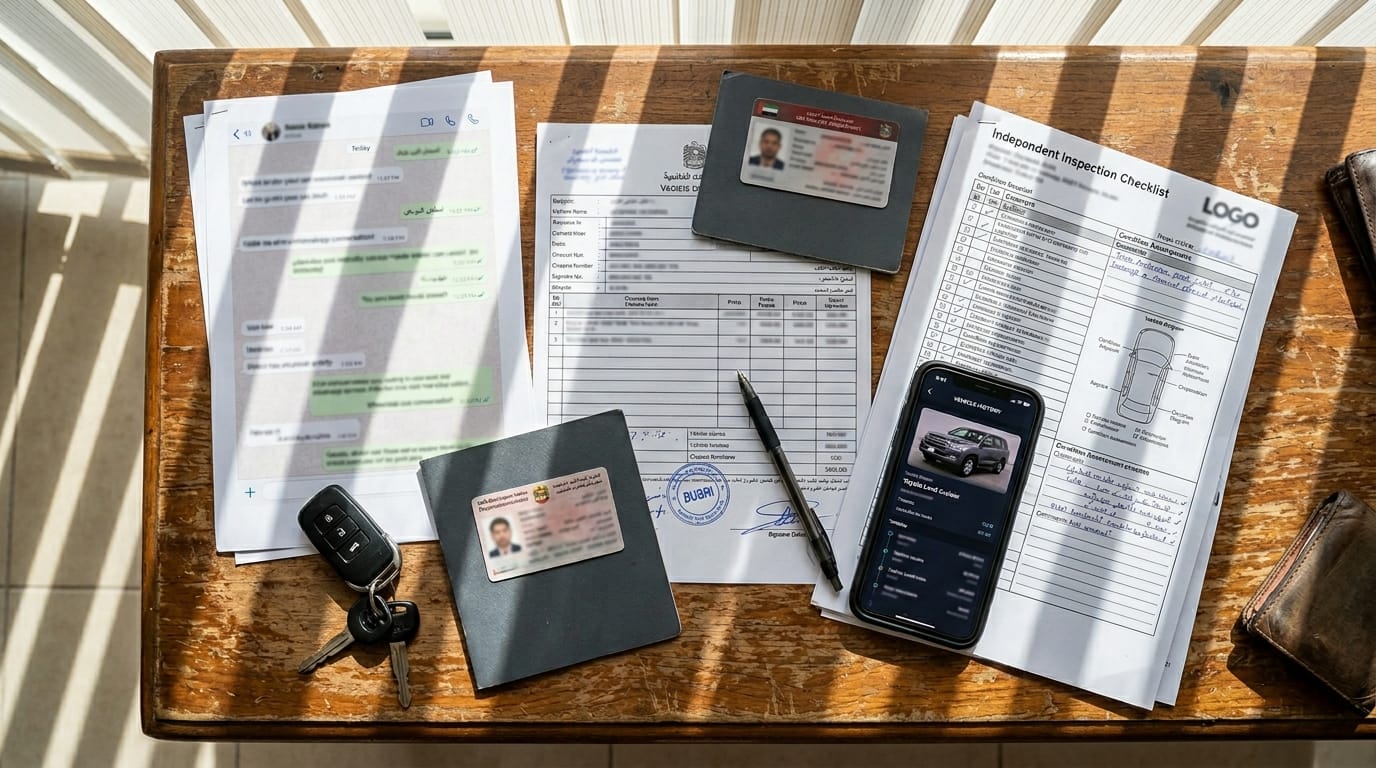
| Original purchase contract and invoice | Documents agreed price, vehicle specifications, and any written representations |
| All WhatsApp and SMS messages with the dealer or salesperson | Verbal claims made in writing — often the most actionable evidence |
| Emails from dealer or salesperson | Same function as WhatsApp — preserve as PDF exports |
| Original Dubizzle or Facebook Marketplace listing (screenshots) | Captures advertised specifications before deletion |
| Photos and videos taken at time of purchase handover | Documents the car’s visible condition at delivery |
| Independent inspection report obtained after purchase | Expert third-party documentation of defects — most weighted evidence type |
| Bank transfer receipt or payment record | Confirms financial transaction and timing |
| Mulkiya copy and VIN photographs | Confirms vehicle identity and registration status |
| Workshop invoices for post-purchase repairs | Establishes documented financial loss from undisclosed defects |
| Dealer’s trade license number | Required for formal complaint submission |
| Vehicle history report (Carfax, AutoCheck, or UAE-equivalent service) | Often reveals accident, salvage, or ownership history not disclosed by seller |
Evidence That Carries the Most Weight
Not all evidence is equal in consumer protection proceedings. Understanding the relative strength of each item helps you prioritize what to collect and what to have prepared before filing.
| Evidence Type | Weight in Proceedings | Notes |
|---|---|---|
| Official independent inspection report | Very High | Expert third-party documentation is typically the most decisive element |
| Original signed purchase invoice | High | Establishes the transaction, price, and any written claims |
| WhatsApp / SMS messages with dealer | High | Written record of verbal claims — often more useful than physical evidence |
| Original advertisement screenshots | High | Captures advertised specifications before they are deleted |
| Photos and videos of defects | Medium | Useful supporting evidence; more powerful when dated and timestamped |
| Workshop repair invoices | Medium | Establishes financial loss; stronger when supported by inspection report |
| Verbal promises (undocumented) | Low | Word-against-word situations — very difficult to support without corroboration |
🚫 Do not repair the vehicle before obtaining an independent inspection report. Unless immediate repairs are required for safety reasons, authorizing repairs removes the primary physical evidence of the defect in the condition it was sold. Get a written inspection report documenting the defect and its probable cause before authorizing any workshop work. Without this, a complaint relying only on repair invoices is significantly harder to substantiate.
Should You Contact the Dealer First?
In many cases, raising the issue directly with the dealer before filing a formal complaint is worth attempting — particularly when you have clear written evidence. Some dealers prefer to resolve complaints quietly rather than face a government investigation that could affect their trade license.
Keep all communication in writing (WhatsApp or email). Avoid verbal-only conversations. State the issue clearly and specifically, reference the evidence you hold, and ask what resolution the dealer proposes. Give a reasonable response window — typically 5 to 7 business days.
If the dealer does not respond or the response is unsatisfactory, you have a clean documented record of having attempted direct resolution before escalating. This record is noted positively by consumer protection investigators.
⚠ Settlement trap to avoid: Do not agree to a partial resolution — such as a modest repair contribution — without clearly understanding what you are signing. A document described as a “settlement agreement” or “full and final” resolution typically closes your ability to pursue a formal complaint for the same matter afterward. Have any settlement reviewed before signing.
How to File a Consumer Protection Complaint — Step by Step
Step 1 — Identify the correct authority for your emirate
Dubai: Dubai Economy and Tourism (DET) — consumerrights.ae or the Dubai Consumer app. Abu Dhabi: Abu Dhabi Department of Economic Development (ADDED). Sharjah: Sharjah Economic Development Department. For other emirates, the respective emirate government portal lists the relevant consumer authority.
Step 2 — Organize your complete evidence file before starting
Prepare everything from the evidence table above before beginning the submission. An incomplete file typically results in delays and follow-up requests that extend the timeline.
Step 3 — Submit the complaint through the official channel
Online submission via the portal or mobile app is the most efficient method. In-person visits to the authority’s customer service center are also accepted. Phone submissions may be used for initial guidance but typically require formal follow-up in writing.
Step 4 — Record your complaint reference number
After submission, a reference number is issued. All follow-up correspondence and enquiries should reference this number.
Step 5 — Cooperate with investigation requests promptly
The authority may request additional documentation, schedule a meeting with both parties, or arrange for an official vehicle inspection. Delays in responding to these requests extend the overall timeline.
Step 6 — Attend mediation if scheduled
Many complaints are resolved through a structured mediation session where both the buyer and the dealer present their positions in front of a consumer protection officer. This stage resolves a substantial share of cases without requiring court escalation.
Step 7 — Escalate if mediation is unsuccessful
If mediation produces no resolution and the evidence supports the complaint, the authority may escalate to formal enforcement action against the dealer’s trade license or refer the matter to the civil courts.
How to File the Complaint Online
For Dubai: Visit consumerrights.ae or use the Dubai Consumer mobile application. You will need your Emirates ID number, the dealer’s trade license number, and supporting documents in PDF or image format.
For Abu Dhabi: The ADDED online portal accepts complaints with UAE Pass login credentials.
For federal-level complaints or cross-emirate matters: The UAE Ministry of Economy (MoEC) accepts consumer complaints across all emirates through its complaints portal.
File size limits and accepted document formats are specified during the submission process on each portal. Most portals accept PDF, JPG, and PNG attachments.
Information Required Before Submitting
| Required Item | Where to Locate It |
|---|---|
| Your full name and UAE Emirates ID number | Your Emirates ID card |
| Dealer’s trade license number | On the invoice, or displayed at the showroom entrance |
| Dealer’s full registered business name and address | Invoice or showroom signage |
| Vehicle VIN number | Dashboard, engine bay sticker, or Mulkiya |
| Date of purchase and purchase price paid | Your invoice or bank transfer record |
| Clear written description of the problem (3–5 sentences) | Prepare this before starting the submission |
| Specific resolution requested | State clearly: refund, repair, or financial compensation |
What Happens After You Submit the Complaint?
Process Timeline
Consumer Protection Complaint Timeline
The authority notifies complainants by email or SMS at key stages. Timelines are affected by case complexity, how quickly the dealer responds, and whether a physical vehicle inspection is scheduled as part of the investigation.
Possible Outcomes
| Outcome | When It Typically Applies |
|---|---|
| Full refund | Strong documented evidence of deliberate misrepresentation; dealer found in clear violation of consumer protection provisions |
| Partial refund or financial compensation | Partial fault established, or shared responsibility situation where some disclosure was made |
| Dealer-funded repair | Undisclosed defect confirmed; repair is a proportionate remedy given the vehicle’s age and price |
| Mediated settlement agreed by both parties | Both sides reach a negotiated figure during the mediation session |
| Complaint rejected | Insufficient evidence; issue falls outside consumer protection scope; or time elapsed significantly before filing |
| Referral to prosecution | Evidence of deliberate criminal fraud — document forgery, organized deception, identity fraud |
Buyers may have legal remedies depending on the available evidence and the specific circumstances of the transaction. Outcomes vary significantly based on how thoroughly the transaction was documented and the nature of what was misrepresented.
Can the Dealer Retaliate After You File a Complaint?
This question comes up frequently among expats who are uncertain about their position. The short answer: filing a formal consumer protection complaint is a legal right for all UAE residents. A dealer cannot legally penalize you for exercising it.
Specifically:
- Can the dealer refuse to communicate after the complaint is filed? Yes, they may choose not to engage directly — but the consumer protection authority will require a formal response from them regardless of whether they want to.
- Can the dealer cancel a warranty they provided? A warranty already issued as part of a sales contract is a contractual obligation. Cancelling it as retaliation for a formal complaint would itself be a breach of contract and reportable.
- Can they threaten legal action against you? Dealers may sometimes send strongly worded communications. However, filing a legitimate consumer protection complaint based on documented evidence is a lawful act. Frivolous counter-claims by dealers in response to consumer complaints are generally not well-received by UAE courts.
- Can they share your personal details or blacklist you? Sharing personal data without consent may conflict with UAE data protection principles. There is no formal vehicle buyer blacklist in UAE law.
The formal complaint process is administered by a government authority, not by the dealer. Once a case reference number is issued, the authority manages the process. You are not negotiating alone.
💡 Practical note: Keep a record of any communications from the dealer after you file your complaint. If the dealer’s behavior after filing appears intended to intimidate or pressure you, that conduct itself can be reported to the same consumer protection authority handling your case.
Possible Outcomes After Filing
See the Possible Outcomes table above for a summary. Beyond that table, it helps to understand what “escalation” means in practice. If mediation at the consumer protection level does not result in a settlement, the authority may:
- Issue a formal warning or fine against the dealer’s trade license.
- Refer the matter to the public prosecution in cases involving suspected criminal fraud.
- Advise the complainant to pursue a civil court claim if the dispute requires judicial resolution.
Civil court proceedings are separate from the consumer protection complaint process. They are slower, typically more expensive, and generally require legal representation. For disputes above 30,000 AED with strong evidence, or any case involving court referral, reviewing the legal cost breakdown for UAE automotive disputes is useful context.
How Long Does the Process Usually Take?
Simple complaints — clear written evidence, cooperating dealer, straightforward misrepresentation — are commonly resolved within 4 to 8 weeks at the consumer protection stage. More complex cases involving disputed vehicle condition, competing expert reports, or an unresponsive dealer typically take 2 to 4 months before a formal outcome is reached.
If the matter is referred to courts, timelines extend considerably. Court scheduling, legal representation requirements, case complexity, and potential appeals all affect the final timeline. Expats planning to leave the UAE should factor this into their decision about whether to pursue a court-level claim after an unsuccessful consumer protection complaint.
When Consumer Protection May Not Help
There are situations where a formal consumer protection complaint is unlikely to produce a satisfactory result, regardless of how strongly the buyer feels wronged:
- The vehicle was purchased from a private individual, not a licensed commercial dealer.
- The contract contained “sold as-is” language and the specific issue raised was visible or mentioned at the time of sale.
- The defect emerged after significant time had passed and there is no documentation establishing it existed at delivery.
- The complaint relies entirely on verbal statements with no supporting written evidence.
- The dealer has closed, surrendered their license, or cannot be located.
- The issue is a disagreement about price, value, or expectation rather than a factual misrepresentation.
When You Should Hire a Lawyer
A lawyer is not required at the initial consumer protection complaint stage. Most expats who file well-documented complaints proceed without legal representation through mediation. Legal advice becomes appropriate when:
- The amount in dispute exceeds 50,000 AED.
- The consumer protection complaint was rejected and you want to pursue a civil court claim.
- Evidence of criminal fraud, document forgery, or organized deception is present.
- A vehicle loan or bank financing arrangement is tied to the dispute.
- You are planning to leave the UAE and need to understand your options before departure.
Lawyer fees for UAE consumer disputes typically range between 3,000 and 15,000 AED or more depending on case complexity and emirate. Initial consultations are available at many firms for 300 to 1,000 AED. This guide is reviewed periodically as UAE legal procedures evolve.
Criminal Fraud vs Civil Dispute
| Civil Dispute | Criminal Fraud | |
|---|---|---|
| Nature | Breach of contract or consumer rights — a commercial disagreement | Deliberate deception with criminal intent — forgery, organized fraud scheme |
| Example | Dealer sold a car with undisclosed accident damage | Dealer presented forged vehicle history documents as genuine |
| Pathway | Consumer protection authority, then civil courts if unresolved | Police report filed with Economic Crimes section; prosecution by state |
| Your role | Claimant seeking financial remedy or resolution | Victim reporting a crime; the state prosecutes the offender |
| Typical timeline | Weeks to months at consumer protection level | Months to years; court-dependent |
The majority of used car complaints in the UAE are civil disputes appropriate for the consumer protection channel. Criminal prosecution is reserved for cases with clear evidence of deliberate document forgery, systematic deception, or organized fraud. This guide is reviewed periodically as Dubai Police and prosecution procedures evolve.
Can Expats File Complaints?
Yes, without qualification. UAE consumer protection legislation applies to all residents regardless of nationality, visa status, or country of origin. There is no requirement to be a UAE national to file a complaint against a licensed dealer.
Residents holding valid UAE residence visas can file and participate in complaint proceedings in the same way as UAE nationals. Tourists and short-term visitors who were misled during a visit may face practical difficulties if they have already left the country — but the complaint itself can still be submitted online from abroad. Outcomes from abroad are less predictable and follow-up participation is more difficult.
Expats planning to leave the UAE should file any complaint and obtain an independent inspection report before their departure date. Physical presence in the UAE typically strengthens a complaint’s progression.
Language Requirements
Consumer protection portals in Dubai and Abu Dhabi operate in both Arabic and English. Complaints and supporting documents can generally be submitted in English at the initial stage.
If the matter progresses to formal legal proceedings, official court documents are required in Arabic, or with certified Arabic translation. Court proceedings are conducted in Arabic.
Evidence in languages other than Arabic or English — such as WhatsApp conversations in Hindi, Tagalog, Urdu, or other languages — may require certified translation before formal acceptance in proceedings.
Costs Involved
| Cost Item | Typical Range |
|---|---|
| Consumer protection complaint filing | Free in most emirates |
| Independent pre-complaint vehicle inspection | 300 to 800 AED |
| Expert technical report (court-level cases) | 800 to 2,500 AED |
| Certified document translation (per document) | 100 to 350 AED |
| Initial lawyer consultation | 300 to 1,000 AED |
| Full legal representation in civil court | Generally 3,000 to 15,000+ AED |
| Court filing fees | Generally between 500 and 2,000 AED depending on claim amount and emirate |
Scam Prevention: How Dealers Exploit the Complaint Process
Beyond the original purchase fraud, a secondary layer of manipulation occurs during the complaint and resolution stage. Knowing these patterns protects you during the process itself.
🚫 Most common post-purchase trap: A dealer contacts the buyer shortly after a defect is discovered and offers to “fix it quietly” for a reduced fee — avoiding any formal complaint. The verbal agreement is made but not documented. Repairs are done incompletely. When the buyer later tries to escalate formally, the dealer claims they already provided a remedy and the buyer accepted it. Without written documentation of what was agreed, what was done, and whether it was satisfactory, this verbal “resolution” severely weakens any subsequent formal complaint.
Other manipulation patterns observed in UAE market complaint cases:
- The mileage reframe — Dealer insists the mileage discrepancy was a “display error” and offers to provide a new service stamp to “correct” the record. Any documentation produced after the dispute begins is not independent evidence.
- The deposit disappearance — Buyer pays a holding deposit and signs nothing. Dealer denies receiving it when the buyer later tries to cancel after discovering a problem. Always get a written receipt for any deposit, however small, referencing the specific vehicle by VIN.
- The escalated counter-threat — Dealer threatens to pursue the buyer for “contract cancellation costs” or “storage fees” if they attempt to reverse the sale. These threats are rarely actionable but are intended to discourage complaint filing. A consumer protection complaint filed against a licensed dealer cannot typically be countered with storage fee claims.
- The forged pre-sale inspection — A certificate from a “certified inspector” is provided at the time of sale, stamped and dated. When checked independently, the inspection either never occurred or was conducted on a different vehicle. Any inspection certificate provided by the seller should be independently verified.
For a broader view of documented dealer manipulation patterns, how to respond to dishonest UAE car dealers covers the most frequently reported tactics and appropriate counter-responses.
Real Case Studies: Workshop & Market Logs
Case 1 — Indian Expat, Deira Showroom, Hidden Structural Damage
A software engineer from Bangalore purchased a 2017 sedan from a licensed showroom in Deira for 27,500 AED. The salesperson verbally confirmed the car had never been in a major accident. A service booklet with regular stamps was provided.
Five weeks post-purchase, the buyer noticed excessive front tire wear and brought the vehicle to an independent workshop in Al Quoz. The technician identified non-factory welds on the front subframe and chassis measurements approximately 8mm out of manufacturer specification — consistent with a repaired front-end impact. A written inspection report was issued for 450 AED.
The buyer sent the dealer a documented WhatsApp summary of findings and requested a formal response. The dealer denied knowledge. The buyer filed with DET online, attaching the inspection report, the original Dubizzle listing screenshot, and the WhatsApp exchange. A mediation session was held 34 days after filing. The dealer, facing the inspection documentation, agreed to contribute 5,500 AED toward structural alignment and related repair costs. The buyer accepted, understanding that a full refund after six weeks of use was unlikely given the absence of a written warranty at purchase.
Key outcome driver: the independent inspection report obtained before any repair work was authorized.
Case 2 — Pakistani Engineer, Abu Dhabi, Flood History Concealed
A civil engineer from Lahore purchased a 2019 SUV from an Abu Dhabi dealer for 38,000 AED. The Carfax report was not requested at the time of purchase. Three months later, the buyer ordered an international vehicle history report after noticing recurring electrical faults. The report returned a prior flood exposure notation from a US auction record — the vehicle was a non-GCC import with a salvage designation.
An independent inspection in Abu Dhabi (cost: 600 AED) documented corrosion behind dashboard panels, evidence of water intrusion in the ECU housing, and non-original wire harness sections on the driver’s side. A formal complaint was filed with ADDED along with the vehicle history report, the inspection report, and bank transfer confirmation.
The dealer disputed the relevance of a foreign vehicle history report. ADDED commissioned an official assessment. On the basis of combined evidence, the outcome was a partial compensation of approximately 9,000 AED plus a dealer-funded full electrical diagnostic. The buyer pursued the remaining amount through civil court, a process still ongoing at the time of this case being documented.
Key outcome driver: the international vehicle history report that the dealer had not disclosed. Without it, the complaint would have had no objective starting point.
Case 3 — British Expat, Sharjah, Odometer Rollback
A financial analyst from London purchased a 2016 compact for 19,000 AED from a Sharjah dealer near Abu Shagara. The listed mileage was 62,000 km. A pre-purchase inspection had not been conducted.
During the RTA transfer process, the buyer noticed that previous Tasjeel records — visible on the official vehicle history — showed the odometer at approximately 89,000 km two years earlier. This was irreconcilable with the 62,000 km presented at sale. The buyer documented this with RTA record screenshots and filed a complaint with the Sharjah Economic Development Department within 10 days of discovery.
The case was resolved at mediation. The dealer, unable to account for the mileage discrepancy, agreed to a refund of 6,000 AED. The buyer retained the vehicle and had the odometer reading corrected through official channels.
Key outcome driver: the official Tasjeel historical records — a freely accessible data point the buyer had not thought to check before purchase.

Common Mistakes That Weaken Complaints
- Repairing the vehicle before obtaining an expert inspection report — This removes the physical evidence of the defect in the condition it was sold. If safety requires immediate repair, photograph extensively and request the workshop to document findings in writing before beginning work.
- Waiting too long after discovery — Consumer protection complaints are considerably stronger when filed promptly. Delays raise questions about when the problem actually appeared and whether it is connected to the original sale condition.
- Relying on verbal agreements and undocumented claims — If the dealer made a verbal promise, follow up immediately in writing: “Just confirming our conversation today where you stated the car has no accident history.” This converts a verbal claim into a written record.
- Signing settlement agreements without legal review — “Full and final settlement” language typically closes all further complaint options for the same matter. Understand what you are waiving before signing.
- Failing to preserve the original advertisement — Dealers frequently delete listings after completing a sale. Screenshot listings at the point of interest, before any negotiation begins.
- Overstating the complaint — Claims that exceed what the evidence supports damage credibility when the investigation proceeds. Stick precisely to what is documented.
Insurance vs Legal Action — Understanding the Difference
Many expats conflate these two channels. They serve entirely different purposes and the distinction affects which steps to take.
| Insurance Claim | Legal Action Against Dealer | |
|---|---|---|
| Against whom | Your insurance company | The dealer who sold you the car |
| Based on | Your policy terms and the covered incident | Evidence of misrepresentation or fraud at the time of sale |
| Relevant when | Damage covered under your policy (accident, fire, theft) | You discovered the car was materially misrepresented when sold |
| Does not help with | Dealer fraud or hidden defects existing before your ownership | New damage or incidents occurring after your purchase |
Evidence Checklist
| Item | Status |
|---|---|
| Original purchase contract and invoice | ☐ Collected |
| Screenshots of original listing (Dubizzle / Facebook / any platform) | ☐ Collected |
| All WhatsApp / SMS / email conversations with dealer | ☐ Collected |
| Photos and videos from time of purchase | ☐ Collected |
| Independent inspection report — obtained BEFORE any repair | ☐ Collected |
| Bank transfer record or payment receipt | ☐ Collected |
| Mulkiya copy and VIN photographs | ☐ Collected |
| Workshop invoices for post-purchase repairs | ☐ Collected |
| Dealer’s trade license number | ☐ Collected |
| Vehicle history report (Carfax / AutoCheck / UAE service) | ☐ Collected |
How to Avoid Dealer Fraud Before Buying
The most effective protection against dealer fraud is prevention applied before the purchase contract is signed. For a detailed walkthrough, our full pre-purchase inspection guide covers every stage of the process.
- Commission an independent inspection from a workshop with no connection to the seller. Workshops in Al Quoz Industrial Area and Abu Shagara in Sharjah routinely offer pre-purchase checks for 300 to 600 AED.
- Request a vehicle history report before paying any deposit. Services covering UAE-market vehicles are available for under 100 AED.
- Verify the dealer’s trade license number on the relevant emirate’s online business registry before meeting.
- Never rely on verbal promises. Request that any specification claims — mileage, accident history, warranty terms — be included in writing on the invoice or a signed addendum.
- Check the Mulkiya at Tasjeel or an RTA service center before signing. Outstanding traffic fines and active bank loans are visible on official records and should be cleared before transfer.
- If a service history booklet is provided, verify the stamps directly with the service centers named. This takes one phone call and is rarely done by buyers.
🚫 Al Aweer and online-sourced vehicles carry elevated risk. Vehicles sourced from auction or purchased entirely via online listings without physical inspection are over-represented in post-purchase fraud complaints. Inspect every vehicle in person before any payment is made.
What You Can Do: Administrative and Legal Actions
- Collect all inspection reports and repair invoices as written documents — printed or PDF format, not only screenshots of chat messages.
- Export WhatsApp, SMS, and email conversations as PDF files and store them separately from your phone.
- Preserve the seller’s trade license number, business name, and contact details.
- Document any verbal claims immediately by following up in writing after the conversation.
- Report to the relevant consumer protection authority in your emirate using the online portals listed in this guide.
- If criminal fraud is suspected — particularly document forgery — file a police report and request the Economic Crimes or Commercial Fraud section specifically.
- Dubai Consumer Protection helpline: 600 54 5555.
The Bottom Line Decision Framework
Data Sources & Methodology
This guide draws on publicly available UAE government legislation, official consumer protection portal procedures, and documented market patterns observed across complaint cases in UAE automotive workshops and consumer protection proceedings. Pricing ranges reflect broad market observations and are not fixed government fees.
Official sources referenced in this article:
- UAE Ministry of Economy (MoEC) — Consumer Protection
- Dubai Economy and Tourism (DET) — Consumer Rights
- Abu Dhabi Department of Economic Development (ADDED)
- Dubai Consumer Rights Portal — consumerrights.ae
- UAE Government Consumer Protection Overview — u.ae
- Roads and Transport Authority (RTA) — Vehicle Registration
💡 Market Volatility Notice: All fee ranges, cost estimates, and procedural timelines cited in this article are based on observations current as of the publication date. Government fees, complaint procedures, and authority mandates in the UAE are subject to periodic revision. Readers should verify current requirements directly with the relevant authority before filing. The Emirates Cars platform does not guarantee the accuracy of third-party fee structures or government process timelines beyond what is documented at the time of publication.
Q: Can I file a complaint if I bought the car from a private individual rather than a licensed dealer?
Q: What if the dealer has closed their showroom or cannot be located?
Q: I signed a contract with “sold as-is” language. Does that eliminate my rights?
Q: Is there a minimum dispute amount to file a consumer protection complaint?
Q: I purchased the vehicle in Sharjah but I live in Dubai. Where do I file?
Q: Can I still file a complaint if I already had the vehicle repaired?
Key Takeaways
- Consumer protection complaints in the UAE are free, available to residents of all nationalities, and managed through accessible online portals.
- Documentation quality determines outcomes more than any other factor. Independent inspection reports, WhatsApp records, and original advertisement screenshots carry the most weight.
- Do not repair the vehicle before obtaining a written independent inspection report — unless immediate safety requires it.
- Outcomes vary depending on available evidence and circumstances. No result is guaranteed. Buyers may have legal remedies depending on the specifics of their case.
- Government fees are generally between 0 and 2,000 AED at the consumer protection stage. Court-level proceedings are significantly more expensive.
- For disputes above 50,000 AED or cases involving suspected document forgery, early legal consultation is advisable.
Related Guides
If you are working through a purchase dispute or want to protect yourself on future transactions, these resources from Emirates Cars are directly relevant:
- Pre-Purchase Used Car Inspection in Dubai — full checklist and recommended service locations
- Flood Damage After Purchase in UAE — legal costs and what to do next
- How to Detect Fake Service History and Odometer Fraud in UAE
- Red Flags When Buying from UAE Car Dealers
- Dubizzle vs Facebook Marketplace UAE — where expats face higher risk
Final Conclusion
Discovering that a purchased vehicle was misrepresented is a stressful experience — more so when you are unfamiliar with UAE administrative processes. The consumer protection system is accessible, English-capable, and free at the complaint filing stage. The key variable is documentation. Expats who collect evidence systematically, file promptly, and engage the process without confrontation tend to achieve better outcomes than those who delay or rely on verbal records alone.
Buyers may have legal remedies depending on the evidence available and the specific circumstances of the sale. Outcomes vary significantly based on how the transaction was conducted and what documentation exists. Before taking any legal or financial action, verify current procedures directly with the relevant UAE authority or a licensed legal professional.
For additional context on ownership costs and what to check before your next purchase, the full cost of owning a car in Dubai covers total monthly expenses in detail.
Disclaimer: Emirates Cars is a 100% independent platform. We do not own showrooms, nor are we affiliated with any used car dealerships or garages. Our sole mission is to protect expats from financial fraud in the automotive market. This article provides general consumer information only and does not constitute legal advice. Procedures and regulations may change. Always verify current requirements directly with the relevant UAE government authority.
