Last Updated: June 2026 | By Omar Al-Fayed, Senior Automotive Consultant | Category: Maintenance & Repairs
Many expats in the UAE spend years driving without ever filing a claim. Then one day, something happens — a rear-end collision on Sheikh Zayed Road, a scrape in a mall parking lot, or a sudden impact in slow traffic on Al Khail Road — and they have absolutely no idea what to do next.
The insurance card is in the glove compartment. The hotline number is printed on it. But after an accident, most people freeze. They feel confused, slightly panicked, and worried about doing something wrong. If you want to avoid the most common first mistake, read our accident guide before that situation ever arrives.
This article follows a realistic first-person claim from the moment of the accident through to the final settlement payment. Along the way, it explains every step, every document, every delay — and every mistake worth avoiding.
By the end, you will know exactly how Dubai car insurance claims work, what to expect at each stage, and how long the process typically takes.
Quick AnswerA standard car insurance claim in Dubai follows five main stages: accident documentation → police report → insurer notification → vehicle inspection and repair → final settlement. For straightforward cases with comprehensive cover, the full process typically takes between 7 and 21 working days from first contact to vehicle collection. Total loss cases and multi-car disputes can take 30 to 60 days or longer. The single most important thing you can do is report accurately and document everything from the first minute.
⚠ Financial & Legal Disclaimer: The information provided in this article is for educational purposes only. Regulations, insurance terms, and coverage conditions in the UAE may change over time. Readers should verify information with licensed UAE professionals or official government portals before making financial or legal decisions.
Before You Ever Need to File a Claim
✔ Five-Minute Pre-Accident ChecklistDo these now — before anything happens:
✔ Save your insurer’s emergency hotline in your phone contacts
✔ Photograph your insurance policy card and save it to your phone gallery
✔ Know your policy deductible amount — check the policy schedule
✔ Know which garage network your policy uses (agency or network list)
✔ Confirm your vehicle’s agency repair eligibility window (usually 3–5 years)
Why Following One Real Claim Helps
Insurance policy documents are long, written in legal language, and not designed for someone standing on the side of a highway in shock. Reading them after an accident is not practical.
Following a single realistic claim from start to finish gives you something a policy document cannot: sequence. You understand not just what happens, but when, in what order, and why each step matters for the one that comes after it.
The case described in this article is an illustrative scenario based on recurring patterns observed across UAE workshops and expat claim experiences. It represents a typical comprehensive insurance claim for a medium-severity accident in Dubai.
The Accident
What Happened
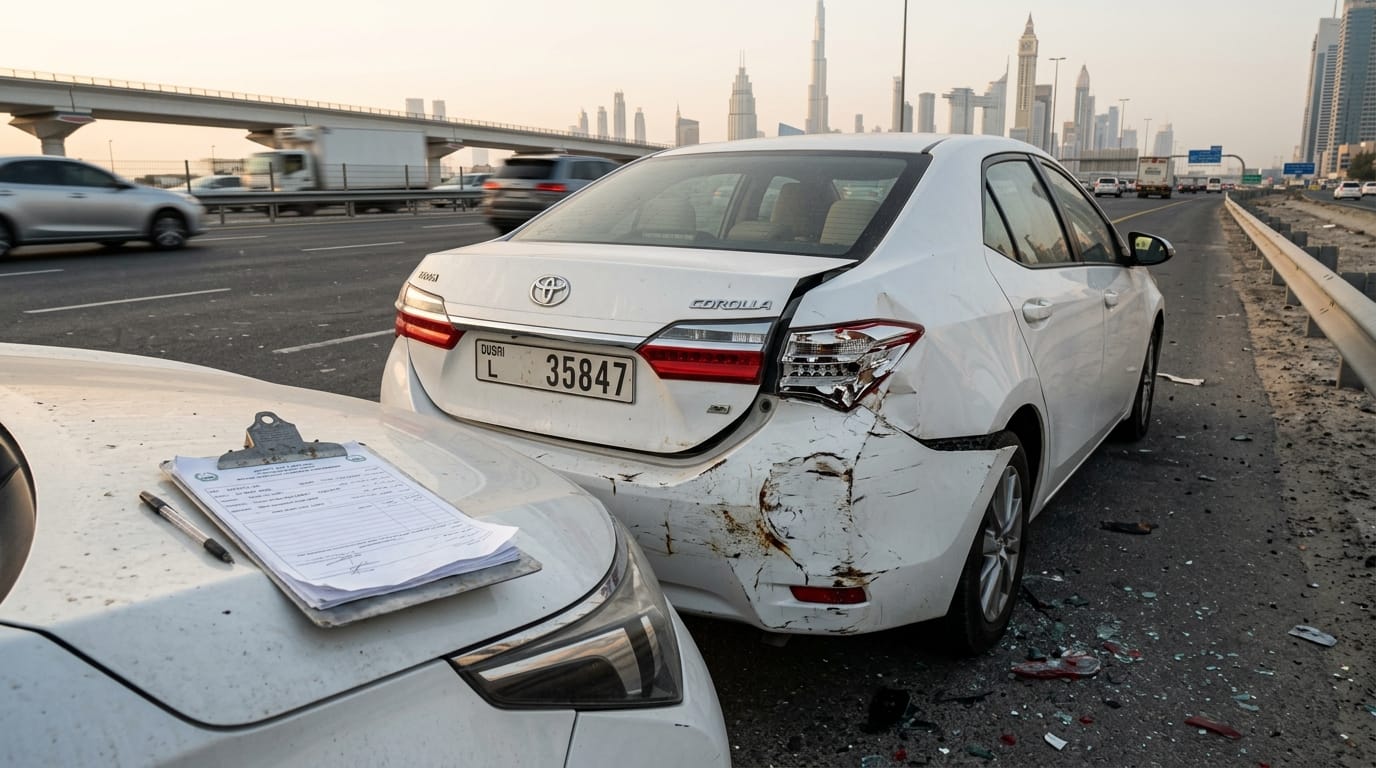
It was a Tuesday morning in January, around 8:15 AM on the approach to Business Bay from Al Khail Road. Traffic had been moving steadily and then slowed suddenly near a merge point. The car behind — a silver Nissan Patrol — did not brake in time and struck the rear bumper and boot area of a 2020 Toyota Corolla at an estimated 30 to 40 km/h.
The impact was significant enough to push the Corolla forward about two metres. The boot was visibly crumpled. The rear bumper was split. One tail light housing was shattered.
Both drivers were uninjured. The Patrol had a damaged front grille and bonnet. No pedestrians were involved. No property other than the two vehicles was damaged.
Immediate Reactions
The natural instinct is to step out of the car and assess the damage immediately. In Dubai, this is understandable but also the moment where mistakes begin. The first priority is always to move the vehicles safely to the side of the road if they are driveable and if doing so does not create additional hazard.
In this case, the Corolla was driveable. Both vehicles were moved to the hard shoulder. Hazard lights were switched on. Neither driver was confrontational — which matters, because arguments at the scene rarely help and sometimes complicate the police report process.
Immediate Actions After the Accident
Step 1: Safety First
Check yourself, your passengers, and the other driver for injuries. If anyone is hurt, call 998 (ambulance) immediately. Do not move injured people unless there is immediate danger to their life from remaining in place.
Step 2: Move to Safety if Possible
On major roads and highways in Dubai, staying in the lane after a minor accident creates risk of a secondary collision. Move to the hard shoulder, a service road, or the nearest safe area. Turn on your hazard lights.
Step 3: Photograph Everything Before Moving (If Safe)
If you can safely take photos before moving the vehicles, do so. Photograph the position of both cars, all visible damage, the road markings, and the surrounding area. These photos matter if there is any dispute later about how the collision occurred.
Step 4: Exchange Information
Collect from the other driver:
- Emirates ID (photograph it)
- Driving licence (photograph it)
- Vehicle registration card / Mulkiya (photograph it)
- Insurance certificate (photograph the card or sticker)
- Phone number
Do not accept verbal assurances. Photograph the actual documents. People’s recollections of their own policy details are frequently inaccurate.
Step 5: Do Not Admit Fault at the Scene
Whatever you believe about fault, do not say “it was my fault” or “I’m sorry” in a way that could be documented. The police report and the insurer’s assessment determine liability. Admissions at the scene create complications, especially in multi-vehicle situations.
Dubai Police Report Process
When Is a Police Report Required?
In Dubai, a police report is required for any accident involving:
- Injury to any person
- Damage to property other than the vehicles (walls, barriers, signs)
- Disputes about fault between drivers
- Hit-and-run situations
- Accidents on major roads and highways
For minor accidents in car parks with no dispute and no injury, some insurers accept a mutual no-objection agreement between both parties instead of a police report. Check with your insurer before assuming this applies to your situation.
This guide is reviewed periodically as Dubai Police procedures evolve.
Digital Reporting via Dubai Police App
Dubai Police provides a mobile app that allows self-reporting of minor traffic accidents. After submission, an officer may attend or the report may be processed digitally. The app generates a report number which your insurer will accept.
For moderate or serious accidents, an officer typically attends the scene. Processing time varies — in busy periods on Sheikh Zayed Road or the Dubai-Abu Dhabi highway, wait times can reach 45 to 90 minutes.
Police Report Colors
| Report Color | Meaning | Effect on Claim |
|---|---|---|
| White | No fault assigned or minor incident | Each party claims against own insurer |
| Green | Partial fault assigned | Proportional liability between parties |
| Red | Full fault assigned to this driver | At-fault driver’s insurer covers third party |
In the rear-end case described above, the Patrol driver received a red report. In most rear-end collisions in UAE, the following driver is held responsible unless investigation reveals exceptional circumstances such as sudden illegal stopping by the lead vehicle.
How Insurers Use the Police Report
The police report is the foundational document for any liability determination. Insurers in Dubai generally accept the police report’s fault assessment without running their own independent investigation for standard claims. If you believe the report is incorrect, you have the right to contest it — but this extends the claim timeline substantially.
Who Pays? A Quick Reference
| Situation | Who Pays? | Notes |
|---|---|---|
| You are at fault — comprehensive cover | Your insurer pays for all parties, minus your deductible | Your NCD is affected at renewal |
| Other driver is at fault — they have insurance | Their third-party insurer covers your damage | Or claim on your own policy for speed — insurer pursues recovery |
| Total loss declaration | Insurer pays agreed current market value, minus deductible and salvage | If you have a car loan, the outstanding balance may exceed the payout |
| Uninsured at-fault driver | Depends on your cover — uninsured motorist clause if present | Your deductible applies; report to police as mandatory insurance violation |
| Hit-and-run (driver unidentified) | Your own comprehensive policy | Police report mandatory — no report, no claim |
| Flood or weather damage | Only if your policy includes Act of God / natural disaster cover | Not standard — verify in writing at renewal |
Contacting the Insurance Company
When to Call
Most UAE insurance policies require you to report an accident within 24 to 48 hours. Some policies specify notification within the same day for accidents involving injury or total loss. Read your policy schedule for the exact requirement. Delayed reporting is one of the most common reasons claims face complications.
What to Have Ready When You Call
- Policy number (on your insurance card)
- Your Emirates ID number
- Vehicle registration number
- Location of the accident
- Police report number (if already obtained)
- Brief description of what happened
- Names and contact details of other parties
The call centre agent will open a claim file and give you a claim reference number. Write this down immediately. Every subsequent interaction — every email, every visit — should reference this number.
Mobile Apps
Most major UAE insurers — RSA, Oman Insurance (now Sukoon), AXA/GIG Gulf, Tokio Marine, Orient Insurance — provide mobile apps where you can initiate a claim, upload documents, and track status. This is often faster than phone calls for initial reporting and document submission. You can compare coverage types in detail in our comprehensive vs third-party insurance guide.
Documents Required
| Document | Why It’s Needed | Notes |
|---|---|---|
| Emirates ID (copy) | Identity verification | Both sides of the card |
| Driving licence (copy) | Confirm you are authorised to drive | Must be valid at time of accident |
| Vehicle registration / Mulkiya | Confirm vehicle ownership | Must be current — expired registration can affect claim |
| Insurance certificate / policy schedule | Confirm coverage details | Available from insurer’s app or portal |
| Police report (original or digital) | Establish fault and accident facts | Digital copies from Dubai Police app accepted |
| Accident photographs | Document damage at scene | More is better — include wide shots and close-ups |
| Completed claim form | Formal claim initiation | Insurer provides this — available online |
| Repair estimate (if obtained) | Initial cost indication | Not always required at first contact |
| Other driver’s details and insurance | Third-party information | If a third-party claim is involved |
Important: Expired DocumentsIf your driving licence or vehicle registration was expired at the time of the accident, your insurer may reduce or deny your claim. This is a standard exclusion in most UAE motor insurance policies. Check both documents now — before you ever need to file a claim.
Vehicle Inspection
What Happens Next
After you submit your claim and documents, the insurer arranges a vehicle inspection. This typically happens in one of two ways:
- You bring the vehicle to the insurer’s approved inspection centre
- An assessor visits you at a location you agree on
In Dubai, most major insurers maintain inspection centres in areas including Al Quoz, Deira, and near their main offices. Appointments are often available within 1 to 3 working days of claim filing. For guidance on what inspectors look for, see our pre-purchase inspection guide — many of the same checkpoints apply.
What the Assessor Checks
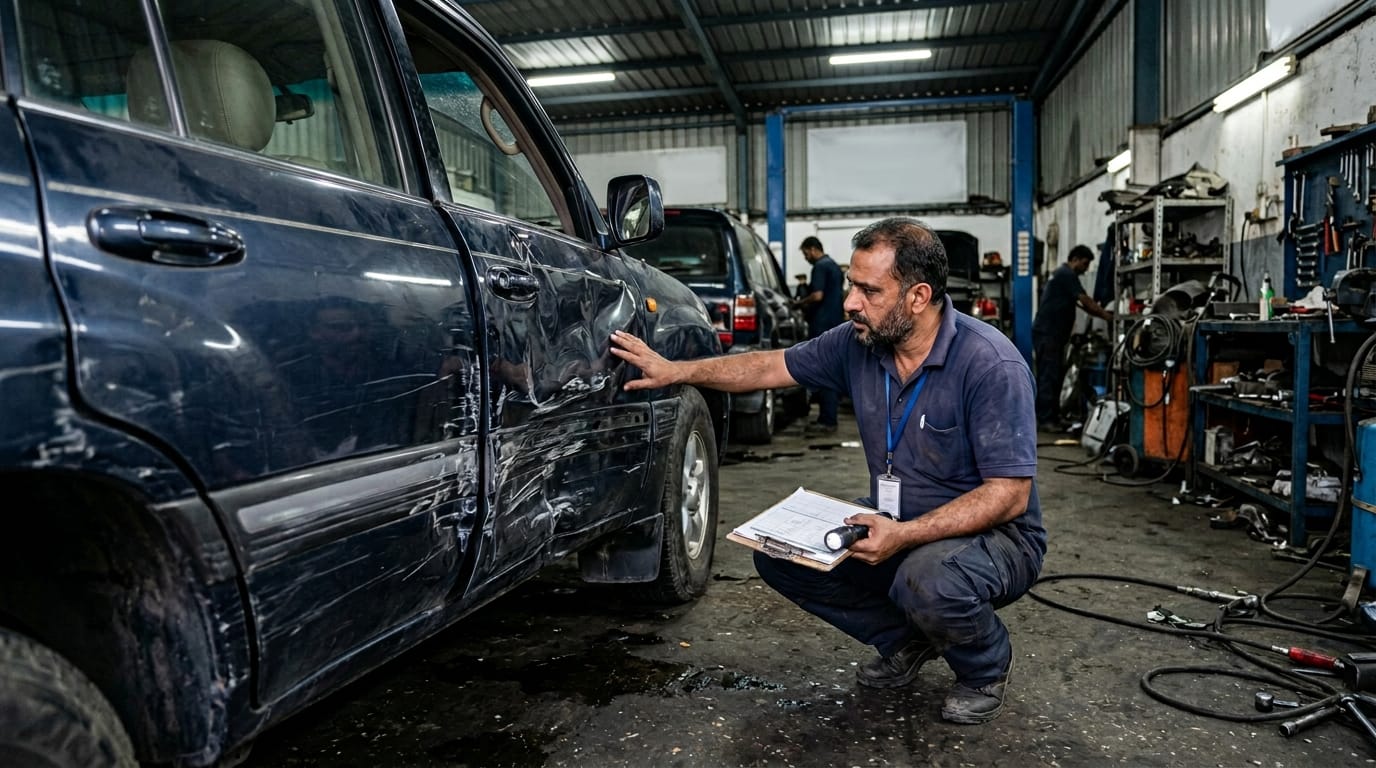
The assessor photographs all visible damage, checks the VIN against the registration, and records the odometer reading. They produce an initial damage assessment report, which forms the basis of the repair authorisation.
Hidden Damage
What looks like a straightforward bumper replacement on the outside sometimes reveals structural damage, sensor damage, or internal component issues once the vehicle is at the garage. Most UAE insurers have a supplement process to handle this — the garage submits a revised estimate covering the additional damage discovered during disassembly. This is normal and does not mean the claim is being contested.
Common Reasons Claims Get Delayed
Most claim delays are avoidable. Understanding them in advance helps you move faster when a claim is active.
- Missing police report — the single most frequent hold-up. Without a report number, the file cannot progress. Digital reports via the Dubai Police app resolve this fastest.
- Expired or missing Mulkiya — insurers verify registration before processing. An expired Mulkiya can trigger a policy review before any repair is authorised.
- Incomplete garage estimate — if the repair quote does not itemise parts, labour, and part numbers separately, the insurer’s assessor will return it for revision. This adds 3 to 5 working days.
- Parts unavailable in the UAE — European models and American-spec imports regularly wait 1 to 3 weeks for imported parts. Toyota, Nissan, and Honda parts are typically stocked same-day across Al Quoz Industrial Area and Sharjah Industrial Area.
- Claim filed late — reporting beyond the 24 to 48 hour policy window triggers a review process before the claim can be accepted. Always call the same day, even on a weekend.
- Disputed liability — if both drivers contest the police report, the insurer waits for the traffic court outcome. This commonly adds 4 to 8 weeks.
- Holiday periods and post-rain surges — Al Quoz and Deira workshops are routinely at full capacity following Dubai rain events. Processing slows during Ramadan and Eid periods.
Repair Authorization
After the inspection, the insurer’s assessor prepares a repair authorisation document that specifies which repairs are approved and at what estimated cost. This document goes to the approved garage.
Typical authorisation processing time in Dubai is 2 to 5 working days after the inspection, though this varies between insurers and the complexity of the damage.
If the garage’s repair estimate is higher than the insurer’s initial approval, a review process begins. The garage and insurer negotiate, which can add 3 to 7 working days before work begins. Staying in contact with both parties during this period moves things along.
Agency Repair vs Network Garage
What Is Agency Repair?
Agency repair means your vehicle is repaired at the brand’s authorised dealer — a Toyota, Nissan, or Honda service centre, for example. Repairs follow the manufacturer’s specifications, use genuine parts, and typically preserve the manufacturer’s warranty.
What Is a Network Garage?
Network garages are independent workshops that the insurer has approved and contracted with. The quality varies significantly between network garages. Some are highly capable. Others do acceptable work for standard repairs but may lack specialist equipment for complex structural or electronic repairs. Our guide on finding honest mechanics in Al Quoz covers what to look for when evaluating any workshop.
Who Gets Agency Repair?
This depends entirely on your policy. Comprehensive policies purchased new in UAE often include agency repair for the first 3 to 5 years of the vehicle’s age. After that period, the vehicle is typically directed to network garages unless you specifically purchased an agency repair extension. For luxury vehicles, see our separate luxury car agency repair guide.
| Comparison Point | Agency Repair | Network Garage |
|---|---|---|
| Parts used | Genuine manufacturer parts | Genuine, OEM, or aftermarket depending on policy |
| Warranty on repairs | Manufacturer warranty usually maintained | Garage warranty only, typically 6 to 12 months |
| Turnaround time | Often longer — 2 to 4 weeks | Often faster — 1 to 2 weeks |
| Premium impact | Higher premium at renewal | Lower premium at renewal |
| Resale value | Full service history maintained | Independent repair history |
Replacement Parts
Genuine Parts
Made by the original vehicle manufacturer. Highest cost, exact fit, full compatibility with vehicle systems. Agency repair typically uses genuine parts.
OEM Parts
Made by the same supplier that produces parts for the manufacturer, but without the manufacturer’s branded packaging. Often comparable quality to genuine at a lower price. Used frequently in UAE network garages for vehicles past agency repair eligibility.
Aftermarket Parts
Made by independent manufacturers. Quality varies widely. UAE insurers are required to notify policyholders when aftermarket parts are being used. If you have concerns about aftermarket parts, raise this with your insurer at the authorisation stage — not after repairs are completed.
The Deductible
The deductible — sometimes called the excess — is the fixed amount you pay toward any claim. If your policy has a 1,000 AED deductible and the repair bill is 8,000 AED, the insurer pays 7,000 AED and you pay 1,000 AED.
You pay the deductible directly to the repair garage, not to the insurer. This is a source of frequent confusion — many first-time claimants expect to pay the insurer and are surprised when the garage collects it.
Common deductible amounts in UAE comprehensive policies range from 500 AED to 2,500 AED depending on the insurer, the vehicle age, and the driver profile. Young drivers and those with less than two years of UAE driving experience are typically assigned higher deductibles. For a full cost comparison of policy types, see our cheapest car insurance UAE comparison.
Deductible Misconception to AvoidIf the other driver is fully at fault and you are claiming against their insurer rather than your own, you typically pay no deductible. Your deductible only applies when you claim against your own policy.
Claim Timeline — Realistic Expectations
Dubai Car Insurance Claim Timeline
Total Cost Breakdown — Example
This example is based on the rear-end Corolla scenario described earlier. The vehicle had a valid comprehensive policy with agency repair cover (vehicle was 4 years old, within the agency repair window of the policy).
| Cost Item | Amount (AED) | Paid By |
|---|---|---|
| Rear bumper replacement (genuine part) | 2,100 | Insurer |
| Boot lid repair and repaint | 3,400 | Insurer |
| Tail light assembly (left) | 1,650 | Insurer |
| Rear sensors (2 units, hidden damage) | 1,200 | Insurer |
| Labour | 1,800 | Insurer |
| Total repair bill | 10,150 | — |
| Deductible paid by vehicle owner | 1,000 | Owner → Garage |
| Insurer paid | 9,150 | Insurer → Garage |
In This CaseBecause the Patrol driver received the red report and was at fault, the Corolla owner could alternatively have claimed against the Patrol driver’s third-party insurance. In practice, many expats claim against their own comprehensive policy to move faster — their insurer then pursues recovery from the at-fault driver’s insurer separately. This does not always affect your No Claim Discount if the at-fault driver is clearly identified and recovery is completed.
Final Settlement
When repairs are complete, the garage notifies both you and the insurer. An inspector from the insurer — or the insurer’s designated assessor — checks the vehicle against the authorised repair list to confirm all approved work was completed satisfactorily.
Once approved, you pay your deductible directly to the garage and collect your vehicle. The insurer settles the remaining amount directly with the garage — you typically never receive a cash payment in a standard repair claim.
The documents you should receive include: a completed repair order showing all work done, a garage warranty certificate (typically 6 to 12 months on workmanship), and updated photographs if the insurer conducted a final inspection.
Total Loss (Write-Off) Situations
If the repair cost exceeds a certain percentage of the vehicle’s market value — typically 50% to 75% depending on the insurer’s policy — the vehicle may be declared a total loss.
In a total loss settlement, the insurer pays you the agreed market value of the vehicle (as defined in your policy) minus the deductible and minus the salvage value of the damaged vehicle (which the insurer retains or sells).
Example: Vehicle market value AED 28,000. Repair cost AED 22,000 (exceeds 75% threshold). Salvage value AED 4,000. Deductible AED 1,500. Settlement to owner: approximately AED 22,500.
Disputes about market value in total loss cases are among the most common insurance disagreements in the UAE. If you believe the insurer’s valuation is significantly below the true market price, you can request an independent vehicle valuation. Buyers may have legal remedies depending on evidence and the specific circumstances of the situation.
Flood Damage Claims
Flood and water damage coverage is not standard in all comprehensive UAE policies. During and after Dubai’s significant rainfall events in recent years, many drivers discovered their comprehensive policies did not include flood cover. See our dedicated flood damage insurance guide for the full picture.
If your policy includes natural disaster or flood cover (sometimes listed as “Act of God” cover), filing a flood claim follows broadly the same process as a standard claim — with additional documentation of the circumstances and independent verification that the damage was water-related rather than pre-existing.
Flood claims typically take longer than standard claims, particularly following widespread weather events when workshops across the UAE are handling a surge in damaged vehicles simultaneously.
Multi-Vehicle Accidents
When three or more vehicles are involved, determining fault and coordinating between multiple insurers adds significant complexity. Each insurer reviews the same police report and may reach slightly different conclusions about proportional fault.
In practice, if you are clearly the non-fault party with a clean police report, the most straightforward approach is often to claim against your own comprehensive policy (if you hold one) and let your insurer pursue the at-fault party’s insurer. This is faster for you than waiting for inter-insurer disputes to resolve.
Hit-and-Run Claims
If the vehicle that damaged yours left the scene:
- File a police report immediately — this is mandatory
- Document any available evidence (CCTV request in writing to police, photographs, witnesses)
- Notify your insurer the same day
Hit-and-run claims are covered under your own comprehensive policy’s uninsured motorist provisions in most cases. Your deductible will typically apply. Expect the process to take longer than a standard claim due to the police investigation element.
Rental Car During Repairs
Whether you receive a replacement vehicle during repairs depends entirely on your policy. This benefit is offered as an add-on by most UAE insurers and is not standard in basic comprehensive cover.
Typical rental cover in UAE policies provides a vehicle in the range of AED 80 to AED 150 per day, for up to 14 to 21 days. Premium policies may offer longer periods or higher daily allowances.
If your vehicle is at an agency for an extended period due to parts availability, and your rental cover expires before repairs are complete, you will pay out of pocket from that point. Ask the insurer at claim initiation exactly how many days you are entitled to, and plan accordingly.
Common Mistakes Expats Make
| Mistake | Why It Causes Problems | What to Do Instead |
|---|---|---|
| Leaving the accident scene quickly | Insufficient documentation, no police report | Stay, document, wait for police or use the app |
| Not photographing the scene | No evidence if fault is disputed | Photograph before moving vehicles when safe |
| Admitting fault verbally at scene | Admission may be used against you | Let the police report determine fault |
| Reporting late to insurer | Claim complication or rejection | Call within 24 hours — even on a weekend |
| Taking vehicle to any garage without approval | Insurer may not cover unauthorised work | Use insurer’s approved network or agency |
| Not asking about rental car cover | Paying out of pocket for a car during repairs | Ask insurer at claim initiation if rental is covered |
| Trusting verbal estimates over written ones | Disputes about what was agreed | Always get written authorisation before repairs start |
| Assuming police report = fault determination | Some insurers conduct their own review | Understand your insurer’s process before assuming outcome |
Insurance Claim vs Legal Action — Understanding the Difference
| Route | Against Whom | What It Covers | Timeline |
|---|---|---|---|
| Insurance claim (your policy) | Your own insurer | Vehicle repair costs, subject to deductible and policy terms | Days to weeks |
| Third-party insurance claim | At-fault driver’s insurer | Your repair costs, if at-fault driver is clearly identified | Weeks to months |
| Legal action | At-fault driver personally | Damages beyond insurance coverage, uninsured driver situations | Months — outcomes vary significantly based on evidence and circumstances |
Many expats conflate an insurance claim with a legal case. They are separate processes. Filing a claim with your insurer does not prevent you from pursuing other legal remedies, but outcomes vary significantly based on available documentation and how the transaction or incident was conducted.
How Claims Affect Future Premiums
No Claim Discount
UAE motor insurance policies commonly include a No Claim Discount (NCD) structure. Each year without a claim typically earns a 5% to 10% premium reduction, up to a maximum of around 20% to 25% depending on the insurer.
Filing a claim — even a small one — generally resets or reduces your NCD. For very minor damage, it is worth comparing the repair cost against the NCD you would lose over the next one to two renewal cycles before deciding whether to claim.
Premium Impact After a Fault Claim
After an at-fault claim, premium increases at renewal are common. The increase depends on the insurer, the severity of the claim, and your overall driving history. Increases of 15% to 30% in the year following a significant fault claim are frequently reported among expats in the UAE market. If your renewal is approaching, see our insurance renewal hidden charges guide before signing anything.
Evidence Checklist — What to Collect and Keep
| Item | Format | Why It Matters |
|---|---|---|
| Accident scene photographs | Phone photos, timestamped | Establishes positions and visible damage |
| Other driver’s Emirates ID | Photo of card | Identity verification if disputes arise |
| Other driver’s insurance card | Photo of card or sticker | Third-party claim information |
| Police report number | Written note or screenshot | Required for claim filing |
| Claim reference number from insurer | Written note or email | Track claim status, reference in all calls |
| Repair authorisation document | PDF or email from insurer | Confirms approved scope of work |
| Repair invoice and receipts | Original documents from garage | Final settlement documentation |
| Garage warranty certificate | Physical document | Required if repairs need revisiting |
Reasons Claims May Be Rejected or Reduced
Common Grounds for Claim Rejection
- Driver under the influence of alcohol or substances at time of accident
- Vehicle driven by an unlisted or excluded driver (common in fleet and family policies)
- Driving licence expired at time of accident
- Vehicle registration expired at time of accident
- Deliberate or intentional damage
- Accident occurred while using the vehicle for purposes excluded by the policy (commercial use on personal policy, racing)
- Late notification beyond the policy’s reporting deadline without valid reason
- Fraud or misrepresentation in the claim
Partial reductions are also possible. If the vehicle had pre-existing damage that the insurer’s inspector identifies as unrelated to this accident, only the accident-related damage is covered.
What You Can Do if You Are Unhappy with a Settlement
- Request a written explanation of the settlement calculation from your insurer
- Obtain an independent vehicle valuation if disputing a total loss amount
- Submit a formal complaint to your insurer’s complaints department in writing
- Escalate to the UAE Insurance Authority if the insurer’s response is unsatisfactory — the IA operates a consumer complaint mechanism
- Preserve all documentation: WhatsApp conversations, emails, estimates, repair invoices
Practical Tips for Faster Claim Processing
- Submit all documents in one complete package — multiple back-and-forth submissions slow processing
- Use the insurer’s app rather than phone calls where possible — digital submissions are timestamped and trackable
- Follow up every 3 working days with a brief status check rather than waiting passively
- Respond quickly to any insurer request for additional information — each day you delay adds a day to the timeline
- Choose a garage on the insurer’s approved list that is nearest to your home or workplace — makes drop-off and collection more practical
- If rental cover is included, activate it from day one — most policies only pay from activation, not from the accident date
Prevention — Things to Check Before You Ever Need to Claim
| Check | How Often | Why It Matters for Claims |
|---|---|---|
| Driving licence validity | Annually | Expired licence = potential claim rejection |
| Vehicle registration (Mulkiya) validity | Annually | Expired registration = potential claim complication |
| Named drivers on policy | When adding regular drivers | Unlisted driver claim can be denied |
| Flood cover inclusion | At each renewal | Not standard — verify it exists in writing |
| Agency repair eligibility window | At each renewal | Know when agency repair ends for your vehicle age |
| Rental car daily limit and days | At each renewal | Plan for longer repairs if limit is short |
Real Case Studies: Workshop and Market Logs
Case 1 — Indian Expat, Rear-End on Emirates Road, Sharjah
A software engineer from Kerala, driving a 2018 Nissan Sunny, was hit from behind on Emirates Road near Sharjah Industrial Area in February. The Sunny’s rear bumper and boot lid were damaged. Total repair cost: approximately 4,200 AED at a network garage in Abu Shagara.
The other driver — a UAE national — had third-party cover only. The Sunny’s owner held comprehensive cover with a 1,000 AED deductible. He claimed against his own policy for speed, paid the deductible at the Abu Shagara garage, and had the vehicle back in 9 working days. His insurer later confirmed they were pursuing cost recovery from the at-fault driver’s insurer — his NCD was not affected.
Case 2 — British Expat, Parking Lot Scrape, Mall of the Emirates
A marketing manager from Manchester discovered a long keyscratch along the driver’s door of her 2021 BMW 3 Series while parked at Mall of the Emirates. No other vehicle was involved — a hit-and-run in the car park.
She filed a Dubai Police digital report the same day, which took approximately 25 minutes. She notified her insurer (AXA/GIG Gulf) within 3 hours. The BMW was directed to the BMW authorised dealer in Al Quoz for agency repair. Parts — a door skin and paint match — were available within the UAE. Total repair: approximately 7,800 AED. She paid a 2,000 AED deductible. Agency repair was completed in 12 working days.
Case 3 — Pakistani Engineer, Total Loss After Highway Collision, Abu Dhabi Road
A structural engineer from Lahore, driving a 2016 Toyota Camry, was involved in a three-vehicle collision near the Dubai-Abu Dhabi border. His vehicle sustained front and side structural damage. Repair estimate: approximately 38,000 AED. The vehicle’s assessed market value was around 32,000 AED.
The insurer declared a total loss. Settlement offered: approximately 30,500 AED (market value minus 1,500 AED deductible). He had no outstanding car loan. He accepted the settlement, which was processed within 11 working days. The insurer retained the salvage vehicle.
He later purchased a replacement using the settlement funds, combined with cash savings. Our used car buying guide covers how to approach that process as a returning buyer.
The Bottom Line Decision Framework
Data Sources and Methodology
Cost figures in this article are based on observations across Al Quoz Industrial Area and Abu Shagara workshops, combined with claim patterns documented across the UAE expat market over multiple years. All AED figures represent typical ranges — actual costs vary by vehicle make, model year, damage extent, insurer pricing, and parts availability at the time of repair.
Government reference sources used in this article:
- Dubai Police — Accident Reporting App and Traffic Services
- UAE Insurance Authority — Consumer Complaint Mechanism
- Roads and Transport Authority Dubai — Vehicle Registration
- UAE Consumer Protection — Vehicle Purchase Disputes
Market Volatility NoticeAll repair cost estimates, deductible ranges, NCD percentages, and premium figures mentioned in this article are averages observed across the UAE market. They are subject to change based on parts pricing, insurer policy revisions, and exchange rate fluctuations. Always verify current figures directly with your insurer or an approved workshop before making financial decisions.
Frequently Asked Questions
Q: How long does a standard car insurance claim take in Dubai?
Q: Can I take my car to any garage after an accident in Dubai?
Q: What happens if the other driver has no insurance?
Q: Will my premium go up after I file a claim?
Q: What is the deductible and do I pay it even if I am not at fault?
Q: Can I contest a police report fault decision?
Key Takeaways
- Report to your insurer within 24 hours of any accident — late reporting is the most common avoidable complication
- Photograph the scene before moving vehicles wherever it is safe to do so
- The police report determines fault — do not admit fault verbally at the scene
- Submit all documents together in one complete package to avoid processing delays
- Understand your deductible, NCD position, and rental cover before you ever file a claim
- For straightforward cases, expect 10 to 25 working days from accident to vehicle collection
- Agency repair eligibility depends on your vehicle’s age and your policy terms — verify at renewal
- Total loss valuation disputes are common — independent valuation is an option
- Flood cover is not standard — confirm it exists in your policy in writing
- Insurance claims and legal action are separate routes — you can pursue both where relevant
Conclusion
Filing a car insurance claim in Dubai is not as complex as it feels at the moment an accident happens. The process has a logical sequence. Each step leads clearly to the next. The main variables — document completeness, reporting speed, parts availability, and fault determination — are all things you can prepare for and manage.
The expats who navigate claims most smoothly are rarely the ones with the most experience. They are simply the ones who photographed everything, called their insurer the same day, and followed up consistently.
If you are buying a used car and want to know what to check before your first drive, see our pre-drive inspection checklist — preventing problems is always faster than recovering from them.

Disclaimer: Emirates Car is a 100% independent platform. We do not own showrooms, nor are we affiliated with any used car dealerships or garages. Our sole mission is to protect expats from financial fraud in the automotive market.
