Last Updated: June 2026 | By Omar Al-Fayed, Senior Automotive Consultant | Fact-Checked By: Emirates Cars Editorial Team | Category: Finance & Legal
Quick Answer: Does Car Insurance Cover Flood Damage in UAE?
If you have comprehensive insurance, flood damage is generally covered — including engine, electronics, and interior. If you only have third-party insurance, flood damage is typically not covered at all.
However, comprehensive policies almost always include exclusions. If you drove into visibly flooded water after official warnings were issued, your insurer may reject the claim. Many expats learn this only after the damage is done. Understanding your policy type before a flood event is the single most important step you can take.
The immediate steps after flood damage: stop the engine, do not attempt to restart it, photograph everything, call your insurer within 24 hours, and arrange towing — not driving — to an approved garage.
| Insurance Type | Flood Damage Coverage | Engine Hydrolocking | Interior Damage |
|---|---|---|---|
| Comprehensive | Generally covered | Generally covered | Generally covered |
| Third Party Only | Not covered | Not covered | Not covered |
Why Flood Damage Has Become a Real Issue for UAE Drivers
The UAE has historically been associated with dry desert conditions. Most expats who arrive here assume rain is rare and brief. That assumption has become less reliable over the past several years.
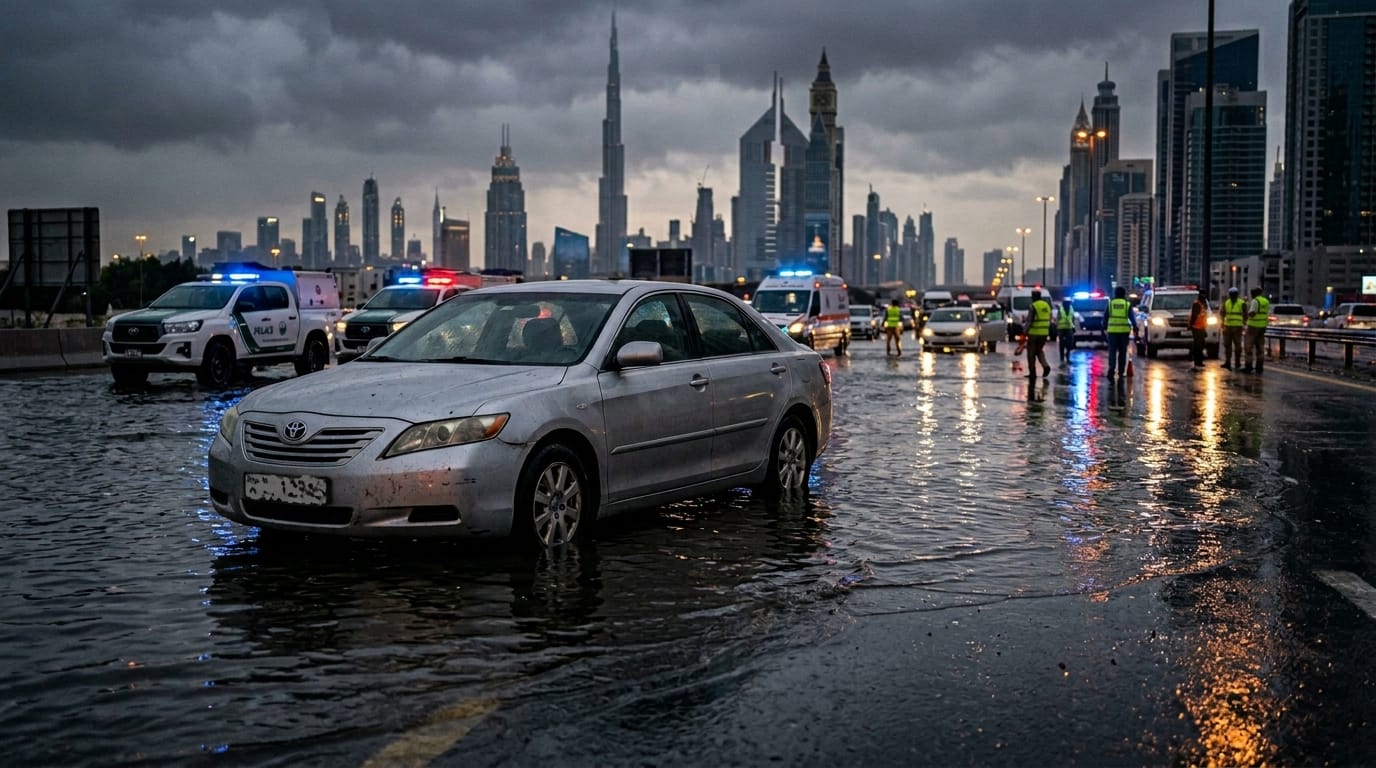
Heavy rainfall events — including the April 2024 storm that affected Dubai, Sharjah, and Ajman — produced standing water on major highways, flooded underpasses, and left thousands of vehicles stranded or damaged. The financial impact on unprotected drivers was significant, with repair costs commonly ranging between 8,000 and 50,000 AED depending on vehicle and damage depth.
Many expats also misunderstand what “comprehensive insurance” actually covers in the UAE context. Policies sold here are not identical to policies in India, the Philippines, or the UK. UAE-specific exclusions — particularly around “driving into known flooded areas” — are written into most policy documents but rarely explained at the point of sale.
The combination of increasing rainfall events and widespread policy misunderstanding has made flood damage one of the most contested claim categories in the UAE market today.
Comprehensive vs Third Party: The Key Difference for Flood Claims
This is the foundational question. Everything else in this guide depends on which type of policy you hold.
| Feature | Comprehensive | Third Party Only |
|---|---|---|
| Own vehicle flood damage | Generally covered | Not covered |
| Third party vehicle damage | Covered | Covered |
| Engine hydrolocking | Generally covered | Not covered |
| Interior water damage | Generally covered | Not covered |
| Towing after flood | Often included | Rarely included |
| Total loss settlement | Yes | No |
| Agency repair option | Often available | N/A |
| Annual premium range (AED) | 1,800 – 6,000+ | 600 – 1,200 |
If you are driving a vehicle worth more than 20,000 AED, or if you have an outstanding bank loan on the vehicle, third-party insurance alone leaves you fully exposed to flood costs. Affordable comprehensive options are available for most budgets and are worth reviewing before the next rainy season.
🚨 Critical Warning: Third-party insurance does NOT cover your own vehicle under any circumstances — flood, accident, fire, or theft. If you chose third-party to save money and your car was flooded, you bear the full repair cost. For a mid-range sedan, that typically means 15,000 to 45,000 AED out of pocket.
What Comprehensive Insurance Usually Covers After Flood Damage
A standard comprehensive policy in the UAE generally covers the following flood-related damage, subject to policy terms and exclusions:
Engine and Mechanical Components
Water entering the air intake and causing hydrolocking — where the engine seizes due to water in the cylinders — is one of the most expensive flood outcomes. This is generally covered under comprehensive policies. Repair or replacement costs typically range from 12,000 to 35,000 AED depending on engine size and vehicle make.
Electronics and ECU
Modern vehicles contain dozens of electronic control units. Flood water short-circuits wiring, sensor arrays, and the main ECU. These repairs are typically covered and can cost 3,000 to 15,000 AED depending on how many units are affected.
Interior and Upholstery
Seat soaking, dashboard damage, carpet water saturation, and headliner staining are generally covered. Interior restoration typically costs between 2,000 and 8,000 AED.
Transmission
Water intrusion into the gearbox — particularly automatic and CVT units — causes significant internal damage. CVT replacement costs in the UAE typically range from 8,000 to 18,000 AED.
Suspension and Brakes
Standing water accelerates rust in brake components and can affect suspension joints. Minor cases cost 1,500 to 4,000 AED. More extensive damage is covered but requires independent assessment.
Airbag Systems
Water damage to airbag control modules and sensors is generally covered. Replacement costs can reach 4,000 to 9,000 AED.
Towing
Many comprehensive policies include roadside assistance or towing to an approved garage. Confirm whether your policy includes this and what the distance limits are.
ℹ️ Expat Tip: Coverage always depends on the specific wording of your policy document. Before the rainy season, spend 20 minutes reading the “Exclusions” section of your policy. Most insurers also offer a free policy review by phone.
When Flood Claims Are Rejected
This is where most disputes occur. Comprehensive insurance does not guarantee claim approval. Insurers may reject or reduce flood claims in the following circumstances:
Driving Into Known Flooded Areas
If the UAE’s National Emergency Crisis and Disaster Management Authority (NCEMA) or local authorities issued flood warnings and you drove into standing water regardless, your insurer may argue this constitutes negligence. This is the most common basis for claim rejection in UAE flood cases.
Attempting to Restart a Flooded Engine
Restarting an engine that has ingested water almost guarantees hydrolocking. Worse, insurers often use evidence of a restart attempt to argue the driver worsened the damage and may reduce the claim accordingly.
Pre-Existing Mechanical Issues
If an assessor identifies mechanical problems unrelated to flooding — worn seals, pre-existing engine faults — the insurer may attribute some damage to prior neglect rather than the flood event.
Late Reporting
Most UAE policies require you to report flood damage within 24 to 48 hours. Delayed notification gives insurers grounds to question whether the damage occurred during the reported event.
Lack of Documentation
Claims with no photographs, no police report (where required), and no independent witness are substantially harder to process and more likely to be contested.
Policy Exclusion Clauses
Some budget comprehensive policies explicitly exclude “flood damage resulting from rising water levels” — a different category from rain damage. Read the fine print carefully. This guide is reviewed periodically as insurance regulations evolve.
Fraud Suspicion
If a vehicle shows inconsistent damage patterns — water marks at unusual heights, damage inconsistent with a reported flood zone — insurers may flag the claim for investigation.
%%{init: {'theme': 'base', 'themeVariables': {'background': '#f8f9fa', 'textColor': '#1a1a1a', 'primaryColor': '#2c3e50', 'secondaryColor': '#c0392b', 'lineColor': '#1a1a1a'}}}%%
flowchart TD
classDef default fill:#2c3e50,stroke:#1a1a1a,stroke-width:1px,color:#ffffff;
A[Flood Damage Occurs] --> B{Do You Have Comprehensive Insurance?}
B -- No --> C[Full Cost Out of Pocket — No Claim Possible]
B -- Yes --> D{Did You Ignore Official Warnings?}
D -- Yes --> E[Claim May Be Rejected — Negligence Clause]
D -- No --> F{Did You Restart the Engine?}
F -- Yes --> G[Partial Rejection Risk — Worsened Damage]
F -- No --> H{Reported Within 24-48 Hours?}
H -- No --> I[Late Reporting — Claim Dispute Risk]
H -- Yes --> J[Claim Likely to Proceed — Assessment Required]
Immediate Steps After Flood Damage — Step-by-Step Checklist
What you do in the first two hours after a flood event directly affects whether your claim is approved and for how much.
Step 1: Prioritize Personal Safety
If water is rising around your vehicle, exit the car immediately. Your safety is more important than the vehicle. Do not attempt to drive through water you cannot see the bottom of.
Step 2: Do Not Restart the Engine
This is the single most important rule. A flooded engine that is restarted will hydrolock within seconds. The resulting damage is almost always worse than the original flood damage — and may give your insurer grounds to reduce the claim.
Step 3: Move to Safety if Possible
If the vehicle can be pushed to higher ground without starting the engine, do so. Otherwise, leave it in place and exit the flooded area on foot if safe.
Step 4: Photograph Everything Immediately
Document: water level marks on the body, interior water depth, engine bay condition, odometer reading, location, date and time. Take video as well as photos. These are your primary evidence for the claim.
Step 5: Call Your Insurer Within 24 Hours
Most UAE policies require reporting within 24 to 48 hours of the incident. Call the claims hotline immediately. Do not wait until the water recedes and you assess the damage — report first, assess later.
Step 6: File a Police Report If Required
Some insurers require a police report for flood claims, particularly if the vehicle was damaged on a public road. Contact Dubai Police or the relevant emirate’s police service. In many cases you can file online or via the relevant police app.
Step 7: Arrange Towing — Not Driving
Request towing to an insurer-approved garage. Driving a flood-damaged vehicle, even if it starts, risks further damage and may compromise your claim.
Step 8: Do Not Remove or Repair Anything Yourself
Any unauthorized repair before the insurer’s assessment can complicate the claim. Leave the vehicle as-is until the assessor confirms what is approved.
The Flood Claim Process From Start to Finish
Process Timeline
Flood Claim Process Timeline
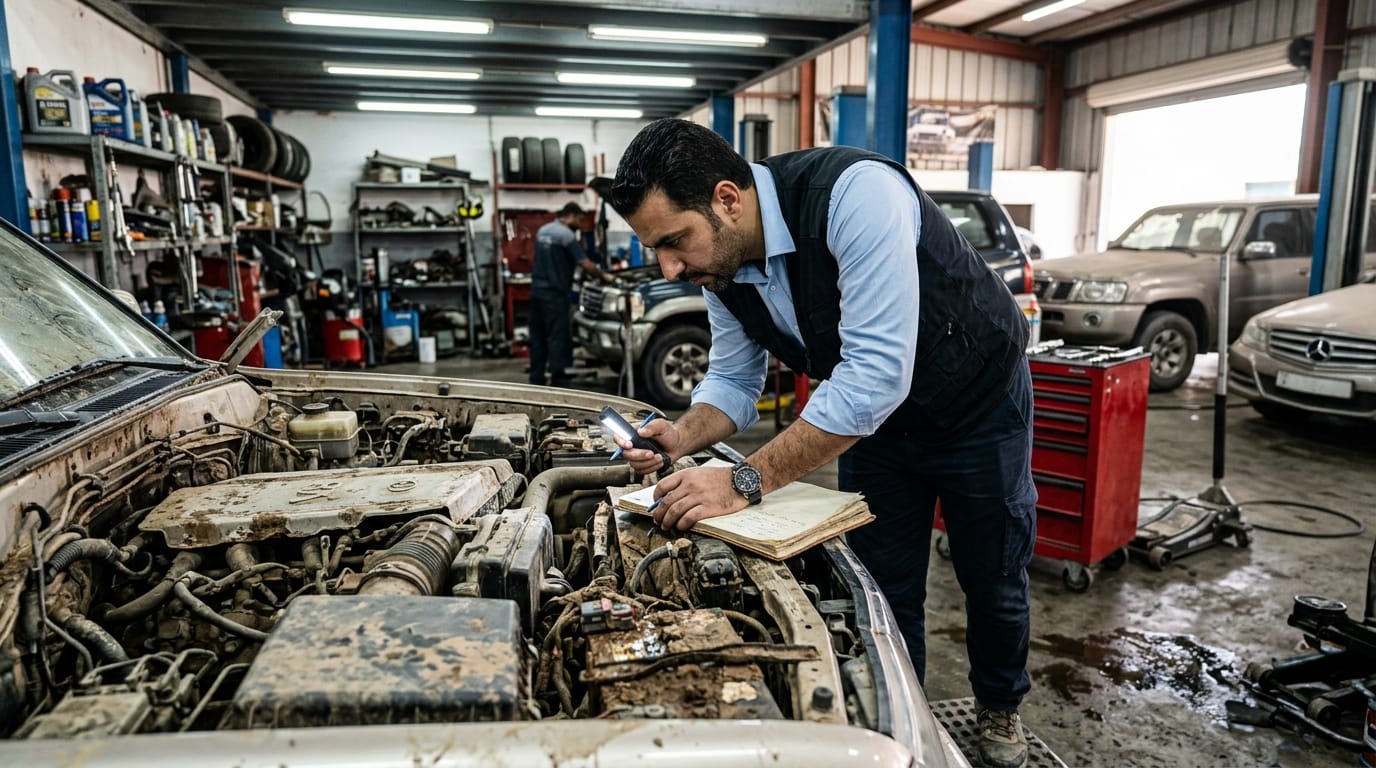
Repair timelines for flood damage are typically longer than standard accident repairs. Electrical components often need to be ordered from outside the UAE, adding 10 to 20 days in some cases. Choosing a well-stocked garage in Al Quoz can reduce waiting time for common Japanese and Korean vehicle parts.
Documents Required for a Flood Damage Claim
| Document | Purpose | Notes |
|---|---|---|
| Emirates ID | Identity verification | Original or clear copy |
| UAE Driving Licence | Confirms valid licence at time of incident | Must be valid — expired licences may void claim |
| Vehicle Registration (Mulkiya) | Confirms ownership and registration validity | Expired registration may complicate claims |
| Insurance Policy Certificate | Confirms coverage at time of incident | Check validity dates |
| Photographs and Video | Primary evidence of flood damage | Taken immediately after incident |
| Police Report | Required by many insurers | Confirm with your insurer if needed |
| Towing Receipt | Confirms vehicle was transported, not driven | Keep the towing company receipt |
| Garage Damage Report | Independent technical assessment | Request this before insurer assessment arrives |
Repair vs Total Loss: How Insurers Decide
After assessment, the insurer calculates the estimated repair cost and compares it to the vehicle’s actual cash value (ACV) — the market value of the vehicle at the time of the flood, not what you paid for it.
Repair Decision
If repair cost is below 50–60% of ACV (the threshold varies by insurer), the vehicle is typically declared repairable. The insurer authorizes repair at an approved garage.
Total Loss Declaration
If repair cost exceeds the insurer’s threshold — commonly 60–75% of ACV — the vehicle is declared a total loss. The insurer pays you the ACV minus your deductible/excess, and takes ownership of the vehicle (salvage).
Actual Cash Value vs Purchase Price
ACV is based on current market value, not what you paid. A vehicle bought for 35,000 AED 18 months ago may have an ACV of 26,000 AED at claim time due to depreciation. This is why gap insurance exists — to cover the difference between ACV and outstanding finance.
Salvage
When a total loss is declared, the insurer typically takes the vehicle. In some cases, owners can buy back the salvage at a reduced price — useful if you want to sell parts. Confirm this option with your insurer at the time of the total loss declaration.
Total Loss Settlements When You Have a Car Loan
This is one of the most financially stressful scenarios for expat buyers. If your vehicle is financed and declared a total loss, the insurer pays the bank — not you — up to the vehicle’s ACV.
Example: You owe 38,000 AED on a bank loan. The vehicle’s ACV is assessed at 28,000 AED. The insurer pays the bank 28,000 AED. You still owe the remaining 10,000 AED. How UAE car loans interact with insurance is something every financed buyer should understand before the rainy season.
🚨 Finance Gap Warning: Without gap insurance or a specific clause in your policy, you may owe thousands of AED to your bank even after a total loss settlement. Ask your insurer specifically whether your policy includes gap coverage, and get the answer in writing.
What Happens If Your Vehicle Is Financed Through a Bank
When a UAE bank finances a vehicle, the bank legally owns the vehicle until the loan is fully repaid. The vehicle registration (Mulkiya) and insurance certificate both reflect this. This has direct consequences for flood claims.
The bank must be named as a beneficiary on your insurance policy. If it is not, the insurer may issue the settlement cheque in your name, but the bank may legally challenge the settlement. Most lenders in the UAE require confirmation that they are listed on the policy before releasing the vehicle loan.
If a total loss occurs, the insurer settles with the bank first. Any remaining balance beyond the settlement is still owed by you. If the vehicle is repairable, the bank typically allows repair to proceed, as the vehicle retains its value as loan collateral.
If your repair or replacement vehicle situation changes significantly, notify the bank immediately. Failure to maintain insured possession of the vehicle can technically trigger loan default clauses in some agreements.
Agency Repair vs Non-Agency Repair After Flood Damage
| Factor | Agency Repair | Non-Agency Repair |
|---|---|---|
| Workshop | Brand-authorized dealer | Independent garage (e.g., Al Quoz) |
| Parts Used | OEM (original) parts | OEM or aftermarket |
| Cost | Higher (typically 30–50% more) | Lower |
| Warranty on Repair | Manufacturer-backed | Garage warranty only |
| Effect on Resale Value | Maintains higher resale | Lower resale value |
| Policy Requirement | Required for new vehicles under warranty | Standard for older vehicles |
| Best For | Vehicles under 3 years old or high value | Budget vehicles over 4 years old |
Many comprehensive policies offer “agency repair” as an add-on or as a standard feature for the first 3 years of the vehicle’s life. If your vehicle is still under manufacturer warranty, agency repair preserves that warranty. For older vehicles, non-agency repair at a reputable independent garage is generally a reasonable choice.
OEM Parts vs Aftermarket Parts in Flood Repairs
After major flood damage, the choice between original manufacturer parts and aftermarket alternatives affects both repair cost and long-term reliability.
OEM Parts
Original equipment manufacturer parts are identical to what came with the vehicle. They cost more — typically 25–40% higher — but fit precisely, maintain warranty validity, and generally last longer. For electronic components like ECU modules and sensor arrays, OEM is strongly preferred after flood damage. Electrical compatibility issues with aftermarket ECUs are commonly reported in UAE workshops.
Aftermarket Parts
For structural and body components — door seals, floor panels, carpet — aftermarket parts from reputable suppliers are usually acceptable. The quality range is wide. Request that the garage specifies the brand and origin of aftermarket parts used, and avoid the cheapest available options for safety-critical components.
Hidden Flood Damage That Appears Weeks Later
This is one of the most frustrating aspects of flood damage. A vehicle can appear fully repaired, pass the workshop’s final check, and then develop faults over the following weeks and months.
Mold and Mildew
Water trapped in seat foam, carpet backing, and door cavities creates mold within 48–72 hours. The smell appears gradually. Full mold remediation costs between 800 and 2,500 AED. Inadequately treated vehicles develop respiratory-irritating spore levels within weeks.
Electrical Failures
Corrosion in wiring harnesses develops over weeks. Sensors begin failing intermittently. Dashboard warning lights appear for systems that tested fine initially. These faults can be expensive and difficult to trace.
Corrosion on Metal Components
Floor pans, chassis rails, and brake components begin rusting after flood exposure. This accelerates significantly in UAE heat. Brake component corrosion is a safety concern.
Transmission Issues
CVT and automatic gearboxes that were submerged may develop slip, hesitation, or rough shifting weeks after repair. This often indicates water contamination of transmission fluid that was not fully flushed during the initial repair.
Sensor Failures
Oxygen sensors, ABS sensors, and TPMS sensors corrode slowly after flood exposure. Failures appear 4–12 weeks post-repair. Each sensor replacement costs between 150 and 600 AED depending on type and vehicle.
How to Inspect a Repaired Flood Vehicle Before Accepting It
Before signing the garage release and paying your excess, perform these checks. You have the right to refuse collection if the repair is not satisfactory.
| Check Item | What to Look For | Problem Sign |
|---|---|---|
| Interior smell | Sniff under seats, in boot, under dashboard | Damp, musty, or chemical smell |
| Carpet and floor | Press firmly on all floor areas | Any moisture or soft spongy feel |
| Dashboard warning lights | Start vehicle, let all lights clear | Any remaining warning lights after startup |
| AC system | Run AC on full for 5 minutes | Unusual smell, reduced cooling, moisture |
| All electrical functions | Test windows, mirrors, infotainment, lights | Any intermittent or non-functioning feature |
| Under bonnet | Check for water marks above engine components | High-water marks, corrosion on wiring |
| Transmission | Drive in all gears including reverse | Slipping, hesitation, unusual noise |
| Brakes | Test at low speed | Grinding, pulling, vibration |
| Repair documentation | Request complete repair order | Vague or incomplete parts list |
If any issue is identified before you accept the vehicle, document it immediately and raise it with the garage and your insurer before signing off. Once you accept the vehicle, post-repair claims for the same incident become substantially more difficult.
No Claim Discount: Will a Flood Claim Affect Your Premium?
In the UAE, making a comprehensive insurance claim — including a flood claim — typically affects your No Claim Discount (NCD) at renewal. Practices vary significantly between insurers.
Some insurers offer “NCD protection” as an optional add-on, allowing one claim per year without affecting the discount. Without this protection, a single flood claim commonly reduces or eliminates an NCD accumulated over 2–3 years.
The financial calculation matters: if your NCD saves you 400 AED per year and your flood repair would cost 3,000 AED out of pocket, claiming is usually worth it. For minor damage under 2,000 AED, self-paying may preserve your NCD better over a 3-year period.
ℹ️ Expat Tip: Before filing any claim, call your insurer and ask specifically: “How will this claim affect my NCD at renewal?” Ask them to confirm the impact in writing via email or WhatsApp before you formally file. This takes 10 minutes and can save significant money.
How Flood Claims Affect Future Insurance Renewals
Beyond NCD, a flood claim creates a record on your insurance history in the UAE. When you renew with a different insurer, they will request details of claims made in the previous 3–5 years.
A single flood claim typically results in a 15–25% premium increase at renewal. Two claims within 3 years may result in some insurers declining to offer coverage, or offering coverage only at significantly higher premiums.
Insurers in the UAE are not centrally connected through a shared claims database at the same level as some Western markets, but most do request a “claims history letter” from your previous insurer as part of the renewal process. Providing false claims history constitutes fraud and can result in policy cancellation.
Common Mistakes UAE Drivers Make After Flooding
Mistake 1: Trying to Start the Vehicle
The most expensive mistake. Attempting to start a flooded engine is the leading cause of claims being reduced or disputed. Do not do it under any circumstances.
Mistake 2: Waiting to Report
Many drivers wait until the vehicle is towed and assessed by a garage before calling their insurer. Most policies require notification within 24–48 hours of the incident, not the assessment.
Mistake 3: Using Unauthorized Repair Shops
Taking the vehicle to a non-approved garage before insurer assessment — even for a preliminary check — can void the claim. Always wait for insurer authorization.
Mistake 4: Poor Documentation
Not photographing the vehicle in the flood water, not recording the water depth, not noting the location. Without this evidence, the burden of proof falls on you.
Mistake 5: Accepting a Repair Without Full Inspection
Signing off on a repaired vehicle without conducting a thorough inspection. Problems discovered after sign-off are treated as new claims.
Mistake 6: Assuming Third Party Covers Own Vehicle
A surprisingly common misunderstanding. Some expats believe “insurance” means full coverage. Third party covers damage you cause to others — not your own vehicle.
How Expats Can Reduce Flood Damage Risk
Parking Strategy
Avoid ground-level parking in underpasses, car parks below street level, or areas near wadis and drainage channels. During forecast rain events, park on elevated ground or inside covered multi-story car parks above ground level.
Weather Alert Monitoring
Register for alerts from the UAE National Centre of Meteorology and download the UAE Pass app which consolidates official government alerts. When rain warnings are issued, adjust your route to avoid known flood-prone areas like Al Khail Road underpasses, Al Barsha, and parts of Deira.
Road Selection
Avoid underpasses and low-lying sections during and immediately after heavy rain. Water accumulates faster than drainage can clear it in several UAE road sections that are known to flood.
Emergency Kit
Keep a basic kit in the vehicle: a warning triangle, torch, emergency contact numbers including your insurer’s claims hotline (save it in your phone now, not after an incident), and a portable phone charger.
Pre-Rainy Season Vehicle Check
Before each rainy season (typically October to March), check door and window seals, ensure the A/C drain is clear, and have your electricals inspected. A seal check at any garage costs around 100–200 AED and can prevent significant water intrusion.
Flood-Damaged Car: Repair or Replace?
| Scenario | Recommended Action | Reason |
|---|---|---|
| Minor flooding, vehicle interior only, comprehensive policy | Claim and repair | Low repair cost, good outcome likely |
| Engine hydrolocking, vehicle under 4 years old | Claim and repair (agency) | Vehicle retains significant value |
| Engine hydrolocking, vehicle over 7 years old, high mileage | Evaluate total loss option | Repair cost may approach or exceed vehicle value |
| Third party only, major engine damage | Sell for parts or scrap — seek independent valuation first | No insurance coverage, repair may not be economical |
| Financed vehicle, total loss declared | Accept settlement, clarify bank balance gap immediately | Outstanding finance is still owed |
| Comprehensive, total loss below outstanding finance | Confirm gap insurance; negotiate with bank | Settlement shortfall requires resolution |
Warning Signs When Buying a Used Car With Previous Flood Damage
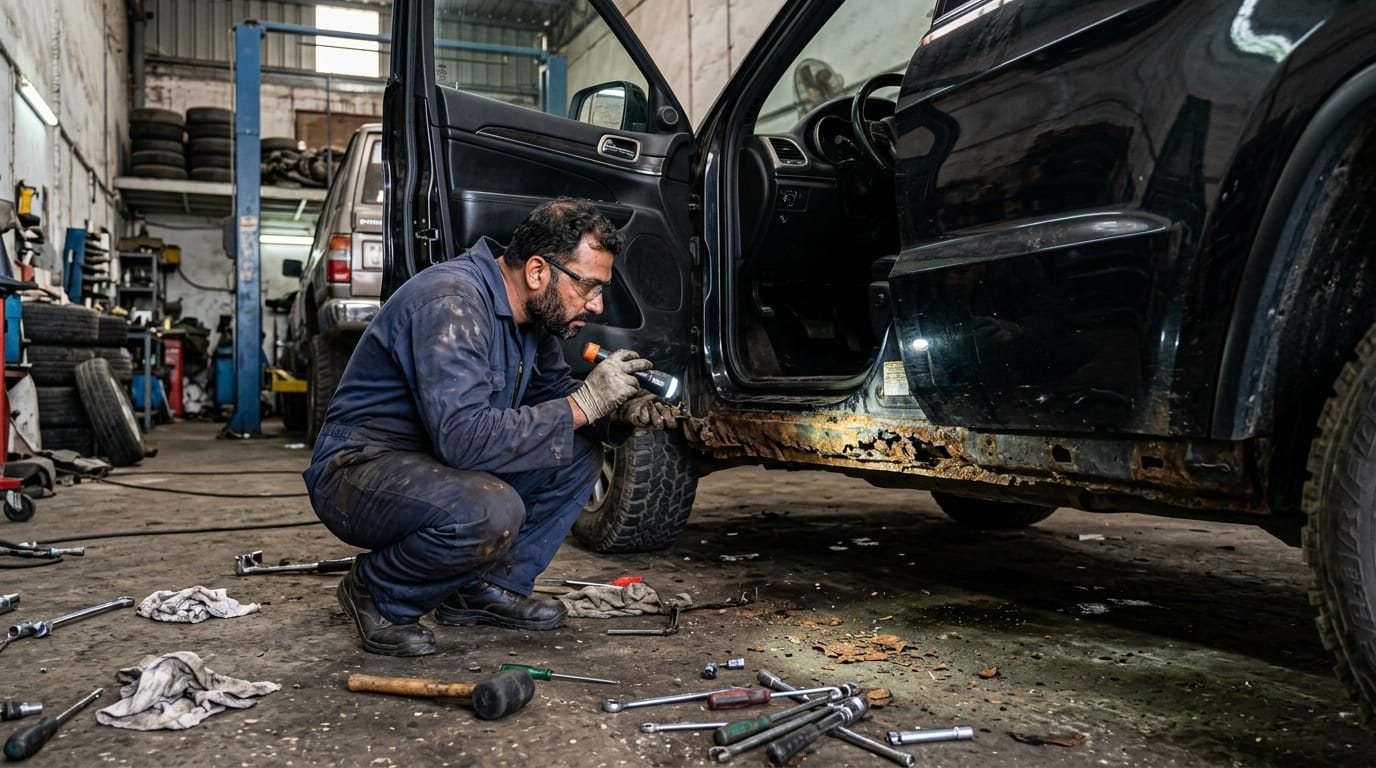
After significant flood events in the UAE, some flood-damaged vehicles are repaired and re-sold without disclosure. How expats lose money on undisclosed flood vehicles is a pattern seen repeatedly in the Al Aweer market and on Dubizzle. Here is what to look for.
| Inspection Point | What to Check | Flood Damage Indicator |
|---|---|---|
| Smell | Inside vehicle with windows closed for 5 minutes | Musty, damp, or unusual chemical smell |
| Seat rails | Check metal rails under seats | Rust or corrosion marks |
| Seat belt housing | Check for water marks or dirt line | Visible high-water line on plastic |
| Boot / trunk | Lift the boot mat | Rust, moisture, or staining on floor |
| Under bonnet | Check wiring harness connectors | Corrosion or white residue on connectors |
| Fuse box | Open and inspect | Corrosion inside fuse box |
| Service history | Check for gaps post-flood event dates | Service gap after April 2024 or similar events |
| VIN check | Run on RTA portal | History anomalies, ownership changes post-flood |
| Independent inspection | Use pre-purchase inspection service | Any damp readings inside doors or panels |
Before buying any used vehicle in UAE, an independent pre-purchase inspection is the single best protection against purchasing an undisclosed flood vehicle.
Real Case Studies: Workshop and Market Logs
Case 1 — Indian Expat, Toyota Corolla, Comprehensive Policy, Dubai
An IT professional based in Dubai Media City drove his 2020 Corolla through an underpass on Al Khail Road during the April 2024 storm. Water level reached the door sills. He stopped immediately, did not restart the engine, and called his insurer within 40 minutes. Full documentation was provided including video of the water level. The claim was approved in full. Interior replacement, ECU cleaning, and a full electrical check totalled approximately 18,500 AED. Vehicle was returned within 23 days. NCD was reduced by one year at renewal, resulting in a 380 AED premium increase. Net outcome: significant repair covered at minimal cost.
Case 2 — Pakistani Engineer, Nissan Sunny, Third Party Only, Sharjah
A site engineer in Sharjah Industrial Area held third-party insurance on a 2016 Sunny valued at approximately 18,000 AED. His vehicle was fully submerged in a basement parking area during a heavy rain event. The engine was hydrolocked. With no comprehensive cover, the full repair estimate of 14,200 AED from a Sharjah garage was his personal responsibility. He chose not to repair and sold the vehicle for approximately 3,500 AED for parts. Net loss: approximately 14,500 AED including loss of vehicle value. He purchased a replacement with comprehensive insurance.
Case 3 — Filipino Expat, Honda City, Comprehensive, Sharjah — Claim Partially Rejected
A nurse working in Sharjah drove her Honda City into standing water on Maliha Road despite seeing cars stopped ahead. She attempted to restart the engine after it stalled. The insurer’s assessment identified evidence of engine restart after hydrolocking. The original flood damage was covered, but the additional engine damage caused by the restart attempt was excluded. Approved amount: 9,800 AED. Excluded amount: 7,200 AED (additional engine damage). She paid the excluded portion from personal funds. Outcome: partial coverage due to the restart attempt.
Scam Prevention: Flood Insurance Fraud Targeting Expats
After major flood events, several categories of fraud have been observed in the UAE market.
Fake Workshop “Flood Inspections”
Unlicensed individuals contact vehicle owners after flood events offering “official flood damage assessments” for 200–500 AED. These have no insurance validity and are simply a cash collection scheme. Your insurer’s authorized assessor provides the official assessment — this is covered by your policy.
Inflated Repair Estimates
Some workshops present highly inflated repair estimates to expats who are unfamiliar with parts costs, then offer to settle for a “cash discount” if you bypass the insurer. This typically means the garage collects full insurer payment while you receive a lower-quality repair using aftermarket parts. Always request an itemized parts list.
🚨 Most Dangerous Scam: After flood events, some individuals approach distressed drivers and offer to “handle everything” including the insurance claim, in exchange for signing a document. These documents sometimes assign insurance rights to the individual, who then claims the settlement. Never sign any document at the incident scene from someone who is not your insurer or police. Verify every identity.
Undisclosed Flood Vehicle Resale
After large flood events, some vehicles declared as total losses are bought back from insurers as salvage, inadequately repaired, and re-listed on Dubizzle or through smaller dealers. Prices are typically 15–25% below market, which is the lure. Always run a VIN check and check the vehicle’s accident and claim history before purchase.
Agency Repair Add-Ons and Optional Policy Enhancements Worth Considering
Standard comprehensive policies in UAE often do not include several items that are particularly relevant to flood damage. These are typically available as optional upgrades.
| Optional Add-On | What It Covers | Approximate Additional Cost (AED/year) |
|---|---|---|
| Agency Repair | Repairs at manufacturer-authorized service centers | 400 – 1,200 |
| NCD Protection | One claim per year without NCD loss | 200 – 500 |
| Roadside Assistance | Towing after flood/breakdown | 150 – 400 |
| Replacement Vehicle | Rental car during repair period | 300 – 700 |
| Personal Accident Cover | Medical costs if injured in flood incident | 100 – 250 |
| Geographic Extension | Coverage outside UAE (Oman, etc.) | 200 – 600 |
No Claim Discount: UAE Typical Structure
%%{init: {'theme': 'base', 'themeVariables': {'background': '#f8f9fa', 'textColor': '#1a1a1a', 'primaryColor': '#2c3e50', 'secondaryColor': '#c0392b', 'lineColor': '#1a1a1a'}}}%%
xychart-beta
title "Typical UAE NCD Accumulation by Claim-Free Years"
x-axis ["Year 1", "Year 2", "Year 3", "Year 4", "Year 5+"]
y-axis "NCD Discount (%)" 0 --> 60
bar [10, 20, 30, 40, 50]
Comprehensive Cost Comparison: Financial Impact of Flood Damage
| Flood Severity | Typical Repair Range (AED) | With Comprehensive | Without Comprehensive |
|---|---|---|---|
| Minor (interior only) | 2,000 – 5,000 | Pay excess only (500–1,500) | Full cost out of pocket |
| Moderate (electronics + interior) | 8,000 – 20,000 | Pay excess only | Full cost out of pocket |
| Major (engine hydrolocking) | 20,000 – 40,000 | Pay excess only (if claim approved) | Full cost or write-off loss |
| Total loss | Vehicle ACV (15,000 – 120,000+) | Receive ACV minus excess | Zero recovery — total loss |
Note: Costs vary significantly based on vehicle make, model, year, and repair workshop. These ranges reflect commonly observed figures in UAE workshops and should not be treated as fixed estimates.
Decision Framework: Which Insurance Type Suits Each Driver
Flood Insurance: Myths vs Facts
| Myth | Fact |
|---|---|
| “The UAE doesn’t flood, so I don’t need to worry.” | The April 2024 event alone affected thousands of vehicles across multiple emirates. Flooding risk is real and increasing. |
| “Comprehensive insurance covers everything.” | Comprehensive policies contain exclusions. Driving into known flood zones and restarting flooded engines are the most common grounds for rejection. |
| “Third party covers my car if it’s damaged in a natural event.” | Third party covers damage you cause to other parties. Your own vehicle is not covered under any circumstances. |
| “If my car is flooded, I just take it to any garage.” | Using a non-approved garage before insurer assessment can void or reduce your claim. |
| “The insurer will tell me everything I need to know when I buy.” | Policy exclusions are your responsibility to read. Insurers are not required to verbally explain every exclusion at point of sale. |
| “A repaired flood car is as good as before.” | Flood-repaired vehicles commonly develop delayed electrical and corrosion issues months after repair. |
| “I can restart my car to check if it’s OK.” | This is one of the most expensive and claim-complicating actions you can take. Never restart a flooded engine. |
Pre-Rainy Season Checklist
| Action | When | Approximate Cost (AED) |
|---|---|---|
| Review insurance policy exclusions | October and February | Free |
| Save insurer claims hotline in phone | Now | Free |
| Check door and window seals | Before rainy season | 100 – 300 |
| Check wiper blades | Before rainy season | 50 – 150 |
| Identify alternative routes avoiding underpasses | Now | Free |
| Confirm parking location flood risk | Now | Free |
| Register for NCEMA weather alerts | Now | Free |
| Check tyre tread depth | Every 3 months | Free check, 1,200–2,400 AED if replacement needed |
When to Call Your Insurer vs When to Call Emergency Assistance
| Situation | Contact | First Step |
|---|---|---|
| Vehicle submerged, engine not running | Insurer claims line | Report incident, request authorized towing |
| Vehicle submerged, occupants trapped | 999 (police/civil defense) | Emergency services first, insurer second |
| Water rising, road blocked | 800 9090 (RTA roadside) or 999 | Emergency assistance, safety first |
| Vehicle stalled in shallow water | Insurer roadside assistance | Do not restart — call for towing |
| Accident occurred during flood event | Police first, then insurer | Police report required for accident claims |
| Unsure whether damage is covered | Insurer claims line | Report anyway — late reporting is a claim risk |
What You Can Do: Legal and Administrative Options
If your flood claim is rejected or underpaid, you have options. This guide is reviewed periodically as Dubai Police procedures evolve.
- Request the rejection in writing with the specific policy clause cited
- File a complaint with the UAE Insurance Authority
- Contact the UAE Ministry of Economy Consumer Protection for formal dispute resolution
- Seek a second independent assessment from a certified loss adjuster
- Document all communications with your insurer via email (not only phone calls)
Outcomes in insurance disputes vary significantly based on available documentation and how thoroughly the claim was initially filed. Buyers may have legal remedies depending on evidence and the specific circumstances of the policy.
Data Sources & Methodology
Cost ranges in this article are based on commonly reported figures from UAE automotive workshops, insurance claims discussions in expat communities, and published reports on flood-related vehicle damage in the UAE. Specific repair cost ranges reflect observations from workshops in Al Quoz Industrial Area, Sharjah Industrial Area, and authorized dealership service centers in Dubai and Abu Dhabi.
Insurance premium ranges are indicative and based on publicly available quotation data from UAE insurers. Actual premiums depend on vehicle make, model, year, driver age, driving history, and chosen coverage options.
Official sources consulted include:
- UAE Insurance Authority — Official Regulator
- NCEMA — National Emergency Crisis and Disaster Management Authority
- UAE National Centre of Meteorology — Weather Alerts
- RTA Dubai — Vehicle Registration and Transfer
- Dubai Police — Traffic and Incident Reporting
- UAE Ministry of Economy — Consumer Protection
ℹ️ Market Volatility Notice: All repair costs, insurance premiums, and financial figures mentioned in this article are indicative averages based on observations up to the date of last update. UAE market conditions, parts prices, and insurance rates change regularly. Verify current figures directly with your insurer, garage, or the relevant government authority before making financial decisions.
Final Decision Framework: Am I Protected?
| Your Situation Right Now | Recommended Action |
|---|---|
| I have third party only — car is unfinanced | Get comprehensive quotes immediately. The cost difference is typically 1,200 – 3,000 AED/year vs total loss exposure of 15,000 – 50,000 AED. |
| I have comprehensive — haven’t read the exclusions | Read the exclusions section of your policy this week. Note what triggers rejection. |
| I have comprehensive — parking in basement or underpass | Identify alternative elevated parking before the next forecast rain event. |
| My car is financed — not sure if bank is on the policy | Call your insurer and confirm. Request written confirmation that the bank is listed as beneficiary. |
| My car was flood damaged and I already restarted it | Report to your insurer immediately and honestly. Disclose what happened. Concealment worsens outcomes. |
| I’m buying a used car and want to check for flood history | Run VIN check on RTA portal, request independent inspection, check the vehicle for all signs listed in Section 20 above. |
Conclusion
Flood damage in the UAE is no longer a rare event. Expat drivers who hold comprehensive insurance, document thoroughly, avoid restarting flooded engines, and report promptly generally receive claim approval with manageable out-of-pocket costs.
Drivers with third-party only coverage, or comprehensive policies with unread exclusions, face significant financial exposure. The difference between a protected and unprotected position is usually a matter of policy choice and preparation rather than luck.
The practical actions are straightforward: confirm your policy type today, read the exclusions this week, save your insurer’s claims line in your phone, and identify alternative parking for heavy rain forecasts. None of this costs money or significant time. Review your insurance renewal details carefully — hidden charges and coverage gaps are commonly missed at annual renewal time.
If your vehicle was flood damaged and you need guidance on next steps, our full guide on legal and financial costs after flood damage covers the claim dispute and recovery process in detail.
⚠ Financial & Legal Disclaimer: The information provided in this article is for educational purposes only. Insurance policy terms, UAE regulations, and coverage conditions may change. Verify all information with your insurer and licensed UAE professionals before making decisions. This guide is reviewed periodically as Dubai Police procedures evolve.
Q: Does comprehensive car insurance in UAE cover flood damage?
Q: What should I do immediately if my car is flooded?
Q: Will a flood claim affect my No Claim Discount in UAE?
Q: My car is financed. What happens if it is a total loss after flooding?
Q: How do I check if a used car has previous flood damage before buying?
Q: Can my insurer reject a flood claim even if I have comprehensive insurance?
Q: Is there a time limit to report flood damage to my insurer in UAE?
