Last Updated: May 2026 | By Omar Al-Fayed | Category: Buying & Selling
Quick Answer
You can check a UAE car accident history for free using four official channels: the RTA vehicle inquiry, Dubai Police traffic portal, Tasjeel inspection history, and an independent OBD scan at a workshop. Total time for the free digital checks: 5 to 10 minutes. Total cost for the complete stack including a physical inspection: 150 to 380 AED. Just like running an initial accident history check, this process surfaces hidden repair costs ranging from 6,000 to 15,000 AED before a dirham changes hands.
Before handing over a single dirham, you can begin verifying a car’s accident history in the UAE at no cost using the RTA Dubai vehicle services portal. This guide covers every free and low-cost channel available across all UAE emirates, what each one actually shows, what it does not show, and how to act on what you find. For the broader picture of total ownership costs once you have bought, our ownership costs guide covers monthly expenses in detail.
Official UAE Accident History Check Portals
Each portal below is free to access and covers a specific part of the UAE vehicle history landscape. Running all four takes under ten minutes and costs nothing.
| Service | Link | Cost | Coverage |
|---|---|---|---|
| RTA Vehicle Inquiry | RTA Dubai Vehicle Services | Free | Registration status, fines, ownership records |
| Dubai Police Traffic Portal | Dubai Police Traffic Services | Free | Accident case numbers (formally filed incidents) |
| TAMM Abu Dhabi | TAMM Abu Dhabi Portal | Free | Abu Dhabi registered vehicles |
| MOI UAE | UAE Ministry of Interior | Free | Northern Emirates vehicle and traffic records |
| EVG Portal | Emirates Vehicle Gate (EVG) | Free | Federal insurance claim history |
Before You Start — Required Information
Collect the following before opening any portal. Missing any item will slow down or block parts of the process.
| Item | Where to Find It | Why You Need It |
|---|---|---|
| VIN (17-digit chassis number) | Mulkiya, dashboard plate through windshield, or door frame sticker | Primary identifier across all UAE and international databases |
| Plate number | Listing photo or Mulkiya | Used for RTA and Dubai Police portal checks |
| Mulkiya copy (if available) | Request from seller before meeting | Cross-references VIN and ownership history |
| Emirate of registration | Listing or plate format | Determines which portal to use for the primary check |
| Phone with camera | Your own device | Screenshot all results with timestamps for your evidence file |
Why Accident History Checks Are Not Optional in the UAE
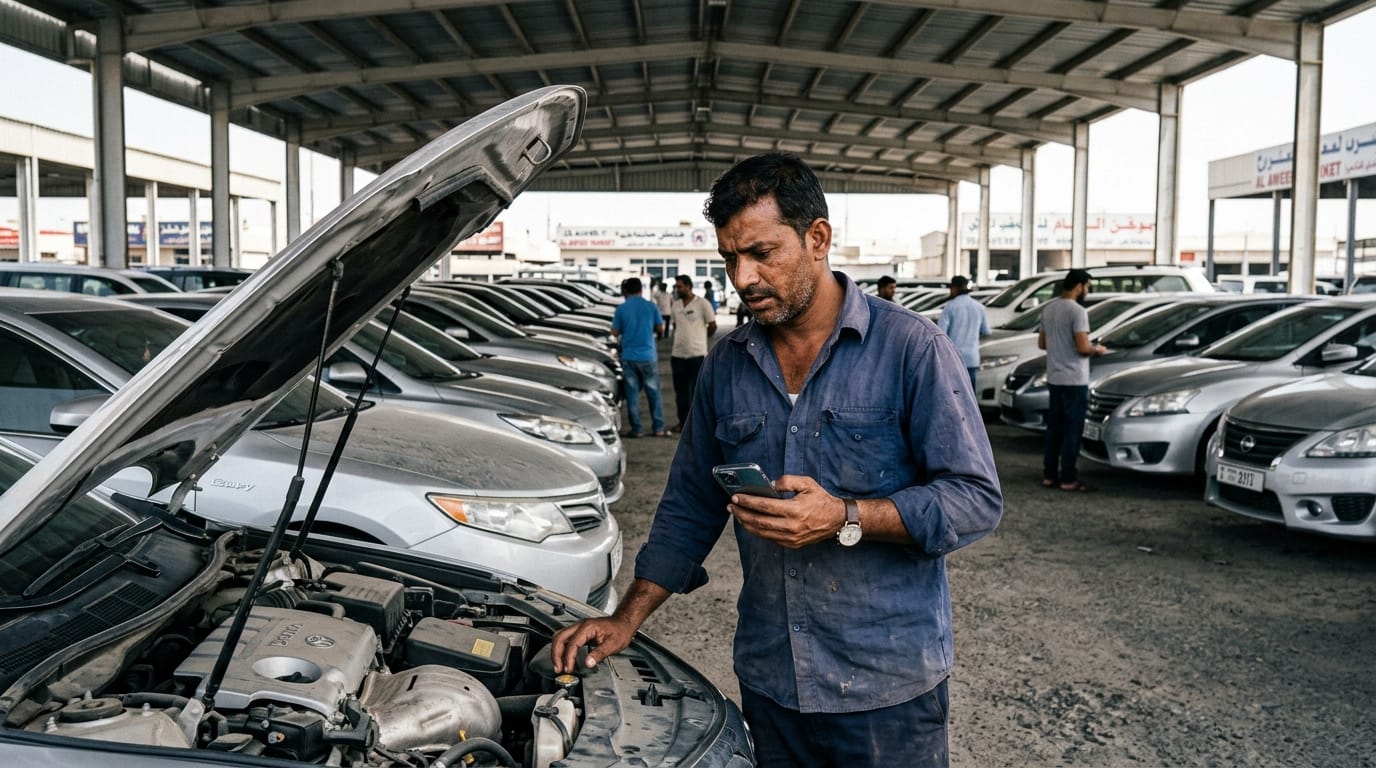
The UAE used car market moves at a pace that does not reward the cautious buyer. On platforms like Dubizzle and dealer lots in Al Quoz, a repainted bumper and a fresh interior detail can conceal months of structural repair history.
Workshop observations across Al Quoz Industrial Area, Sharjah Industrial Area, and Ras Al Khor indicate that a notable share of vehicles listed in the 40,000 to 90,000 AED range carry undisclosed repair records — ranging from minor panel work to airbag deployments that were reset without replacement of the modules.
Sellers in a private sale are not legally required to disclose accident history unless directly asked, and verbal claims carry limited enforceability in any subsequent dispute. The buyer carries the responsibility for verification.
Check UAE Car Accident History by Chassis Number Online
The chassis number — also called the VIN — is the most reliable identifier across all UAE vehicle databases. It does not change with ownership, plate replacement, or re-registration. When you need to check UAE car accident history by chassis number online, databases require these exact identifiers to function properly and retrieve the correct asset data.
- Locate the VIN: Check the Mulkiya (registration card), the dashboard VIN plate visible through the windshield, or the driver door frame sticker. All three should match. A mismatch between any two is a significant flag.
- Open the RTA vehicle inquiry portal: Go to the RTA Dubai vehicle services portal and enter the chassis number or plate number to retrieve available registration and administrative status information.
- Run the Dubai Police inquiry: Open the Dubai Police traffic services portal and check for any traffic fines or accident case numbers linked to the vehicle.
- Request the Tasjeel inspection result: Visit any Tasjeel branch with the chassis number and request the most recent roadworthiness test result. Failed items related to chassis, suspension, or lighting are specifically relevant.
- Compare ownership record count: If the vehicle has had three or more previous owners within five years, this warrants additional scrutiny — particularly combined with any administrative irregularity on the RTA check.
- Save all screenshots with timestamps: Every digital result should be saved with the timestamp visible. This forms the foundation of your evidence package for negotiation or any subsequent dispute.
- Cross-check with service history: Any vehicle with UAE dealer service records should show mileage progression consistent with the registration date. A gap between registration renewal dates and service entries is worth investigating.
Method 1 — RTA Vehicle Inquiry (Free, Instant)
The RTA Dubai vehicle services portal allows any buyer to input a plate number or chassis number and retrieve available registration and vehicle status information, which may include current administrative status, ownership transfer records, and any active fines or registration restrictions depending on the vehicle and service tier accessed.
This check is free and takes under two minutes. It does not display workshop repair records. A registration that shows as restricted or inactive on a vehicle being offered in a private sale frequently indicates an unresolved administrative or technical issue worth clarifying before proceeding.
| What RTA Check May Show | What It Does Not Show |
|---|---|
| Current registration status | Repair or body shop history |
| Ownership transfer records | Airbag deployment records |
| Active traffic fines | Insurance claim details |
| Administrative restrictions (where applicable) | Frame or chassis damage |
| Vehicle category and basic specs | Odometer manipulation |
Method 2 — Dubai Police Traffic and Accident Inquiry (Free)
The Dubai Police traffic services portal offers a vehicle-level inquiry where some accident-linked information may be available when a formal police report was filed at the scene. Not all accidents generate a police report — minor collisions settled privately between parties typically leave no digital trace on this channel.
Any incident where a police patrol attended — standard for collisions involving airbag deployment, significant structural damage, or third-party injury — will typically produce a case record. The availability of that record through the public inquiry depends on the nature of the case and how it was processed.
Method 3 — Tasjeel and Vehicle Testing Centers (Free to 30 AED)
When a vehicle undergoes its annual registration renewal at Tasjeel or other authorized Vehicle Testing Centers in Dubai, the inspection result is tied to the chassis number. A vehicle that failed its roadworthiness test due to structural or safety-related items carries that record in the system.
You can request a copy of the most recent test result at any Tasjeel branch. Fees typically range from 0 to 30 AED depending on the service tier. Look specifically for failed items under chassis integrity, suspension geometry deviation, or lighting system failure following impact.
Method 4 — Request Insurance Claim History From the Seller
Rather than relying on a central insurance database channel immediately, the more practical approach for a private buyer is to request documentation directly. A seller who has maintained a clean claims history will typically be willing to provide supporting documentation.
What to request from the seller:
- A copy of the current insurance policy showing the vehicle’s No Claims Discount history
- Dealer service records showing mileage and repair entries
- Any insurance company repair authorization letters if repairs were conducted through a claim
- The name of the insurer and policy number so you can request a claims summary directly from the provider
Note on Insurance Inquiries: Direct consumer access to vehicle-level insurance claim databases varies by provider and emirate. The most reliable route for a private buyer is to request documentation from the seller and, if proceeding, ask your own insurer to run an insurance claim history check as part of the policy quotation process.
Insurance Claim vs Legal Action — Understanding the Difference
Many expat buyers conflate two separate processes when they discover undisclosed damage after purchase. Understanding the distinction saves time and sets realistic expectations.
| Path | Who You’re Claiming Against | What You Need | Realistic Outcome |
|---|---|---|---|
| Insurance Claim | Your own insurer (or seller’s insurer if liability established) | Active comprehensive policy; documented damage event | Repair cost coverage depending on policy type and excess amount |
| Legal Action Against Seller | The individual who sold you the vehicle | Written evidence of misrepresentation — WhatsApp, sale agreement, OBD report | Buyers may have legal remedies depending on available evidence. Outcomes vary. |
| Consumer Protection Complaint | Dubai Economy and Tourism / relevant emirate authority | Documented correspondence, inspection report, sales receipt | Mediation possible; outcomes depend on case specifics |
Method 5 — International VIN Database Reports for Imported Vehicles (50 to 150 AED)
For any vehicle originally registered outside the GCC — particularly imports from the United States, Canada, or Europe — paid international VIN database reports represent the only method that surfaces pre-import damage history.
Services such as CarVertical pull from international insurance, police, and auction databases and can surface total-loss declarations, airbag deployment events, and odometer discrepancies that no UAE government portal would capture. These reports typically cost 50 to 150 AED and return results within minutes to 24 hours.
Note on Imported Vehicles: In many documented expat purchase cases, vehicles sourced from North America and relisted in Al Aweer or Sharjah carry clean UAE registration histories that do not reflect prior damage in their country of origin. A paid international report is the only method that surfaces this data reliably.
Free Checks vs Paid Reports — Which Is Worth It?
| Tool | Cost | Accident History | Odometer Check | Covers Imports |
|---|---|---|---|---|
| RTA vehicle inquiry | Free | Partial (admin records) | No | Post-import only |
| Dubai Police inquiry | Free | Partial (filed reports) | No | Post-import only |
| Tasjeel inspection record | 0 – 30 AED | Partial (test failures) | No | Post-import only |
| Independent OBD + physical inspection | 150 – 350 AED | Yes (airbags, chassis) | Partially | Yes |
| CarVertical / international VIN report | 50 – 150 AED | Yes (full history) | Yes | Yes (primary use) |
Inspection Cost by Emirate
Rates for pre-purchase verifications at independent workshops vary across the UAE. The figures below reflect typical ranges observed across Al Quoz, Abu Shagara, and equivalent industrial areas in each emirate.
| Emirate | Basic OBD + Visual Check | Full Inspection (OBD + Physical + Paint Gauge) |
|---|---|---|
| Dubai (Al Quoz, Ras Al Khor, Deira) | 180 – 350 AED | 300 – 500 AED |
| Abu Dhabi | 150 – 320 AED | 280 – 450 AED |
| Sharjah (Abu Shagara, Industrial Area) | 120 – 300 AED | 250 – 400 AED |
| Ajman / Ras Al Khaimah | 100 – 250 AED | 200 – 380 AED |
How Accident History Checks Differ Across UAE Emirates
The checks available vary meaningfully by emirate. Dubai has the most developed public-facing digital infrastructure. Other emirates have varying levels of online access.
| Emirate | Primary Authority | Online Check Available | Notes |
|---|---|---|---|
| Dubai | RTA + Dubai Police | Yes — both portals active | Most comprehensive digital access |
| Abu Dhabi | TAMM / Abu Dhabi Police | Yes — via TAMM portal | Registration and vehicle status available |
| Sharjah | Sharjah Traffic Department | Partial | Vehicle inquiry available; accident data limited |
| Northern Emirates | MOI — Ministry of Interior | Via MOI portal | Basic data; in-person inquiry often more reliable |
Questions to Ask the Seller Before Inspection
These questions serve two purposes: they surface relevant information and they establish a written record of the seller’s claims before handover. Send them via WhatsApp — not verbally at the lot.
- Have the airbags ever deployed or been replaced? — A hesitant or evasive response is itself informative.
- Has the vehicle ever been subject to an insurance claim? — Request a No Claims Discount letter from the insurer if the answer is no.
- Is the vehicle GCC-spec or was it imported? — This determines which checks are necessary and how much pre-import history may be invisible.
- Has the chassis, subframe, or any structural component been replaced or repaired? — Frame work rarely appears in database checks; asking directly puts a written claim on record.
- Are there any service records from the UAE dealer network? — A seller who cannot provide records for a vehicle under 80,000 km with an active dealer warranty period warrants further scrutiny.
7 Visual Signs a Car May Have Been in an Accident
An OBD scan and database checks cover the digital layer. The physical layer requires a trained eye and takes under 20 minutes on a well-lit surface. These are the most commonly observed indicators across Al Quoz and Sharjah Industrial Area workshops.
- Uneven panel gaps: Stand at the front or rear of the vehicle and sight down the gap between the hood and fender, or between panels around the doors.
- Mismatched paint shades: View the vehicle from a 45-degree angle in daylight. A repainted panel frequently shows a slight color shift against adjacent factory panels.
- Overspray on rubber seals or trim: Open the doors and inspect the rubber weather seals at the door edge. Paint overspray on rubber is difficult to mask completely.
- Welding marks or underseal repairs: With a torch, inspect the chassis rails, floor pan edges, and front strut towers from underneath.
- Moisture or condensation inside headlights or tail lamps: Factory-sealed lighting units do not develop internal condensation under normal conditions.
- Steering wheel misalignment at rest: Park on a flat surface and observe whether the steering wheel sits level.
- New airbag covers or trim on an older interior: A visibly newer-condition driver airbag cover against a worn general interior is a material inconsistency.
How Airbag Fraud Occurs in UAE Used Cars
The airbag system is one of the most commonly misrepresented areas in post-accident vehicles. The fraud does not require sophisticated equipment — it is well-documented across independent workshop observations in Al Quoz and Deira.
- Resistor bypass: A small resistor is wired into the airbag circuit in place of the deployed module. The airbag warning light extinguishes.
- Dashboard or column replacement: In higher-impact cases, the entire steering column assembly or dashboard is replaced with a donor unit.
- Warning light circuit interruption: The airbag warning light circuit is interrupted at the instrument cluster level rather than at the module level.
- SRS control module reset without module replacement: The airbag control module stores a crash data record after deployment. Some aftermarket tools can reset this record.
Critical Note on Airbag Checks: A basic OBD scan that only reads current fault codes may miss airbag fraud. Request specifically that the workshop read stored fault codes on the SRS system and retrieve any crash data record from the airbag control module.
Mechanic’s Inspection Log — Documented Case Study
Location: Independent workshop, Al Quoz Industrial Area 3, Dubai
Vehicle: 2019 Toyota Camry SE, 2.5L, listed at 62,000 AED on a local classifieds platform
Chassis Check: RTA inquiry returned registration and administrative information showing multiple ownership transfers. Dubai Police inquiry surfaced a linked case number from approximately 18 months prior.
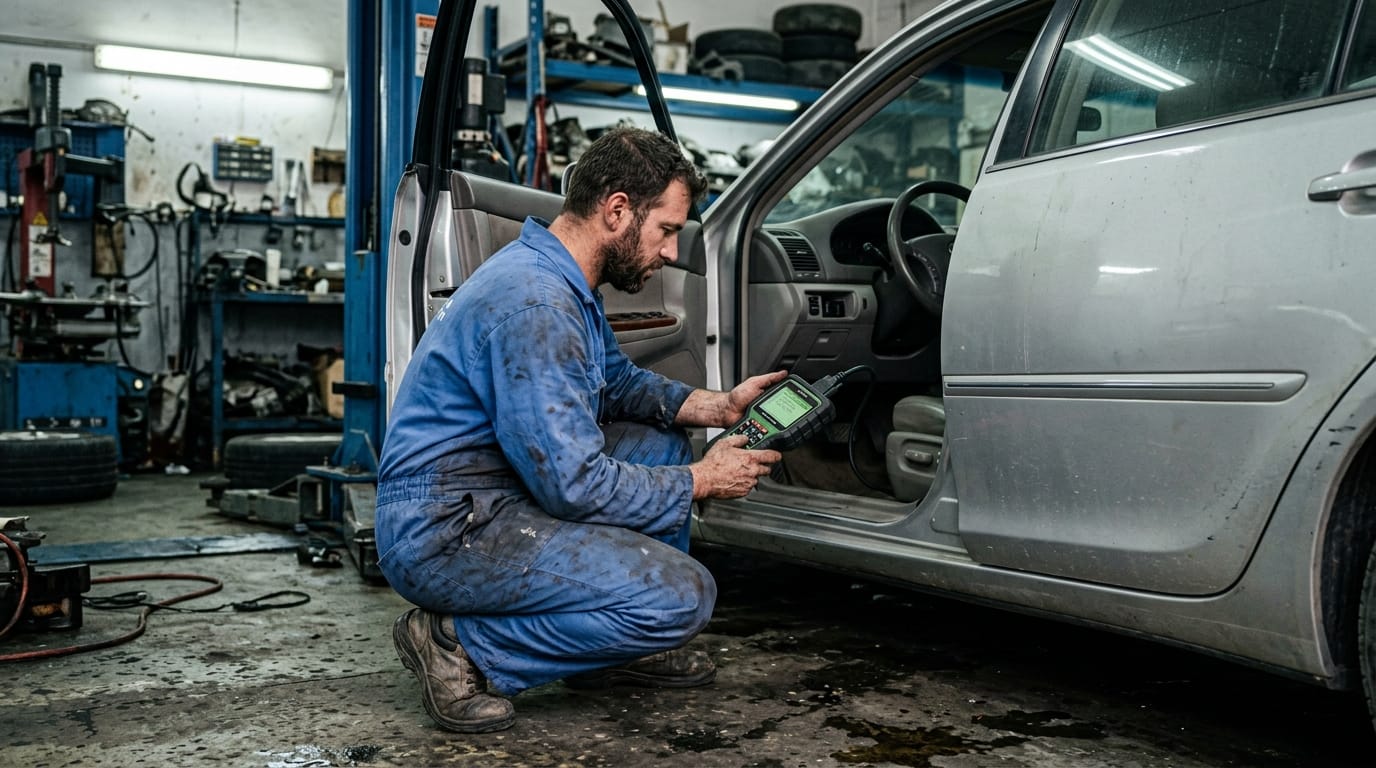
OBD Reading: Stored fault codes B0001 (Driver airbag circuit open) and B0002 (Passenger airbag circuit open) — both indicating airbag deployment events that were cleared at the module level without physical replacement. Scan tool used: Autel MaxiCOM MK908P.
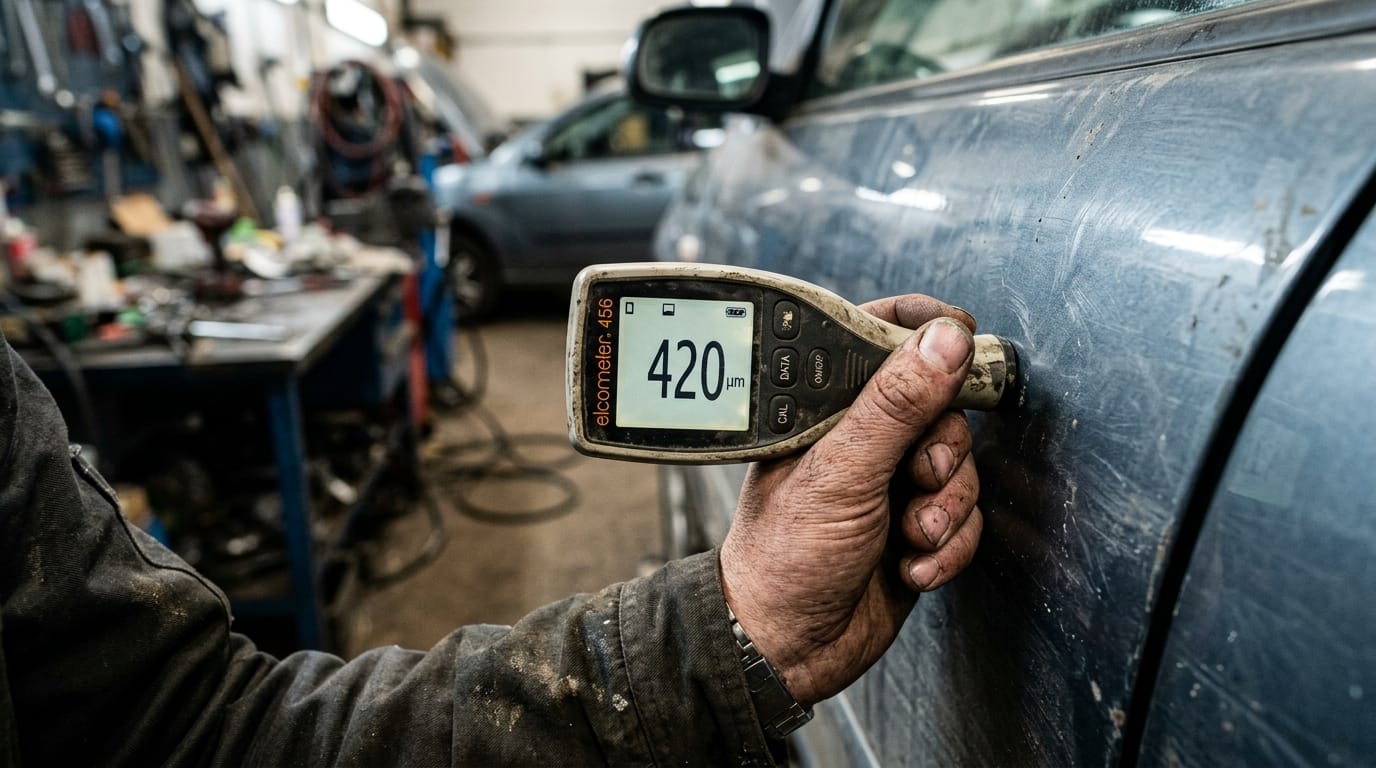
Physical Findings: Front subframe misalignment of approximately 8mm to the left side. Paint thickness readings on the left front quarter panel and hood registered 380 to 420 microns, against a factory specification of 90 to 110 microns — confirming multi-layer respray over body filler work.
| Repair Item | Estimated Cost (AED) |
|---|---|
| Driver + passenger airbag modules (OEM) | 4,200 – 5,800 |
| Airbag control module reset or replacement | 800 – 1,400 |
| Front subframe realignment | 1,200 – 2,000 |
| Suspension geometry recalibration | 350 – 600 |
| Total Estimated Hidden Cost | 6,550 – 9,800 |
The buyer negotiated a 7,000 AED reduction after presenting the scan report, then declined to proceed on safety grounds. The same vehicle was relisted at the original price on a different account within approximately two weeks.
Signs You Are Looking at a Clean-History Vehicle
Not every private sale is a risk scenario. A notable share of used vehicles listed in UAE markets carry genuine, verifiable clean histories. Knowing what a straightforward vehicle looks like is as useful as knowing the warning signs.
- Consistent VIN across all three locations: Mulkiya, dashboard plate, and door frame sticker all match — no tampering, no replacement panels hiding behind a VIN discrepancy.
- Uniform paint depth readings across all panels: A paint thickness gauge reading 90 to 130 microns consistently across hood, fenders, doors, and quarter panels is a strong indicator of unrepainted factory bodywork.
- Full dealer service history with mileage progression: A Toyota or Nissan with every 10,000 km service stamped and dated at an authorized UAE dealer.
- Clean OBD scan with no stored fault codes: A scan that returns zero current and zero stored codes across the SRS, ABS, and engine control units indicates a system that has not experienced the electrical events associated with a significant collision.
- Single owner with GCC spec and matching registration history: A vehicle with one previous owner, continuous UAE registration from new, GCC specification, and a Tasjeel inspection that passed without deficiencies represents the cleanest available profile.
Dangerous Mistakes Buyers Frequently Make
Relying on the Seller’s Own Inspection Report: In many cases observed across Al Aweer and online classifieds, sellers present inspection reports conducted at workshops they selected. These reports are not independent. Always commission your own inspection at a workshop of your choosing, with no prior relationship to the seller.
Skipping the Check on Low Mileage Vehicles: A vehicle with 28,000 km on the odometer from a private seller, aged five years, frequently generates less scrutiny from buyers. Workshop observations suggest that low-mileage listings priced 15 to 25 percent below market commonly show evidence of a prior repair event. The mileage and the price discount are often related.
Skipping the Inter-Emirate History Check: A vehicle re-registered from Sharjah or Ajman to Dubai within the past 12 months may carry administrative or inspection records from its original emirate that do not appear in the RTA Dubai check alone. Running both the RTA inquiry and the source emirate’s traffic authority check adds under five minutes and surfaces this gap.
Common Expat Buyer Mistakes in the UAE Used Car Market
These are the patterns most frequently observed across Al Aweer, Dubizzle, and Sharjah private listings — particularly among buyers in their first UAE purchase.
- Buying before understanding ownership transfer costs: The RTA transfer process typically costs generally between 350 and 600 AED depending on vehicle type. First-time buyers frequently omit this from their budget calculation.
- Ignoring GCC vs non-GCC specification: A US-spec vehicle may look identical to a GCC model but carry a different cooling system calibration, different emissions compliance, and limited dealer warranty coverage.
- Relying on the Dubizzle listing description as fact: Listing descriptions in the UAE private market are not legally verified. The seller’s written WhatsApp statement — captured before purchase — carries more weight than any listing text.
- Treating a Tasjeel pass certificate as a mechanical guarantee: Tasjeel tests roadworthiness against a defined checklist. A vehicle that passed Tasjeel last month may still carry undisclosed repair history or deferred maintenance items that fall outside the test scope during the vehicle registration protocol.
How to Negotiate After Finding Accident Records
Finding evidence of prior accident damage does not automatically mean walking away. It means the negotiation has moved onto your terms rather than the seller’s. Here is how that typically plays out in the UAE private market.
| Item | Figure (AED) |
|---|---|
| Listed market value | 62,000 |
| Estimated repair cost to roadworthy standard | 6,550 – 9,800 |
| Reasonable negotiation target | 52,000 – 55,000 |
| Walk-away threshold (if airbag non-deployment confirmed) | Any price |
The negotiation approach that works most consistently in Al Aweer and private classifieds is to present the scan report in writing — not verbally — and state a revised offer with the repair estimate attached. Sellers who know the history and have already priced it in will often meet somewhere in the middle.
Practical Tip: Once you have the OBD report and physical inspection results, send the repair estimate to the seller via WhatsApp — not verbally at the lot. A written message creates a paper trail that documents both your findings and the seller’s response, which is material if any dispute arises after the sale.
The Recommended Verification Stack (Free to Low-Cost)
| Step | Method | Cost | Time Required |
|---|---|---|---|
| 1 | RTA vehicle inquiry (plate or chassis) | Free | 2 minutes |
| 2 | Dubai Police traffic and accident inquiry | Free | 3 minutes |
| 3 | Tasjeel last inspection result | 0 – 30 AED | Same day |
| 4 | Physical inspection and OBD scan at independent workshop | 150 – 350 AED | 1 to 2 hours |
| 5 (imports only) | International VIN database report | 50 – 150 AED | Instant to 24 hours |
Evidence Checklist — What to Collect Before Making an Offer
| Document | What to Capture | Why It Matters |
|---|---|---|
| RTA inquiry screenshot | Full result with timestamp | Documents administrative status at time of purchase |
| Dubai Police inquiry screenshot | Full result with timestamp | Documents any linked case numbers |
| Tasjeel inspection result | Most recent test including failed items | Documents roadworthiness history |
| OBD scan report | Stored fault codes, SRS system, crash data | Documents airbag and safety system status |
| Paint thickness readings | Photograph of meter display on each panel | Documents respray evidence by panel |
| Chassis and undercarriage photos | Rails, firewall, strut towers | Documents structural condition at purchase |
| Seller’s no-accident claim (written) | WhatsApp or SMS — do not rely on verbal | Creates enforceable record if misrepresentation arises |
Analytical Conclusion — What the Numbers Say
A buyer who skips pre-purchase verification on a 60,000 AED used vehicle and later discovers undisclosed structural damage is typically looking at repair costs in the 6,000 to 15,000 AED range — representing 10 to 25 percent of the vehicle’s purchase price.
Against that, the complete verification stack — RTA check (free), Dubai Police check (free), Tasjeel inspection copy (0 to 30 AED), and an independent workshop inspection with full OBD scan (150 to 350 AED) — totals a maximum of 380 AED.
The return ratio on this 380 AED investment is, in many documented cases, anywhere from 15:1 to 40:1. In cases where the inspection identified airbag non-deployment risk, the value extends beyond financial into personal safety — a distinction no price negotiation fully addresses. To fully protect your investment from regional engineering variances before finalizing any transaction, read our comprehensive (gcc specification guide)##GCC Spec vs Non-GCC Spec UAE: Complete Guide to What It Means and Why It Matters##.
Data Sources Used
- RTA Dubai — Official Vehicle Services and Registration Inquiry Portal
- Dubai Police — Traffic Services and Accident Report Inquiry
- TAMM Abu Dhabi — Vehicle and Registration Services Portal
- UAE Ministry of Interior — Traffic and Licensing Services
- Emirates Vehicle Gate (EVG) — Federal Insurance Claim Database
- Ministry of Industry and Advanced Technology standards
Frequently Asked Questions
