Last Updated: May 2026 | By Omar Al-Fayed | Category: Maintenance & Repairs
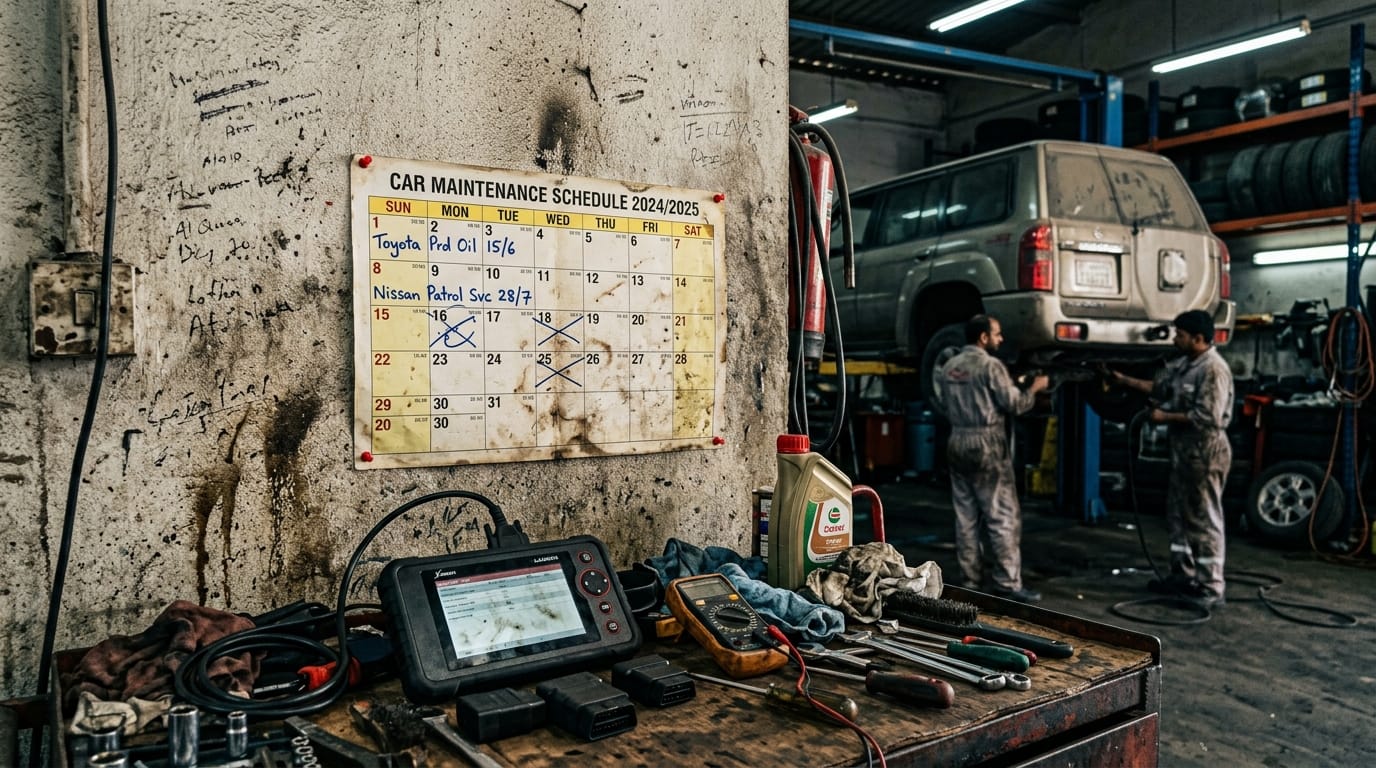
Most expats in the UAE manage car ownership reactively — they address issues when something breaks rather than when it is due. Many accumulate several thousand AED annually in avoidable maintenance and administrative costs when vehicle ownership is managed without a structured schedule. A 12-month calendar reduces that exposure substantially by addressing the right items at the right time — before they become expensive. This guide covers every month of the year: what to check, what to pay, and what deadlines to track — built around UAE-specific conditions, deadlines, and regulatory requirements. Managing your vehicle timelines efficiently is just as critical as keeping track of unexpected road penalties, which you can audit in our previous guide on UAE Traffic Fines for Expats 2026: Complete List With AED Amounts and How to Pay.
The calendar is organized around two realities: the UAE climate cycle, which creates predictable mechanical stress in specific months, and the UAE administrative cycle, which creates fixed legal deadlines around Tasjeel renewal, insurance, and registration. Missing either costs money. Tracking both saves it.
If you are new to buying or selling a vehicle in the UAE, our used car buyer’s guide for expats covers the pre-purchase inspection process in full detail before you reach this calendar.
Annual UAE Car Ownership Snapshot
Before entering the month-by-month detail, here is the full annual picture. Most expat drivers underestimate the total cost of ownership because they budget only for fuel and occasional repairs — without accounting for insurance, registration, and scheduled maintenance together.
| Category | Estimated Annual Cost (AED) |
|---|---|
| Registration + Tasjeel inspection | 540 – 860 |
| Scheduled maintenance (oil, filters, fluids) | 1,300 – 2,500 |
| Insurance (third-party to comprehensive) | 1,800 – 5,500 |
| Fuel (average expat commuter, 1,500–2,000 km/month) | 6,500 – 12,000 |
| Unexpected repair reserve | 500 – 1,500 |
| Salik and parking fees | 600 – 3,600 |
| Estimated Annual Total | 11,240 – 25,960 |
These figures are based on observations across UAE workshop cases and market patterns in 2024 and 2025 for a mid-size GCC-spec sedan. Your actual numbers depend on vehicle age, driving pattern, emirate, and insurance type. The calendar below addresses the maintenance and administrative portions — the two categories most directly controlled by ownership behavior.
Before the Calendar — Four Numbers You Must Track
The calendar only works if you track four baseline numbers from the day you take ownership of any vehicle in UAE.
| Number to Track | Where to Find It | Why It Matters |
|---|---|---|
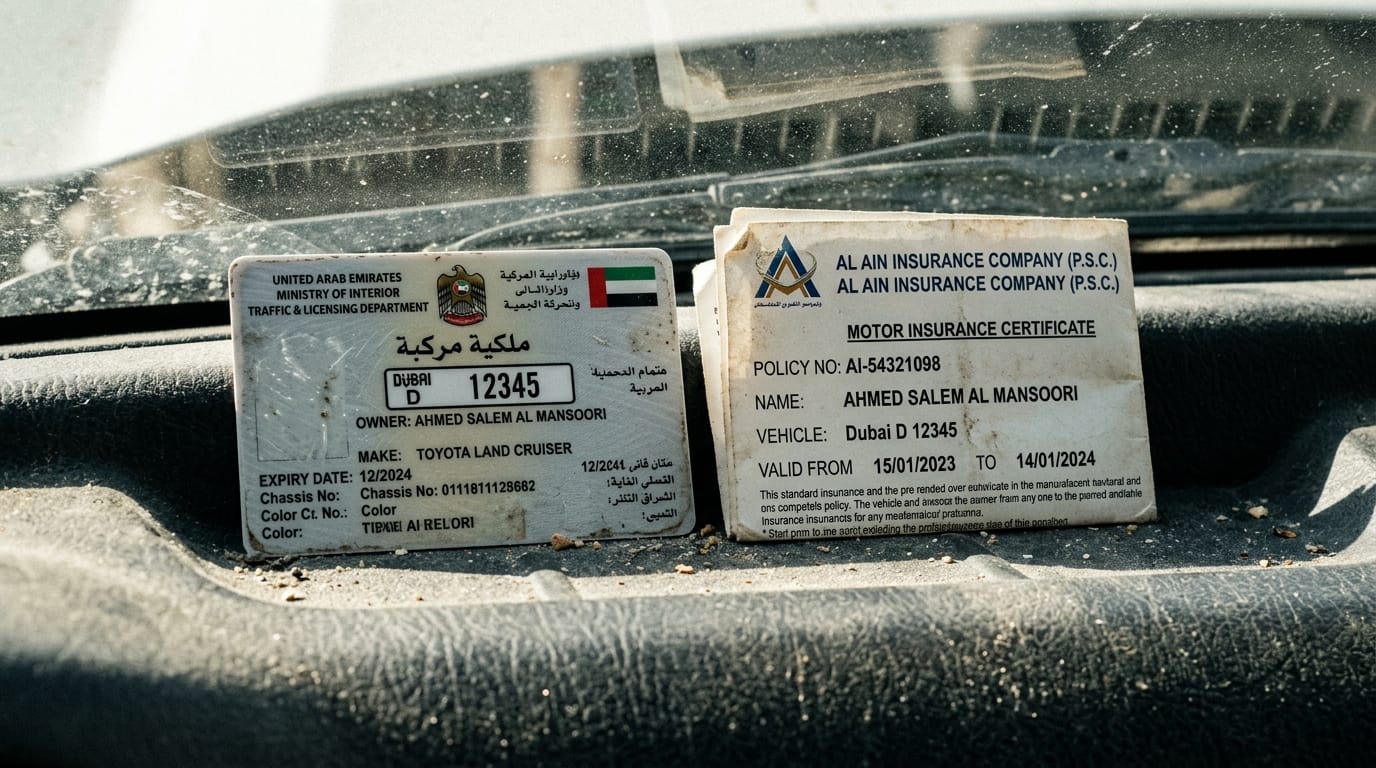
| Registration (Mulkiya) expiry date | Mulkiya card — top right corner | Driving with expired Mulkiya: 500 AED fine + impoundment risk |
| Insurance policy expiry date | Insurance certificate or insurer app | Driving uninsured: 500 AED fine + no coverage for any incident |
| Current odometer reading at purchase | Dashboard at time of key handover | Sets baseline for all maintenance intervals |
| Last service date and type | Service booklet or workshop receipt | Determines when next oil change, filter, and fluid services are due |
Write all four in your phone notes on the day you take ownership. Set calendar reminders 45 days before both the Mulkiya and insurance expiry dates. These two deadlines — if missed — are the most expensive administrative errors in UAE car ownership.
You can check your vehicle’s current registration status, outstanding fines, and insurance validity through the UAE Federal Traffic Portal (EVG) using your chassis number. This is also where you verify that no fines were inherited from a previous owner at the time of purchase. Check it once per quarter as part of the calendar below.
Mechanic’s Inspection Log — The Calendar That Saved Over 3,000 AED
Documented consultation, February 2026, independent workshop, Al Quoz Industrial Area 2, Dubai. Details adjusted for privacy. Example scenario based on recurring UAE market patterns observed in workshops.
Client: Accountant working in Dubai’s DIFC district
Vehicle: 2019 Toyota Corolla 1.6L GCC, 61,000 km at consultation
Situation: Called after a Tasjeel renewal notice showing the inspection failed due to front brake pad thickness below minimum threshold. His insurer had also flagged a premium increase at renewal due to a minor parking claim from 7 months earlier.
When reviewing his ownership record, three preventable cost clusters had accumulated:
- The brake pads had worn below the Tasjeel threshold — detectable at any routine inspection since approximately 45,000 km. He had not had the vehicle inspected at any independent workshop since purchase at 38,000 km. Replacement cost: 380 AED. The Tasjeel retest added another 80 AED.
- The insurance renewal premium had increased by around 540 AED annually above his no-claims rate, because a 7-month-old parking claim — worth approximately 1,100 AED of bodywork — had been filed through insurance rather than paid privately. The NCD loss cost more over two renewal cycles than the repair itself.
- The CVT transmission fluid had not been serviced at the 40,000 km interval. Servicing at 61,000 km cost 720 AED — the same as it would have cost at 40,000 km, but with 21,000 additional km on degraded fluid.
Total avoidable costs: between 3,000 and 3,200 AED across 23 months of ownership. All three would have been identified and addressed with a structured annual calendar and one independent inspection per year.
The most common cost pattern in UAE car ownership is not a single large repair — it is the accumulation of small avoidable costs that each seem minor in isolation. Brake pads at 380 AED, an NCD loss at around 540 AED per year, and a delayed fluid service at 720 AED add up to a notable annual expense. Over two years of ownership, that total becomes meaningful on most expat salaries in the UAE.
The 12-Month Calendar — Month by Month
January — Post-Winter Check and Insurance Review
January is the mildest month in the UAE calendar — ideal for any outdoor inspection or tyre check that summer heat makes uncomfortable. It is also a natural point to review the insurance policy you are currently holding.
- Run a standalone OBD scan at any Al Quoz or Sharjah Industrial Area workshop (50 to 100 AED). Clear-weather driving conditions mean any intermittent fault that was masked by summer heat load becomes visible in the system.
- Check tyre tread depth on all four tyres. Minimum legal tread in UAE: 1.6mm. Check the spare tyre condition simultaneously — this is frequently skipped and frequently needed at the least convenient moment.
- Review your insurance policy. If your renewal is within 90 days, begin comparison shopping now. The UAE Insurance Authority publishes the regulatory framework for motor insurance pricing, useful as a reference when comparing insurer quotes.
AED to budget: 50 to 100 AED for OBD scan. 0 AED if no issues found.
February — Wheel Alignment and Tyre Rotation
Winter roads in the UAE are not particularly punishing, but the combination of speed bumps, kerb contacts in parking lots, and varying road surfaces in Abu Dhabi and Sharjah frequently move wheel alignment out of specification. February is the correct time to address this before summer driving conditions amplify any uneven wear pattern.
- Wheel alignment check and adjustment: 100 to 140 AED at an independent workshop. Address this if you notice the vehicle pulling slightly left or right at motorway speed.
- Tyre rotation: 40 to 60 AED. Moves front tyres to rear and vice versa to equalize wear across all four.
- Check brake fluid condition. If the fluid on the dipstick is dark brown rather than clear or amber, a flush is due: 150 to 200 AED.
AED to budget: 140 to 200 AED
March — Pre-Summer Preparation Begins
March is the transition month. Daytime temperatures in Dubai begin reaching 35 to 38 degrees by mid-March. The AC system, cooling circuit, and engine oil all face increasing thermal load from this point forward. Any deferred maintenance that has accumulated through winter should be addressed in March — not June, when a busy workshop queue and an issue that cannot wait will cost more and delay more.
- AC system check: request a cooling performance test (center vent temperature measurement with the engine running at idle). A well-functioning system should reach 4 to 8 degrees Celsius at the center vent after 90 seconds on maximum setting. If it reaches only 12 to 15 degrees, the refrigerant level or compressor needs attention. Refrigerant recharge: 180 to 280 AED.
- Cabin filter replacement: 60 to 100 AED. A blocked cabin filter reduces AC performance measurably and is among the most under-serviced items across the UAE used car market.
- Engine oil change if due within the next 1,500 km. In UAE summer conditions from April onwards, fresh oil going into the hot months produces better engine protection than degraded oil.
AED to budget: 250 to 400 AED
April — AC Stress Test Month and Cooling System Verification
April marks the beginning of the period where the AC runs continuously during commuting hours. This is when a compressor that was marginal in February reveals itself more clearly. Addressing a refrigerant shortage or a marginal compressor in April is preferable to a full compressor failure in July — which takes longer in a busy workshop and removes vehicle availability on the hottest days of the year.
- Check coolant level and condition in the reservoir. The fluid should be visibly colored (green, blue, or orange depending on type) and between minimum and maximum marks. Brown or rusty coolant indicates the cooling system needs flushing: 250 to 350 AED.
- Inspect the radiator fan for correct operation. With the engine at operating temperature and AC on maximum, the radiator fan should run continuously. If it cycles off while the AC is running, the fan sensor or relay needs attention.
- Verify that all engine oil caps and seals are tight. Heat expansion accelerates any pre-existing minor leak into a visible one by May.
AED to budget: 0 to 350 AED depending on findings
May — Mid-Year Oil Change and Filter Service
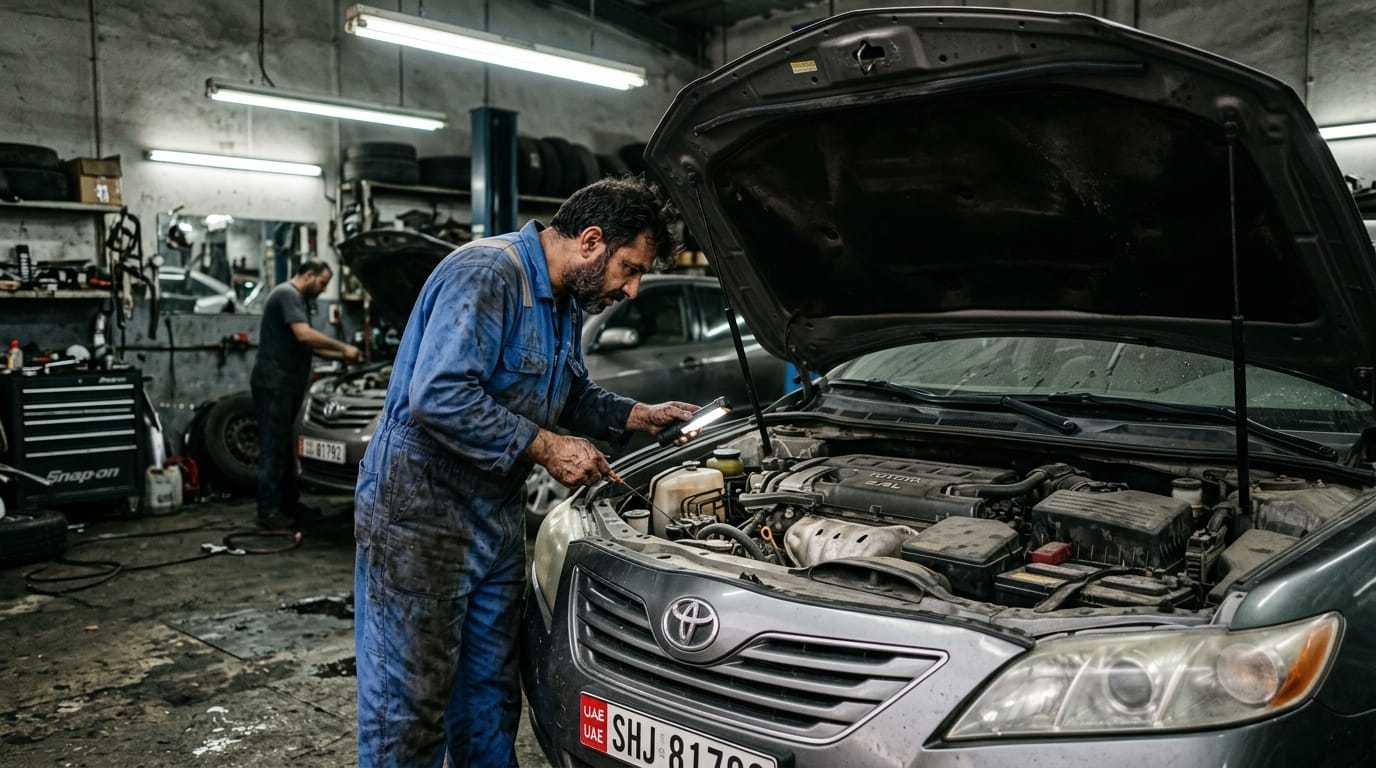
For most expats driving 1,200 to 2,000 km per month, May represents a natural oil change point from a January or February service. In UAE summer conditions, oil degrades faster than in temperate climates — the combination of constant AC compressor load, sustained highway speeds, and ambient heat above 45 degrees accelerates oil film oxidation.
- Engine oil and filter change: 250 to 400 AED at an independent workshop using the manufacturer-specified grade. Always follow the manufacturer specification first. Under UAE severe-use conditions — heat, traffic, frequent short trips — some workshops recommend intervals shorter than the factory specification. Verify the correct grade: a Toyota Corolla 1.6L 2016–2022 uses 0W-20 fully synthetic; a Nissan Sunny uses 5W-30. Using the wrong grade reduces protection.
- Air filter inspection: if visibly grey or brown rather than off-white, replace it (70 to 100 AED). A blocked air filter increases fuel consumption measurably.
- Check tyre pressure on all four tyres plus spare. Pressure increases as ambient temperature rises — tyres inflated correctly in January may be over-inflated by May. Refer to the sticker inside the driver’s door frame for correct cold-inflation figures.
AED to budget: 320 to 500 AED
June — Insurance Renewal Window (45-Day Preparation)
If your insurance policy expires between July and August — common for expats who purchased in UAE summer the prior year — June is the comparison and negotiation window. Renewing in the month of expiry leaves no time to compare, negotiate, or identify a better rate.
- Get at least three insurance quotes using an independent comparison platform. Bayzat and similar UAE platforms generate multiple insurer quotes simultaneously for the same driver and vehicle profile.
- Review whether the agency repair endorsement is appropriate for your vehicle’s age. For vehicles above 5 to 6 years old, the agency repair premium (typically 250 to 600 AED annually) produces marginal benefit — independent Al Quoz workshops handle most repairs at equivalent quality.
- Confirm your no-claims discount percentage in writing. An insurer who cannot state your NCD clearly before renewal requires follow-up.
- Active comparison with multiple insurers may result in lower premiums compared with renewing automatically with the same provider without checking the market.
Factors that affect your premium:
- Driver age and years of UAE driving experience
- Accident and claims history (including minor parking claims)
- Vehicle age and market value
- GCC-spec versus imported specification
- Agency repair option included or excluded
- No Claims Discount (NCD) percentage
AED to budget: 0 AED this month if you purchase through comparison. Potential saving of 300 to 600 AED versus auto-renewal.
July — Minimal Maintenance Month, Maximum Monitoring
July in the UAE records ambient temperatures above 45 degrees in Dubai, Sharjah, and Abu Dhabi. Major maintenance that requires the car to be stationary — paint work, suspension overhauls, anything involving standing in direct sun — is best deferred to October or November. July is a monitoring and fluid-check month, not a major work month.
- Weekly: check engine temperature gauge during the first 10 minutes of each day’s driving. Any consistent rise above the normal operating band indicates a cooling system issue that is less expensive to address now than after an overheating event.
- Check engine oil level once per month in July and August. Heat increases oil consumption slightly in older engines. A level below the minimum mark in this heat must be addressed immediately.
- Park in shade wherever possible. Prolonged UV exposure above 45 degrees accelerates tyre sidewall degradation — particularly relevant for older used vehicles with tyres already approaching replacement range.
AED to budget: 0 to 50 AED (oil top-up if needed)
August — Battery Check Month
UAE automotive workshops report a pattern where battery failures occur most frequently in September and October — after the summer heat cycle has completed its effect on cells that were already marginal. The battery may not fail in peak July heat — it tends to fail when the first significant load is placed on a heat-affected cell after summer. Checking in August allows planned replacement rather than a roadside situation.
- Battery load test at any independent workshop or petrol station with battery service: 0 to 50 AED. The test measures the battery’s cranking reserve under simulated load. A battery showing below 70 percent of rated capacity should be replaced proactively: 380 to 650 AED for a standard replacement.
- Check battery terminals for corrosion — white or blue-green oxidation increases resistance and adds load to the alternator. Terminal cleaning is typically included in battery service checks.
- Verify that the alternator warning light does not flicker during AC-on idle. A flickering charge warning indicates alternator output is marginal under summer load: replacement cost 700 to 1,400 AED.
AED to budget: 50 AED for test + 380 to 650 AED if replacement is needed
September — Tasjeel Renewal Preparation (45-Day Window)
For vehicles registered in the last quarter of the year — October to December — September is the preparation month for Tasjeel renewal. UAE registration law requires a valid Tasjeel pass certificate before the Mulkiya can be renewed. An expired Mulkiya carries a 500 AED fine.
- Check your Mulkiya expiry date now. If it expires in October, November, or December, begin preparation this month.
- Verify tyre tread on all four tyres. Below 1.6mm is an automatic Tasjeel failure. If tread is borderline (2 to 2.5mm), address it now rather than under deadline pressure at the test.
- Check all exterior lights: headlights, indicators front and rear, brake lights, reverse light. A blown indicator is among the most common single-item causes of Tasjeel retest fees.
- Visit the RTA Dubai official website to check outstanding fines on your plate before booking the Tasjeel appointment. Active fines above the test threshold must be paid before registration renewal is processed.
AED to budget: 0 to 900 AED depending on tyre condition
October — Annual Independent Inspection
October is the most important maintenance month in the UAE calendar. The summer heat cycle is complete, temperatures have dropped to manageable levels, and any wear that accumulated through July, August, and September is visible and testable. Every expat car owner in the UAE benefits from one full independent inspection per year — October is the recommended month.
What the annual inspection should cover:
| Inspection Area | What to Check | Cost if Issue Found (AED) |
|---|---|---|
| Full OBD scan with freeze-frame | Active and historical fault codes | 50 – 100 for scan; repair varies |
| Brake system | Pad thickness (all 4), rotor condition, fluid age | 200 – 800 for pads and fluid |
| Suspension and steering | Strut mounts, bushings, ball joints, steering play | 400 – 1,800 per worn component |
| Cooling system | Coolant condition, radiator integrity, hoses | 250 – 500 for flush and hose set |
| AC system | Refrigerant level, compressor cycling, condenser fins | 180 – 3,500 depending on issue |
| Fluid levels and condition | Engine oil, transmission fluid, power steering fluid | 250 – 900 for relevant services |
| Battery load test | Cranking reserve capacity | 380 – 650 if replacement needed |
| Paint thickness all panels | Identifies prior accident repair | N/A — information only |
| Undercarriage visual | Active leaks, rust, exhaust integrity | Variable by finding |
Questions to ask your mechanic at the October inspection:
- Are there any active fault codes or stored historical codes?
- Any visible fluid leaks from the engine bay or undercarriage?
- Are the tyres wearing evenly across the tread face?
- Any detectable play in the suspension or steering joints?
- Any signs of prior bodywork or panel repair on paint thickness scan?
Total inspection cost: 200 to 350 AED for the inspection itself. Repair costs are separate and depend on findings.
Book the October annual inspection at a workshop you have selected independently — not a Tasjeel-affiliated center. The independent inspection uses more time and more checkpoints than the Tasjeel process, and produces a written report you can reference during any subsequent negotiation or resale discussion. Tasjeel checks road safety; an independent workshop checks mechanical health. Both are worth doing annually.
November — Tasjeel Test and Registration Renewal
For most expats whose vehicles were registered in late 2023 or early 2024, November is the Tasjeel and Mulkiya renewal month. Book a Tasjeel appointment through the RTA vehicle registration portal — appointment booking significantly reduces waiting time compared to walk-in.
Common Tasjeel failure reasons and approximate fix costs:
| Failure Item | Approximate Fix Cost (AED) |
|---|---|
| Worn tyres below 1.6mm tread | 900 – 1,500 per pair |
| Brake lights or indicators not functioning | 20 – 60 per bulb |
| Emissions test outside threshold | Varies — typically 150 – 600 |
| Brake pads below minimum thickness | 200 – 600 per axle |
| Windscreen crack in driver’s vision zone | 350 – 900 |
| Outstanding fines not cleared | Fine amount + admin |
What to bring to Tasjeel:
- Original Mulkiya (registration card)
- Your UAE Emirates ID
- Current valid insurance certificate
- Vehicle with all lights functional
- Tyres above 1.6mm tread on all four wheels
Standard Tasjeel and renewal fees in Dubai:
| Item | Approximate Fee (AED) |
|---|---|
| Tasjeel vehicle inspection (private vehicle, under 10 years) | 150 – 220 |
| Annual registration renewal fee | 370 – 620 depending on vehicle age and type |
| Knowledge and innovation fee | 20 |
| Retest if first attempt fails | 50 – 80 |
| Estimated total | 540 – 860 AED |
Note: Fees are subject to revision. Verify current fees via the Dubai Drive app before your appointment.
December — Year-End Service and Resale Planning
December is the planning month for the year ahead — and for expats approaching the end of their UAE contract, it is the month to begin thinking about the vehicle exit strategy.
For those continuing ownership into the next year:
- Engine oil change if due within 1,000 km — starting the new year with fresh oil is cleaner practice.
- Check wiper blades — summer UV degrades rubber wiper inserts over 8 to 9 months of direct sun exposure. Replacement cost: 40 to 90 AED for a set.
- Review the Salik account balance through the official Salik portal. An account in deficit generates automatic fines. Verify no outstanding disputed crossings.
For those planning to sell within 6 months:
- Begin pre-sale inspection planning. A documented pre-sale inspection report costs 150 to 300 AED and may support price protection of 1,500 to 4,000 AED by preventing a buyer’s inspector from being the first to identify your car’s condition issues.
- Gather all service receipts and the service booklet. A gap in documentation may reduce the market price on Dubizzle. An organized file may recover that value.
AED to budget: 300 to 600 AED for oil change and minor items
Maintenance by Mileage — For High-Mileage and Low-Mileage Drivers
The monthly calendar above works for drivers covering 1,200 to 2,000 km per month. If you drive significantly more or less, the calendar must shift to a mileage basis rather than a monthly one. A delivery driver covering 3,500 km monthly and an office commuter covering 800 km monthly follow different service schedules — even in the same calendar month.
| Mileage Reached | Recommended Action | Approximate Cost (AED) |
|---|---|---|
| 5,000 km | Engine oil and filter change | 250 – 400 |
| 10,000 km | Tyre rotation + tread depth check | 40 – 80 |
| 20,000 km | Cabin filter + air filter replacement | 130 – 200 |
| 30,000 km | Spark plugs (petrol) + battery check | 200 – 450 |
| 40,000 km | CVT or automatic transmission fluid service | 600 – 900 |
| 60,000 km | Coolant flush + brake fluid flush | 400 – 600 |
| 80,000 km | Full suspension inspection + wheel bearing check | 300 – 400 for inspection; repair separate |
| 100,000 km | Timing belt or chain inspection (model-dependent) | 800 – 2,500 if replacement needed |
For high-mileage drivers covering above 2,500 km monthly — Dubai–Abu Dhabi commuters, delivery workers, sales executives — the mileage intervals arrive faster than the monthly calendar allows for. Track both: whichever arrives first takes priority.
UAE Summer vs Winter Ownership Priorities
The UAE has two distinct mechanical seasons. Summer (May to October) creates heat-related stress on the cooling, AC, battery, and tyre systems. Winter (November to March) is milder but creates its own checklist. Understanding which systems are under load in which season prevents the pattern of addressing summer damage in winter — too late to prevent it.
| Priority | Summer Focus (May–October) | Winter Focus (November–March) |
|---|---|---|
| 1 | AC system performance and refrigerant level | Battery cranking capacity |
| 2 | Coolant level and cooling fan operation | Tyre condition for Tasjeel renewal |
| 3 | Engine oil condition under thermal load | Brake system inspection |
| 4 | Tyre pressure (increases in heat) | Wheel alignment after summer road use |
| 5 | UV damage to tyre sidewalls and wiper blades | Suspension inspection before inspection season |
| 6 | Battery degradation monitoring | Insurance renewal comparison |
How the Calendar Changes for New Cars vs Used Cars
A new GCC-spec vehicle under warranty follows a different ownership calendar from a used vehicle purchased at 40,000 to 80,000 km. The differences are significant enough that treating them identically produces either unnecessary spending (over-servicing a new car) or under-attention (assuming a used car has the same margin for deferred maintenance).
| Calendar Element | New Car (0–60,000 km, in warranty) | Used Car (60,000 km+, post-warranty) |
|---|---|---|
| Service location | Agency servicing to protect warranty | Independent workshop often lower cost |
| Independent inspection frequency | Once at 2-year mark or warranty transfer | Annual — October as primary month |
| Repair reserve budget | Lower — warranty covers most components | 500 to 1,500 AED annual reserve recommended |
| Transmission fluid service | Per manufacturer schedule | Verify if prior owner completed 40,000 km service — if not, do immediately |
| Battery check frequency | Annual from year 3 | Every August regardless of age |
| Resale documentation | Agency service stamps add significant value | Independent receipts with detail add measurable value |
For used vehicles purchased with an unknown service history — common in the Dubizzle market — treat all fluid services (transmission, coolant, brake fluid) as overdue regardless of the odometer reading and service them within the first 90 days of ownership.
Emergency Items Every UAE Expat Should Keep in the Car
UAE road conditions mean that a vehicle issue in the wrong location can mean a wait of 30 to 60 minutes for roadside assistance. The following items address the most common situations: tyre pressure loss, battery jump starts, and overheating.
| Item | Why It Matters in UAE | Approximate Cost (AED) |
|---|---|---|
| Portable tyre inflator (12V) | Slow pressure loss is common in summer heat; allows self-recovery to nearest workshop | 60 – 120 |
| Jumper cables (3m minimum) | Battery failures peak in September–October; needed before roadside assistance arrives | 30 – 80 |
| Warning triangle (mandatory by law) | Required at any breakdown stop. Fines apply if not deployed correctly | 20 – 40 |
| 1–2 litres bottled water | Cooling system top-up if needed; personal safety if stranded in summer | 5 – 10 |
| Small first-aid kit | Required equipment per UAE traffic regulations | 25 – 60 |
| Phone power bank (10,000 mAh+) | Navigation and roadside assistance calls require phone charge | 60 – 150 |
| Reflective vest | Recommended for any roadside stop, particularly on highways | 15 – 30 |
| Flashlight or torch | Useful for tyre checks and under-bonnet inspection at night | 20 – 50 |
Useful Apps for UAE Car Owners
Managing UAE car ownership across fines, registration, tolls, and insurance is more efficient when the right apps are in place from day one. These are the most widely used tools among expat car owners in Dubai and Abu Dhabi.
| App | Primary Use | Coverage |
|---|---|---|
| Dubai Drive (RTA) | Vehicle registration, fines, Tasjeel appointments | Dubai vehicles |
| Dubai Police | Traffic fine check and payment | Dubai |
| ADPC (Abu Dhabi Police) | Fines and vehicle services in Abu Dhabi | Abu Dhabi vehicles |
| Salik | Toll account balance, crossing history, top-up | Dubai Salik gates |
| EVG (evg.ae) | Vehicle history, registration status by VIN/chassis | Federal — all emirates |
| Your insurer’s app | Policy details, NCD certificate, claims tracking | Your insurer only |
| Bayzat or Yallamotor | Insurance comparison at renewal | Multiple UAE insurers |
Annual Cost Summary — What the Calendar Costs in Total
| Month | Primary Action | Budgeted Cost (AED) |
|---|---|---|
| January | OBD scan + insurance review | 50 – 100 |
| February | Wheel alignment + tyre rotation + brake fluid | 140 – 200 |
| March | AC check + cabin filter + pre-summer oil if due | 250 – 400 |
| April | Coolant and cooling system verification | 0 – 350 |
| May | Oil and filter service + air filter | 320 – 500 |
| June | Insurance comparison and renewal | 0 (potential saving vs auto-renewal) |
| July | Monitoring only | 0 – 50 |
| August | Battery load test | 50 – 100 |
| September | Tasjeel prep + tyre check + fine clearance | 0 – 900 |
| October | Full annual independent inspection | 200 – 350 |
| November | Tasjeel test + Mulkiya renewal | 540 – 860 |
| December | Year-end service + Salik review | 300 – 600 |
| Full Year Total | Excluding Repairs | 1,850 – 3,610 AED |
This total covers scheduled maintenance and administrative costs for a typical mid-size GCC-spec sedan driven 1,500 to 2,000 km monthly. Budget an additional 500 to 1,500 AED per year as a repair reserve for any finding from the October annual inspection.
Decision Framework — Adapting the Calendar to Your Situation
| Your Situation | Calendar Adjustment | Priority |
|---|---|---|
| Driving Dubai–Abu Dhabi daily | Increase oil change frequency to every 4,000 km; tyre rotation every 8,000 km | High — accelerated wear |
| Vehicle above 80,000 km | Add suspension bushing check to October inspection; verify fluid status | High — age-related items |
| Contract ending within 12 months | Begin pre-sale inspection planning early; keep all receipts from day one | Critical — resale value |
| New expat, first car in UAE | Add a general familiarization check in month one to protect budget | Foundation — cost prevention |
Evidence Checklist — What to Keep in Your Car File
| Document | Where to Keep It | Why It Matters |
|---|---|---|
| Original Mulkiya (registration card) | In the car at all times | Required for any traffic stop, Tasjeel test, or sale |
| Current insurance certificate | In the car at all times | Required for accidents, traffic stops, Tasjeel renewal |
| All service receipts since purchase | Physical folder or phone photos | Documented history may positively influence resale value |
| Pre-purchase inspection report | Physical folder | Reference for any dispute about pre-existing condition |
| Insurance NCD certificate | Email or insurer app | Required to transfer NCD to new insurer at renewal |
The most effective single habit in UAE car ownership is keeping all service receipts from day one. A documented service history may improve buyer confidence and can positively influence resale value when selling on Dubizzle or through private channels — particularly compared to an equivalent vehicle where receipts are absent. The folder takes five minutes to set up on the day of purchase.
When the Calendar Approach Breaks Down — Common Failure Patterns
Skipping the October annual inspection to save 200 to 350 AED. This produces the pattern documented in the Mechanic’s Inspection Log — issues detectable at low cost in September become workshop problems in January. The inspection cost is among the lowest line items in the entire calendar and is frequently the most skipped.
Renewing insurance automatically without comparison. Active comparison with multiple insurers at renewal may result in lower premiums compared to auto-renewal with the same provider. The June comparison window takes approximately 30 minutes and frequently produces a better outcome.
Deferring tyre replacement until Tasjeel forces the issue. Tyres that are marginal at 2.5mm tread in October may become a Tasjeel failure at 1.3mm in November. Replacing in October at a planned price produces a better outcome than replacing under deadline pressure.
Analytical Conclusion — What the Calendar Produces Over Two Years
An expat who follows the 12-month calendar across a two-year ownership period spends approximately 3,700 to 7,220 AED on scheduled maintenance and administrative costs. This may appear significant in isolation — but it compares favorably against ownership patterns observed in Dubai and Sharjah workshops where reactive management accumulated substantially higher costs over equivalent periods.
The unstructured approach does not save money — it defers costs to more expensive moments and adds penalty costs (Tasjeel retest fees, NCD loss, Mulkiya fines) that the calendar eliminates. The structured approach also produces a second financial benefit: a documented vehicle at resale. An owner who has kept receipts, followed service intervals, and has a clean Tasjeel history is in a stronger negotiating position at sale compared to an equivalent undocumented vehicle in the Dubizzle market.
The calendar costs approximately 300 AED per month in scheduled maintenance. The avoided emergency costs, penalty fees, and improved resale position represent a meaningful financial counterpart over a two-year ownership period. For a comprehensive view of what used car ownership costs beyond maintenance, our total ownership cost breakdown covers insurance, depreciation, and fuel across popular UAE models. To see how these maintenance habits directly impact long-term cost outcomes between the market’s two most common commuter models, continue to our next guide: Toyota Corolla vs Nissan Sunny UAE 2026: Full 2-Year Cost Comparison.
FAQ — UAE Car Ownership Annual Calendar
Data Sources Used
- UAE Federal Traffic Portal (evg.ae) — vehicle history verification, outstanding fines, and registration status
- Salik UAE Official Portal — Salik account management, fine verification, and top-up procedures
- RTA Dubai — Vehicle Registration and Tasjeel Services, registration renewal fees, Tasjeel inspection requirements
- UAE Insurance Authority — motor insurance regulatory framework and consumer rights documentation
- Dubai Police — Traffic fine checking systems and enforcement records
- Abu Dhabi Police — ADPC traffic portals and fine settlement structures
- ADNOC UAE — Fuel pricing index influencing ADNOC fuel cost calculations
- Independent workshop observations: Al Quoz Industrial Area 1 and 2, Sharjah Industrial Area, Deira auto workshops — service invoice data and seasonal maintenance pattern observations, 2024 to 2026
