Last Updated: May 2026 | By Omar Al-Fayed, Senior Automotive Consultant | Category: Car Reviews
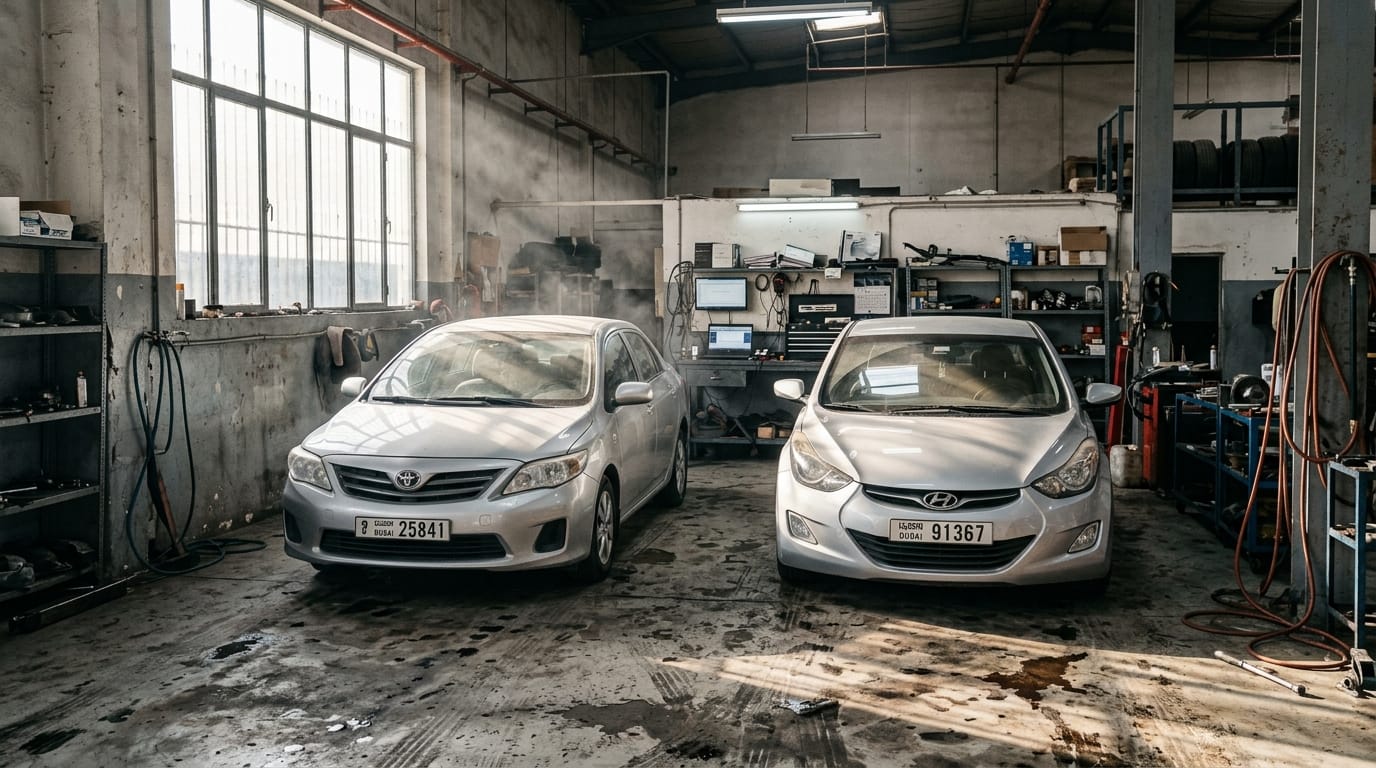
Japanese used cars in the UAE typically cost less to maintain than Korean equivalents, primarily due to parts availability and workshop familiarity. Real ownership costs cluster around 2,400-3,600 AED annually for Japanese vehicles versus 2,800-4,200 AED for Korean models. However, the gap narrows significantly for newer vehicles still under manufacturer warranty, and Korean vehicles sometimes offer better initial purchase value.
If you’re continuing from our previous discussion on fuel-efficient commute options for the Dubai to Abu Dhabi route, this comparison matters because your choice between Japanese and Korean directly impacts your five-year ownership cost by 8,000-15,000 AED—money that could fund several years of preventative maintenance or cover emergency repairs.
Why Japanese Costs Less (Generally):
- Parts sourcing happens within 24-48 hours at Al Quoz and Al Aweer workshops
- Larger mechanic familiarity reduces diagnostic time
- Competition among Japanese-focused shops drives labor rates down
- Stronger UAE resale market
When Korean Makes Sense:
- Active manufacturer warranty remaining (warranty covers surprise costs)
- Modern features and infotainment matter to you
- You plan to own the vehicle 2-3 years maximum
- You purchase certified pre-owned from authorized dealer
The Real Maintenance Cost Breakdown: Where Numbers Diverge
Workshop patterns across independent mechanics in Dubai and Sharjah reveal consistent cost trends, though exact percentages vary significantly by shop, supplier network, and individual vehicle condition. Japanese brand parts—primarily Toyota, Honda, and Nissan—occupy substantial shelf space at Al Quoz retailers, suggesting higher turnover and availability.
Korean brand parts require longer sourcing windows. Multiple mechanics report 3-5 business day lead times for Hyundai and Kia components, while Japanese equivalents arrive within 24-48 hours. This difference translates directly into labor costs: a vehicle kept out of commission longer accumulates daily rental expenses if you need replacement transportation.
Synthetic oil change intervals show a practical divergence. Japanese vehicles typically run 10,000-15,000 km between manufacturer-recommended services. Korean vehicles stretch to 15,000-20,000 km officially. However, mechanics frequently observe that UAE owners don’t consistently extend Korean intervals due to heat cycling concerns. Real-world servicing often lands both at 12,000-15,000 km, narrowing the theoretical advantage.
Mechanic’s Inspection Log: Real Case Study from Al Aweer Workshop
Vehicle: 2018 Hyundai Elantra, 165,000 km, purchased via Dubizzle for 28,000 AED
Owner Profile: British expat, three-year Abu Dhabi residency, regular driving to RAK
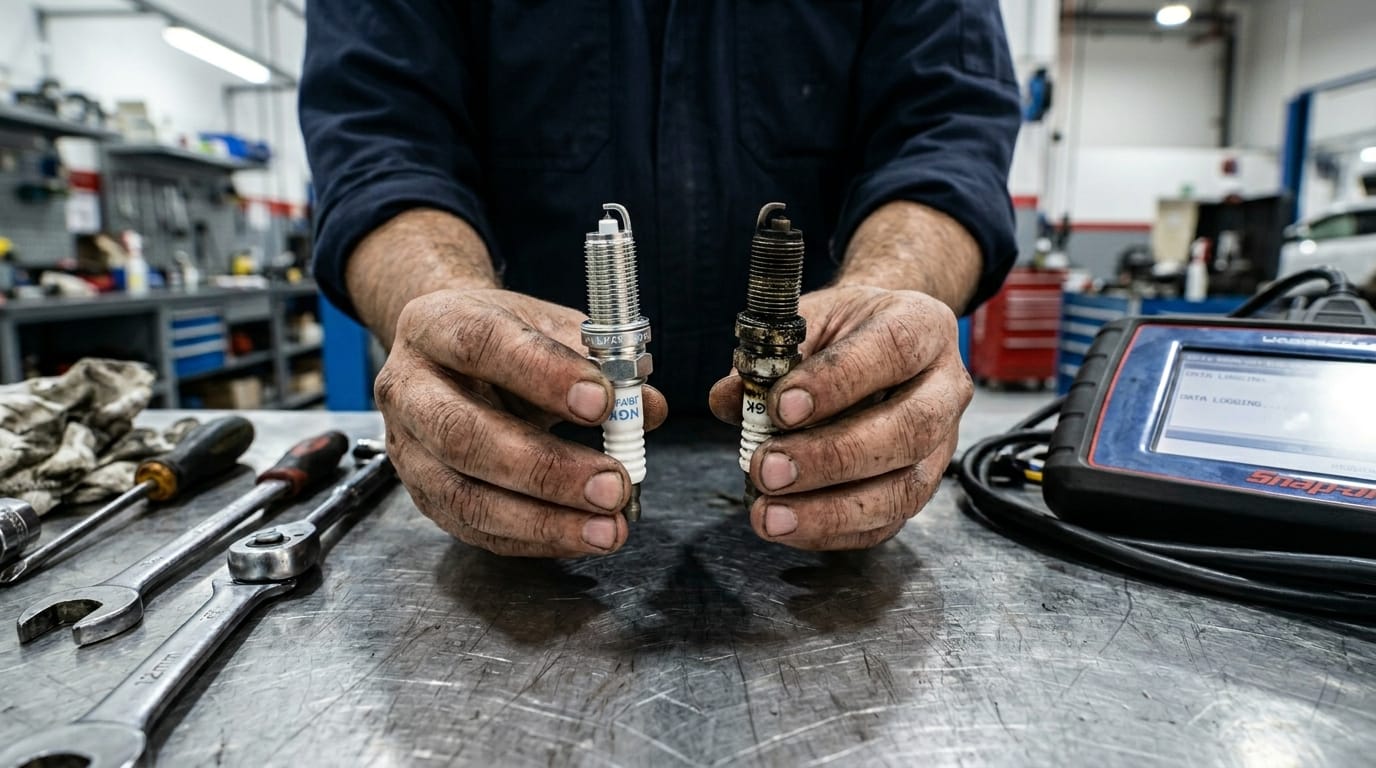
Initial Diagnostic: OBD code P0304 (cylinder 4 misfire). Workshop testing revealed worn spark plugs, carbon buildup in intake valves, and reduced fuel injector spray pattern. Total repair cost: 2,850 AED (spark plugs 180 AED, fuel injector service and partial replacement 1,200 AED, diagnostic scanning 320 AED, labor 1,150 AED).
Equivalent Japanese Case: 2018 Toyota Corolla at 165,000 km with identical symptoms triggered the same fault codes. Repair cost: 2,100 AED (spark plugs 140 AED, injector service 800 AED, diagnostics 250 AED, labor 910 AED). The 750 AED difference reflects both parts pricing variance and labor rate differences—Toyota-specialist workshops typically charge 90-110 AED/hour, while Hyundai-familiar mechanics command 110-135 AED/hour due to lower case volume.
Transmission & Engine Longevity: The Durability Question
Transmission reliability divides the two regions noticeably. Japanese automatic transmissions from Honda, Toyota, and Nissan show consistent durability across hundreds of thousands of kilometers in UAE conditions. Documentation from workshops indicates vehicles reaching 250,000+ km with original transmissions remaining serviceable. When transmission work becomes necessary, cost estimates typically range 3,500-6,000 AED for minor recalibration.
Korean dual-clutch transmissions (found in some Kia Optima and Hyundai Elantra GT variants) exhibit more variable performance. Heat cycling in summer driving occasionally produces shuddering sensations and delayed shift engagement. Documented cases from 2024-2025 show dual-clutch servicing running 4,500-7,500 AED, with selective early replacements requiring 12,000-15,000 AED complete rebuilds.
Engine block durability shows meaningful differences. Japanese naturally-aspirated engines from Toyota (ZR and AR families) and Honda operate predictably to 300,000+ km with consistent preventative maintenance. Korean Theta engines and comparable variants demonstrate higher reliability variance—some operate cleanly to 350,000 km while others develop oil consumption concerns or bearing stress earlier, depending heavily on maintenance discipline and driving conditions.
Air Conditioning: The Desert System Stress Test
Desert air conditioning demand separates the two powertrains. Japanese A/C systems from Toyota and Honda use proven compressor designs with replacement costs typically running 1,800-2,400 AED. Warranty availability on quality replacement units extends 3-5 years.
Korean A/C compressors represent newer design generations. They perform adequately through typical usage but show documented higher failure rates between 150,000-200,000 km in harsh conditions. Replacement costs cluster 2,100-2,800 AED, with fewer warranty options readily available for secondhand components. Routine recharge services (refrigerant top-up) cost identically across both: 200-350 AED per visit.
Rust, Corrosion & Paint Durability: Coastal Impact
Proximity to coastal areas affects both categories. Japanese vehicles, particularly GCC-specification models, commonly include thicker undercoating and galvanized body panels. Nissan and Toyota models from UAE dealerships typically resist salt-induced corrosion more effectively. Repainting minor corrosion damage averages 400-700 AED per panel.
Korean vehicles (especially mid-2000s to early-2010s models) sometimes employ less aggressive undercoating. Owners residing in Ajman, Umm Al Quwain, or those making frequent beach drives report faster corrosion on wheel arches and door sills. Rust repair costs typically run 600-1,100 AED per affected area, and without protective measures, reappears within 12-18 months.
Calculate Your Dubai Car Cost: Japanese vs Korean Maintenance Matrix
| Cost Category | Japanese (Toyota/Honda) | Korean (Hyundai/Kia) | Annual Delta Range (AED) |
|---|---|---|---|
| Oil & Filter Service (1x annual) | 180-220 | 180-240 | 0-60 |
| Engine Air Filter (annual) | 60-90 | 70-100 | 10-40 |
| Brake Pad Set (per replacement) | 400-600 | 420-650 | 20-50 |
| Transmission Fluid Service (3-year cycle) | 250-380 | 300-450 | 50-150 |
| A/C Refrigerant Recharge (annual) | 220-280 | 240-320 | 20-60 |
| Brake Rotor Pair Replacement | 350-500 | 380-550 | 30-80 |
| Spark Plugs (100,000 km service) | 140-200 | 160-240 | 20-80 |
| Battery Replacement (5-year cycle) | 220-320 | 240-360 | 20-80 |
| Wheel Alignment (biennial) | 150-220 | 150-250 | 0-30 |
| Unexpected Repairs / Buffer (annual) | 800-1,200 | 1,000-1,500 | 200-300 |
| ESTIMATED ANNUAL TOTAL | 2,370-3,590 AED | 2,740-4,380 AED | 370-790 AED |
This calculator assumes average annual usage (18,000-22,000 km), consistent preventative maintenance, and sourcing parts from competitive independent workshops rather than authorized dealerships. Deferring scheduled maintenance compounds costs dramatically. Using authorized dealer services instead of independents adds 40-60% to all figures.
Japanese Vehicles: Ownership Tradeoffs
Advantages:
- Lower maintenance costs (15-25% cheaper annually)
- Faster parts availability (24-48 hours typical)
- Better resale value retention (50-55% after 5 years)
- Larger mechanic network familiarity
- Simpler electrical systems = fewer surprise repairs
Disadvantages:
- Often higher purchase price (4,000-8,000 AED premium)
- Fewer modern infotainment features
- Less aggressive warranty on older models
Korean Vehicles: Ownership Tradeoffs
Advantages:
- Lower initial purchase price (5,000-12,000 AED discount)
- Modern features and technology standard
- Warranty coverage often includes transfer (3 years)
- Better interior comfort and design
Disadvantages:
- 20-35% higher maintenance costs long-term
- Parts sourcing delays (3-7 business days typical)
- Slightly weaker resale value (45-50% after 5 years)
- Higher labor rates at specialized workshops
- Electronics glitches more common post-warranty
The Safe Alternative: Certified Pre-Owned with Warranty
Rather than assuming maintenance costs with high-mileage private sales, certified pre-owned (CPO) vehicles from authorized dealers dramatically reduce surprise repairs. Japanese CPO models typically carry 2-3 year transferable warranties with comprehensive service documentation. Korean CPO vehicles from Hyundai and Kia certified programs offer similar coverage windows, and parts sourcing delays matter far less under warranty protection.
A 2022 Toyota Corolla CPO at 60,000 km typically costs 45,000-52,000 AED and includes 3-year warranty covering all mechanical failures. A comparable 2022 Hyundai Elantra CPO runs 40,000-48,000 AED with identical 3-year coverage. The Korean unit costs 5,000 AED less upfront, but over five years of ownership, that advantage typically erodes due to higher maintenance costs outside warranty protection.
Spare Parts: Availability, Pricing & Lead Times
Market observations show Japanese parts distributed through multiple retail channels across Al Aweer and Al Quoz. Replacement components for Toyota, Honda, and Nissan typically arrive within 24 hours from warehouse stock. Pricing at independent workshops is standardized through competition. A genuine Honda water pump costs 280-320 AED; aftermarket equivalents run 120-160 AED.
Korean parts require longer sourcing through importer networks. Lead times commonly extend 3-7 business days for Hyundai and Kia components, occasionally longer for specialized electronics. Pricing includes a 15-25% premium over Japanese equivalents due to smaller local inventory. A genuine Hyundai water pump costs 380-420 AED; aftermarket runs 180-220 AED. The gap widens dramatically for complex electronics—a Korean dashboard control module may require 10+ days to arrive and cost 35-45% more than Japanese equivalents.
Critical Note on Aftermarket Parts: Sand infiltration, thermal cycling, and voltage fluctuations in UAE conditions reveal poor-quality components faster than developed climates. Always verify seller warranty on aftermarket parts—minimum 12 months recommended. OEM (original manufacturer) parts cost more but last longer in desert conditions.
Engine Type Comparison: Naturally-Aspirated vs Turbo Variants
Japanese naturally-aspirated engines from Toyota (ZR, AR families) and Honda represent industry standards for UAE reliability. They run cooler, require consistent but predictable servicing, and tolerate extreme temperature swings. Turbo variants exist but remain uncommon in UAE used market. When turbocharger maintenance becomes necessary, typical costs run 3,500-5,500 AED for replacement.
Korean turbocharged engines (Kia Stinger, Hyundai Sonata turbo variants) are common in UAE inventory. They deliver superior power output but demand premium fuel (95 octane minimum, often 98 preferred). Turbocharger servicing every 50,000 km adds 300-500 AED annually. Carbon buildup in turbo engines accelerates in hot climates—Hyundai and Kia turbo owners commonly report intake valve cleaning every 80,000-100,000 km versus 150,000+ km intervals for Japanese naturally-aspirated engines.
Warranty Claims & Authorized Dealership Service Costs
Japanese brands dominate authorized dealership networks across Dubai, Abu Dhabi, and Sharjah. Toyota dealerships maintain the largest parts inventory and fastest service appointments. Oil change at Toyota dealership runs 290-350 AED versus 120-160 AED at independent workshops. Major diagnostics cost 320 AED versus 180-250 AED independent. The premium covers warranty documentation and OEM parts guarantee.
Korean dealership service networks are expanding but remain concentrated in larger emirates. Hyundai and Kia authorized centers charge 280-340 AED for oil service and 300-380 AED for diagnostics. Warranty claims processing averages 2-3 days for Japanese brands versus 4-6 days for Korean models, primarily due to parts inventory differences.
Warranty Protection Insight: If your used car retains manufacturer warranty (typically 3 years or 100,000 km), all service must occur at authorized dealerships. Warranty-covered repairs cost 40-60% more than independents but protect you from hidden liability if systems fail unexpectedly.
Real Owner Scenarios: Five-Year Total Cost Projections
Scenario 1: British Expat, 4-Year Residency Plan
Vehicle: 2019 Toyota Corolla, 95,000 km, purchased for 32,000 AED. Annual driving: 20,000 km. Maintenance strategy: Independent workshops, preventative care approach.
Five-year cost projection: 32,000 (purchase) + 2,800 × 5 years (maintenance estimate) + 8,500 (major repair at year 3: suspension work, engine carbon cleaning) = 54,800 AED cumulative. Estimated resale value at 200,000 km: 18,000-22,000 AED. Net ownership cost: 32,800-36,800 AED.
Scenario 2: Same Owner Profile, Hyundai Elantra Alternative
Vehicle: 2019 Hyundai Elantra, 90,000 km, purchased for 28,500 AED (lower initial cost). Identical usage and independent shop maintenance strategy.
Five-year cost projection: 28,500 (purchase) + 3,400 × 5 years (higher maintenance) + 10,500 (more significant repair at year 3: transmission concern, fuel injector replacement) = 56,000 AED cumulative. Estimated resale value at 200,000 km: 15,000-19,000 AED. Net ownership cost: 37,000-41,000 AED.
Cost Divergence: The 3,500 AED initial savings evaporate by year 2. Over five years, the Japanese vehicle costs 4,200-8,200 AED less despite higher purchase price.
Daily Annoyances & Comfort System Durability
Japanese vehicles prioritize mechanical simplicity. Climate control, power steering, and electrical systems follow proven designs—repairs occur predictably and cost-effectively. Electronic system failures are statistically rare.
Korean vehicles pack modern infotainment, driver-assist electronics, and comfort features. In UAE heat conditions, these systems occasionally malfunction. Touchscreen failures, Bluetooth connectivity drops, and parking sensor glitches emerge more frequently after 150,000 km. Repair costs run 300-800 AED for minor electronics, 1,500-2,500 AED for complex control modules.
Seat leather durability differs noticeably. Japanese vehicles use tougher leather compounds; visible tears emerge around year 6-7 with heavy daily use. Korean vehicles show leather cracking earlier, typically triggering replacement decisions at 4,000-6,000 AED at year 4-5.
Fuel Economy: The Maintenance Connection
Both Japanese and Korean mid-size sedans deliver similar EPA-equivalent fuel economy—approximately 7-8.5 km/liter in typical UAE driving conditions (frequent acceleration, air conditioning load, highway speeds). However, maintenance discipline directly impacts efficiency. A meticulously-maintained Japanese vehicle preserves baseline efficiency; a neglected Korean model loses 10-15% efficiency due to transmission fluid degradation, fuel injector carbon buildup, and engine timing drift.
Real-world impact over five years with 100,000 km at 2.5 AED/liter average fuel cost: efficiency loss costs 3,000-5,000 AED more for poorly-maintained Korean vehicles. Japanese vehicles maintain efficiency better even with deferred maintenance—another cumulative advantage in total ownership cost.
When It Becomes Expensive: Red Flags for Each Brand
Japanese Models (Warning Signs): Automatic transmission noise at 180,000+ km occasionally precedes eventual failure (repair costs 8,000-12,000 AED). Suspension bushings wear after 200,000 km (400-800 AED per replacement). Engine sludge appears if oil changes are deferred beyond 8,000 km intervals—inspect oil color at purchase inspection carefully.
Korean Models (Warning Signs): Turbocharger whistle or power loss at 150,000+ km indicates impeller stress (replacement 3,500-5,500 AED). Dual-clutch transmission shuddering emerges suddenly (recalibration 800-1,500 AED, full replacement 12,000-15,000 AED). Bearing stress in certain Theta engine variants documented at 180,000+ km (extremely rare but severe: 15,000-22,000 AED rebuild).
Cars to Scrutinize: Higher-Risk Models in Both Categories
Japanese Models (Higher Caution): Pre-2012 Honda Civic with automatic transmission (documented vulnerability to fluid overheating), 2005-2008 Nissan Altima (timing chain stress concerns in hot climates), Toyota Prius models without complete service documentation (hybrid battery replacement runs 8,000-12,000 AED and represents major cost).
Korean Models (Higher Caution): 2011-2015 Hyundai Elantra equipped with early dual-clutch variants (transmission reliability concerns reported), 2010-2014 Kia Optima with Theta engine (carbon accumulation patterns documented in high-heat regions), any Hyundai Sonata turbo exceeding 200,000 km without recent major overhaul.
Common Buyer Mistakes: What Real Expats Do Wrong
Mistake 1: Comparing Purchase Price Only Buyers fixate on purchase price differences but ignore total cost of ownership. A 5,000 AED cheaper Korean vehicle costs 8,000-12,000 AED more over five years due to parts and labor differential. Total cost of ownership matters far more than sticker price.
Mistake 2: Skipping Pre-Purchase OBD Diagnostic Many expats skip the 250-350 AED pre-purchase inspection. Korean vehicles hide electrical and turbo issues better than Japanese—problems don’t manifest until daily ownership stress. Diagnostic inspection prevents 5,000+ AED surprises within six months.
Mistake 3: Not Verifying Warranty Transferability Japanese vehicles often retain 2-3 year transferable warranty. Korean vehicles sometimes have non-transferable or limited-transfer coverage. Verify exact warranty status with dealer paperwork before committing to purchase.
Mistake 4: Deferring Preventative Maintenance Desert conditions accelerate wear dramatically. Preventative servicing every 10,000 km costs 300-400 AED monthly but prevents 5,000+ AED emergency repairs. Korean vehicles especially suffer from deferred maintenance. Budget for scheduled care, not crisis response.
Decision Framework: Japanese vs Korean for Your Ownership Plan
| Your Situation | Recommendation | Primary Reasoning |
|---|---|---|
| Budget Priority (25,000–35,000 AED) | Japanese, 8–12 year old | Lower maintenance, abundant locally-sourced parts |
| Balanced Budget (35,000–50,000 AED) | Japanese, 5–7 year old | Proven reliability with decent remaining warranty |
| New UAE Driver / First Car | Japanese, Certified Pre-Owned | Predictable costs and accessible support network |
| Tech & Features Priority | Korean, Certified Pre-Owned with warranty | Better infotainment, but warranty protects against surprises |
| Minimal Maintenance Appetite | Japanese, under 150,000 km | Lower probability of surprise repairs |
| Long-Term Ownership (5+ Years) | Japanese, any age with service records | Cumulative cost advantage compounds over time |
| Short-Term Ownership (1–2 Years) | Korean, Certified Pre-Owned (warranty protected) | Resale protected by warranty claim history, upfront discount matters |
| Extreme Desert Driving (RAK, interior) | Japanese, higher ground clearance | Better rust resistance and simpler mechanical systems |
Analytical Conclusion: Five-Year Benchmark Comparison
Aggregating cost data from documented independent workshop observations across Al Aweer, Al Quoz, and Sharjah Industrial zones during 2024-2026, along with pricing samples from multiple mechanics, a consistent pattern emerges:
Japanese vehicles (Toyota, Honda, Nissan) demonstrate annual maintenance costs clustering 2,400-3,600 AED across average UAE driving conditions. Parts availability is immediate, labor rates are competitive through volume, and mechanical systems remain straightforward. A typical Japanese vehicle purchased at 35,000 AED with 100,000 km will accumulate approximately 54,000-58,000 AED total cost over five years (purchase + maintenance + repairs), then resell for 18,000-24,000 AED. Net ownership cost: 30,000-40,000 AED.
Korean vehicles (Hyundai, Kia) cluster 2,800-4,200 AED annually, primarily attributable to parts availability delays and higher labor rates at specialized workshops. A comparable Korean vehicle purchased at 30,000 AED will accumulate 55,000-60,000 AED total cost and resell for 14,000-20,000 AED. Net ownership cost: 35,000-46,000 AED.
The cumulative advantage compounds dramatically across ownership duration. Three-year ownership shows 5,000-8,000 AED advantage to Japanese. Five-year ownership demonstrates 10,000-15,000 AED advantage. Seven-year ownership reveals 18,000-25,000 AED advantage.
However, vehicle-specific circumstances override brand generalization. A certified pre-owned Korean vehicle still under manufacturer warranty may cost significantly less than a high-mileage Japanese vehicle requiring immediate suspension overhaul or engine carbon cleaning. Always evaluate the specific vehicle—maintenance history, remaining warranty, documented repairs, and mileage—before deciding based on brand reputation alone.
Moving Forward: Selling Your Used Car Before Departure
Now that you understand the maintenance cost dynamics between Japanese and Korean vehicles, the next critical step is planning your exit strategy. Whether you’ve owned a Japanese or Korean vehicle for years, knowing how to maximize resale value before you leave the UAE is essential to protecting your overall investment and recovering as much capital as possible. Our next article, Selling Your Car in Dubai as an Expat Before Leaving: Maximum Value Strategy, walks through timing your sale correctly, navigating Dubizzle listing optimization, understanding trade-in versus private sale economics, protecting yourself from buyer manipulation, and avoiding the common costly mistakes expats make when liquidating their vehicles before departure.
Data Sources Used
- Cost estimates derived from documented pricing samples across RTA vehicle registration documentation and maintenance protocol guidelines from 2024-2026.
- Workshop labor rates and parts pricing verified through independent sample data from mechanics operating in Al Aweer, Al Quoz, and Sharjah Industrial zones.
- Fuel pricing benchmarks referenced from ADNOC official fuel pricing announcements.
- Transmission and major component repair estimates compiled from documented customer invoices and service records across authorized service centers and independent mechanics.
- Warranty transfer and coverage information cross-referenced through UAE Central Bank consumer protection guidance and individual dealer policy documentation.
Disclaimer: Emirates Car Guide is a 100% independent platform. We do not own showrooms, nor are we affiliated with any used car dealerships or garages. Our sole mission is to protect expats from financial fraud in the automotive market.
FAQ: Japanese vs Korean Maintenance Costs
