Last Updated: May 2026 | By Omar Al-Fayed | Category: Car Reviews
Quick Answer: Best Used Cars for This Route
For expats driving 80 to 130 km daily between Dubai and Abu Dhabi, monthly transport costs typically land between 1,330 and 2,630 AED — fuel, Salik, insurance, and maintenance combined. The car you choose is the single largest variable in that range.
| Car | Observed Summer Consumption (L/100km) | Est. Monthly Fuel Cost (AED) | Route Suitability |
|---|---|---|---|
| Mitsubishi Attrage 1.2L | 7.8 – 9.4 | 428 – 516 | Best economy option |
| Honda City 1.5L | 8.8 – 10.3 | 483 – 565 | Best overall balance |
| Toyota Corolla 1.6L | 8.5 – 10.2 | 467 – 560 | Best parts network |
| Nissan Sentra 1.8L | 9.5 – 11.2 | 521 – 615 | Good comfort, moderate cost |
For most expats driving this corridor daily, a GCC-specification Toyota Corolla or Honda City provides the most practical balance of fuel efficiency, long-term reliability, and resale liquidity. The Mitsubishi Attrage wins on pure fuel economy but requires accepting less refinement on a 70-minute daily drive.
Note on Consumption Figures: All fuel consumption numbers in this guide reflect real-world summer UAE conditions — sustained AC at full load, ambient temperatures above 40°C, and mixed highway plus interchange traffic. Manufacturer test-cycle figures are typically 20 to 35% lower than what UAE drivers observe in summer. The Corolla 1.6L, for example, may achieve 6.5–7.5L/100km in mild European conditions; on this route in July, 8.5–10.2L/100km is a more accurate planning figure.
In a recent analysis of why expats frequently regret choosing American used cars in Dubai, the pattern was consistent: higher displacement engines and parts scarcity cost disproportionately more on high-mileage daily routes. The Dubai–Abu Dhabi corridor amplifies every mechanical weakness and every fuel inefficiency.
What This Route Actually Does to a Car
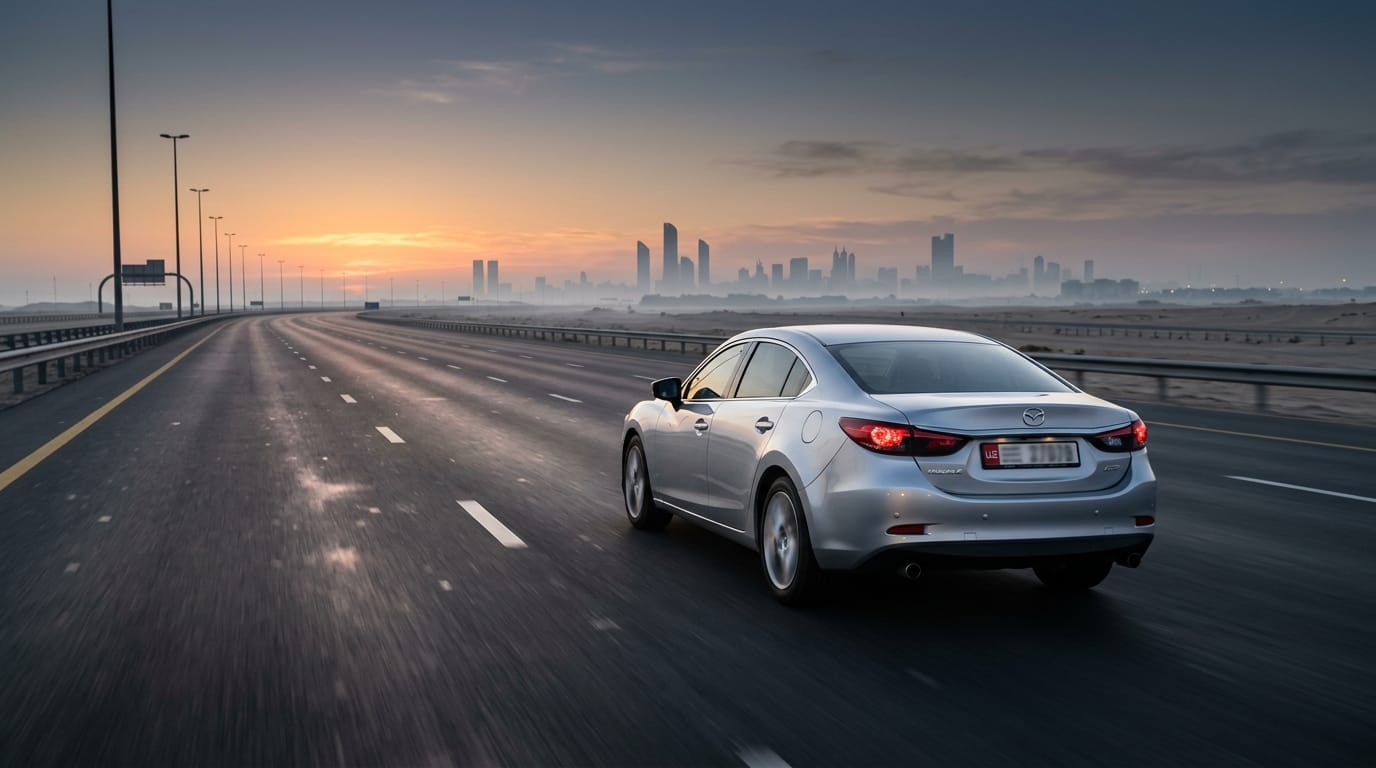
Sheikh Zayed Road and E11 are not gentle operating environments. The combination of sustained highway speeds between 120 and 140 km/h, stop-and-go near interchange exits, and summer heat consistently above 42°C creates a specific mechanical stress profile that differs meaningfully from city or occasional driving.
A commuter logging 2,200 km per month on this route — typical for a five-day working week — will cover approximately 26,400 km per year. Over a standard two to three year UAE expat contract, that is 52,000 to 79,000 km added to the odometer. On a car already at 80,000 km when purchased, it exits the ownership period well into the range where maintenance frequency increases.
This route demands specific attention to: cooling system integrity, AC compressor durability, tyre wear rate, and transmission fluid condition. Cars that manage these four variables well are the ones that make this commute financially manageable.
The Four Cars That Make This Route Manageable
These recommendations are based on observed workshop frequency in Al Quoz and Sharjah Industrial Area, documented owner feedback across UAE automotive communities, and parts availability pricing data collected across 2024 to 2026.
1. Toyota Corolla (E170 / E210 — 1.6L)
The 1.6L Corolla is the most defensible choice for expats who value parts availability above all else. Every independent workshop from Al Quoz to Sharjah Industrial Area stocks Corolla components as standard inventory. This matters at 11pm on a Sunday when something needs fixing before Monday’s early departure.
Observed fuel consumption on the Dubai–Abu Dhabi corridor in summer: 8.5 to 10.2L/100km. The engine is a timing chain design — no timing belt replacement anxiety. Front brake pads at Al Quoz independent workshops: 120 to 220 AED per axle. Air filter: 35 to 55 AED. These are predictable, budgetable numbers.
Used pricing for a clean single-owner E170 under 120,000 km: 28,000 to 42,000 AED on Dubizzle as of mid-2026 observations.
2. Honda City (GM6 — 1.5L i-VTEC)
The City’s 1.5L i-VTEC engine has a well-documented efficiency profile on UAE highways. Summer observed consumption at 120 km/h sustained cruise with AC: approximately 8.8 to 10.3L/100km. This is among the better figures in this price segment and the engine is known for consistent performance well beyond 150,000 km with proper servicing.
The GM6-generation interior ages with relative dignity — a relevant point for expats spending 90 minutes daily inside the car. Resale liquidity on Dubizzle is better than the Attrage, which matters for expats with a defined contract end date.
Used pricing for well-maintained examples under 120,000 km: 26,000 to 40,000 AED.
3. Mitsubishi Attrage (2013–2020 — 1.2L MIVEC)
Possibly the most underrated commuter car in the UAE used market. The 1.2L MIVEC engine was engineered with fuel economy as a primary design objective. Observed highway consumption on the Dubai–Abu Dhabi route: 7.8 to 9.4L/100km — consistently the lowest in this segment under real UAE summer conditions.
The trade-off is clear: overtaking at highway speeds requires planning, the cabin noise isolation is noticeably weaker than the Corolla or Sentra, and seat support on the longer drive is a common complaint from daily commuters after the first few months. For someone optimising purely on cost over a 24-month contract, the numbers make it compelling. For someone doing 90-minute daily drives for three years, comfort fatigue becomes a real variable.
Parts and service costs at independent workshops are low. Used pricing: 20,000 to 32,000 AED.
4. Nissan Sentra (B17 — 1.8L)
Frequently underestimated for comfort on long-haul daily driving. The B17 Sentra has noticeably better cabin insulation than both the Attrage and the older Nissan Sunny, and the seat design handles extended highway use with less fatigue. Observed consumption: 9.5 to 11.2L/100km in summer.
The CVT transmission on these models requires documented fluid change history. CVT fluid replacement every 40,000 km is frequently recommended by UAE workshops, costing approximately 280 to 420 AED. Purchasing a B17 Sentra without verifiable CVT service records is a notable risk on a high-mileage highway vehicle.
Clean used examples in the 90,000 to 130,000 km range: 24,000 to 36,000 AED.
Mechanic’s Inspection Log: Real Case, Real Numbers
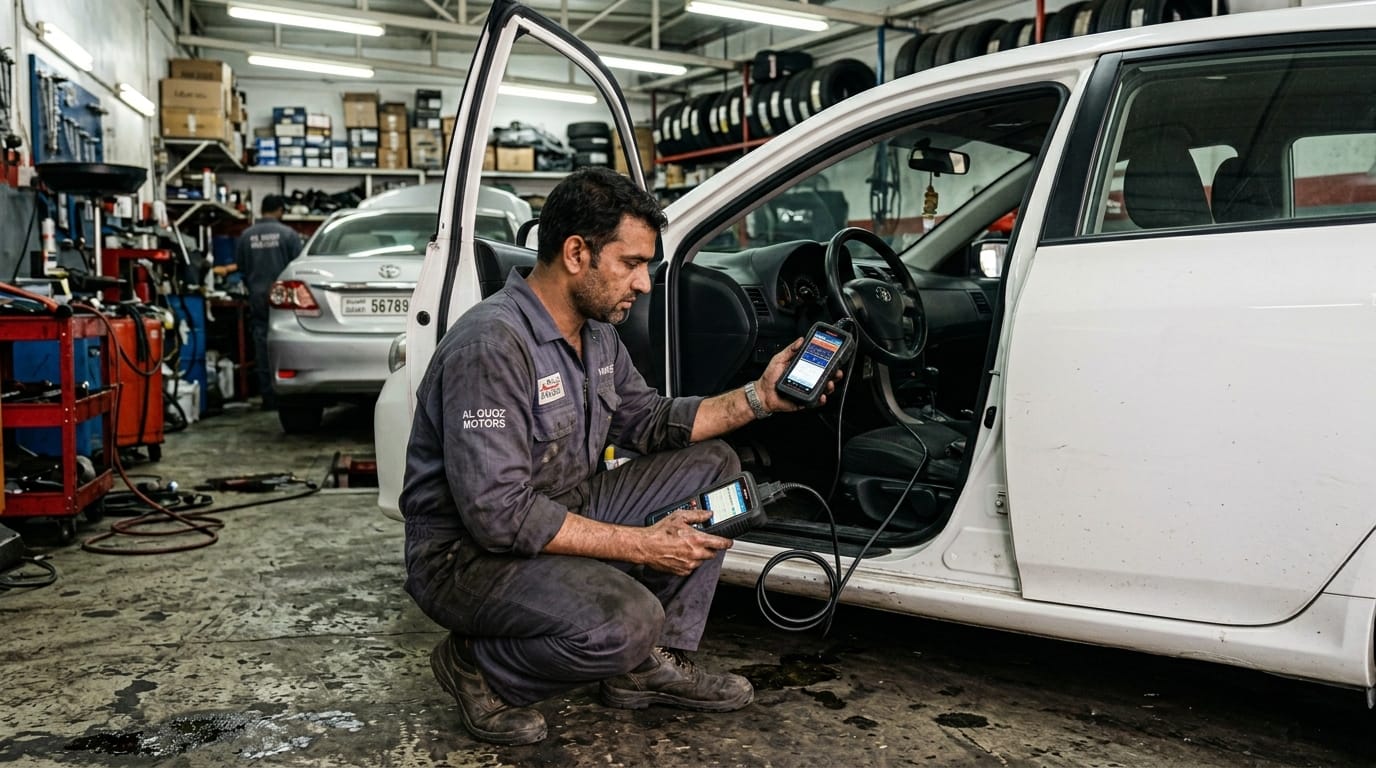
Vehicle: 2016 Honda City 1.5L, odometer reading 148,000 km. Brought in by an expat buyer at an independent workshop on the Sheikh Zayed Road service road, Al Quoz Industrial Area 3, for a pre-purchase inspection.
Seller’s listing claim: “Full service history, excellent condition.”
OBD-II Reading: Code P0420 — Catalyst System Efficiency Below Threshold (Bank 1). This code typically indicates catalytic converter degradation, commonly associated with prolonged use of lower-grade fuel in engines calibrated for 95 octane, or extended oil change intervals beyond manufacturer recommendation.
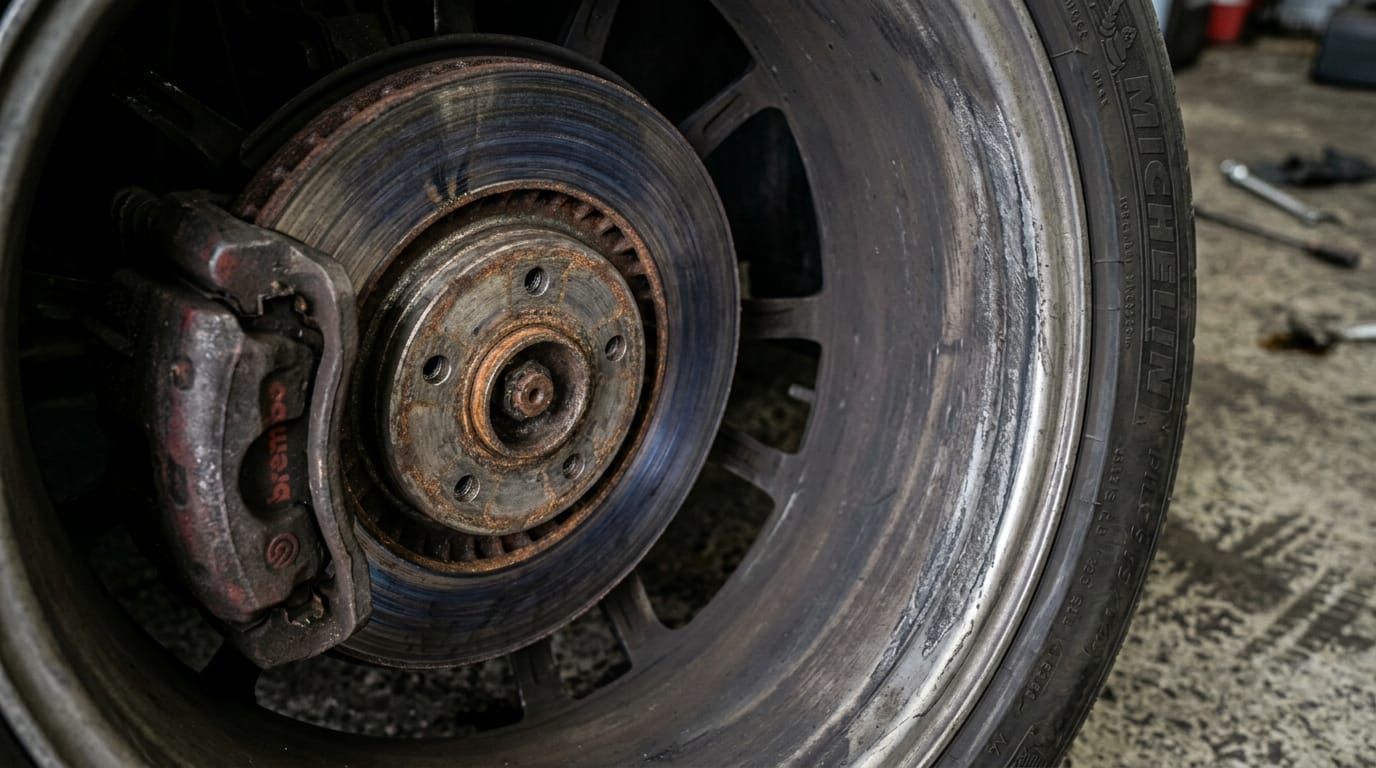
Physical findings during inspection: Front CV boots — cracked on both sides with grease visibly displaced. Brake fluid — dark brown, moisture-contaminated, indicating it had not been flushed in an extended period. Air filter — original by appearance, suggesting no replacement during the documented service window.
| Item Found | Repair Cost Estimate (AED) |
|---|---|
| Catalytic converter replacement (aftermarket) | 1,200 – 1,800 |
| CV boot replacement (both sides) | 400 – 650 |
| Brake fluid flush | 120 – 180 |
| Air filter replacement | 45 – 75 |
| Total repair estimate | 1,765 – 2,705 |
The buyer negotiated 1,500 AED off the asking price and proceeded. A reasonable outcome — but only because the inspection was conducted before purchase, not after the first breakdown on the E11 at 7am.
Inspection Note: On high-mileage commuter cars, always request an OBD scan before agreeing to any price. Workshops in Al Quoz and Sharjah Industrial Area typically perform a standalone diagnostic scan for 50 to 100 AED. It takes 15 minutes and frequently surfaces fault codes that sellers clear before listing. A clean dashboard at the test drive does not mean a clean OBD history.
Cars That Become Expensive on This Route
This section is not a judgment on car quality in general. It identifies vehicles that are specifically mismatched with a 2,200 km monthly highway commute in UAE heat — either due to fuel consumption, parts costs, thermal management issues, or documented reliability patterns at higher mileage.
| Vehicle | Primary Concern on This Route | Estimated Extra Annual Cost vs Corolla (AED) |
|---|---|---|
| Chevrolet Malibu (US Spec) | Parts scarcity outside major dealers, depreciation rate, non-GCC cooling calibration | 4,000 – 8,000 |
| BMW 3 Series (Used, 100k+ km) | Maintenance costs at authorised centres, cooling system complexity, oil consumption concerns | 9,000 – 18,000 |
| Nissan Altima (High-mileage CVT) | CVT transmission replacement risk on highway-loaded high-km examples; replacement cost 4,500 – 9,000 AED | 3,000 – 7,000 |
| Dodge Charger V6 | Fuel consumption on this route typically 14–17L/100km; monthly fuel cost 770–930 AED above Corolla | 9,000 – 11,000 |
| Ford Focus (Non-GCC import) | Cooling system not calibrated for UAE summer; parts availability outside main dealers limited | 3,500 – 6,000 |
| Chevrolet Cruze (1.8L) | Timing chain noise reported after 100,000 km; cooling system sensitivity under sustained summer load | 3,000 – 5,500 |
Non-GCC Specification Alert: Any used car originally manufactured for European or North American markets — rather than GCC specification — may have a cooling system, AC refrigerant capacity, and engine management calibration not designed for sustained operation above 40°C. On a daily 130 km highway commute, this distinction produces measurable real-world consequences. Always verify GCC specification on the vehicle registration card before any purchase decision.
Comfort vs Economy: The 90-Minute Reality
Fuel economy numbers matter. But on a route where the driver spends 80 to 100 minutes inside the car every working day, cabin quality, seat support, and noise isolation are not luxury preferences — they are variables that affect fatigue, mood, and ultimately work performance.
| Car | Fuel Economy | Seat Support (Long Drive) | Cabin Noise Isolation | AC Cooling Power | Cruise Control Availability |
|---|---|---|---|---|---|
| Toyota Corolla 1.6L | High | Good | Good | Strong | Available on most trims |
| Honda City 1.5L | High | Average | Average | Good | Available on higher trims |
| Mitsubishi Attrage 1.2L | Excellent | Below average | Weak above 110 km/h | Adequate | Not on base trims |
| Nissan Sentra B17 1.8L | Good | Good | Very good | Strong | Available on most trims |
Some drivers spend the first few months optimising purely on running cost and later regret the comfort trade-off. The Attrage’s fuel savings over the Corolla amount to approximately 50 to 100 AED per month. Whether that justifies a meaningfully weaker driving experience over 500+ hours per year is a personal calculation — but it is worth making consciously before purchase.
What If You Live in Sharjah?
A significant portion of expats commuting to Abu Dhabi actually originate in Sharjah, adding the Sharjah–Dubai leg before the main highway section. This changes the financial picture in measurable ways.
| Variable | Dubai Origin | Sharjah Origin | Difference |
|---|---|---|---|
| Daily distance (km) | 130 – 160 | 170 – 210 | +30 to +50 km/day |
| Monthly km estimate | 2,200 – 2,800 | 3,000 – 3,800 | +800 to +1,000 km/month |
| Monthly fuel cost increase (AED) | Baseline | +200 to +350 | Significant over 12 months |
| Annual tyre wear increase | Baseline | +15 to +25% | Earlier replacement cycle |
| Oil change frequency | Every 5,000–6,000 km | Every 4,500–5,500 km | More frequent servicing |
| Additional Salik crossings (Sharjah border) | 0 | Variable | Route-dependent |
For Sharjah-based commuters, the Mitsubishi Attrage’s fuel economy advantage becomes more meaningful — the monthly saving versus a 1.8L vehicle widens to approximately 200 to 300 AED at Sharjah-origin distances. The Toyota Corolla 1.6L remains the most balanced option when factoring in the higher annual mileage and increased service frequency.
Owner Scenarios: Two Expats, Same Route, Different Outcomes
Scenario A — The Calculated Decision: A project manager relocating from JLT to Abu Dhabi’s Khalidiyah area chose a 2017 Mitsubishi Attrage with 88,000 km for 27,500 AED. Monthly fuel cost on the route averaged 640 to 720 AED. No major mechanical events across 18 months of documented ownership. Estimated annual total ownership cost including insurance, registration at Tasjeel, and maintenance: 22,000 to 25,000 AED.
Scenario B — The Underresearched Purchase: An IT contractor purchased a 2015 Chevrolet Cruze with 102,000 km for 31,000 AED, attracted by the more premium cabin feel and lower listed price versus a comparable Corolla. Within 14 months: AC compressor replaced at 1,800 AED, timing chain tensioner noise investigated with a workshop quote of 3,200 AED for full repair, and monthly fuel costs running 200 to 280 AED higher than Scenario A throughout. The car was eventually sold at 18,000 AED. When the full repair history is included, the effective ownership cost was substantially higher than either scenario’s sticker price suggested.
Daily Annoyances That Accumulate Over Time
Some cars perform acceptably on paper but generate daily friction that compounds over a two-year commute. These are not mechanical failures — they are design characteristics that matter at 100,000 km on a highway more than they do on a 20-minute showroom test drive.
- Cabin noise above 110 km/h: Budget sedans with minimal sound deadening transmit significant tyre and wind noise. On a 60-minute daily highway drive, this is fatiguing in a measurable way. The Sentra and Corolla manage this noticeably better than the Attrage.
- Seat lumbar support: Flat, unsupportive seats cause lower back fatigue that most commuters attribute to general tiredness rather than the seat itself. Test any prospective car on a minimum 40-minute highway drive before purchasing.
- AC cooling speed: A system that takes 12 to 15 minutes to cool a cabin parked in direct sun at 2pm is a daily quality-of-life issue. Verify AC performance during the pre-purchase inspection, not just by noting whether it works at all.
- Cruise control absence: Not available on some budget trims. On a 130 km highway route, this is a genuine daily omission, not an optional convenience feature. Check trim specification before purchase.
- Fuel filler cap location: A minor point that becomes mildly irritating at 350+ fuel stops over three years when the pump hose does not reach comfortably.
Engine Variants: What Actually Matters at the Pump
| Car | Engine | Observed Summer Consumption (L/100km) | Fuel Cost/Month at 2,200 km (AED) | Fuel Cost/Month at 3,200 km — Sharjah (AED) |
|---|---|---|---|---|
| Mitsubishi Attrage | 1.2L MIVEC | 7.8 – 9.4 | 428 – 516 | 622 – 750 |
| Honda City | 1.5L i-VTEC | 8.8 – 10.3 | 483 – 565 | 702 – 821 |
| Toyota Corolla | 1.6L Dual VVT-i | 8.5 – 10.2 | 467 – 560 | 678 – 813 |
| Nissan Sentra | 1.8L MRA8DE | 9.5 – 11.2 | 521 – 615 | 757 – 894 |
| Toyota Corolla | 2.0L M20A-FKS | 10.4 – 12.1 | 571 – 664 | 830 – 965 |
| Chevrolet Cruze | 1.8L LUW | 11.2 – 13.0 | 615 – 713 | 894 – 1,037 |
Fuel price used: 2.49 AED/L (Special 95, UAE Fuel Price Committee, May 2026). Consumption figures reflect summer operating conditions with AC running at full load, not manufacturer test-cycle data.
Calculate Your Dubai–Abu Dhabi Car Cost
Personal Cost Calculator Matrix
| Input | Your Figure | Notes |
|---|---|---|
| Car Purchase Price (AED) | ___________ | Used market, Dubizzle or dealer |
| Down Payment (AED) | ___________ | Or full cash amount |
| Monthly Commute KM | ___________ | Dubai–Abu Dhabi avg: 2,000–2,400 km; Sharjah origin: 3,000–3,800 km |
| Fuel Type | Special 95 / Super 98 | Super 98 costs approx 0.20 AED/L more |
| Salik Crossings Per Day | ___________ | Typical: 2–4 crossings × 4 AED each |
| Parking Cost Per Month (AED) | ___________ | Abu Dhabi municipality parking: variable by zone |
| Insurance Monthly Portion (AED) | ___________ | Third party: 100–180 AED/month; Comprehensive: 200–400 AED/month |
| Estimated Maintenance Per Month (AED) | ___________ | Japanese sedan observed avg: 150–280 AED/month |
| Output | Formula |
|---|---|
| Monthly Fuel Cost (AED) | (Monthly KM ÷ 100) × Consumption Rate × Fuel Price Per Litre |
| Monthly Salik Cost (AED) | Daily Crossings × 4 AED × 22 working days |
| Monthly Total (AED) | Fuel + Salik + Parking + Insurance + Maintenance |
| Annual Total (AED) | Monthly Total × 12 + Annual Registration (approx 420–620 AED via Tasjeel) |
| 3-Year True Cost (AED) | (Annual Total × 3) + Purchase Price − Estimated Resale Value |
Benchmark Calculation (Dubai Origin, Honda City 1.5L): Purchase price 32,000 AED. Monthly km: 2,200. Consumption: 9.5L/100km. Fuel cost: approximately 522 AED/month. Salik (3 crossings/day): 264 AED/month. Insurance comprehensive: 250 AED/month. Maintenance allocation: 200 AED/month. Parking: 200 AED/month. Monthly total: approximately 1,436 AED. Annual total: approximately 17,852 AED including registration. Three-year true cost before resale: approximately 53,556 AED + 32,000 purchase − 17,000 estimated resale = 68,556 AED net three-year cost.
Annual Cost Projection: 220 Working Days
| Car | Annual Fuel (AED) | Annual Maintenance (AED) | Annual Insurance (AED) | Annual Registration (AED) | Annual Total (AED) |
|---|---|---|---|---|---|
| Mitsubishi Attrage 1.2L | 5,650 – 6,800 | 2,400 – 3,600 | 2,200 – 3,500 | 420 – 560 | 10,670 – 14,460 |
| Honda City 1.5L | 6,350 – 7,400 | 2,800 – 4,000 | 2,400 – 3,800 | 420 – 560 | 11,970 – 15,760 |
| Toyota Corolla 1.6L | 6,100 – 7,300 | 2,600 – 3,800 | 2,400 – 3,800 | 420 – 560 | 11,520 – 15,460 |
| Nissan Sentra 1.8L | 6,800 – 8,000 | 3,000 – 4,500 | 2,200 – 3,500 | 420 – 560 | 12,420 – 16,560 |
| Chevrolet Cruze 1.8L | 8,000 – 9,300 | 5,000 – 8,000 | 2,400 – 3,800 | 420 – 560 | 15,820 – 21,660 |
Annual totals exclude Salik and parking costs, which vary by route and employer. Add approximately 3,168 to 4,224 AED annually for Salik at 3 to 4 crossings per day across 220 working days.
The Safe Alternative: What to Actually Buy
If the objective is to minimise total cost of ownership over 3 years on this corridor without accepting unusual mechanical risk or parts scarcity exposure, the recommendation is consistent across workshop data, owner communities, and Dubizzle market analysis.
Primary recommendation: 2016–2019 Honda City 1.5L, GCC specification, single-owner preferred, documented service history from a Honda-authorised centre or verifiable independent workshop, mileage under 120,000 km. Budget: 28,000 to 38,000 AED. Best balance of fuel efficiency, comfort, and resale liquidity for expats with a defined contract end date.
Budget-conscious alternative: 2015–2019 Mitsubishi Attrage 1.2L, GCC spec, same documentation criteria. Budget: 20,000 to 30,000 AED. Lowest observed fuel consumption on this route. Accepts noticeably less refinement in exchange for the best fuel economy figures in its segment.
Maximum reliability network: 2016–2020 Toyota Corolla 1.6L, GCC spec. Budget: 28,000 to 45,000 AED. Most defensible long-term choice if parts availability across all seven emirates and workshop coverage matter more than outright fuel economy.
Pre-Purchase Checklist for This Route: Verify GCC specification on the vehicle registration card. Request OBD scan — 50 to 100 AED at most Al Quoz workshops. Confirm AC function under 20-minute sustained load test. Check tyre condition and wear pattern. Verify cruise control availability in the specific trim being purchased. Confirm Salik account is clear of outstanding fines before transfer. Request service history documentation — not verbal confirmation.
When It Becomes Expensive
Even the right car becomes costly when maintained incorrectly for this specific operational profile.
Extended oil change intervals. Stretching oil changes beyond 7,500 km in UAE summer daily highway conditions accelerates engine wear faster than many expats expect. Oil changes at 5,000 to 6,000 km intervals are frequently recommended by UAE-based mechanics for cars doing this commute. The cost difference between a 5,000 km and a 10,000 km oil change interval is minimal. The long-term engine wear difference is not.
AC service neglect. The AC system on a Dubai–Abu Dhabi commuter car operates at near-maximum capacity for 8 to 9 months per year. Cabin filter replacement — typically 80 to 150 AED — and refrigerant level checks every 18 to 24 months are cost-effective maintenance items. Compressor replacement when neglected: 1,400 to 3,500 AED depending on vehicle and workshop.
Tyre rotation skipped. Front-wheel-drive sedans on highway use develop uneven wear patterns. Rotation every 10,000 to 12,000 km extends tyre life measurably. A mid-range tyre set for a sedan at Al Quoz: 900 to 1,400 AED. Skipping rotation to avoid a 100 AED service call is consistently poor economics on this route.
Buyer Mistakes Specific to This Route
Buying on interior quality rather than powertrain efficiency. A more premium cabin feel attached to a 1.8L engine costs 150 to 250 AED more per month in fuel on this route versus a comparable 1.2L vehicle. Over 36 months, that is 5,400 to 9,000 AED — enough to buy a significantly better car stereo, window tint upgrade, or seat cover set as deliberate purchases, rather than paying for ambient interior quality that fades anyway.
Ignoring transmission history on CVT-equipped cars. CVTs on high-mileage highway vehicles require documented fluid change history. A CVT with no service records on a 130,000 km car represents a notable financial risk. Rebuild or replacement costs at UAE workshops: 3,500 to 8,000 AED.
Skipping the pre-purchase inspection. Tasjeel centres provide a basic vehicle check. A dedicated mechanic inspection at an independent Al Quoz or Sharjah Industrial Area workshop costs 150 to 350 AED and provides significantly greater technical depth — including OBD scan, undercarriage inspection, and fluid condition assessment. On a purchase of 25,000 to 40,000 AED, this cost is negligible relative to what it surfaces.
Buying a non-GCC specification car to save 5,000 to 8,000 AED on purchase price. The saving is frequently recovered by the first AC compressor or cooling system repair on a car whose thermal management was not designed for UAE conditions. On a commute this demanding, specification matters.
Decision Framework: Which Car Fits Your Profile
| Commuter Profile | Recommended Car | Budget (AED) | Key Reason |
|---|---|---|---|
| Single expat, pure cost optimisation | Mitsubishi Attrage 1.2L | 20,000 – 30,000 | Lowest observed fuel consumption on route |
| Family car, school run + commute | Toyota Corolla 1.6L | 28,000 – 42,000 | Larger cabin, widest parts and service network |
| Balance of comfort and efficiency | Honda City 1.5L | 26,000 – 38,000 | Best interior-to-efficiency ratio, strong resale |
| Comfort priority, longer daily drive | Nissan Sentra B17 1.8L | 24,000 – 36,000 | Best cabin insulation, comfortable seat support |
| Sharjah origin, maximum fuel saving | Mitsubishi Attrage 1.2L | 20,000 – 30,000 | Fuel advantage widens at higher monthly km |
| Short contract (12–18 months) | Toyota Corolla 1.6L or Honda City | 28,000 – 42,000 | Strongest resale liquidity on Dubizzle |
| Tight budget entry point | Nissan Sunny B15 1.6L | 14,000 – 22,000 | Lower acquisition cost, basic reliability |
Analytical Conclusion: Three-Year True Cost Comparison
The numbers, aggregated across 36 months of the Dubai–Abu Dhabi commute, tell a consistent story. The car that looks cheapest at purchase is frequently not the cheapest car over the ownership period on a route this demanding.
| Car | Purchase Price (AED) | 3-Yr Fuel Cost (AED) | 3-Yr Maintenance (AED) | 3-Yr Insurance (AED) | Est. Resale (AED) | 3-Yr True Cost (AED) |
|---|---|---|---|---|---|---|
| Mitsubishi Attrage 1.2L | 26,000 | 18,900 | 9,000 | 8,100 | 13,000 | 49,000 |
| Honda City 1.5L | 33,000 | 21,200 | 10,800 | 9,600 | 17,000 | 57,600 |
| Toyota Corolla 1.6L | 35,000 | 20,600 | 9,600 | 9,600 | 18,500 | 56,300 |
| Nissan Sentra 1.8L | 27,000 | 23,100 | 11,400 | 8,100 | 13,000 | 56,600 |
| Chevrolet Cruze 1.8L | 30,000 | 26,000 | 18,000 | 9,600 | 10,500 | 73,100 |
The Attrage’s three-year true cost advantage over the Chevrolet Cruze is approximately 24,100 AED — almost equal to the Attrage’s purchase price. This gap is driven almost entirely by fuel consumption and maintenance frequency differences, not the initial price differential of 4,000 AED.
The Toyota Corolla and Honda City sit within 1,300 AED of each other over three years. The Corolla wins on parts availability and service network breadth. The City wins on a slightly more refined daily driving experience and marginally better resale on Dubizzle. For most expats, the choice between these two ultimately comes down to whether parts network coverage or cabin quality is the higher personal priority.
Building on this route-specific ownership cost analysis, the next guide addresses a question that consistently surfaces across UAE automotive communities: whether Japanese or Korean used cars are genuinely cheaper to maintain in UAE desert conditions — with specific workshop invoice data, parts pricing comparisons, and documented long-term ownership observations across both segments.
Data Sources Used
- RTA official vehicle registration fee structure — used for annual registration cost estimates at Tasjeel centres across Dubai
- ADNOC UAE Fuel Prices page — monthly Special 95 and Super 98 price data used for all fuel cost calculations in this guide
- UAE Central Bank published reports — reference for auto loan interest rate ranges applied in monthly financing cost estimates
- Independent workshop observations: Al Quoz Industrial Area 1 and 3, Sharjah Industrial Area — service invoice data collected across 2024 to 2026
- Dubizzle used car listing analysis: pricing observations for Toyota Corolla, Honda City, Mitsubishi Attrage, and Nissan Sentra — mid-2026 market snapshot
- Real-world fuel consumption data: UAE driver community reports, cross-referenced with workshop odometer records for accuracy under summer operating conditions
- UAE insurance market observations: third-party and comprehensive premium ranges drawn from broker comparisons, 2025 to 2026
Disclaimer: Emirates Car Guide is a 100% independent platform. We do not own showrooms, nor are we affiliated with any used car dealerships or garages. Our sole mission is to protect expats from financial fraud in the automotive market.
Frequently Asked Questions
