Last Updated: June 2026 | By Omar Al-Fayed, Senior Automotive Consultant | Category: Maintenance & Repairs
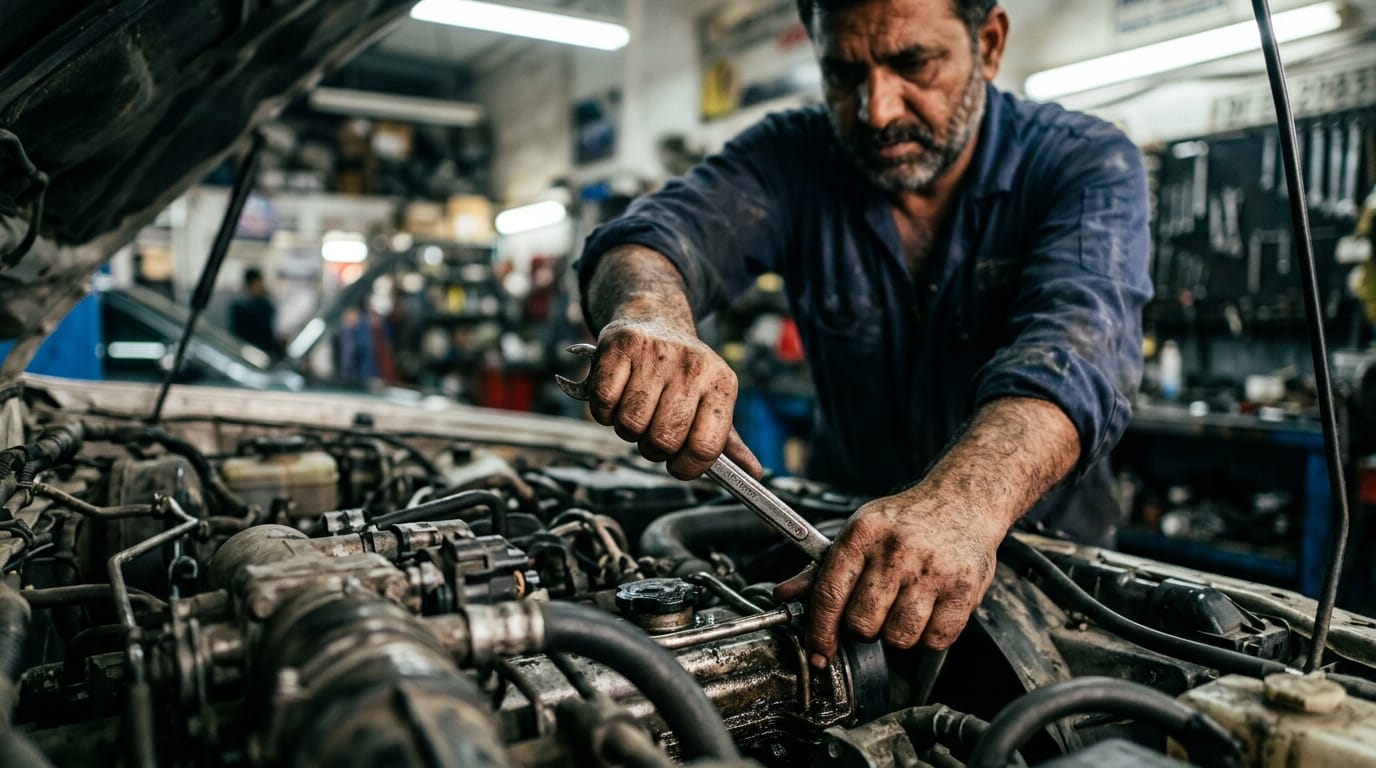
Finding a trustworthy and honest car mechanic al quoz dubai costs most expats between 500 and 3,000 AED more than necessary — not because honest workshops do not exist, but because most drivers do not know what questions to ask before handing over their keys. This guide gives you the exact tools to avoid that outcome. Before diving into the details of selecting a garage, understanding your monthly ownership cost provides a crucial baseline for your vehicle budget.
Al Quoz Industrial Area remains Dubai’s largest independent automotive repair hub, with over 400 registered workshops operating within a few square kilometres. The concentration is both an advantage and a complication: competition keeps prices competitive, but the sheer volume of options makes it genuinely difficult to separate skilled and honest mechanics from those running on short-term profit margins.
For expats from India, Pakistan, Bangladesh, the Philippines, Egypt, and elsewhere — who often arrive with limited knowledge of local consumer protection channels and no existing workshop relationships — the stakes are higher than they are for long-term residents. This guide addresses that gap directly.
📋 Quick Answer: The single most reliable indicator of an honest workshop in Al Quoz is willingness to provide a written estimate before any work begins, return old replaced parts on request, and offer a minimum 30-day parts and labour warranty in writing. Workshops that resist any of these three practices are worth avoiding regardless of how competitive their pricing appears.
If you are also evaluating which used car to buy before you even visit a workshop, our Toyota Corolla 18-month ownership breakdown provides a realistic picture of what repair and maintenance budgets look like after purchase.
Why Al Quoz Has Become Dubai’s Largest Car Repair Hub
Al Quoz Industrial Areas 1, 2, 3, and 4 occupy a strategically central position between Sheikh Zayed Road, Al Khail Road, and the Umm Suqeim interchange. For workshops, this location translates directly into accessibility from Jumeirah, Downtown, Motor City, and Business Bay — covering a dense corridor of car-owning residents and company fleet operators.
The area developed organically from the 1990s onward, initially attracting body shops and tyre fitters, then gradually drawing AC specialists, electrical fault workshops, gearbox rebuilders, and eventually brand-specific specialists for German, Japanese, and Korean vehicles. Today, a driver can find a dedicated BMW independent specialist within 200 metres of a CVT transmission rebuilder and a diesel injector cleaning service.
This concentration creates genuine advantages for consumers. Specialists competing for the same customer base within walking distance of each other tend to keep labour rates more honest than isolated workshops in residential areas. It also makes comparison shopping straightforward — you can physically visit three workshops in under an hour without significant travel.
The disadvantages are equally real. High workshop density attracts workshops operating on thin margins with low-quality aftermarket parts and high staff turnover. Some businesses open under new trade names after accumulating negative reviews, making reputation tracking unreliable without knowing what to look for.
What Al Quoz Offers That Other Areas Do Not
Al Quoz Industrial Area contains a range of workshop types that other Dubai districts simply cannot match in concentration:
| Workshop Type | Concentration in Al Quoz | Alternative Dubai Locations |
|---|---|---|
| General independent workshops | Very high | Deira, Sharjah Industrial |
| Japanese car specialists | High | Abu Shagara (Sharjah) |
| German car specialists | High | Ras Al Khor |
| Body repair and painting | Very high | Deira, Al Qusais |
| AC and electrical specialists | High | Limited alternatives |
| Gearbox and transmission | Medium-high | Sharjah Industrial |
| Luxury and sports car specialists | Medium | Motor City |
| Tyre and alignment centres | Very high | Available citywide |
How to Choose a Workshop Based on Your Car Brand
One of the most common and avoidable mistakes expats make is choosing a workshop based purely on proximity or price without considering whether that workshop has genuine experience with their specific vehicle. The gap between a general workshop and a brand-appropriate specialist becomes meaningful when diagnosing complex faults or sourcing correct parts for less common models.
Toyota Owners (Corolla, Camry, Yaris, Land Cruiser, Fortuner)
Toyota ownership in Al Quoz is genuinely straightforward. Parts for the Corolla, Camry, and Yaris are among the most widely stocked items across Al Quoz Industrial Area and Abu Shagara in Sharjah — most components are available same day without ordering. Any well-regarded general workshop with experience on Japanese vehicles handles routine Toyota maintenance competently.
For complex CVT issues on Corolla models fitted with the CVT transmission (post-2014), a Japanese specialist with documented CVT rebuild experience is preferable over a general workshop. For Land Cruiser diesel models, a workshop with specific diesel injection experience adds meaningful value. Authorised Toyota service at Toyota UAE centres is warranted for vehicles still under manufacturer warranty or when factory software updates are required.
Recommended approach: General workshop for routine maintenance. Japanese specialist for CVT or diesel fault diagnosis. Authorised dealer for warranty work.
Nissan Owners (Sunny, Altima, Patrol, X-Trail)
Nissan maintenance in Al Quoz follows a similar pattern to Toyota. Parts availability for the Sunny and Altima is high across the area. General workshops with Nissan experience handle oil changes, brake work, suspension, and most electrical faults without difficulty.
The Nissan CVT — fitted to the Altima and X-Trail — warrants the same caution as Toyota CVT units. Workshops advertising CVT experience should be questioned specifically: ask whether they rebuild CVT units in-house or send them out. A workshop that sends CVT units to a specialist and marks up the cost is not the same as a workshop with in-house CVT expertise.
Recommended approach: General workshop for routine work. CVT specialist for transmission-related faults. Nissan dealer for Patrol diesel and advanced electrical diagnosis.
Honda Owners (City, Accord, CR-V, HR-V)
Honda vehicles are well-serviced across Al Quoz with generally good parts availability for the City and Accord. The Honda City’s 1.5L i-VTEC engine is familiar to most general workshops. Where Honda ownership becomes more demanding is the Accord with the 1.5T turbocharged engine (post-2018 models) — fewer independent workshops have deep experience with this unit, and some fuel system faults are best handled by a Honda specialist or the authorised dealer.
The CR-V hybrid requires dealer-level diagnostic equipment for hybrid system faults. Routine maintenance on the hybrid can be performed by any workshop experienced with Honda hybrids, but electrical or battery system issues are firmly in dealer territory.
Recommended approach: General or Japanese specialist for City and older Accord. Honda specialist or dealer for 1.5T and hybrid models.
Hyundai and Kia Owners (Elantra, Sonata, Tucson, Cerato, Sportage)
Korean vehicle parts availability in Al Quoz has improved substantially over recent years. Hyundai and Kia components for common models are stocked by several parts suppliers within the area, though same-day availability is less consistent than for Toyota or Nissan. A workshop with documented experience on Korean vehicles handles routine maintenance reliably.
For the Hyundai Sonata and Kia Sportage with the turbocharged GDI engines, a workshop familiar with direct injection carbon buildup — a documented maintenance requirement at around 50,000 to 60,000 km intervals — is worth identifying before the vehicle reaches that mileage. General workshops unfamiliar with this requirement may miss it.
Recommended approach: General workshop with Korean vehicle experience for routine work. Korean specialist for GDI engine maintenance and complex diagnosis.
BMW Owners (3 Series, 5 Series, X3, X5)
BMW ownership in Al Quoz requires a more selective approach than Japanese vehicles. While several dedicated BMW independent specialists operate in Al Quoz — identifiable by their BMW-branded signage and brand-specific diagnostic equipment — the quality gap between a BMW specialist and a general workshop attempting BMW work is significant for fault diagnosis and electrical system work.
For routine oil changes and brake work on BMW models, a BMW-experienced independent specialist in Al Quoz can perform this work at meaningfully lower cost than the authorised dealer, using OEM-equivalent or genuine parts. For complex faults involving the N-series engines, DSC systems, or any fault requiring BMW ISTA+ software, the authorised Al-Futtaim Motors BMW service centres offer the factory diagnostic capability that independent workshops cannot replicate.
Recommended approach: BMW independent specialist in Al Quoz for routine maintenance. Authorised BMW dealer for software-dependent diagnosis, recalls, and complex electrical faults.
Mercedes-Benz Owners (C-Class, E-Class, GLC, S-Class)
Mercedes-Benz independent specialists in Al Quoz operate at a similar level to their BMW counterparts — capable on routine maintenance and common fault patterns, less equipped for dealer-level software diagnosis. The STAR diagnostic system used by authorised Mercedes-Benz service centres provides capabilities that generic OBD tools cannot match on complex models.
For C-Class and E-Class owners beyond the warranty period, a reputable Mercedes independent specialist in Al Quoz typically handles oil services, suspension work, and common fault diagnosis at 30 to 50 percent lower cost than the authorised dealer. For S-Class, AMG models, and any fault involving the 4MATIC AWD system or AIRMATIC suspension, authorised service is the more reliable option.
Recommended approach: Mercedes independent specialist for C-Class and E-Class routine work. Authorised dealer for S-Class, AMG, and complex electronic systems. If you need a reliable alternative, exploring trusted car mechanics specifically for German cars is vital.
Audi Owners (A4, A6, Q5, Q7)
Audi ownership in the UAE presents parts availability challenges that Toyota and Nissan owners never encounter. Common maintenance items are stocked by Audi-focused parts importers in Deira and Al Quoz, but less common components frequently require ordering with lead times of three to seven days. Audi-experienced independent specialists in Al Quoz generally handle the 2.0 TFSI engine and the DSG gearbox service competently, but only if they have the VAG-COM (VCDS) diagnostic interface.
Always confirm that an Audi specialist has VAG-COM capability before approving diagnostic work. A workshop using only generic OBD readers on an Audi cannot access the manufacturer-specific fault codes that make accurate diagnosis possible.
Recommended approach: Audi independent specialist with VAG-COM for post-warranty work. Authorised dealer for under-warranty vehicles and complex software faults.
Land Rover Owners (Defender, Discovery, Range Rover)
Land Rover ownership is among the most demanding in the UAE independent workshop context. Parts availability for current models in Al Quoz is limited — most non-consumable components require ordering, and some require sourcing through authorised Land Rover channels. Independent specialists with genuine Land Rover experience exist in Al Quoz but are fewer in number than Japanese or German equivalents.
For Defender and Discovery owners who have moved beyond the warranty period, identifying a specialist with documented Land Rover experience and the Autologic or IIDTool diagnostic capability is the approach most likely to result in accurate diagnosis at a reasonable cost. For Range Rover Sport and full-size Range Rover models with air suspension, Terrain Response systems, and complex electrical architecture, authorised dealer service is the practical default for anything beyond routine maintenance.
Recommended approach: Land Rover specialist only — not general workshop. Authorised dealer for complex diagnosis and current models.
| Brand | Routine Maintenance | Complex Faults | Parts Availability (Al Quoz) |
|---|---|---|---|
| Toyota | Any reputable general workshop | Japanese specialist for CVT/diesel | Very high — same day |
| Nissan | General workshop with Nissan experience | CVT specialist for transmission | Very high |
| Honda | General or Japanese specialist | Honda specialist for 1.5T and hybrid | High |
| Hyundai/Kia | Korean-experienced workshop | Korean specialist for GDI engines | Medium-High |
| BMW | BMW independent specialist | Authorised dealer for ISTA+ software | Medium — some ordering required |
| Mercedes-Benz | Mercedes independent specialist | Authorised dealer for STAR system | Medium |
| Audi | VAG-COM equipped specialist only | Authorised dealer for software faults | Medium — ordering common |
| Land Rover | Land Rover specialist only | Authorised dealer for complex models | Low — most items require ordering |
How to Read a Garage Estimate Like a Pro
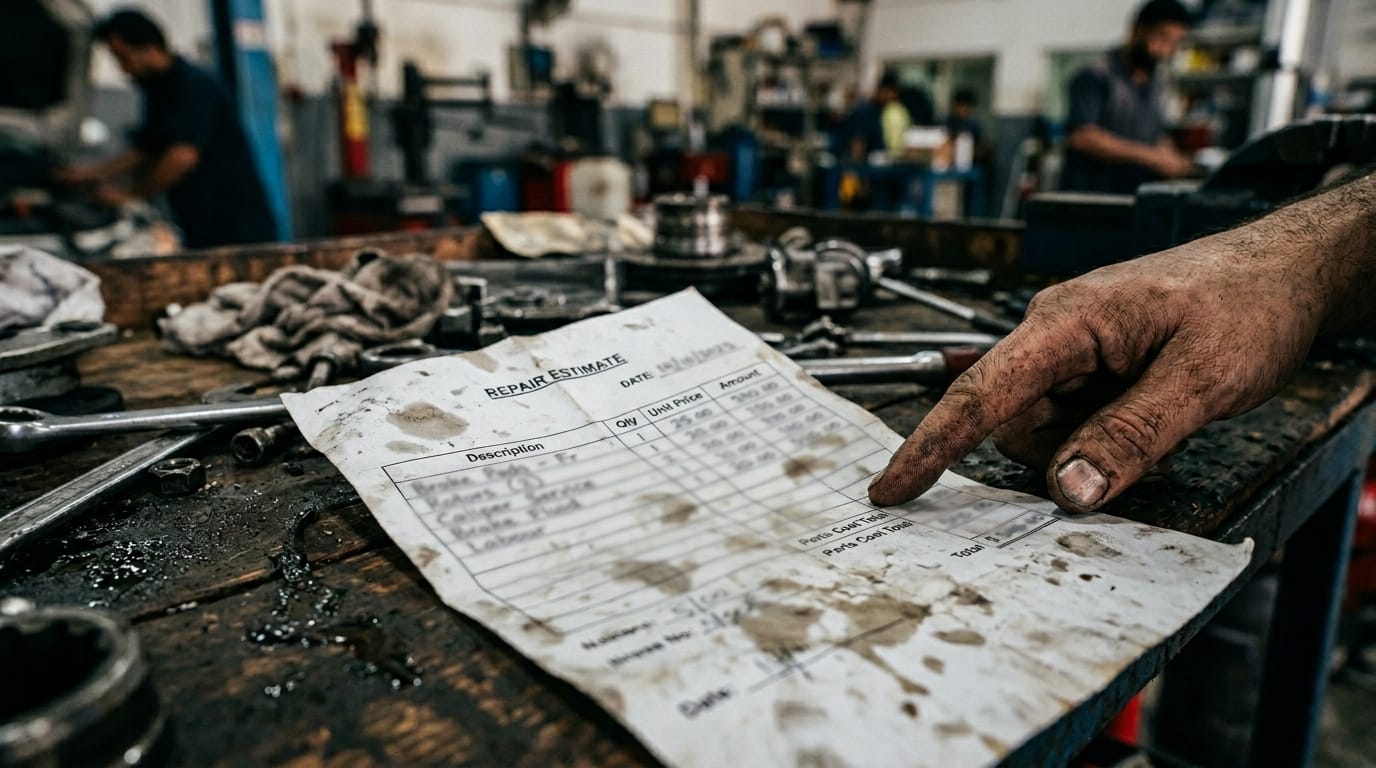
A written estimate from an Al Quoz workshop is not a single number — it is a document with multiple line items, each of which tells you something specific about how the workshop operates and where its margins are built. Most expats approve estimates without understanding what they are reading, which is how workshops generate revenue on items that look reasonable in isolation but represent significant overcharges when examined.
The Standard Estimate Structure
A professionally structured estimate separates costs into distinct categories. Understanding each category tells you where to look carefully:
| Line Item Category | What It Should Contain | Where to Look Carefully |
|---|---|---|
| Parts | Specific part name, part number, brand, quantity, unit price | Is the brand named? Is it genuine, OEM, or aftermarket? No brand listed = ask before approving |
| Labour | Job description and hours charged at the workshop rate | Is the hourly rate stated? Are hours reasonable for the job? Compare with the job time guides below |
| Diagnostics | OBD scan, specialist test, or inspection fee | A basic OBD scan is 50–150 AED. “Advanced diagnostics” above 300 AED should be explained in detail |
| Consumables | Fluids, lubricants, gaskets, small hardware items used during the repair | Should be modest. Consumables above 150–200 AED on a basic repair warrants a line-by-line check |
| Miscellaneous | Catch-all category used inconsistently across workshops | Any amount in “miscellaneous” requires a specific explanation. “Miscellaneous: 350 AED” is not an acceptable line item without detail |
| Shop Supplies / Environmental Fee | Disposal of oils, filters, and cleaning materials | Legitimate at 20–50 AED. Amounts above 100 AED should be questioned and itemised |
| VAT (5%) | Applied to the total after all other charges | Should be calculated correctly on the net total. Verify the calculation on larger invoices |
How Workshop Margins Are Commonly Hidden
The “Miscellaneous” and “Shop Supplies” categories are the two most commonly used to add margin without clear justification. A 200 AED miscellaneous line on a brake pad replacement that costs 300 AED in parts and 150 AED in labour is a 40 percent invisible markup. Requesting itemisation of any non-specific line item is both reasonable and standard practice.
Labour hour inflation is the second common pattern. For reference, a front brake pad replacement on a Toyota Corolla requires approximately 30 to 45 minutes of actual work. If an estimate shows 2 hours of labour at 200 AED per hour, that is 400 AED for a job requiring under an hour. Knowing approximate job times — or simply asking “how long will this job take?” — provides a useful cross-check against labour charges.
Red Flags in an Estimate Document
Beyond specific line items, the structure and presentation of an estimate itself communicates information. An estimate with no part numbers, no brand names, and labour listed as a single undifferentiated total is structured to prevent comparison shopping rather than to facilitate it. A workshop confident in its pricing provides itemised detail because it has nothing to hide.
Parts listed only by generic description (“brake pads — 2 pcs”) without brand or specification cannot be compared to quotes from other workshops. You cannot verify whether you are being quoted for TRW pads, a reputable aftermarket equivalent, or an unbranded item without the specification being stated.
📋 Estimate Checklist: Before signing any workshop estimate, confirm it includes: part name + brand + part number for each component, labour hours and hourly rate stated separately, any diagnostic charge with specific description, and zero unexplained “miscellaneous” amounts. A workshop that cannot provide this level of detail in writing is one where the final invoice may be difficult to predict.
Workshop Terminology Every Expat Needs to Know
Al Quoz workshops use a specific vocabulary that varies meaningfully in quality implication. Using incorrect terms — or not recognising the difference between them — can result in paying premium prices for basic components, or accepting lower-grade parts when you intended to pay for quality.
| Term | What It Means | Quality Implication | When to Accept It |
|---|---|---|---|
| Genuine / OE Part | Part produced by or for the original vehicle manufacturer, supplied through their distribution channel | Highest quality, full manufacturer specification | Vehicles under warranty; safety-critical parts; luxury vehicles |
| OEM-Equivalent | Part made by the same supplier that manufactures the OE part, sold under the supplier’s brand (e.g., Bosch, Denso, NGK, TRW) | Equivalent to genuine in most cases | Most post-warranty maintenance on Japanese and Korean vehicles — best value balance |
| Aftermarket (branded) | Part from a known aftermarket brand not affiliated with the vehicle manufacturer (Monroe, Gates, Valeo, Kayaba) | Generally acceptable for non-safety-critical components | Budget maintenance on older, higher-mileage vehicles |
| Aftermarket (unbranded) | Part with no identifiable brand, typically sourced through grey-market importers in Deira | Variable to low — no quality guarantee | Not recommended for brakes, suspension, or engine components |
| Reconditioned / Remanufactured | A used part that has been rebuilt to a specified standard — common for alternators, starters, and AC compressors | Quality depends entirely on who reconditioned it and to what standard | Acceptable from established remanufacturers with warranty. Ask specifically: who reconditioned it and what warranty applies |
| Used Part / Scrap Part | A part removed from a salvage or written-off vehicle and sold as-is | Unknown remaining service life — no warranty in most cases | Only for low-risk body parts (mirrors, trim, handles) on older vehicles where new parts are unavailable or disproportionately expensive |
| Warranty (Parts) | Coverage for component defect or failure within the stated period | Varies — 3 months to 12 months is typical range | Always ask for warranty period in months AND kilometres. “6 months or 10,000 km, whichever comes first” is a standard acceptable form |
| Warranty (Labour) | Commitment by the workshop to re-do work at no charge if it fails within the stated period | 30 days is minimum acceptable. 90 days is typical for quality workshops | Always confirm this is separate from parts warranty and documented on the invoice |
| Engine Overhaul | Comprehensive internal engine rebuild — typically involving piston rings, bearings, gaskets, and valve seals | Outcome quality depends heavily on workshop experience and machining facilities | Only consider when compression test and oil consumption data confirms the engine is beyond service life. Get at least two assessments before approving |
| Gearbox Rebuild | Internal rebuild of an automatic or manual gearbox — replacing worn clutch packs, solenoids, and sealing components | A legitimate specialist repair; quality varies widely by workshop expertise | Confirm the workshop performs the rebuild in-house. A workshop sending the gearbox to a third party adds margin without adding expertise accountability |
| Top-Up | Adding fluid to an existing system (coolant, brake fluid, power steering) without a full flush and replace | Often not disclosed on invoices — may appear as a charge without prior approval | Legitimate on first service. Repeated top-ups without addressing root cause (why is the level low?) suggest an underlying issue not being addressed |
| Flush and Fill | Complete drain and replacement of a fluid system (coolant flush, brake fluid flush, transmission fluid service) | Generally higher quality than top-up for aged fluids | Appropriate at manufacturer-specified service intervals. Confirm interval requirement before approving on a vehicle without documented service history |
Best Times of Year to Service Your Car in the UAE
The UAE’s climate creates service timing patterns that do not exist in Europe or North America. Understanding when to service specific systems — and when workshops are busiest — has both mechanical and financial implications.
Pre-Summer Service Window: March to April
The period from mid-March through April is the most important service window for UAE drivers. Temperatures begin rising toward the 35–40°C range that stresses cooling systems, AC compressors, and tyres simultaneously. Addressing these systems before summer rather than after the first failure during summer is consistently the lower-cost approach.
Key services to schedule before summer: AC system inspection and refrigerant check, coolant condition and level, radiator hose inspection, battery load test (heat is the primary cause of UAE battery failure), and tyre condition assessment for any tyre showing age cracking or wear.
Workshop demand increases in April and May as drivers who deferred pre-summer checks begin presenting vehicles with actual failures. Scheduling pre-summer service in March typically means faster workshop turnaround, more appointment flexibility, and occasionally better pricing on non-urgent additional items identified during inspection.
Post-Summer Service Window: October to November
After the summer months, several service items benefit from scheduled attention. Tyres that survived summer heat should be inspected for accelerated sidewall degradation. Battery performance should be re-verified — a battery that weakened through summer heat may fail during the cooler months when cold-start conditions change the performance requirements. AC filters frequently accumulate significant debris during peak summer use.
October and November also represent the optimal window for body and paint work, as lower humidity and temperatures make paint curing more consistent and workshop conditions more comfortable for detailed work.
Pre-Annual Leave Service: Before Extended Travel
A significant proportion of UAE expats travel for four to six weeks annually, typically leaving vehicles in parking structures. A brief pre-departure service check — battery state of charge, tyre pressure set slightly above normal for extended storage, fluid levels — reduces the likelihood of returning to a vehicle requiring immediate attention. Leaving a vehicle for six weeks with a marginal battery in summer parking conditions is a combination that commonly results in a flat battery on return.
Pre-Registration Renewal Service Window
In the UAE, vehicle registration renewal requires passing the RTA technical inspection. Understanding what the inspection checks and addressing known issues before the inspection date avoids the cost and inconvenience of a failed test and re-inspection fee. Common RTA test failure points include tyre condition, brake system performance, lighting faults, and excessive exhaust smoke on diesel vehicles.
Scheduling a pre-registration inspection at a trusted workshop two to three weeks before the RTA test date provides time to address identified issues without urgency pricing from a workshop aware that you have an imminent inspection deadline.
| Service Window | Timing | Key Items to Address | Why This Window |
|---|---|---|---|
| Pre-Summer | March–April | AC, coolant, battery, tyres, radiator hoses | Prevents failure during peak heat. Better workshop availability |
| Post-Summer | October–November | Tyre inspection, battery test, AC filters, brake fluid | Addresses summer wear before cooler months. Good conditions for bodywork |
| Pre-Annual Leave | 2 weeks before departure | Battery check, tyre pressure, fluid levels | Prevents return-from-leave failures. Reduces storage-related issues |
| Pre-Registration | 2–3 weeks before RTA test date | Tyres, brakes, lights, exhaust (diesel) | Time to address issues without urgency pricing. Avoids re-inspection fees |
Emergency Breakdown Guide: What to Do When Your Car Stops on UAE Roads
A vehicle breakdown on UAE highways presents a specific set of decisions that need to be made quickly. The wrong sequence — or a common instinctive response like attempting a roadside repair on a live highway — creates risks beyond the mechanical fault itself.
Immediate Steps When the Car Stops
The first priority is vehicle and personal safety, not diagnosing the fault. On a high-speed road including Sheikh Zayed Road, Emirates Road, or Al Ain Road, a stopped vehicle in any lane creates a significant hazard. The sequence that minimises risk:
Move the vehicle to the hard shoulder or emergency lane if it has any remaining movement. If the vehicle cannot move, activate hazard lights immediately and do not exit the vehicle until you are certain it is in a position where you can safely reach the barrier or verge without crossing live traffic lanes. If a collision occurred, treating it as a standard road accident in UAE is your immediate priority before worrying about repairs.
Once safely off the road or inside the vehicle on the shoulder: place warning triangles at 50 metres and 100 metres behind the vehicle if it is safe to do so. Call for assistance before attempting any assessment under the bonnet or under the vehicle.
When to Call Insurance vs Workshop
| Situation | Call First | Why |
|---|---|---|
| Road traffic accident (any contact with another vehicle) | Police (999) then insurance | Police report required for insurance claim. Do not move vehicles before police arrive unless blocking traffic with officer permission |
| Breakdown with comprehensive insurance including roadside assistance | Insurance roadside assistance number | Coverage typically includes towing to approved workshop. Using a non-approved tow operator may affect reimbursement |
| Breakdown with basic third-party insurance only | Trusted workshop directly | No breakdown assistance coverage — arrange towing independently |
| Flat tyre on a safe surface (car park, side street) | Workshop or tyre service | Roadside tyre change is manageable. Do not change a tyre on a live highway shoulder |
| Engine warning light — car still driving normally | Workshop (non-emergency) | Not all warning lights indicate immediate shutdown situations. Drive carefully to the nearest workshop for diagnosis |
| Smoke from engine bay or burning smell | Stop immediately — call RTA roadside (800-9090) or police | Smoke under the bonnet while driving can indicate cooling system failure or electrical fault. Do not continue driving |
%%{init: {"theme": "base", "themeVariables": {"background": "#f8f9fa", "textColor": "#1a1a1a", "primaryColor": "#2c3e50", "secondaryColor": "#c0392b", "lineColor": "#1a1a1a"}}}%%
flowchart TD
classDef default fill:#2c3e50,stroke:#1a1a1a,stroke-width:1px,color:#ffffff;
A["Car Stops on Highway"] --> B{"Is there smoke or fire?"}
B -->|Yes| C["Evacuate immediately. Call 999."]
B -->|No| D{"Did you hit another vehicle?"}
D -->|Yes| E["Call Police. Do not move unless blocking traffic."]
D -->|No| F{"Move to hard shoulder safely"}
F --> G{"Do you have Comprehensive Roadside Assist?"}
G -->|Yes| H["Call Insurance Towing Number"]
G -->|No| I["Call Independent Towing to Al Quoz"]
When Not to Move the Car
Several failure types can result in further damage if the vehicle is driven rather than towed. Recognising these prevents a repairable fault from becoming a significantly more expensive one:
A temperature gauge reading in the red zone or a coolant warning light indicates the engine is overheating. Continuing to drive an overheating engine can result in head gasket failure or engine seizure — repair costs that can reach between 4,000 and 12,000 AED or more compared to a roadside stop and tow at a fraction of that cost.
Any sound suggesting contact between rotating components — a grinding metallic noise from the wheel area that worsens under braking — indicates brake pad material has worn completely through. Driving further risks scored brake discs and, in advanced cases, brake system compromise.
A warning light combined with a sudden change in steering feel — heavy steering, pulling strongly to one side — warrants stopping before diagnosis. Power steering pump failure is not dangerous if caught immediately, but driving with sudden steering change risks losing situational awareness of the vehicle’s behaviour.
Towing in UAE: What to Know
Roadside towing services in the UAE operate both through insurance networks and independently. Agreed towing rates should be confirmed before the tow begins — not after arrival at the destination. Unscrupulous roadside operators occasionally present inflated charges after the vehicle is loaded. Confirming the total cost including any distance surcharges before loading is the straightforward protection against this.
RTA’s roadside assistance service (800-9090) provides a structured and regulated option for vehicles on major Dubai roads. For vehicles covered by comprehensive insurance with roadside assistance, the insurer’s dedicated number connects to an approved tow operator within the insurer’s network.
How to Compare Three Workshop Quotes Effectively
Obtaining three written quotes is the single most financially effective step available to an expat before approving any repair above 500 AED. The process is straightforward in Al Quoz, where multiple workshops are within short driving distance, but the comparison only works if the quotes are genuinely comparable. A 600 AED quote using unbranded parts with no warranty is not comparable to an 850 AED quote using OEM-equivalent parts with a six-month warranty.
Making Quotes Comparable
Before visiting any workshop for a quote, prepare a simple description of the fault or service required. Specify: the vehicle make, model, and year; the symptom or service needed; and your preference for parts quality (genuine, OEM-equivalent, or reputable aftermarket). Providing the same specification to all three workshops ensures you are comparing equivalent work rather than different approaches to the same problem.
| Comparison Factor | Workshop A | Workshop B | Workshop C |
|---|---|---|---|
| Total quoted price (AED) | — | — | — |
| Parts brand named? | Yes / No | Yes / No | Yes / No |
| Parts warranty (months/km) | — | — | — |
| Labour warranty (days) | — | — | — |
| Written estimate provided? | Yes / No | Yes / No | Yes / No |
| Old parts returned? | Yes / No | Yes / No | Yes / No |
| Completion time (days) | — | — | — |
| Impression of communication quality | — | — | — |
How to Interpret the Three Quotes
The lowest quote is not automatically the best choice and the highest is not automatically the most reliable. Several documented patterns recur when expats compare three quotes:
A quote significantly below the other two — more than 30 percent lower — typically reflects one of three things: unbranded parts, a shorter warranty period (or no warranty), or a workshop planning to identify additional required work after the vehicle is already in the bay. The gap between the lowest and the estimate you eventually approve represents potential savings — but only if the quote conditions are genuinely equivalent.
The middle quote in a three-quote comparison, where the middle quote uses named OEM-equivalent parts with a standard warranty, frequently represents the most practical choice. It is competitive on price without being suspiciously low and comes with the accountability structures that make the post-repair relationship manageable.
When all three quotes are within 10 to 15 percent of each other, communication quality, workshop condition, and willingness to provide written documentation become the differentiating factors. A workshop that answered the seven questions above confidently and provided a clear written estimate without being asked is the practical selection in this scenario.
Common Mistakes New Expats Make in Their First Year
Most of the financial losses expats experience with Dubai workshops are not the result of sophisticated fraud — they are the result of predictable mistakes that can be avoided with awareness. These patterns recur consistently across expat community forums, consumer complaint records, and workshop feedback platforms.
Mistake 1: Choosing the Cheapest Workshop Without Verifying Why It Is Cheap
The cheapest quote in Al Quoz is cheap for a reason. In documented patterns, workshops operating at the lowest price point achieve this through unbranded parts, minimal warranty coverage, and a business model oriented toward volume rather than quality. A 150 AED oil change may involve mineral oil and an unbranded filter not suitable for the UAE summer heat range, requiring more frequent replacement and potentially accelerating engine wear between services.
Mistake 2: Approving Work by Phone Without Written Confirmation
A service advisor calls and says: “We found some additional problems — it will be another 800 AED.” Responding “okay, go ahead” by phone without a written record creates an unverifiable verbal agreement. Workshops generally do not record phone calls. The standard protection is requesting a WhatsApp message or email confirming any additional work and cost before approving it — a request that takes ten seconds and creates a timestamped record.
Mistake 3: Not Requesting a Written Invoice
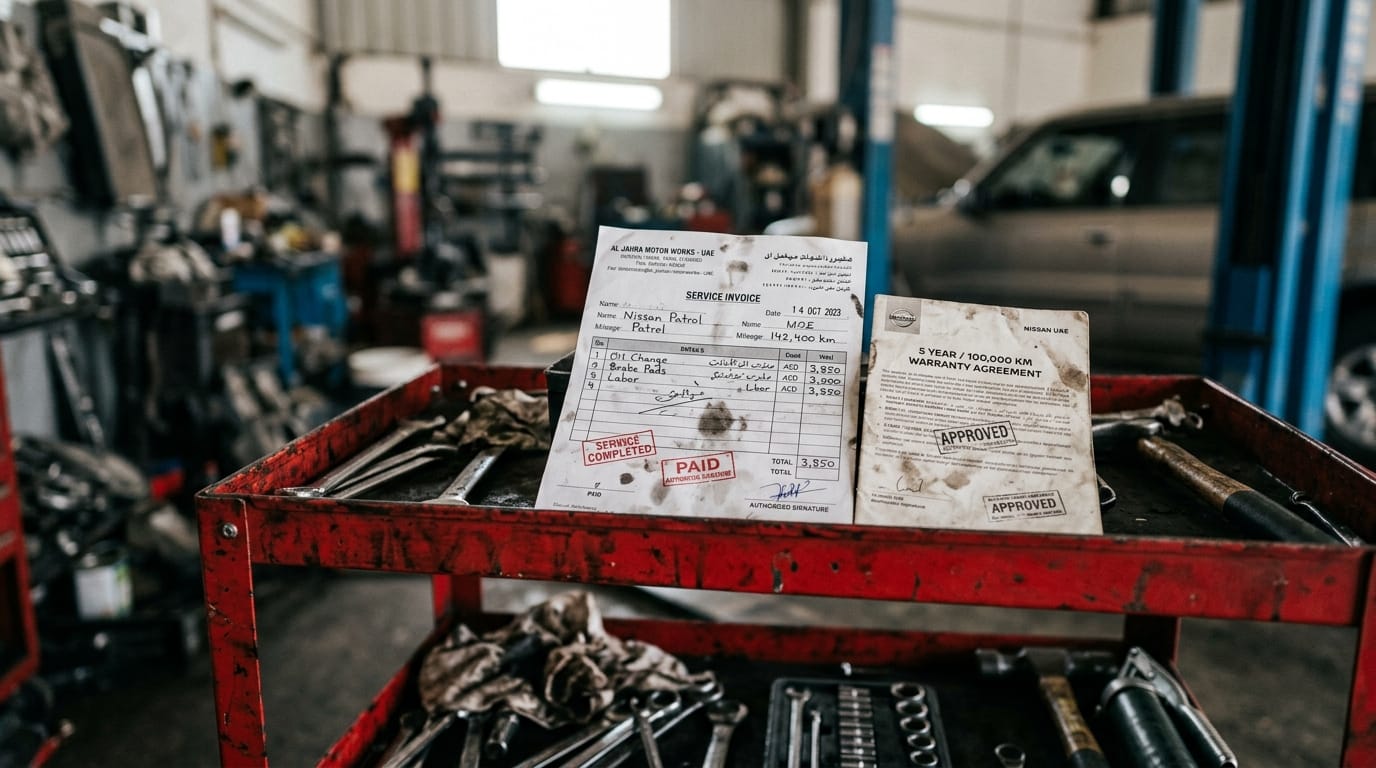
Some budget workshops in Al Quoz operate on verbal pricing and handwritten receipts without itemisation. Accepting a handwritten total without an itemised invoice makes it impossible to verify what was charged for what — and eliminates the documentary foundation for any subsequent dispute. A printed or digital itemised invoice is standard practice and can be requested at any workshop without it being an unusual or unreasonable request.
Mistake 4: Not Retaining Old Replaced Parts
Most expats do not think to ask for old parts. This is also the most straightforward protection against being charged for replacements that were never made. A workshop that refuses to return old parts when asked in advance is demonstrating its own discomfort with the verification. A workshop that has nothing to hide returns the old brake pads, filter, or battery without hesitation.
Mistake 5: Treating the RTA Tasjeel Test as a Mechanical Certification
The RTA Tasjeel test confirms that a vehicle meets basic roadworthiness standards at the moment of inspection — lights work, brakes stop the car within a basic threshold, tyres have minimum tread depth. It does not assess engine condition, transmission health, suspension wear depth, AC performance, electrical fault codes, or body structure integrity. Many expats who have just bought a vehicle with a current Tasjeel pass assume the vehicle has received a mechanical clearance. It has not. Arranging dedicated pre-purchase check services from an independent workshop addresses what Tasjeel does not.
Mistake 6: Not Calculating Insurance Cost Before Committing to a Workshop
For accident damage, the total repair cost to the vehicle owner depends on whether the workshop is on the insurer’s approved network. Choosing a non-approved workshop for insurance-covered repairs may require the owner to pay the full repair cost out of pocket and seek reimbursement — a process that is not always straightforward and may result in partial payment only.
Mistake 7: Ignoring Workshop Reviews That Are More Than 18 Months Old
Workshop quality in Al Quoz is not static. Ownership changes, key mechanics move between workshops, and management practices evolve. A workshop with consistently excellent reviews from three years ago and a pattern of declining reviews in the past year is communicating something meaningful. Filtering Google reviews to show only those from the past 12 months provides a more accurate current picture than the aggregate score.
Consumer Rights in Dubai Garages: What You Are Entitled To
UAE consumer protection law provides specific rights relevant to automotive workshop transactions. Most expats are unaware of the formal framework that governs these interactions, which reduces their willingness to pursue legitimate complaints.
Your Core Rights in Any Workshop Transaction
Under UAE consumer protection regulations, customers at automotive workshops are entitled to: a clear price estimate before work begins, an itemised invoice upon completion, repair work that meets professional standards, and recourse through formal complaint channels when these standards are not met.
The right to a pre-work estimate is foundational. A workshop that charges significantly more than any amount discussed or quoted in advance, without explicit customer approval of the additional cost before it was incurred, has not followed standard practice and can be subject to a formal complaint.
When a Workshop Can Legitimately Change the Price
Price changes during a repair are sometimes legitimate. A fault identified during an approved repair that requires additional parts or labour — discovered after the vehicle is disassembled — constitutes a genuine change in scope. The key requirement is that the workshop contacts the customer before proceeding with the additional work, explains the additional scope, and obtains explicit approval. A workshop that performs additional work and presents it in the final invoice without prior approval has not followed this process.
Legitimate price adjustments are communicated before the work is done, not after.
When You Have the Right to Object
You have the right to object to, and potentially pursue, charges in the following situations: work performed beyond the approved scope without prior approval, parts installed that differ from those quoted by category or quality level, warranty claims refused for repairs that have failed within the stated warranty period, and invoices that do not correspond to written estimates in ways that were never approved.
How to File a Formal Complaint
| Step | Action | Documentation Required |
|---|---|---|
| 1 | Raise issue directly with workshop manager — many disputes are resolved at this stage | Invoice, written estimate, photos of vehicle condition |
| 2 | If unresolved: file complaint with Dubai Economy (Consumer Protection) via consumerrights.ae or call 600 54 5555 | All invoices, estimates, WhatsApp records, photos |
| 3 | Obtain independent inspection report from a separate workshop documenting the disputed work quality | Third-party written report — strengthens formal complaint significantly |
| 4 | If the amount involved warrants it: consult a UAE legal advisor about civil claim options | All documentation from steps 1–3 |
Buyers may have legal remedies depending on the evidence available and the specific circumstances of the transaction. Outcomes vary significantly based on documentation quality and how clearly approvals were established in writing before work began. Complaints supported by written estimates, WhatsApp approval records, and independent inspection reports have a substantially stronger foundation than those relying on verbal accounts alone.
Key Documentation to Preserve for Any Potential Complaint
| Document Type | Why It Matters |
|---|---|
| Written estimate (signed or dated) | Establishes agreed scope and price baseline |
| WhatsApp approval messages | Timestamps additional work approvals |
| Final itemised invoice | Documents what was charged |
| Old replaced parts | Physical verification of work claimed |
| Photographs of vehicle before service | Disputes about damage occurring during workshop visit |
| Independent inspection report | Third-party assessment of work quality in dispute |
Specialist vs Multi-Service Workshop: When to Choose Which
Al Quoz contains both multi-service general workshops that handle everything from oil changes to gearbox rebuilds, and single-discipline specialists focused on one repair category. The choice between them is not obvious and depends on the nature of the fault.
AC Specialists
A dedicated AC workshop — not a general workshop that “also does AC” — brings advantages for complex cooling system faults. Specialist AC workshops in Al Quoz invest in refrigerant recovery and recharge equipment calibrated more precisely than the basic top-up systems found in general workshops. For faults involving the evaporator, expansion valve, or condenser tube damage, a specialist diagnosis is more likely to identify the root cause accurately on the first visit.
For a simple refrigerant recharge without identified leaks, a general workshop with standard recharge equipment handles the job adequately. The specialist becomes meaningfully better when the AC is not simply low on refrigerant but has a fault requiring diagnosis.
Gearbox and Transmission Specialists
Gearbox and transmission work is among the highest-stakes repair categories in terms of cost and the consequences of incorrect diagnosis. A general workshop that offers gearbox repair typically sends the unit to a specialist and marks up the cost — you are paying the specialist’s price plus the workshop’s margin. Identifying and working directly with the specialist removes the markup and the communication layer that can result in misdiagnosis.
For CVT transmission issues specifically, a dedicated CVT specialist with documented rebuild experience is the appropriate first contact. CVT faults can progress from a relatively inexpensive fluid and filter service issue to a full unit replacement if misdiagnosed or if the wrong fluid type is used. The cost difference between these outcomes is typically between 500 and 8,000 AED or more.
Electrical Specialists
Modern vehicles — particularly post-2015 models — have electrical architectures complex enough that general workshop mechanics with basic OBD readers cannot reliably diagnose faults beyond straightforward fault code reads. An electrical specialist with brand-appropriate diagnostic software (VAG-COM for Volkswagen Group vehicles, ISTA+ for BMW, STAR for Mercedes, and equivalent tools for Japanese brands) provides diagnostic capability that general workshops cannot match.
For common electrical faults on Japanese vehicles — alternator issues, starter motor failure, battery drain diagnosis — general workshops handle these reliably. For complex faults involving multiple control modules, CAN bus communication errors, or sensor calibration, an electrical specialist avoids the expensive sequential component replacement approach that general workshops sometimes default to.
General Multi-Service Workshops
A well-regarded general workshop handles the majority of maintenance and repair needs for common Japanese and Korean vehicles at competitive cost. Routine oil changes, brake work, tyre fitting, wheel alignment, suspension component replacement, and most common fault repairs are within the competence of a good general workshop without requiring specialist referral.
The general workshop becomes the wrong choice when: the fault is unusual, the vehicle is European or requires brand-specific diagnostic equipment, or the repair involves a transmission rebuild or complex electrical diagnosis. Knowing when to step outside the general workshop to a specialist is the judgment that saves money in the long run.
| Repair Type | General Workshop | Specialist | Dealer |
|---|---|---|---|
| Oil change, filters, brake pads | ✓ Appropriate | Unnecessary | Unnecessary (post-warranty) |
| Tyre fitting and alignment | ✓ Appropriate | Unnecessary | Unnecessary |
| Suspension component replacement | ✓ Appropriate on Japanese/Korean | Consider for complex diagnoses | Unnecessary post-warranty |
| AC recharge (simple) | ✓ Appropriate | Not required | Not required |
| AC fault diagnosis (complex) | Consider only if experienced | ✓ Preferable | For under-warranty vehicles |
| CVT fluid service | Only if experienced with CVT | ✓ Preferable | For under-warranty vehicles |
| CVT rebuild | Not recommended | ✓ Required | For under-warranty vehicles |
| Electrical fault diagnosis (complex) | Not recommended for European | ✓ Required for complex | For software faults |
| Software update / module programming | Not capable | Not typically capable | ✓ Required |
| Engine overhaul | Only with documented experience | ✓ Preferable | For warranty coverage |
%%{init: {"theme": "base", "themeVariables": {"background": "#f8f9fa", "textColor": "#1a1a1a", "primaryColor": "#2c3e50", "secondaryColor": "#c0392b", "lineColor": "#1a1a1a"}}}%%
pie title "Where Expats Take Cars in Al Quoz (Based on Estimates)"
"General Multi-Service" : 45
"Brand Specialist" : 30
"AC/Electrical Specialist" : 15
"Transmission Specialist" : 10
Scam Prevention: Common Repair Scams Reported by Expats in Dubai
Understanding how specific scams operate is more protective than a general warning to “be careful.” Each pattern below has been observed and reported across Dubai workshop review platforms over recent years. Being hyper-aware of these prevents finding yourself stuck with heavily manipulated estimates or worse, forged records for work never completed.
🔴 Most Dangerous Scam — The Fake Parts Switch: A workshop charges for genuine or OEM-equivalent parts at the corresponding premium price but deliberately installs unbranded, counterfeit, or inferior alternatives. The customer receives an invoice referencing the correct part number and brand (e.g., Bosch, Denso) but cannot verify what was actually fitted without specialist dismantling. This is particularly rampant for oil filters, air filters, and brake pads on high-volume models like Toyota Corolla or Nissan Sunny. How to reduce exposure: Demand to see the parts packaging before installation. A mechanic who opens a plain white box while billing for a premium branded part should trigger a direct confrontation. Always request your old parts back.
The Unnecessary Repair Recommendation
A car is brought in for a specific complaint. During inspection, the mechanic identifies several additional “urgent” items requiring immediate attention. Some of these may be legitimate observations. Others may be items presented as urgent that are either not genuinely urgent or not faults at all.
In workshop observations across Al Quoz, engine mounts, CV boots, and AC belts are among the items most commonly presented as more urgent than their actual condition warrants.
How to reduce exposure: When additional repairs are recommended beyond the original complaint, ask the mechanic to show you the specific problem physically. If they cannot demonstrate the fault visually, request a second opinion before approving the additional work.
The Diagnostic Scam
An OBD scan is described as a complex “computer diagnostic” requiring 200 to 400 AED. The actual OBD scan takes under five minutes and costs workshops essentially nothing beyond the tool investment. Charging moderately for a diagnostic scan (50 to 150 AED) is standard practice and reasonable. Charging 300+ AED for a standard OBD scan on a common vehicle without additional specialist analysis is an overcharge.
How to reduce exposure: Ask specifically what the diagnostic process involves before agreeing to it. For basic fault code reading on Toyota, Nissan, or Hyundai vehicles, most Al Quoz workshops with an OBD reader can provide the fault codes in under 10 minutes.
The AC Refrigerant Scam
A driver reports that AC is not cooling well. The workshop checks refrigerant level, confirms it is low, recharges the system, and charges accordingly. Within two to three weeks, the AC is again underperforming. The actual cause — a minor leak in the system — was never addressed. Repeated recharging without leak detection is both expensive and ineffective.
How to reduce exposure: Request leak detection as part of any AC recharge service. A UV dye test or electronic leak detector adds a modest cost (50 to 150 AED) but identifies whether the system has an underlying leak requiring repair.
Double Billing
Labour for a repair that shares steps with another repair is billed twice. Example: replacing a timing belt and a water pump on a Toyota 2.0L engine shares significant disassembly time. Billing full independent labour for both jobs when performed simultaneously is an overcharge.
How to reduce exposure: When multiple repairs are approved simultaneously, ask whether any shared labour applies. Most honest workshops will acknowledge and apply a combined labour rate without prompting.
The Battery Replacement Pressure
A driver visits for an oil change. The mechanic checks the battery and reports it is “almost dead” and must be replaced today. In many documented cases, the battery being replaced is functioning adequately and has remaining service life.
How to reduce exposure: Request a proper load test (not just a voltage reading) and ask what the test result actually shows. If the battery passes a load test, replacement is not urgent.
⚠️ Common Pattern: Expats who arrive at a workshop without a prior appointment, show visible signs of urgency (late for work, family waiting), or immediately ask “how long will it take” rather than “what does it cost” are more likely to receive inflated estimates. Calm, methodical questioning changes the dynamic significantly.
🔴 High Risk Situation: Expats who have recently arrived in the UAE and are unfamiliar with both the vehicle’s service history and local workshop practices face the highest exposure to the unnecessary repair recommendation pattern. Bringing a technically informed colleague or trusted contact to any major repair approval discussion reduces this exposure substantially.
🔴 Counterfeit Parts Advisory: Counterfeit brake components and oil filters for Toyota and Nissan models are periodically seized by UAE authorities from Deira and Sharjah market suppliers. When in doubt, ask for the parts supplier’s name and check whether they are an authorised importer.
Real Case Studies: Workshop & Market Logs
The following are representative scenarios drawn from patterns observed across expat communities in Dubai. Names and specific details have been adjusted for privacy. Each reflects a recurring situation rather than a single isolated event, offering a clear view of how an honest car mechanic al quoz dubai operates versus a dishonest one.
Case Study 1: The Oil Service That Became a 1,400 AED Bill
An Indian IT professional brings his 2018 Nissan Sunny to an Al Quoz workshop for a routine oil change, quoted verbally at 180 AED. When collecting the car, the invoice reads 1,380 AED. Additional items include: cabin air filter (280 AED), engine flush (150 AED), brake fluid replacement (200 AED), AC belt inspection and tensioner adjustment (320 AED), and spark plug inspection (150 AED). None of these additional services were agreed in advance.
The driver initially paid in full, uncertain of his position. He later discovered through Dubai Consumer Protection channels that work performed without prior written approval may entitle customers to dispute charges for unapproved items.
Lesson: A written estimate and explicit approval requirement before any service begins would have prevented this situation entirely.
Case Study 2: The AC Repair That Needed Three Attempts
A Filipino family’s Toyota Corolla AC loses cooling effectiveness. Workshop 1 in Al Quoz recharges the system: 280 AED. Cooling returns for 11 days then fails again. Workshop 1 recommends compressor replacement at 1,800 AED. The family visits Workshop 2 for a second opinion. Workshop 2 identifies a leaking high-pressure hose connection costing 320 AED to repair. After the leak repair and recharge, the AC functions normally for the following 14 months.
Lesson: A second opinion before approving expensive component replacement saved approximately 1,500 AED.
Case Study 3: The Engine Warning Light Misdiagnosis
A Pakistani driver’s 2016 Mitsubishi Lancer displays an engine warning light. Workshop 1 scans the OBD system, reads a P0420 catalyst efficiency code, and recommends catalytic converter replacement at 2,200 AED. The driver visits a second workshop in Al Quoz. The second workshop checks upstream oxygen sensor function, finds the pre-cat oxygen sensor is providing incorrect readings, replaces the sensor for 380 AED including labour, and clears the code. The warning light does not return over the following six months.
Lesson: An OBD fault code identifies a sensor reading or system performance issue — it does not always directly identify the failed component.
Case Study 4: The Honest Workshop Found Through Systematic Checking
An Egyptian expat developed a systematic approach after two overcharging experiences. He visited three workshops in person in Al Quoz, asked each the seven questions above, requested written estimates for the same job at each, and checked Google Reviews specifically for one-star reviews mentioning invoice disputes. Workshop 3 gave the clearest answers, produced a written estimate without being asked, and returned the old brake pads unprompted. The repair came in 40 AED below the written estimate.
Lesson: Systematic selection takes approximately one hour for a non-emergency repair. In this case it resulted in a better experience and a lower total cost than either previous workshop.
How to Verify a Workshop Before Visiting
Reading Google Reviews Accurately
A workshop with 4.8 stars from 300 reviews is not automatically trustworthy. Review patterns matter more than average scores.
Indicators of authentic positive review history: reviews are spread over two or more years, include detailed descriptions of specific repairs, mention staff names, and show occasional 3-4 star reviews with specific observations. Workshops with 100 five-star reviews posted within a two-month period, all using similar generic language, show patterns consistent with review manipulation.
One-star reviews are often more informative than five-star reviews. Look specifically for one-star reviews mentioning invoice disputes, parts not replaced as claimed, or warranty refusals. Two or more independent one-star reviews describing the same specific pattern within the past 12 months are a meaningful signal.
Physical Verification Before Leaving Your Car
A brief in-person visit before committing to a workshop tells you things that no review platform can. Observe: cleanliness of workshop area, whether cars are actively being worked on or simply parked, whether there is a designated reception or customer area, and how the service advisor responds to basic questions about parts and warranties.
Dealership vs Independent Workshop: Honest Comparison
| Factor | Authorised Dealer Service | Independent Al Quoz Workshop |
|---|---|---|
| Parts quality | Genuine manufacturer parts standard | Varies — OEM-equivalent to unbranded |
| Typical cost | 30–80% higher than independent | Lower baseline |
| Warranty on repairs | Typically 12 months / 20,000 km | Varies — often 30 days to 6 months |
| Service history documentation | Digitally recorded in manufacturer system | Paper invoice only in most cases |
| Brand-specific diagnostic tools | Full factory diagnostic access | Generic OBD, limited on newer models |
| Waiting time | Often longer — appointment-based | Generally faster turnaround |
| Resale value impact | Full service history adds value | Independent records accepted but less valued |
| Communication quality | More structured, multilingual | Highly variable |
For vehicles still within the manufacturer’s warranty period, authorised dealer service preserves warranty validity. For vehicles between three and eight years old in common Japanese or Korean models, a well-selected independent workshop in Al Quoz provides equivalent repair quality at meaningfully lower cost, provided the workshop meets the selection criteria above.
How Insurance Repairs Work in Dubai
Insurance repairs operate through a separate process from standard workshop visits, and the distinction matters significantly for customers navigating the claims process for the first time.
Insurance-Approved Garage Network
Comprehensive insurance policies in the UAE typically include a list of approved repair centres. Work performed at these centres is billed directly between the workshop and the insurance company after the customer pays the policy excess. Common mistake: bringing a vehicle to a non-approved workshop after an accident and expecting the insurer to reimburse the cost. Most comprehensive policies require pre-authorisation for repairs above a specified amount.
What Insurance Does and Does Not Cover
| Coverage Type | Typically Covered (Comprehensive) | Typically Not Covered |
|---|---|---|
| Accident damage | Yes, after excess payment | Pre-existing damage |
| Mechanical failure | No | All mechanical wear and breakdown |
| Flood damage | Yes if comprehensive includes natural perils | Excluded in many third-party policies |
| Theft | Yes (comprehensive only) | Third-party policies only cover damage to others |
| Roadside assistance | Depends on policy tier | Basic third-party policies |
📋 Insurance vs Workshop Claim — Key Distinction: An insurance claim is made against your insurance company for covered events. A complaint about workshop overcharging or poor repair quality is a separate matter handled through Dubai Consumer Protection or direct dispute with the workshop. These are two separate processes and should not be confused when pursuing either route.
Car Brand and Specialist Workshop Guidance
Not all workshops in Al Quoz have equal familiarity with all brands. For most common Japanese and Korean models, the difference between a Toyota specialist and a general workshop is minor for routine maintenance. For complex repairs or less common vehicles, brand experience matters.
| Vehicle Type | Recommended Workshop Approach | Parts Availability in Al Quoz |
|---|---|---|
| Toyota (Corolla, Camry, Yaris) | Any well-regarded general workshop or Japanese specialist | Very high — same-day in most cases |
| Nissan (Sunny, Altima, Patrol) | General workshop with Nissan experience | Very high |
| Mitsubishi (Lancer, Outlander) | Japanese specialist preferred for CVT issues | High |
| Honda (City, Accord, CR-V) | General or Japanese specialist | High |
| Hyundai / Kia | Korean-experienced general workshop | Medium-High |
| BMW / Mercedes-Benz / Audi | Brand-specific independent specialist or dealer | Medium — many parts require ordering |
| Ford / Chevrolet | American brand specialist — general workshops less experienced | Medium — some delays common |
| Land Rover / Porsche | Specialist or dealer strongly recommended | Low for independent workshops |
Toyota and Nissan parts are widely stocked across Al Quoz Industrial Area and the Abu Shagara Industrial Area in Sharjah, typically available same day without special ordering. This parts availability is one reason ownership costs for these brands remain lower than alternatives in the UAE market.
Before You Leave Your Car: Practical Checklist
| Stage | Action | Why It Matters |
|---|---|---|
| Before leaving | Photograph all exterior panels, including existing scratches | Prevents disputes about damage occurring during the workshop visit |
| Before leaving | Note fuel gauge level | Occasional reports of fuel removal during extended stays |
| Before leaving | Remove personal valuables from interior | Standard precaution |
| Before leaving | Obtain written work authorisation with specific items listed | Legal protection against unapproved additional work |
| Before leaving | Confirm contact person name and mobile number | Ensures communication goes through the same person throughout |
| Before leaving | Confirm expected collection date and time in writing | Prevents indefinite delays |
| During repair | Request update if timeline changes beyond agreed estimate | Maintains communication and keeps job prioritised |
| Before payment | Review invoice line by line against written estimate | Identifies any additions not previously approved |
| Before payment | Request old replaced parts | Verifies replacement actually occurred |
| Before payment | Confirm warranty terms are on invoice | Documents post-repair protection |
| After collection | Test specific repaired function immediately before leaving | Any quality issue is best raised while still at the workshop |
Printable Pre-Service Checklist
| Check | Item | Done? |
|---|---|---|
| □ | Written estimate obtained and signed | |
| □ | Parts brand and warranty confirmed in writing | |
| □ | Labour warranty period confirmed on estimate | |
| □ | Photos of all exterior panels taken | |
| □ | Fuel gauge level recorded | |
| □ | Personal valuables removed | |
| □ | Old replaced parts requested in writing | |
| □ | Expected completion date confirmed | |
| □ | Contact person name and number recorded | |
| □ | Invoice reviewed line by line before payment | |
| □ | Repaired function tested before leaving workshop |
How to Save Money Without Compromising Quality
Saving on car maintenance in Dubai is achievable without accepting lower-quality repairs.
Preventive maintenance adherence: Addressing issues at scheduled service intervals consistently costs less than repairing failures caused by deferred maintenance.
Comparing three estimates for any non-emergency repair: For a repair estimated above 500 AED, three written quotes from three Al Quoz workshops takes under two hours. The spread between highest and lowest quote for identical work on the same vehicle frequently reaches 30 to 50 percent.
OEM-equivalent parts selection: For most maintenance items on Japanese and Korean vehicles, OEM-equivalent parts from established brands (Denso, NGK, Monroe, TRW, Valeo) offer quality equivalent to genuine parts at 20 to 40 percent lower cost.
Avoiding dealer service for out-of-warranty vehicles: Once a vehicle is beyond its manufacturer warranty period, authorised dealer service costs a meaningful premium over comparable quality independent workshop service without a corresponding benefit for most repair categories.
Fleet Drivers and Company Vehicle Considerations
A significant proportion of expats in Dubai drive employer-provided or employer-financed vehicles. Most corporate fleet policies specify approved workshops for repairs above a threshold value. Understanding your employer’s fleet policy before a breakdown situation arises is worth the time required to read it.
For delivery drivers, taxi drivers, and ride-hailing operators, vehicle downtime has a direct daily income cost. A trusted workshop with fast turnaround — and the flexibility to handle urgent work without appointments — is often worth a modest price premium over the cheapest available option that requires a three-day wait.
The True Cost of Choosing the Wrong Workshop
A misdiagnosed fault on a CVT transmission, where a fluid contamination issue was addressed as a mechanical failure, resulted in a repeat transmission fault within four months. The initial repair cost was approximately 2,800 AED. The subsequent transmission rebuild cost was between 4,500 and 6,000 AED — a total of over 8,000 AED for a problem that a proper initial diagnosis and CVT fluid replacement at 600 to 800 AED might have prevented progressing.
Counterfeit brake pads installed by a budget workshop required replacement after 18,000 km on a vehicle that would normally expect 35,000 to 45,000 km from quality pads. The total cost of two sets of counterfeit pads and the associated labour exceeded the cost of a single set of OEM-equivalent pads with proper installation.
Prevention Maintenance Schedule for UAE Conditions
| Service Item | Interval | UAE-Specific Note | Approximate Cost (AED) |
|---|---|---|---|
| Engine oil change | Every 5,000–7,500 km (synthetic) | UAE heat accelerates oil degradation — use full synthetic | 180–350 |
| Air filter inspection | Every 15,000 km | Sand and dust loads are high — may require earlier replacement | 60–150 |
| Cabin air filter | Every 15,000 km | Affects AC efficiency significantly in dusty conditions | 60–140 |
| Tyre pressure check | Weekly | Heat fluctuation affects pressure — check cold | Free |
| Wheel alignment | Every 20,000 km or after kerb impact | Road surface quality variation affects alignment faster | 80–200 |
| Brake fluid replacement | Every 2 years | Moisture absorption accelerated by temperature cycles | 150–280 |
| AC system check | Annually before summer (April) | AC failure in UAE summer is not a minor inconvenience | 100–200 |
| Battery health check | Every 18 months | UAE heat reduces battery life to 2–3 years typically | Free–50 |
| CVT fluid replacement (if applicable) | Every 30,000–40,000 km | Neglect commonly leads to expensive transmission wear | 300–600 |
| Coolant replacement | Every 2 years or 40,000 km | Cooling system condition is particularly important in UAE heat | 200–400 |
%%{init: {"theme": "base", "themeVariables": {"background": "#f8f9fa", "textColor": "#1a1a1a", "primaryColor": "#2c3e50", "secondaryColor": "#c0392b", "lineColor": "#1a1a1a"}}}%%
xychart-beta
title "Average Preventative Maintenance Costs in Al Quoz (AED)"
x-axis ["Oil Change", "Air Filter", "Wheel Align", "Brake Fluid", "AC Check", "CVT Fluid"]
y-axis "Cost in AED" 0 --> 600
bar [265, 105, 140, 215, 150, 450]
The Bottom Line Decision Framework
| If You Are… | Workshop Approach | Key Priority |
|---|---|---|
| Newly arrived expat (under 6 months in UAE) | Ask long-term resident colleagues for a recommendation before selecting independently | Trust network over online reviews |
| Daily commuter driving 50–80 km/day | Establish a relationship with one mid-range Al Quoz workshop for consistent service | Reliability and fast turnaround |
| Budget-conscious driver on older vehicle | Compare three estimates before any repair above 500 AED | Written estimates and OEM-equivalent parts |
| Family vehicle owner | Prioritise brakes, tyres, and AC quality — use OEM-equivalent or genuine for safety items | Safety component quality |
| Delivery or ride-hailing driver | Identify a workshop with rapid turnaround and extended hours | Turnaround speed and availability |
| Luxury vehicle owner | Use brand-specific independent specialist or authorised dealer | Diagnostic capability and parts authenticity |
| Expat leaving UAE within 12 months | Maintain service history documentation for resale value — authorised dealer records preferred | Resale value preservation |
What to Do If You Believe You Were Overcharged
If a workshop has charged for work not approved in advance, used parts different from those quoted, or refused to honour a warranty for a failed repair, the following steps reflect the options available to UAE residents:
| Step | Action | Notes |
|---|---|---|
| 1 | Retain all invoices and written estimates | Foundation of any subsequent complaint |
| 2 | Photograph all relevant documentation | Prevents document disputes |
| 3 | Raise the issue directly with the workshop manager first | Many disputes are resolved at this stage |
| 4 | File a complaint with Dubai Economy via consumerrights.ae or call 600 54 5555 | Consumer Protection section handles workshop disputes |
| 5 | Obtain an independent inspection report on disputed work | Third-party assessment strengthens a formal complaint |
Buyers may have legal remedies depending on the evidence available and the specific circumstances of the transaction. Outcomes vary significantly based on documentation quality and how clearly approvals were established in writing before work began.
Expert Analysis: What Distinguishes Honest Workshops in Practice
After observing and interacting with workshops across Al Quoz Industrial Area, Abu Shagara, and the Sharjah Industrial Zone over several years, a consistent pattern distinguishes workshops with long-term customer relationships from those operating on short-term transactional margins.
Transparency is not primarily a moral choice in successful workshops — it is a practical business decision. A workshop that clearly explains a diagnosis, produces a written estimate, and delivers on time builds a customer base of returning clients and referrals within expat communities, where word-of-mouth carries significant weight.
The adoption of modern diagnostic equipment has also changed workshop dynamics. OBD II scanning tools, now standard equipment in any credible workshop, generate fault codes that customers can independently look up on their phones. A workshop that cannot explain why its diagnosis differs from the generic code description is more exposed to sceptical customers than was the case a decade ago.
Data Sources & Methodology
Pricing estimates, diagnostic procedures, and industry practices documented in this guide are gathered from physical observations and aggregated estimates across multiple active garages in Al Quoz Industrial Area, Dubai, alongside regulations mapped by the following UAE authorities:
- Roads and Transport Authority (RTA) Dubai — Vehicle inspection and registration standards.
- Dubai Economy (Consumer Protection) — Consumer rights framework and formal garage dispute resolution.
- TAMM Abu Dhabi — Vehicle services and cross-emirate compliance checks.
ℹ Market Volatility Notice: All repair costs, parts pricing, and diagnostic fee ranges mentioned in this article are averages based on observations in Al Quoz across 2025–2026. The UAE auto repair market is highly dynamic. Hourly labour rates, imported parts costs, and supply chain availability for OEM and aftermarket components fluctuate constantly. Readers must verify current pricing directly with at least three independent garages before approving any major repair or financial commitment.
Frequently Asked Questions
Q: How much should a standard oil change cost at an Al Quoz workshop?
Q: Can I trust an honest car mechanic al quoz dubai with five-star reviews on Google?
Q: What should I do if a workshop refuses to return my old parts?
Q: Is it worth using a dealership instead of Al Quoz for a car out of warranty?
Q: How do I know if an AC problem requires full compressor replacement?
Q: How long should a typical repair take at an Al Quoz workshop?
Conclusion: A Practical Summary for Expats in Dubai
The Al Quoz automotive repair market is not a uniformly reliable or uniformly problematic environment. It contains genuinely skilled, honest workshops alongside operations that have learned to take advantage of customers with limited local knowledge. The difference between these two outcomes for a given expat is almost entirely determined by the questions they ask and the documentation they require before work begins.
The seven questions in this guide are not aggressive or adversarial. Any workshop worth using answers them confidently. A written estimate, the right to return old parts, and a documented warranty are standard practices in professional workshops and cost the customer nothing to request.
Understanding which workshop type fits your vehicle brand — and when to escalate from a general workshop to a specialist — is the second layer of protection that most expats acquire only after an expensive first-year experience. This guide exists to compress that learning curve.
For a broader perspective on used car ownership costs in Dubai, including what to expect in maintenance over the first two years, our Toyota Camry 20-month ownership report provides a detailed financial picture across a typical expat vehicle holding period.
Disclaimer: Emirates Car Guide is a 100% independent platform. We do not own showrooms, nor are we affiliated with any used car dealerships or garages. Our sole mission is to protect expats from financial fraud in the automotive market.
