Written By: Omar Al-Fayed, Senior Automotive Consultant | Fact-Checked By: Emirates Cars Editorial Team | Last Updated: June 2026 | Category: Finance & Legal
Every year, thousands of expatriates in the UAE face an unexpected situation: a road accident they had no plan for. Not because accidents are rare — they are not — but because most drivers have no clear picture of what happens legally after the vehicles stop moving.
Understanding legal liability in UAE road accidents is not optional knowledge for expats. It directly affects whether your insurance pays, whether you face a court case, and in serious situations, whether a travel ban may be placed on you before a case concludes. This guide covers the complete legal framework — civil liability, criminal liability, insurance gaps, and the practical steps that protect your position — in plain language that requires no legal background to follow.
If you have recently experienced an incident, the first 30 minutes guide covers the immediate steps at the scene. For insurance-specific concerns, our UAE car insurance renewal article explains the coverage gaps many expats only discover after an accident.
This guide is reviewed periodically as Dubai Police procedures evolve.
Quick Answer: Legal Liability After a UAE Road Accident
When a road accident happens in the UAE, legal liability falls into two separate categories: civil liability (who pays for damages and compensation) and criminal liability (whether a driver may face prosecution, fines, or imprisonment). Both can apply to the same accident simultaneously.
The UAE Traffic Law — Federal Law No. 21 of 1995 and subsequent amendments — is the primary legal framework. The Dubai Police report determines initial fault. Insurance handles property damage in most standard cases. But when injuries, deaths, reckless driving, or alcohol are involved, the legal process becomes significantly more complex — and insurance alone cannot resolve it.
What “Legal Liability” Actually Means
Legal liability means legal responsibility. When you are found legally liable after a road accident, you are the person the law holds responsible for the consequences — whether that means paying compensation, attending court, or both.
Four terms appear throughout this topic and are worth understanding clearly before going further:
- Legal responsibility: The obligation recognised by law to answer for what happened.
- Fault: The determination of which driver caused or contributed to the accident through their actions or failures.
- Negligence: Failing to take the reasonable care that a responsible driver should take — for example, speeding, tailgating, or running a red light.
- Damages: The financial losses suffered by the affected party — vehicle repair, medical treatment, lost income, and similar costs.
In the UAE, liability is assessed based on the official police report, traffic camera footage, witness statements, and in some cases accident reconstruction analysis. The Roads and Transport Authority (RTA) and emirate police forces maintain extensive camera infrastructure that is routinely used in investigations.
Civil Liability vs Criminal Liability: The Core Difference
This distinction confuses many expatriates because in their home countries the two systems may work very differently. In the UAE, they are separate legal processes that can run simultaneously.
| Factor | Civil Liability | Criminal Liability |
|---|---|---|
| Purpose | Compensate the injured or damaged party | Punish behaviour that violates public law |
| Who files the case | The affected individual (or their insurer) | The Public Prosecution (state authority) |
| Typical penalties | Financial compensation payments | Fines, licence suspension, imprisonment |
| Compensation involved | Yes — central purpose | Not directly, though diya (blood money) may apply |
| Court involved | Civil Court | Criminal Court |
| Insurance role | Usually covers civil damages up to policy limits | Insurance does not cover criminal penalties |
| Settlement possible | Yes — many cases settle before court | Some cases allow settlement (e.g., diya payment in injury/death cases) |
| Applies when | Any accident causing property damage or personal injury | Reckless driving, serious injury, death, DUI, hit-and-run |
Can One Accident Create Both Civil and Criminal Liability?
Yes. This is one of the most important things to understand about UAE law.
A single road accident can trigger a civil case (to compensate the victim) and a criminal case (to prosecute the responsible driver) at the same time. These are separate legal proceedings that happen in parallel.
Example 1: A driver runs a red light and hits another vehicle, injuring the passenger. The injured party files a civil claim for medical expenses and vehicle repair. The Public Prosecution simultaneously files a criminal case for dangerous driving. The driver faces both compensation demands and potential fines or imprisonment — at the same time.
Example 2: A delivery driver, distracted by his phone, rear-ends a car on Sheikh Zayed Road. The damage is moderate and no one is seriously injured. The insurance covers the civil claim. But police cite him for using a mobile device while driving, which is a criminal traffic offence. He pays a fine — the criminal side — while his insurer handles the civil side.
Legal Framing Note: Outcomes in both civil and criminal proceedings depend significantly on available documentation and how the transaction or incident was conducted. Buyers and drivers may have legal remedies depending on evidence and specific circumstances. This guide is reviewed periodically as Dubai Police procedures evolve.
How UAE Police Determine Fault
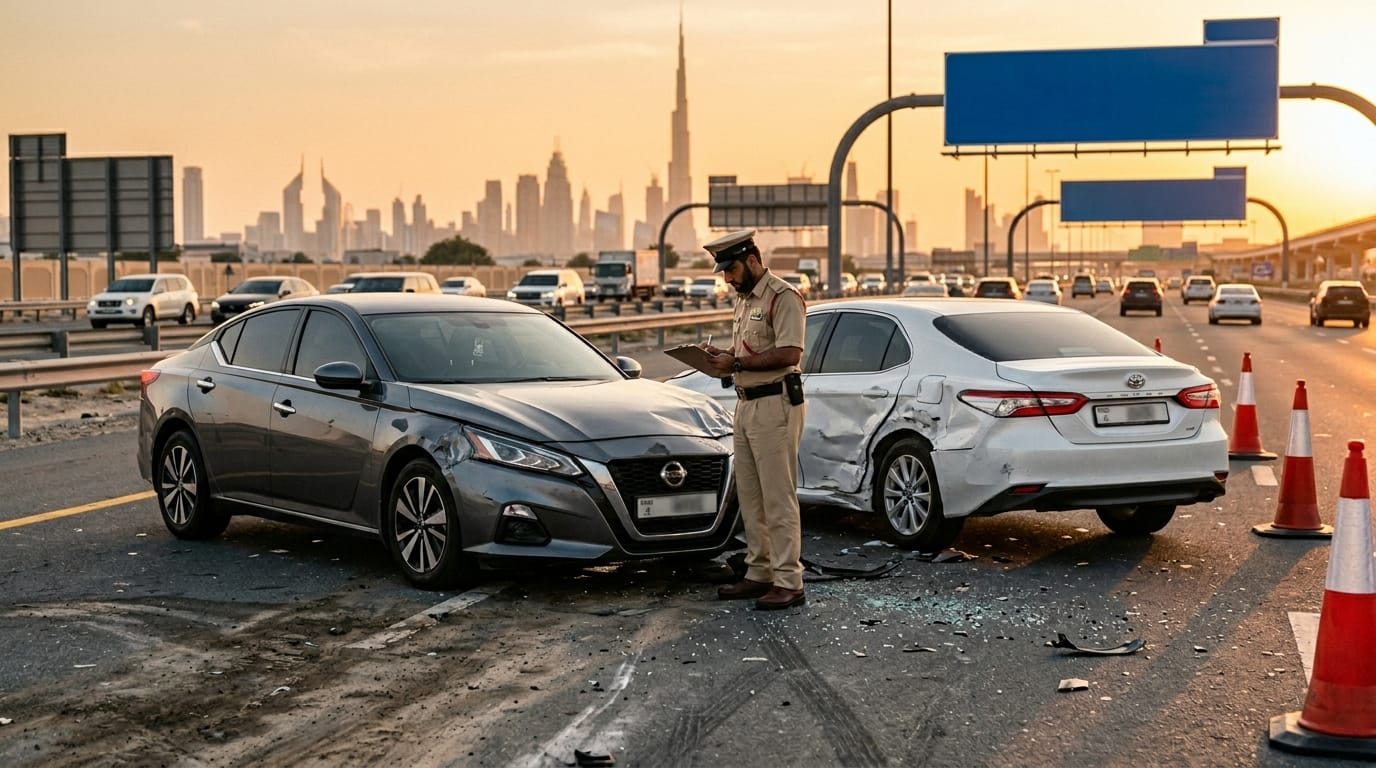
After any road accident in the UAE, police conduct a formal investigation. Leaving the scene before police arrive is itself a legal offence.
Police determine fault using several sources:
- Physical evidence: Vehicle positions, tyre marks, point of impact, road conditions.
- Traffic cameras: Dubai, Abu Dhabi, and Sharjah have extensive camera coverage on major roads.
- Dashcam footage: If either vehicle has a dashcam, police may request the recording.
- Witness statements: Other drivers, pedestrians, or passengers at the scene. Independent witness statements can strengthen your position if the circumstances of the accident are disputed.
- Traffic violations recorded on file: Speeding, signal violations, or tailgating alerts from smart systems.
- Accident reconstruction: In serious cases involving injury or death, specialised units may reconstruct what happened.
Drivers should avoid admitting legal liability at the scene. Police determine fault after reviewing all available evidence — not based on what drivers say to each other in the moments after the collision.
Dashcam Evidence: A Brief but Important Note
Dashcam footage is not mandatory in the UAE, but when legally obtained it may help support your version of events during insurance investigations or court proceedings. If your vehicle has a dashcam, secure the footage immediately after any accident before it is overwritten by the recording cycle.
The Police Report: Why It Controls Everything
The police report — known locally as a “traffic accident report” — is the foundation of every insurance claim, every civil case, and every criminal proceeding that follows a UAE road accident.
Without it, your insurer will not process your claim. Without it, you have no formal legal standing to demand compensation. Without it, a criminal prosecution cannot formally proceed.
The report records: date, time, location, involved vehicles, drivers’ details, nature of the accident, fault determination, and whether violations were committed. You can check current procedures and download accident reports via the Dubai Police portal or the Abu Dhabi Police portal.
Expat Tip: Always request a copy of the police report from the station that handled your case. In Dubai, download it from the Dubai Police app or website after a few days. In Abu Dhabi, through the ADPOL portal. Keep both a digital and paper copy.
| Report Type | When Issued | Implication |
|---|---|---|
| Standard Traffic Accident Report | Property damage only, no injuries | Sufficient for insurance claim processing |
| Criminal Traffic Report | Injuries, death, DUI, hit-and-run | Triggers Public Prosecution involvement |
What to Do Immediately After a UAE Road Accident
The sequence of events matters. The wrong step in the first hour can worsen your legal position significantly.
| Time | What to Do | Why It Matters |
|---|---|---|
| Immediately | Stop. Do not move the vehicle unless directed by police or it creates a highway safety hazard. | Moving without permission can be interpreted as tampering with evidence. |
| First 5 minutes | Check for injuries. Call 999 (Police) or 998 (Ambulance) if anyone is hurt. | Failure to report injuries is a separate offence. |
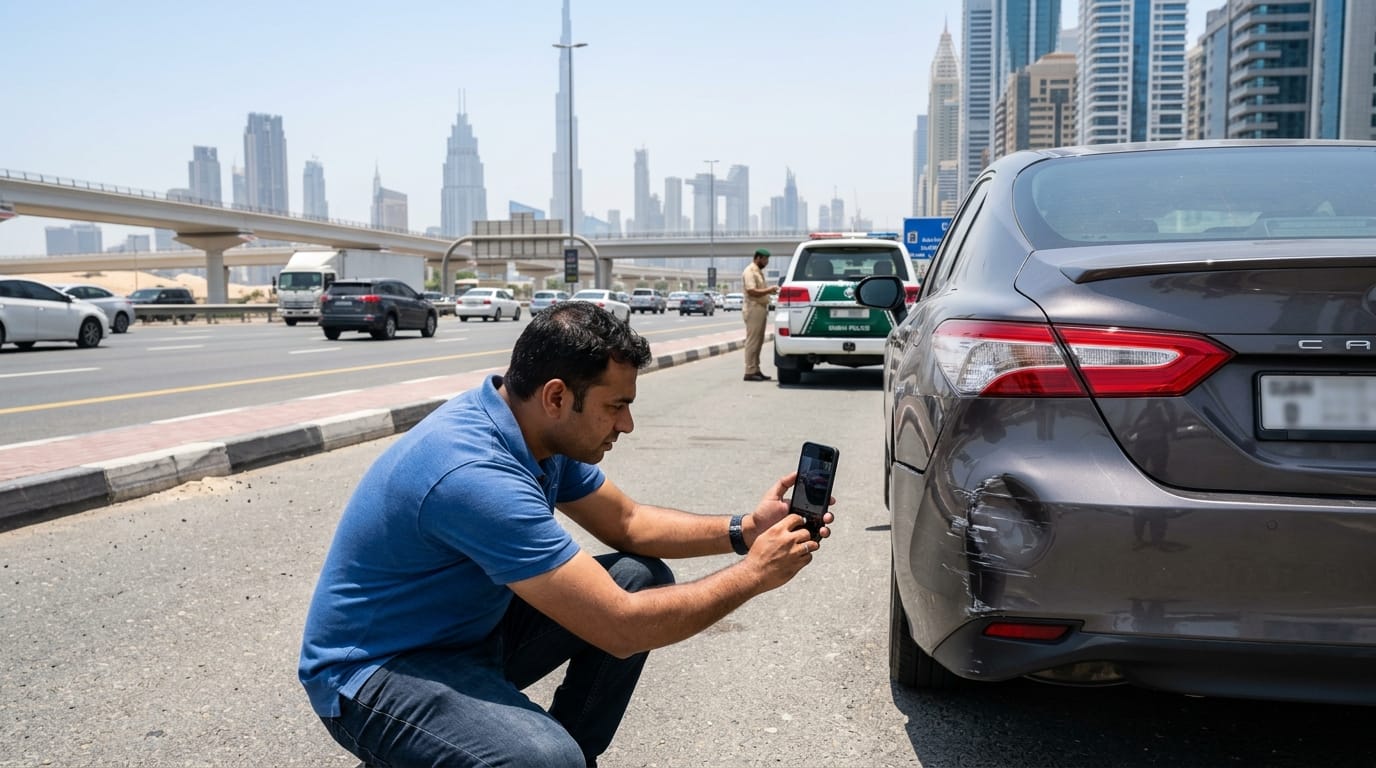
| First 10 minutes | Photograph the scene — all vehicles, positions, damage, road markings, traffic signs. | Evidence disappears once vehicles are moved. |
| 15 to 30 minutes | Wait for police. Do not admit fault verbally to the other driver. | Verbal admissions can be used against you. |
| After police arrive | Provide licence, registration (Mulkiya), insurance documents. Answer factual questions only. | Accurate statements protect your legal position. |
| Within 24 hours | Notify your insurance company, even if you are not at fault. | Most policies require prompt notification. |
| Within 3 to 7 days | Collect the official police report. Follow up with insurer. | Required to begin the claims process formally. |
Minor Accidents vs Serious Accidents: Different Legal Paths
| Factor | Minor Accident | Serious Accident |
|---|---|---|
| Definition | Property damage only, no injuries | Injuries, serious damage, death, or criminal offence involved |
| Police response | Report filed, fault noted | Full investigation, potential arrest |
| Legal track | Civil only (insurance handles) | Civil + Criminal (separate proceedings) |
| Insurance outcome | Claim processed based on report | Insurance covers civil damages; criminal penalties separate |
| Court involvement | Rare — most settle through insurance | Likely — Public Prosecution may file charges |
| Travel restrictions | Typically none | Travel ban possible pending court resolution |
| Typical timeline | Days to a few weeks | Weeks to months — sometimes longer |
For context on related financial risks expats face when buying used vehicles involved in prior accidents, checking a car’s accident history before purchase is an important step that many skip.
When Does Insurance Cover the Damage?
Insurance covers the civil side of accidents — meaning property damage and sometimes medical costs — but only within the limits and conditions of your specific policy.
Third-party insurance (the minimum required by UAE law) covers damage you cause to other people’s vehicles or property. It does not cover your own vehicle damage.
Comprehensive insurance covers your own vehicle as well, subject to deductibles and policy terms. Comparing comprehensive vs third-party options is covered in depth in our insurance comparison guide.
Important limits on what insurance typically covers:
- Damage caused while under the influence of alcohol or drugs — typically excluded.
- Damage caused during use of the vehicle for purposes not covered by the policy (e.g., using a private vehicle for commercial delivery without declaring it).
- Cases where the driver had no valid licence at the time of the accident.
- Intentional damage.
⚠ Important: Insurance pays the civil side. It does not pay your criminal fines, cover your legal defence costs in a criminal case, or prevent a travel ban. These are separate consequences that require personal attention.
When Does the Driver Become Personally Liable?
When insurance refuses to pay — or pays only partially — the liable driver may be personally responsible for the remaining costs. Common situations where this occurs:
- Driving under the influence of alcohol (zero tolerance in UAE).
- Driving without a valid UAE licence or with an expired licence.
- Using the vehicle for commercial activity not covered by the policy.
- Intentional damage or fraud.
- Allowing an unlicensed person to drive your vehicle.
- Damage exceeding policy coverage limits.
In these cases, the affected party may pursue the driver directly through civil court to recover costs that insurance does not cover. Outcomes vary significantly based on available documentation and how the original incident was handled.
Civil Compensation: What Can Be Claimed
Under UAE civil law, a person who suffers losses due to another driver’s negligence may claim compensation for a range of costs:
| Type of Loss | Examples |
|---|---|
| Property damage | Vehicle repair or replacement value |
| Medical expenses | Hospital bills, treatment, rehabilitation, ongoing care |
| Lost income | Wages or salary lost during recovery period |
| Reduced earning capacity | If injuries permanently affect the ability to work |
| Pain and suffering | Courts may award moral damages in serious cases |
| Rental car costs | If the damaged vehicle was unavailable during repairs |
The amount awarded depends on evidence presented — medical records, wage slips, repair invoices, and expert assessments. Courts do not accept verbal claims without documentation.
Criminal Responsibility: When Drivers Face Prosecution
Criminal liability is handled by the Public Prosecution. The prosecutor decides whether to file charges — the victim alone cannot “press charges” in the UAE system. Situations that commonly trigger criminal proceedings include the following.
Serious Injury
When an accident results in significant bodily harm to another person, the at-fault driver may face criminal charges under the UAE Penal Code in addition to traffic law violations.
Death
When a road accident results in a fatality, the case is treated as a criminal matter regardless of whether the death was intentional. The family of the deceased may also have a civil claim for diya (compensation under Islamic law) and additional damages. This guide is reviewed periodically as Dubai Police procedures evolve.
Reckless Driving
Driving in a manner that shows clear disregard for others’ safety — such as extreme speeding, racing, or aggressive weaving through traffic — is a criminal offence independent of whether an accident results.
Driving Under the Influence
The UAE has a zero-tolerance policy for alcohol and drugs when driving. Any detectable level is a criminal offence. Insurance typically will not cover accidents caused while under the influence, and the driver faces separate criminal prosecution.
Hit and Run
Leaving the scene of an accident — especially one involving injuries — is a serious criminal offence. It eliminates most legal protections available to the driver and typically results in harsher penalties.
Driving with a Fake or Invalid Licence
Fraudulent documents, driving on an expired licence, or driving on a foreign licence that is not legally valid for UAE use adds a criminal dimension to any accident case.
Possible Legal Consequences in the UAE
| Consequence | When It Typically Applies |
|---|---|
| Traffic fines | Most accidents involving a traffic violation |
| Black points on licence | Traffic violations — accumulation leads to suspension |
| Licence suspension | Serious violations, repeated offences |
| Vehicle impoundment | Serious violations, DUI, no licence |
| Court appearance | Criminal charges, civil disputes not settled by insurance |
| Imprisonment | DUI, death, hit-and-run, reckless driving causing harm |
| Travel ban | Outstanding cases, unpaid fines, pending court rulings |
| Deportation | Criminal conviction for expatriates in serious cases |
| Diya payment | Death or serious injury — compensation to victim’s family |
| Insurance premium increase | At-fault accidents — even settled claims typically affect renewal pricing |
If you have received traffic fines related to an accident, contesting a wrong traffic fine in Dubai is a formal process with specific steps that expats often overlook.
⚠ Travel Ban Warning: In cases involving injuries or death, a travel ban may be placed on the at-fault driver until the case is fully resolved — which can take weeks or months. Expatriates planning to leave the UAE should verify whether any restrictions apply before booking flights. Check through the UAE FAWRI service or by consulting a local lawyer.
Liability When Someone Is Injured
When a person is injured in a road accident, the at-fault driver faces both civil and potentially criminal consequences.
On the civil side, the injured party has the right to claim full compensation for medical treatment, lost income during recovery, and ongoing consequences of the injury. The at-fault driver’s insurance covers this up to policy limits. If costs exceed those limits, personal liability may apply.
On the criminal side, if the injury is described as “serious” or “grievous” under UAE law — meaning it required hospitalisation, caused permanent effects, or involved significant incapacity — the Public Prosecution may file charges. The driver may face a fine, licence suspension, or in some cases a short custodial sentence.
Liability When Someone Dies
Fatal road accidents involve the most complex legal situation a driver in the UAE can face.
Under UAE law, when a death results from a road accident, two distinct elements come into play:
Diya (blood money): Under Islamic law as applied in UAE courts, the family of the deceased may be entitled to diya — a financial payment. The amount is set by UAE law and is periodically updated. It may be covered by comprehensive insurance policies that include diya coverage — confirm with your insurer whether your policy includes this. The family of the deceased may choose to waive diya as a form of pardon, which may reduce criminal penalties.
Criminal prosecution: Independent of the civil and diya matter, the Public Prosecution will typically file criminal charges. Prison sentences are possible, particularly if reckless driving, DUI, or fleeing the scene was involved.
Expatriates involved in fatal accidents are commonly placed under a travel ban until the full legal process concludes.
Hit-and-Run Accidents
Leaving the scene of an accident without stopping is a serious offence under UAE traffic law. The legal consequences are substantially harsher than for drivers who remain at the scene and cooperate.
If you are identified as the hit-and-run driver — which is increasingly likely given the density of traffic cameras across UAE roads — you face:
- Criminal charges for leaving the scene.
- Aggravated penalties in any related injury or death proceedings.
- Likely refusal by your insurer to cover claims (most policies exclude deliberate flight from scene).
- Potential vehicle impoundment and licence suspension.
If you witness a hit-and-run and can record the vehicle’s plate number or dashcam footage, report it to police immediately. This is the primary evidence used to identify the responsible driver.
Shared Fault: When Both Drivers Are Partially Responsible
Not every accident has one clearly responsible party. UAE courts and police can assign shared or partial fault.
| Scenario | Typical Fault Assignment | Practical Effect |
|---|---|---|
| Driver A runs red light; Driver B was speeding | Split — higher share to red-light runner | Each party’s compensation reduced by their fault percentage |
| Rear-end collision on motorway | In most cases, the following driver bears primary responsibility | Following driver’s insurer typically covers, unless evidence shows exceptional circumstances |
| Lane change collision | Driver changing lanes usually holds primary fault | Subject to camera evidence and witness statements |
| Parking lot collision | Assessed case by case | Often split liability; CCTV footage from the facility is key |
When fault is shared, compensation amounts are typically adjusted proportionally. A driver found 30% at fault may receive 70% of their claimed compensation from the other party.
Note on Rear-End Accidents: In most UAE rear-end accident cases, the following driver is typically held primarily responsible — but this is not an absolute rule. Investigation may reveal that the leading driver braked suddenly without cause, had faulty brake lights, or was reversing. Evidence always determines the final outcome.
Employer Liability: Company Vehicles and Business Drivers
When an accident occurs in a company vehicle or while performing job duties, employer liability becomes relevant.
Under UAE civil law, employers may be held vicariously liable for accidents caused by employees acting within the scope of their employment. This means the affected party can pursue a claim against the company as well as the driver.
- Company vehicles: If a driver uses a company car for personal errands outside work hours, the employer’s liability is less clear. Courts examine whether the driver was “acting in the course of employment” at the time.
- Delivery drivers: Drivers making deliveries for employers are generally considered to be acting within employment at the time of accidents on delivery routes.
- Fleet insurance: Companies with fleets are required to hold commercial vehicle insurance. Claims run through the company’s policy in most cases.
If you are an employee who caused an accident while driving a company vehicle, speak with your employer’s HR or legal department promptly. The employer’s insurer handles most civil claims, but criminal liability remains personal to the driver.
Rental Car Accidents
| Party | Responsibility |
|---|---|
| Rental company | Provides mandatory third-party insurance; may offer additional collision waiver |
| Renting driver | Responsible for damage within the contract’s excess/deductible; personally liable for excluded events (DUI, off-road use, etc.) |
| Third-party victim | Claims against the rental company’s insurance in most property damage cases |
Read your rental agreement carefully before driving. The Collision Damage Waiver (CDW) reduces — but rarely eliminates — your personal financial exposure. Criminal liability is always personal to the driver regardless of rental agreements.
Borrowed Vehicle Accidents
- The vehicle owner’s insurance typically covers third-party damage claims, as policies generally cover the vehicle rather than specifically the named driver.
- However, if the owner knowingly lent the vehicle to an unlicensed driver, they may be personally liable for damages not covered by insurance.
- The borrowing driver bears personal criminal liability for any offences committed.
If you lend your vehicle to someone, ensure they hold a valid UAE driving licence or a licence legally recognised for use in the UAE.
Passenger Rights After a UAE Road Accident
Passengers injured in road accidents have rights distinct from those of the drivers involved.
A passenger who is injured can typically claim civil compensation from:
- The insurance of the at-fault driver (if another driver caused the accident).
- The insurance of the vehicle they were travelling in (in some comprehensive or personal accident coverage situations).
Passengers should seek medical attention, document all injuries, request the police report number, and keep all medical receipts. Consider consulting a legal professional if injuries are serious.
Pedestrian Accidents
Accidents involving pedestrians are treated seriously in the UAE. Drivers have a heightened duty of care toward pedestrians, particularly in designated crossing zones.
Shared fault — where the pedestrian was also acting negligently (crossing on a red signal, for example) — may reduce the driver’s compensation obligation but does not eliminate the criminal investigation.
How Insurance Companies Investigate Liability
After receiving a claim notification, UAE insurers conduct their own investigation — separate from the police investigation — to determine whether and how much to pay.
- Police report review: The insurer reads the official fault determination.
- Vehicle inspection: An approved assessor examines the damage and verifies it matches the reported accident.
- Fraud screening: Inconsistencies between the claimed damage and physical evidence are flagged. Staged accidents are a known issue in the UAE and insurers have dedicated detection units.
- Repair estimate approval: The insurer typically directs the vehicle to an approved workshop or requires multiple estimates.
- Medical documentation review: For injury claims, insurers review hospital records, treatment plans, and medical opinions.
Providing misleading information during an insurance investigation is a form of fraud — a separate criminal offence. For insight into real insurance claim experiences, a documented UAE insurance claim story shows what the process looks like in practice.
Scam Prevention: Fraud Risks Around UAE Road Accidents
Road accident fraud is a documented problem in the UAE and globally. Expats unfamiliar with local procedures are sometimes targeted. Common patterns to recognise:
⚠ Staged Accident Alert: One of the more commonly reported patterns involves a driver deliberately braking sharply in front of a following vehicle to induce a rear-end collision. Because the following driver typically bears primary responsibility in rear-end cases, the staged driver then claims exaggerated injury and repair costs. If you suspect a staged accident, report your concerns to police at the scene and inform your insurer immediately. Dashcam footage is particularly useful in these situations.
Additional fraud patterns to be aware of:
- Inflated repair estimates: Workshops connected to a particular party may quote significantly above market rate. Your insurer uses approved workshops — request this channel if you suspect manipulation.
- False witness recruitment: In disputed accidents, some parties attempt to produce witnesses who were not present. Traffic camera evidence and dashcam footage counter this.
- Identity misrepresentation: In rare cases, the driver at the scene is not the registered owner or insurance policyholder. Always photograph the licence, Mulkiya, and insurance certificate of the other party immediately.
- Pressure to settle privately: Being asked to pay cash at the scene without involving police is a risk. You lose the legal protection of the official report and have no recourse if the other party later changes their account.
Insurance vs Personal Liability: A Quick Reference
| Situation | Insurance Covers | Personal Liability |
|---|---|---|
| Standard at-fault accident, property damage only | Third-party damage | Minimal — policy deductible only |
| At-fault accident with injuries | Third-party medical costs up to policy limit | Costs exceeding policy limit |
| DUI accident | Typically excluded entirely | All damages + criminal penalties |
| Driving without valid licence | Typically excluded | All damages + criminal penalties |
| Hit-and-run | Typically excluded or disputed | All damages + serious criminal penalties |
| Vehicle used for undeclared commercial purpose | May be excluded | Potentially all damages |
Insurance vs Legal Action: Understanding the Difference
Many expats conflate insurance claims with legal action. They are distinct processes with different targets and different outcomes.
| Type | Target | Based On | Outcome |
|---|---|---|---|
| Insurance Claim | Against the insurance company | Policy terms and police report | Financial settlement up to policy limits |
| Civil Legal Action | Against the responsible driver | Available evidence and documentation | Court-ordered compensation — may vary significantly |
| Criminal Proceedings | Filed by Public Prosecution (state) | Evidence of criminal offence | Fines, suspension, imprisonment — insurance does not cover these |
Buyers may have legal remedies depending on evidence and the specific circumstances of the case. Outcomes vary significantly based on available documentation and how the incident was conducted. Consulting a licensed UAE legal professional before pursuing formal legal action is advisable in any case involving injury or significant financial loss.
Common Mistakes That Make Legal Problems Worse
| Mistake | Why It Causes Problems |
|---|---|
| Leaving the scene | Treated as hit-and-run; aggravates all other charges |
| Verbally admitting fault at the scene | Can be recorded or used as a statement against you; fault is for police and courts to determine |
| Posting about the accident on social media | Posts may be used as evidence; photos or statements can contradict your official account |
| Repairing your vehicle before the insurer inspects it | Destroys physical evidence; insurer may refuse the claim |
| Failing to notify your insurer promptly | Many policies have strict notification deadlines — missing them can affect coverage |
| Ignoring traffic fines from the accident | Unpaid fines accumulate; may result in vehicle impoundment and travel restrictions |
| Assuming Tasjeel passing means the car is mechanically sound | Tasjeel certifies registration compliance, not overall mechanical fitness |
| Moving the vehicle before police document positions | Alters the accident scene; complicates fault determination |
Step-by-Step Legal Timeline After a UAE Road Accident
UAE Road Accident Legal Timeline
Real Case Studies: Workshop and Market Logs
Case 1 — Indian IT Worker, Minor Rear-End Collision, Al Barsha
Rahul, a software engineer based in Dubai, stopped at a traffic light in Al Barsha when the vehicle behind him failed to brake in time and contacted his rear bumper. No injuries. He photographed the scene, waited for police, and received the report four days later. His comprehensive insurer covered his vehicle repair — approximately 2,800 to 3,200 AED — after inspection at an approved Al Quoz workshop. The other driver’s third-party insurance paid for Rahul’s bumper damage. The case was resolved within three weeks with no court involvement and no premium dispute at renewal.
Case 2 — Pakistani Sales Representative, Injury Accident, Sheikh Zayed Road
Imran changed lanes without checking his mirrors on Sheikh Zayed Road during peak hour and clipped another vehicle. The other driver suffered a fractured arm requiring six weeks of treatment. The police report assigned fault to Imran. His insurer covered the third party’s vehicle and initial medical costs, totalling approximately 18,000 to 22,000 AED. However, the injured driver’s extended physiotherapy pushed the claim above Imran’s policy limit. The injured driver filed a civil case for the difference — approximately 9,000 to 12,000 AED — which Imran paid personally after settlement. Separately, the Public Prosecution filed a charge of negligent driving causing injury. Imran attended two court sessions, paid a fine in the range of 1,000 to 2,000 AED, and received a three-month licence suspension. His insurance premium increased noticeably at the next renewal.
Case 3 — British Business Visitor, Rental Car Accident, Abu Dhabi
James, visiting Abu Dhabi on a work assignment, rented a vehicle and was involved in a side-collision at a junction. The rental agreement included a Collision Damage Waiver with a deductible of approximately 1,500 AED. The other driver was found primarily at fault. The rental company’s insurance covered the third-party claim. James paid the deductible under his rental agreement. No criminal liability arose. The deposit refund was delayed by approximately two weeks while the insurer completed their assessment — something James had not anticipated when planning his trip.
Evidence Collection Checklist
| ✔ | Item | Why It Matters |
|---|---|---|
| ✔ | Photos of all vehicles — all angles, all damage | Documents pre-repair condition; essential for insurance and court |
| ✔ | Photos of the full accident scene — road markings, signs, positions | Establishes context and supports your account of events |
| ✔ | Other driver’s licence, registration (Mulkiya), insurance certificate | Required for the insurance claim |
| ✔ | Other driver’s phone number and Emirates ID if possible | Useful if the driver disputes details later |
| ✔ | Names and numbers of witnesses at the scene | Witness statements can support your position in disputed cases |
| ✔ | Dashcam footage saved before it is overwritten | Video evidence is highly persuasive in insurance investigations and court |
| ✔ | Official police report (collect within a few days) | Required by your insurer; forms the basis of all proceedings |
| ✔ | Medical records and hospital receipts | Required to substantiate any injury compensation claim |
| ✔ | Repair estimates from approved workshops | Required by most insurers before authorising repair |
| ✔ | Insurer notification confirmation (email or app) | Proves timely notification in case of later dispute |
After-Accident Legal Checklist
| ✔ | Action |
|---|---|
| ✔ | Stop and remain at the scene |
| ✔ | Call police (999) — do not move vehicles without instruction |
| ✔ | Call ambulance (998) if anyone is injured |
| ✔ | Photograph scene, damage, and all vehicles |
| ✔ | Exchange details with other driver — licence, Mulkiya, insurance |
| ✔ | Do not admit fault or argue at the scene |
| ✔ | Notify your insurer within 24 hours |
| ✔ | Collect police report within 3 to 5 days |
| ✔ | Do not repair vehicle before insurer inspection |
| ✔ | Save all WhatsApp, SMS, and written communications |
| ✔ | Seek legal advice if injuries or criminal charges are involved |
| ✔ | Check for travel restrictions if a court case is pending |
What You Can Do: Practical Legal Steps
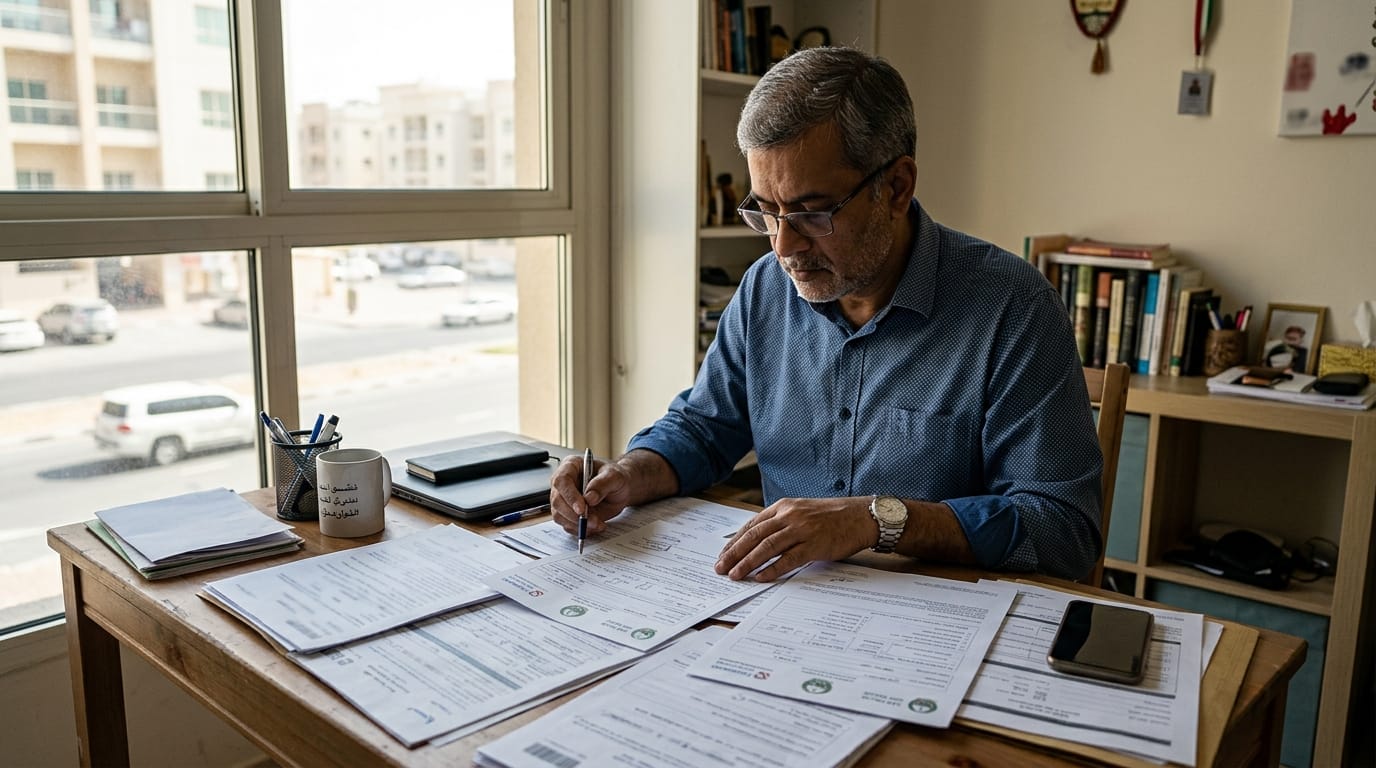
- Collect all inspection reports and assessments in writing — verbal agreements are difficult to enforce.
- Save all WhatsApp and SMS conversations with the other driver, dealers, or workshops involved.
- Request and keep a copy of the official police accident report.
- Document all verbal claims in follow-up texts (“As we discussed, you confirmed that…”) to create a written record.
- Report consumer protection issues or dealer fraud to the relevant emirate’s consumer protection authority via consumerrights.ae.
- In cases involving injury or significant financial loss, consult a UAE-licensed lawyer before signing any settlement agreement.
- If detained, contact your home country’s embassy or consulate in the UAE promptly.
This guide is reviewed periodically as Dubai Police procedures evolve.
Rights Every Expat Driver Should Know
- You have the right to request a copy of the official police accident report.
- You have the right to seek independent legal advice before making statements in a criminal case.
- You have the right to an interpreter during official proceedings if you are not fluent in Arabic.
- You have the right to contact your country’s embassy or consulate if you are detained.
- You have the right to dispute a police fault determination through formal legal channels.
- You have the right to have your vehicle inspected by an independent assessor before repair.
- You have the right to know whether a travel ban has been placed against you — check via UAE FAWRI or consult a local lawyer.
The Bottom Line Decision Framework
Data Sources and Methodology
The information in this article is based on the UAE Federal Traffic Law (Federal Law No. 21 of 1995 and amendments), publicly available guidance from UAE police and government portals, and observations drawn from documented expat cases across UAE workshops and legal consultations. Cost ranges cited for fines and repairs reflect commonly reported figures across Al Quoz workshops and Dubai-based legal consultations and are expressed as ranges rather than precise figures, as these vary by emirate, vehicle type, and individual circumstances.
Official sources used and linked throughout this article include:
- Dubai Police — dubaipolice.gov.ae
- Abu Dhabi Police — adpolice.gov.ae
- Sharjah Police — sharjahpolice.gov.ae
- Roads and Transport Authority — rta.ae
- UAE Consumer Protection — consumerrights.ae
- UAE Ministry of Justice — moj.gov.ae
- UAE Government Portal — Traffic and Road Safety
Market Volatility Notice: All fines, fees, compensation ranges, and cost estimates mentioned in this article are based on observed patterns at the time of writing. UAE traffic laws, fines, and government fees are subject to periodic revision. Legal outcomes vary based on specific case circumstances, available evidence, and the discretion of courts and prosecution. Verify current figures with official portals or a licensed UAE legal professional before making any formal decisions.
Frequently Asked Questions
Q: Who is legally responsible after a UAE road accident?
Q: Can a driver go to jail after a road accident in the UAE?
Q: What is diya and when does it apply?
Q: What happens if the other driver has no insurance?
Q: Can an expat be deported after a road accident?
Q: Does the police report automatically decide the court case?
Q: How long does a travel ban last after a UAE road accident?
Q: Do I need to go to court for every accident?
Final Practical Takeaways
Understanding legal liability in UAE road accidents is less about memorising law and more about knowing what matters in the moments after an accident happens.
Remain at the scene. Document everything before vehicles are moved. Notify your insurer within 24 hours. Collect the police report. Do not repair your vehicle before the insurer inspects it. If anyone is injured or if criminal charges are possible — seek legal advice rather than navigating it alone.
Insurance handles the civil side in most standard accidents. But insurance cannot resolve criminal proceedings, pay criminal fines, or lift a travel ban. These are personal consequences that require personal attention.
Expats who understand this framework are in a stronger position than those who assume insurance covers everything. In the UAE, the legal framework is well-developed and enforced. Treating it seriously from the first moment costs very little. Overlooking it can be considerably more expensive.
For further reading on protecting yourself in the UAE automotive market, see the complete UAE traffic fines guide and our article on how to respond to dishonest dealer tactics.
Emergency Contacts:
Police: 999
Ambulance: 998
Dubai Police accident report: dubaipolice.gov.ae
Abu Dhabi Police: adpolice.gov.ae
Sharjah Police: sharjahpolice.gov.ae
UAE Consumer Protection: consumerrights.ae
Disclaimer: Emirates Cars is a 100% independent platform. We do not own showrooms, nor are we affiliated with any used car dealerships or garages. Our sole mission is to protect expats from financial risk in the UAE automotive market.
⚠ Financial and Legal Disclaimer: The information provided in this article is for educational purposes only. Regulations, legal procedures, and insurance terms in the UAE may change over time. Readers should verify information with licensed UAE legal professionals or official government portals before making legal decisions or taking formal action.
