Last Updated: July 2026 | By Omar Al-Fayed, Senior Automotive Consultant | Fact-Checked By: Emirates Cars Editorial Team | Category: Buying & Selling
Buying a used car in the UAE with hidden accident damage is one of the most common and costly mistakes expats make in this market. A vehicle that was involved in a serious collision — and later repaired without disclosure — can cost you between 15,000 and 40,000 AED more than its actual market value, and it may carry structural problems that standard visual checks simply cannot detect.
our complete buying guide covers the broader process, but this article focuses specifically on accident history: how to verify it before you pay, and what your realistic options are if you discover hidden damage after the sale.
You can check a vehicle’s accident history using official UAE platforms, VIN-based databases, and an independent inspection. If hidden damage is discovered after purchase, preserve evidence, obtain an inspection report, and consider negotiation, consumer protection, or legal advice depending on the circumstances.
⚠ Legal Disclaimer: The information provided in this article is for educational purposes only. UAE legal procedures, court fees, traffic laws, and judicial mandates may change over time. Readers should verify current requirements with a licensed UAE legal consultant or official government portals before taking formal legal action. This guide is reviewed periodically as Dubai Courts and police procedures evolve.
Why Hidden Accident History Is a Common Used Car Problem in the UAE
The UAE used car market moves fast. Dubizzle and Facebook Marketplace list hundreds of vehicles daily, and sellers — both private and commercial — know that accident history reduces buyer interest and sale price significantly. In an environment where many buyers focus almost entirely on visual appearance and test drive feel, the incentive to stay quiet about past collisions is real.
Several market conditions make this problem more common here than in many other countries:
- A large volume of imported vehicles arrives from the US, Canada, and Japan — with accident records that do not automatically transfer to UAE systems.
- Repair quality varies widely across UAE workshops. Some vehicles receive professional structural repairs; others receive cosmetic-only work that masks deeper problems.
- Many expat buyers are first-time UAE car purchasers unfamiliar with local verification tools.
- Private sellers in particular face no obligation to proactively disclose accident history in most informal transactions.
dealer red flags guide covers deceptive sales practices in detail. Here, we focus specifically on accident history concealment and how to protect yourself.
What Counts as an Undisclosed Accident?
Not all accidents carry the same impact on a vehicle. Understanding the spectrum helps you assess risk more accurately.
Minor Incidents
Parking lot contact, low-speed scrapes, and bumper damage repaired at a body shop typically have limited structural impact. If repaired properly and disclosed, they may reduce value by 3,000 to 8,000 AED depending on model and age — but they do not necessarily compromise safety.
Major Collisions
High-speed impacts, side T-bone collisions, and front or rear structural damage are a different category entirely. These may have required chassis straightening, airbag replacement, or structural welding. A vehicle with this history that was not properly repaired can behave unpredictably in subsequent incidents.
Structural and Chassis Damage
When the chassis rails, A-pillars, B-pillars, or firewall are involved in a collision, the vehicle’s geometry changes. Even after workshop repair, subtle misalignment can affect handling and crash protection. This is the category buyers most need to identify before purchase.
Flood-Related Damage Classified as Accident
In the UAE context, flood events — including those following heavy rainfall — sometimes involve insurance claims processed as accident records. Vehicles with unresolved flood damage may appear in accident history databases or may not, depending on how the claim was categorized. our flood damage report covers this in more detail.
Why Sellers Sometimes Hide Accident History
Understanding seller motivation is not about judging individuals. It is about knowing where the pressure to conceal comes from, so you can calibrate your verification effort.
Private sellers typically want to recover as much of their purchase price as possible. A disclosed accident history can reduce a negotiated price by 10 to 25 percent depending on severity. For a 40,000 AED vehicle, that is a 4,000 to 10,000 AED difference — enough motivation for some sellers to stay quiet about incidents they consider resolved.
Some dealers buy accident vehicles at reduced prices, invest in repair work, and attempt to sell at or near undamaged market rates without disclosing the history. The profit margin justifies the risk in their calculation.
A third category involves sellers who genuinely do not know about all accidents in the vehicle’s history — particularly with imported cars, or vehicles purchased second or third-hand where original documentation was not transferred.
How Hidden Accident History Affects Vehicle Value
| Accident Type | Typical Value Reduction | Key Concerns |
|---|---|---|
| Minor cosmetic (bumper, panel) | 3,000–8,000 AED | Paint match, corrosion |
| Airbag deployment | 8,000–18,000 AED | Airbag replacement quality, ECU reset |
| Front/rear structural | 15,000–30,000 AED | Frame alignment, crumple zone integrity |
| Chassis/B-pillar damage | 25,000–45,000 AED+ | Safety in subsequent collision |
| Total loss / salvage rebuilt | 40–60% of clean market value | Insurance refusal, resale difficulty |
Beyond the direct resale impact, an undisclosed accident can affect your ability to obtain comprehensive insurance, complicate future financing, and create liability questions if the vehicle is involved in a subsequent incident and the hidden structural damage is identified as a contributing factor.
How to Check Accident History Before Buying
There is no single source in the UAE that captures 100% of all accident events across all vehicles. The practical approach is to combine official database checks with physical inspection — each method catches what the other misses.
Official UAE Accident History Sources
Dubai: RTA Vehicle History Check
The Roads and Transport Authority (RTA) provides accident records for vehicles registered in Dubai. You can access this through the RTA official portal or the Dubai Now app. Enter the vehicle’s plate number or chassis number (VIN). The system returns records of police-reported accidents involving that vehicle while registered in Dubai.
Important limitation: this covers only accidents that were officially reported to Dubai Police and processed through the insurance or traffic system. Low-speed incidents settled privately between parties typically do not appear.
Abu Dhabi: TAMM and Abu Dhabi Police
For Abu Dhabi-registered vehicles, the TAMM platform provides some vehicle history services, and the Abu Dhabi Police portal at adpolice.gov.ae offers traffic-related records. Coverage is similar to Dubai — officially reported incidents only.
Sharjah and Other Emirates
Sharjah, Ajman, Ras Al Khaimah, Fujairah, and Umm Al Quwain operate their own traffic departments. Online accident history lookup is less standardized across these jurisdictions. For vehicles registered in these emirates, a direct inquiry to the relevant traffic department — or a professional inspection — is typically more reliable than an online check alone.
Tasjeel / AMAS Vehicle History
Tasjeel, operated under the RTA framework, provides some registration and inspection history. our Tasjeel inspection guide explains what this system covers. It is useful for confirming registration continuity, but it is not a substitute for a full accident history query.
🚨 Important Limitation: No UAE authority operates a single nationwide accident database that covers all seven emirates simultaneously. A vehicle registered in Sharjah involved in an accident in Dubai may or may not appear in either system depending on how the incident was reported and processed. Always verify based on the emirate of registration, not just the emirate where you are buying.
How to Check Using the VIN Number
The Vehicle Identification Number (VIN) is a 17-character code stamped on the vehicle’s chassis, dashboard, and listed on all official documents. It is your most reliable cross-reference tool.
For UAE-registered vehicles, use the VIN when querying official portals — some systems accept VIN in addition to plate number, which is particularly useful when the plates have been changed between ownership transfers.
For imported vehicles — particularly those from the United States — the VIN enables access to American accident databases. Services such as Carfax and AutoCheck maintain records of US-title accidents, salvage designations, and flood damage. These are particularly relevant when evaluating American-spec imports in the UAE market.
Check the VIN in three locations physically on the vehicle: the dashboard visible through the windshield, the driver’s door jamb sticker, and the engine bay stamp. If any of these do not match exactly, do not proceed with the purchase.
How to Spot Signs of Previous Accident Repairs
Physical inspection remains essential because database gaps are real. The following signs are observable by any careful buyer — no specialist equipment required.
Paint Inconsistency
Stand at one end of the vehicle and look along the body panels in natural daylight. Repainted panels often have a slightly different texture, gloss level, or color shade than original factory paint. Orange peel texture differences between panels are a common indicator.
Panel Gap Irregularity
All factory-installed panels have consistent gaps between them. Uneven gaps — particularly around doors, hood, trunk lid, and fenders — suggest that panels were removed, repaired, or replaced. Run your finger along the gaps on both sides of the vehicle and compare.
Welding and Seam Evidence
Factory welds are uniform and often covered with factory underseal. Non-factory welds appear in irregular shapes, with different metal texture around them. Checking the inner engine bay seams, the wheel arches from underneath, and the trunk floor reveals more than the exterior alone.
Mismatched or Replacement Parts
Look for part numbers or date stamps inside doors and under hood panels. A 2019 vehicle with a door manufactured in 2022 has had that door replaced — which may be explained by an accident or may reflect legitimate repair of unrelated damage.
Overspray on Rubber Seals and Trim
When a panel is repainted, masking is rarely perfect. Look for paint overspray on door rubber seals, on plastic trim pieces, and around windshield edges. Factory assembly does not produce overspray in these areas.
How Professional Inspectors Detect Hidden Repairs
A professional pre-purchase inspection adds tools and expertise that a self-check cannot replicate.
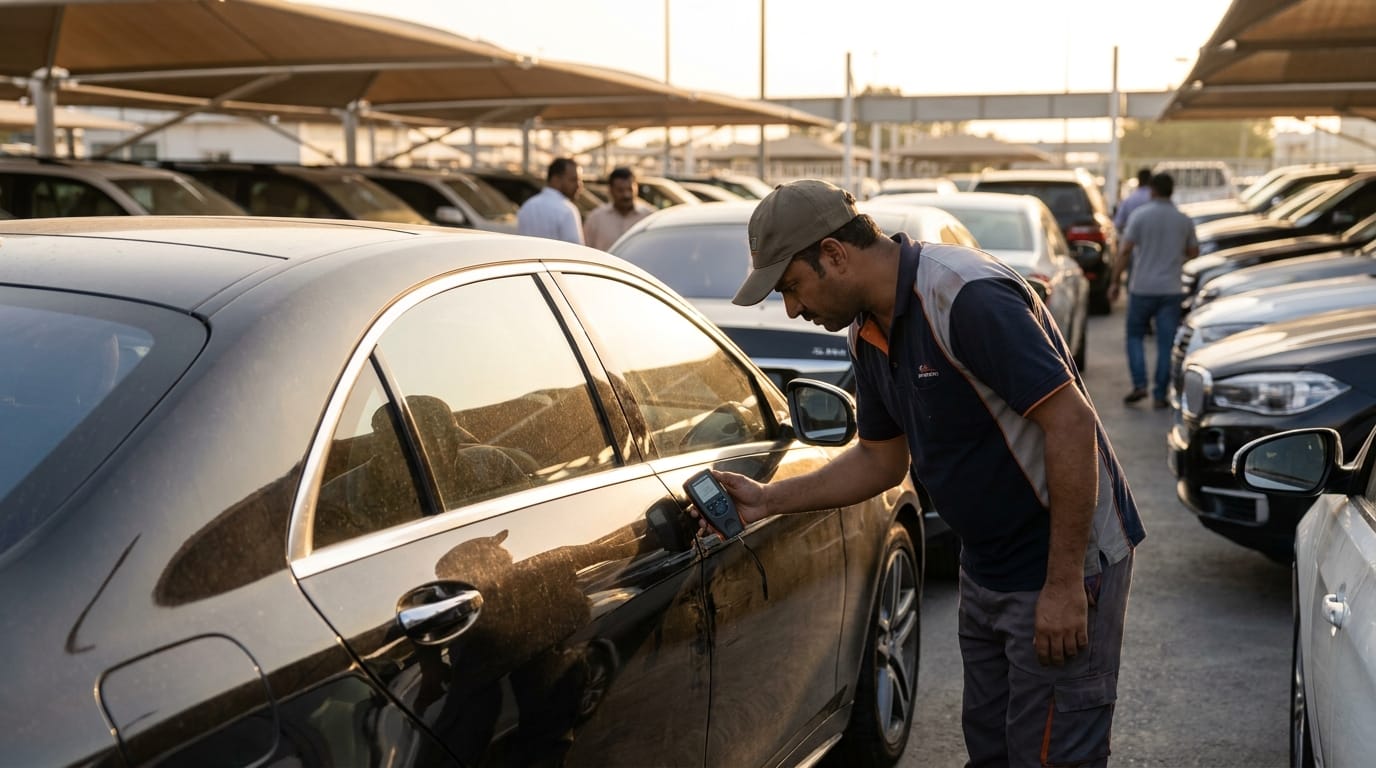
Paint thickness gauges measure the depth of paint on each panel. Factory paint is applied in consistent layers, typically between 90 and 130 microns. A reading of 200 to 400 microns on one panel compared to 110 on adjacent panels confirms filler or repainting over body repair. our inspection services guide lists pre-purchase inspection providers in Dubai and Sharjah.
Chassis alignment measurement on a workshop lift can detect frame distortion not visible to the eye. A vehicle that was straightened after structural damage may show measurement deviations that affect tire wear and handling.
OBD scanning reads stored fault codes from the vehicle’s electronic systems. Airbag deployment events, stability control interventions, and ABS events often leave codes that persist even after a workshop reset attempt. An experienced inspector knows which codes indicate incident history versus routine maintenance events.
Can Service History Reveal Accident Repairs?
Sometimes. When a vehicle was repaired at an authorized dealer workshop and the repair was documented in the service record, the history may show unusual part replacements — doors, hoods, fenders, airbags — at a mileage or date that does not correspond to a routine service interval.
Independent workshop repairs are less consistently documented. A body repair completed at an Al Quoz workshop may never appear in the service book if the seller chose not to record it.
What service history does confirm reliably: consistent servicing, ownership continuity, and dealer versus independent workshop use. These are useful signals but not accident detection tools on their own.
Can Insurance Records Reveal Previous Accidents?
In theory, yes. In practice, UAE insurance records are not publicly accessible in a centralized way that allows individual buyers to run a query on any vehicle.
What you can do: ask the seller to provide a letter from their insurance company confirming claim history on the vehicle. Some sellers will agree; many will not. If a seller declines without explanation, that is a relevant data point in your evaluation.
Insurance companies in the UAE do share some information between themselves through the Insurance Authority’s coordination mechanisms, but this does not translate into a publicly queryable buyer tool at present.
Can Vehicle History Reports Miss Some Accidents?
Yes — and this is an important reality to understand before you rely on a clean report as full reassurance.
Accidents settled privately between drivers — without police involvement and without insurance claims — typically produce no record in any system. In the UAE, minor fender contacts in parking areas are frequently settled with a cash payment on the spot, particularly among drivers who want to avoid insurance premium increases. These incidents leave no digital trace.
Accidents occurring in other countries before the vehicle was imported are only traceable if the importing country’s records are accessible by the tool you use. UAE government systems do not query foreign databases. For US-spec imports, Carfax may capture US-based incidents; for vehicles imported from other GCC countries, records are more difficult to obtain.
Imported Vehicles and Missing Accident Records
This deserves specific attention because imported vehicles represent a meaningful portion of the UAE used car market, particularly in the sub-30,000 AED range.
American Imports
Vehicles imported from the United States may carry salvage titles, rebuilt titles, or hail damage designations. The VIN can be checked against Carfax or AutoCheck to retrieve this history. A vehicle with a US salvage title that has been imported and re-registered in the UAE without disclosure is a significant concern both for safety and resale. our GCC vs non-GCC guide explains additional issues with US-spec vehicles.
Japanese Imports
Japan has its own vehicle history system, and some importers provide Japanese auction sheets that include accident grade assessments. An auction sheet grading of A or B typically indicates clean or minor condition; grades of C and below indicate progressively more significant damage history. Ask for the original auction sheet when evaluating Japanese imports.
Other GCC Imports
Vehicles transferred from Saudi Arabia, Bahrain, Kuwait, or Oman carry their home country registration history. Accident records from these countries are not automatically visible in UAE systems. Request whatever documentation the seller has from the country of origin.
How Dealers Usually Verify Accident History
Professional dealers typically run a VIN-based database check and conduct a visual inspection before pricing a vehicle. However, the depth of this process varies significantly between established dealerships and smaller traders.
Large certified pre-owned programs — offered by some brand authorized dealers — include thorough inspection protocols with documented findings. These programs typically carry some form of disclosure guarantee and may offer limited warranty coverage.
Smaller used car traders in markets like Al Aweer in Dubai or Abu Shagara in Sharjah operate with more variable practices. Some are thorough and transparent; others prioritize turnover. The absence of a formal certification process does not mean a dealer is operating dishonestly, but it does mean you need to conduct your own verification rather than relying on the dealer’s assessment alone.
Private Seller vs Dealer Risk Comparison
| Factor | Private Seller | Dealer / Trader |
|---|---|---|
| Disclosure obligation | Generally no formal obligation in private sale | Consumer protection regulations may apply |
| Accident history access | Limited — what they know from ownership | Typically run database checks before purchase |
| Complaint channel availability | More limited after sale | Consumer Protection, DED may be relevant |
| Price negotiation flexibility | Often more flexible | Typically less flexible |
| Documentation completeness | Variable | Generally more complete |
| Hidden problem risk | Higher with unverified sellers | Lower with established dealers, variable with traders |
Warning Signs Before Buying
🚨 Stop Before You Pay: If you observe any combination of these warning signs, do not proceed with the purchase until you have completed an independent professional inspection with a written report. The cost of a pre-purchase inspection — typically between 300 and 700 AED depending on provider — is minimal compared to the potential cost of buying a concealed accident vehicle.
- Seller discourages or refuses an independent mechanical inspection
- Paint panels that do not match in shade or texture
- VIN numbers that do not match across all locations on the vehicle
- Service history with unexplained gaps at low mileage points
- Airbag warning light, or obvious signs of airbag cover replacement
- Unusually low price relative to comparable clean-history vehicles
- Seller cannot explain why the price is significantly below market
- Vehicle registration history shows multiple emirate transfers in short periods
- The vehicle was recently imported with incomplete history documentation
Questions Every Buyer Should Ask the Seller
Ask these questions directly, in writing where possible — via WhatsApp or SMS — before meeting to view the vehicle. Written responses become evidence if problems emerge later.
- Has this vehicle been involved in any road accident, parking incident, or collision during your ownership?
- Has any panel, bumper, door, hood, or trunk been repaired or repainted since purchase?
- Have any airbags ever deployed in this vehicle?
- Is there any insurance claim history on this vehicle you are aware of?
- Has this vehicle been imported from outside the UAE? If so, do you have any documentation from the country of origin?
- Can I take this vehicle to an independent inspector of my choice before I pay?
A seller who answers these questions clearly and consistently, and agrees to an independent inspection, is behaving transparently. Evasive answers or refusal to allow inspection warrant caution.
Documents That Help Confirm Accident History
| Document | What It Reveals | Where to Obtain |
|---|---|---|
| Police accident report | Official record of reported incidents | Dubai Police, Abu Dhabi Police portals |
| Insurance claim history letter | Filed claims and payout events | Seller’s insurance company, on request |
| Authorized dealer service record | Parts replaced, repair events at dealer | Seller provides; verifiable at dealer |
| RTA vehicle history print | Registered accidents in Dubai system | RTA portal / Dubai Now app |
| US/international VIN report | Title status, salvage designations | Carfax, AutoCheck (for US imports) |
| Japanese auction sheet | Condition grade, damage notation | Importer should provide on request |
| Pre-purchase inspection report | Physical evidence of past repairs | Independent inspection provider |
Illustrative Field Scenarios: Workshop and Market Patterns
Example scenario based on recurring UAE market patterns, not actual documented cases.
Scenario 1 — The Camry with a Repainted Front End
Ravi, an Indian software engineer working in Dubai Marina, found a 2019 Toyota Camry listed on Dubizzle for 52,000 AED — approximately 8,000 AED below comparable listings. The seller, a private individual in Deira, explained the lower price as “urgent sale due to visa change.” Ravi ran an RTA check and found no official accident records. That reassured him, but he still booked an independent paint thickness check at an inspection service near Al Quoz Industrial Area.
The gauge returned readings of 340–420 microns on the front hood and both fenders, compared to 115 microns on the roof and doors. The written report confirmed previous front-end collision repair with filler application. Ravi went back to the seller with the report and negotiated an additional reduction of 6,000 AED. He purchased with full awareness of the repair history — a workable outcome because he had documentation before paying. Without that inspection, he would have paid full undamaged market price for a repaired vehicle.
Scenario 2 — The American Import with a Salvage Background
Maria, a Filipino nurse working at a private hospital in Abu Dhabi, was shown a 2020 Nissan Altima by a small trader in Mussafah at 38,000 AED — significantly below the typical 48,000–52,000 AED range for similar GCC-spec examples. The trader described it as “perfect condition, just imported.” Maria ran a Carfax check on the VIN before agreeing to inspect the vehicle in person.
The report came back with a US salvage title following a flood event in Texas. She brought the report to the meeting anyway. The trader acknowledged the history only after seeing the printout, then described the vehicle as “professionally inspected and cleared.” Maria declined and found a clean GCC-spec Altima through a private seller in Sharjah three days later at 47,500 AED. The Mussafah vehicle eventually resold to another buyer who may not have run the check. Running the VIN before travelling to view the car saved Maria both time and money.
Scenario 3 — The Private Sale with No Records
Asif, a Pakistani logistics driver based in Sharjah, purchased a 2017 Honda City from a private seller for 22,000 AED. The car looked clean and drove well on a short test drive. Asif skipped the independent inspection to save the 400 AED fee and avoid the extra day of waiting — the seller was pushing for a quick transfer. Within three months, he noticed irregular front tire wear.
A mechanic in the Sharjah Industrial Area found that the front subframe had been welded following a previous impact and that alignment was measurably off from factory spec. Correction required between 2,800 and 4,500 AED in parts and labor. On top of that, front tires wore unevenly and needed replacement earlier than they would have on a correctly aligned vehicle. The total additional cost over 12 months exceeded the 400 AED inspection fee by a significant margin. Asif still owns the car. He says he would never skip the inspection again.
What If You Discover the Hidden Accident After Buying?
This situation is more common than most buyers expect, and the options available to you depend significantly on what evidence you have, how the transaction was conducted, and how much time has passed since the sale.
First Steps After Discovery
The sequence in which you act after discovering hidden accident damage matters. Following the right order preserves your options; acting out of order can close them.
- Stop making changes to the vehicle. Do not repair, repaint, or modify anything related to the discovered damage. Any alterations to the vehicle’s condition reduce the evidentiary value of the current state.
- Get an independent professional inspection immediately. A written report from a qualified inspector, documenting the nature and extent of the hidden damage, is the foundation of any complaint or legal step. Without this, you are making verbal claims that are difficult to support.
- Preserve all original documentation. The sale agreement, bank transfer records, vehicle advertisement screenshots, WhatsApp conversations with the seller — everything that relates to the transaction should be saved in at least two separate locations.
- Document the damage with photographs. Date-stamped photographs of the damage, taken before any workshop visit, support your timeline and the argument that you did not know about the problem at the time of purchase.

How to Gather Evidence
| Evidence Item | Why It Matters | How to Obtain |
|---|---|---|
| Independent inspection report | Technical foundation of your claim | Any reputable pre-purchase inspection provider |
| Photographs of hidden damage | Visual documentation before repair | Take yourself — date-stamped |
| Repair cost estimate | Quantifies your financial loss | Two to three workshop quotes in writing |
| Original advertisement | Shows what was claimed at point of sale | Screenshot before it disappears |
| All seller communications | Captures verbal claims made in writing | WhatsApp, SMS, email history |
| Sale agreement / receipt | Establishes transaction terms | Keep original from point of sale |
| Seller’s Emirates ID copy | Required for any formal complaint | Request at point of sale |
| VIN report (Carfax or UAE official) | Shows what records existed before purchase | Run before and save immediately after purchase |
Can the Seller Be Asked to Compensate?
Yes, and in many cases a direct approach to the seller — presenting the inspection report and repair cost estimates — resolves the matter without formal legal steps. Some sellers, when confronted with documented evidence of concealed damage, will negotiate a partial refund or contribution toward repair costs to avoid escalation.
Outcomes vary significantly based on the seller’s willingness to engage and the strength of your documentation. There is no guarantee of any specific outcome from a direct approach, but it is generally the fastest and least expensive first step.
When making this approach: be factual rather than emotional. Present the inspection report, the repair estimates, and a specific number you are seeking. Keep all communication in writing.
Can You Cancel the Sale?
This depends on the specific facts of your transaction, the terms of any written agreement, and applicable UAE consumer protection regulations.
In general, UAE consumer protection law provides some recourse when a product is materially different from what was represented at the point of sale. Hidden structural accident damage, if it can be demonstrated to have been present at the time of purchase, may constitute such a material misrepresentation.
Buyers may have legal remedies depending on the evidence available and the specific circumstances of the sale. Outcomes vary significantly based on available documentation, how the transaction was conducted, whether the sale involved a registered business or a private individual, and whether any written representations were made about the vehicle’s condition. This is an area where formal legal advice is genuinely useful before committing to any course of action.
When Consumer Protection May Help
If the vehicle was sold by a registered dealer or trader — a business rather than a private individual — the relevant consumer protection authority may be able to assist.
In Dubai, the Department of Economy and Tourism (DET) operates the Consumer Rights department and accepts complaints about business practices. Their portal is at det.gov.ae. Filing a complaint requires documentation: your purchase records, the inspection report, evidence of misrepresentation.
In Abu Dhabi, the Department of Economic Development handles consumer protection matters.
Consumer protection channels are generally more effective when the seller is a registered business with an identifiable trade license, when you have clear written documentation of what was represented, and when the sale occurred recently. Private individual-to-individual sales fall into less certain territory under consumer protection frameworks.
When Legal Advice May Be Necessary
If the hidden damage is significant — involving structural safety issues or representing more than 10,000 to 15,000 AED in repair costs or value reduction — and the seller declines to engage, consulting a UAE-licensed legal professional becomes a practical consideration rather than an extreme measure.
UAE courts, including the Small Claims Court for Dubai, handle disputes of this nature. our small claims guide covers the process in practical detail. Legal advice helps you understand whether the facts of your specific case are likely to support a viable claim, and what the realistic costs and timeline of pursuing that claim would be.
Do not rely on general descriptions of the legal process — including this article — as the basis for deciding whether to take formal legal action. The specific facts of your transaction matter significantly.
Scam Prevention: Fraud Patterns Around Accident History
🚨 Most Common Fraud Pattern: The “we already had it inspected” claim. A seller presents a paper inspection certificate — often a genuine-looking but selectively obtained Tasjeel pass certificate — as proof the vehicle has no problems. Tasjeel inspection confirms roadworthiness and emissions compliance. It does not verify accident history, frame alignment, paint thickness, or structural integrity. A Tasjeel pass certificate is not accident clearance documentation. Never accept it as such.
Other fraud patterns to recognize in the UAE used car market:
- The urgency narrative: Sellers who must sell immediately create time pressure that discourages proper verification. “My visa expires in three days” is a common version. Genuine sellers can wait 24 to 48 hours for an inspection.
- The pre-screened inspection offer: A seller who offers to take you to “their” mechanic for an inspection is offering a mechanic with whom they have a relationship. Always use an inspector you find independently.
- The clean report that covers only part of the vehicle: Some sellers obtain targeted inspection reports that document the engine and mechanical systems while avoiding any mention of body and structural condition. Read the scope of any inspection report carefully.
- Multiple owners in short succession: A vehicle that has changed hands three times in 18 months, particularly with different emirate registrations each time, warrants extra scrutiny. Sellers moving vehicles through quick transfers sometimes do so to distance the accident history from the current sale.
How Hidden Accident History Changes Future Resale Value
The market is increasingly aware of accident history as a valuation factor. Platforms like Dubizzle now include fields for accident history declaration, and buyers are increasingly asking for documented verification. our marketplace comparison discusses how these platforms handle disclosure.
When you attempt to sell a vehicle with hidden accident history you have now discovered, you face a choice. Selling without disclosure creates the same ethical and potentially legal situation the original seller created. Selling with full disclosure typically requires a price reduction. The extent of that reduction depends on what the market currently regards as an appropriate discount for the specific type and extent of damage.
Rough market guidance: minor repaired damage (panels, bumpers) typically reduces resale offers by 5 to 12 percent. Airbag deployment history reduces offers by 15 to 25 percent on most models. Structural or chassis damage significantly affects buyer interest regardless of repair quality — many buyers will simply decline rather than negotiate on a structurally damaged vehicle.
Should You Repair or Sell the Vehicle?
The Bottom Line Decision Framework
| Your Situation | Recommended Approach |
|---|---|
| Minor cosmetic damage, repair under 3,000 AED | Repair, use the vehicle, disclose fully when selling |
| Panel or bumper damage, repair 3,000–10,000 AED | Get seller to contribute or pursue complaint; repair and sell with disclosure |
| Airbag deployment or structural damage | Prioritize complaint or legal route first; seek independent repair assessment before deciding to keep |
| Chassis or frame damage | Get legal advice; consider whether the vehicle is suitable for continued use depending on repair quality assessment |
| Salvage or rebuilt title import | Seek legal advice; resale and insurance implications are substantial |
Quick Decision Flow: Found Accident Damage?
%%{init: {'theme': 'base', 'themeVariables': {'background': '#f8f9fa', 'textColor': '#1a1a1a', 'primaryColor': '#2c3e50', 'secondaryColor': '#c0392b', 'lineColor': '#1a1a1a'}}}%%
flowchart TD
    classDef default fill:#2c3e50,stroke:#1a1a1a,stroke-width:1px,color:#ffffff;
    A[Found accident history?] --> B{Minor damage only?}
    B -->|Yes| C{Price reduction acceptable?}
    C -->|Yes| D[Buy with written inspection report]
    C -->|No| E[Walk away or renegotiate]
    B -->|No| F{Airbag or structural?}
    F -->|Airbag| G[Get full airbag system inspection first]
    G --> H{Cost and quality acceptable?}
    H -->|Yes| D
    H -->|No| E
    F -->|Structural/Chassis| I[Walk away — risk not worth negotiating]
Accident Type: Usually Acceptable to Buy?
| Damage Type | Usually Acceptable? | Condition |
|---|---|---|
| Paint scratch or scuff | Yes | No structural involvement |
| Bumper repair or replacement | Usually yes | Good quality repair, price adjusted |
| Door replacement (single) | Usually yes | Paint match confirmed, no frame damage |
| Fender or hood replacement | Often yes | No firewall or chassis involvement |
| Airbag deployment | Often no | Only if airbag system fully replaced and tested |
| Chassis or A/B-pillar damage | No | Structural integrity cannot be fully guaranteed after repair |
| Salvage or rebuilt title | No | Insurance and resale implications are substantial |
How Much Value Can an Accident Reduce?
Market behavior in the UAE used car market generally produces the following patterns, based on workshop observations and resale activity across Al Quoz, Al Aweer, and Abu Shagara markets:
- A 2018–2021 Toyota Corolla with disclosed minor cosmetic accident history typically sells for 8 to 12 percent less than a clean example of the same specification and mileage.
- A Honda Accord with airbag deployment history typically attracts 20 to 30 percent lower offers than equivalent clean examples, partly due to buyer uncertainty about airbag replacement quality.
- A Nissan Sunny with structural damage history, even if repaired, typically trades at 25 to 40 percent below clean-market value — partly because the model’s overall market position gives buyers little incentive to accept unknown repair quality risk at similar prices to cleaner alternatives.
These are market patterns, not guarantees. Individual transactions vary based on the specific repair quality, available documentation, and buyer confidence.
What Buyers Usually Miss During Inspection
Most buyers check the obvious areas — paint, panel gaps, bumpers. The following spots are less commonly checked but often reveal more useful information about a vehicle’s accident history.
- Roof welds and pillars: A-pillar and B-pillar welds are visible if you look at the junction between the roof and the door frames from outside. Non-factory welding in these areas indicates significant structural repair.
- Trunk floor and spare tire well: Open the trunk and remove the spare tire. The floor underneath should be smooth, factory-finished metal. Filler, weld marks, or replaced metal in this area typically indicates a rear collision.
- Seat belt date stamps: Most seat belts carry a manufacture date stamp on the webbing or hardware. Seat belts replaced after the car’s build date — particularly on the side that would align with a collision — may indicate airbag or safety system involvement.
- Windshield date stamp: The windshield carries a manufacture date in the corner. A replacement windshield significantly newer than the car’s build year may indicate front-end collision damage — or it may simply reflect a crack repair. Context matters.
- ECU replacement evidence: An OBD scan sometimes reveals that the engine control unit or airbag control unit has a different manufacturing date or serial prefix than expected. This is a specialist check, but it can indicate module replacement following impact events.
What Does NOT Always Mean a Major Accident
Inexperienced buyers sometimes interpret normal repairs as evidence of serious collisions. Understanding what can be replaced without accident involvement helps you evaluate evidence correctly — and avoid walking away from perfectly reasonable vehicles.
- Repaint on a single panel: Panels get repainted for many reasons — parking lot scrapes, hail pitting, paint fade in the UAE sun. A single repainted rear door does not automatically indicate a major collision. Check the panel gap and the surrounding structure.
- Bumper replacement: Bumpers are designed to absorb low-speed impacts and are frequently replaced after minor contact. A newer bumper on an otherwise clean vehicle, with no evidence of structural involvement, is often a routine repair.
- Mirror replacement: Side mirrors are commonly replaced after car wash damage, parking contact, or theft. A newer mirror unit is a very weak indicator of accident history on its own.
- Windshield replacement: Windscreens in the UAE are replaced regularly due to stone chips from highway driving. A replacement windshield alone is not accident evidence.
- Minor paint oxidation differences: In the UAE’s heat, paint on sun-exposed panels sometimes oxidizes at slightly different rates. Minor shade differences on aging vehicles are not necessarily evidence of repainting.
ℹ The Right Approach: Each sign should be evaluated in context, not in isolation. A single repainted panel with consistent panel gaps, no structural involvement, and a reasonable explanation from the seller is different from three repainted panels with mismatched gaps and a seller who cannot explain the history. Look for patterns, not individual data points.
Common Buyer Mistakes
- Relying only on the RTA history check and skipping physical inspection. The database captures officially reported incidents; a physical inspection captures repair evidence regardless of whether any report was filed.
- Trusting the seller’s statement that the vehicle has “no accidents.” Even genuinely honest sellers may not know the full history of a vehicle they purchased second-hand.
- Skipping the inspection to save 400 to 700 AED. This is the most common mistake. The inspection cost is trivial relative to the potential cost of buying a concealed accident vehicle.
- Focusing only on purchase price relative to other listings. A vehicle priced 10,000 AED below market for an unexplained reason should trigger more verification, not less.
- Assuming a Tasjeel pass equals a clean vehicle history. As covered above, these are entirely different assessments.
- Not documenting the pre-purchase conversation with the seller. If you ask the seller verbally about accident history and they deny it, that denial needs to be confirmed in writing to have any value later.
Complete Pre-Purchase Accident Verification Checklist
| Step | Action | Tool / Resource |
|---|---|---|
| 1 | Run official RTA or emirate database check | RTA portal, Dubai Now app, TAMM |
| 2 | Check VIN across all physical locations on the vehicle | Visual check — dashboard, door jamb, engine bay |
| 3 | Run Carfax or equivalent for imported vehicles | carfax.com, autocheck.com |
| 4 | Ask seller all accident history questions in writing | WhatsApp or SMS — save responses |
| 5 | Request seller insurance claim history letter | Seller provides — from their insurance company |
| 6 | Conduct visual inspection: paint, gaps, seams, trim | Your own eyes — see checklist above |
| 7 | Book independent professional inspection | Independent provider, not seller’s mechanic |
| 8 | Get written inspection report with paint thickness data | Report from inspector — keep original |
| 9 | Screenshot the original advertisement before it closes | Your phone — date-stamped screenshot |
| 10 | Complete sale only after reviewing all findings | — |
After Discovery: Action Plan Checklist
| Priority | Action | Timing |
|---|---|---|
| 1 | Stop all vehicle modifications or related repairs | Immediately |
| 2 | Photograph all damage — date-stamped | Same day |
| 3 | Book independent inspection — get written report | Within 1 to 3 days |
| 4 | Obtain two to three repair cost estimates in writing | Within 3 to 5 days |
| 5 | Gather and save all transaction and communication records | Immediately |
| 6 | Contact seller — present evidence, state your position | After inspection report received |
| 7 | File consumer protection complaint if seller is a business | If direct approach fails |
| 8 | Consult legal professional if damage is significant | Based on repair costs and circumstances |
Data Sources and Methodology
The accident history verification methods, market patterns, and depreciation estimates in this article are based on observations from pre-purchase inspections conducted across Dubai, Sharjah, and Abu Dhabi workshops, combined with publicly available UAE government guidance and international vehicle history databases. All AED value estimates are illustrative ranges derived from market observation across Al Quoz, Al Aweer, and Abu Shagara used car trading areas.
Official sources referenced:
- Roads and Transport Authority (RTA) — Dubai
- TAMM Abu Dhabi Government Services
- Abu Dhabi Police — Traffic Services
- Dubai Department of Economy and Tourism — Consumer Rights
- Carfax — International Vehicle History
- AutoCheck — Vehicle History Reports
ℹ Market Volatility Notice: All vehicle value estimates, depreciation ranges, and market price comparisons in this article reflect observed patterns at the time of writing. UAE used car prices fluctuate based on supply, seasonal demand, fuel prices, and broader economic conditions. Verify current market values independently before making any purchase or sale decision.
Frequently Asked Questions
Final Buying Advice
The single most effective protection against buying a vehicle with undisclosed accident history in the UAE is a written independent inspection report obtained before payment. Everything else — database checks, visual inspection, seller questioning — supports that central step but does not replace it.
Budget 400 to 700 AED for an inspection on any vehicle you are seriously considering. Think of it as the cost of the information you need to make a properly informed decision. On a 40,000 AED purchase, this represents less than two percent of the transaction value.
If a seller declines an independent inspection or creates conditions that make it difficult — urgent timelines, requirements to pay before inspecting, refusal to allow your chosen mechanic — treat this as significant information about the transaction, not just an inconvenience to work around.
The UAE used car market has many honest sellers and many good vehicles. It also has a real pattern of undisclosed accident history. The buyers who avoid problems are almost always the ones who built verification into their process rather than relying on trust and appearance alone. our service history fraud guide covers the parallel problem of odometer and service record manipulation — a common companion issue to accident history concealment.
Disclaimer: Emirates Cars is a 100% independent platform. We do not own showrooms, nor are we affiliated with any used car dealerships or garages. Our sole mission is to protect expats from financial fraud in the automotive market.
