Last Updated: July 2026 | By Omar Al-Fayed, Senior Automotive Consultant | Category: Buying & Selling
Document fraud is one of the quieter risks in the UAE used car market. A buyer inspects the engine, checks the tyres, takes a test drive — and then signs papers without reading them carefully.
This guide covers every document you need to verify before paying for a used car in the UAE, how to check each one, and what the warning signs look like. If you are planning a purchase on Dubizzle or Facebook Marketplace, document verification is not optional — it is the step most expats skip.
⚠ Legal Disclaimer: The information provided in this article is for educational purposes only. UAE legal procedures, document verification requirements, and RTA regulations may change over time. Readers should verify current requirements with official UAE government portals before making any purchase decisions. Emirates Cars is an independent advisory platform and does not provide legal advice.
Why Fake Vehicle Documents Are Becoming More Common in the UAE
The UAE used car market has grown significantly over the past several years. Platforms like Dubizzle, YallaMotor, and Facebook Marketplace allow anyone to list a car in minutes — with no document verification at the point of listing.
Several factors have contributed to the increase in document fraud:
- Smartphone editing tools make it possible to alter PDFs and image files with minimal skill
- High demand for affordable used cars means buyers sometimes move quickly without checking thoroughly
- Imported vehicles — particularly US-spec and flood-salvage imports — may carry documents from multiple jurisdictions that are harder to cross-check
- Service records from independent workshops are especially easy to fabricate because there is no central independent workshop database in the UAE
The most common targets are buyers who are new to the UAE, unfamiliar with local paperwork, or under time pressure. Red flags from dealers often appear in the documents before they appear anywhere else.
What Documents Every UAE Used Car Buyer Should Verify
Before any money changes hands, ask for the following:
| Document | What It Proves | Can Be Faked? |
|---|---|---|
| Mulkiya (Registration Card) | Current ownership and registration validity | Yes — commonly |
| Emirates ID of Seller | Identity of the person you are dealing with | Possible |
| Service History Book or Records | Maintenance history and mileage progression | Yes — frequently |
| Insurance Certificate | Current coverage and claim history (partial) | Less common |
| Finance Clearance Letter | Confirms no active bank loan on the vehicle | Yes |
| Purchase Invoice | Previous sale price (useful for price history) | Occasionally |
| Export Documents | Required for imported vehicles — confirms origin | Yes |
Never accept photocopies as your only reference. Always ask to see originals and compare them with the vehicle physically present.
What Is the UAE Mulkiya?
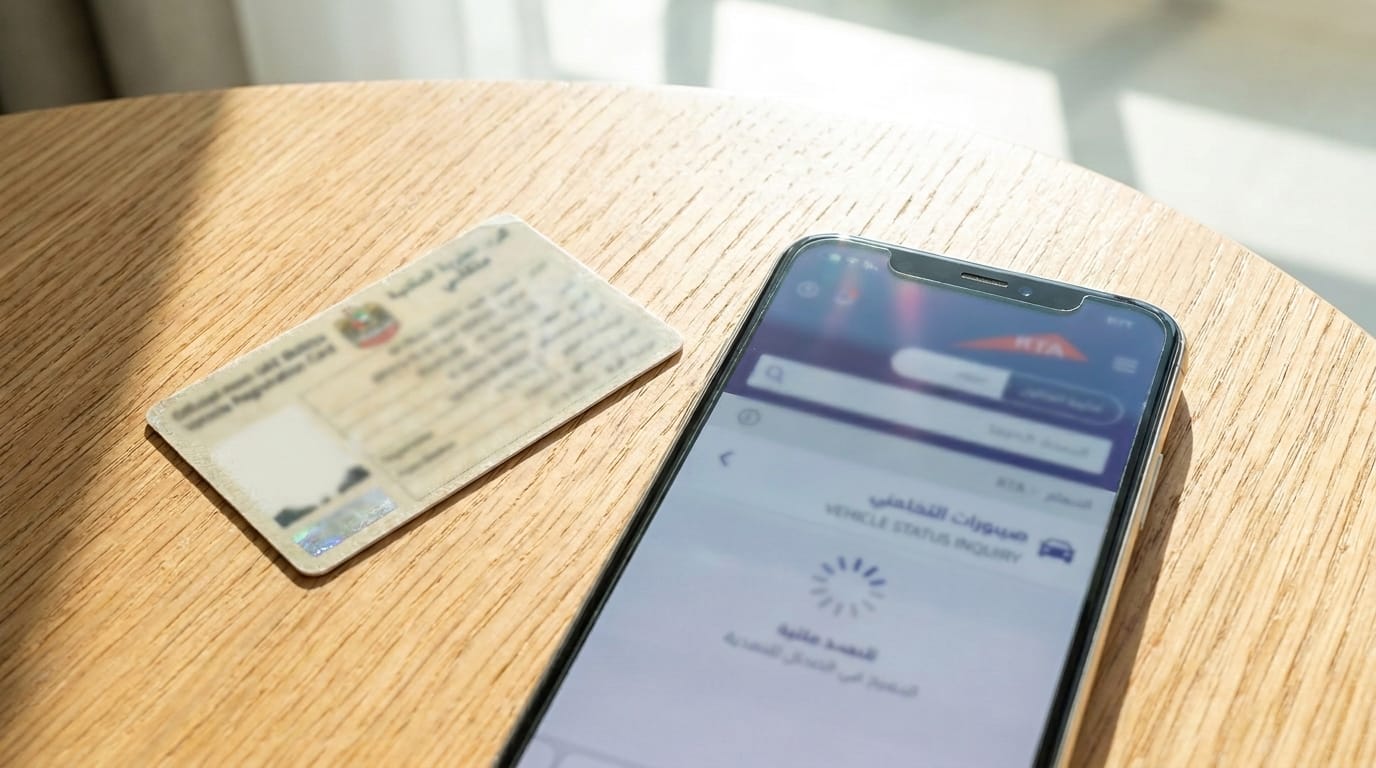
The Mulkiya is the official vehicle registration card issued by the Roads and Transport Authority (RTA) in Dubai, or by the equivalent traffic authority in each emirate. It is the primary legal document proving ownership of a vehicle in the UAE.
A standard Mulkiya includes:
- Full name of the registered owner
- Vehicle make, model, year, and colour
- Chassis number (VIN)
- Engine number
- Plate number
- Registration expiry date
- Issuing authority and emirate
The Mulkiya must be renewed annually. An expired Mulkiya means the vehicle has not passed a recent inspection and cannot legally be driven. Passing the Tasjeel inspection is a requirement before registration renewal — meaning a valid Mulkiya provides some mechanical baseline assurance, though it is not a comprehensive mechanical report.
How to Verify a Mulkiya Online
Each emirate has its own vehicle verification portal. The most widely used are:
| Emirate | Verification Source | What You Can Check |
|---|---|---|
| Dubai | rta.ae — Vehicle Inquiry | Registration status, fines, ownership |
| Abu Dhabi | adpolice.gov.ae — Vehicle Services | Registration, fines, technical data |
| Sharjah | shjmot.gov.ae | Registration status |
| All Emirates | moi.gov.ae — Traffic Services | National traffic fines, plate lookup |
To use these portals, you typically need the plate number or chassis number. The RTA Dubai portal and Abu Dhabi Police portal are the most detailed. They will confirm whether the vehicle is currently registered, whether there are outstanding fines, and in some cases, ownership details.
One important limitation: these portals confirm the registration record but do not automatically detect whether the physical document in front of you has been altered. A fraudster can present a fake Mulkiya while the official record is clean — so always cross-reference the document details with the portal results character by character.
Signs That a Mulkiya May Be Fake
Physical examination of the document reveals most forgeries. Check the following:
🚨 Priority Warning: If the chassis number on the Mulkiya does not exactly match the VIN plate on the vehicle dashboard and the VIN stamped on the engine bay, do not proceed with the purchase. This is the single most reliable indicator of document fraud or a cloned vehicle.
| What to Check | Genuine Mulkiya | Possible Fake |
|---|---|---|
| Font consistency | Uniform throughout | Mixed fonts or sizes |
| QR code | Scans to official RTA/authority page | Does not scan or leads to blank page |
| Paper quality | Firm card stock, slight texture | Regular paper, thin, or glossy |
| Stamp and seal | Clear authority logo, correct colours | Blurred, pixelated, or wrong shade |
| Expiry date format | Consistent with year of purchase | Altered dates, inconsistent year |
| VIN match | Exactly matches vehicle chassis plate | Any discrepancy, even one digit |
| Plate number | Matches physical plates on vehicle | Different from current plates |
Scan the QR code with your phone immediately. A genuine RTA Dubai Mulkiya QR code directs to the RTA vehicle details page. If it redirects anywhere else or fails to load, treat it as a serious concern.
How to Verify Vehicle Ownership
The name on the Mulkiya must match the Emirates ID of the person selling the vehicle. This sounds obvious, but a significant number of fraud cases involve a seller presenting a valid Mulkiya registered to someone else — often claiming to be selling on behalf of a relative, employer, or friend.
Steps to verify ownership:
- Ask for the seller’s original Emirates ID and photograph it
- Compare the name on the Mulkiya exactly with the Emirates ID
- If the names differ, ask for a notarised Power of Attorney — not just a verbal explanation
- Run the plate number through rta.ae and confirm the registered owner name matches what you are seeing
Company-owned vehicles carry additional complexity. If the Mulkiya shows a company name, confirm that the person selling has legal authority to do so. Request the company trade licence and a letter of authorisation on company letterhead.
For financed vehicles, the Mulkiya may show a bank as a co-owner or lien holder. Understanding car bank loans in UAE helps you know what clearance documents to request before transferring ownership. A finance clearance letter from the bank — original, not a photograph — is required before the ownership transfer can proceed at the RTA.
How to Verify Service History Online
This is where verification becomes more difficult. The UAE does not currently operate a single national service history database accessible to private buyers. Service record verification depends on where the vehicle was serviced.
For agency-serviced vehicles: Toyota, Nissan, Hyundai, Honda, and other major brands maintain digital service records at their authorised UAE dealerships. You can ask the seller to request a service history printout from the dealership. Alternatively, with the vehicle’s VIN, you can visit the authorised dealer yourself and ask them to confirm service dates and mileage entries. Dealerships are generally willing to share this with a prospective buyer when the seller is present or has provided authorisation.
For vehicles serviced at independent workshops: There is no central database. Each workshop keeps its own records. Verification requires contacting the workshop directly with the invoice numbers shown on the service book.
Can Independent Workshop Records Be Trusted?
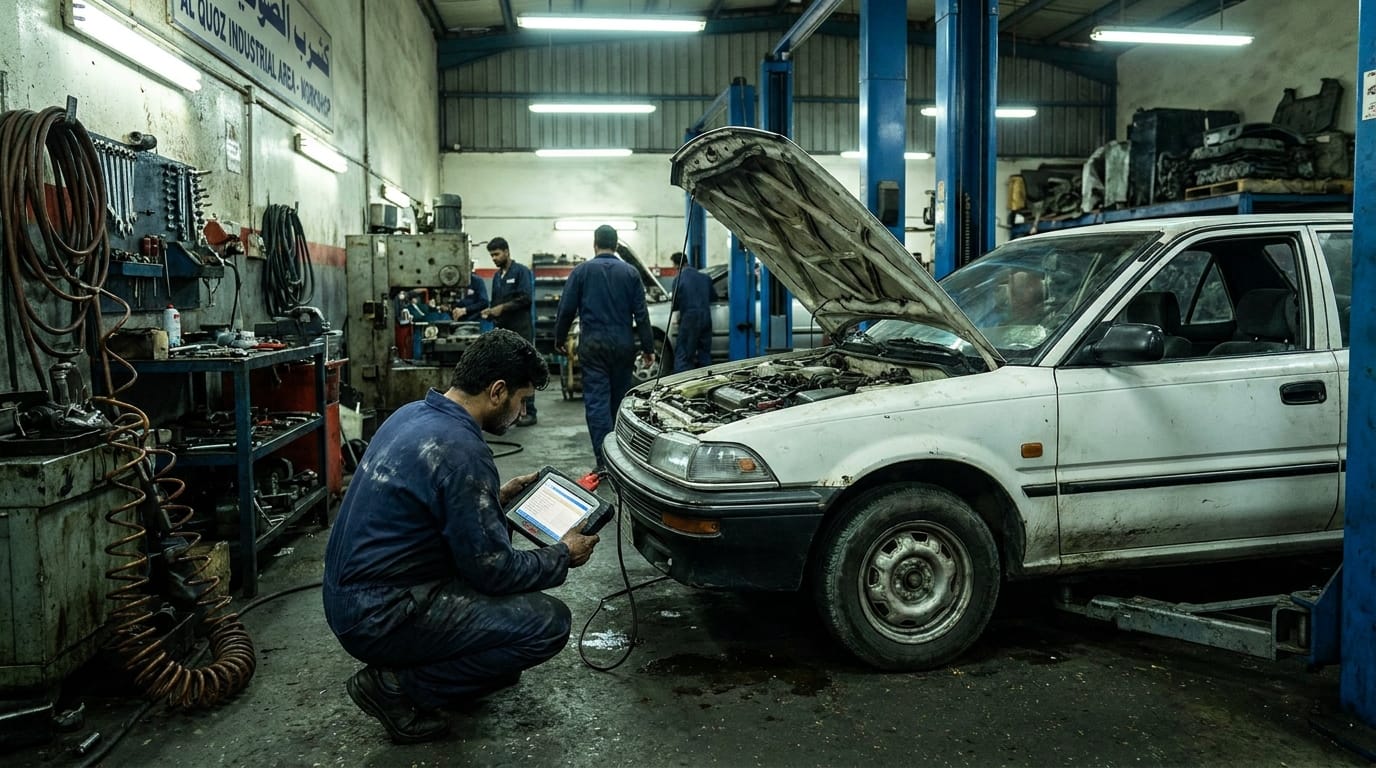
Independent workshop records from established workshops in areas like Al Quoz Industrial Area or Abu Shagara in Sharjah can be verified by visiting or calling the workshop directly. Reputable independent workshops in these areas maintain customer records going back several years.
The reliability varies. A well-known workshop with a fixed address, a visible signboard, and years of community reputation is a reasonable source. A workshop name printed on an invoice that you cannot find when you search online, or a workshop address that does not exist, is a significant concern.
Always call the workshop number on the invoice before your meeting with the seller. Confirm the vehicle’s registration number, service date, and mileage reading over the phone. This takes approximately five minutes and catches most forged workshop invoices.
How to Detect Forged Service Records
Forged service records follow recognisable patterns:
| Warning Sign | What It Suggests |
|---|---|
| Mileage jumps irregularly between services | Odometer tampering or missing service entries |
| All services done at the same mileage interval regardless of time gaps | Entries likely fabricated to appear consistent |
| Workshop stamps that look identical across multiple pages | Digital stamp copied and pasted |
| Service intervals far shorter than manufacturer recommendations | Inflated entry count to appear well-maintained |
| Oil change records showing 5,000 km intervals in hot UAE conditions | Possibly fabricated — most UAE workshops recommend 5,000–7,500 km but verify the pattern |
| Workshop phone number does not connect or connects to wrong business | Fake workshop details |
| Handwritten entries with no workshop stamp | Unverifiable — treat as absent |
A vehicle with genuine service history from an authorised dealer will have a printed record with the VIN, consistent mileage progression, and entries that match the vehicle’s age and typical usage in the UAE.
How to Verify Vehicle Mileage
Mileage verification requires multiple sources to cross-reference:
- Tasjeel inspection records: Each time a vehicle passes a Tasjeel or ADNOC vehicle inspection, the mileage is recorded. An inspection centre can sometimes provide historical mileage readings. This is the most reliable official source within the UAE.
- Service history mileage progression: Service entries should show a smooth and consistent increase in mileage over time. Any sudden drop in mileage between services strongly suggests tampering.
- OBD diagnostic scan: A professional OBD-II scanner can in some cases retrieve stored mileage values from the vehicle’s engine control unit. Some vehicles retain historical mileage data in the ECU that cannot easily be altered without specialist equipment.
- Physical wear indicators: Wear on the steering wheel, driver’s seat bolster, floor mats, pedal rubber, and gear shift knob should be roughly consistent with the claimed mileage. A car claiming 40,000 km but showing severely worn pedals and a cracked steering wheel suggests higher actual usage.
Odometer Fraud vs Fake Documents
These are related but distinct problems. Odometer fraud involves physically or digitally rolling back the mileage reading on the vehicle’s dashboard. Fake documents involve fabricating or altering the paper trail.
They frequently occur together. A seller who has tampered with the odometer will also alter service records to show mileage figures consistent with the rolled-back reading. This is why verifying both independently — the vehicle itself through an OBD scan, and the documents through workshop verification — is more effective than either check alone.
Odometer fraud in UAE is covered in detail in a separate guide, but as a baseline: any vehicle where the physical condition does not match the documented mileage warrants a professional OBD inspection before purchase.
How to Verify the VIN Number
The Vehicle Identification Number (VIN) is a 17-character code that uniquely identifies every vehicle. It appears in three standard locations:
- Dashboard plate visible through the windscreen on the driver’s side
- Door jamb sticker on the driver’s door
- Engine bay stamp on the chassis
All three locations must show the same VIN. Compare the VIN against the Mulkiya character by character — not word by word. Fraudsters sometimes change a single digit. The most commonly altered characters are 0/O, 1/I, and 8/B because they look similar.
Once you have confirmed the VIN, enter it into the RTA vehicle inquiry portal or the Abu Dhabi Police vehicle services portal to confirm the registration record matches. You can also use international VIN decoders such as nhtsa.gov for US-imported vehicles to check the original manufacturer specification and country of origin.
How GCC and Imported Cars Affect Document Verification
Document verification is more straightforward for GCC-specification vehicles that have always been registered in the UAE. The entire paper trail — from original sale to current registration — exists within the UAE system.
Imported vehicles present additional layers of complexity:
| Vehicle Type | Additional Verification Needed | Risk Level |
|---|---|---|
| GCC-spec, UAE-registered from new | Standard Mulkiya and service check | Lower |
| GCC-spec, imported from Saudi/Kuwait | Original export papers + UAE re-registration check | Moderate |
| US-spec import | US title document, auction record, UAE compliance cert | Higher |
| Japanese import | Export certificate (Shakken), UAE registration history | Moderate |
| Salvage/flood import | Full history report + independent structural inspection | High |
GCC-spec vs non-GCC spec vehicles carry meaningfully different documentation risks. A US-spec vehicle that entered the UAE through a grey import channel may carry a salvage title that the seller has not disclosed. Always ask for the original import documentation and the customs clearance certificate when buying any imported vehicle.
How to Verify Accident History
The UAE does not currently offer a comprehensive, publicly accessible accident history database equivalent to Carfax in the United States. However, several partial sources are available:
- RTA Dubai fine records: Major accident-related fines may appear in the vehicle’s fine history, which is accessible via rta.ae
- Insurance claim inquiry: Some insurance companies will share general claim history on a vehicle if you provide the VIN and the seller authorises the inquiry
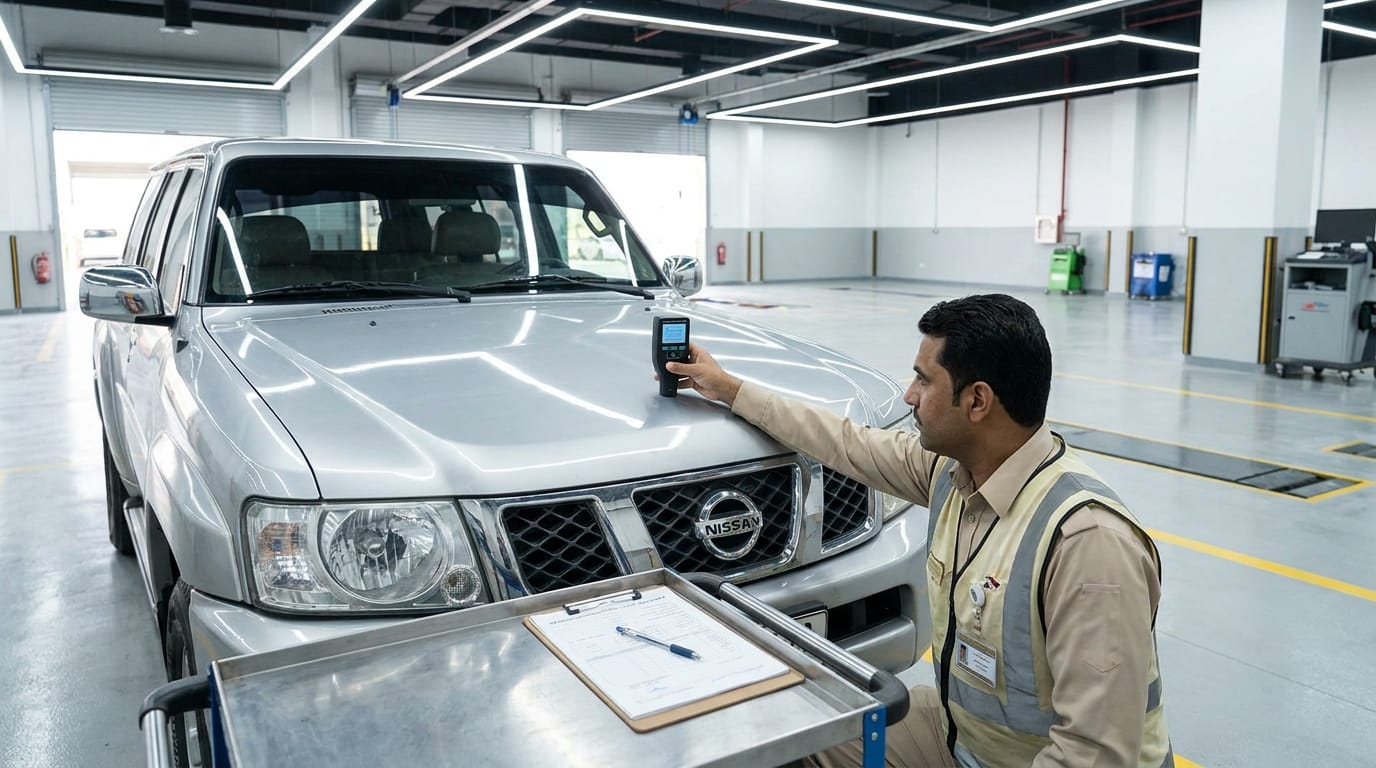
- Professional inspection: A trained inspector checking panel gaps, paint overspray, and structural alignment can detect most prior accident repairs within a 30-minute inspection
- Free UAE accident history checks are covered in a detailed guide with current available sources
No online tool currently provides guaranteed complete accident history for UAE-registered vehicles. Physical inspection by a trained mechanic remains the most reliable method.
How Insurance Records Can Reveal Hidden Problems
A vehicle with a history of major insurance claims — particularly total loss declarations or structural repair authorisations — may have problems that are difficult to detect through a standard visual inspection.
Ask the seller to request an insurance history summary from their insurer. Not all insurers provide this readily, but some will confirm whether the vehicle has been declared a total loss or had claims above a certain threshold. This takes one to three days and costs nothing if the seller is cooperative.
A seller who refuses this request entirely is worth noting. It does not confirm fraud, but it removes one verification option from your process.
Common Used Car Scams Involving Fake Documents
🚨 Most Dangerous Scam in UAE Used Car Market: The “bank clearance fake letter” scam. A seller presents a forged bank clearance letter claiming the vehicle is free of finance. The buyer transfers ownership, then discovers the bank still has a lien. The original loan remains active, and in some cases the vehicle can be repossessed. Always verify the clearance letter directly with the bank — call the bank’s customer service line using the number on their official website, not the number on the letter.
Other frequently reported document-related scams in the UAE used car market:
- Fake Mulkiya: A digitally altered registration card showing a different owner name or a different expiry date
- Cloned VIN: A stolen vehicle fitted with VIN plates copied from a legitimately registered vehicle of the same model
- Forged service book: A blank service book stamped with fabricated workshop details and mileage entries that do not match the vehicle’s actual history
- Fake warranty documentation: Extended warranty paperwork from a company that either does not exist or that the vehicle is not actually enrolled with
- Seller identity fraud: The person presenting documents is not the registered owner — they are selling a vehicle they do not have legal authority to sell
- Altered export documents: Import paperwork showing a clean title when the original export record shows salvage status
Warning Signs Before Meeting the Seller
Most document fraud can be anticipated before you even see the vehicle. Review the listing carefully:
| Warning Sign | Why It Matters |
|---|---|
| Price significantly below market average | Motivated sellers often have something to conceal |
| Photos do not show the Mulkiya or VIN plate | Legitimate sellers typically include these |
| Seller refuses to video call to show the vehicle live | Vehicle may not match the listing |
| Seller cannot confirm where the vehicle is currently registered | Possible cross-emirate confusion or re-registration issue |
| Seller pressures for a deposit before you have seen documents | Common advance fraud technique |
| Contact number does not match the emirate where car is listed | May indicate a brokered or fictitious listing |
| Listing age is very recent, seller account is very new | Account created specifically for this transaction |
Documents That Are Most Commonly Altered
Based on patterns observed across UAE market fraud cases, the documents most frequently altered are, in order of frequency:
- Service history records (independent workshop invoices are easiest to fabricate)
- Finance clearance letters (critical because they are required for ownership transfer)
- Mulkiya registration card (particularly expiry dates and owner names)
- Purchase invoices (used to misrepresent price history)
- Export and import documents (used to conceal salvage status)
Step-by-Step Verification Checklist Before Paying
flowchart TD
    A[Get Vehicle Documents from Seller] --> B[Check Mulkiya via MOI / RTA / EVG Portals]
    B --> C{Is Mulkiya Record Valid?}
    C -->|No - Record Mismatch| D[Flag Document Fraud & Walk Away]
    C -->|Yes - Valid Record| E[Cross-Reference VIN with Service History]
    E --> F{Do Mileage Logs Align Chronologically?}
    F -->|No - Discrepancies Found| G[Flag Odometer Rollback & Decline]
    F -->|Yes - Clear History| H[Proceed to Technical Physical Inspection]
    classDef default fill:#000000,color:#ffffff,stroke:#000000;
While the diagram above highlights the conditional logic of your check, the comprehensive table below provides the exact execution steps and the realistic time required for each verification:
| Step | Action | Time Required |
|---|---|---|
| 1 | Request full documents list before meeting — Mulkiya, Emirates ID, service records, finance clearance | 0 min (remote) |
| 2 | Photograph seller’s original Emirates ID at meeting | 1 min |
| 3 | Check name on Mulkiya exactly matches Emirates ID | 2 min |
| 4 | Scan QR code on Mulkiya to verify against official portal | 2 min |
| 5 | Check plate number on RTA or emirate traffic portal — confirm registration status and outstanding fines | 5 min |
| 6 | Physically check VIN in all three locations against Mulkiya | 5 min |
| 7 | Call each workshop listed in service book to confirm vehicle records | 10–20 min |
| 8 | If agency-serviced, visit or call dealer to confirm service history against VIN | 1–3 days if needed |
| 9 | If financed, call issuing bank directly to confirm clearance letter is genuine | 10–20 min |
| 10 | Book independent pre-purchase inspection | 1 day |
The full pre-purchase test drive and inspection checklist covers mechanical verification that should run alongside document verification.
Free Online Verification Resources in the UAE
| Resource | URL | What It Verifies | What It Cannot Verify |
|---|---|---|---|
| RTA Dubai Vehicle Inquiry | rta.ae | Registration, fines, ownership status (Dubai) | Service history, accident history |
| Abu Dhabi Police Vehicle Services | adpolice.gov.ae | AD registration, fines, technical data | Service history |
| Ministry of Interior Traffic Services | moi.gov.ae | National traffic fines across all emirates | Registration status, service history |
| Sharjah Traffic Dept | shjmot.gov.ae | Sharjah registration status | Service history |
| NHTSA VIN Check (for US-imports) | nhtsa.gov | Original spec, recall history, US title info | UAE service history |
None of these free resources provide a complete history report. They are starting points, not substitutes for physical inspection.
When You Should Pay for a Professional Inspection
A professional pre-purchase inspection — typically available from Tasjeel centres, Al-Futtaim Auto Centers, or independent inspection specialists across Dubai and Sharjah — is worth arranging when:
- The vehicle is priced above 25,000 AED
- The vehicle is imported (US-spec, Japanese import, or re-exported GCC)
- The seller cannot produce complete service records
- There is any mismatch between the vehicle’s physical condition and its claimed mileage
- The vehicle has been involved in any accident, however minor, that the seller has disclosed
- The vehicle is a high-mileage model above 100,000 km where component wear varies significantly by maintenance quality
Professional pre-purchase inspections in the UAE typically cost between 300 and 700 AED depending on the provider and depth of inspection. Pre-purchase inspection services in Dubai are covered in full detail separately.
What Professional Inspectors Usually Check
A standard professional pre-purchase inspection covers:
- Document verification (VIN matching, Mulkiya cross-check)
- OBD-II diagnostic scan for active and stored fault codes
- Engine condition: oil, coolant, air filter, belt condition
- Transmission: fluid condition, shift quality
- Brakes: disc thickness, pad wear, handbrake function
- Suspension: shock absorber condition, ball joints, tie rods
- Body panel inspection: paint depth measurement to detect respray, gap consistency to detect accident repairs
- Tyre condition and tread depth
- AC system performance
- Electrical systems: lights, windows, central locking
The inspection report should clearly separate document findings from mechanical findings. Request a written report with photographs.
Common Used Car Scams: Scam Prevention Section
🚨 Most Dangerous Trap for Expat Buyers: The “deposit to hold” scam. A seller — often operating across multiple platforms simultaneously — asks for a 1,000 to 3,000 AED deposit via bank transfer or cash to “hold” the vehicle while you arrange inspection. Once the deposit is paid, the seller becomes difficult to reach, delays the meeting repeatedly, and eventually disappears. Never transfer any amount to a seller you have not met in person and whose identity you have not verified. No legitimate private seller requires a deposit before a viewing.
Additional scam patterns to recognise:
- The agent claiming overseas seller: A “representative” meets you because the owner is abroad. There is no legal basis for this arrangement without a notarised power of attorney. Walk away without this document.
- The low-price urgency push: “Three other buyers are coming this afternoon.” This is a pressure technique to prevent you from doing proper verification. Legitimate sellers understand that buyers need time to check documents.
- The already-transferred ownership scam: The seller claims they can transfer ownership “after you pay” because the RTA is closed. Ownership transfer in the UAE requires both parties present at the relevant authority. Payment before transfer creates no legal protection for the buyer.
Illustrative Field Scenarios: Workshop and Market Patterns
Example scenario based on recurring UAE market patterns, not an actual documented case.
Scenario 1 — The forged workshop stamp: An Indian expat working in Dubai was purchasing a 2016 Toyota Corolla listed at 28,000 AED on Dubizzle. The service book showed regular oil changes at a workshop in Al Quoz. When he called the number on the invoice, it connected to a different business entirely. The workshop name on the invoice did not exist at the listed address. When he requested the seller to visit an authorised Toyota dealer with the VIN, the dealer confirmed no agency service records existed for this vehicle in the UAE. The actual mileage, estimated from visible wear, was likely between 35,000 and 45,000 km higher than shown. He walked away from the purchase.
Scenario 2 — The financed vehicle clearance issue: A Filipino nurse in Abu Dhabi was purchasing a 2019 Nissan Sunny for 22,000 AED. The seller provided what appeared to be a bank clearance letter. Before paying, she called the bank’s main customer service line (not the number on the letter) and confirmed with the bank that no clearance letter had been issued for that vehicle. The bank confirmed an active loan was still outstanding. The “clearance letter” was a fabricated document. She reported the matter to the Abu Dhabi Police and did not proceed with the purchase.
Scenario 3 — GCC-spec identity mismatch: A Pakistani engineer in Sharjah found a 2017 Honda Accord listed at 32,000 AED. On meeting the seller, the name on the Emirates ID did not match the name on the Mulkiya. The seller explained his “brother” had originally bought the car. Without a notarised power of attorney from the registered owner present, there was no way to confirm the sale was authorised. He declined the purchase and arranged a viewing of a different vehicle through a more transparent seller.
What to Do If You Discover Fake Documents
flowchart TD
    A[Discover Fake Documents Post-Purchase] --> B[Preserve Digital Logs & Forged Papers]
    B --> C[Request Official RTA/MOI Status Report]
    C --> D{Is Seller a Commercial Dealer?}
    D -->|Yes - Licensed Entity| E[File Consumer Complaint with Dubai DET / DED]
    D -->|No - Private Expat| F[File Forgery Criminal Case at UAE Police Station]
    E --> G[Government Arbitration & Refund Demand]
    F --> H[Case Escalation to UAE Public Prosecution]
    G --> I[Financial Recovery or Court Small Claims]
    H --> I
    classDef default fill:#000000,color:#ffffff,stroke:#000000;
If you discover document fraud before payment:
- Stop the transaction immediately — do not pay any amount, including deposits
- Photograph the fraudulent documents for your own records
- Note the seller’s name, Emirates ID number, phone number, and vehicle details
- Report to the relevant authority: Dubai Police (dubaipolice.gov.ae), Abu Dhabi Police, or your local emirate police station
- Report the listing as fraudulent on the platform where you found it
- Avoid confrontation with the seller — leave the meeting calmly
If you have already paid and subsequently discovered fraud, preserve all evidence — payment receipts, WhatsApp conversations, photographs of the documents — and consult with a UAE legal professional or the Consumer Protection department of the relevant emirate. Consumer protection processes for car fraud in UAE are covered in a separate guide.
Can You Recover Your Money?
Outcomes vary significantly depending on the quality of evidence available, whether the seller can be identified and located, and how the transaction was conducted. Buyers who paid via bank transfer have a stronger paper trail than those who paid in cash. Buyers who have the seller’s Emirates ID, contact number, and documented communications are in a better position than those who met a seller with minimal identity verification.
Legal action through Dubai Courts or the Small Claims Track is available for amounts that meet the threshold, but outcomes depend on the specific evidence in each case. Small claims court processes for car disputes can provide guidance on what to realistically expect.
The most practical position is to avoid reaching this point. Verification before payment costs one to three days of checking. Recovery after fraud typically takes months and is not guaranteed.
Legal Consequences of Selling a Car Using Fake Documents
Under UAE Federal Law, document forgery is a criminal offence. Convictions can result in imprisonment and fines. The UAE also has provisions under the Cybercrime Law that may apply when fraud is conducted through digital channels, including WhatsApp, email, or listing platforms.
This is not intended as legal advice. Anyone who believes they have been a victim of document fraud should consult a licensed UAE legal professional or contact the relevant police authority directly.
How Dealers Usually Verify Documents
Established dealers — particularly larger showrooms in Al Aweer or authorised dealers across Dubai and Abu Dhabi — typically verify documents through a set process:
- Mulkiya and VIN cross-reference against RTA records
- Finance check via direct bank inquiry to confirm no active lien
- Tasjeel or inspection centre confirmation for recent inspection status
- Optional: third-party vehicle history report for imported vehicles
When buying from a dealer rather than a private seller, you benefit from this institutional verification process. However, dishonest dealers exist in UAE as well, and dealer verification is not a guarantee that all information about the vehicle is accurate or complete.
Private Seller vs Dealer Verification Risk
| Factor | Private Seller | Licensed Dealer |
|---|---|---|
| Mulkiya genuineness | Must verify yourself | Usually pre-verified |
| Finance clearance | Verify directly with bank | Should be cleared before listing |
| Service history | Verify each entry independently | Dealer may have partial records |
| Accident history | Inspect independently | Dealer may disclose, may not |
| Accountability | Limited — individual may be hard to trace | Trade licence provides accountability |
| Price | Typically lower | Typically higher, includes margin |
| Overall document risk | Higher | Moderate |
Evidence Checklist: What to Save Before and After Purchase
| Item | Format | Why It Matters |
|---|---|---|
| Photographs of all original documents | Timestamped phone photos | Proves what was presented to you |
| Seller’s Emirates ID photograph | Clear photo of front and back | Confirms identity if dispute arises |
| Screenshot of original listing | Full page screenshot with date | Records seller’s stated claims |
| All WhatsApp / SMS conversations | Backup to cloud | Documents verbal claims made in writing |
| Payment receipt or bank transfer confirmation | PDF or screenshot | Proves financial transaction |
| Mulkiya photograph front and back | High-resolution photo | Captures registration details at time of purchase |
| Pre-purchase inspection report | Written report with photos | Documents vehicle condition at time of purchase |
| Any invoices for post-purchase repairs | Originals or PDF | Documents financial impact of undisclosed issues |
The Bottom Line Decision Framework
| Your Situation | Recommended Action |
|---|---|
| Buying from private seller, vehicle under 20,000 AED | Run full document checklist + 300–500 AED independent inspection minimum |
| Buying from private seller, vehicle 20,000–40,000 AED | Full checklist + dealer service history verification + independent inspection |
| Buying any imported vehicle (US-spec, Japanese import) | Request original import documents, run VIN on NHTSA, book structural inspection |
| Seller cannot produce complete service records | Factor in unknown maintenance cost, request AED 2,000–5,000 price reduction minimum, or walk away |
| Finance clearance cannot be verified directly with bank | Do not pay under any circumstances until verified |
| Any mismatch between seller identity and Mulkiya | Require notarised Power of Attorney or decline the purchase |
| Seller applies time pressure or requests deposit before viewing | Decline — this is a recognised fraud signal in the UAE market |
💡 Expat Tip: The safest single addition to any UAE used car purchase process is calling the relevant government vehicle inquiry line with the plate number before you meet the seller. This takes five minutes and confirms the vehicle is currently registered, has no major outstanding fines, and is registered to the person you are dealing with. It costs nothing and eliminates the most basic category of fraud.
Data Sources and Methodology
The information in this article is drawn from publicly available UAE government portal information, patterns observed across UAE used car market transactions documented through Emirates Cars’ advisory work, and publicly available guidance from RTA Dubai and Abu Dhabi Police vehicle services.
Official sources referenced in this article:
- Roads and Transport Authority Dubai — Vehicle Inquiry Service
- Abu Dhabi Police — Vehicle Services
- UAE Ministry of Interior — Traffic Services
- Sharjah Roads and Transport Authority
- Dubai Police — Online Crime Reporting
- NHTSA — Vehicle VIN Decoder (for US-imported vehicles)
💡 Market Volatility Notice: All fee ranges, service costs, and market observations cited in this article reflect general patterns observed in the UAE used car market and are subject to change. Specific costs and procedures should be verified directly with the relevant authority or service provider at the time of your transaction. Emirates Cars updates this content periodically but cannot guarantee all figures reflect current conditions.
Frequently Asked Questions
Full guide to fake service history and odometer fraud covers these topics in depth, including specific detection methods used by UAE inspection professionals.
Final Buying Advice
The most reliable approach to document verification in the UAE used car market is to treat it as a process, not a checklist to rush through. A seller who is genuinely confident in their vehicle’s history will cooperate with every verification step. Resistance to any part of the process — particularly to independent inspection, workshop call verification, or bank clearance confirmation — is useful information in itself.
For budget-conscious buyers, the minimum viable verification process is: confirm registration via the official emirate portal, scan the Mulkiya QR code, check VIN in three locations, call the finance bank if a clearance letter is presented, and book a 300–500 AED independent inspection before final payment. The complete used car buying guide for Dubai expats covers the full purchase process from search through ownership transfer.
Document fraud in the UAE used car market is preventable. The tools are available — most of them free — and the process takes one to three days. That is a reasonable investment before transferring 20,000 to 50,000 AED to someone you met online.
Disclaimer: Emirates Cars is a 100% independent platform. We do not own showrooms, nor are we affiliated with any used car dealerships or garages. Our sole mission is to protect expats from financial fraud in the automotive market. Website: emiratescarssite.com
