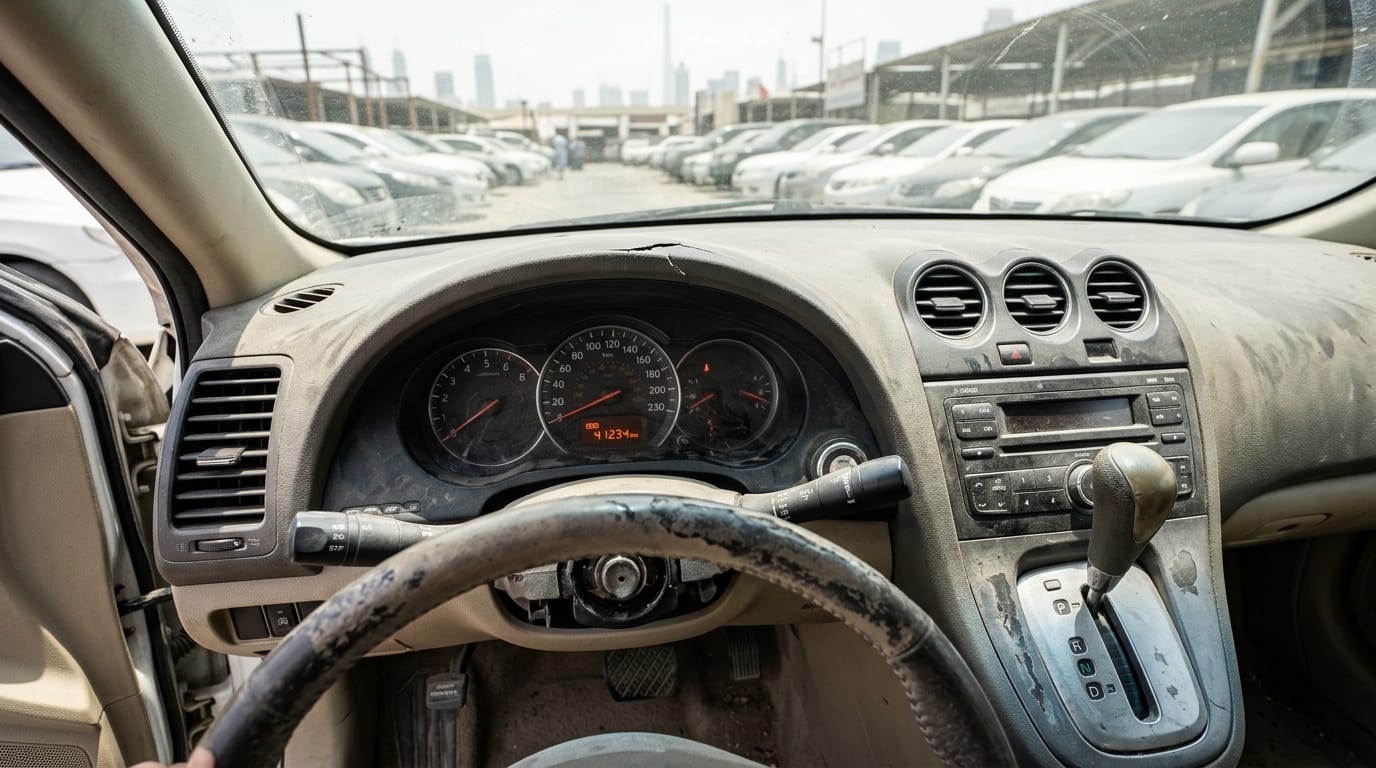
Last Updated: May 2026 | By Omar Al-Fayed, Senior Automotive Consultant | Category: Buying & Selling
Forged service records and tampered odometers are among the most financially damaging problems expat buyers encounter in the UAE used car market. A vehicle with a rolled-back odometer can cost a buyer between 8,000 and 22,000 AED in unexpected repairs within the first 12 months of ownership — components that should have been serviced at 80,000 km are being used as if they are at 45,000 km, because the seller changed the number. This guide covers exactly how to identify a tampered odometer, how to verify a service history that may be partially or completely forged, and what physical evidence to look for before any money changes hands. If you have read our guide on Red Flags When Buying a Used Car in Dubai: Dealer Tricks Expats Fall For, this article goes deeper into the specific documentation fraud patterns that follow those red flags.
Why This Fraud Is Widespread in the UAE Used Car Market
The UAE used car market moves a high volume of vehicles from rental fleets, corporate leases, and short-term expat ownership. Many of these vehicles accumulate high mileage quickly — a Nissan Sunny used as a delivery vehicle in Sharjah can cover 60,000 to 80,000 km in 18 months. When that vehicle enters the resale market, it carries real wear that does not match what a buyer expects for its age.
Odometer rollback reduces the displayed mileage — making a 140,000 km vehicle appear to have 72,000 km. The price difference between these two odometer readings on a 2019 Toyota Corolla in the UAE market is approximately 8,000 to 14,000 AED. That gap is the financial incentive that drives the fraud.
Forged service records compound the problem. A vehicle with a manipulated odometer also needs a service history that matches the false reading. Sellers create this by issuing stamped service invoices from cooperative workshops, producing printed records on templates that resemble dealer documentation, or simply removing pages from the genuine service book and replacing them with fabricated ones.
In workshop observations from Al Quoz and the Sharjah Industrial Area, a consistent pattern emerges: the fraud is most common on vehicles aged 3 to 6 years with claimed mileage below 70,000 km. These vehicles attract premium used-car pricing. The financial incentive is highest in this category.
🔧 Mechanic’s Inspection Log — The Camry That Showed 58,000 km and Had 142,000 km of Wear
Documented inspection case, November 2025, independent workshop, Al Quoz Industrial Area 2, Dubai.
Vehicle: 2020 Toyota Camry 2.5L GCC, displayed odometer: 58,400 km
Prospective Buyer: IT project manager from India, Dubai Marina, monthly salary 14,500 AED
Asking Price: 74,000 AED
Reason for Inspection: Pre-purchase check requested by buyer before signing agreement
The vehicle presented well externally. Paint condition was uniform, the interior showed normal wear consistent with the claimed mileage, and the seller had produced a service book showing five stamped service entries at Toyota dealer intervals, all in the correct mileage sequence up to 55,000 km.
The inspection began with a visual sweep of the engine bay. The air filter housing showed dust accumulation levels that the mechanic assessed as consistent with 90,000 to 110,000 km of driving — not 58,000 km. The serpentine belt showed fatigue cracking along the rib edges, typically observed above 80,000 km in UAE heat conditions. The brake rotors showed wear grooves that matched a vehicle well past 100,000 km. The rear shock absorbers had minor oil seepage — not expected at 58,000 km on a 2020 GCC model.
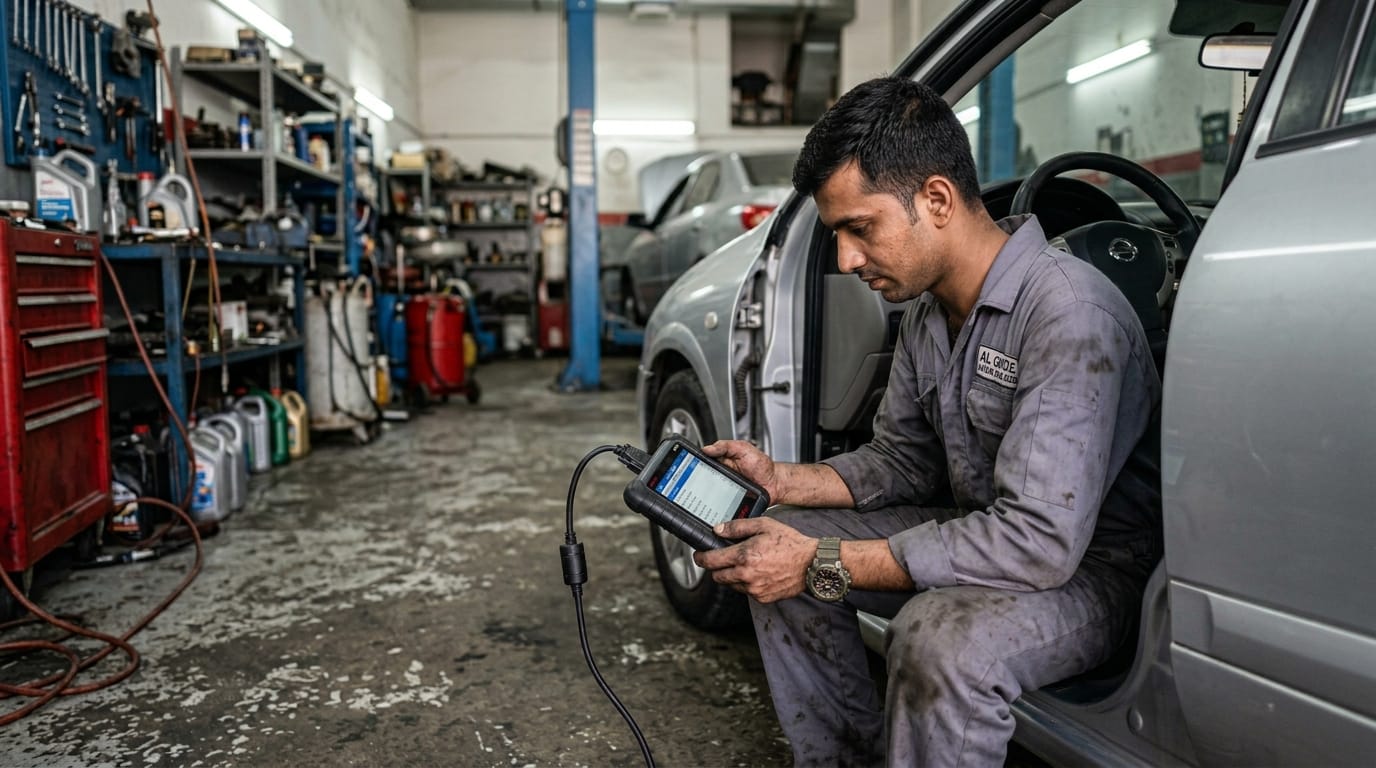
OBD scan result: freeze frame data retained in the ECU showed a service reset at 97,400 km — a data point that survives odometer rollback because it is stored in a different part of the vehicle’s memory. The dashboard displayed 58,400 km. The ECU remembered 97,400 km at the last service reset.
Further finding: the instrument cluster showed faint tool marks around the bezel housing — consistent with the cluster having been removed for manipulation. On this generation of Camry, the odometer is stored digitally in the instrument cluster. Removing and reprogramming the cluster is the most common rollback method for Toyota vehicles in this market.
Estimated actual mileage based on component wear assessment: 130,000 to 150,000 km.
The buyer did not proceed with the purchase. The seller withdrew the vehicle from the market three days later.
Physical Evidence of Odometer Tampering — What to Look For Yourself
Dashboard and Instrument Cluster
The instrument cluster is the most commonly accessed component during an odometer rollback. Removing it leaves physical evidence that a careful inspection can identify.
Look at the cluster bezel — the plastic trim piece surrounding the gauges. Tool marks, fine scratches in the finish, or any visible distortion in the bezel’s fit indicate the cluster has been removed. On most sedans, the bezel should have a perfectly uniform, unmarked fit from the factory.
Check for fingerprints or smudges on the inside face of the instrument cluster glass — the area behind the clear cover that sits over the dials. Factory assembly does not leave interior prints. If you can see prints between the cover and the dials, the cover has been opened after manufacture.
Look at the dash illumination around the cluster at night or with the engine running. A cluster that has been reprogrammed sometimes shows slightly different LED warmth or brightness compared to the surrounding dash lighting. This is a secondary indicator, not definitive — but it adds to a pattern.
Wear Indicators That Do Not Match Claimed Mileage
Several vehicle components wear at predictable rates in UAE conditions. When these wear rates conflict significantly with the displayed odometer, the discrepancy indicates likely tampering.
| Component | Expected Condition at 50,000–60,000 km | What High-Mileage Wear Looks Like |
|---|---|---|
| Brake rotors | Minimal grooves, full original thickness | Visible wear grooves, edge lip formation, thinning |
| Steering wheel leather | Uniform surface texture, no thin spots | Worn flat areas at 9 and 3 o’clock grip positions |
| Driver’s seat bolster | Full padding, no permanent compression | Permanently flattened left bolster from entry/exit wear |
| Pedal rubber pads | Clear raised pattern, minimal wear | Polished, worn-smooth center section |
| Serpentine belt | Smooth ribs, no cracking | Rib edge cracking, surface glazing |
| Air filter | Light dust, uniform grey | Heavy grey-brown loading, restricted airflow visually obvious |
| Front shock absorbers | No seepage, firm response | Oil seepage from seal area, soft or bouncy response |
| Cabin scent | Light interior plastic, mild AC smell | Embedded driving odour — synthetic fabrics absorb years of use |
No single indicator from this list is conclusive on its own. A combination of three or more indicators that conflict with claimed mileage warrants OBD verification and consideration of a professional inspection.
Tyre Date Codes
Every tyre manufactured since 2000 has a four-digit DOT date code moulded into the sidewall — the last four digits of the DOT sequence. The first two digits are the week of manufacture, the last two are the year. A tyre marked 2823 was manufactured in the 28th week of 2023.
If a vehicle’s claimed odometer shows 48,000 km but the tyres show a manufacture date from four or five years ago, there is a conflict. Tyres on a well-maintained vehicle are typically replaced at 40,000 to 60,000 km in UAE conditions — which means the tyre age should broadly correspond to the period during which the claimed mileage was accumulated.
More specifically: if all four tyres show the same manufacture date and it predates the claimed purchase date of the vehicle, those are likely original factory-fit tyres that were never replaced — suggesting the claimed low mileage is inaccurate, because original tyres on a genuinely low-mileage vehicle in UAE would not be expected to need replacement yet.
How to Identify Forged Service Records
The Five Most Common Forgery Methods
Service history forgery in UAE typically takes one of five forms, each with identifiable characteristics.
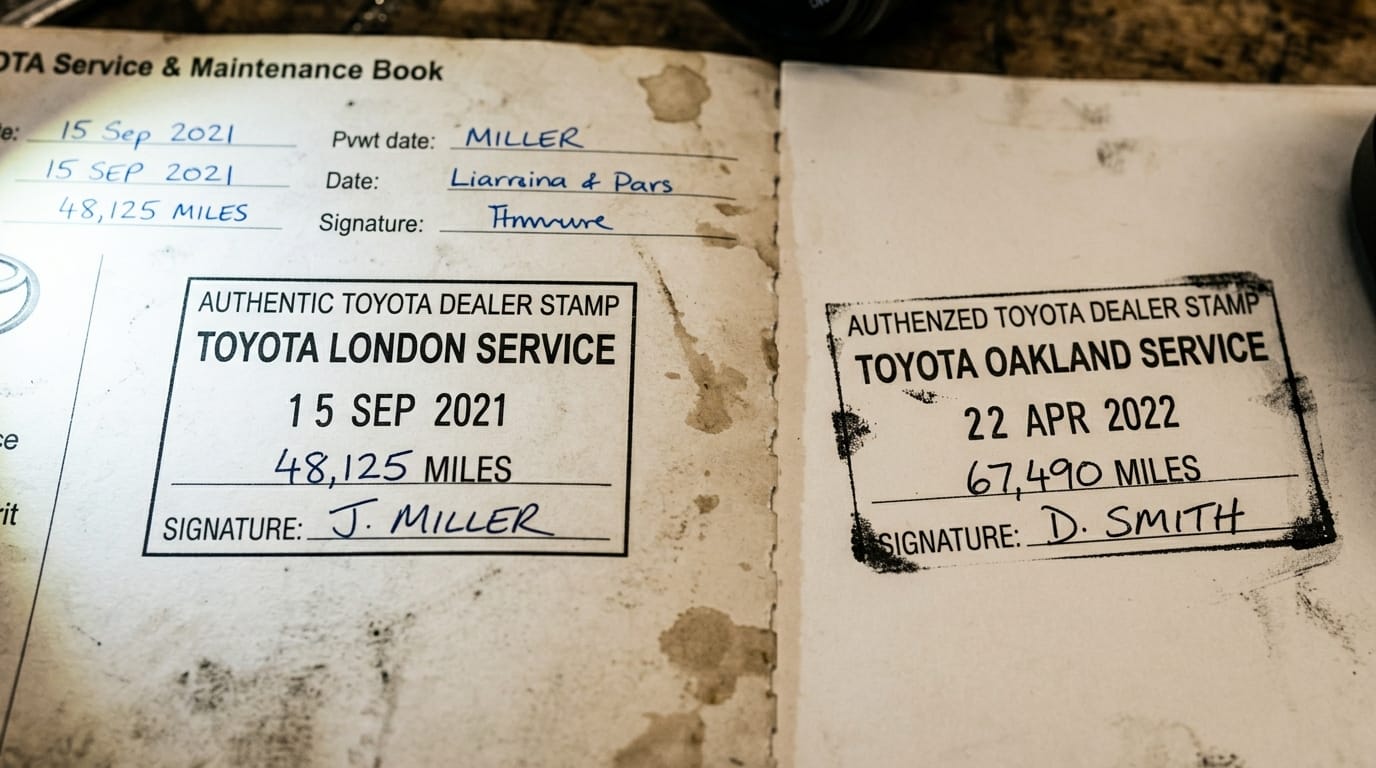
Rubber stamp forgeries. The seller purchases or copies a dealer workshop stamp and applies it to blank service record pages or printed templates. The stamps look authentic at a glance but show inconsistencies under close inspection: ink saturation varies between entries, the stamp alignment shifts between pages, or the stamp design is slightly incorrect for the claimed dealer.
Genuine stamps on false mileage entries. Some sellers have access to real workshop stamps — either through cooperative workshops or from earlier legitimate service visits — and use them to stamp records that show incorrect mileage. The stamp is genuine; the mileage written next to it is not. This is harder to identify visually but can be cross-checked against other indicators.
Selective page removal. The seller removes pages from a genuine service book that show the true mileage and replaces them with blank or fabricated pages. The remaining genuine pages show only the first few low-mileage service visits. Physical evidence: the binding shows missing pages, the paper quality of later entries differs from earlier entries, or the page numbering sequence is non-sequential.
Complete fabrication. A fully printed service history with no genuine component. These are recognisable because the font and formatting are generic rather than workshop-specific, the mileage intervals are suspiciously round numbers, and the service items listed are identical across every entry rather than varying by mileage-specific service requirements.
Digital record manipulation. For vehicles where the manufacturer’s service system can be accessed by the seller or a cooperative dealer, digital service records may be altered before a CarFax or VehicleHistory report is generated. This is less common but has been documented in UAE market cases. Cross-referencing digital reports with physical component wear remains the most reliable check.
How to Verify Service Records Before Purchase
The most direct verification method for Toyota and Nissan vehicles in UAE is contacting the specific dealer workshop where the service was allegedly performed. Every Toyota dealer service visit in UAE is logged in the manufacturer’s regional system under the vehicle’s VIN. Call the service department of the dealership listed in the service book, provide the VIN, and ask to confirm the service history on file.
For Nissan, the same process applies through authorised Nissan dealers. For Honda, Al-Futtaim Honda in Dubai maintains digital service records accessible by VIN for vehicles serviced in their network.
Independent workshop services are more difficult to verify because there is no centralised database. However, legitimate independent workshops in Al Quoz and Sharjah issue invoices with specific technician names, parts batch numbers, and oil viscosity details. Forged records typically lack this level of specificity — they list “oil change” without specifying the oil grade, filter part number, or technician.
Cross-reference the service records against the UAE vehicle history available through CarSwitch, dubizzle’s Vehicle Check, or a Tasjeel history report. These sources may not show every service entry but will show registration dates, owner transfer history, and any reported accident or insurance claim events. A vehicle that appears on the record as having changed ownership twice in three years — despite a service book showing consistent single-owner history — warrants explanation.
VIN Verification — The Layer That Cannot Be Forged on the Vehicle
The Vehicle Identification Number is stamped into the vehicle in multiple physical locations. For most sedans sold in UAE, this includes the dashboard VIN plate visible through the windshield, a stamped plate in the door jamb on the driver’s side, and a stamped or etched VIN in the engine bay. All three should match the VIN on the Mulkiya, the service book, and any digital records.
The VIN also encodes the production year and factory of origin. The 10th character of the VIN indicates the model year — a standardised code that does not change regardless of what a seller claims about the vehicle’s age. Verify this against the claimed year independently of what the registration paperwork shows.
A mismatched VIN between dashboard plate and door jamb stamp is a serious concern that warrants immediate withdrawal from the purchase process and, potentially, reporting to Dubai Police’s vehicle crime unit.
The Practical Pre-Purchase Verification Checklist
| Check | What to Look For | Tool Needed | Red Flag Result |
|---|---|---|---|
| Instrument cluster bezel | Tool marks, distorted fit, interior prints | Flashlight, bare eyes | Any visible marks |
| OBD ECU freeze frame | Last service reset mileage vs displayed | OBD scanner (workshop) | Discrepancy over 5,000 km |
| Brake rotor wear | Groove depth, edge lip, thickness | Flashlight, visual | Heavy grooves claimed at under 70,000 km |
| Serpentine belt ribs | Cracking, glazing along rib edges | Flashlight, visual | Visible cracking under 80,000 km claim |
| Tyre DOT date code | Manufacture year vs claimed ownership period | Flashlight, sidewall inspection | Date code conflicts with mileage accumulation timeline |
| Pedal rubber wear | Worn-smooth center vs raised pattern | Bare eyes | Smooth-worn pedals at claimed low mileage |
| Service book binding | Missing pages, inconsistent paper, non-sequential numbering | Bare eyes, page count | Any binding anomaly |
| Dealer VIN verification | Call dealer with VIN — confirm service records on file | Phone, VIN from Mulkiya | Dealer has no record of claimed services |
| Oil spec in service records | Listed oil grade matches vehicle specification | Vehicle owner’s manual, service book | Wrong spec oil listed in entries |
| All VIN locations match | Dashboard, door jamb, engine bay, Mulkiya | VIN in Mulkiya, flashlight | Any mismatch between locations |
Engine Variants and Mileage-Specific Risk
Toyota Corolla and Camry — CVT and Service History Sensitivity
The Toyota Corolla 2.0L (E210, 2019–2022) and Camry 2.5L (XV70) both use CVT transmissions that require fluid service at 40,000 km intervals in UAE conditions. A vehicle with a rolled-back odometer showing 55,000 km when the true mileage is 120,000 km may have never received the CVT fluid service that was due at 40,000 km and again at 80,000 km. CVT failure on these models costs 8,000 to 14,000 AED to repair at an independent workshop — 18,000 to 24,000 AED at a Toyota dealer.
For the Corolla 1.6L (E170), the main risk is oil sludge buildup from extended service intervals. A vehicle claiming 48,000 km that actually has 110,000 km has typically missed at least six to eight oil changes. Pull the oil filler cap and inspect the inside of the valve cover. Clean oil systems show light golden-brown residue at worst. Sludge-contaminated systems show dark brown to black paste — a condition that precedes significant engine wear.
Nissan Sunny and Altima
The Nissan Sunny HR15DE is particularly vulnerable to CVT wear from missed fluid services. At claimed mileages above 70,000 km, the CVT fluid should show evidence of at least one replacement — workshop records should reflect this. At any claimed mileage, an OBD scan on the Sunny should be checked for CVT fault codes stored in history even if none are currently active.
The Nissan Altima 2.5L QR25DE engine has a documented tendency toward oil consumption in UAE heat above 100,000 km. A rolled-back Altima claiming 65,000 km may be consuming 1 litre of oil per 3,000 km — a condition the service records will not show because they have been fabricated to match the false mileage.
Signs of Positive Side — When the Records Are Genuine
Not every used vehicle in UAE has a manipulated history. Genuine service records have identifiable characteristics that distinguish them from fabrications.
Genuine dealer service books contain handwritten mileage entries with natural variation in handwriting — different service advisors writing different entries on different days. Fabricated records often show uniform handwriting across all entries or printed mileage values that look typed rather than written.
Genuine independent workshop invoices list specific parts: filter part numbers, oil brand and viscosity, and the name of the technician who performed the service. The margins are often marked with handwritten notes. They look like working documents, not clean templates.
Genuine service histories show interval variation. A vehicle that was used more heavily for a year shows a shorter gap between service dates. Fabricated histories tend to show suspiciously consistent 5,000 km or 10,000 km intervals with no variation — because the person creating them was following a formula rather than recording reality.
A vehicle with a consistent service history from a single authorised dealer — where all entries can be verified by calling the dealership — is as close to confirmed authenticity as a private purchase in UAE can offer. This is the benchmark to measure all other histories against.
When It Becomes Expensive — Even With a Real Service History
A genuine service history does not guarantee no surprises. Several conditions develop regardless of proper service, particularly in UAE’s high-temperature operating environment.
Cooling system rubber components — hoses and the thermostat housing — degrade from heat cycling above 80,000 km even on properly serviced vehicles. A 2018 vehicle with a genuine 95,000 km service history may still need cooling system hose replacement within 12 to 18 months of purchase.
AC compressor bearing wear begins to develop on most sedans between 90,000 and 120,000 km in UAE conditions. This produces a subtle bearing noise that is often inaudible during a test drive with the AC at normal settings but becomes apparent under sustained high-load cooling on a hot day. Testing the AC at maximum output for 10 minutes during a test drive in UAE summer is a specific check worth performing.
Suspension bushings on the front lower control arms typically need replacement between 80,000 and 120,000 km on Japanese sedans in UAE. This is a maintenance item that genuine service histories often do not record because it is typically identified during a wheel alignment rather than a standard service. A car with a genuine 95,000 km history may still need 1,200 to 1,800 AED in front suspension bushing work within the first year of ownership.
Owner Scenarios — How This Risk Plays Out Differently by Situation
New Expat, First UAE Car, Budget 20,000–28,000 AED
At this price point, vehicles are typically 7 to 9 years old with accumulated mileage that makes odometer rollback economically meaningful for sellers. The risk is highest in this bracket. Prioritise the OBD scan and the dealer verification call above all other checks. Independent workshops in Al Quoz and Sharjah Industrial Area offer pre-purchase inspections for 200 to 350 AED — this cost is mandatory, not optional, at this budget level.
Settled Expat, Mid-Range Budget, 38,000–55,000 AED
Vehicles in this range are typically 4 to 6 years old — the bracket where rollback fraud is most common and most financially significant. The seller is attempting to represent a 100,000 to 140,000 km vehicle as a 55,000 to 75,000 km vehicle, with a price premium of 10,000 to 18,000 AED. The physical wear indicators in this guide become the primary tools. Add a Tasjeel history report and a direct dealer verification call as non-negotiable steps.
Expat Family, Buying for Long-Term UAE Stay, 55,000–75,000 AED
At this price, a rolled-back vehicle is a particularly poor outcome because the buyer typically intends to drive the vehicle for 3 to 5 years. A vehicle with genuine 140,000 km being purchased as a 70,000 km vehicle will reach the end of its practical economic life 3 to 4 years earlier than expected — requiring replacement at a time and budget not planned for. The investment in a full pre-purchase inspection at 350 to 500 AED is proportionate to the exposure.
Expat Leaving UAE in 12 to 18 Months
A rolled-back vehicle with inflated pricing purchased by someone planning to resell in 12 to 18 months produces a compounding loss: the vehicle is worth less at resale than paid, and any major component failure during the ownership period accelerates the financial damage. At this time horizon, the resale calculation must factor in realistic mileage and wear disclosure to the next buyer — which, if honest, will produce a lower price than what was paid.
What to Do If You Discover Tampering After Purchase
If you have purchased a vehicle and subsequently discover evidence of odometer tampering or forged service records, preserve all documentation before taking any action.
Collect the original purchase contract, any service records provided at the time of sale, the seller’s contact details and any WhatsApp or SMS communications, the original Dubizzle or showroom listing saved as a screenshot, and any inspection reports you may have obtained — including the OBD scan if conducted after purchase.
Contact the Dubai Consumer Protection department or the Economic Department of the relevant emirate. Odometer fraud is a consumer protection offence and a formal complaint can be filed with supporting evidence. Buyers may have legal remedies depending on the available evidence and the specific circumstances of the transaction — outcomes vary significantly based on documentation quality and how the sale was structured.
If the vehicle was purchased from a registered dealership rather than a private seller, the dealer is subject to regulation by the relevant emirate’s licensing authority. A formal complaint to the licensing body against a registered dealer carries more procedural weight than a complaint against an individual private seller.
Evidence Checklist — What to Preserve in Any Odometer Dispute
| Document or Evidence | Why It Matters | How to Preserve |
|---|---|---|
| OBD freeze frame screenshot | Shows last service reset mileage stored in ECU | Photo on phone + save to cloud immediately |
| Timestamped photos of cluster bezel | Documents tool marks and evidence of removal | Phone photos with date/time metadata visible |
| Component wear photographs | Shows physical wear inconsistent with claimed mileage | Detailed photos of brakes, belt, pedals, tyres |
| Tyre DOT code photographs | Establishes manufacture date conflict | Close-up sidewall photo showing full DOT sequence |
| Service records provided at sale | Original documents submitted by seller | Physical originals + scanned copies |
| Original listing screenshot | Records seller’s represented mileage and condition | Screenshot with timestamp and URL visible |
| Purchase contract | Establishes transaction terms and seller identity | Physical original + scanned copy |
| WhatsApp conversation with seller | Records any verbal claims made in writing | Screenshot of full conversation thread |
| Dealer verification response | Confirms service records not on file at claimed dealer | Written email or WhatsApp reply from dealer service department |
Market Comparison — Tampered Odometer Risk Across Vehicle Categories
| Vehicle Category | Typical Rollback Range (km) | Financial Exposure (AED) | Verification Priority |
|---|---|---|---|
| Japanese GCC sedan, 3–5 years old (Corolla, Sunny, City) | 40,000 – 80,000 km rolled back | 8,000 – 18,000 in unexpected repairs | High — most common target |
| Japanese GCC sedan, 6–8 years old (Corolla, Altima) | 30,000 – 60,000 km rolled back | 5,000 – 12,000 in unexpected repairs | Medium — lower price means lower fraud incentive |
| SUV, 3–6 years old (Fortuner, Pajero, Prado) | 50,000 – 100,000 km rolled back | 15,000 – 35,000 in unexpected repairs | Very high — highest resale value = highest fraud incentive |
| German/European brand, any age | Variable — less common in UAE due to complex ECU | Highly variable — repair costs already elevated | High — ECU manipulation more technically complex but documented |
| Vehicles from rental or corporate fleets | Often legitimate but serviced to a minimum standard | Lower repair risk but AC and suspension wear elevated | Medium — focus on service standard rather than rollback |
Dangerous Mistakes Section — What Buyers Do That Makes This Worse
Accepting the service book at face value without verifying entries. A service book that looks complete is not the same as a service book that is genuine. The physical appearance of a well-maintained record is reproducible. The verification call to the dealer is not.
Relying on a Tasjeel pass as evidence of acceptable mechanical condition. The RTA roadworthiness test checks safety systems — brakes, lights, tyres, steering response. It does not assess mileage accuracy, service history authenticity, or developing wear in components not included in the test. A Tasjeel pass is necessary for road use; it is not a substitute for a mechanical inspection.
Skipping the OBD scan because the car “seems fine.” ECU freeze frame data is the only check that directly contradicts a tampered odometer with a data point stored in a different system. A vehicle can look completely fine, drive well in a 15-minute test, and still have ECU data showing a service reset at 40,000 km above the displayed reading. The scan takes 10 minutes as part of any pre-purchase inspection.
Not checking the tyres’ date codes. This is a 30-second check that requires only a flashlight and basic knowledge of the DOT format. It is consistently overlooked by buyers and consistently informative when the mileage claim is false.
Believing that a low price means low risk. A seller who has rolled back 80,000 km and still prices the vehicle 5,000 AED below comparable legitimate listings is not making a generous offer — they are making a calculated discount that still produces a significant profit on the fraud. The price reduction is part of the transaction design, not evidence of the seller’s goodwill.
Analytical Conclusion — The Real Cost of Skipping Verification
The pre-purchase inspection at an independent workshop in Al Quoz or the Sharjah Industrial Area costs between 200 and 400 AED. The dealer verification call costs nothing beyond the time to make it. The OBD scan is included in most pre-purchase inspections. The tyre date code check requires a flashlight.
The total investment in verification: approximately 300 to 450 AED and 2 to 4 hours.
The documented financial exposure from purchasing a vehicle with a rolled-back odometer of 70,000 to 80,000 km: 8,000 to 22,000 AED in unexpected repairs within the first 12 to 18 months of ownership — plus the permanent resale value loss on a vehicle that cannot be honestly represented.
The ratio is approximately 50:1. Three hundred AED and three hours prevent a potential 15,000 AED loss. In most documented cases from UAE workshop observations, the buyers who skipped verification did so not because they could not afford the inspection — but because the seller created time pressure that made the delay seem costly. That time pressure is itself a red flag, and it is one worth naming explicitly: a legitimate seller with a genuine vehicle does not lose the sale because a buyer takes 48 hours for a pre-purchase inspection.
For the next step in verifying your chosen vehicle’s condition through a reliable independent workshop, read our full guide: Trusted Car Mechanics Dubai for Expats: How to Find an Honest Garage in Al Quoz
FAQ — Fake Service History and Odometer Tampering UAE
