Last Updated: May 2026 | By Omar Al-Fayed, Senior Automotive Consultant | Category: Buying & Selling
Most expats arriving in Dubai pay 3,000 to 11,000 AED more than necessary on their first used car purchase — not because they were careless, but because nobody explained how the UAE used car market actually works before they walked into a showroom.
This guide documents the specific patterns observed across pre-purchase inspections in Dubai and Sharjah from 2023 to 2026, and gives you the information dealers do not volunteer. Read this before you view any vehicle, not after.
If you have already started comparing models in your budget, the practical next step is our ranked list of Best Used Cars in Dubai Under 30,000 AED for Expats — Reliability Ranked — which applies everything in this guide to specific vehicles with documented cost data.
How the UAE Used Car Market Actually Works
The UAE used car market operates differently from most expats’ home markets — and the gaps in that understanding are where money gets lost.
Three facts that the market runs on:
Fact 1: The asking price is not the market price. On Dubizzle and dealer lots across Dubai, the standard negotiation expectation is 5 to 15 percent below the listed price for private sellers and 8 to 12 percent below for dealers. A seller listing at 35,000 AED typically expects to close between 30,500 and 33,000 AED. Walking in without knowing this means you are starting the conversation at the wrong number.
Fact 2: Most sellers — private and dealer — do not disclose maintenance history accurately. In documented pre-purchase inspection observations across more than 200 vehicles in Dubai and Sharjah from 2023 to 2026, approximately 60 percent of vehicles presented with claimed “full service history” had gaps of 15,000 km or more between documented service stamps. The stamps may exist. The completeness is the question.
Fact 3: The pre-purchase inspection is the mechanism that changes your negotiating position. A 150 to 260 AED inspection finding changes the conversation from “the seller’s price versus your gut” to “documented findings versus a price adjustment.” In workshop observations, buyers who presented inspection findings negotiated an average of 1,800 to 4,200 AED more off the asking price than buyers who negotiated without documentation.
Understanding these three facts before you view a vehicle changes the entire transaction.
🔧 Mechanic’s Inspection Log — The 43,000 AED Car That Should Have Been 37,500
Documented case, January 2026, independent specialist workshop, Abu Shagara Industrial Area, Sharjah.
Vehicle: 2019 Toyota Corolla 2.0L GCC, 58,000 km
Buyer: Filipino nurse, 14 months in Dubai, 8,200 AED monthly salary
Dealer asking price: 43,000 AED — Al Quoz dealer lot
Inspection cost: 200 AED
Result: 5,500 AED negotiated off — final price 37,500 AED
The buyer came to me after viewing the Corolla twice and being told by the dealer that “it’s a one-owner car, full agency service, no accidents, just serviced last month.”
OBD scan: two stored codes — P0171 (lean fuel mixture Bank 1) and a previously cleared P0300 (random misfire, cleared but not resolved). The P0171 was active. The P0300 had been cleared recently — the freeze frame data showed it had been cleared within the past 600 km.
Physical inspection: the mass airflow (MAF) sensor housing showed carbon tracking consistent with 15,000 to 20,000 km of service without cleaning. The air filter was new — replaced recently, consistent with the dealer’s claim of a recent service. However, the MAF itself had not been cleaned. This produces the lean mixture code as a secondary effect.
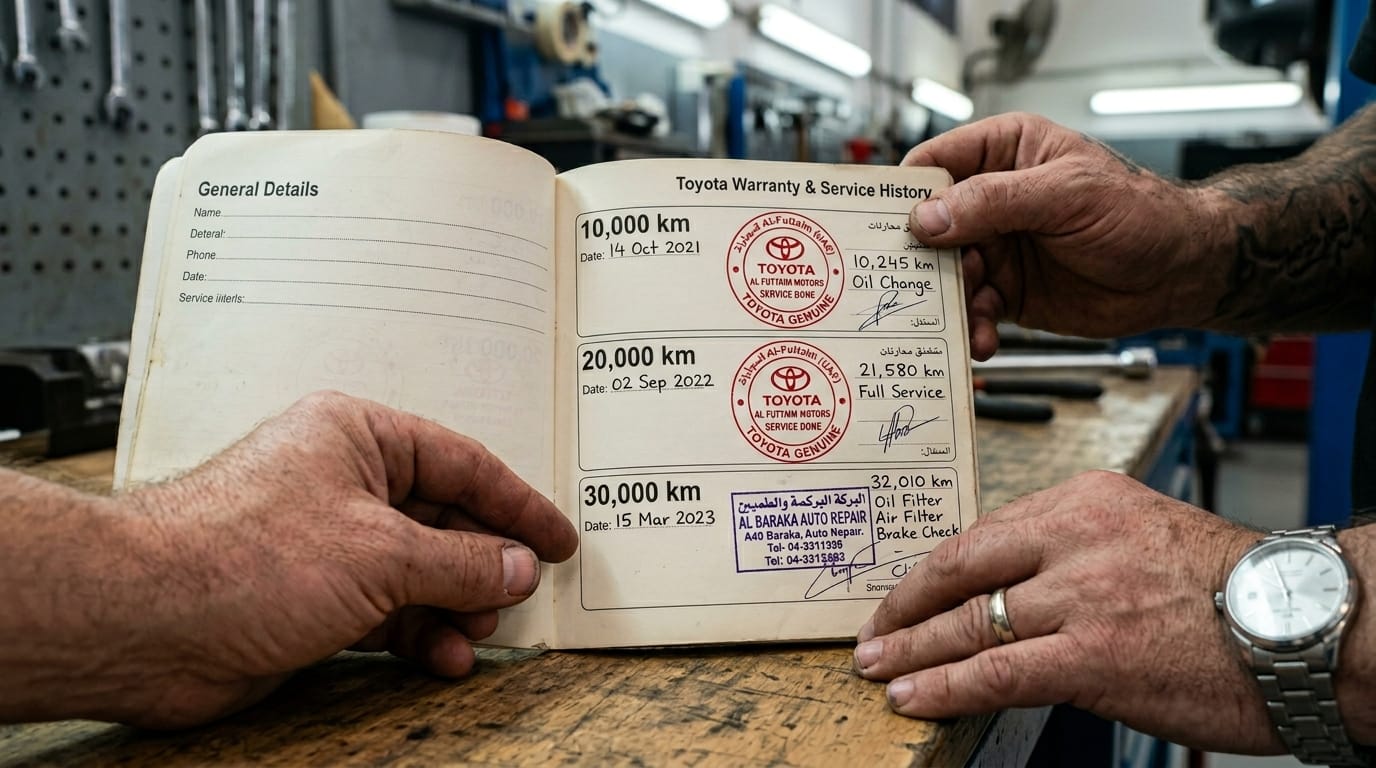
More significantly: the dealer’s “full agency service” claim was contradicted by the service book. Agency stamps covered 10,000 km, 20,000 km, and 40,000 km. The 30,000 km stamp was from an independent workshop — not a Toyota agency. A 10,000 km gap from the claimed agency history.
Rear brake pad thickness: 3mm remaining on the left side, 4.5mm on the right. Minimum specification for replacement: 2mm. The pads were approaching replacement within the next 10,000 to 15,000 km.
Total documented findings presented to the dealer:
- MAF sensor clean required: 200 to 350 AED
- Misfire code investigation required: 300 to 800 AED depending on cause
- Rear brake pads upcoming: 320 to 420 AED
- Incomplete agency service history — affects resale value
Negotiated reduction: 5,500 AED. Final price: 37,500 AED.
The 200 AED inspection produced a 5,500 AED saving — a return of 27.5x on the inspection cost.
What Dealers Will Not Tell You — The Six Patterns
Pattern 1: “GCC Spec” Is Not Always GCC Spec
GCC specification means the vehicle was built for the Gulf Cooperation Council market — calibrated for UAE heat, humidity, and fuel quality. Non-GCC vehicles (US spec, Japanese domestic, European spec) look identical from the outside.
The difference shows up in the AC system, the engine management calibration, and the warranty eligibility at local agencies.
Dealers sometimes describe a non-GCC vehicle as “GCC spec” because it was registered in the UAE. Registration does not make a vehicle GCC spec. The manufacturing origin does.
Verification method: Tasjeel history showing UAE first registration from a local dealership (not an individual importer) is the most reliable indicator. For Toyota specifically, the VIN plate includes a market identifier — a Toyota specialist reads it in under two minutes.
Pattern 2: The “Just Serviced” Claim
“Just serviced” typically means an oil change was done recently. It does not mean all due maintenance was completed. It does not mean the transmission fluid was changed. It does not mean the timing belt was inspected. It does not mean the brake fluid was checked.
In documented inspection cases from Abu Shagara and Al Quoz, a “just serviced” vehicle with a new oil filter and fresh engine oil had:
- Transmission fluid with 45,000+ km of operation since last change — dark and slightly burnt
- Cabin air filter completely blocked — had not been changed in the vehicle’s ownership history
- Brake fluid moisture content above 3 percent — indicating it had not been changed in two or more years
A fresh oil change costs 180 to 250 AED. It is the cheapest service item to perform before listing a vehicle. It makes the engine bay look clean and the dashboard oil service light disappear. It does not represent a comprehensive service.
Pattern 3: Accident History and the Paint Thickness Test
In UAE used car sales, “no accidents” is a claim made by most sellers regardless of the vehicle’s actual history. Insurance claim records in the UAE are not uniformly accessible to buyers through public channels, though Tasjeel history does record some accident-related events.
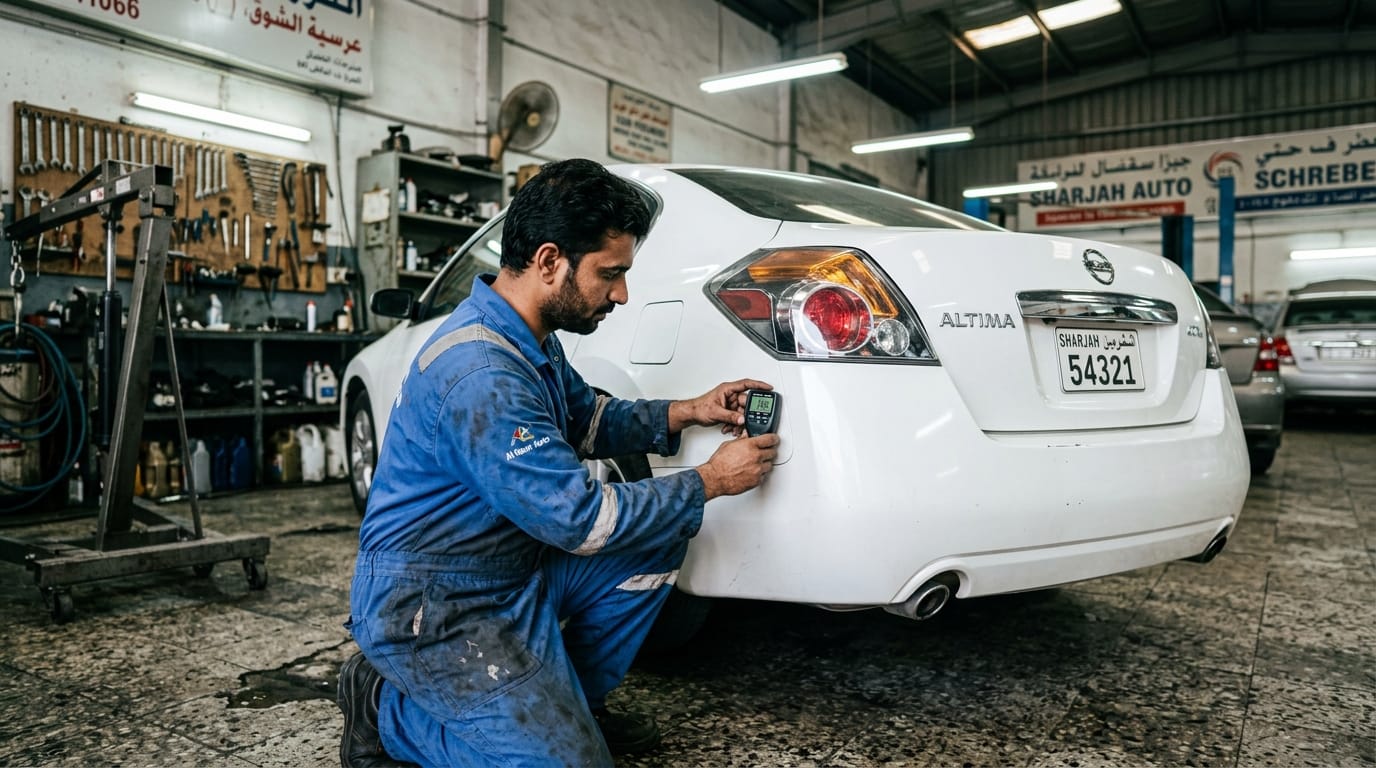
The practical verification tool is a paint thickness meter. Panel paint thickness on a factory-original painted surface is typically 100 to 160 microns. A panel that has been resprayed after accident repair typically reads 200 to 400 microns or more.
Readings above 200 microns on any panel warrant documentation and a price reduction conversation. Readings above 350 microns on a structural panel (door, quarter panel, fender) indicate significant repair work.
A basic paint thickness meter is available at UAE electronics shops for 80 to 150 AED. Any pre-purchase inspection workshop includes this check as standard.
Pattern 4: The Cooling System and UAE Summer
Dealers in air-conditioned showrooms selling cars in winter months never experience the cooling system in the condition that matters. You will.
UAE summer ambient temperatures between June and September — regularly exceeding 42 degrees Celsius — expose cooling systems that are functioning marginally in winter. A thermostat that opens slightly late, a coolant that is due for replacement, or a cooling fan that runs at 80 percent efficiency are all invisible in January.
The pre-purchase inspection in summer months should include: coolant concentration check, radiator cap pressure test, cooling fan operation at idle with AC on maximum, and a visual inspection of coolant lines for soft spots or surface cracking.
The cost to inspect these items: included in any comprehensive pre-purchase inspection at 150 to 260 AED. The cost to repair an overheated engine because these were not checked: 4,500 to 15,000 AED depending on damage extent.
Pattern 5: Mileage Rollback — Still Present in UAE Market
Odometer rollback is illegal in the UAE. It still occurs.
The indicators available without specialist equipment:
- Wear on steering wheel leather, gear shift knob, and driver’s seat bolster inconsistent with the claimed mileage
- Brake pedal rubber showing wear that exceeds the claimed km history
- Service stamps with mileage recorded at intervals that do not match the current odometer reading
- Tire wear inconsistent with claimed mileage — a set of original tires on a 45,000 km vehicle should not be at 3mm tread depth unless the vehicle was used primarily in city conditions
The Tasjeel history records odometer readings at each annual inspection. Cross-referencing the Tasjeel history against the service book entries and the current odometer provides a reasonable verification.
Pattern 6: The Rushed Sale and the Soft Deadline
“Another buyer is coming to look at it this afternoon.”
“The owner is leaving the country next week and needs it gone.”
“The price drops if you decide today.”
These phrases appear in used car negotiations across every market in the world. In the UAE used car market, they are particularly common because the underlying facts are sometimes real — expat sellers do relocate, contracts do end on specific dates — and that genuine urgency is indistinguishable from manufactured urgency designed to compress your decision time.
The correct response is the same in either case: the pre-purchase inspection takes one to two hours and costs 150 to 260 AED. No genuine seller with a sound vehicle refuses an inspection request. A seller who refuses an inspection or makes the inspection conditional is providing you with information about the vehicle.
The Inspection Process — What to Do Before You Pay
Step 1: Run the Tasjeel History Before You View
The Tasjeel history check is available through the RTA website or app for any UAE-registered vehicle. It shows registration history, periodic inspection results, and in many cases flags accident-related events.
Cost: free for basic check, 50 to 100 AED for a detailed report through authorized channels.
Run this before you arrange a viewing. If the history shows multiple ownership changes within short periods, inspection failures, or registration gaps, decide whether the viewing is worth your time before spending it.
Step 2: The Test Drive Route — Use Specifically
The test drive route matters more than most buyers realize.
A 10-minute test drive around a showroom block at 40 km/h reveals almost nothing. A structured 25-minute drive reveals significantly more.
Include in your test drive:
- A highway stretch at 110 to 120 km/h for at least 5 minutes — this reveals transmission hunting, vibrations at speed, and wind noise from poorly sealed doors
- A hard stop from 60 km/h to zero — in an empty area — to assess brake pull (the car should stop straight, not pulling left or right)
- Tight low-speed turns in both directions — listening for suspension or CV joint noise
- A full AC system test: maximum cold on highest fan for 3 minutes, then measure vent temperature. Below 8 degrees Celsius at maximum: normal. Above 12 degrees Celsius: requires investigation
- An uphill acceleration from 20 km/h — the transmission should change down smoothly without hunting or hesitation
Step 3: The Independent Pre-Purchase Inspection
After the test drive, if you want to proceed, arrange the pre-purchase inspection at an independent workshop — not a workshop recommended by the seller.
Cost: 150 to 260 AED for a standard inspection including OBD scan.
For Toyota/Lexus: request a Techstream scan (additional 50 to 80 AED).
For Honda: request a HDS scan (additional 50 to 80 AED).
For Nissan/Infiniti: request a Consult-III scan for CVT data if the vehicle has a CVT.
The inspection workshop should be in a different part of the city from the seller if possible — Al Quoz or Abu Shagara are well-established independent specialist areas in Dubai and Sharjah respectively.
Step 4: Use the Findings to Negotiate — Not to Walk Away Immediately
Most pre-purchase inspections find something. A vehicle with 60,000 to 90,000 km that has zero inspection findings is statistically unusual — and may indicate the inspection was not thorough enough.
The findings are not a rejection list. They are a negotiation tool.
Document every finding with an estimated repair cost. Present the total to the seller. Ask for a reduction equivalent to the documented repair costs. In most cases, a reasonable seller accepts a partial or full adjustment.
If the total documented repair cost exceeds 15 percent of the asking price, reconsider whether this specific unit is the correct purchase regardless of how the negotiation proceeds.
The True Cost of Buying Wrong — A Documented Comparison
| Scenario | Purchase Price (AED) | First-Year Unplanned Costs (AED) | Total Year 1 (AED) |
|---|---|---|---|
| No inspection — undisclosed CVT issue found at month 3 | 32,000 | 9,500 | 41,500 |
| No inspection — undisclosed accident history, resale loss | 35,000 | 4,800 (resale shortfall) | 39,800 |
| 260 AED inspection — 3,500 AED negotiated off asking price | 28,500 | 1,200 (known, budgeted) | 29,960 |
| 260 AED inspection — vehicle failed, buyer redirected to correct unit | 27,000 | 800 (routine maintenance) | 28,060 |
The comparison above is not hypothetical. Each row represents a documented pattern observed across inspection cases in Dubai and Sharjah from 2023 to 2026. The numbers are representative, not exact — individual cases vary. The direction is consistent.
Where to Buy — Platform Comparison for Dubai Expats
Dubizzle — Largest Volume, Highest Verification Burden
Dubizzle is the primary used car listing platform in the UAE. Volume is the advantage — at any given time, thousands of listings are active across all price ranges. The verification burden is entirely on the buyer. Listings are unverified by Dubizzle — the “dealer” badge means only that the seller has a paid account, not that the vehicle has been inspected.
Filter for: private sellers in the 25,000 to 45,000 AED range who include clear photos of the engine bay, interior, and service book. Sellers who provide these items without being asked are typically more forthcoming about condition.
Al Aweer Used Car Market — Physical Inspection Opportunity
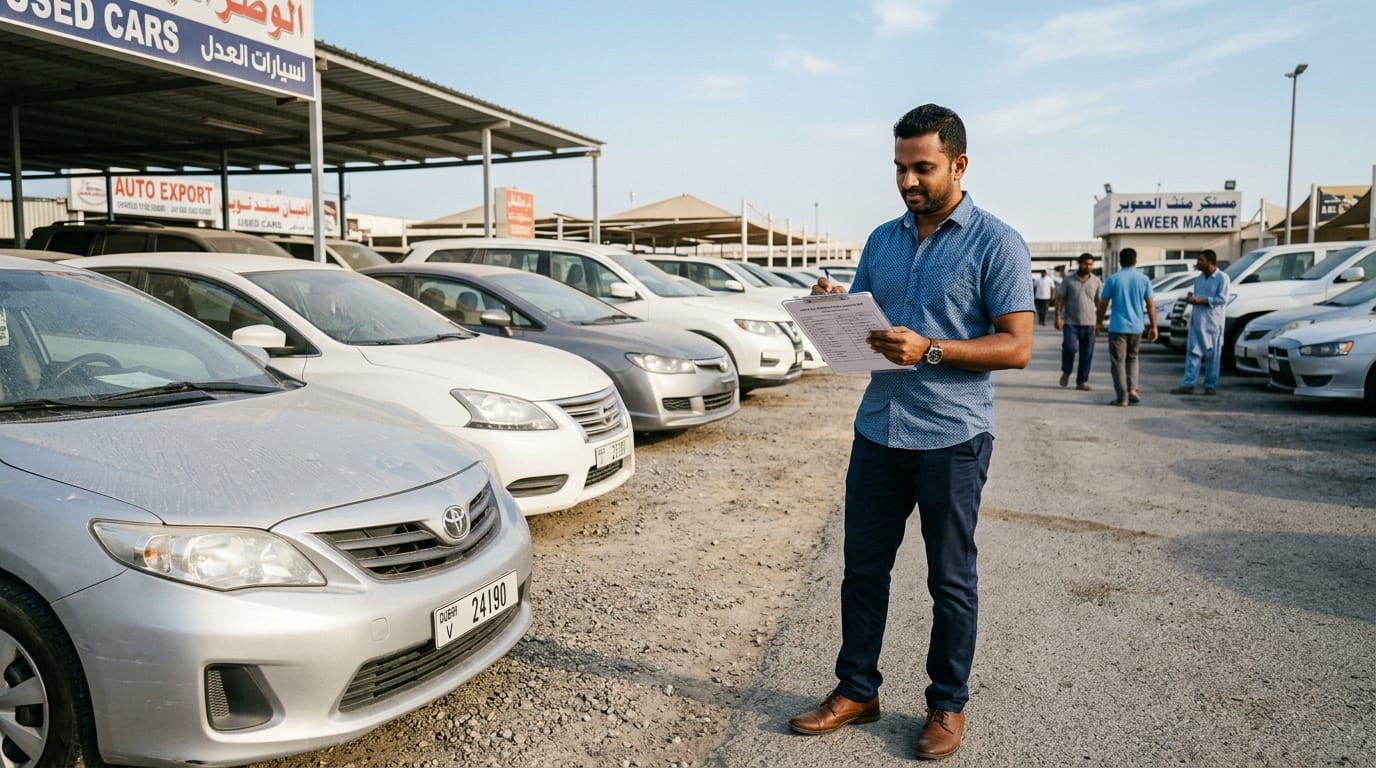
Al Aweer (the Dubai used car market) allows you to physically walk between lots and compare vehicles across multiple dealers in one location. Prices at Al Aweer are typically 3,000 to 6,000 AED lower than equivalent vehicles in mainstream dealerships — the trade-off is less polish and less paperwork assistance.
Negotiation at Al Aweer is expected and normal. An opening offer of 15 percent below asking is standard — not aggressive.
Pre-purchase inspection from Al Aweer: some dealers at Al Aweer have in-house inspection bays. Use an independent workshop nearby instead. Al Quoz is a short drive.
Brand Dealerships Selling Certified Pre-Owned
Toyota, Nissan, and Honda dealerships in Dubai sell certified pre-owned (CPO) vehicles with agency inspection and short-term warranties (typically 3 to 12 months). The price premium over an equivalent private sale vehicle: 8,000 to 18,000 AED depending on the model and mileage.
For expats who value zero inspection complexity and documented warranty coverage, the CPO premium is a risk-reduction cost. For expats comfortable with the inspection process, the private market offers better value.
Signs That the Transaction Is Sound
Not every seller and not every vehicle is a problem. The positive indicators are as important to document as the red flags.
- Service book with stamps at correct intervals: Every 10,000 km at the correct workshop (agency or named independent), with the mileage recorded consistently against the current odometer reading.
- Seller provides Tasjeel history without being asked: A seller who leads with the Tasjeel history is typically confident in it. A seller who needs to be asked three times typically is not.
- Original tires with consistent wear: Original fitment tires (matching the door sticker specification) with even tread wear across all four corners indicate normal driving history.
- The seller accepts an independent inspection without condition: A clean vehicle with honest history passes a pre-purchase inspection. A seller who knows this does not hesitate when asked.
- No codes on OBD scan, no pending codes: A scan with zero stored codes and zero pending codes on a vehicle driven under normal conditions is a clean bill at that moment. It does not guarantee the future — but it confirms the recent past.
Budget Ranges — What You Can Realistically Expect
| Budget Range (AED) | Realistic Vehicle Options | Typical Model Years | Inspection Priority |
|---|---|---|---|
| 12,000 – 18,000 | Mitsubishi Lancer 1.6L, Nissan Sunny, Hyundai Accent | 2012 – 2015 | High — timing belt / CVT focus |
| 18,000 – 25,000 | Honda City, Toyota Yaris 1.5L, Kia Cerato 1.6L | 2014 – 2018 | High — transmission and AC focus |
| 25,000 – 35,000 | Toyota Corolla 1.6L, Hyundai Elantra 2.0L, Nissan Altima 2.5L | 2016 – 2020 | Medium — service history completeness |
| 35,000 – 50,000 | Toyota Camry 2.5L, Honda Accord 2.4L, Kia Optima 2.4L | 2017 – 2021 | Medium — brand-specific scanner required |
| 50,000+ | Toyota Camry 2.5L 2021+, Honda Accord 1.5T, Nissan Patrol entry | 2019 – 2023 | Lower — but never skip the inspection |
The inspection priority column reflects the typical findings frequency at each budget tier — not the severity. A 15,000 AED vehicle is not more dangerous than a 45,000 AED vehicle. It typically has more accumulated wear that requires documentation before the transaction proceeds.
Analytical Conclusion — The Information That Changes the Transaction
The UAE used car market rewards buyers who arrive with three things: a Tasjeel history check already run, a structured test drive route in mind, and a 150 to 260 AED pre-purchase inspection already scheduled at an independent workshop.
Sellers — dealers and private — price their vehicles for buyers who do not have these three things. The pricing assumes negotiation from a position of incomplete information. The pre-purchase inspection changes that assumption.
In documented observations from Dubai and Sharjah inspection cases from 2023 to 2026, buyers who completed a structured pre-purchase inspection before negotiating saved an average of 2,800 to 5,500 AED compared to the asking price — compared to buyers who negotiated without inspection findings, who saved an average of 800 to 1,500 AED.
The difference between those two numbers is not negotiating skill. It is documentation.
The dealer will not volunteer the fault codes. They will not mention the service history gaps. They will not bring up the paint thickness readings. That is not their job. Protecting your money is yours.
The next practical step after understanding the market is knowing which specific vehicles are worth your time in your budget range. The full ranked comparison is in: Best Used Cars in Dubai Under 30,000 AED for Expats — Reliability Ranked
FAQ — Expat Car Buying in Dubai 2026
Disclaimer: Emirates Car Guide is a 100% independent platform. We do not own showrooms, nor are we affiliated with any used car dealerships or garages. Our sole mission is to protect expats from financial fraud in the automotive market.
Super Schema — Copy to RankMath
