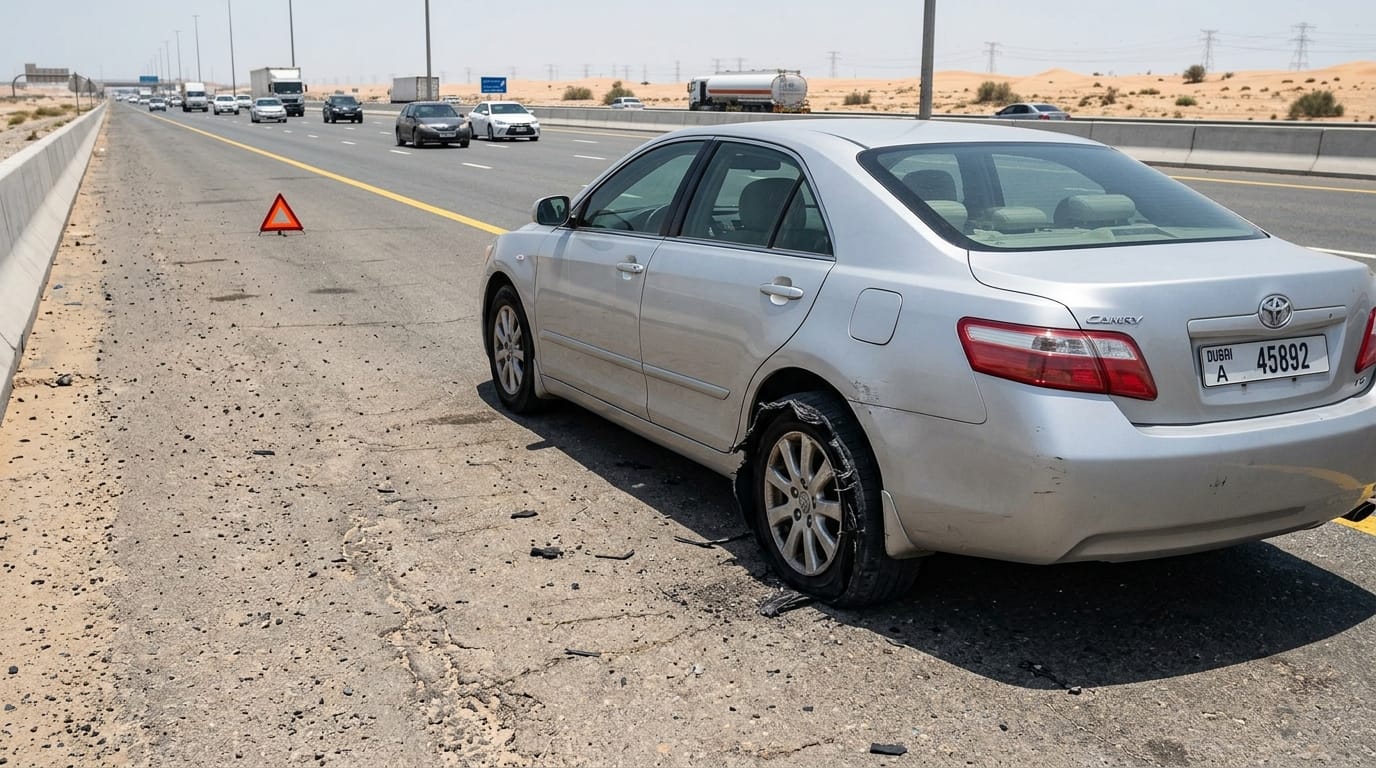
Tire Blowout on UAE Highway: Exact Steps When It Happens at 120 km/h (2026)
Last Updated: May 2026 | By Omar Al-Fayed, Senior Automotive Consultant | Category: Driving Rules & Fines
Short Answer First:
A tire blowout at highway speed in the UAE is survivable in most cases if you do the right thing in the first four seconds. Do not brake immediately. Grip the wheel firmly, hold your lane, release the accelerator slowly, and let the car decelerate on its own before steering toward the hard shoulder. The repair cost after a blowout is typically between 180 and 950 AED — depending on tire size, vehicle type, and whether rim damage occurred. The danger is not always the blowout itself. In many documented cases, it is the driver’s reaction in the first three seconds that determines the outcome.
If you want to understand how ownership costs and hidden risks accumulate on a used car in the UAE, read our full account of I Bought a Flood-Damaged Car in Dubai Without Knowing — Full Story and Losses — a documented case that covers what happens when the risks you cannot see catch up with you on the road.
Why Tire Blowouts Happen More Frequently on UAE Roads
The UAE highway environment creates conditions that accelerate tire stress beyond what many expats are accustomed to from their home countries.
Ambient asphalt temperatures in summer regularly reach 65 to 75 degrees Celsius on major highways between Dubai and Abu Dhabi. A tire already running at elevated internal pressure — which happens naturally as the tire heats up from friction — faces a structurally different load than a tire operating in a 25-degree European climate.
The Four Main Causes Seen in UAE Workshop Observations
Under-inflation in summer conditions: A tire that is 6 to 8 PSI below the recommended pressure generates significantly more heat during highway driving. In UAE summer temperatures, this additional heat load accelerates internal structural fatigue. Based on observations from Al Quoz tyre specialists and Sharjah Industrial Area workshops, under-inflation is a contributing factor in a notable proportion of highway blowout cases involving used cars.
Aged sidewall rubber: GCC-spec tires sitting in the UAE climate degrade at a faster rate than the manufacturing date alone suggests. A tire produced in 2020 and used in UAE conditions through 2025 may show sidewall cracking that compromises structural integrity — even if the tread depth appears acceptable. Sidewall condition is the inspection point that most expat owners miss.
Overloading: Exceeding the tire’s load index — particularly common in family SUVs carrying passengers plus cargo to Oman or the northern emirates — compresses the sidewall and raises internal temperature above design limits.
Road debris impact: UAE construction activity generates road debris that appears without warning. A single impact with a bolt, piece of rebar, or concrete fragment at 120 km/h can cause an immediate or delayed structural failure.
🔧 Mechanic’s Inspection Log — The Sharjah Case That Clarified the Pattern
Documented case, August 2025, tyre specialist workshop, Abu Shagara, Sharjah.
Vehicle: 2019 Toyota Fortuner 2.7L GCC, 78,000 km
Owner: Filipino expat, 4 years in UAE, works in logistics sector
Incident: Rear right tire blowout at approximately 110 km/h on Emirates Road (E611), between Sharjah and Ajman
Initial presentation: Vehicle was towed to Abu Shagara workshop. Owner reported the car “pulled hard to the right, then the rear felt like it dropped.”
The blown tire — a 265/65R17 — showed classic signs of heat failure rather than impact failure. The inner liner had separated from the sidewall over an area of approximately 18 cm, consistent with sustained internal pressure buildup followed by structural failure. The tread depth was 4 mm — legally acceptable — but the sidewall on the inboard face showed visible cracking that would have been detectable during a ground-level inspection.
The owner had not checked tire pressure in six weeks. The rim showed moderate kerbing damage on the outer lip — pre-existing — but no impact deformation from the blowout event. This was a favorable outcome for rim preservation.
Workshop assessment and costs:
- Blown tire replacement (265/65R17, mid-range brand): 420 AED
- Rim inspection and confirmation (no structural damage): 0 AED — included
- Wheel alignment — four-wheel: 160 AED
- Spare tire inspection and refitting: 40 AED
- Tow truck (Emirates Road to Abu Shagara): 250 AED
- Total incident cost: 870 AED
The owner confirmed he had been unaware of the sidewall cracking. He had checked tread depth at his last service but had not been shown the sidewall condition by the service workshop.
The First 4 Seconds — What to Do When the Blowout Happens
This is the section that matters most. The sequence of actions in the first four seconds after a blowout determines whether the incident is a controlled stop or something more serious.
Second 1: Grip and Hold
The blowout will produce a sharp noise — often described as a loud bang or a rapid flapping sound — and an immediate pull toward the side of the failed tire. Your instinct will be to brake or steer against the pull. Both responses, if applied forcefully, can destabilize the vehicle.
Grip the steering wheel firmly with both hands. Do not tighten grip to the point of fighting the wheel — firm, controlled. Hold your current lane if traffic allows.
Second 2: Do Not Brake
Hard braking immediately after a blowout at highway speed shifts weight forward onto the front axle and reduces rear traction further. On a rear tire blowout, this significantly increases the risk of the rear stepping out. On a front tire blowout, hard braking compounds the steering force fighting you.
Release the accelerator. Allow the vehicle to begin decelerating naturally. The aerodynamic drag at 120 km/h is substantial — the car will slow without braking input.
Second 3: Steer Straight
Counter-steer only enough to maintain your lane position. Do not over-correct. UAE highways at speed leave limited margin for large steering corrections. Small, deliberate inputs are more effective than large reactive ones.
If you are in the middle or right lane, your goal over the next 5 to 8 seconds is to move progressively toward the hard shoulder — not immediately and not aggressively.
Second 4: Signal and Begin Moving Right
Activate your hazard lights as early as possible — within the first few seconds. This is the fastest communication to vehicles behind you that something has changed. In UAE highway traffic, rear collision risk during a stopped or slowing vehicle scenario is a documented concern.
Begin a gradual, controlled move toward the hard shoulder. Maintain enough speed to allow controlled steering — steering authority decreases substantially below approximately 40 km/h on a flat tire.
After the Blowout — The Hard Shoulder Protocol
Once the vehicle is stopped on the hard shoulder, the sequence matters.
Immediately After Stopping
Activate hazard lights if not already done. Keep all passengers in the vehicle with seatbelts on. If the vehicle has come to rest in a safe position on the hard shoulder, do not exit immediately onto the carriageway side. Exit from the passenger side — away from moving traffic — if you must exit.
Place the warning triangle at 100 metres behind the vehicle. This is a legal requirement in the UAE. Failure to place a warning triangle at an incident scene carries a fine.
Changing the Tire vs Calling Recovery
A tire change on the hard shoulder of a UAE highway is possible but carries risk. Consider the conditions:
If it is UAE summer daytime (June to September, 8 AM to 6 PM): asphalt surface temperature on the hard shoulder can exceed 65 degrees Celsius. Ground contact for an extended period is uncomfortable and surface heat radiates significantly. A recovery call may be the more practical choice.
If it is nighttime: visibility from approaching traffic is reduced. Reflective warning equipment is essential. If your spare is accessible and the road surface is clear, a change is practical. If there is any doubt about incoming traffic visibility, wait for recovery.
Recovery options and approximate costs:
- RTA roadside assistance (Dubai registered vehicles): costs vary by insurance coverage — check your policy
- Comprehensive insurance with roadside assistance: typically covered at 0 AED additional cost
- Private tow truck, Dubai metropolitan: 200 to 400 AED depending on distance
- Private tow truck, inter-emirate (e.g. Abu Dhabi highway to Dubai): 350 to 600 AED
- Al Futtaim Motors roadside (if vehicle covered): check policy documentation
Store the roadside assistance number from your UAE insurance policy in your phone before you need it. Searching for it roadside in summer heat is an avoidable complication.
[IMAGE PLACEHOLDER 2 — MID ARTICLE]
Alt Text: Male South Asian driver placing an orange warning triangle on the hard shoulder of a UAE multi-lane highway behind a stopped silver SUV with hazard lights flashing
Title: warning-triangle-uae-highway-hard-shoulder-blowout
File name before upload: warning-triangle-uae-highway-hard-shoulder-blowout
Tire Replacement Costs in UAE — What You Will Pay in 2026
The cost after a blowout depends on three variables: tire size, brand tier you choose, and whether rim damage occurred.
| Tire Size | Budget Brand (AED) | Mid-Range Brand (AED) | Premium Brand (AED) | Common Vehicle Examples in UAE |
|---|---|---|---|---|
| 185/65R15 | 150 – 200 | 220 – 320 | 350 – 500 | Toyota Corolla, Honda City, Hyundai Accent |
| 205/55R16 | 180 – 250 | 280 – 380 | 400 – 580 | Toyota Camry, Nissan Altima, Kia Cerato |
| 225/60R17 | 220 – 300 | 340 – 480 | 500 – 700 | Toyota RAV4, Hyundai Tucson, Kia Sportage |
| 265/65R17 | 300 – 400 | 420 – 580 | 650 – 950 | Toyota Fortuner, Mitsubishi Pajero, Nissan Patrol |
| 275/55R20 | 380 – 500 | 550 – 750 | 850 – 1,300 | Toyota Land Cruiser, GMC Yukon, Ford Expedition |
Additional costs to factor in:
- Wheel alignment (four-wheel): 120 to 180 AED — always recommended after a blowout
- Rim straightening (if bent): 150 to 350 AED at specialist rim repair workshops
- Rim replacement (if cracked): 400 to 1,800 AED depending on vehicle and rim type
- Spare tire refitting and pressure check: 30 to 60 AED
Summary Cost Table — Full Blowout Incident Costs
| Cost Item | Low Estimate (AED) | High Estimate (AED) | Notes |
|---|---|---|---|
| Tow truck (local, within emirate) | 200 | 400 | If covered by insurance: 0 |
| Tow truck (inter-emirate) | 350 | 600 | Check policy coverage |
| Tire replacement (mid-range) | 220 | 750 | Depends on vehicle size |
| Wheel alignment (4-wheel) | 120 | 180 | Always do this after blowout |
| Rim inspection | 0 | 80 | Often included with tire purchase |
| Rim repair (if bent) | 0 | 350 | Only if rim is damaged |
| Warning triangle fine (if not placed) | 0 | 500 | Avoidable — keep triangle in boot |
| Grand Total Range | 540 | 2,860 | Most cases fall between 700 and 1,200 AED |
Signs of Positive Side — When a Blowout Outcome Is Better Than Expected
A tire blowout does not automatically mean severe damage or high cost. Based on observations from UAE tyre workshops and post-incident vehicle inspections, several factors produce better outcomes:
- Rear tire blowout vs front: A rear tire blowout is typically easier to control than a front. The rear of the vehicle loses traction rather than the steering axis, and with correct response — no immediate braking, hold the wheel — most rear blowouts result in a controlled deceleration. Many drivers who experience a rear blowout at 110 to 120 km/h on UAE highways manage a safe stop with no secondary incident.
- Rim survival is common: In many blowout cases at highway speed, the rim survives if the vehicle is brought to rest progressively rather than stopped abruptly. A controlled deceleration over 300 to 500 metres puts significantly less lateral load on the rim than an emergency stop. Rim survival means the total repair cost stays within the tire replacement bracket.
- Insurance coverage reduces net cost substantially: Most comprehensive UAE car insurance policies issued by major insurers include roadside assistance. For expats with valid comprehensive cover, the tow truck cost — 200 to 600 AED — is typically covered. The out-of-pocket cost then falls to the tire and alignment only.
- Spare tires in UAE cars are generally GCC-spec full-size or space-saver units: GCC-specification vehicles sold in the UAE market typically include a full-size spare or a space-saver spare rated for 80 km/h and limited distance. If the spare is properly inflated and accessible, roadside change remains a practical option in lower-risk conditions and eliminates the tow cost entirely.
- UAE highway design includes hard shoulders: Major UAE highways — Sheikh Zayed Road, Emirates Road, Abu Dhabi–Dubai highway (E11) — include defined hard shoulder lanes. A vehicle that can decelerate in a controlled manner after a blowout has a designated safe zone to reach. The hard shoulder is there specifically for this scenario.
Owner Scenarios — How the Situation Changes Based on Your Circumstances
If You Drive 30 to 50 km Daily on UAE Highways
High highway mileage in UAE conditions means higher cumulative heat exposure for your tires per month. Tire rotation every 10,000 km is standard advice — but in UAE conditions, a sidewall condition check at every rotation is equally important. A tire specialist inspection focused on sidewall integrity costs 0 to 50 AED at most independent workshops and is typically performed during any routine service visit if you ask specifically.
Budget 600 to 900 AED per year for one tire replacement as a planning estimate if your vehicle is above 60,000 km. This is not a prediction — it is a contingency figure that prevents a blowout from appearing as an unplanned financial event.
If Your Contract Ends in 12 to 18 Months
Tire condition directly affects resale value and the buyer’s pre-purchase inspection outcome. A car presented for sale on Dubizzle with tires showing sidewall cracking — even if tread depth is acceptable — will receive lower offers or requests for tire replacement as a condition of sale.
Replacing tires 4 to 6 months before selling is a documented strategy among experienced expat sellers in Dubai. A set of four mid-range tires at 900 to 1,600 AED total typically adds 1,500 to 2,500 AED to the achievable sale price by removing the objection from the buyer’s inspection checklist.
If You Drive Delivery or Rideshare in the UAE
Commercial use increases tire heat exposure significantly — more stop-start, more low-speed manoeuvres, and more urban driving that generates heat without the cooling airflow of highway speeds. Delivery and rideshare vehicles in the UAE also typically carry higher cumulative monthly mileage.
Tire inspection frequency for commercial-use vehicles should be monthly rather than at service intervals. A blowout in a rideshare vehicle is not just a personal incident — it may have insurance and licensing implications depending on your policy terms. Verify your UAE insurance policy specifically covers commercial or semi-commercial use.
If You Are a New Expat Who Has Not Driven UAE Highways Before
UAE highways operate at 120 to 140 km/h in normal traffic flow. This is the legal limit on many major roads — and the practical speed at which most vehicles travel. If your previous driving experience is primarily in lower-speed urban environments or European motorways at 110 km/h, the sensory experience of a tire event at UAE highway speeds will be significantly more intense.
The practical preparation: drive UAE highways during daylight hours in non-peak periods until the speed feels familiar. Keep tire pressure checked at every second fuel stop — most UAE petrol stations have free air and pressure gauges. Know the number of your roadside assistance provider before your first long-distance journey.
Market Comparison — Tire Maintenance Costs Across Common Expat Cars in UAE
| Vehicle | Standard Tire Size | Single Tire Replacement (Mid-Range, AED) | Full Set (4 Tires, Mid-Range, AED) | Annual Tire Cost Estimate (AED) |
|---|---|---|---|---|
| Toyota Corolla 1.6L GCC | 195/65R15 | 200 – 300 | 800 – 1,200 | 300 – 500 / year |
| Toyota Camry 2.5L GCC | 215/55R17 | 280 – 400 | 1,100 – 1,600 | 400 – 650 / year |
| Nissan Altima 2.5L GCC | 215/55R17 | 270 – 390 | 1,080 – 1,560 | 380 – 620 / year |
| Honda Accord 2.4L GCC | 225/50R17 | 300 – 450 | 1,200 – 1,800 | 420 – 700 / year |
| Kia Sportage 2.0L GCC | 235/55R18 | 340 – 500 | 1,360 – 2,000 | 480 – 750 / year |
| Toyota Fortuner 2.7L GCC | 265/65R17 | 420 – 580 | 1,680 – 2,320 | 600 – 900 / year |
| Toyota Land Cruiser 4.0L GCC | 285/60R18 | 550 – 800 | 2,200 – 3,200 | 800 – 1,200 / year |
Annual tire cost estimates are based on replacement of one to two tires per year for standard UAE highway and urban driving conditions. Vehicles with higher load ratings and larger tire profiles cost proportionally more per incident.
The Pre-Journey Tire Check — 5 Minutes That Change the Risk Profile
Based on observations from Abu Shagara and Al Quoz tyre specialists, a five-minute pre-journey check addresses the majority of preventable blowout causes.
Pressure Check
Most UAE petrol stations (ADNOC, Emarat, ENOC) have free air and pressure gauges. The correct pressure for your vehicle is printed on a sticker inside the driver’s door frame — not on the tire sidewall (the number on the sidewall is the maximum pressure, not the recommended operating pressure). Check cold — before driving, not after.
Sidewall Visual Inspection
Walk around the vehicle and look at the outer sidewall of each tire. You are looking for: visible cracks in the rubber (small surface cracks vs deeper structural cracks — deeper is concerning), any bulging or deformation in the sidewall profile, and any embedded objects (bolts, nails) that have not yet caused visible deflation.
A sidewall bulge — a rounded protrusion in the otherwise flat sidewall profile — indicates internal structural separation and means the tire should not be driven on at highway speed. This requires immediate replacement.
Tread Depth
UAE law requires a minimum tread depth. A 20-dirham coin placed in the tread groove: if the milling on the coin edge is partially covered, the depth is adequate. If the coin sits flush with the tread surface, the tire is at or below the minimum.
Spare Tire
Check the spare tire is present and inflated. A flat spare is discovered at the moment it is most inconvenient. A 30-second check at any petrol station prevents this. Many UAE expats drive for months with a spare that is either missing or deflated — both discovered only during a roadside incident.
[IMAGE PLACEHOLDER 3 — CLOSING]
Alt Text: Male Arab mechanic using a professional tire pressure gauge on the rear tire of a white Toyota Fortuner at an ADNOC petrol station in Dubai
Title: tire-pressure-check-adnoc-petrol-station-dubai-uae
File name before upload: tire-pressure-check-adnoc-petrol-station-dubai-uae
The Safe Alternative — Tire Brands That Perform Well in UAE Conditions
Not all tires perform equally in UAE summer heat. Workshop observations from Al Quoz and Abu Shagara specialists point to consistent patterns.
Mid-range tires from brands with documented GCC distribution — Bridgestone, Continental, Yokohama, and Hankook — perform consistently in UAE ambient temperature conditions and are widely stocked across Dubai and Sharjah independent workshops. Parts availability reduces waiting time and price volatility.
Budget-tier tires from lesser-known brands may appear at 30 to 40 percent lower cost but show higher rates of premature sidewall degradation in UAE conditions, particularly on vehicles used for daily highway commuting. The 100 to 200 AED saving per tire becomes less compelling when the replacement cycle shortens by 12 to 18 months.
If you are replacing tires on a vehicle you plan to keep for 2 or more years in the UAE, the mid-range bracket with GCC-specific distribution is typically the more cost-effective choice over the full ownership period.
Analytical Conclusion — The Blowout Risk Is Manageable, the Reaction Risk Is Not
Based on documented incident reviews from UAE workshops and RTA-affiliated recovery operators between 2024 and 2026, tire blowouts at highway speed in the UAE are survivable in most cases when the driver response is correct.
The pattern is consistent: the drivers who experience the worst outcomes are those who brake hard immediately or over-steer in the first two seconds. The structural damage from the blowout itself — the tire, the rim — is typically a controlled financial event between 700 and 1,500 AED. The secondary outcomes from incorrect driver response can be considerably more serious and are entirely separate from the mechanical event.
The preparation that reduces risk is not complicated: keep tires correctly inflated, check sidewall condition at every service, carry a warning triangle, know your insurance roadside assistance number, and understand the correct response before it is needed.
A blowout on a UAE highway at 120 km/h is a high-speed event that allows for a controlled outcome. The window for correct response is approximately four seconds. Those four seconds are worth knowing in advance.
For a comprehensive understanding of the full financial picture of expat car ownership in Dubai — including what dealers will not tell you about used cars, total cost of ownership, and how to avoid the most documented financial risks in the UAE automotive market — read our detailed guide: The Honest Expat Car Guide Dubai 2025: What Dealers Will Never Tell You
Disclaimer: Emirates Car Guide is a 100% independent platform. We do not own showrooms, nor are we affiliated with any used car dealerships or garages. Our sole mission is to protect expats from financial fraud in the automotive market.
FAQ — Tire Blowout on UAE Highway
