Last Updated: July 2026 | By Omar Al-Fayed, Senior Automotive Consultant | Category: UAE Market News
Short answer: A used EV makes sense for expats who can charge at home or work, drive mostly within a single Emirate, and plan to keep the car for a few years. Entry-level used EVs in the UAE typically start in the AED 40,000–70,000 range, with mainstream mid-size models more commonly seen between AED 80,000 and AED 160,000 depending on age, battery size and mileage.
If you rent an apartment without dedicated parking, or you plan to leave the UAE within a year, a petrol or hybrid car is usually the simpler choice.
ℹ Note on figures: No single official UAE government body publishes a nationwide used-EV price index. The ranges in this article come from cross-referencing multiple UAE marketplace listings (Dubizzle, YallaMotor, DubiCars) and are illustrative market estimates, not fixed prices. Always check live listings before budgeting.
How the UAE Used EV Market Has Changed by 2026
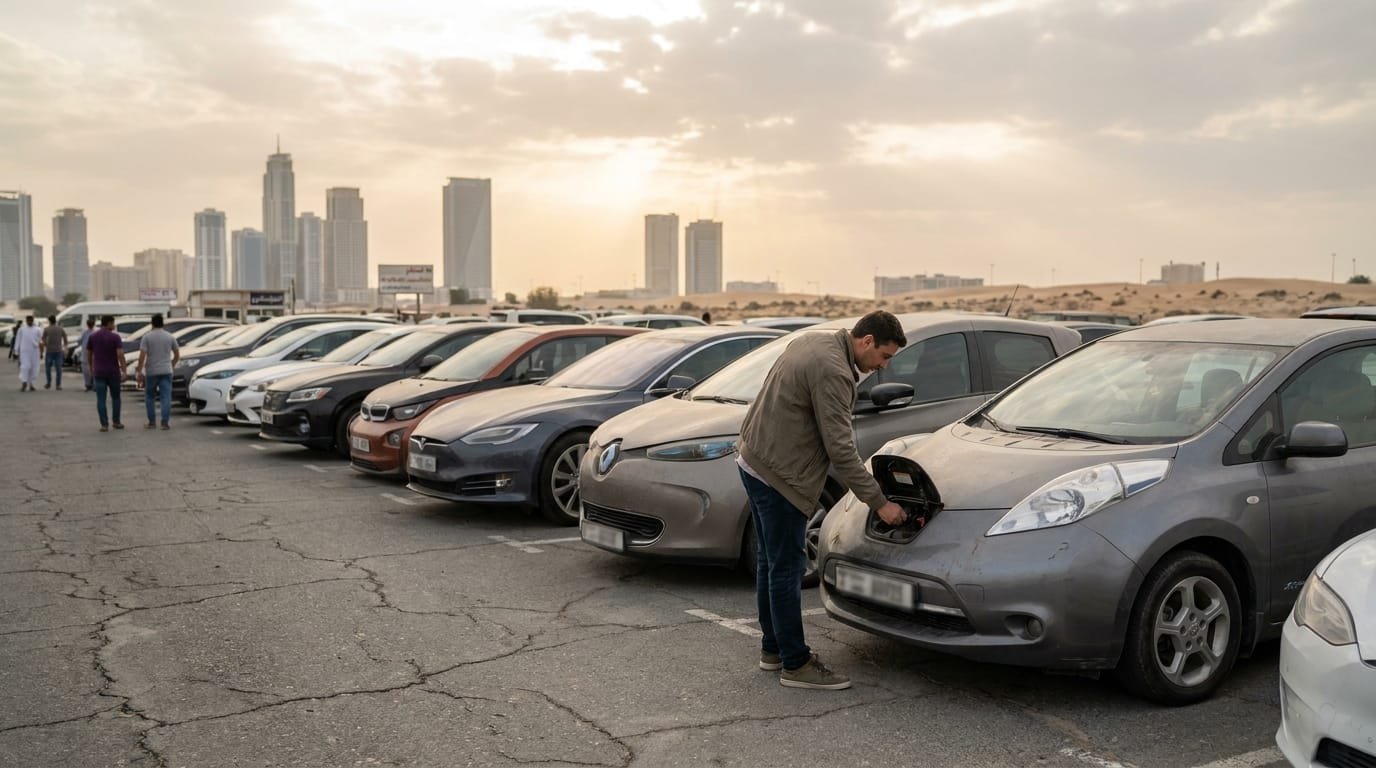
The used EV segment in the UAE has grown from a niche curiosity into a recognised, if still small, part of the used car market. Market reports describe electrified vehicles as moving from a marginal share toward a more established segment as early lease and short-ownership EVs reach the resale market. This is a gradual shift, not a sudden one, and mainstream Japanese and Korean petrol models still define the core of the used market by volume.
Supply has widened mainly because of two things: more new EVs sold in 2023–2025 that are now aging into the used market, and a growing number of affordable Chinese brands (BYD, GAC, MG) that expanded the price ladder below what Tesla and European brands previously occupied.
Why Expats Are Considering a Used EV
Three practical drivers repeat across expat forums and dealer conversations:
- Running cost relief. Electricity for home charging is generally cheaper per kilometre than petrol, though the gap depends on your DEWA or utility tariff and driving pattern.
- Free or reduced perks in some Emirates. Dubai has offered incentives such as free Salik tags and discounted parking for registered EVs at various points; these programs can change, so confirm current terms with the RTA before assuming a benefit applies.
- Falling entry prices. Budget Chinese-brand EVs have pushed new-car starting prices below AED 70,000 in 2026, which pulls used prices for older or higher-mileage examples even lower.
None of this means an EV is automatically cheaper to own. Section 7 below compares running costs directly.
Used EV Purchase Prices in the UAE
Because used EV listings are still a smaller pool than petrol cars, prices vary more between similar-looking cars depending on battery health and service history. The table below reflects typical marketplace ranges observed across major UAE listing sites in 2026, not a fixed price list.
| Segment | Example Models | Typical Used Price Range (AED) |
|---|---|---|
| Budget city EV | BYD Seagull, GAC Aion Y-class | 40,000 – 70,000 |
| Mainstream sedan/hatch | Tesla Model 3 (older), MG4, BYD Song | 80,000 – 150,000 |
| Family SUV EV | Kia EV5/EV6, VW ID.4 | 100,000 – 180,000 |
| Premium/luxury EV | Tesla Model X, Mercedes EQE/EQS | 180,000 and above |
Prices swing on three things every time: remaining battery health, whether the car is GCC-spec or a grey import, and full-service documentation. A car missing service records is routinely priced lower, but that discount can turn into a larger repair bill later.
Common Used EV Models Available to Expats
| Model | Strength | Watch-Out |
|---|---|---|
| Tesla Model 3 | Wide Supercharger access, strong resale among EVs | Non-GCC import versions need careful parts/warranty checks |
| BYD Seagull/Song | Lowest entry price, LFP battery generally tolerates heat well | Newer to UAE market, fewer long-term ownership records |
| Kia EV5/EV6 | Family-sized, factory warranty often still active on younger units | Higher price band than Chinese budget rivals |
| VW ID.4 | Balanced range and driving feel | European parts costs are typically higher than Japanese/Korean equivalents |
Battery Health: The Single Most Important Check
Battery condition affects range, resale value and future repair cost more than any other factor. A pre-purchase check should always include:
- State-of-health (SOH) reading from a diagnostic tool, not just the dashboard range estimate
- Charging history — frequent DC fast-charging accelerates wear more than home AC charging
- Vehicle age combined with total kilometres, since both time and mileage degrade a battery
- Any recorded battery-related warning lights or replacement history
Warning signs include a dashboard range that has visibly dropped compared to the original rated figure, inconsistent charging speeds, or a seller unable to produce any charging or service history at all. This is a normal part of any pre-purchase inspection, and it is worth paying a specialist for an EV-specific check rather than a generic inspection.
Real-World Driving Range in UAE Conditions
Manufacturer range figures are tested under conditions that rarely match daily UAE driving. Constant air-conditioning use, high average speeds on highways like Sheikh Zayed Road, and summer heat all reduce real-world range below the advertised number. Buyers should plan around a practical range meaningfully lower than the official spec, especially on older batteries, and treat the manufacturer figure as a ceiling rather than an expectation.
Charging: Home, Apartment and Public Options
| Situation | Practicality |
|---|---|
| Villa with private parking | Easiest — a home charger can usually be installed, subject to utility approval |
| Apartment with dedicated parking | Depends entirely on building management approving installation; not guaranteed |
| Apartment with shared/no parking | Hardest scenario — relies fully on public charging, which adds time to daily routine |
| Public fast charging | Growing network of DEWA Green Charger stations in Dubai and equivalent operators in other Emirates; useful for top-ups, not ideal as a sole daily solution |
DEWA’s Green Charger initiative has expanded its public charging footprint in Dubai over recent years, with incentives for early adopters at various points. Coverage and pricing tiers can change, so verify current details directly on the DEWA website before assuming a specific tariff or free-charging period applies to your vehicle.
Running Costs: EV vs Petrol
| Cost Item | Petrol Car | Used EV |
|---|---|---|
| Energy/fuel per km | Higher, tracks fuel price | Generally lower with home charging; less advantage if relying mainly on public fast charging |
| Routine servicing | Oil, filters, spark plugs on a fixed schedule | No oil changes; fewer moving parts, but tyres and brakes still wear |
| Brake wear | Standard wear rate | Often slower due to regenerative braking, though this varies by driving style |
| Major repair risk | Engine/transmission repair risk rises with age | Battery replacement is the main long-term risk and can be a significant expense out of warranty |
The honest summary: day-to-day running costs typically favour the EV, but the risk profile shifts toward a single large potential expense (the battery) instead of a wider range of smaller, more predictable petrol-car repairs.
Insurance for Used EVs
EV insurance in the UAE is generally available from mainstream insurers, but premiums can run higher than an equivalent petrol car because of battery replacement costs and a smaller pool of approved repair centres. Confirm the following before buying:
- Whether the insurer covers battery damage and to what value
- Whether repairs must go through an agency-approved workshop for EV-specific coverage
- How the no-claims discount from a previous petrol-car policy transfers
For a broader comparison of policy types, see our guide on comprehensive vs third-party cover.
Registration and Legal Considerations
Registering a used EV follows the same general RTA process as any used car: a passing vehicle test, ownership transfer, and updated Mulkiya. A few EV-specific points to confirm directly with the RTA or the relevant authority in your Emirate:
- Whether any remaining manufacturer battery warranty is transferable to a second owner
- Current registration or Salik incentives applicable to EVs, since these programs are periodically updated
- Import status (GCC-spec vs grey import) and its effect on warranty and parts support
The general transfer steps mirror those covered in our car transfer guide.
Common Problems and Parts Availability
- Battery degradation — the primary long-term concern, more relevant on higher-mileage or older units
- Parts availability — mainstream brands (Tesla, Kia, VW) have a growing UAE service network; newer Chinese entrants have a smaller but expanding footprint
- Software and infotainment updates — some models rely on over-the-air updates that may lag on grey-import units
- Charging equipment issues — home charger faults are less common but should be checked as part of any pre-purchase review if a home unit is included in the sale
🚩 Biggest risk to watch: Buying a used EV with no verifiable battery health report and no charging history. A seller who cannot or will not provide this should be treated as a red flag, the same way a missing service book is a red flag on a petrol car.
Who Should NOT Buy a Used EV
- Renters in apartments without approved parking or charger access
- Anyone planning to leave the UAE within 12 months, given resale uncertainty in a still-developing used EV market
- Frequent long-distance drivers between Emirates who rely heavily on fast public charging
- Buyers who cannot budget for a potential battery-related repair outside warranty
Salary and Budget Suitability
| Monthly Salary Band (Illustrative) | Realistic Used EV Segment |
|---|---|
| Under AED 8,000 | Budget city EV, cash purchase preferred over financing |
| AED 8,000 – 15,000 | Mainstream sedan/hatch EV, financing feasible with standard down payment |
| Above AED 15,000 | Family SUV EV or premium model, wider financing options |
These are general planning bands, not lending criteria. Actual loan approval depends on the bank’s own assessment; see our overview of loan vs cash purchase for a fuller comparison.
Used EV Buying Checklist
| Item | What to Check | Red Flag |
|---|---|---|
| Battery health report | SOH reading from diagnostic tool | No report available or seller refuses |
| Charging history | Frequency of DC fast charging vs home AC charging | Heavy reliance on fast charging with no home charging record |
| Service and ownership history | Full digital or paper trail | Gaps in ownership or missing documents |
| Import status | GCC-spec vs grey import | Unclear origin, no dealer support |
| Warranty transfer | Manufacturer battery/drivetrain warranty terms | Warranty non-transferable or already expired |
| Home charging feasibility | Parking type, building/utility approval | No realistic charging plan at your residence |
| Charging port condition | Physical inspection of port and charging cable | Burn marks, loose fitting, damaged or missing cable |
| Fluid levels | Brake fluid and coolant, even on EVs | Low or discoloured fluid, no recent top-up record |
| Tyre type and wear | EV-rated tyres suited to higher vehicle weight | Standard petrol-car tyres fitted, uneven wear from added weight |
When a Petrol or Hybrid Car Makes More Sense
A hybrid or petrol car remains the simpler choice when charging access is uncertain, when resale speed matters more than running cost, or when the buyer plans a short UAE stay. Mainstream petrol models also benefit from a much deeper used-parts and workshop network across areas like Al Quoz and Sharjah Industrial Area, which keeps repair costs predictable.
Illustrative Field Scenarios: Workshop and Market Patterns
Example scenario based on recurring UAE market patterns, not an actual documented case.
Scenario 1 — Indian software engineer, Dubai Marina. Bought a three-year-old Tesla Model 3 with full service history for roughly AED 100,000–120,000. Home charging was straightforward through building-approved parking, and the buyer reported the electricity cost was noticeably lower than his previous petrol bill, though he factored in a higher insurance premium.
Scenario 2 — Filipino nurse, Sharjah. Considered a budget Chinese-brand EV priced under AED 60,000 but found no approved home charging option at her rented apartment. She opted for a used hybrid instead, reflecting the pattern that charging access, not price, is often the deciding factor for renters.
Scenario 3 — British engineer, Abu Dhabi. Bought a used EV SUV with a battery health report showing moderate degradation. Negotiated the price down by an estimated 10–15% based on that report, illustrating how a documented battery check directly supports price negotiation.
The Bottom Line Decision Framework
| Your Situation | Recommendation |
|---|---|
| Villa or approved apartment parking, staying 2+ years | Used EV is worth serious consideration |
| Renter with no charger access | Choose petrol or hybrid instead |
| Leaving UAE within 12 months | Avoid a used EV purchase — resale timing risk is too high |
| Heavy inter-Emirate daily commuter | Only consider EV models with strong real-world range; otherwise stay petrol/hybrid |
| Tight budget, no repair buffer | Petrol or hybrid, given the EV battery repair risk |
| Factor | Used EV | Used Hybrid | Used Petrol |
|---|---|---|---|
| Running cost | Lowest with home charging | Lower than petrol, no charging needed | Highest fuel cost |
| Charging/refuelling | Requires home or public charging access | Standard petrol station, no charging needed | Standard petrol station |
| Major repair risk | Battery replacement if out of warranty | Battery pack smaller, generally lower-cost than full EV battery | Engine/transmission wear with age |
| Best for | Home/office charging, longer stay in UAE | No charging access, still want lower fuel use | Simplicity, widest parts and workshop network |
✅ Who should buy a used EV today? Buyers with approved home or workplace charging, a planned stay of 2+ years in the UAE, and budget flexibility for a possible out-of-warranty battery repair.
⏳ Who should wait? Renters with no confirmed charging access, anyone leaving the UAE within 12 months, and buyers who cannot absorb an unplanned major repair cost.
Data Sources and Methodology
Purchase price ranges were cross-referenced across multiple UAE marketplace listings (Dubizzle, YallaMotor, DubiCars) rather than a single source. Charging infrastructure details reference DEWA’s official EV Green Charger program. Where no official nationwide figure exists — such as used-EV-specific depreciation rates — this article uses cautious, labelled estimates instead of invented statistics.
ℹ Market Volatility Notice: All prices, incentives and cost figures in this article are variable market averages subject to ongoing change in supply, demand and government policy. Verify current pricing and incentive terms before making a purchase decision.

Frequently Asked Questions
Final Verdict
A used EV is a sound choice for expats with reliable home or workplace charging who plan to stay in the UAE for several years and can absorb the small chance of a significant battery-related repair. It is not the right choice for renters without charger access, short-term residents, or buyers with no budget flexibility for an unplanned repair. For everyone else, the deciding factor is rarely the car itself — it is whether you can actually plug it in every night.
Continue with our resale value comparison to see how EVs stack up against petrol models before you finalize a purchase.
Disclaimer: Emirates Cars is a 100% independent platform. We do not own showrooms, nor are we affiliated with any used car dealerships or garages. Our sole mission is to protect expats from financial fraud in the automotive market.
