Last Updated: July 2026 | By Omar Al-Fayed, Senior Automotive Consultant | Fact-Checked By: Emirates Cars Editorial Team | Category: Driving Rules & Fines
In the UAE, school zone speed limits vary by emirate and road type — typically 30 km/h in Abu Dhabi and 30–40 km/h in Dubai and Sharjah, enforced by fixed and variable radar cameras. Fines for speeding in school zones range from AED 300 to AED 3,000 depending on how much you exceed the posted limit, with black points and vehicle confiscation for serious violations. Ignoring a school bus stop sign carries a fixed penalty of AED 1,000 plus 10 black points across all emirates. For a broader picture of how UAE fines work, see our complete expat fines guide.

⚠ Legal Disclaimer: This article is for educational purposes only. UAE traffic laws, school zone speed limits, and fine amounts are governed by Federal Decree-Law No. 14 of 2024 (in effect from March 2025) and individual emirate regulations, both of which may be updated. Always verify current figures through RTA Dubai, Abu Dhabi Police, or the UAE Government Portal before making any decisions.
School Zone Speed Limits at a Glance
| Factor | Detail |
|---|---|
| Speed limit — Abu Dhabi school zones | 30 km/h (no speed buffer — zero tolerance) |
| Speed limit — Dubai and Sharjah school zones | 30–40 km/h depending on specific road and posted sign |
| Speed buffer | Dubai: generally +20 km/h buffer exists on standard roads, but school zone cameras may enforce exact limits. Abu Dhabi: zero buffer on all roads including school zones. Always obey the posted sign. |
| Active hours (general) | Approx. 7:00–9:00 AM and 1:00–3:30 PM on school days — electronic signs override schedules |
| Radar type | Fixed, variable (speed-activated), and smart AI cameras |
| Minimum fine (speeding) | AED 300 (exceeding limit by up to 20 km/h) |
| Maximum fine (speeding) | AED 3,000 + 23 black points + 60-day vehicle confiscation |
| School bus stop sign violation | AED 1,000 + 10 black points (all emirates) |
| Mobile phone use near school | AED 800 + 4 black points |
| Active during holidays | Generally inactive — but electronic signs always take legal precedence over assumptions |
flowchart TD
    classDef default fill:#000000,color:#ffffff,stroke:#000000,font-size:16px,padding:14px;
    Title["School Zone Speed — Which Limit Applies?"]
    A["Is an electronic flashing sign active?"]
    B["Obey the sign — legally enforceable regardless of time or day"]
    C["Are you in Abu Dhabi?"]
    D["30 km/h — zero buffer — radar may be active anytime"]
    E["30–40 km/h depending on posted sign — check signage"]
    Title --> A
    A -->|Yes| B
    A -->|No| C
    C -->|Yes| D
    C -->|No| E
    style Title fill:#c0392b,color:#ffffff,stroke:#c0392b,font-weight:bold
What Is a UAE School Zone?
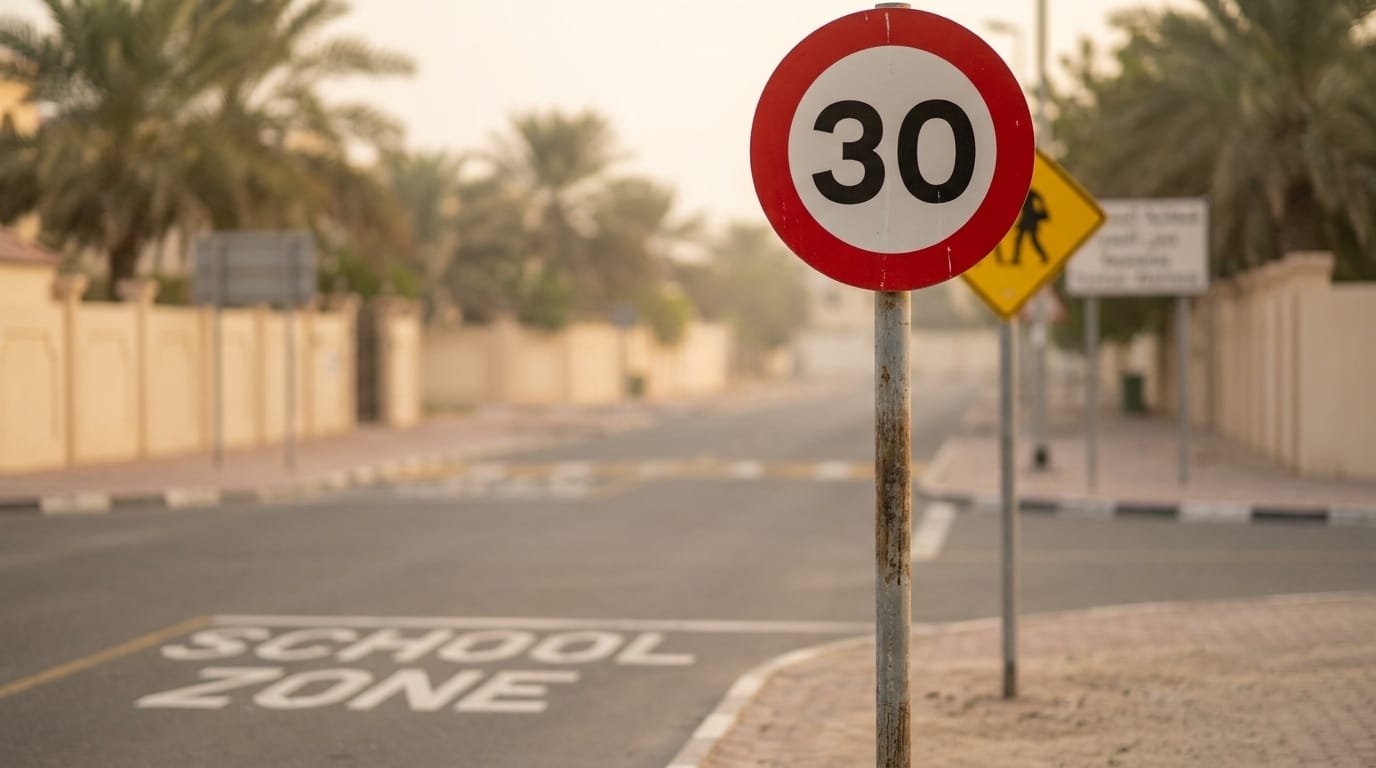
A school zone is a designated road stretch — typically within the immediate vicinity of a school entrance — marked by yellow warning signs showing children crossing imagery, painted road markings, and in many locations, electronic variable message signs (VMS) that display the reduced speed limit during active enforcement windows.
In newer installations across Dubai and Abu Dhabi, radar-activated LED signs automatically illuminate the reduced limit when a vehicle approaches above the permitted speed. School crossings within these zones carry additional legal protections — failing to yield to children crossing is a separate violation from speeding.
UAE School Zone Speed Limits by Emirate
Verified figures from Khaleej Times (citing Dubai Police and RTA, August 2023) and Gulf News (September 2025) confirm the following:
| Emirate | School Zone Speed Limit | Speed Buffer | Key Notes |
|---|---|---|---|
| Abu Dhabi | 30 km/h | Zero — no buffer whatsoever | Radar calibrated to exact posted limit; any excess triggers a fine |
| Dubai | 30–40 km/h (posted sign determines) | +20 km/h buffer exists on standard roads — but school zone cameras may enforce exact limits | Verify via RTA Drive app for road-specific limits; do not assume the buffer applies |
| Sharjah | 30–40 km/h urban; 25–40 km/h in internal residential areas | Generally +20 km/h, but school zones may differ | Mix of fixed and variable installations — obey every posted sign |
| Ajman / UAQ / Fujairah / RAK | Follow posted signs — typically 40 km/h near schools | Varies — confirm locally | Electronic enforcement less widespread; manual police patrols common during school hours |
🚨 Abu Dhabi Warning: Abu Dhabi operates a strict zero-buffer policy on all roads, including school zones. A speed of 31 km/h in a 30 km/h school zone is a fineable offence. Drivers accustomed to Dubai’s +20 km/h tolerance must adjust immediately when crossing into Abu Dhabi. This is one of the most common and avoidable fine scenarios for expats commuting between emirates.
When School Zone Speed Limits Apply
| Time / Situation | Is the Reduced Limit Active? | Radar Active? |
|---|---|---|
| School day morning (approx. 6:30–9:00 AM) | Yes — typically active | Commonly active |
| School day afternoon (approx. 1:00–3:30 PM) | Yes — typically active | Commonly active |
| Midday between sessions | Often inactive — standard road limit applies | May remain active (fixed installations) |
| Evening / night | Generally inactive | Fixed cameras may remain on standard enforcement |
| Weekends (Sat–Sun) | Generally inactive | Varies by installation |
| Public holidays | Generally inactive | Varies |
| Summer vacation | Generally inactive | Fixed cameras may continue enforcing standard road limit |
| Electronic sign displaying reduced limit | Always active — regardless of day, time, or season | Yes |
Do School Zone Cameras Work All Day?
| Camera Type | Where Found | Enforcement Hours | What It Detects |
|---|---|---|---|
| Variable radar | Most modern school zones — Dubai and Abu Dhabi | Active windows only (approx. 6:30–9:00 AM and 1:00–3:30 PM on school days); reverts to standard road limit outside those windows | Speed only |
| Fixed radar | Older installations — some Sharjah and outer Dubai districts | Continuous — enforces school zone limit regardless of school hours or season | Speed only — treat as always active |
| Smart AI cameras | Newer Dubai and Abu Dhabi deployments (from 2025) | Not time-window limited — operate independently of schedule | Speed, mobile phone use, unsafe following distance — simultaneously |
| School bus cameras | Fitted to school buses in Abu Dhabi and Dubai | Active whenever STOP sign is extended | Overtaking, insufficient stopping distance — violations registered automatically |
💡 Drop-Off Reminder: Dubai’s RTA specifically advises parents not to stop on the opposite side of the road from the school, as this forces children to cross moving traffic. Use the designated drop-off bay on the school side of the road — even if it adds a short walk to the gate.
UAE School Zone Speeding Fines — Verified Schedule
The following fine schedule is sourced from the UAE Federal Traffic Law as reported by Khaleej Times (citing Dubai Police and RTA, August 2023) and Gulf News (September 2025, citing Ministry of Interior). These figures reflect the Federal Traffic Law fine structure applied across all emirates for exceeding a posted speed limit — including school zones. Fine amounts are subject to change; verify through official portals before acting on them.
| Speed Excess Above Posted Limit | Fine (AED) | Black Points | Vehicle Confiscation |
|---|---|---|---|
| Up to 20 km/h over | 300 | None | No |
| Up to 30 km/h over | 600 | None | No |
| Up to 40 km/h over | 700 | None | No |
| Up to 50 km/h over | 1,000 | None | No |
| Up to 60 km/h over | 1,500 | 6 | 15 days (light vehicles) |
| More than 60 km/h over | 2,000 | 12 | 30 days (light vehicles) |
| More than 80 km/h over | 3,000 | 23 | 60 days (light vehicles) |
Fine amounts are subject to change. Verify current figures via RTA Dubai or Abu Dhabi Police before acting on them.
Fines can reach AED 3,000 with 23 black points and 60-day confiscation — making school zone speeding one of the most expensive violation categories available under UAE traffic law. For context on how black points accumulate and how to manage them, see our black points guide.
flowchart TD
    classDef default fill:#000000,color:#ffffff,stroke:#000000,font-size:16px,padding:14px;
    Title["School Zone Fine Escalation — By Excess Speed"]
    A["Up to 20 km/h over: AED 300 — no points"]
    B["Up to 40 km/h over: AED 600–700 — no points"]
    C["Up to 60 km/h over: AED 700–1,500 + 6 pts + 15-day confiscation"]
    D["60+ km/h over: AED 2,000–3,000 + 12–23 pts + 30–60 day confiscation"]
    Title --> A
    A --> B
    B --> C
    C --> D
    style Title fill:#c0392b,color:#ffffff,stroke:#c0392b,font-weight:bold
School Bus Rules — Verified Fines (2026)
School bus rules are governed by Articles 90 and 91 of the Federal Traffic Law. The following penalties are confirmed by Abu Dhabi Police (September 2025, January 2026), Sharjah Police, and Gulf News (September 2025).
| Situation | Required Action | Fine (AED) | Black Points |
|---|---|---|---|
| School bus displays STOP sign — single-lane or one-way road | All vehicles in both directions must stop at least 5 metres behind the bus | 1,000 | 10 |
| School bus displays STOP sign — divided road (central barrier) | Only vehicles travelling in the same direction as the bus must stop | 1,000 | 10 |
| Overtaking a school bus with STOP sign activated | Prohibited — stop and wait until sign is retracted | 1,000 | 10 |
| Stopping less than 5 metres from a school bus | Maintain at least 5 metres clearance | 1,000 | 10 |
| Mobile phone use near school zone | No phone use while vehicle is in motion | 800 | 4 |
| Parking in People of Determination spot near school | Use authorised parking only | 1,000 | 6 |
Smart monitoring cameras are now fitted to school buses in Abu Dhabi and Dubai to electronically detect overtaking violations when the STOP sign is activated. These cameras register violations automatically — you do not need to be seen by a police officer for the fine to be issued.

Pick-Up and Drop-Off Mistakes That Result in Fines
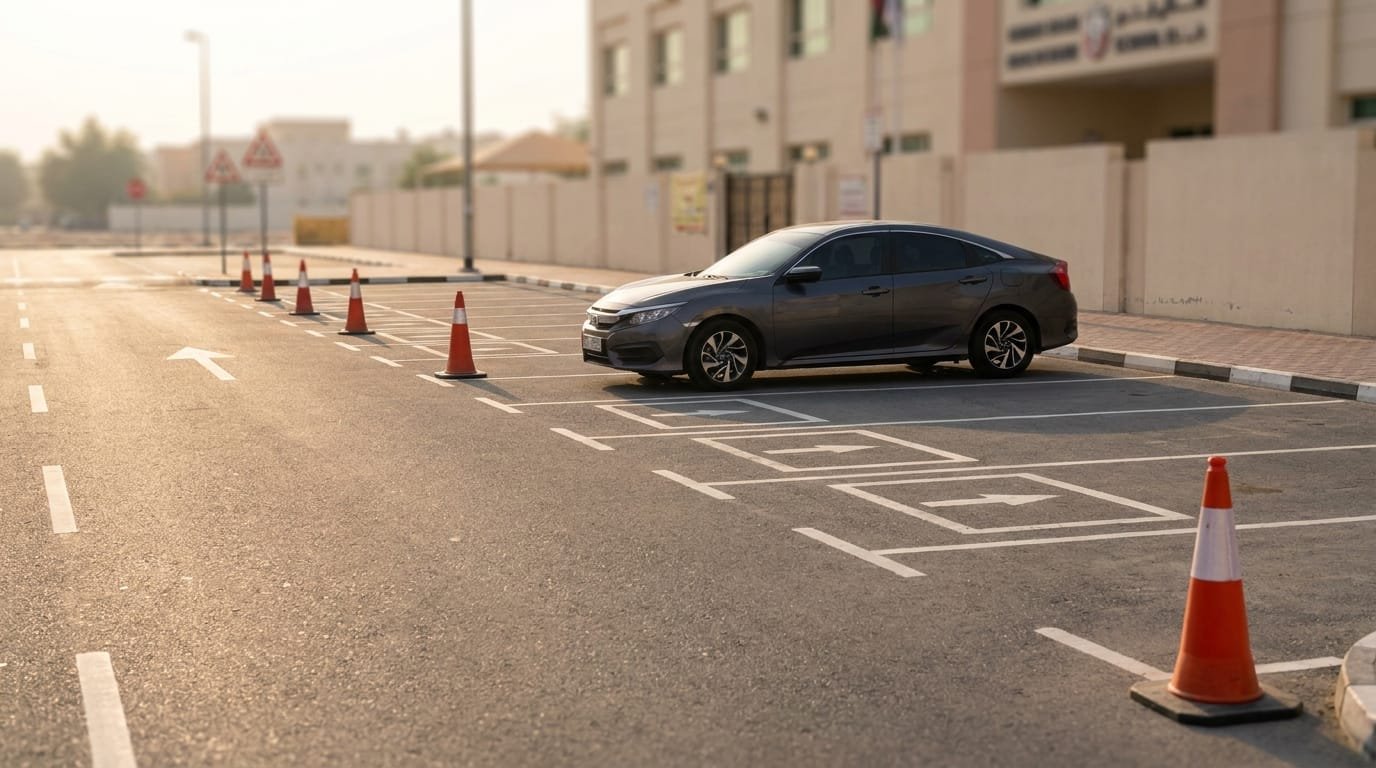
A significant proportion of school zone fines are not speeding fines — they are parking and stopping violations during morning and afternoon school runs.
| Mistake | Why Drivers Do It | Possible Consequence |
|---|---|---|
| Double parking to drop off children | No available space | Fine + possible towing (amount varies by emirate) |
| Stopping in an active lane | Impatience or unfamiliarity | Fine + black points |
| Blocking the school bus bay | Unaware of designated zone | Fine + towing risk |
| Parking on a pedestrian crossing | Brief stop assumption | Fine |
| Performing a U-turn inside school zone | Missed entry point | Fine (amount varies by road type) |
| Using mobile phone while stationary near school | Assuming stationary = exempt | AED 800 + 4 black points if phone used while engine running |
| Stopping across from school requiring children to cross road | Closer to school entrance | Risk of accident — RTA specifically warns against this practice |
School Zone Driving Checklist
| Action Before and Inside Any School Zone | Status |
|---|---|
| Know the posted speed limit for this specific zone (30 or 40 km/h — not 25) | Mandatory |
| In Abu Dhabi: drive at exactly the posted limit — zero buffer | Mandatory |
| Check for flashing electronic signs — obey regardless of time, day, or season | Mandatory |
| Look for children near crossings — they have absolute priority | Mandatory |
| Identify the official drop-off bay before arriving on the first day | Strongly recommended |
| Do not use mobile phone — even when stationary with engine running | Mandatory |
| Do not overtake any vehicle inside the zone | Mandatory |
| Stop fully at least 5 metres behind any school bus with STOP sign out | Mandatory — AED 1,000 + 10 points if violated |
| Do not stop on the opposite side of the road from the school entrance | Strongly recommended — RTA advisory |
Illustrative Field Scenarios
Example scenario based on recurring UAE market patterns, not an actual documented case.
Scenario 1 — Abu Dhabi, Mohammed Bin Zayed City: A Bangladeshi driver regularly passed through a school zone posted at 30 km/h on his morning commute. Accustomed to Dubai’s +20 km/h buffer, he typically drove at around 48–50 km/h. In Abu Dhabi, however, there is no buffer whatsoever — a speed of 31 km/h is a fineable offence. Within one academic term, he accumulated two fines and 6 black points, bringing his total close to a suspension review threshold. The fines alone came to approximately AED 1,200 to AED 1,400 based on the excess speed bracket. The same driving behaviour in Dubai might not have triggered a camera at all — this inter-emirate difference catches a large number of expat commuters every year.
Example scenario based on recurring UAE market patterns, not an actual documented case.
Scenario 2 — Dubai, Al Barsha (school bus violation): An Indian driver pulled up behind a school bus that had extended its STOP arm. Assuming the bus was simply waiting and not in active loading, he pulled around it. Smart cameras mounted on the bus detected the overtaking manoeuvre and automatically issued a fine of AED 1,000 plus 10 black points. With his existing 8 black points from earlier in the year, he was now at 18 — approaching the 24-point suspension threshold. He was unaware that the camera system was active or that overtaking a STOP-arm bus regardless of the road situation carried this specific penalty. For information on contesting traffic fines when you believe a violation was issued in error, our guide on contesting UAE traffic decisions explains the formal process.
Do School Zone Rules Differ Between Emirates?
| Emirate | Authority | Key Practical Difference |
|---|---|---|
| Dubai | RTA / Dubai Police | 30–40 km/h zones; +20 km/h buffer exists on standard roads but school zone cameras may enforce exact limits; fines via Dubai Police app or RTA portal |
| Abu Dhabi | Abu Dhabi Police / ITC | 30 km/h; strict zero-buffer policy; Darb AI cameras monitor school zones; fines via TAMM app or Abu Dhabi Police portal |
| Sharjah | Sharjah Traffic Department | 30–40 km/h urban; 25–40 km/h internal residential areas; mix of fixed and variable radar; some older fixed cameras enforce limit continuously |
| Ajman / UAQ / Fujairah / RAK | Respective police traffic departments | Posted limits near schools typically 40 km/h; electronic enforcement less widespread; manual police patrols more common during school hours |
Scam Prevention: What to Watch For
🚨 Common Trap: Informal “fine clearance” services have no authority over RTA, Abu Dhabi Police, or Sharjah traffic fines. The only legitimate channels to contest or pay a fine are official government portals or the relevant traffic court. Paying a third party provides no guarantee and may result in financial loss with no recourse. Official traffic marshals never collect cash from drivers — any cash request from someone claiming to be a marshal should be reported to police immediately.
The Bottom Line Decision Framework
| Driver Profile | Key Risk | Recommended Action |
|---|---|---|
| Parent driving children to school daily in Dubai | Drop-off zone violations; camera may enforce exact speed with no buffer | Know the specific posted limit for your school’s road; use designated bay; add 5 minutes to morning routine |
| Parent driving in Abu Dhabi | Zero-buffer — any speed above 30 km/h is a fine | Drive at exactly 30 km/h in marked school zones; do not rely on any buffer |
| Commuter passing near schools | Radar fine from fixed or variable camera | Reduce speed before reaching the zone marking — not after |
| Driver commuting between Dubai and Abu Dhabi | Different speed buffers catch inter-emirate commuters frequently | Reset speed expectations immediately upon crossing into Abu Dhabi — zero tolerance applies from that point |
| Driver with existing black points near suspension threshold | Any school zone violation adds 10 points (bus) or up to 23 points (extreme speeding) | Treat school zones as absolute priority compliance zones — the stakes are licence suspension |
Questions Expat Parents Frequently Ask
Key Takeaways
- UAE school zone speed limits are 30 km/h in Abu Dhabi and 30–40 km/h in Dubai and Sharjah — always obey the posted sign on the specific road.
- Abu Dhabi has zero speed buffer on all roads. Any speed above the posted limit is fineable from AED 300.
- Speeding fines range from AED 300 to AED 3,000, with vehicle confiscation up to 60 days for extreme violations.
- Ignoring a school bus STOP sign carries a fixed AED 1,000 + 10 black points, enforced by cameras mounted on the buses themselves.
- Smart bus cameras issue fines automatically — you do not need to be observed by a police officer for the fine to be registered.
- Electronic variable speed signs override all time-based assumptions. If it is displaying a limit, that limit applies.
- Pick-up and drop-off violations — double parking, stopping in active lanes, blocking bus bays — generate a significant share of school-area fines. Use designated bays only.
- No third-party service can legitimately reduce or clear a valid UAE traffic fine. Use official portals only.
For expats managing the full picture of UAE vehicle compliance, our 12-month car ownership calendar covers the complete annual regulatory schedule. If you are new to driving in the UAE, our expat traffic fines guide provides a broader overview of the UAE enforcement system.
Disclaimer: Emirates Cars is a 100% independent platform. We do not own showrooms, nor are we affiliated with any used car dealerships or garages. Our sole mission is to protect expats from financial and administrative risk in the UAE automotive market.
