Last Updated: May 2026 — market rates Written by: Omar Al-Fayed | Senior Automotive Consultant — UAE Market Section: Car Reviews
If you already went through our Used Nissan Patrol Platinum gearbox guide, you know that hidden mechanical problems are the biggest financial risk when buying a used car in the UAE. Imported American vehicles — especially US-spec models — carry a completely different set of risks. And most expats find out too late, after the money is already gone.
This guide covers what to check, what to avoid, and how to protect your savings before signing anything.
Short answer first: US-spec cars can work in the UAE, but the import process, insurance complications, and parts availability create real financial risks that GCC-spec vehicles simply do not have. If your budget is under 60,000 AED, a GCC-spec Japanese car will almost always be the safer financial decision.
Why US-Spec Cars End Up in the UAE Market
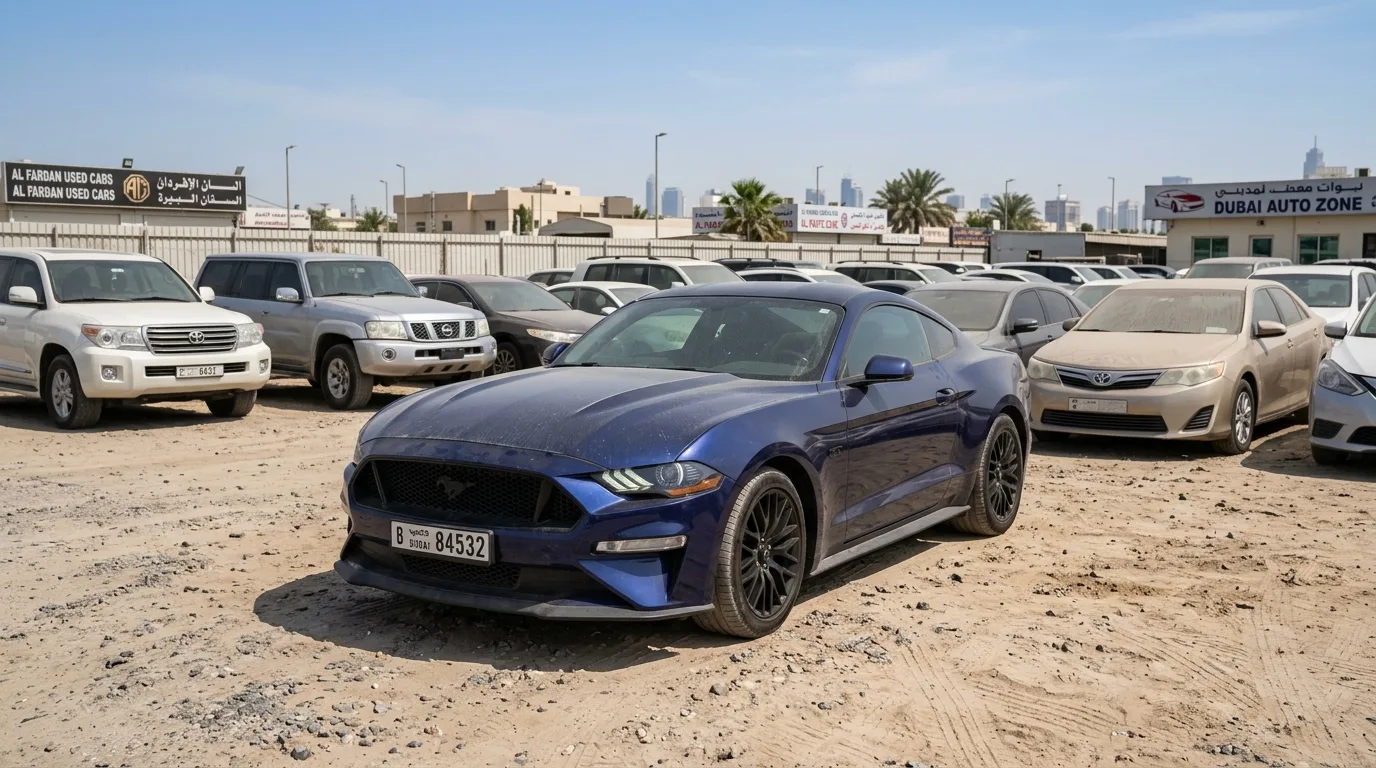
Every year, thousands of American-specification vehicles arrive in the UAE through private importers, small trading companies, and individual sellers. The pricing looks attractive — sometimes 20,000 to 35,000 AED below a comparable GCC-spec model.
That price gap is not a bargain. It is the cost of the problems built into the car.
Here is how these vehicles typically arrive:
- Bought at US auto auctions (Copart, IAAI) — sometimes after flood damage, collision, or insurance write-off
- Shipped through ports in Georgia or New Jersey, then transited through Jebel Ali
- Registered in UAE with a local chassis inspection — which does not verify the original US title status
- Listed on Dubizzle or sold through small showrooms with no disclosure of import history
The seller often does not explain any of this. The price does the talking instead.
The Real Difference Between GCC-Spec and US-Spec
Many expats — especially those arriving from India, Pakistan, Malaysia, or the Philippines — are not familiar with what “GCC spec” means. Here is a simple explanation.
GCC-spec means the car was built specifically for the Gulf region:
- Cooling system: Larger radiator and stronger AC compressor rated for 50-degree heat
- Engine tuning: Adjusted fuel mapping for 95-octane fuel available at UAE petrol stations
- Suspension: Calibrated for smooth Gulf roads and occasional sand
- Warranty: Valid at UAE dealerships
- Insurance: Accepted by all UAE insurance companies without extra conditions
US-spec means the car was built for American roads and American climate:
- Cooling system: Smaller — not built for UAE summer temperatures
- Fuel: Often tuned for 87-octane American fuel — runs less efficiently on UAE fuel
- Speedometer: Miles per hour — requires recalibration or causes confusion
- Airbag calibration: Sometimes different — can affect insurance claim acceptance
- Insurance: Many UAE insurers either reject US-spec vehicles or charge 15 to 30 percent more in premium
This is not a small difference. Over two years of ownership, these gaps add up to real money.
🔧 Mechanic’s Inspection Log
This section documents a real vehicle inspection carried out by our team. Names are changed for privacy.
Vehicle: 2019 Ford Mustang GT, US-Spec, 5.0L V8 Location: Independent workshop, Industrial Area 13, Sharjah Odometer: 67,000 km (claimed by seller) Asking Price: 58,000 AED
What the seller said: “Clean car, no accidents, brought from America by previous owner who worked there.”
What the inspection found:
We started with the floor area under the front seats. The carpet padding felt slightly stiff — not wet, but not fully normal either. We pulled back the edge of the carpet near the door sill and found a faint watermark line at approximately 8 centimeters from the floor. This is a common sign of water entry that dried out months before the sale.
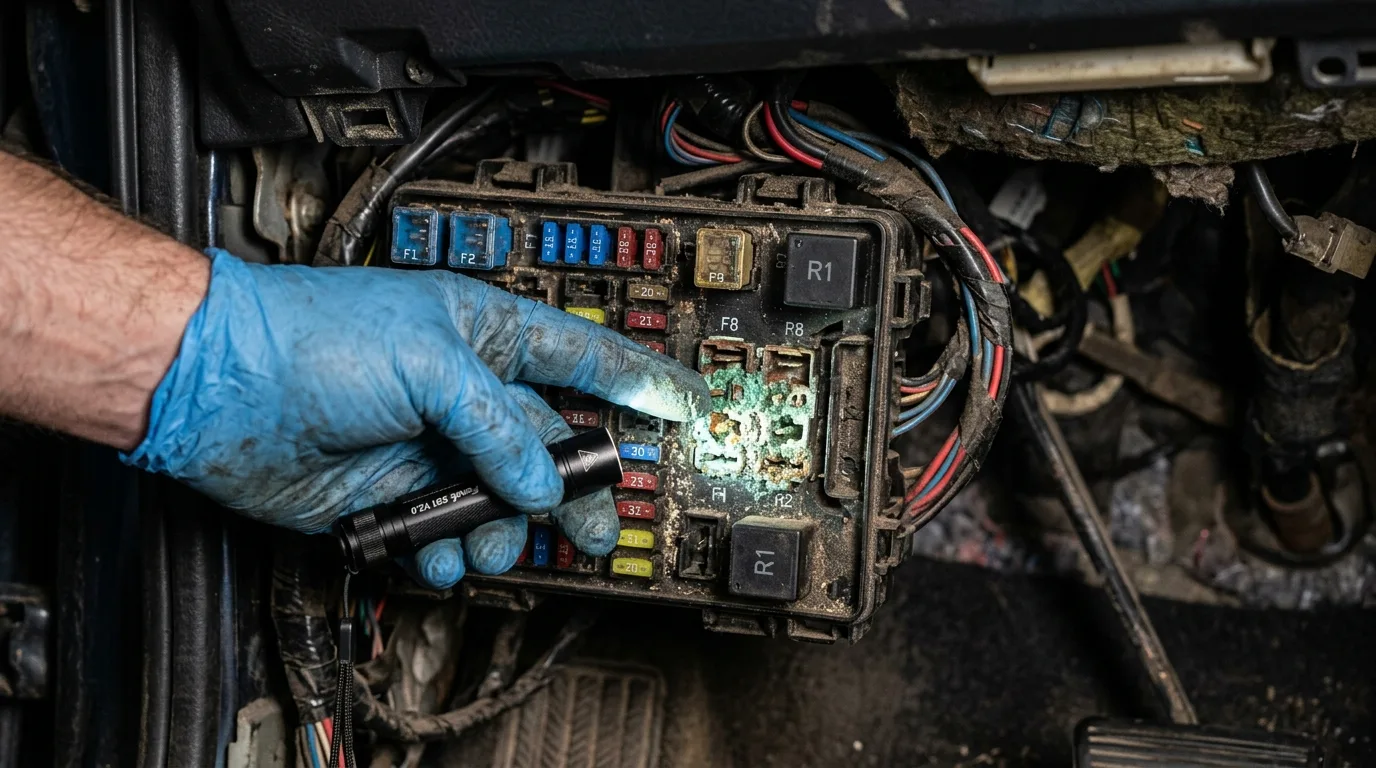
Next, we checked the fuse box under the dashboard. Two fuse sockets showed visible oxidation — a green-white residue that does not appear from normal humidity. This residue forms when electrical components are submerged or exposed to standing water.
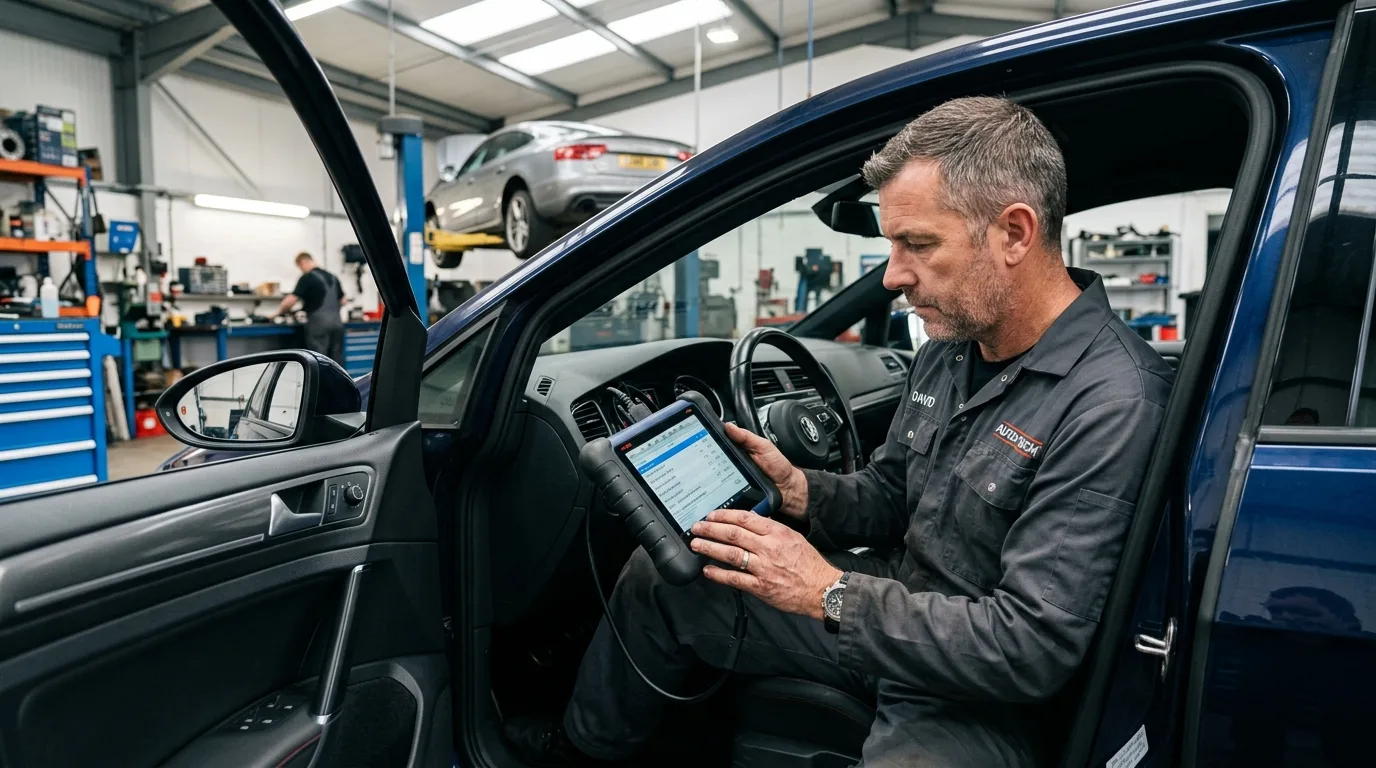
The OBD scan showed no active fault codes — the seller had clearly cleared them. But the freeze-frame history showed three separate events of engine temperature warnings recorded over the previous four months.
We checked the VIN against the Carfax report the seller provided. The report showed a “damage” notation from a US state in 2022 — listed as “other” damage with no repair records attached.
Our advice to the buyer: Do not purchase at any price without a full independent structural inspection and a clear title history from the originating US state. The 58,000 AED asking price becomes 75,000+ AED once you factor in electrical repair, potential ECU replacement, and the insurance surcharge for a non-clean-title vehicle.
Buyer’s decision: Walked away. Found a 2018 GCC-spec Toyota Camry with full agency history for 52,000 AED two weeks later.
How to Spot Flood Damage — Specific Checks Anyone Can Do
You do not need to be a mechanic to run these checks. Go through them in order before you agree to anything.
Check 1 — The Carpet and Floor Mat Test
Remove the floor mats completely. Press your hand flat on the carpet underneath and hold it there for five seconds.
- Normal: dry, firm, slightly warm from the sun
- Flood warning: any dampness, stiffness, or a faint musty smell that gets stronger when you press
Pull the carpet edge near the door sill slightly. A watermark line — even a faint one — means water entered the cabin at some point.
Check 2 — The Fuse Box Inspection
Open the fuse panel under the dashboard (usually on the driver’s left side).
- Normal: clean metal contacts, no residue
- Flood warning: white, green, or grey oxidation on any fuse socket or relay terminal
This oxidation is almost impossible to clean completely. If you see it, the electrical system has been water-damaged.
Check 3 — The Seatbelt Retractor Test
Pull each seatbelt out fully and let it retract slowly.
- Normal: smooth, consistent retraction
- Flood warning: the belt feels gritty, retracts unevenly, or smells musty at the end of the pull
Seatbelt retractors trap debris and moisture from flood events. Sellers rarely clean them before resale.
Check 4 — The Air Conditioning Smell Test
Turn the AC to maximum cold and press the recirculation button. After 60 seconds, lean toward the vent and breathe in.
- Normal: cold air, neutral or plastic smell
- Flood warning: a mouldy, earthy, or musty smell that intensifies after 90 seconds
Mould in the AC evaporator takes months to develop after a flood event. By the time you smell it, the damage is already deep in the system.
Check 5 — The VIN and Carfax Verification
Every US-spec vehicle has a 17-digit VIN. You can run this number on Carfax or AutoCheck for approximately 35 to 50 AED equivalent.
Look specifically for:
- Any “damage” notation — even listed as “minor”
- Flood, fire, or hail damage disclosure
- Title issued in Florida, Louisiana, Texas, or New Jersey — states with higher flood vehicle rates
- Large mileage gaps between service records
If the seller refuses to provide the VIN or becomes defensive when you ask for a Carfax report, that is your answer.
Real 2026 Cost Breakdown — US-Spec vs GCC-Spec
This table shows the actual financial difference over two years of ownership for a comparable vehicle in both specifications. These figures are based on current UAE market rates.
| Cost Item | US-Spec Vehicle | GCC-Spec Vehicle |
|---|---|---|
| Purchase price (example) | 55,000 AED | 68,000 AED |
| Insurance annual premium | 6,500 – 9,000 AED | 4,200 – 5,500 AED |
| Parts availability | 2 to 6 weeks wait | Available same day or next day |
| Parts cost premium | 20 – 40% higher | Standard market price |
| AC system repair risk | Higher — smaller original system | Lower — built for Gulf climate |
| Tasjeel pass rate | Requires modifications in some cases | Passes standard inspection |
| Resale value after 2 years | 15 – 25% lower than GCC equivalent | Standard depreciation |
| Estimated 2-year total cost | 85,000 – 95,000 AED | 88,000 – 96,000 AED |
The purchase price gap closes completely within 18 months. After that, the US-spec vehicle costs more to run, harder to insure, and harder to sell.
The Ford Mustang Specifically — What Makes It High Risk
The Ford Mustang is the most commonly imported American vehicle in the UAE used market. It is also one of the riskiest purchases for an expat on a standard salary.
Here is why, specifically:
Cooling system mismatch: The US-spec Mustang GT 5.0L was calibrated for American ambient temperatures. In UAE summer conditions above 45 degrees, the factory cooling system runs near its thermal limit during normal driving. This is confirmed in multiple owner reports on Mustang6G forums from UAE-based owners who have documented coolant temperature spikes during summer traffic on the E11.
Parts supply: Ford does not have an official dealership network in the UAE for the Mustang at the same scale as Toyota or Nissan. Independent parts importers typically add 25 to 40 percent to the US retail price, plus two to four weeks wait time for non-stocked components.
Insurance complications: Several major UAE insurers — including some listed on Bayzat’s insurance comparison platform — classify US-spec Mustangs under non-standard vehicle categories, which affects both premium pricing and claim settlement terms.
Resale difficulty: The buyer pool for a US-spec Mustang in the UAE is significantly smaller than for a GCC-spec Japanese or German vehicle. When your work contract ends and you need to sell quickly, a smaller buyer pool means a lower final price.
Why Some Expats Still Buy US-Spec Cars — And When It Makes Sense
This is not a one-sided situation. There are genuine reasons why some expats choose imported American vehicles, and it is fair to acknowledge them.
The driving experience: A Ford Mustang GT with 450 horsepower is a genuinely different driving experience from anything available in the GCC-spec market at the same price point. For an expat who enjoys performance driving on the Abu Dhabi highway on a weekend, that experience has real value.
The price point: A US-spec Mustang at 55,000 AED gets you a V8 engine and sport suspension. A GCC-spec equivalent with similar performance would cost 90,000 AED or more. For some buyers, that price gap is the deciding factor.
Short-term ownership: If you plan to stay in the UAE for 12 to 18 months and you find a verified, clean-title US-spec vehicle with a solid inspection report, the financial risks are manageable within that timeframe.
When it genuinely makes sense:
- Your UAE contract is confirmed for at least 24 months
- The vehicle has a fully verified Carfax report with no damage notations
- An independent mechanic has completed a full structural and electrical inspection
- Your insurance quote is confirmed in writing before purchase
- You have a clear resale plan before your contract ends
The Al Aweer and Sharjah Market — Specific Warning Signs
The Al Aweer car market in Dubai and the used car lots along the industrial areas of Sharjah are the primary locations where US-spec vehicles are sold to expats in the UAE.
Specific patterns to watch for in these markets:
- “American specs, full option” listed as a selling point rather than disclosed as a specification difference
- Sellers who cannot produce the original shipping documents or UAE customs clearance certificate
- Vehicles with UAE registration but no service history between import date and current mileage
- Prices listed in dollars rather than dirhams — sometimes a sign the seller is targeting buyers unfamiliar with local market pricing
- Showrooms that offer to “fix the speedometer” as part of the deal — this conversion is rarely done properly and affects instrument cluster accuracy
If a seller in Al Aweer cannot answer these three questions directly, leave immediately:
- What is the original US title status of this vehicle?
- Can I see the Carfax or AutoCheck report for this VIN?
- Who completed the UAE customs clearance and do you have the paperwork?
FAQ — Questions Expats Actually Search Before Buying
Can a US-spec car pass the Tasjeel inspection in UAE?
Yes, in most cases it can pass the basic Tasjeel test. However, the test checks road safety items like brakes, lights, and tires — not the vehicle’s original specification or import history. Passing Tasjeel does not mean the vehicle is GCC-spec or free from hidden damage.
Is it legal to buy a US-spec car in the UAE?
Yes, it is legal. Imported vehicles can be registered in the UAE after clearing customs and passing the roadworthiness inspection. The legal process does not verify flood damage history, prior accident status, or whether the vehicle is suitable for UAE climate conditions.
Will UAE insurance cover a US-spec Ford Mustang?
Most major insurers will provide coverage, but terms vary significantly. Some insurers exclude certain claim types for non-GCC vehicles, and premiums are generally 20 to 35 percent higher. Always confirm coverage terms in writing before purchasing the vehicle.
How do I check if a US-spec car was flood damaged?
Run the 17-digit VIN through Carfax or AutoCheck. Check the fuse box for oxidation, the carpet for watermarks, and the AC system for mould smell. An independent mechanic inspection with an OBD scanner reading freeze-frame data is the most reliable method.
What is the best US-spec car to buy in UAE if I have to choose one?
If the import history is clean and verified, US-spec Chevrolet Tahoe and GMC Yukon models tend to perform better in UAE conditions than performance cars, because their V8 engines and cooling systems are already oversized by design. They also have a larger buyer pool at resale.
Should an expat on a 5,000 AED salary buy a US-spec car in UAE?
No. At that salary level, the insurance premium alone represents 10 to 15 percent of annual income, and any unexpected repair — electrical, cooling, or mechanical — can create serious financial pressure. A GCC-spec Toyota Corolla or Nissan Sunny in the 25,000 to 35,000 AED range is a significantly safer financial decision.
The Bottom Line — A Simple Decision Framework
Before you decide on any US-spec imported vehicle, go through these four questions in order:
- Question 1: Do you have a clean Carfax report with zero damage notations?
If no — stop here. Do not continue. - Question 2: Has an independent mechanic completed a full inspection including OBD freeze-frame data?
If no — do not sign until this is done. - Question 3: Do you have a confirmed insurance quote in writing from a UAE insurer?
If no — get this before negotiating the price. - Question 4: Is your UAE work contract confirmed for at least 18 more months?
If no — a GCC-spec vehicle with better resale liquidity is the safer choice for your situation.
If all four answers are yes, a US-spec vehicle can be a reasonable purchase at the right price. If any answer is no, the financial risk is not worth taking.
Understanding the risks of imported American vehicles is one layer of protection. The next layer is knowing what to look for in any used car transaction in the UAE — regardless of origin. Read our detailed breakdown of the most common inspection loopholes and cosmetic traps in the UAE used car market: US Spec Ford Mustang: Inspection Loopholes Exposing Flood Damage & Rust
