Last Updated: June 2026 | By Omar Al-Fayed, Senior Automotive Consultant | Category: UAE Market News
If you leave UAE without selling or transferring your car, registration fines accumulate from around AED 500 for expired plates. If the car sits in public or airport parking, impound fees commonly reach AED 35–100 per day. Banks with active loans may initiate repossession proceedings within 30 to 90 days of missed payments. For most expats asking what happens to my car if I leave UAE, the short answer is: the costs compound faster than most expect, and the safest financial outcome is nearly always to sell or formally transfer ownership before your flight. In related territory, our UAE registration guide covers renewal steps from abroad in detail.
⚠ Worth Knowing Before You Read Further: Many expats leave UAE assuming their parked car will be manageable for a few months. In practice, unpaid traffic fines, expired registration, lapsed insurance, and airport storage fees can combine well beyond the vehicle’s residual value — often discovered only when attempting to return to UAE or apply for a new visa.
Quick Answer: Your Situation in One Table
| Question | Short Answer |
|---|---|
| Can I legally leave my car in UAE? | Yes, if privately stored — but public parking rules still apply |
| Can a friend drive it? | Only with valid insurance naming them and a Power of Attorney |
| Can I keep registration active from abroad? | Yes, via online renewal through RTA or Abu Dhabi Mobility portals |
| Can I leave with an outstanding loan? | Technically yes, but missed payments trigger bank action quickly |
| Can police impound it? | Yes — after expired registration or abandoned vehicle classification |
| Can I sell remotely? | Yes, through a notarised Power of Attorney |
| Can I export it later? | Yes, but costs typically range AED 3,000–8,000 plus shipping |
| How long before abandoned classification? | Dubai: typically 15–30 days in public areas |
The Four Types of Expat Departure — and Why Each Is Different
Not all departures create the same risk. The legal and financial consequences differ significantly depending on the nature of your exit.
Permanent Departure or Visa Cancellation
When your visa is cancelled — through job loss, end of contract, or voluntary resignation — your legal residency in UAE ends. You remain the registered vehicle owner on paper, but your ability to manage the vehicle in person disappears. Banks, insurers, and government systems do not automatically account for your absence. The vehicle does not go into administrative “pause.”
Emergency Departure
Family emergencies, medical situations, or sudden redundancies push many expats to board a flight within 24–72 hours. Vehicle arrangements are commonly forgotten or rushed in these cases. This is where the majority of long-term compounding problems begin.
Relocation to Another GCC Country
Moving to Saudi Arabia, Qatar, Bahrain, or Oman creates a specific opportunity — GCC-to-GCC vehicle transfers and temporary imports are possible under certain conditions, though the process involves specific paperwork and timeline requirements that vary by destination country.
Short Trip vs Final Exit
A two-week holiday is fundamentally different from permanent departure. For trips under 30 days to a private garage or trusted contact’s care, the risks remain manageable. For permanent exits, treating the vehicle as “temporarily parked” consistently leads to compounding costs that expats rarely anticipated.
How UAE Authorities View an Unattended Vehicle
UAE traffic law and municipal regulations treat unattended vehicles on public land as a liability — not a neutral storage arrangement. Vehicle ownership carries ongoing responsibilities that do not pause because the owner has left the country.
Abandoned Vehicle Classification
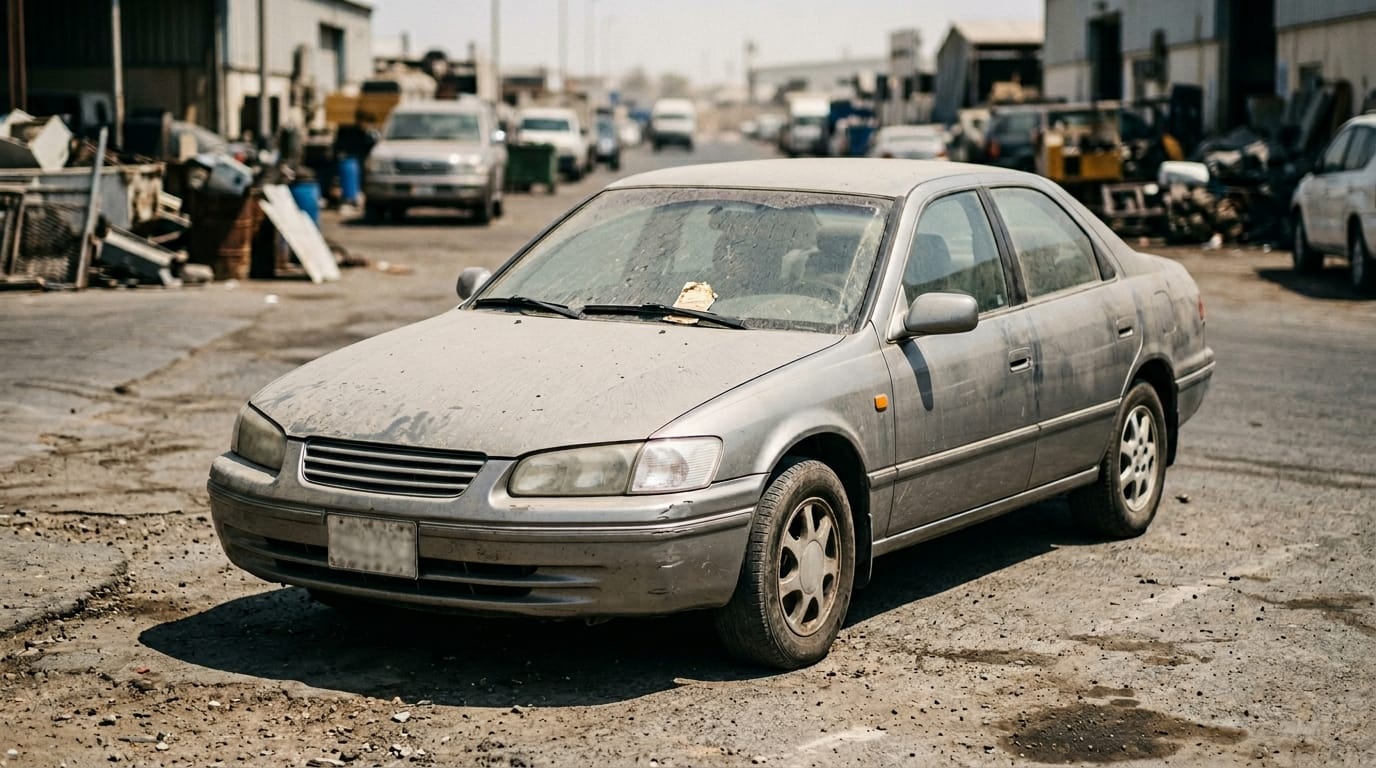
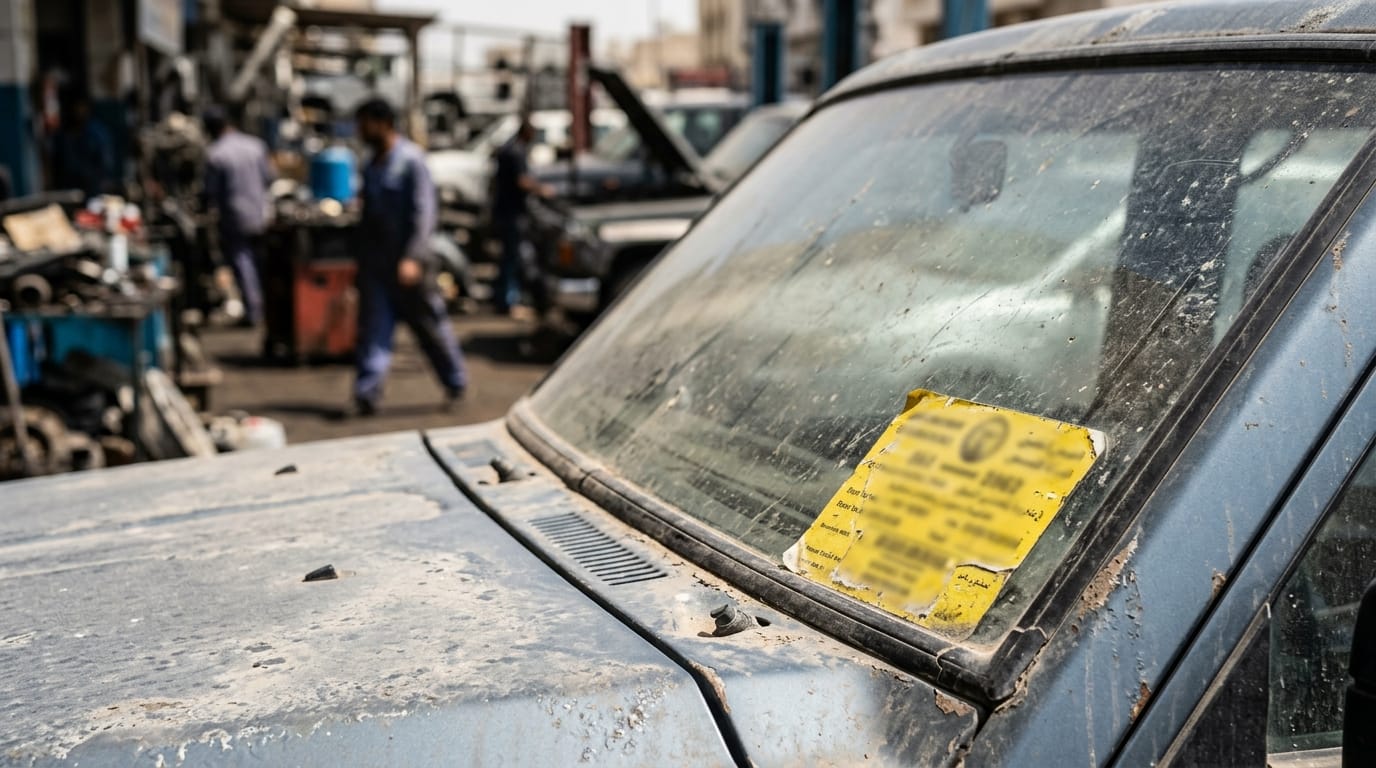
In Dubai, a vehicle parked in a public area without movement for a period typically between 15 and 30 days may receive a warning sticker from the Roads and Transport Authority or Dubai Police. A second stage involves towing to an impound facility. Abu Dhabi Mobility follows broadly similar principles, though enforcement timelines can differ by district and road type.
Public vs Private Parking: The Most Important Distinction
Vehicles in paid private parking — covered garages, residential building basements, or storage facilities — are not subject to the same abandoned vehicle rules, provided fees are being paid. This distinction between “private stored” and “publicly parked” is the single most important variable for any expat planning to leave a vehicle behind.
Workshop records from garages in Al Quoz Industrial Area and Abu Shagara, Sharjah, consistently show that expats who arrange private covered storage before departure face far fewer administrative complications than those who leave vehicles in public areas or airport parking.
Timeline: What Typically Happens After You Leave
| Timeframe | Typical Events | Estimated Cost Risk |
|---|---|---|
| Week 1–2 | Nothing visible. Battery begins slow discharge in heat. | Minimal |
| Month 1 | Battery likely flat. Tyre pressure declining. Public parking: warning sticker possible. | AED 200–500 in parking fees |
| Month 3 | Registration may have expired. Insurance may have lapsed. Tow risk increases. | AED 500–2,000 cumulative |
| Month 6 | Engine oil degradation. Rubber seals drying. Notable parking or storage fees accumulated. | AED 2,000–6,000 |
| Month 12 | Mechanical repairs likely needed before road use. Possible impound fees. Multiple fines. | AED 5,000–15,000+ |
| Month 24+ | Vehicle may be processed for auction if impounded and unclaimed. Owner still liable for fees. | Vehicle may be lost entirely |
⚠ Airport Parking Note: Dubai International Airport long-term parking runs approximately AED 25–40 per day. A 12-month period accumulates to roughly AED 9,000–14,400 in parking fees alone — often more than the vehicle’s resale value for budget cars under AED 20,000.
Scenario 1: Leaving With a Fully Paid-Off Car
Your Legal Position
You retain full legal ownership. There is no creditor who can legally take the vehicle. However, this does not protect against municipal action if the vehicle is left in public areas for extended periods.
Options in Order of Financial Outcome
Option A — Sell before departure: Typically the strongest financial outcome, especially for vehicles under AED 40,000. Common models like Corolla, Sunny, or Elantra typically sell through Dubizzle within 2–6 weeks at realistic pricing. You receive the full residual value with no ongoing obligations.
Option B — Transfer ownership to a trusted person: A relative or close contact can hold the vehicle. This requires a formal ownership transfer at an RTA Tasjeel centre — it is not a verbal arrangement. Associated transfer fees typically range AED 350–600.
Option C — Private covered storage: Storage facilities in Al Quoz Industrial Area and the Sharjah Industrial Area offer vehicle storage for approximately AED 300–700 per month depending on covered or uncovered options. You pay remotely and manage sale or collection from abroad.
Option D — Leave with a friend via Power of Attorney: Possible but carries insurance and liability complications discussed in detail below.
Scenario 2: Leaving With an Active Car Loan
This is the highest-risk scenario for most expats. UAE banks treat vehicle loans as secured debt — the vehicle is the collateral. When payments stop and the borrower is outside the country, banks have legal authority to locate and repossess the vehicle.
Bank Rights and the Repossession Process
Under standard UAE loan agreements, a missed payment triggers a formal notice. Two to three missed payments typically initiate recovery action. Banks work with licensed recovery agents across UAE. The vehicle does not need to be reported missing — the bank’s lien means they can reclaim it legally through established channels.
AECB (Credit Bureau) Implications
UAE’s Al Etihad Credit Bureau records loan defaults. This is relevant not only for future UAE visas and financial relationships, but also for banking activity in Gulf countries that reference UAE credit history. A loan default in UAE creates a documented financial record that can affect future visa applications and banking access in the broader GCC region.
What Expats Commonly Underestimate
Many assume that leaving the country means the bank cannot reach them. In practice, UAE banks have legal teams and the AECB record is accessible across GCC banking systems. For expats planning to return to UAE or any GCC country, an unresolved vehicle loan default is a notable complication that does not disappear with time.
⚠ If you have a car loan and are leaving UAE: Contact your bank before departure. Options often include early settlement (sometimes with a modest fee), transfer of the loan to another person with bank approval, or a negotiated handover arrangement. Many banks have specific expat departure protocols — ask directly. Do not simply stop paying and leave.
Can Someone Else Drive My Car After I Leave?
The Insurance Reality
Standard UAE vehicle insurance names a primary driver. Some comprehensive policies cover “any licensed driver,” but many budget policies — especially those commonly purchased for older vehicles in the AED 15,000–25,000 range — cover named drivers only. Before handing keys to anyone, review your policy document or call your insurer directly.
Power of Attorney Requirements
A Power of Attorney (POA) allows a named person in UAE to act on your behalf for specific vehicle-related transactions — registration renewal, sale, or RTA procedures. It must be notarised in UAE before you leave, OR notarised at a UAE embassy in your home country and subsequently attested by the UAE Ministry of Foreign Affairs. It must specifically state what the agent is authorised to do — sell, renew, store, or all of the above.
A POA does not automatically resolve the insurance question. The person driving your vehicle under your POA still needs to be named on a valid insurance policy for that vehicle.
Family Members in UAE
Spouses or adult children with valid UAE licences and residence visas can hold a POA and maintain the vehicle. This is the most common practical arrangement and generally the most reliable. If the entire family is departing together, this option is unavailable.
Can I Leave My Car at Dubai Airport?
Technically yes — Dubai International Airport’s long-term facilities accept vehicles for extended periods. In practice, this is rarely a sound financial decision for vehicles in the typical expat budget range.
| Duration | Estimated Parking Cost | Notes |
|---|---|---|
| 1 week | AED 175–280 | Manageable for short trips |
| 1 month | AED 750–1,200 | Begins to exceed private storage alternatives |
| 3 months | AED 2,250–3,600 | Approaches low-range vehicle values |
| 6 months | AED 4,500–7,200 | Exceeds value of many budget vehicles |
| 12 months | AED 9,000–14,400 | Almost always more than vehicle worth for budget cars |
Airport parking also does not constitute private covered storage for insurance purposes. The vehicle remains exposed to outdoor UAE temperatures and is not covered under standard parked-vehicle storage provisions in most policies.
What Happens When Registration Expires
UAE vehicle registration is annual. Driving an unregistered vehicle in Dubai carries a fine of AED 500 plus vehicle impoundment. Even if you are not driving — if the vehicle is in a public space — expired registration plates can trigger enforcement action from traffic patrols.
Registration renewal requires a valid RTA-approved fitness test (Tasjeel or authorised centre), valid insurance, and payment of registration fees. If the vehicle is mechanically degraded from storage, it may fail the fitness test before it can be re-registered, adding repair costs to the administrative burden.
⚠ Online Registration Renewal: UAE’s RTA and Abu Dhabi Mobility portals allow registration renewal online. If the vehicle passed its last test and insurance is active, renewal is possible remotely. However, if a physical Tasjeel test is required — which applies to vehicles above certain age thresholds — someone in UAE must present the vehicle.
What Happens When Insurance Expires
UAE law requires all registered vehicles to carry at minimum third-party liability insurance. A lapsed policy means any damage to the vehicle — theft, fire, flooding — is entirely uninsured. Registration renewal is also impossible until insurance is reinstated. If the vehicle somehow causes third-party damage while parked uninsured (fire spread to adjacent vehicles, for example), the registered owner carries personal financial liability.
Insurance renewal for an absent owner is possible through some brokers via POA or written authorisation, but this varies by insurer. Confirm this with your current insurer before departure — do not assume it is possible.
How UAE’s Climate Affects a Stored Vehicle
| Storage Duration | Typical Condition Issues | Estimated Repair Cost |
|---|---|---|
| 1 month (covered) | Flat battery, low tyre pressure | AED 150–300 |
| 3 months (outdoor) | Battery replacement, tyre pressure check, belt and rubber inspection | AED 400–900 |
| 6 months | Battery, tyres, brake caliper condition, AC refrigerant partial loss | AED 800–2,500 |
| 12 months | All of the above plus fuel system and engine oil degradation | AED 2,000–6,000+ |
| 24+ months | Comprehensive mechanical assessment needed before road use | AED 4,000–12,000+ |
UAE summer temperatures — frequently above 45°C in direct sun — accelerate every form of automotive deterioration. Tyre sidewalls crack faster, rubber seals harden, and battery electrolyte evaporates at rates significantly higher than temperate climates. Mechanics at independent garages across Al Quoz frequently note that vehicles stored outdoors for 6 or more months require a comprehensive assessment before safe road use — not just a battery jump start.
What Happens If a Vehicle Is Classified as Abandoned
The Process in Dubai
Dubai Police and RTA operate a joint process for abandoned vehicles. A warning sticker is typically applied first. If no action is taken within the period specified on the sticker — commonly 5–15 days — the vehicle is towed to an impound facility. Storage fees accumulate at the impound at approximately AED 35–100 per day depending on vehicle type and facility.
After a statutory period that can range from 30 to 90+ days depending on circumstances, unclaimed vehicles may be processed for auction or disposal. The registered owner retains financial liability for all accumulated fees regardless of where the vehicle ends up.
Abu Dhabi and Sharjah Differences
Abu Dhabi Mobility and Abu Dhabi Police handle abandoned vehicles under similar but distinct regulations from Dubai. Timelines and fee structures differ. Sharjah municipality enforcement varies by district. The common factor across all three emirates: leaving a vehicle in public space without management creates escalating cost exposure that is difficult to resolve from abroad.
Dubai vs Abu Dhabi vs Sharjah: Key Differences
| Factor | Dubai | Abu Dhabi | Sharjah |
|---|---|---|---|
| Abandoned vehicle trigger (approx.) | 15–30 days public | 10–20 days public | Varies by municipality |
| Impound storage fee range | AED 35–100/day | AED 30–90/day | AED 25–70/day |
| Online registration renewal | Yes (RTA portal) | Yes (AD Mobility) | Yes (Sharjah portals) |
| Registration fine (expired) | AED 500 + potential impound | AED 500+ | AED 500+ |
| Enforcement activity level | High — active patrol | High — active patrol | Moderate |

Fines and Costs That Accumulate While You Are Away
| Cost Category | Approximate Rate | 6-Month Estimate | 12-Month Estimate |
|---|---|---|---|
| Expired registration fine | AED 500 one-time | AED 500 | AED 500 |
| Public parking fees | AED 2–5/hr or daily max | AED 1,500–4,000 | AED 3,000–8,000 |
| Airport long-term parking | AED 25–40/day | AED 4,500–7,200 | AED 9,000–14,400 |
| Impound storage (if towed) | AED 35–100/day | AED 6,300–18,000 | AED 12,600–36,000 |
| Insurance renewal lapse | Varies by insurer | Loss of coverage | Cannot renew registration |
| Salik charges (if someone drives) | AED 4 per trip | Varies | Varies |
| Worst-case 12-month total | AED 15,000–50,000+ | ||
%%{init: {'theme': 'base', 'themeVariables': {'background': '#f8f9fa', 'textColor': '#1a1a1a', 'primaryColor': '#2c3e50', 'secondaryColor': '#c0392b', 'lineColor': '#1a1a1a'}}}%%
xychart-beta
    title "12-Month Cost Accumulation by Parking Type (AED)"
    x-axis ["Private Storage", "Public Parking", "Airport Parking", "Impound (towed)"]
    y-axis "AED" 0 --> 40000
    bar [5500, 5500, 11700, 24300]
Can I Sell My Car Remotely While Outside UAE?
Yes — this is possible and increasingly common. The process requires a notarised and attested Special Power of Attorney that specifically authorises the named agent to sign sale documentation, complete RTA ownership transfer, and receive or transfer payment on your behalf.
A POA signed abroad must be notarised locally, then attested by the UAE embassy in your home country, followed by UAE Ministry of Foreign Affairs attestation. This process typically takes 7–21 days depending on the country. Our used car buyer guide covers the transfer process and full documentation requirements.
Several UAE-based vehicle buying platforms have developed remote sale processes that handle POA documentation as part of their service — particularly for expats from India, Pakistan, and the Philippines, which represent the largest returning expat populations in the UAE market.
Can I Export My Car Later?
The Export Process
Exporting a UAE-registered vehicle requires customs clearance, an export certificate from RTA, and formal de-registration. Shipping costs from Dubai or Abu Dhabi to South Asia range broadly from AED 3,000 to AED 8,000+ depending on destination, shipping method (RoRo vs container), and vehicle size.
When Export Makes Financial Sense
For vehicles valued below AED 25,000, export rarely makes financial sense once shipping, clearance, and import duties at the destination are calculated. For well-maintained vehicles above AED 40,000, export can recover meaningful value — particularly for destinations where UAE-spec vehicles hold desirability, such as parts of South Asia and East Africa.
Owner Scenarios: What Your Situation Actually Costs
The financial outcome of leaving a vehicle behind varies significantly by circumstance. The following owner profiles reflect commonly observed patterns in UAE workshop and market consultations.
If You Drive 30–40 km Daily and Leave Suddenly
Higher-mileage drivers typically have vehicles in the AED 15,000–30,000 range with more wear. These cars sell within 14–21 days at realistic prices for common models. The resale value recovered almost always exceeds the cost of any storage or administrative arrangement. Quick sale is the clear choice here.
If Your Contract Ends in 30 Days and You Have a Loan
This is the most time-pressured scenario. With 30 days, you have sufficient time to contact your bank, obtain a settlement figure, and list the vehicle. Many expats in this position underestimate how cooperative banks can be when approached before default — the bank prefers a managed settlement over a repossession and legal process. Contact the bank on day one, not day twenty-nine.
If You Are Relocating to Another GCC Country
Temporary GCC import across borders is possible for periods typically between 30 and 90 days depending on the destination country’s regulations. For longer relocations, selling in UAE and repurchasing locally is often more financially straightforward than maintaining two sets of administrative obligations across borders.
If Your Family Is Staying in UAE
This is the most manageable scenario. A spouse or adult family member with a valid UAE licence, named on your insurance policy, and holding a notarised POA can maintain the vehicle indefinitely. Registration renewal, insurance renewal, and routine maintenance can all be managed on your behalf. The vehicle retains its mechanical condition and market value.
If You Are Leaving Permanently with a Budget Vehicle Under AED 20,000
The numbers are direct. A vehicle worth AED 16,000–18,000 at departure will lose value in storage. After 12 months of paid private storage at AED 400–500 per month, you have spent AED 4,800–6,000 to preserve a vehicle whose market value may have declined to AED 12,000–14,000. Selling before departure is the correct financial decision at this price range in almost every case.
When the Affordable Exit Becomes the Expensive One
Loan Balance Exceeds Market Value
If you owe AED 35,000 on a vehicle now worth AED 28,000–30,000, selling before departure means covering the shortfall out of pocket. Many expats avoid this conversation and simply leave. The outcome — repossession, AECB default, and potential legal complications — typically costs far more than the shortfall would have. Banks often offer structured arrangements for expats with documented departure dates.
Uncleared Traffic Fines That Grow
Uncleared traffic fines in UAE accumulate additional charges over time under certain emirate regulations. An outstanding fine balance of AED 1,000 can grow over two to three years. When the vehicle is eventually retrieved or the owner returns, the combined fine total frequently surprises. Clearing all fines via the Dubai Police or RTA apps before departure costs nothing beyond the fine amount itself.
Insurance Lapse During Storage
A vehicle stored without insurance that sustains damage — fire from a neighbouring vehicle, flooding, or theft — is entirely the owner’s financial responsibility. Workshop records from Al Quoz Industrial Area note that incidents affecting stored vehicles without active insurance cover occur with some frequency during summer months, when heat-related incidents occasionally spread between adjacent vehicles.
Tasjeel Test Failure After Long Storage
When an expat returns or attempts to re-register a stored vehicle, a physical Tasjeel test is commonly required. Vehicles stored outdoors for 12+ months frequently present tyre condition, brake performance, and emissions issues that result in test failure. Bringing the vehicle to road-legal standard after extended storage ranges broadly from AED 800 to AED 5,000+ depending on what has deteriorated.
Scam Prevention: What Expats Face When Leaving a Vehicle Behind
⚠ Most Common Fraud Scenario: An expat hands keys and a verbal authorisation to a “trusted contact” without a POA or insurance update. The contact then uses the vehicle extensively, incurs fines and Salik charges, or — in documented cases — sells the vehicle informally and retains the proceeds. The registered owner, still abroad, receives the accumulated fines and has no legal claim without documented evidence of the arrangement. A notarised POA costs approximately AED 100–300 at a UAE notary and provides full legal protection.
Other Situations to Watch For
Fake storage receipts from informal storage providers who take a deposit and disappear — particularly noted in older industrial areas of Deira and parts of Sharjah. Remote sale situations where departing expats listing vehicles on Dubizzle from abroad are asked to “hold” the vehicle on receipt of a deposit that never materialises as a real bank transfer. Garage “safekeeping” arrangements without a written contract that result in the vehicle being used, damaged, or resold by workshop staff.
The consistent protection across all these scenarios is documentation: written contract, signed receipt, and formal notarised authority before you board your flight.
Real Case Studies: Workshop and Market Logs
Case 1 — Indian Expat, Nissan Sunny, Fully Paid, Sudden Departure
Example scenario based on recurring UAE market patterns observed in workshops and expat community records.
| Factor | Details |
|---|---|
| Vehicle | 2019 Nissan Sunny, GCC spec, fully paid, approximately AED 18,000–22,000 market value range at departure |
| Scenario A — Sell before departure | Sold via Dubizzle in approximately 3 weeks at realistic price. Clean outcome — full residual value recovered. Cost to owner: RTA transfer fee approximately AED 400. |
| Scenario B — Left with friend (no POA, no insurance update) | Friend drove without proper insurance coverage. Minor accident occurred. Owner received fine notice months later. Legal liability remained with registered owner despite physical absence from UAE. |
| Scenario C — Left in public parking, Dubai | Towed after approximately 3 weeks. Impound fees accumulated over months. Vehicle eventually collected after incurring AED 4,000–7,000 in combined fines and impound fees — significantly reducing net outcome vs the sale price available at departure. |
| Best outcome | Scenario A: Sell before departure |
Case 2 — Pakistani Engineer, Toyota Corolla, Active Bank Loan
Example scenario based on recurring UAE market patterns observed in workshops and expat community records.
| Factor | Details |
|---|---|
| Vehicle | 2020 Toyota Corolla, active bank loan, outstanding balance approximately AED 28,000–32,000, market value approximately AED 34,000–38,000 |
| Option A — Early settlement | Bank agreed to settlement arrangement when approached before departure. Vehicle sold above loan balance. After settlement: clear title, net recovery to owner, no AECB record impact. |
| Option B — Stopped payments, left UAE | Bank issued formal notice within approximately 45 days. Vehicle repossessed within approximately 60 days. AECB default recorded. Owner’s subsequent UAE visa application encountered documented complications. |
| Lesson | Bank negotiation before default consistently produces a better outcome than payment abandonment — even when the shortfall feels uncomfortable to discuss. |
Case 3 — British Expat, Emergency Departure, Honda Accord
Example scenario based on patterns observed across multiple workshop consultations.
| Factor | Details |
|---|---|
| Vehicle | 2017 Honda Accord, fully paid, estimated value AED 38,000–42,000 at time of departure |
| Arrangement | Moved vehicle to covered storage in Al Quoz Industrial Area at approximately AED 550/month. Remote POA arranged via UAE embassy within 10 days. Vehicle listed on Dubizzle remotely through agent. |
| Outcome | Vehicle sold within 5 weeks of listing. Total storage cost incurred: approximately AED 1,100. Net recovery after storage and transfer fees: approximately AED 39,500–40,500. Clean exit with no ongoing obligations. |
| Key factor | Covered private storage + formal POA = vehicle retained mechanical condition and market value throughout. |
Mechanic’s Inspection Log: What We See on Stored Vehicles
Workshop observations from independent garages in Al Quoz and Abu Shagara, Sharjah, document consistent patterns for vehicles returned from storage.
A 2018 Toyota Corolla brought into Abu Shagara after approximately 8 months in an uncovered outdoor space showed: flat battery (replacement approximately AED 280), tyre pressure at 18 PSI across all four wheels (service approximately AED 30–50), one cracked tyre sidewall requiring replacement (approximately AED 240–280), and AC refrigerant partial loss needing top-up (approximately AED 150). Total to bring the vehicle to road-ready condition: approximately AED 700–800.
A 2016 Honda Accord returned after approximately 14 months of outdoor storage in a Deira side street required: new battery, all four tyre replacements due to sidewall cracking, brake caliper service on partially seized units, and full AC recharge. Estimated total for that vehicle type: approximately AED 2,500–3,500.
The cost of storage-related repairs frequently surprises owners who expected to collect their vehicle and drive immediately. A pre-collection mechanical check from an independent garage is recommended for any vehicle stored beyond 3 months.
Signs of Positive Outcomes: When It Works Well
✅ Positive Outcomes Regularly Reported:
1. Covered private storage with active insurance: Vehicles maintained in covered Al Quoz or Sharjah Industrial Area facilities with insurance renewed remotely consistently return in good mechanical condition after 6–12 months.
2. Trusted family member with POA and named insurance: Where a spouse or adult relative uses the vehicle occasionally — maintaining battery and mechanical condition — vehicles frequently sell at strong market prices or are collected in good condition.
3. Quick sale via Dubizzle with 3–4 weeks lead time: Common models typically sell within 14–28 days at realistic pricing, producing clean exits with full residual value.
4. Bank early settlement: Expats who approach banks transparently about planned departure often find negotiated settlements more accessible than expected. Banks generally prefer managed arrangements over repossession procedures.
5. Remote sale via POA from home country: Increasingly smooth for common models, with several UAE buyers now offering streamlined services specifically for returning expats from India, Pakistan, and the Philippines.
Financial Comparison: Sell vs Store vs Export
| Option | Vehicle AED 15,000–25,000 | Vehicle AED 25,000–50,000 | Vehicle AED 50,000+ |
|---|---|---|---|
| Sell before departure | ✅ Best option — recover most value | ✅ Best option with 3+ weeks | ✅ Best if time allows |
| Private covered storage | ⚠ Cost approaches value within 24 months | ✅ Viable for 6–12 months | ✅ Viable — worth maintaining |
| Export to home country | ❌ Export costs often exceed benefit | ⚠ Marginal — depends on destination | ✅ Potentially worthwhile |
| Transfer to trusted person (formal) | ✅ Good if properly insured and documented | ✅ Good option | ✅ Good option |
| Leave in public parking | ❌ Almost always a net loss | ❌ Notable risk | ❌ Not recommended |
Total Ownership Exit Cost Comparison
| Exit Strategy | One-Time Costs | Monthly Costs | 12-Month Total | Net Outcome |
|---|---|---|---|---|
| Sell before departure | Transfer fee AED 350–550 | None | AED 350–550 | Full sale value minus fees |
| Covered private storage + remote sale | POA fees AED 100–300 | AED 300–700 | AED 3,700–8,700 | Sale value minus storage and fees |
| Airport parking + retrieval | — | AED 750–1,200 | AED 9,000–14,400 | Often exceeds value of budget cars |
| Left in public parking (towed) | AED 35–100/day impound | AED 1,050–3,000 | AED 12,600–36,000+ | Notable net loss |
| Loan default + repossession | Legal costs + AECB impact | Ongoing fines possible | Variable | Negative credit record, potential legal exposure |
| Best outcome: Sell before departure — clean title, full residual value, zero ongoing obligations | ||||
%%{init: {"theme": "base", "themeVariables": {"background": "#f8f9fa", "textColor": "#1a1a1a", "lineColor": "#1a1a1a"}}}%%
flowchart TD
  classDef default fill:#2c3e50,stroke:#1a1a1a,stroke-width:1px,color:#ffffff;
  A["Leaving UAE — What to do with my car?"] --> B{"Car fully paid?"}
  B -->|Yes| C{"Family staying in UAE?"}
  B -->|No| D["Contact bank — negotiate settlement or arrangement"]
  C -->|Yes| E["POA + named insurance — family maintains vehicle"]
  C -->|No| F{"Returning within 90 days?"}
  F -->|Yes| G["Covered private storage — Al Quoz or Sharjah Industrial Area — AED 300–700/month"]
  F -->|No| H["Sell before departure — Dubizzle — 14–28 days for common models"]
  D --> I{"Loan exceeds market value?"}
  I -->|Yes| J["Negotiate shortfall settlement with bank — avoid default"]
  I -->|No| K["Sell vehicle — settle loan at transfer — clean exit"]
Insurance vs Legal Action: What Expats Commonly Confuse
| Situation | Insurance Claim | Legal Action |
|---|---|---|
| Vehicle damaged in storage | Against your insurer — depends on policy terms and storage type | Against storage facility if negligence can be documented |
| Vehicle sold without your permission | Typically not an insurance matter | Against the person who sold it — requires documented evidence |
| Bank repossession dispute | Not applicable | Against the bank — requires full loan agreement review |
| Vehicle towed and damaged in process | Against your insurer potentially | Against municipality if tow was conducted improperly |
Owners may have legal remedies depending on the evidence available and the specific circumstances of the arrangement. Outcomes vary significantly based on available documentation and how the arrangement was conducted. An independent legal consultation — typically ranging from AED 300 to AED 1,500 for an initial session — is advisable before pursuing formal claims.
Where to Report Issues
| Authority | Contact |
|---|---|
| Dubai Police | 800-POLICE (800-76543) |
| Dubai RTA | 800-9090 |
| Dubai Consumer Protection | 600-54-5555 |
| Abu Dhabi Police | 800-2626 |
| Abu Dhabi Mobility | 800-234 |
| Sharjah Police | 06-5632222 |
| Al Etihad Credit Bureau (AECB) | aecb.gov.ae |
Evidence and Document Checklist Before Leaving
| ✓ | Document / Item | Why It Matters |
|---|---|---|
| ☐ | Full vehicle photos (exterior, interior, tyres, undercarriage) | Pre-departure condition record for any future disputes |
| ☐ | Mulkiya (registration card) — digital copy in cloud storage | Proof of ownership and current registration status |
| ☐ | Insurance policy document with exact expiry date | Know precisely when coverage lapses |
| ☐ | Loan statement with current balance if applicable | For bank settlement negotiation |
| ☐ | Notarised Power of Attorney (if leaving with agent) | Legally authorises agent to act on your behalf |
| ☐ | Storage facility contract and remote payment arrangement confirmed | Confirms legal private storage status |
| ☐ | VIN number noted separately from vehicle documents | Needed for any remote transactions |
| ☐ | Outstanding fines — cleared via RTA or Dubai Police app before departure | Fines accumulate additional charges over time |
| ☐ | Bank contact and loan reference number | For communication from abroad if needed |
| ☐ | Screenshots of all WhatsApp or SMS conversations about the vehicle arrangement | Evidence if disputes arise later |
Process Timeline: Emergency Departure
| Stage | Action | Approximate Timeframe |
|---|---|---|
| Hour 1–2 | Move vehicle to private parking. Call bank immediately. | Day 1 |
| Hour 3–6 | Photograph vehicle, gather documents, check and clear outstanding fines. | Day 1 |
| Day 1–3 | Arrange POA at nearest UAE notary (same-day service available at most locations). Contact used car buyer for quick valuation. | Days 1–3 |
| Day 3–7 | Initiate remote sale listing or confirm storage facility booking and remote payment method. | Week 1 |
| Week 2–4 | Remote sale process under way, or storage payment confirmed as running. | Month 1 |
| Month 1–3 | Monitor registration and insurance dates remotely. Renew online where no physical test is required. | Ongoing |
The Bottom Line Decision Framework
| If You Are… | Recommended Action | Why |
|---|---|---|
| Leaving permanently, fully paid vehicle under AED 20,000 | Sell before departure — even a quick-sale price preserves more than storage costs | Storage costs approach or exceed vehicle value within 18–24 months |
| Leaving permanently, vehicle AED 20,000–40,000 | Sell via Dubizzle with 3–4 weeks lead time, or transfer to trusted family with full documentation | Common models sell within 14–28 days at realistic pricing |
| Leaving permanently, active loan | Contact bank immediately — negotiate early settlement or formal arrangement before default | Bank negotiation consistently produces better outcomes than abandonment |
| Relocating to another GCC country | Explore temporary GCC import options — consult RTA Export section for current requirements | Temporary import possible for 30–90 days under certain conditions |
| Emergency departure, no time to sell | Covered private storage (Al Quoz or Sharjah Industrial Area) + POA arranged within first few days | Private storage removes abandoned vehicle risk while remote sale proceeds |
| Family still in UAE | Transfer insurance to named driver + full POA + maintain registration actively | Vehicle maintained in use retains mechanical condition and market value |
| Returning within 60–90 days | Covered private storage is economically viable at AED 300–700/month | Total storage cost remains well below vehicle value loss or impound risk |
Analytical Conclusion: What the Numbers Tell You
Across every scenario examined in this guide, the data consistently points in one direction: the earlier you act, the better the financial outcome.
Selling before departure with 3–4 weeks lead time costs roughly AED 350–550 in transfer fees and produces the vehicle’s full market value. Covered private storage for 12 months costs AED 3,600–8,400 — a figure that, for any vehicle under AED 25,000, represents a notable percentage of the remaining value. Airport parking for the same period runs AED 9,000–14,400. And leaving a vehicle in public parking until tow can produce 12-month costs between AED 12,600 and AED 36,000+ — multiples of most budget vehicle values.
The comparison to active ownership costs is instructive. Annual registration and insurance for a running vehicle in UAE typically totals AED 1,200–2,500 combined. That is the cost of keeping a vehicle road-legal for a full year in the hands of a trusted person with proper documentation. For any vehicle worth more than AED 15,000, that is a sensible investment to preserve the asset. The alternatives — impound, default, lapse — consistently cost more.
The breakeven point between selling quickly at a modest discount versus private storage with remote sale is approximately AED 3,000–5,000. If a quick sale offers AED 3,000–5,000 less than the ideal market price, that is still financially equivalent to one year of decent private storage — without the ongoing administrative obligations. For the full picture of UAE car ownership finances, our monthly cost breakdown covers every line item from purchase to departure.
If you are evaluating vehicles before your next UAE purchase, our pre-purchase inspection guide and our red flags checklist cover what to verify before committing. For resale planning, our resale value guide provides a practical strategy for departing expats, and our reliability ranking for budget used cars gives a clear starting point for your next purchase.
Data Sources and Methodology
Cost figures in this guide are drawn from independent observations across UAE workshops in Al Quoz Industrial Area, Abu Shagara Sharjah, and Deira, combined with publicly available information from the following official sources:
- Roads and Transport Authority Dubai (rta.ae) — registration, renewal, and transfer fee structures
- Abu Dhabi Mobility / TAMM (tamm.abudhabi) — Abu Dhabi vehicle registration and abandoned vehicle regulations
- Dubai Police (dubaipolice.gov.ae) — fine structures and abandoned vehicle classification
- Al Etihad Credit Bureau (aecb.gov.ae) — credit record and loan default documentation
- Dubizzle UAE (dubizzle.com) — vehicle listing timelines and market pricing observations
- Sharjah Police (sharjahpolice.gov.ae) — Sharjah emirate vehicle regulations
Storage cost ranges reflect current market rates observed across commercial providers in Al Quoz and the Sharjah Industrial Area. Impound fee ranges are based on publicly stated structures from RTA and Dubai Police. All figures are estimates and subject to revision.
ℹ Market Volatility Notice: All cost figures, fee ranges, fine amounts, and pricing estimates in this guide are averages based on observations current at the time of writing. UAE government fee structures, storage market rates, and vehicle values are subject to ongoing change. Readers should verify current figures directly with the relevant authority or service provider before making financial decisions. This guide is intended as general orientation, not as a statement of current official fees.
Frequently Asked Questions
Q: Can I legally leave UAE and keep my car registered in my name?
A: Yes. UAE vehicle registration is tied to the vehicle, not to your physical presence. Registration can be renewed online through RTA or Abu Dhabi Mobility portals as long as no physical Tasjeel test is required. If a test is required, someone with a valid notarised POA must present the vehicle on your behalf.
Q: How long can a car stay parked before being classified abandoned in Dubai?
A: In public parking areas, vehicles stationary for approximately 15–30 days in Dubai may receive an abandoned vehicle warning sticker. Enforcement varies by location and circumstances. In private covered storage or residential assigned parking with paid fees, this classification does not apply.
Q: Can I leave UAE if I still have a car loan?
A: There is no specific legal restriction on physically departing with an outstanding vehicle loan. However, missed payments after departure trigger bank recovery procedures, which can result in vehicle repossession and a negative AECB credit record. Contacting your bank before departure to discuss options is strongly advisable.
Q: Can I sell my car remotely from outside UAE?
A: Yes, through a properly notarised and attested Power of Attorney that specifically authorises a named person in UAE to complete the sale on your behalf. The POA must be prepared in UAE before departure or via a UAE embassy in your home country with subsequent Ministry of Foreign Affairs attestation.
Q: What happens if my car registration expires while I am abroad?
A: The vehicle becomes illegal to drive. In Dubai, an expired registration carries a fine of AED 500 and potential impoundment if the vehicle is on public roads. Registration can be renewed online if no physical Tasjeel test is required. If a test is required, someone with your POA must present the vehicle.
Q: Can an abandoned car be auctioned in UAE?
A: Yes. Vehicles impounded and left unclaimed for a statutory period — commonly 30–90+ days depending on emirate and circumstances — may be processed for public auction or disposal. The registered owner remains financially responsible for all accumulated fees regardless of the outcome.
Q: Do I need a lawyer to sell my car remotely from abroad?
A: Not necessarily. A notarised and attested POA is the primary legal instrument required. A lawyer is advisable if the situation involves a disputed loan, a contested ownership claim, or any formal legal action. For straightforward remote sales of fully paid vehicles, a POA and a reliable agent are generally sufficient.
Disclaimer: Emirates Car Guide is a 100% independent platform. We do not own showrooms, nor are we affiliated with any used car dealerships or garages. Our sole mission is to protect expats from financial fraud in the automotive market.
