Last Updated: May 2026 | By Omar Al-Fayed, Senior Automotive Consultant | Category: UAE Market News
Transferring a car ownership in Dubai without a broker costs between 350 and 650 AED in total government fees — and takes between 45 minutes and 2 hours at an RTA vehicle licensing centre. Most expats pay 800 to 1,500 AED extra by using a broker for a process that is entirely manageable on your own. This guide covers every RTA car transfer document Dubai expat buyers need to prepare, every step, and every fee so you arrive prepared and leave with the transfer completed. If you are planning around a tighter budget, our breakdown of the cheapest cars to maintain in UAE is worth reading before you decide which vehicle to purchase.
Car Transfer in Dubai — Quick Summary
| Item | Detail |
|---|---|
| Total government cost | 350 – 650 AED |
| Time at RTA counter | 45 – 120 minutes |
| Buyer insurance required | Yes — must be active before transfer |
| Both parties must attend | Yes — standard private sale requires both |
| Technical inspection | Usually required unless current pass on file |
| Loan clearance needed | Yes — if vehicle was financed |
| Broker required | No |
⚠ Important Before You Start: In standard private sales, both the buyer and the seller are typically required to be present at the RTA centre. Power of attorney arrangements exist for exceptional cases but involve additional legal steps and fees. Confirm the current requirement with the RTA before your transfer date if one party cannot attend.
What the Transfer Actually Involves
A car ownership transfer in Dubai is handled by the Roads and Transport Authority (RTA). The process cancels the seller’s registration and issues new registration in the buyer’s name. It is not a complex procedure — but it does require specific documents from both parties, and missing even one item means you return another day.
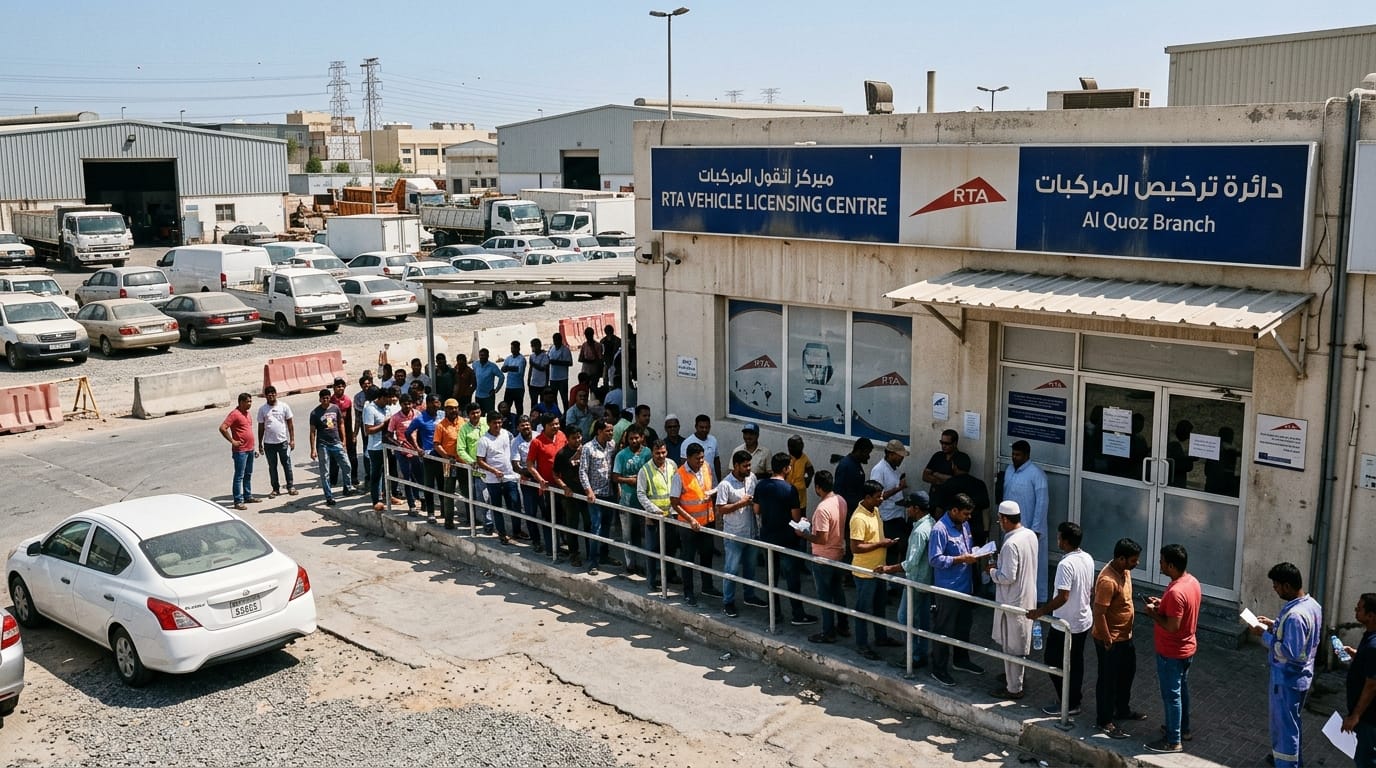
The full transfer is completed at an RTA vehicle licensing centre or an authorised typing centre. The most commonly used locations by expats are the Al Quoz Vehicle Licensing Centre and the Umm Ramool Customer Happiness Centre. Both have reliable queuing systems and typically process transfers without unusual delays on weekday mornings.
The transfer also requires the vehicle to pass a technical fitness test — commonly referred to as a “car test” or Tasjeel inspection — before registration is issued in the buyer’s name. This is a safety and emissions check, not a guarantee of the vehicle’s mechanical condition. Do not confuse Tasjeel clearance with a full pre-purchase inspection from an independent garage. For a full picture of what that independent check covers, our used car inspection guide for Dubai expats explains what mechanics assess and which workshops in Al Quoz are commonly used.
Red Flags to Spot Before You Even Meet the Seller
Many transfer complications start before the RTA visit. These warning signs, observed across private sale cases in Dubai, are worth checking before you commit time and travel.
🔴 Warning Signs in Listings and Early Communication:
- Price is 25 to 35% below comparable market listings without a clear reason
- Seller refuses to share the VIN or vehicle plate number before meeting
- Seller declines an independent pre-purchase inspection
- A deposit or upfront payment is requested before documents are verified
- Seller is unwilling to send a clear photo of the Mulkiya before meeting
- Name on listing does not match name on Mulkiya when documents are finally shown
These patterns do not automatically indicate fraud, but each one warrants a clear explanation from the seller before proceeding. Documenting your questions and the seller’s responses in text — WhatsApp or SMS — creates a record that may be useful if disputes arise later. For a detailed look at how misleading listings are typically structured, our guide to red flags when buying a used car in Dubai covers the most common dealer and private seller tactics reported by expats.
Documents Required — Seller and Buyer Checklist
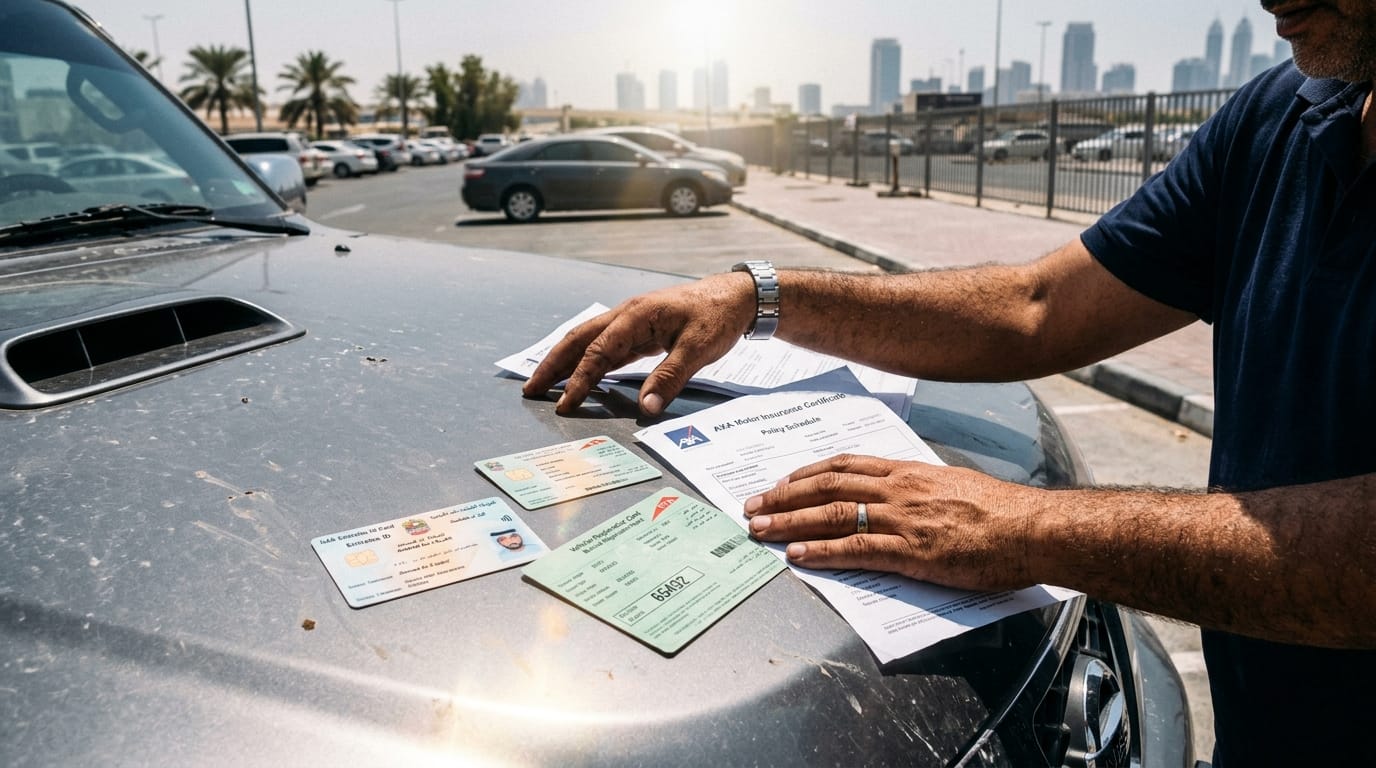
Preparing documents in advance is the single most effective way to reduce your time at the RTA centre. The following checklist reflects what is consistently required across standard private sale transfers in Dubai. These are the core RTA car transfer documents Dubai expat buyers most frequently arrive without.
Documents the Seller Must Bring
| Document | Notes |
|---|---|
| Original Emirates ID | Must be valid — not expired |
| Original vehicle Mulkiya (registration card) | Both sides — buyer will keep original after transfer |
| Valid UAE car insurance in seller’s name | Must be active on transfer day |
| Loan clearance letter (if financed) | Required if bank lien exists on the vehicle — can take 3 to 7 working days to obtain |
| Settled traffic fines | All outstanding fines must be paid before transfer proceeds |
Documents the Buyer Must Bring
| Document | Notes |
|---|---|
| Original Emirates ID | Must be valid — not expired |
| Valid UAE residence visa | Verified by the system — bring physical copy as backup |
| New insurance policy in buyer’s name | Must be active on or before transfer date — the most commonly forgotten document |
| Payment method | RTA centres accept card and cash — confirm with the specific centre beforehand |
🔴 Most Common Reason Transfers Fail on the Day: The buyer arrives without insurance already issued in their name. Insurance should be arranged at least one working day before transfer day through a UAE-licensed insurer. Bring the printed certificate or a clearly accessible digital copy. Some RTA-adjacent locations have insurance partner offices nearby, but relying on same-day issuance on-site creates unnecessary risk of delays.
Step-by-Step Transfer Process at RTA Dubai
Step 1 — Settle Outstanding Fines Before Arrival
Check the vehicle’s traffic fine status through the Dubai Police Traffic Fines Inquiry portal or the RTA Vehicle Ownership Transfer page using the plate number and Mulkiya details. Fines accumulated under the seller’s name must be paid before the system will allow the transfer. The RTA system pulls fine records automatically — unpaid fines block the process at the counter.
Payment typically reflects in the RTA system within a few hours, though some expats report occasional delays during busy periods. If fines are settled on the same day as the transfer, arriving after midday gives the system time to update.
Step 2 — Obtain Insurance in the Buyer’s Name
The buyer needs a valid comprehensive or third-party insurance policy already active before the transfer is processed. Several UAE insurers offer same-day or next-day policy issuance online. For reference, third-party insurance for a standard used sedan in Dubai typically costs between 900 and 1,800 AED annually depending on vehicle age and the buyer’s driving history.
Bring a printed policy certificate or have it accessible digitally. The RTA staff will verify the policy number and expiry date. For a comparison of insurer options and what coverage levels are appropriate for used vehicles, see our UAE car insurance renewal guide covering common charges expats overlook.
Step 3 — Vehicle Fitness Test (Tasjeel / Car Test)
Before ownership transfers, the vehicle must pass an RTA technical inspection at an authorised Tasjeel centre or at designated RTA facilities — unless a current valid technical pass is already on file for the vehicle.
The technical test checks basic safety items: lights, brakes, tyre condition, emissions, and structural visibility. Fees for this test generally range between 170 and 350 AED depending on vehicle type and whether the test is conducted at an RTA facility or a private authorised centre such as Tasjeel locations in Deira or Al Quoz.
If the vehicle fails the test, the transfer cannot proceed until the fault is corrected and the vehicle is retested. Common failure reasons include tyre wear below the minimum tread depth, non-functional lights, and visible windscreen cracks.
Step 4 — Arrive at the RTA Centre
The Al Quoz Vehicle Licensing Centre and the Umm Ramool centre are the most frequently used by expats for private transfers. Both open Sunday to Thursday from approximately 7:30 AM, with the Al Quoz centre also open Saturday. Arriving before 9:30 AM on a weekday typically results in shorter queue times.
Take a queue number at the vehicle licensing counter. Both the buyer and seller present their documents together at the service window. The RTA officer verifies identity, checks fine status, confirms insurance, and processes the ownership change in the system.
Step 5 — Payment Safety on Transfer Day
The sequence of payment matters. Following a structured order reduces the risk for both parties in a private sale.
| Stage | Action |
|---|---|
| 1 | Vehicle passes Tasjeel fitness inspection |
| 2 | Documents verified by both parties before entering RTA counter |
| 3 | Ownership transfer submitted at the RTA counter |
| 4 | Payment released to seller |
| 5 | New Mulkiya issued in buyer’s name — transfer complete |
Bank transfer is generally considered safer than cash for large amounts. If paying by cash, count and confirm the amount with a witness present. Avoid releasing full payment before the new Mulkiya is physically in the buyer’s hand. Some buyers use a mutually trusted third party to hold payment during the RTA visit — this is a personal arrangement and not an RTA requirement.
Step 6 — Pay Fees and Collect New Mulkiya
Once documents are verified and the system confirms no outstanding blocks, the fee is processed and the new registration card (Mulkiya) is issued in the buyer’s name — usually at the same counter or at an adjacent payment point.
Keep both the old and new Mulkiya documents until the new plates are issued if a plate change is required.
✅ Tip from Workshop Experience: If both buyer and seller arrive with all documents prepared, the RTA counter process — once at the window — typically takes between 15 and 25 minutes. Most of the elapsed time is in the queue. Arriving early on a weekday is the most effective single step to reduce your overall visit time.
Can You Transfer a Car Online in Dubai?
Several preparatory steps can be completed digitally through RTA channels before the transfer visit. However, complete private ownership transfer between two individuals may still require physical attendance depending on the specific case and current RTA service availability.
What Can Be Done Digitally
| Task | Digital Channel |
|---|---|
| Traffic fine check and payment | Dubai Police app / RTA website |
| Vehicle registration status check | RTA Dubai app |
| Insurance policy issuance | UAE insurer websites / comparison platforms |
| Appointment booking at RTA centre | RTA Dubai app / RTA website |
| Service fee estimate | RTA website fee calculator |
Some Smart Kiosk locations in Dubai allow registration renewal and selected vehicle services without a counter visit. Private ownership transfer between two individuals, in most standard cases, still requires both parties to attend an RTA centre or authorised typing centre in person. Confirm current digital service availability directly with the RTA website before planning your transfer — services available online may expand over time.
RTA Centre Comparison — Where to Go in Dubai
| Centre | Best For | Typical Wait | Parking | Saturday |
|---|---|---|---|---|
| Al Quoz Vehicle Licensing | Expats, Al Quoz area buyers | Moderate — shorter before 9:30 AM | Easy — ample surface parking | Yes |
| Umm Ramool Customer Happiness | Airport-area residents, Deira | Generally shorter midweek | Moderate — multi-storey available | Limited |
| Tasjeel Al Barsha | South Dubai, JVC, Motor City area | Moderate | Easy | Yes |
| Authorised Typing Centres | Document preparation support | Short — no queue for typing | Varies by location | Many open |
Authorised typing centres can assist with document preparation and some RTA submission steps, though the physical vehicle and both parties typically still need to present at an RTA or Tasjeel facility for the fitness test and final ownership processing.
Dubai vs Sharjah vs Abu Dhabi — Transfer Differences
Many expats purchase vehicles across emirate boundaries. The transfer process varies by emirate authority.
| Item | Dubai | Sharjah | Abu Dhabi |
|---|---|---|---|
| Licensing authority | RTA Dubai | SRTA (Sharjah RTA) | TAMM / Abu Dhabi DMT |
| Fitness test required | Yes | Yes | Yes |
| Cross-emirate transfer | Export + Import process | Export + Import process | Export + Import process |
| Typical fee range | 350 – 650 AED | Generally lower | Comparable to Dubai |
| Processing time | Half day if prepared | Similar | Similar |
A vehicle registered in Sharjah being transferred to a Dubai-based buyer involves exporting the registration from SRTA and importing it through the RTA. This typically adds several days and requires coordination between both emirate authorities. Confirm the exact cross-emirate process with the RTA customer service line (800 9090) before scheduling the transfer day.
Full Cost Breakdown — Transfer Without a Broker
| Fee Item | Typical Range (AED) | Paid By |
|---|---|---|
| Vehicle technical fitness test (Tasjeel) | 170 – 350 | Buyer or negotiated |
| RTA ownership transfer fee | Varies by vehicle category — confirm on rta.ae | Buyer (standard) |
| Registration renewal (if due) | 290 – 420 | Buyer |
| Knowledge / Innovation fees | 20 – 30 | Buyer |
| Plate change fee (if applicable) | 35 – 50 | Buyer |
| Traffic fine settlement (variable) | Depends on outstanding fines | Seller |
| Grand Total (excluding fines) | 350 – 650 AED (estimate) | Buyer side |
Fee amounts above are estimates based on publicly available RTA information as of May 2026. Government fees may change periodically — verify current fees on the official RTA transfer page before your transfer date. Compare this overall range to the typical broker arrangement of 800 to 1,500 AED for the same process in areas like Al Aweer or Deira showroom zones where broker-assisted transfers are actively promoted to first-time buyers.
DIY Transfer vs Broker Transfer — Side by Side
| Factor | DIY Transfer | Broker-Assisted |
|---|---|---|
| Government fee cost | 350 – 650 AED | 350 – 650 AED (same fees apply) |
| Broker service fee | 0 | 800 – 1,500 AED additional |
| Preparation required | Moderate — documents + insurance in advance | Lower — broker guides process |
| Time at RTA | 45 – 120 minutes | Similar — time saved is minimal |
| Suitable for | Prepared expats familiar with UAE systems | First-time buyers with limited time |
| Control over process | Full visibility at each step | Broker manages — less direct oversight |
Mechanic’s Inspection Log — What One Transfer Looked Like
In a documented case observed at the Al Quoz Vehicle Licensing Centre, a buyer from India was purchasing a 2019 Nissan Sunny with approximately 87,000 km on the odometer. The seller was a private UAE national who had listed the car on Dubizzle. The sale price was agreed at 21,500 AED.
During the Tasjeel inspection, the right rear tyre was flagged for insufficient tread depth — a minor issue but one that blocked the transfer. The tyre was replaced the same morning at a nearby tyre shop in the Al Quoz Industrial Area for approximately 190 AED. The vehicle passed on retest. Total transfer fees including the retest came to 540 AED.
The buyer had confirmed no bank lien on the vehicle beforehand — a step that added two days to the preparation timeline but avoided a potential complication at the counter. An OBD scan conducted during the buyer’s independent pre-purchase inspection had shown no active fault codes, and odometer readings were consistent with wear patterns on the steering column, seat bolsters, and pedal rubbers.
Special Transfer Situations
Transfer Between Family Members
Ownership transfers between family members — spouse to spouse, parent to child — follow a similar process to private sales at the RTA centre. Some fee structures may differ for first-degree family transfers. Confirm the current fee schedule with the RTA, as family transfer processing may have specific documentation requirements such as a marriage certificate or proof of relationship.
Transfer Between Companies or Corporate Owners
When a vehicle is registered under a company name, the transfer process requires company documentation including trade licence and authorised signatory identification. Processing typically takes longer and may require additional administrative steps through the relevant emirate’s licensing authority. Corporate fleet transfers in Dubai are processed through the RTA commercial services channel.
Transfer of Imported Vehicles
Vehicles imported into the UAE from outside the GCC may require customs clearance documentation and a GCC homologation certificate before registration and transfer can proceed. The RTA will flag any missing homologation documentation during the fitness test process. Independent inspections at specialists in the Sharjah Industrial Area or Al Quoz frequently identify import-related documentation gaps before the RTA visit.
Transfer of GCC-Spec vs Non-GCC Vehicles
GCC-specification vehicles transfer more straightforwardly — they are already compliant with UAE standards. Non-GCC imports, including US-spec vehicles, may require additional certification for air conditioning systems, headlight configuration, and emissions. This is a separate process from the standard ownership transfer and can add cost and time. Always confirm the specification before purchase.
Transfer of Electric Vehicles
Electric vehicle transfers in Dubai follow the same general ownership transfer process at the RTA. The technical fitness test for EVs covers charging system safety and battery condition indicators in addition to standard safety items. EV registrations may qualify for reduced fee structures — confirm current EV registration incentives on the RTA vehicle registration renewal page.
Common Mistakes Expats Make During Car Transfers
Based on patterns observed across multiple transfer cases in Dubai workshops and RTA centres, the following mistakes appear frequently among first-time expat buyers.
Mistake 1 — Trusting the Seller to Arrange Insurance
Insurance must be in the buyer’s name before transfer. Some sellers offer to “help arrange” it and use this as a way to steer buyers toward specific policies. Obtain insurance independently through a UAE-licensed insurer or comparison platform before transfer day.
Mistake 2 — Not Checking for Bank Liens
If the seller financed the vehicle, the bank may have a lien recorded with the RTA. The transfer will not proceed without a formal clearance letter from the financing bank. This letter typically takes 3 to 7 working days to obtain and may involve an administrative fee. Confirm this with the seller before agreeing to a transfer date.
Mistake 3 — Assuming Tasjeel Pass Means Mechanical Clearance
The RTA fitness test confirms the vehicle meets basic road-legal safety requirements. It does not assess engine condition, transmission health, suspension wear, or the presence of prior accident damage. Always arrange an independent inspection at a workshop in Al Quoz or the Sharjah Industrial Area before completing any purchase.
Mistake 4 — Ignoring Outstanding Fines Until Transfer Day
Fine payments may take several hours to reflect in the RTA system. Checking and settling fines at least two days before the planned transfer date avoids unnecessary repeat trips.
Mistake 5 — Not Confirming the Seller’s Identity Against Mulkiya
Verify that the name on the Mulkiya matches the Emirates ID of the person selling the vehicle. In a number of documented expat cases, the person presenting the vehicle was not the registered owner — a situation that creates significant complications during the transfer process.
⚠ Verify Before Transfer: Always check that the seller’s Emirates ID name matches the Mulkiya owner name exactly. If they do not match, request a written explanation and confirm the legal authority for the sale before proceeding.
Transfer Day — 5-Minute Checklist Before Leaving Home
| Item | Buyer | Seller |
|---|---|---|
| Original Emirates ID (valid) | ✔ | ✔ |
| Insurance policy in own name (active) | ✔ | ✔ |
| Original Mulkiya (both sides) | — | ✔ |
| Loan clearance letter (if financed) | — | ✔ |
| Fine check completed and cleared | Confirm | ✔ |
| Payment method ready (card/transfer) | ✔ | — |
| Seller’s contact number saved | ✔ | — |
| RTA centre address confirmed | ✔ | ✔ |
What to Do if the Transfer Cannot Be Completed on the Day
If the transfer is blocked due to outstanding fines, a lien, or a failed fitness test, the sale does not need to be cancelled. Document the situation in writing with the seller, agree on a revised transfer date, and keep all communications in text format. Written communications — whether SMS, email, or messaging apps — may help document discussions and representations made by both parties, though their weight as evidence varies by situation and is not guaranteed.
Buyers may have legal remedies depending on the evidence available and the specific circumstances of the transaction. Consulting Dubai Consumer Protection or an independent legal advisor is a reasonable step if disputes arise. Outcomes vary significantly based on available documentation and how the transaction was conducted — no specific result can be guaranteed.
Evidence Checklist — What to Save Before and During Transfer
| Item to Document | Why It Matters |
|---|---|
| ✔ Screenshot of original Dubizzle / Facebook listing | Evidence of seller’s stated condition and price |
| ✔ Written communications with seller (SMS/messaging app) | Documents representations made before sale |
| ✔ Copy of seller’s Emirates ID | Identity confirmation and reference if disputes arise |
| ✔ Independent inspection report (written) | Pre-sale mechanical condition baseline |
| ✔ Transfer receipt from RTA | Proof of completed transfer date and fees paid |
| ✔ New Mulkiya in buyer’s name | Primary ownership document — photograph both sides |
| ✔ Fine clearance confirmation | Confirms no fines were outstanding at transfer time |
| ✔ Loan clearance letter (if financed) | Confirms bank lien was released before transfer |
| ✔ Payment receipt or bank transfer confirmation | Documents financial transaction |
| ✔ VIN photo and Mulkiya VIN match confirmation | Confirms vehicle identity matches paperwork |
Process Timeline — What to Expect
| Stage | Typical Timeframe |
|---|---|
| Agree sale and confirm documents needed | Day 1 |
| Seller requests loan clearance (if financed) | Day 1 → Day 3 to 7 |
| Buyer obtains insurance in their name | 1 to 2 days |
| Settle outstanding traffic fines | At least 2 days before transfer |
| Vehicle fitness test (Tasjeel) | 30 to 60 minutes on transfer day |
| Queue and counter time at RTA centre | 30 to 90 minutes depending on day and time |
| New Mulkiya issued in buyer’s name | Same session at counter |
| Total elapsed time (well-prepared) | Half day on transfer day; 2 to 7 days preparation |
Signs the Transfer Is Going Well — Positive Indicators
Not every transfer involves complications. Many expats in Dubai complete private car transfers without any issues. These indicators suggest the process is likely to proceed smoothly.
- The seller provides the original Mulkiya readily and it matches their Emirates ID without hesitation.
- A fine check on the vehicle shows zero outstanding fines before the agreed transfer date.
- The seller confirms no financing history or provides a loan clearance letter proactively before you ask.
- The vehicle passes the Tasjeel test on the first attempt — indicating the seller maintained basic road-legal condition.
- Both parties arrive with all documents and the counter officer finds no system blocks — the entire RTA process completes in one visit.
What Happens After the Transfer — Next Steps
Once the new Mulkiya is issued, several follow-up steps are worth completing within the first few days of ownership.
| Task | Why It Matters | When |
|---|---|---|
| Activate or transfer Salik tag | Avoid unpaid toll accumulation on Sheikh Zayed Road and Al Khail Road | Same day or day after |
| Save digital copy of new Mulkiya | Quick access during traffic checks | Same day |
| Update vehicle in insurer app | Confirm new ownership is reflected in policy | Within 2 days |
| Update parking apps (Mawaqif, RTA app) | Plate-linked parking in Dubai and Abu Dhabi areas | Within 1 week |
| Check service interval on vehicle | Know when the next oil change or service is due | Within 1 week |
| Keep transfer receipt and all documents together | Complete ownership file for resale or disputes later | File immediately |
Hidden Costs Buyers Discover After Transfer
The transfer fee is rarely the last unexpected expense. These items frequently appear in the first few months of ownership and are worth budgeting for before committing to a purchase price.
- Tyre replacement — if the Tasjeel test passed on marginal tread, new tyres may be needed within months. Budget 600 to 1,400 AED for a set of four mid-range tyres for a standard sedan.
- Battery replacement — commonly needed on vehicles approaching or past 80,000 km, particularly those that spent long periods in Dubai’s summer heat. Battery replacement typically costs 250 to 500 AED at Al Quoz workshops.
- Major service due soon — if the seller’s service history shows a service approaching (e.g., 90,000 km service), budget for it. A full major service on a Japanese mid-range sedan typically runs between 600 and 1,200 AED.
- Salik tag registration — if the vehicle has no active Salik account, a new tag costs approximately 50 AED plus an initial top-up balance requirement.
- Window tint condition — tints outside UAE legal limits may need removal or replacement if flagged during any future inspection. Retinting a standard sedan runs roughly 400 to 900 AED.
- Registration renewal timing — if the registration expires within a few months of the transfer, that renewal cost will arrive soon after purchase.
Safe Alternative — When to Consider a Dealer Transfer Instead
For some expats — particularly those who are new to the UAE, have limited time, or are purchasing a vehicle with a complex history — using a reputable dealer for the purchase and transfer may reduce friction. Established dealerships in the Al Quoz area and the Abu Shagara used car market in Sharjah handle transfers as part of the sale process and absorb the Tasjeel and fine-clearance steps on the buyer’s behalf.
The trade-off is typically a higher purchase price — roughly 1,500 to 3,000 AED above comparable private sale listings for the same vehicle — in exchange for reduced procedural complexity. For a first-time buyer on a tight schedule, this trade-off may be reasonable. For an expat who plans to buy and sell regularly, the private transfer process is worth learning once and applying every time.
For a broader look at where expats find used cars and how the two main platforms compare, see our Dubizzle vs Facebook Marketplace analysis for UAE expats.
Owner Scenarios — What Transfer Looks Like for Different Expats
If You Are a New Arrival with No UAE Driving History
Insurance providers typically price policies higher without a UAE no-claims history. Budget between 1,400 and 2,000 AED for a first-year third-party policy on a used mid-range sedan. The transfer process itself remains the same — insurance cost is the main variable for new arrivals.
If Your Visa Is Due for Renewal
The RTA system links vehicle registration to a valid residence visa. If your visa expires within 30 days of the transfer date, you may encounter a system flag requesting visa confirmation. Bring your visa renewal receipt or updated visa copy to avoid delays.
If You Are Buying from a Non-UAE Resident Seller
A seller who has already left the UAE but left a vehicle behind creates a significantly more complex situation. Power of attorney arrangements are possible but involve additional notarisation steps and fees. This scenario typically benefits from professional legal assistance — the cost and complexity are meaningfully higher than a standard same-country private sale.
If You Are Planning to Leave UAE Within 12 Months
Factor depreciation and resale friction into your decision before purchasing. Toyota and Nissan models in the Corolla, Camry, Sunny, and Altima range typically retain better resale positioning in the UAE market and move faster in private sales before departure. The transfer process when selling is the same procedure in reverse — you become the seller going through the same steps. For a full strategy on maximising your return when selling before departure, our guide to selling your car in Dubai as an expat covers timing, platforms, and negotiation.
Decision Framework — Which Transfer Route Is Right for You
| Your Situation | Recommended Approach |
|---|---|
| First-time UAE buyer, limited time | Consider dealer purchase — absorbs transfer complexity |
| Experienced UAE resident, buying privately | DIY transfer — straightforward with this checklist |
| Buying GCC-spec from a private seller | DIY transfer — most efficient and lowest-cost route |
| Vehicle has finance history | Request clearance letter first, then DIY or dealer |
| Seller is outside UAE | Seek legal advice — power of attorney required |
| Leaving UAE in under 6 months | Prioritise high-resale Toyota/Nissan — makes resale faster |
| Cross-emirate purchase (e.g. Sharjah to Dubai) | Allow extra days — inter-emirate export/import process applies |
Total Ownership Cost After Transfer — What Buyers Often Miss
| Cost Item | Typical Annual Amount (AED) |
|---|---|
| Vehicle purchase price (example: used Corolla 2018) | 38,000 – 45,000 (one-time) |
| Transfer and registration fees | 350 – 650 (one-time at purchase) |
| Insurance (third-party to comprehensive) | 1,200 – 3,500 per year |
| Annual registration renewal | 290 – 420 per year |
| Fuel (average 1,500 km/month) | 4,500 – 6,000 per year |
| Routine maintenance (oil, filters, tyres) | 1,500 – 2,800 per year |
| Salik and parking (estimate) | 2,400 – 4,800 per year |
| Estimated depreciation per year | 3,000 – 6,000 per year |
| Grand Total Annual Cost (excluding purchase price) | 13,000 – 23,500 AED/year |
This works out to approximately 1,100 to 1,950 AED per month in ongoing ownership costs — a figure that surprises many expats who focus primarily on the purchase price during the buying decision.
Official RTA Resources and Verification
The following official sources should be used to verify current fee amounts, service availability, and any updates to the transfer process before your visit. Government fees and service procedures may change, and the most accurate information comes directly from the issuing authority.
- RTA Vehicle Ownership Transfer Service Page
- RTA Vehicle Registration Renewal
- Dubai Police Traffic Fines Inquiry
- Tasjeel Official Inspection Services
- Dubai Consumer Rights — Consumer Protection
- TAMM Abu Dhabi — Vehicle Ownership Transfer
- SRTA Sharjah — Roads and Transport Authority
- RTA Customer Service: 800 9090 (toll-free within UAE)
✅ Fee Verification Reminder: Fee ranges in this guide are estimates based on publicly available RTA information as of May 2026. RTA transfer fees, registration renewal amounts, and Tasjeel inspection charges may be updated periodically. Always verify the current fee schedule on rta.ae or by calling RTA customer service before your transfer date.
Analytical Conclusion
Transferring a car privately in Dubai is a manageable process for most expats. The total government fees run between 350 and 650 AED. Preparation accounts for most of the complexity — particularly insurance issuance, fine settlement, and lien confirmation. The actual time at the RTA counter, when both parties arrive with complete documents, is typically under 30 minutes.
The broker fee of 800 to 1,500 AED that many first-time buyers pay is essentially the cost of uncertainty — arriving unprepared, not knowing what to bring, or not wanting to navigate a UAE government process independently. This guide eliminates that uncertainty.
For context: saving 1,000 AED by skipping a broker represents roughly half a month of fuel costs for a typical Dubai commuter. The documents required are standard. The process is linear. The fee structure is predictable. Most expats who complete a private transfer once say they would handle every future transfer the same way.
Once your transfer is complete and the Mulkiya is in your name, the next step is knowing what the RTA car test covers every year at renewal — our RTA Car Test Dubai guide explains what expats must know before each annual inspection, what commonly causes a fail, and how to prepare.
Frequently Asked Questions
Q: Can I transfer a car in Dubai without the seller being present?
Q: How long does the full car transfer process take in Dubai?
Q: What are the RTA car transfer documents a Dubai expat must bring?
Q: What happens to the old plates when a car is transferred?
Q: Do I need to arrange insurance before or after the transfer?
Q: Can I transfer a car in Dubai with expired registration?
Q: Can I transfer a financed car in Dubai?
Q: Can I transfer a car on weekends in Dubai?
Q: What if the seller has unpaid fines they refuse to clear?
Data Sources Used
- RTA Dubai — Vehicle Ownership Transfer
- RTA Dubai — Vehicle Registration Renewal
- Dubai Police — Traffic Fines Inquiry
- Tasjeel — Authorised Technical Inspection
- Dubai Consumer Rights — Consumer Protection
- TAMM Abu Dhabi — Vehicle Ownership Transfer
- SRTA Sharjah — Roads and Transport Authority
- RTA Dubai — Official Portal (rta.ae)
Disclaimer: Emirates Car Guide is a 100% independent platform. We do not own showrooms, nor are we affiliated with any used car dealerships or garages. Our sole mission is to protect expats from financial fraud in the automotive market.
