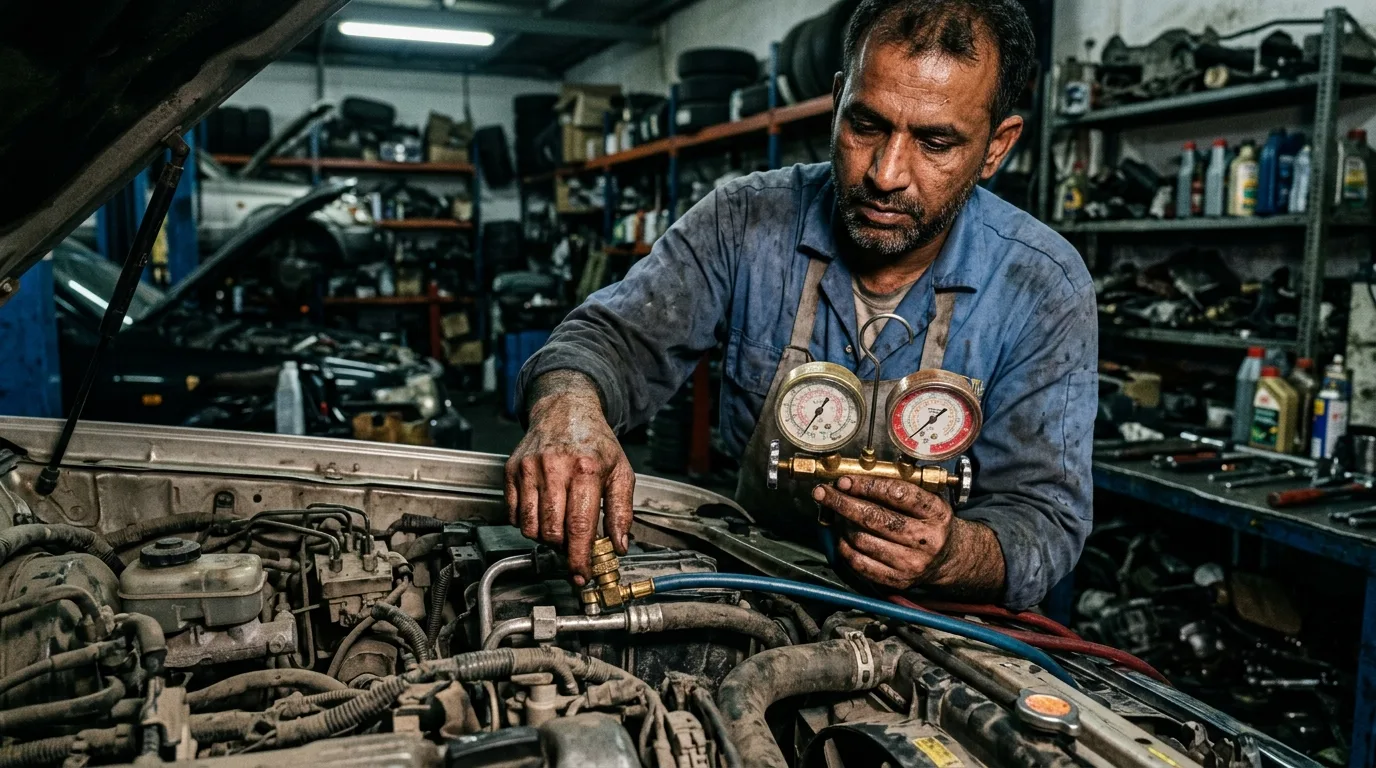
Last Updated: May 2026 | By Omar Al-Fayed | Category: Maintenance & Repairs
Your AC stopped blowing cold air in mid-June. You’re stuck in traffic on Sheikh Zayed Road with the interior hitting 55°C. This isn’t just uncomfortable — it’s a real mechanical problem with real costs. Just like managing your quarterly checks to avoid sudden uae traffic fines, monitoring your vehicle’s cooling performance before the heat spikes prevents costly emergency repairs and unexpected breakdowns on major highways.
Based on inspection patterns from Al Quoz specialists and Abu Shagara workshops, AC failures in summer typically cost between AED 800 and AED 3,500 depending on what’s actually broken. Most owners don’t know the difference between a cheap refrigerant top-up and a compressor replacement until they’re at the counter.
Short answer: If your AC stopped cooling suddenly, the most common cause is low refrigerant (AED 400–800 fix). If it cools weakly or only when driving, the compressor may be showing advanced wear (AED 2,200–3,500). Diagnosing the exact problem takes 30 minutes at a workshop — getting the fix wrong costs significantly more.
Quick Symptom Checker: What’s Happening to Your AC?
Before spending AED 250–400 on a diagnostic, narrow down the likely cause using what you’re observing right now. This table reflects the most common patterns documented across Al Quoz and Abu Shagara workshops. When evaluating long-term budget parameters like the ownership behavior keeping track of these micro-failures protects your savings during extreme seasonal shifts.
| What You Notice | Likely Cause | Estimated Cost |
|---|---|---|
| Cold while driving, warm in traffic | Condenser airflow restriction | AED 300–900 |
| Blowing warm air only | Low refrigerant or compressor issue | AED 400–3,500 |
| Clicking noise when AC turns on | Compressor clutch electrical fault | AED 900–1,400 |
| Musty or sour smell from vents | Cabin filter contamination or mold buildup | AED 150–500 |
| Water pooling inside cabin floor | Clogged AC drain pipe | AED 150–400 |
| Weak airflow despite max blower | Blocked cabin air filter | AED 80–300 |
| Temperature dial unresponsive | Blend door actuator failure | AED 600–1,400 |
Why AC Systems Fail in UAE Summer Heat
The UAE summer doesn’t just test your AC — it exposes every weakness in the cooling system. Outside temperatures routinely exceed 48°C from June through August. Inside a parked car, dashboard temperatures can reach 70–80°C. Your AC compressor operates at maximum load continuously.
Most AC failures in the UAE follow a predictable progression. The system rarely fails all at once. Instead, it degrades over months or years, then fails completely when temperatures peak and demand is highest.
Common progression: refrigerant leak → low charge → compressor overworks → thermal stress → compressor wear accelerates. The entire chain typically develops over 6–18 months. Most owners notice nothing until the AC stops working entirely.
Amber Alert: Addressing weak AC early can be significantly cheaper than waiting for full failure. A refrigerant top-up now may cost AED 500–800. Replacing a worn compressor later typically costs AED 2,500–3,500. The timing of your repair decision affects the total cost considerably.
The Three AC System Zones That Fail
Your car’s AC isn’t one component — it’s three separate systems working together. Each fails differently and costs differently to fix.
- Zone 1: Refrigerant Circuit — holds the cooling fluid. Failures here mean refrigerant leaks or low charge. Diagnostic cost: AED 200–400. Repair cost: AED 400–1,200.
- Zone 2: Compressor — pumps and pressurizes refrigerant. Failures here include worn seals, degraded internal components, or electrical disconnect. Diagnostic cost: included in AC service. Repair cost: AED 2,200–3,500.
- Zone 3: Condenser and Airflow — moves heat outside and blows cold air inside. Failures include clogged condenser, weak blower motor, or blend door failure. Diagnostic cost: AED 200–300. Repair cost: AED 600–1,800.
Diagnosis: What the AC Service Actually Tests
A proper AC diagnostic at Al Quoz or Abu Shagara takes 30–45 minutes and costs AED 200–400. Most workshops follow this sequence. Requesting a thorough independent inspection before signing off on parts guarantees you only settle bills for components that are definitively compromised.
| Test Step | What They’re Checking | Cost |
|---|---|---|
| Visual inspection | Refrigerant hoses, compressor mounting, visible oil residue | Included |
| Pressure gauge test | High and low-side pressure readings with AC running | Included |
| Compressor amp draw | Electrical load on compressor — reveals internal friction | Included |
| UV dye leak detection | Fluorescent dye in refrigerant — shows leak location under UV light | AED 200–300 extra |
| Blend door actuator test | Temperature control valve — tests range of movement | Included |
After this test, the mechanic tells you one of three things: “Low on refrigerant only,” “Compressor shows internal wear,” or “Multiple issues.” Each diagnosis leads to a different cost path.
The Five Most Common AC Failures and Their Costs
Failure 1: Low Refrigerant (No Active Leak)
Refrigerant doesn’t get consumed like fuel. It circulates the same fluid indefinitely. Low refrigerant means a leak somewhere — but not always an active one now.
A common pattern: a slow micro-leak in hose connections that stopped leaking months ago when pressure dropped below the leak threshold. The system still holds reduced charge but may have another slow leak developing.
Symptoms: AC blows cool but not cold. Takes extended highway driving to cool the car. Doesn’t cool well in traffic. Temperature varies noticeably with engine RPM.
Diagnostic cost: AED 200–400 (pressure test and visual inspection)
Repair cost: AED 400–800
Breakdown: refrigerant top-up including labor and gas AED 300–500; UV dye tracing if requested AED 200–300 extra; hose fitting tightening if needed AED 100–150. Many times, verifying competitive insurer quotes can free up administrative room in your budget to absorb these recurring summer line items.
Representative scenario (Abu Shagara workshop pattern): Toyota Corolla, 2015 model, AC cooling weakly. Pressure test showed approximately 60% of normal charge. Technician performed dye injection — no visible leak under UV light. Likely micro-leak previously sealed or leak point inside condenser. Owner chose refrigerant top-up only. AC returned to full cooling. Technician noted: monitor monthly — if charge drops again by August, active leak likely requires hose inspection.
Failure 2: Compressor Clutch Failure (Electrical)
Your compressor has an electromagnetic clutch. When AC is switched on, the clutch engages and the compressor spins. This clutch can fail electrically — the compressor mechanism itself remains intact, but the clutch simply won’t engage.
Symptoms: Compressor pulley spins but center hub stays still (visible with hood open). Pressure gauges show very low readings on low side. No cooling sound from compressor when AC activates.
Diagnostic cost: AED 200–300
Repair cost: AED 900–1,400
Breakdown: new compressor clutch (aftermarket) AED 400–700; labor to remove and install AED 300–500; system evacuation and recharge AED 200–300.
Representative scenario (Al Quoz workshop pattern): Nissan Sunny, 2014 model. AC stopped working without prior warning. Compressor belt was turning but clutch center was not engaging. Electrical connector at compressor showed voltage present, but clutch coil tested faulty on resistance check. Clutch replacement restored function. Technician note: clutch coil lifespan in UAE climate typically ranges 8–12 years depending on usage patterns.
Failure 3: Compressor Internal Wear (Mechanical)
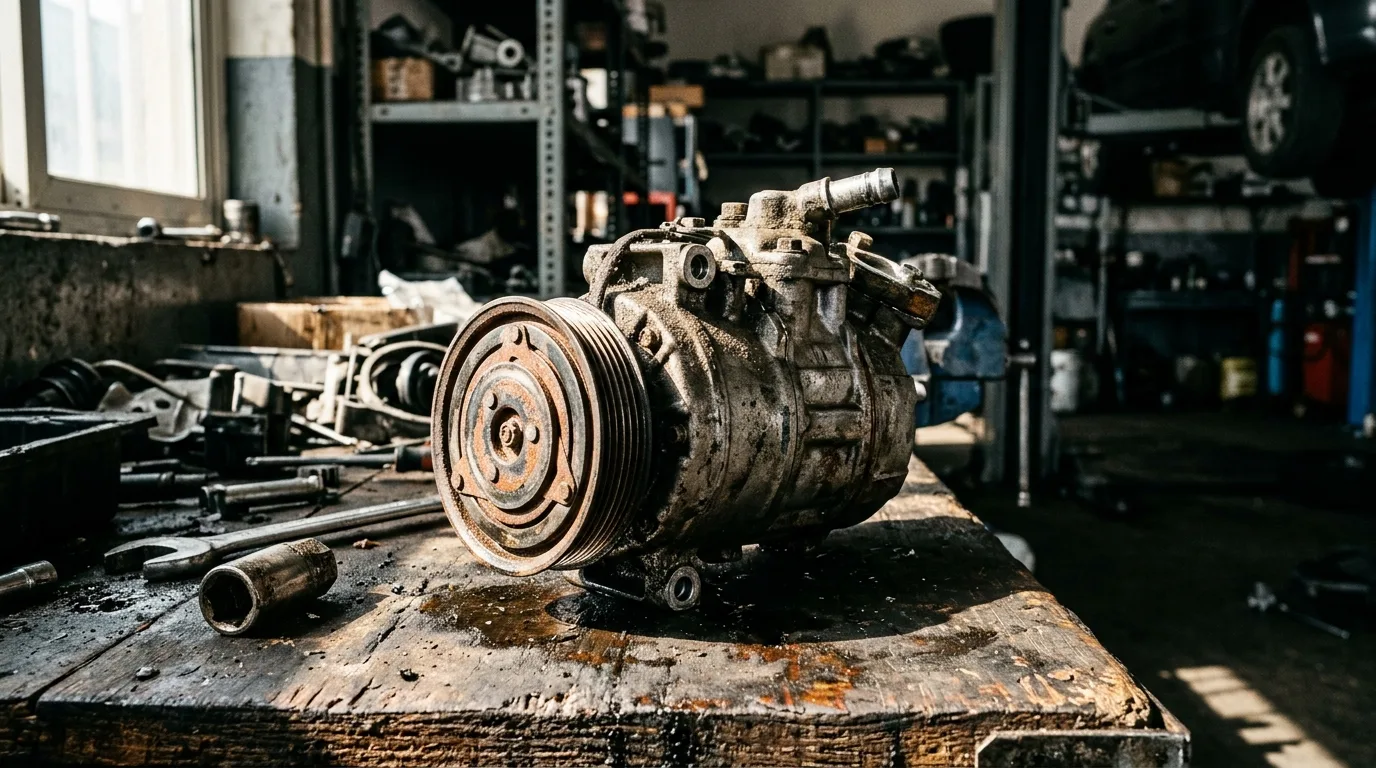
The compressor is a pump with internal moving parts — pistons, valves, and seals operating under sustained high pressure. After extended high-mileage or years of UAE summer use, internal wear is a normal progression pattern.
A worn compressor draws higher electrical current, delivers lower cooling capacity, and often produces grinding or squealing under load. Replacement is typically the only viable path at this stage.
Symptoms: AC blows barely cool air even after refrigerant top-up. Grinding or squealing noise when compressor engages. Oil residue visible on compressor housing. Pressure readings elevated on both sides.
Diagnostic cost: AED 300–500 (pressure test and amp draw measurement)
Repair cost: AED 2,200–3,500
Breakdown: OEM compressor (Toyota/Nissan) AED 1,400–2,000; aftermarket remanufactured compressor AED 900–1,200; labor AED 500–800; system evacuation, flush, and recharge AED 300–500; compressor oil lubricant AED 100–150.
Representative scenario (Abu Shagara workshop pattern): Honda Accord, 2012 model, high mileage. AC cooling weakly after recent refrigerant top-up. Amp draw on compressor measured notably above normal operating range for that model. Internal component wear confirmed on inspection. Owner chose aftermarket remanufactured unit with 18-month warranty. Workshop note: when compressor has leaked oil into system, full system flush is recommended before new unit installation.
Failure 4: Condenser Clogged or Restricted
The condenser is positioned at the front of the car, behind the grille. It releases heat from the refrigerant so the AC cycle can repeat. Over time, UAE road dust, sand, and pollen accumulate on condenser fins — particularly on vehicles parked outdoors in areas like Deira or Sharjah Industrial Area.
Heavily restricted condenser fins reduce cooling efficiency noticeably. In peak summer, moderate restriction becomes complete cooling loss in traffic. This exact drop-off explains why a driver notes that their car ac blows hot air when idling uae, as the front condenser loses its ability to transfer thermal energy unless forced highway air drives it down.
Symptoms: AC works at highway speed but fails in traffic. Cooling improves when the car moves (natural airflow through grille). Condenser fins visibly clogged when viewed through front bumper.
Diagnostic cost: AED 150–250 (visual inspection only)
Repair cost: AED 400–800 for cleaning; AED 800–1,200 if full replacement needed
Representative scenario (Deira workshop pattern): Hyundai Elantra, 2016 model, two years of outdoor parking in high-dust area. Visual inspection revealed condenser heavily clogged with sand. Refrigerant levels normal. Compressed air and water cleaning restored full cooling performance. Cost approximately AED 280. Technician recommendation: outdoor-parked vehicles benefit from condenser cleaning every 12–15 months in UAE conditions.
Failure 5: Blend Door Actuator Failure
The blend door controls the ratio of cold and warm air to set cabin temperature. If the actuator motor burns out, the door stays fixed — you get either maximum cold or maximum warm with no adjustment possible.
Symptoms: AC blows cold but temperature dial has no effect. Driver and passenger sides at noticeably different temperatures. Temperature only responds at extreme dial positions.
Diagnostic cost: AED 200–350 (actuator electrical test)
Repair cost: AED 600–1,400
Breakdown: blend door actuator replacement AED 400–800; labor AED 300–500; full blend door assembly if additionally needed AED 300–600 extra.
Representative scenario (Al Quoz workshop pattern): Toyota Camry, 2013 model. AC blowing cold continuously — temperature adjustment completely non-responsive. Actuator motor confirmed burned out on electrical test. Replacement restored temperature control. Workshop note: motorized plastic actuators in this generation show accelerated wear in sustained UAE heat and humidity, with typical lifespan of 9–12 years.
Green Signal: If your AC still blows cool air (even if weak), the system is likely salvageable for under AED 1,500 in most cases. Compressor damage is confirmed by pressure test and amp draw measurement — not by guessing. Get the diagnosis first before agreeing to any major repair.
Total AC Repair Cost Summary
| Failure Type | Diagnosis | Repair | Total |
|---|---|---|---|
| Low Refrigerant | AED 200–400 | AED 400–800 | AED 600–1,200 |
| Compressor Clutch | AED 200–300 | AED 900–1,400 | AED 1,100–1,700 |
| Compressor Internal Wear | AED 300–500 | AED 2,200–3,500 | AED 2,500–4,000 |
| Condenser Clogged | AED 150–250 | AED 280–1,200 | AED 430–1,450 |
| Blend Door Actuator | AED 200–350 | AED 600–1,400 | AED 800–1,750 |
| Bad Smell (Filter/Mold) | AED 100–200 | AED 150–700 | AED 250–900 |
| Drain Pipe Clogged | AED 100–150 | AED 150–300 | AED 250–450 |
| Grand Total Range | AED 250 – AED 4,000 depending on failure type | ||
Bad Smells From Your AC Vents
This is one of the most searched AC complaints in UAE summer — and the most commonly ignored. UAE heat and humidity create ideal conditions for mold growth on the evaporator coil and bacterial buildup in the cabin filter.
Types of Smells and What They Mean
- Musty or damp smell: Mold or bacteria growth on the evaporator coil. Common in cars parked for extended periods or driven in coastal humidity. Fix: evaporator cleaning with antibacterial treatment (AED 300–700) or cabin filter replacement first to rule out simpler cause (AED 80–300).
- Sour or vinegar smell: Bacteria buildup in the drain tray beneath the evaporator. Often combined with slow drainage. Fix: system sanitization (AED 150–350) and drain cleaning if needed (AED 150–300).
- Burning or rubber smell: More serious. Can indicate compressor belt wear, electrical connector overheating, or blend door actuator burning out. Requires diagnostic inspection immediately. Cost: AED 200–400 diagnosis, then repair depending on finding.
| Smell Type | Likely Cause | Fix Cost |
|---|---|---|
| Musty / stale | Cabin filter contamination or evaporator mold | AED 80–700 |
| Sour / vinegar | Bacteria in drain tray or evaporator | AED 150–500 |
| Burning / rubber | Belt wear or electrical component overheating | AED 200–800 |
| Dusty / dry | Severely clogged cabin filter | AED 80–300 |
Prevention tip: Run the fan only (AC off) for 2–3 minutes before switching off the engine. This dries the evaporator surface and significantly reduces mold growth. No cost — just a habit.
Cabin Air Filter: The Overlooked Cause
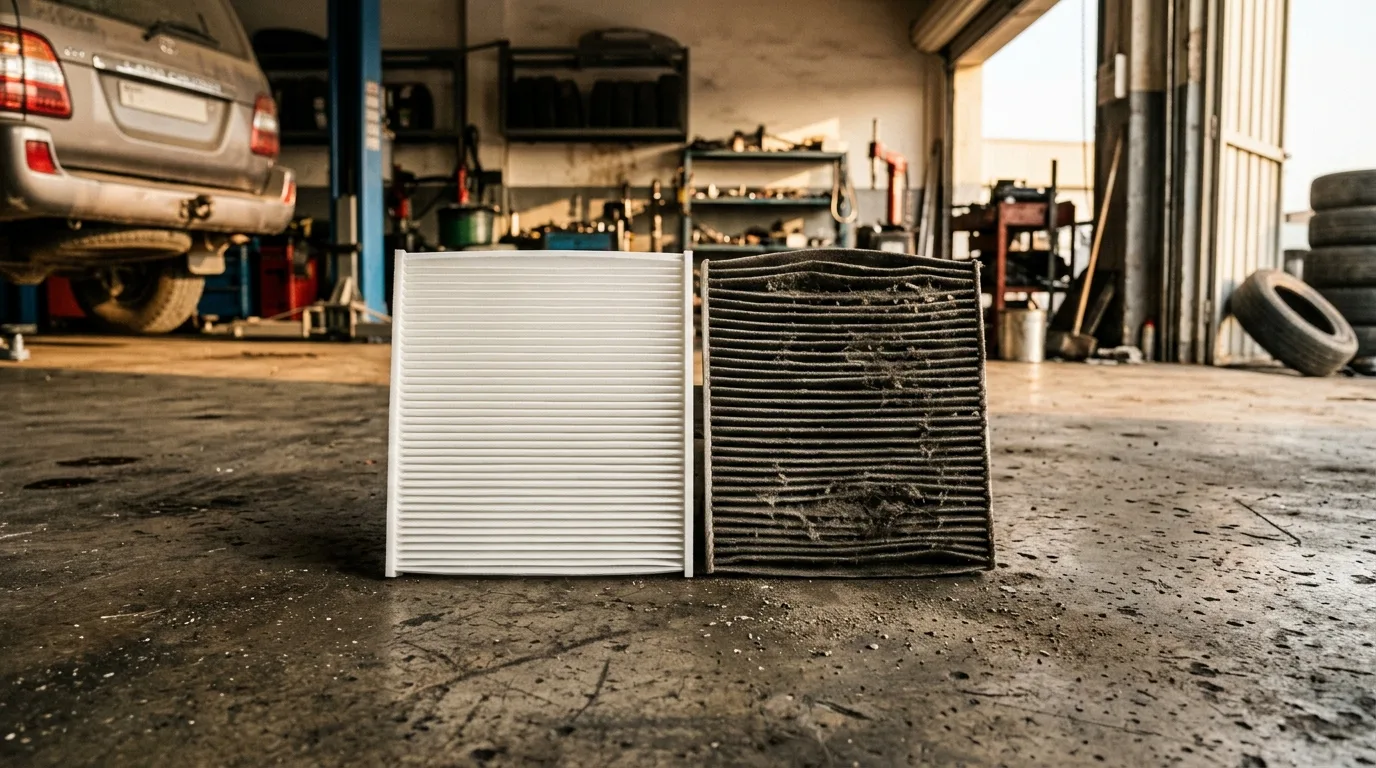
The cabin air filter is one of the cheapest AC-related fixes in the UAE — and one of the most skipped. It filters all air entering the cabin through the AC system. A heavily clogged filter restricts airflow, reduces cooling efficiency, and causes persistent bad odors.
Symptoms of blocked cabin filter: Noticeably weak airflow even at maximum blower setting. Dust visible blowing from vents. Musty smell when AC first starts. AC cools adequately but air volume feels insufficient.
How often to replace: Every 15,000 km or every 12 months in UAE conditions — whichever comes first. If you park outdoors in dusty areas (Sharjah Industrial, Deira, Mussafah), consider every 10,000 km.
| Filter Type | Cost | Notes |
|---|---|---|
| Aftermarket standard | AED 80–150 | Widely available in Al Quoz and Abu Shagara |
| OEM (manufacturer) | AED 150–300 | Higher filtration quality, recommended for dust-heavy environments |
| Carbon-activated filter | AED 200–400 | Adds odor-elimination layer; good choice after mold treatment |
Cabin filter replacement is a task most Toyota, Nissan, and Hyundai owners can perform in 10–15 minutes without tools. The filter is typically located behind the glove box. If you prefer workshop installation, labor is AED 50–100 on top of filter cost.
Water Under Your Car vs Water Inside the Cabin
This confuses many owners — and searching “water under car UAE” is a common reaction to noticing drips after parking. Knowing the difference helps you avoid unnecessary alarm or unnecessary delay.
- Water dripping under parked car = normal. Your AC removes humidity from cabin air. This condensation drains through a pipe to the underside of the vehicle. In UAE humidity, especially in coastal areas and during spring months, this drainage can be substantial — a small puddle under the car after parking is completely normal operation.
- Water inside the cabin floor or carpets = repair needed. This means the AC drain pipe is clogged. Instead of draining outside, condensation accumulates in the drain tray and eventually overflows into the passenger footwell.
Signs the sample drain is clogged: wet carpet on front passenger floor, gurgling sound from dashboard when braking, visible moisture on lower dashboard trim.
Drain pipe cleaning cost: AED 150–400 depending on workshop and accessibility. Most technicians clear it in 20–30 minutes using compressed air or a thin clearing tool. Left unaddressed, trapped moisture causes mold growth under carpets and can damage floor electronics — a significantly more expensive secondary problem.
OEM vs Aftermarket vs Used AC Parts
When a workshop quotes you for a replacement part, the price varies significantly based on the parts source. Understanding the difference helps you make an informed decision.
| Part Type | Relative Cost | Pros | Cons |
|---|---|---|---|
| OEM (manufacturer original) | Highest | Guaranteed fit, full warranty, same specs as factory | Higher cost; some parts require ordering lead time |
| Aftermarket (new) | Medium | More affordable; widely available in Al Quoz same day | Quality varies by brand; warranty varies 6–24 months |
| Aftermarket (remanufactured) | Medium-low | Cost-effective for compressors; rebuilt with new internal components | Core quality depends on remanufacturer — ask about warranty |
| Used / salvage | Lowest | Lowest purchase price | Unknown lifespan, no warranty, risk of pre-existing wear |
General guidance for UAE conditions: For compressors, remanufactured aftermarket with 18-month minimum warranty is typically the most practical balance of cost and reliability. For hoses, condenser, and cabin filter, OEM is preferable when available — price difference is usually minor. Used AC parts carry meaningful risk in the UAE climate and are generally not recommended unless budget is the primary constraint.
Car Models Commonly Seen With AC Issues in UAE Workshops
Patterns observed across Al Quoz and Abu Shagara workshops suggest certain models appear more frequently for specific AC complaints. Prior to scheduling any baseline RTA vehicle registration portal appointments, cross-checking your vehicle class’s typical cooling longevity cuts down on failure tracking errors.
| Model | Commonly Observed Issue | Notes |
|---|---|---|
| Nissan Sunny (pre-2015) | Compressor wear above 120,000 km | Parts widely available in Al Quoz; repair cost moderate |
| Toyota Corolla (2011–2014) | Blend door actuator failure | Plastic motor degrades in sustained heat; well-documented in workshops |
| Hyundai Elantra (2013–2017) | Condenser clogging in dust-heavy areas | Lower front fascia design traps road dust; cleaning recommended annually |
| Honda Accord (pre-2016) | Compressor wear at higher mileage | OEM parts pricier; aftermarket alternatives available from Al Quoz stockists |
| Mitsubishi Lancer (older) | Refrigerant hose micro-leaks | Hose rubber degrades in UAE heat cycle; common in cars above 10 years |
How Long Does Each Repair Take?
Knowing how long you’ll be without your car helps you plan transportation alternatives in summer.
| Repair Type | Time at Workshop | Notes |
|---|---|---|
| Refrigerant recharge | 30–60 minutes | Same day; usually no advance booking needed |
| Condenser cleaning | 45–60 minutes | Same day; no parts ordering required |
| Cabin filter replacement | 15–30 minutes | Parts in stock at most workshops |
| Drain pipe clearing | 20–40 minutes | Same day; no parts needed |
| Compressor clutch replacement | 2–4 hours | Same day if parts in stock; may require next day if ordering |
| Blend door actuator | 2–5 hours | Dashboard access required on some models |
| Compressor replacement | 4–8 hours | Often 1–2 days if OEM part needs to be ordered; aftermarket same day at Al Quoz |
Best Time of Year to Service Your AC
The optimal window for AC service in the UAE is March through April. Here’s why this matters practically.
In March–April, temperatures are rising but not yet at peak demand. Workshops are moderately busy — not overloaded. Diagnostic appointments are easier to schedule same-day or next-day. Refrigerant gas availability is high. Workshop prices are stable, not inflated by peak season demand pressure.
By June and July, the same workshops are working at full capacity. Wait times increase from 1–2 days to 5–10 days. Some parts (particularly compressors) may be on back-order due to seasonal demand spike. Labor pricing at some workshops reflects peak season conditions.
Summer Service Timing Comparison
| Timing | Workshop Availability | Typical Wait | Parts Availability |
|---|---|---|---|
| March–April | High | Same day to 2 days | Full stock |
| May | Moderate | 1–3 days | Good availability |
| June–August | Low (peak demand) | 5–10 days | Some parts may require ordering |
| September–October | Moderate-high | 2–4 days | Restocking underway |
Emergency Cooling Tricks Before Your Repair Appointment
If your AC is failing now and your workshop appointment is 3–5 days away, these approaches reduce interior heat load while you wait.
- Before entering the car: Open all four doors for 30–60 seconds before getting in. This vents the superheated air trapped inside. Interior temperature drops noticeably within 60 seconds. More effective than turning AC on maximum immediately in a heat-soaked cabin.
- Use recirculation mode: Once inside, switch to recirculation (the button showing air circling inside the car silhouette). This recirculates the progressively cooler cabin air instead of pulling in 48°C outside air. Reduces time to comfortable temperature by roughly 30–40%.
- Use windshield sunshades when parked: A reflective sunshade on the front windshield reduces interior temperature by 15–20°C compared to unshaded parking. Available at most petrol stations and Carrefour for AED 30–70. One of the highest-value AC-related purchases in the UAE.
- Park in shade whenever possible: Underground parking or shaded structures reduce interior temperature by 20–30°C compared to direct sun. Even partial shade on the windshield makes a meaningful difference.
- Crack windows when parked: A 1–2 cm gap on two opposing windows allows convective air circulation. Reduces heat buildup by allowing the hottest air at ceiling level to escape while cooler outside air enters at ground level. Not effective in direct sun with no airflow — only helps with some ambient breeze present.
Red Alert: If your AC is completely non-functional and temperatures exceed 48°C, do not make extended drives during midday hours (11am–4pm). Heat stress can affect driver alertness and reaction time. Use rideshare or limit driving to early morning and after sunset until repair is completed.
What You Can Fix Yourself vs What Requires a Workshop
Some AC-related maintenance is genuinely safe for owners to handle. Other tasks carry real risk if done incorrectly.
| Task | DIY Safe? | Notes |
|---|---|---|
| Cabin air filter replacement | Yes | Behind glove box on most models; 10–15 minutes, no tools |
| Light condenser fin cleaning (compressed air) | Yes (carefully) | Use low pressure; fins bend easily. For heavy cleaning, use workshop |
| Installing windshield sunshade | Yes | No mechanical skill required |
| Refrigerant top-up | Caution | DIY kits can mask leaks and risk overcharging. A workshop diagnosis is more reliable |
| Drain pipe clearing | Partial | Some owners clear accessible drain with compressed air. Risks pushing debris further if done incorrectly |
| Compressor replacement | Workshop only | Requires system evacuation equipment; incorrect installation damages new unit |
| Any pressure or refrigerant work | Workshop only | Refrigerant handling requires proper equipment; overcharging damages compressor |
Preventing AC Failure: Maintenance Schedule
AC failures follow a predictable timeline. Most can be delayed or prevented by staying ahead of the maintenance curve.
| Maintenance Task | Frequency | Cost | Prevents |
|---|---|---|---|
| AC pressure and performance check | Every 12 months | AED 250–400 | Catches slow leaks early |
| Condenser cleaning (outdoor parked) | Every 12–15 months | AED 200–300 | Weak cooling during peak heat |
| Refrigerant top-up (if pressure low) | As needed (typically 2–3 years) | AED 400–700 | Compressor overwork and wear |
| Cabin air filter replacement | Every 15,000 km or 12 months | AED 80–300 | Airflow loss and persistent odors |
| AC sanitization (odor prevention) | Every 18–24 months | AED 150–350 | Mold and bacteria buildup |
Total preventive maintenance per year: approximately AED 1,080–2,050 if all tasks are performed. Spread monthly, this is roughly AED 90–170 per month — considerably lower than reactive repair costs when failure occurs in peak summer.
Common Mistakes Owners Make With AC Problems
Mistake 1: Seeking “AC Top-Up” Without Diagnosis First
Some owners drive to a nearby garage and ask for a gas top-up without any testing. The technician adds refrigerant to a system that may have a compressor problem, condenser restriction, or blend door issue. The AC still doesn’t cool — because refrigerant was never the actual problem. This costs AED 500–700 for a top-up that doesn’t resolve the issue, then another diagnostic and repair later. Total unnecessary spend: AED 700–1,000 or more.
Mistake 2: Ignoring Weak Cooling for Weeks
Weak cooling means something specific has already changed in the system. It doesn’t improve on its own. Workshop observations suggest owners who address weak cooling within the first 1–2 weeks of noticing it tend to face lower repair costs than those who delay 4+ weeks into peak heat conditions, where secondary wear from running a low-charge system can compound the original issue.
Mistake 3: Setting Maximum Cold Immediately After Entering a Hot Car
A heat-soaked car interior doesn’t respond well to immediate maximum-cold demand. The more effective approach: open all doors for 30–60 seconds to vent the worst of the trapped heat, then use recirculation mode at moderate settings. This reduces the thermal load on the system at the most demanding moment.
Mistake 4: Trusting Workshops Without Diagnostic Equipment
A proper AC diagnosis requires pressure gauges, amp draw measurement, UV dye capability, and electrical testing equipment. Some garages assess AC cooling with a thermometer at the vent only — that’s a performance check, not a diagnosis. Without understanding pressure readings and compressor behavior, a mechanic is making an educated guess rather than an informed diagnosis. Stick to workshops in Al Quoz Industrial Area or Abu Shagara with visible diagnostic equipment on the floor. Ask: “Do you use pressure gauges and an amp clamp for AC diagnosis?” A genuine workshop answers yes without hesitation.
Mistake 5: Replacing Compressor When Only the Clutch Has Failed
Compressor and compressor clutch are different components. If only the clutch has failed electrically, replacing the entire compressor costs AED 2,200–3,500 when a clutch replacement would have cost AED 900–1,400. This distinction requires accurate diagnosis — specifically, confirming whether the compressor housing itself has internal mechanical damage or just an electrical clutch fault.
Owner Scenarios: What Your AC Repair Actually Costs
Scenario 1: New Expat, First Summer, 2016 Toyota Corolla
You arrive in the UAE in May. Car runs fine. In mid-June, AC starts cooling weakly. Workshop visit in Al Quoz: diagnosis reveals low refrigerant with no visible active leak. Refrigerant top-up restores full cooling. Approximate cost: AED 350 diagnosis + AED 550 top-up = AED 900 total. One afternoon, one repair.
Scenario 2: Long-Term Resident, High-Mileage Car, 2010 Honda Accord
Car has approximately 190,000 km. AC has been weak for several months. In July it stops cooling entirely. Workshop: pressure test reveals internal compressor wear with elevated amp draw. Compressor replacement required. Approximate cost: AED 450 diagnosis + AED 2,400 aftermarket compressor + AED 650 labor and recharge = AED 3,500 total. Add rideshare costs for 5–7 days waiting for parts (approximately AED 800–1,500). Total real cost: AED 4,300–5,000.
Scenario 3: Budget Owner, 2013 Nissan Sunny, Outdoor Parked
AC cools slowly. Owner suspects low refrigerant. Three separate top-ups over the summer using workshop “quick fills” (AED 550 each = AED 1,650 total). In August, condenser cleaning at a different workshop reveals heavily clogged fins as the primary cause — not refrigerant. Cleaning costs AED 280. The refrigerant top-ups were addressing a symptom of the condenser restriction rather than the source. A proper diagnosis in March for AED 300 would have identified the condenser issue for AED 580 total. Instead: AED 1,930 spent across summer for the same result.
Scenario 4: Family, Two Cars, One AC Fails Mid-July
Daily driver AC fails. Repair requires 3 days including parts wait. No spare car available for the full household schedule. Daily rental: approximately AED 200/day for 5 days = AED 1,000. Repair: AED 2,500. Total: AED 3,500. Annual AC check in April (AED 350) may have identified the developing issue and scheduled a planned repair before peak season — avoiding the rental car cost entirely and the logistical stress.
Comparing AC Repair to Buying a Newer Car
At some point, AC repair cost raises the question: “Should I just buy a different car?” The framework depends on the ratio of repair cost to current market value, and your expected remaining ownership period.
| Car Current Value | AC Repair Cost | % of Value | Guidance |
|---|---|---|---|
| AED 20,000+ | AED 3,000 | 15% or less | Repair makes economic sense |
| AED 12,000–18,000 | AED 3,000 | 17–25% | Repair if car is otherwise reliable with clean history |
| AED 8,000–12,000 | AED 3,000 | 25–37% | Consider total condition carefully before committing to repair |
| Below AED 8,000 | AED 3,000 | 37%+ | Selling and buying a replacement with working AC is often the more practical choice |
The Safe Alternative: Buying a Car With Documented AC History
When buying a used car, AC condition is frequently overlooked. A documented AC service history signals something important about the previous owner’s maintenance habits.
Look for these indicators: service records showing annual AC pressure checks; recent AC service within the past six months; a test drive in peak midday heat (not morning or evening — the car’s AC should cool the cabin within 5 minutes at noon in June or July); no visible condenser clogging through the front grille.
When comparing two vehicles on Dubizzle or at Abu Shagara used car markets:
Car A: AED 14,500, documented AC service, GCC spec, full service history.
Car B: AED 13,200, weak AC reported, no service records, US spec import.
The AED 1,300 difference disappears immediately when Car B requires AED 300 diagnosis plus AED 2,000–3,500 repair. Car A is the economically rational choice regardless of the higher asking price.
Exceptions and Nuance: When It’s Not a Problem
Not every AC complaint requires significant repair. Some situations are more straightforward than they initially appear.
- Seasonal charge loss is expected. Minor refrigerant loss of 5–10% capacity per year in UAE conditions is a normal pattern, not an emergency. Annual top-ups are routine maintenance in this climate, not evidence of system failure.
- Weak cooling in January doesn’t predict summer failure. An AC that feels slightly weak in cooler months may perform adequately in summer — or vice versa. Test cooling capacity in actual peak heat conditions before concluding repair is needed.
- Not all vehicles cool equally. A Toyota Yaris has a smaller cooling system than a Toyota Camry. Comparing cooling power across different vehicle classes and sizes isn’t meaningful. Compare your car’s current performance against its own history and the same model for accurate assessment.
- Water dripping under parked car is normal operation. Many owners mistake AC condensate drainage for a leak. A small puddle directly under the center of the car (front-to-rear) after parking in hot weather is the drain pipe working correctly.
Frequently Asked Questions
Data Sources Used
- RTA Dubai — Vehicle Registration and Tasjeel Services
- UAE Federal Traffic Portal (evg.ae)
- Salik UAE Official Portal
Disclaimer: Emirates Car Guide is a 100% independent platform. We do not own showrooms, nor are we affiliated with any used car dealerships or garages. Our sole mission is to protect expats from financial fraud in the automotive market.
Analytical Conclusion
The decision framework for UAE car AC repair is simpler than it appears when you have the right information.
Most AC failures presenting as “no cold air” in summer fall into one of two categories: low refrigerant with a condenser or hose issue (typically AED 600–1,200 to resolve), or compressor wear after extended high-mileage UAE operation (typically AED 2,500–4,000). The diagnostic determines which — and skipping the diagnostic to guess at a repair is consistently the more expensive path.
The strongest financial case for preventive maintenance is when you compare annual costs directly: AED 1,000–1,500 per year in proactive AC servicing versus AED 3,000–5,000 (including alternative transportation) when a major failure hits in peak summer with a 5–10 day workshop backlog. The economics favor prevention by a significant margin. For an exhaustive breakdown of the long-term structural durability and spare parts accessibility across the market’s two most dominant commuter models, read our upcoming two-year cost comparison.
