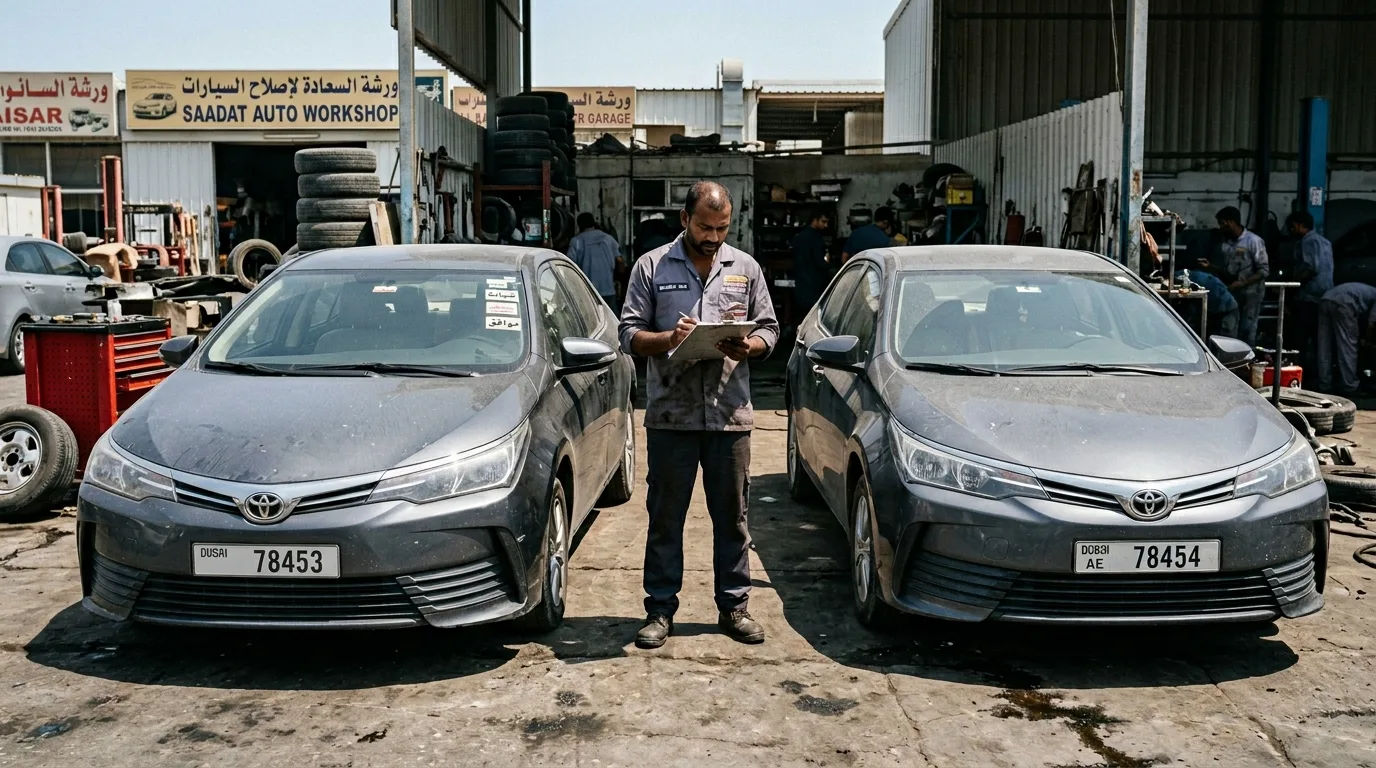
Last Updated: May 2026 | By Omar Al-Fayed, Senior Automotive Consultant | Category: Buying & Selling
Quick Answer
A GCC-spec vehicle is a car manufactured to the technical and regulatory standards of the Gulf Cooperation Council market — covering the UAE, Saudi Arabia, Kuwait, Qatar, Bahrain, and Oman. A non-GCC-spec vehicle is the same model built to a different regional standard, most commonly for the United States, Canada, or Europe, and then re-exported to the UAE through unofficial import channels.
The price gap between a GCC-spec and a comparable non-GCC-spec used car in the UAE typically ranges from 10,000 to 25,000 AED depending on the model and year. That difference often disappears — and then reverses — once non-GCC-specific repair costs, insurance premiums, and resale discounts are factored into the total ownership calculation. Knowing how to verify GCC spec before buying in Dubai takes under ten minutes and is the single most effective step a buyer can take before negotiating price. This guide covers the engineering differences, the financial implications, and every physical and digital check needed to confirm a vehicle’s specification with confidence.
For context on the related step of verifying a vehicle’s prior damage history regardless of specification, our guide on red flags when buying a used car in Dubai covers every available UAE and international verification channel. For monthly running costs once the vehicle is in your name, the real cost of owning a car in Dubai 2025 covers fuel, insurance, maintenance, and depreciation by model.
| Quick Reference | Answer |
|---|---|
| What is GCC spec? | A vehicle built to Gulf Cooperation Council engineering and regulatory standards — with cooling, AC, and fuel systems calibrated for Gulf climate conditions |
| Is buying a non-GCC car in the UAE legal? | Yes — provided it passes Tasjeel inspection and meets registration standards |
| Can I insure a non-GCC car comprehensively? | In many cases yes, but insurers frequently apply premium loadings — confirm in writing with your chassis number before purchase |
| How do I check GCC spec? | See the physical verification section below — VIN alone does not determine market specification |
| Typical purchase price gap (AED) | 10,000 – 25,000 AED in favour of non-GCC at point of purchase |
What GCC Specification Actually Means — Engineering Differences
The term “GCC spec” is frequently used in UAE listings and dealer conversations without a clear explanation of what the specification actually covers. It is not a marketing label. It refers to a set of engineering and component decisions made at the manufacturer level for vehicles destined for the Gulf market.
The key engineering differences between GCC-spec and US-spec or European-spec variants are consistent across most mainstream brands.
| System | GCC Specification | US / European Specification | UAE Relevance |
|---|---|---|---|
| Cooling system | Larger radiator capacity, high-temperature coolant calibration, reinforced fan clutch | Standard capacity for temperate climate operation | Summer ambient temperatures in the UAE can exceed 45°C — GCC cooling systems are calibrated for sustained operation in these conditions |
| Air conditioning | Higher-capacity compressor, additional condenser surface area, cabin insulation rated for extreme heat | Adequate for 30–35°C operating environments | A non-GCC AC system may cool adequately during early morning but progressively underperforms during prolonged afternoon idle or slow traffic |
| Engine air intake | Intake filter rated for fine sand and dust particulate common to desert environments | Standard air filtration for temperate conditions | Fine silica dust in UAE air accelerates engine wear in non-GCC intake systems without modification |
| Suspension calibration | Tuned for regional road surfaces and load patterns | Tuned for regional market roads — different profile | Minor but relevant for ride quality and tire wear patterns over time |
| Underbody protection | Additional heat shielding on exhaust and fuel system components | Standard shielding for moderate temperature ranges | Relevant for vehicles parked on dark surfaces or exposed to reflected ground heat in summer |
| Fuel system | Calibrated for 91–98 RON fuel grades available at UAE ADNOC and ENOC stations | US spec: calibrated for 87–93 AKI (approximately 91–98 RON equivalent — similar, but ECU calibration differs) | Fuel grade compatibility is often cited but is less critical than cooling and AC differences for most mainstream Japanese and Korean models |
| Warranty coverage | Full manufacturer warranty through UAE dealer network | Warranty transferability varies by manufacturer — most major brands do not extend UAE dealer warranty coverage to non-GCC imports | A non-GCC vehicle may carry no active warranty through UAE dealers even if it is a recent model year |
| Arabic language | Arabic menus, labels, and manual included | English or source country language only | Administrative requirement for some official processes |
How to Check GCC Spec Online in UAE
Many buyers search for ways to verify GCC spec before buying in Dubai without visiting the vehicle in person. Several online methods can help, though none is fully conclusive without physical confirmation. The most reliable approach combines two or three of the following channels.
- Manufacturer VIN decoder: Most mainstream brands — Toyota, Nissan, Honda, Hyundai — offer official VIN lookup portals. Toyota’s owner tools and Nissan’s equivalent allow partial VIN lookups that identify market destination in many cases. The Toyota global portal and Nissan’s international site are starting points for confirming GCC-destined builds.
- NHTSA database (for US-assembled vehicles): The NHTSA vehicle database is the most reliable source for confirming North American assembly and US-spec registration. If your VIN appears in NHTSA records, the vehicle was built to US domestic market standards.
- International VIN history services: Carfax, AutoCheck, and CarVertical retrieve historical records including country of original registration, prior title status, and service events from the source market. Particularly useful for identifying vehicles with salvage or flood titles before import.
- UAE dealer service history search: Major UAE franchise dealers — Al Futtaim Toyota, Arabian Automobiles Nissan, Gargash Mercedes — can search their service history databases by chassis number. A GCC-spec vehicle sold new in the UAE or another Gulf state typically has at least some dealer service entries visible to the receiving UAE dealer.
- Door-jamb specification label photo: Request a photograph of the door-frame sticker from the seller via WhatsApp before the meeting. A GCC-spec vehicle shows Arabic text, kPa alongside PSI values, and Gulf-region compliance references. This takes the seller under two minutes and confirms the specification visually without requiring a site visit.
Important Clarification on VIN and Market Specification: A VIN’s first character identifies the country of assembly — not the market for which the vehicle was specified. Some GCC-spec Toyota and Nissan models are assembled in North American plants and carry a VIN beginning with “1” or “2” while still being built to GCC specification for Gulf market export. VIN prefix narrows the probability but must be confirmed through manufacturer records, vehicle labels, and physical inspection before drawing a conclusion.
How Non-GCC Vehicles Enter the UAE Market
Non-GCC-spec vehicles enter the UAE through several channels, not all of which carry equivalent risk. Understanding the channel helps assess the specific risk profile before committing to an inspection.
Personal Import by a UAE Resident
A UAE resident who previously lived in the United States or Europe may have shipped their personal vehicle to the UAE. These vehicles are re-registered locally after clearing customs. The vehicle’s history in its country of origin is typically well-documented, and the import was conducted for personal use rather than commercial resale. This is the lower-risk category of non-GCC import.
Commercial Re-Export Through Auction Sourcing
A common channel involves vehicles purchased at US auto auctions — frequently including insurance write-offs, flood-damaged vehicles, or high-mileage fleet cars — exported through ports in Georgia, New Jersey, or Houston, cleared through Jebel Ali, and relisted on UAE classifieds platforms or sold through informal dealer networks in Al Aweer or the Sharjah used car market.
Workshop observations across Al Quoz Industrial Area and the Sharjah Industrial Area indicate that a notable share of US-sourced imports inspected independently show evidence of prior structural repair, airbag deployment, or water ingress not visible in UAE administrative records.
European Grey Market Imports
European-spec vehicles — particularly German luxury models — occasionally enter the UAE through similar re-export channels. European spec shares some climate modifications with GCC spec in higher-end models but typically lacks the cooling system uprating specific to Gulf temperatures. Warranty coverage in the UAE is equally absent in most cases.
Market Observation: Non-GCC vehicles commonly appear on Dubizzle and Al Aweer listings at prices 15 to 30 percent below the comparable GCC-spec market rate. In many cases observed across UAE workshops, the initial saving is partially or fully offset by repair costs, higher insurance premiums, and a steeper depreciation curve at resale — particularly for vehicles over 80,000 km.
Most Common Non-GCC Import Sources in UAE
Understanding where a non-GCC vehicle originated helps assess its specific risk profile. Each source market carries a distinct pattern of issues most commonly observed in UAE workshops.
| Source Country | Typical Vehicles | Common Concerns | Risk Level |
|---|---|---|---|
| United States | Toyota Camry, Nissan Altima, Dodge Charger, Chevrolet Tahoe, Ford F-150 | Salvage and flood title history from US auctions; undisclosed structural repair; airbag deployment; AC system underperformance in UAE summer | Medium to high — depends heavily on pre-import history |
| Canada | SUVs, crossovers, pickup trucks | Undercarriage corrosion from road salt exposure; rust on brake components and subframe; lower-specification cold-climate variants | Medium — rust damage not always visible in UAE climate until advanced |
| Germany / European Union | BMW, Mercedes-Benz, Audi, Volkswagen | High parts cost for European-spec variants at Al Quoz workshops; ECU coding incompatibilities with UAE dealer systems; no active UAE dealer warranty | Medium — parts availability is the primary ongoing concern |
| South Korea | Hyundai, Kia domestic-market variants | Lower specification than export-market equivalents; occasional feature differences not disclosed in listings | Lower — fewer import channel issues than US-sourced vehicles |
| Japan (domestic JDM) | Toyota Mark X, Nissan Skyline, Lexus IS | Right-hand drive configuration requiring RTA special approval; administrative hurdles at registration | Lower for documentation — administrative complexity at registration stage |
How to Spot Flood-Damaged Imported Cars
A notable proportion of US-sourced imports entering the UAE have flood damage histories — particularly vehicles originating from Gulf Coast states or areas affected by major weather events. US auction platforms assign a flood or water damage title designation to documented cases, but not every flood-exposed vehicle receives a formal title brand before entering the re-export supply chain.
Physical indicators that suggest prior water ingress — observable during a standard pre-purchase inspection in Al Quoz or Abu Shagara:
- Rust beneath the front seats or along the seat rail channels: Inconsistent with the vehicle’s age and UAE climate — particularly on models that should not show rust in this region after dry-climate operation
- Persistent humidity or musty odour inside the cabin: Most noticeable when the AC is first activated after the car has been parked in the sun — standard UAE vehicles do not develop this odour from local operation
- Fogging or condensation inside instrument cluster glass: Moisture trapped inside sealed instrument panels indicates prior submersion or significant water ingress that was not fully remediated
- Mud or silt deposits in the wiring loom, behind door panels, or inside the spare wheel well: Dried sediment in electrical connectors is one of the most reliable physical indicators of prior flooding
- Corrosion on electrical connectors under the dashboard or in the engine bay: Green or white oxidation on connectors that should be clean on a vehicle of the stated age and mileage
- Water staining on the seat foam or carpet backing: Visible when the seat is removed or the carpet is lifted — a straightforward check for any independent mechanic during inspection
Flood Damage and UAE Insurance: A vehicle with undisclosed flood damage that later develops electrical or mechanical faults may face claim complications if the insurer’s assessor identifies the pre-existing condition. Flood history should be verified through an international VIN history report — not relied upon to emerge through the Tasjeel roadworthiness inspection process, which does not routinely identify prior flood exposure.
How to Identify GCC Spec vs Non-GCC Spec — Physical Checks
Several physical identifiers help distinguish GCC-spec vehicles from imports during an in-person inspection. These checks take under five minutes and can be completed before booking a full workshop inspection. Knowing how to verify GCC spec before buying in Dubai starts here — with labels you can see with your own eyes before any money changes hands.
| Check | GCC Spec Indicator | Non-GCC Indicator | Where to Look |
|---|---|---|---|
| Speedometer | KM/H only | MPH primary scale with KM secondary, or dual markings | Instrument cluster |
| VIN country of assembly | Does not determine GCC specification on its own — must be combined with vehicle labels and manufacturer records | A “1”, “2”, or “3” VIN prefix indicates North American assembly — requires label confirmation | Dashboard plate, door frame sticker, Mulkiya |
| Emission label | GCC or UAE regulatory compliance label | US EPA or CARB emissions label, or EU Euro standard label | Under the hood / engine bay sticker |
| Tyre pressure label | PSI and kPa values with Arabic text | PSI only, English only | Driver door frame sticker |
| Owner’s manual language | Arabic included (bilingual or separate Arabic manual) | English or source country language only | Glovebox |
| Headlight beam pattern | Left-hand traffic beam pattern | US: symmetric; European right-hand traffic spec: asymmetric — may require adjustment | Physical inspection or low-beam test at night |
| Dealer service stickers | UAE franchise dealer names — Al Futtaim Toyota, Arabian Automobiles Nissan, Gargash, etc. | US or European dealership names, or no stickers | Inside door jambs, oil filler cap area |
| Cooling system capacity label | Higher-temperature rating printed on the reservoir cap or radiator label | Standard rating for origin market | Under the hood |
VIN Decoding — A Starting Point, Not a Conclusion — How to Verify GCC Spec Before Buying Dubai
The VIN’s first character identifies the country of assembly. Positions four through eight encode the vehicle’s body, engine, and restraint system configuration, which varies between market specifications for the same model. However, country of assembly and market specification are not always the same. A Toyota Camry assembled in Kentucky for the GCC export market carries a VIN beginning with “4” — indicating US assembly — while still being built to GCC specification for Gulf market delivery.
VIN decoding is therefore most useful as a starting-point filter. If the VIN reveals US or Canadian assembly, the next step is to check the vehicle’s physical labels and, where possible, the manufacturer’s market records. The NHTSA vehicle database is the most reliable source for confirming North American-registered vehicles specifically.
[IMAGE PLACEHOLDER 2 — CLOSE-UP/TECHNICAL]
Alt Text: Close-up of VIN plate on dashboard of used car in UAE showing North American assembly code being cross-checked against Mulkiya registration card
Title: vin-check-gcc-spec-uae-import-identification
File name before upload: vin-check-gcc-spec-uae-import-identification
(1200×630 minimum — Sony A7R IV, dirty realism, UAE workshops — no women in frame)
Engine Variants — How Specification Affects Each Version
Japanese and Korean Mainstream Models (Toyota, Nissan, Hyundai, Kia)
For the most commonly traded models in the UAE used car market, the GCC vs non-GCC difference primarily affects the cooling and AC systems rather than the engine itself. A 2.5L Toyota Camry assembled for GCC markets uses the same engine family as the US-spec version, but the radiator, coolant thermostat calibration, and AC compressor are different components.
Owners of US-spec Japanese sedans in the UAE most frequently report AC performance degradation under prolonged idle in summer as the first notable difference. Workshop observations from Al Quoz specialists suggest that AC-related complaints appear more frequently on some non-GCC Japanese models than GCC equivalents under similar mileage and UAE summer operating conditions.
European and German Models (BMW, Mercedes-Benz, Audi)
European-spec German vehicles present a more complex specification gap. The cooling systems of German executive cars are typically engineered to a higher absolute standard than Japanese equivalents in both GCC and European configurations. The more significant issues observed in the UAE with European-spec imports involve ECU calibration for fuel grade, the absence of UAE dealer diagnostic access, and the absence of active warranty coverage in most cases.
Parts availability for European-spec variants at Al Quoz workshops varies. GCC-spec German models have strong parts stocking through the Al Quoz and Deira trade parts network. European-spec or US-market variants occasionally require ordered parts at meaningfully higher cost and lead time.
American Full-Size Models (Dodge, GMC, Chevrolet)
American full-size pickups and SUVs — Dodge Ram, GMC Sierra, Chevrolet Tahoe — are sold in the UAE both as GCC-spec through official dealers and as US imports through the grey market. For this segment, the specification difference is notably smaller because the US domestic market already calibrates these engines for a hot climate. The more relevant concern with US-spec American vehicles is undisclosed history, particularly flood damage from Gulf Coast weather events and salvage title origins.
Total Ownership Cost Comparison — GCC Spec vs Non-GCC Spec
The cost comparison below uses a 2020 Toyota Camry 2.5L as the reference model, representing a common high-volume transaction in the UAE used car market. Figures are based on workshop-observed ranges and publicly listed insurance and registration costs.
| Cost Category | GCC Spec (AED) | Non-GCC Spec (AED) | Notes |
|---|---|---|---|
| Purchase price (used, ~80,000 km) | 65,000 – 72,000 | 48,000 – 58,000 | One-time cost — non-GCC saving appears largest here |
| Comprehensive insurance (annual) | 2,800 – 3,600 | 3,400 – 4,800 | Non-GCC vehicles commonly attract higher premiums — some insurers apply additional conditions or decline comprehensive cover |
| Annual maintenance (service + filters) | 1,200 – 1,800 | 1,400 – 2,200 | Non-GCC parts occasionally require ordering; prices vary by availability at Al Quoz and Sharjah |
| AC system maintenance | 400 – 800 | 600 – 1,400 | AC-related complaints reported more frequently on some non-GCC variants under UAE summer conditions |
| Registration renewal (annual) | 420 – 580 | 420 – 580 | Same process — registration cost does not vary by specification. See RTA vehicle registration portal for current fee schedule |
| Fuel (monthly 1,500 km, 95 unleaded) | 550 – 700 | 550 – 700 | Negligible difference for mainstream Japanese models on similar engine variants. Current UAE fuel prices at ADNOC |
| Depreciation (annual estimate) | 6,500 – 9,000 | 9,000 – 13,000 | Non-GCC resale value typically lower — fewer buyers, more scrutiny, lower finance eligibility |
| Estimated 3-Year Total Cost of Ownership | ~38,000 – 50,000 AED | ~47,000 – 67,000 AED | Purchase price plus 3-year running and depreciation combined |
Note on These Figures: Individual costs vary significantly depending on driving pattern, parking conditions, insurer, and whether the vehicle has a documented service history. The ranges above are based on workshop observations and publicly available data across the UAE market. They represent typical patterns rather than guaranteed outcomes.
GCC vs Non-GCC — Quick Pros and Cons
GCC Specification — Key Advantages:
✓ Better resale value — wider buyer pool at Al Aweer and Dubizzle
✓ Easier comprehensive insurance — standard market rates without loading in most cases
✓ Full manufacturer warranty eligibility where applicable
✓ Better dealer support and same-day parts availability across Al Quoz Industrial Area and Sharjah Industrial Area
✓ Finance eligibility with UAE banks and auto loan products
✓ Cooling and AC systems calibrated for UAE summer operating conditions
Non-GCC Specification — Key Advantages:
✓ Lower purchase price — typically 10,000 to 25,000 AED below GCC equivalent at point of sale
✓ Wider inventory at certain price points — more options available under 40,000 AED
✓ Acceptable value if sourced with clean international history and thorough pre-purchase inspection
✓ US-spec American full-size models may carry a smaller performance specification gap than Japanese equivalents
Insurance Implications — Non-GCC Spec in the UAE
The insurance dimension is one of the most practically significant consequences of non-GCC specification, and one that many buyers only discover after purchase.
How Insurers Treat Non-GCC Vehicles
UAE insurance companies vary in their approach to non-GCC-spec vehicles. In many documented cases, buyers report that the vehicle was insured on a comprehensive policy without the insurer flagging the specification. The issue typically surfaces at the point of a claim, when the assessor’s report identifies the non-GCC origin and the insurer’s market value calculation is based on what an equivalent GCC-spec model would cost.
Common insurance patterns observed for non-GCC vehicles in the UAE:
- Some insurers offer comprehensive coverage with an additional premium loading — typically 15 to 25 percent above the equivalent GCC-spec rate
- Some insurers offer third-party only coverage and decline comprehensive cover entirely
- Some insurers issue comprehensive policies without checking specification — creating a discrepancy that may affect claims settlement
- At renewal, if the insurer’s records are updated to reflect the non-GCC specification, the renewal premium may increase
Insurance vs Legal Action — Understanding the Difference
Many expat buyers conflate insurance claims and legal action against a seller, particularly in cases where a non-GCC vehicle’s undisclosed condition causes an unexpected expense. These are distinct processes with different requirements and different likely outcomes. Our guide on what to do after a road accident in UAE as an expat covers the insurance claim process in full.
| Route | Who It Is Against | What It Depends On | Likely Timeline |
|---|---|---|---|
| Insurance Claim | Your insurance company | Policy wording, vehicle specification declared at inception, cause of damage | Days to weeks for assessment; settlement timelines vary by insurer and claim type |
| Legal Action Against Seller | The previous owner or dealer | Documented evidence of misrepresentation — written claims, VIN records, inspection reports. Buyers may have legal remedies depending on evidence and the specific circumstances of the sale. Outcomes vary significantly based on available documentation and how the transaction was conducted. | Weeks to months through UAE Consumer Protection or civil channels |
Before Purchasing a Non-GCC Vehicle: Contact at least two UAE insurance providers and obtain a written quotation confirming comprehensive cover availability and the premium for the specific chassis number you are considering. Do not assume that the vehicle can be comprehensively insured at standard rates until you have a written quotation with the VIN referenced.
Buying From a Dealer vs Private Seller — GCC and Non-GCC
The channel through which a non-GCC vehicle is sold affects both the available documentation and the practical options if issues arise post-purchase.
| Factor | Dealer (Al Aweer / Used Car Lot) | Private Seller (Dubizzle / WhatsApp) |
|---|---|---|
| Price | Typically higher — dealer margin factored in; less negotiation room | Often lower — seller may accept offers; more pricing flexibility |
| Documentation | Basic paperwork typically provided; seller’s ID on file; some transparency | Variable — ranges from comprehensive to minimal depending on seller |
| Warranty or guarantee | Some used car dealers offer limited short-term guarantees — verify in writing what is covered | None — purchased as seen; all responsibility transfers immediately |
| Inspection transparency | Medium — dealers may resist independent inspections; some will accommodate | Variable — genuine private sellers typically allow full independent inspection without resistance |
| Post-purchase recourse | Slightly better — a registered business can be traced and approached through Consumer Protection if misrepresentation is documented | Limited — private individuals are harder to pursue; documentation of all seller representations is essential |
| Non-GCC specification disclosure | Inconsistent — some dealers disclose clearly; others list as “GCC” without verification | Inconsistent — always verify independently regardless of seller’s claim |
Resale Value — The Long-Term Financial Difference
Resale value is the area where the non-GCC price saving most frequently reverses. When a buyer eventually lists a non-GCC-spec vehicle, they face the same buyer scrutiny they should have applied at their own purchase.
Patterns observed across Al Aweer dealers and Dubizzle listings for non-GCC-spec vehicles:
- Private buyers familiar with the UAE market typically expect a discount of 15 to 30 percent against the GCC-spec equivalent — regardless of the non-GCC vehicle’s actual condition
- Finance eligibility is often restricted or unavailable for non-GCC vehicles through UAE bank auto loan products — this limits the buyer pool to cash-only purchasers
- Dealer trade-in values for non-GCC vehicles are consistently lower than for GCC equivalents of the same model and mileage
- Corporate fleet buyers and rental companies — who represent a significant portion of high-volume used car transactions — typically exclude non-GCC spec from their purchasing criteria
Toyota and Nissan GCC-spec models retain resale value most consistently across the UAE market. Toyota and Nissan parts are widely stocked across the Al Quoz Industrial Area and the Sharjah Industrial Area, typically available same day without ordering, which keeps both maintenance costs and future buyer confidence higher than for brands with more limited parts networks. For a data-driven view of which models hold value best, our best resale value cars UAE guide ranks models by three-year depreciation curves.
Mechanic’s Inspection Log — Non-GCC Case Study
Example scenario based on recurring UAE market patterns observed in workshops.
Location: Independent workshop, Sharjah Industrial Area
Vehicle: 2021 Nissan Altima 2.5 SV, listed at 56,000 AED
GCC-spec equivalent market value: 74,000 – 78,000 AED
VIN check result: First digit “1” — North American assembly. Physical label checks confirmed US market specification: speedometer showing dual MPH/KM marking, US EPA emissions sticker in engine bay, tyre pressure sticker in English and PSI only with no Arabic text, no UAE dealer service stickers. VIN and physical labels together confirmed US-spec, not GCC.
OBD reading: No stored fault codes. Cooling system temperature sensor showing readings within normal range. AC compressor showing no current faults but 14 months of service gap with no UAE workshop record.
Physical findings: Intake filter showing fine sand accumulation consistent with 30,000+ km of UAE operation without replacement. AC condenser showing early oxidation on the fins. No Arabic text anywhere in the vehicle — manual, door stickers, or instrument cluster menus.
| Finding | Estimated Cost to Address (AED) |
|---|---|
| Air intake filter replacement (non-standard size — ordered part) | 180 – 320 |
| AC condenser cleaning and refrigerant recharge | 400 – 700 |
| Insurance premium loading vs GCC-spec equivalent (annual) | 600 – 1,200 |
| Estimated resale discount vs GCC-spec at 3 years | 12,000 – 18,000 |
| Total additional 3-year ownership cost vs GCC-spec | ~13,000 – 20,000 AED |
The buyer had identified the non-GCC vehicle as a saving of 18,000 AED against the GCC market price. After the inspection, the realistic 3-year additional cost was estimated to largely offset that saving. The buyer ultimately negotiated to 49,000 AED and proceeded with full awareness of the known conditions.
Signs of a Well-Maintained Non-GCC Vehicle — The Positive Side
Not every non-GCC-spec vehicle represents a problematic purchase. The following indicators suggest a non-GCC import that was maintained appropriately and presents a lower-risk transaction.
- Complete service history from a UAE independent workshop or Tasjeel-affiliated service center — showing consistent mileage progression and regular maintenance intervals since UAE registration
- Clean international VIN report with no salvage, flood, or total-loss flags from the country of origin — confirming the vehicle was not sourced from an insurance write-off pool
- AC system serviced within the past 12 months with a documented refrigerant recharge and condenser inspection — suggesting the owner addressed the most common non-GCC degradation point
- Upgraded intake filter to UAE-rated equivalent — a modification that is inexpensive but indicates the previous owner understood and addressed the specification gap
- Mileage consistent with registration date and service records — no unexplained gaps between UAE registration and first service entry
Exceptions and Nuance: A non-GCC-spec vehicle with a fully documented UAE service history, clean international VIN report, and no evidence of pre-import damage may represent an acceptable purchase at an appropriate discount — particularly for buyers on a defined budget who are aware of the insurance and resale implications and factor them into the negotiation. Informed purchase at the right price is meaningfully different from an uninformed purchase at any price.
Daily Ownership Differences — What Non-GCC Owners Actually Report
Beyond the technical specifications, the ownership experience of a non-GCC vehicle in the UAE differs in several practical ways that are commonly reported across Al Quoz workshop conversations and expat community forums.
- AC cooling under prolonged afternoon idle: The most frequently mentioned experience — particularly for US-spec Japanese and Korean sedans — is that the AC maintains comfortable cabin temperature during motion but progressively struggles during extended idle in afternoon summer conditions. This reflects the compressor capacity difference rather than a fault.
- Infotainment language limitation: US and European-spec infotainment systems do not include Arabic language options, which is a minor inconvenience for most expat owners but an administrative limitation for some official processes.
- Workshop familiarity: Some Al Quoz workshops are less familiar with US-spec variant service procedures and part numbers. This occasionally causes delays or incorrect part ordering for non-standard specifications.
- Finance application rejections: Owners who attempt to refinance or take personal loans against a non-GCC vehicle as collateral commonly find UAE banks either decline or apply additional conditions relative to the market price paid.
- RTA inspection caution: Tasjeel inspectors are generally familiar with non-GCC vehicles but occasionally flag items — particularly lighting patterns — that require adjustment before a renewal pass is issued.
When a Non-GCC Vehicle Becomes Expensive
A non-GCC vehicle that was reasonably priced and well-maintained at purchase can become a notably higher-cost proposition under specific conditions. These are the scenarios most consistently associated with elevated repair bills across workshop observations in Al Quoz and Abu Shagara.
- AC system failure above 80,000 km: When the condenser, compressor, or evaporator on a non-GCC-spec vehicle reaches the end of its service life, replacement parts for US-spec variants occasionally carry a price premium or require ordering — unlike GCC equivalents where common parts are shelf-stocked across the Sharjah and Al Quoz supply network
- Undisclosed pre-import damage discovered post-purchase: If a structural repair or flood history surfaces after purchase, remediation costs are the buyer’s responsibility — with no dealer recourse and limited options without documented written representations from the seller
- ECU or transmission control module replacement: For vehicles where the ECU requires manufacturer-specific coding to region of origin, UAE dealers may decline to program a replacement module for a non-GCC variant — escalating repair costs significantly and extending the vehicle’s off-road time
- Warranty claim on a recent model: A buyer who purchases a three-year-old non-GCC vehicle expecting some residual warranty coverage will find that the manufacturer’s UAE dealership is typically unable to honour the warranty of a non-GCC import
Buyer Mistakes Specific to GCC vs Non-GCC Decisions
These are patterns observed most frequently among expats making their first or second UAE vehicle purchase when comparing GCC and non-GCC options.
- Treating the purchase price gap as pure saving: The 15,000 to 25,000 AED price difference between GCC and non-GCC equivalents is real at the point of purchase. It is not necessarily a net saving once insurance loading, maintenance differences, and resale discount are included in the three-year cost calculation.
- Assuming all non-GCC vehicles are low quality: A well-sourced non-GCC vehicle with documented history and appropriate pre-purchase inspection can be a reasonable purchase for a buyer with a clear exit timeline and realistic resale expectations.
- Accepting “GCC spec” claims without verification: “GCC spec” is commonly stated in listings without documentation. The physical checks described above — speedometer, emission label, door-frame sticker — take under five minutes and verify the claim directly.
- Not checking insurance eligibility before purchase: Several buyers have purchased non-GCC vehicles only to discover that comprehensive insurance is either unavailable or priced significantly higher than budgeted. Insurance confirmation should precede the purchase decision, not follow it.
- Comparing sticker prices without adjusting for finance eligibility: If you plan to purchase with a UAE bank auto loan, confirm that the specific vehicle is eligible for financing before proceeding to contract stage.
For an expanded list of deceptive seller tactics to watch for during negotiations, our guide on what dishonest UAE car dealers say — and how to reply covers the ten most commonly observed patterns in Al Aweer and private listings.
Evidence Checklist — What to Document Before and After Purchase
| Document | Why It Matters | When to Collect |
|---|---|---|
| ✔ Photographs of all physical specification labels | Confirms spec at time of purchase — prevents later disputes about what was represented | During inspection, before signing |
| ✔ International VIN history report (Carfax / CarVertical) | Identifies salvage, flood, or structural damage history from source country | Before meeting the seller |
| ✔ Independent inspection report from a licensed UAE workshop | Documents condition at purchase; creates a record of any known faults disclosed or undisclosed | Before payment |
| ✔ WhatsApp and SMS conversation with seller | Written record of all seller claims about specification, service history, and condition | Throughout negotiation |
| ✔ Screenshot of the original listing | Preserves the specification and price claims made at the point of sale | Before the listing is removed |
| ✔ Payment receipt or bank transfer record | Confirms transaction date, amount, and parties involved | At point of payment |
| ✔ Seller’s Emirates ID copy or trade license | Establishes the seller’s identity for any subsequent administrative process | At point of sale |
| ✔ Copy of VIN and Mulkiya | Core vehicle identification — essential for any insurance or legal process | At point of sale |
| ✔ Written insurance confirmation with VIN referenced | Confirms comprehensive cover eligibility before the purchase is finalised | Before signing the sale agreement |
Practical Checklist — Verifying GCC Spec Before Purchase
| Check | What to Look For | Result to Confirm GCC Spec |
|---|---|---|
| Speedometer | Instrument cluster markings | KM/H only — no MPH scale |
| VIN origin (starting point only) | Dashboard plate or door frame sticker | Note assembly country — confirm through physical labels, not VIN alone |
| Emissions label | Engine bay sticker | GCC/UAE compliance — not US EPA or EU Euro standard |
| Owner’s manual | Glovebox | Arabic included alongside English |
| Door frame tyre pressure sticker | Driver door frame | Arabic text present alongside PSI/kPa values |
| UAE dealer service stickers | Inside door jambs, oil filler cap area | UAE franchise dealer names — Al Futtaim, Arabian Automobiles, Gargash, etc. |
| International VIN report (if imported) | CarVertical or equivalent service | No salvage, flood, or total-loss history in source country |
| Insurance quotation | Written quotation from insurer with VIN referenced | Comprehensive cover confirmed at standard market rate |
User Type Recommendation — Which Specification Fits Your Situation
| If You Are… | Recommended Specification | Reason |
|---|---|---|
| New expat arriving for a 2–3 year contract | GCC spec strongly preferred | Higher resale value at exit — Toyota and Nissan GCC models hold value best at Al Aweer and Dubizzle |
| Long-term UAE resident (5+ years planned) | GCC spec preferred — non-GCC acceptable with full knowledge | Total cost of ownership advantage grows with time held; GCC spec requires less management overhead |
| Budget buyer under 35,000 AED | Non-GCC acceptable with inspection | GCC-spec budget options at this price point are typically high-mileage; a lower-mileage non-GCC with clean history may represent better mechanical value — insurance confirmation required first |
| Planning to finance the purchase | GCC spec only | Many UAE banks apply additional conditions or lower valuation thresholds to non-GCC vehicles |
| High daily mileage (highway driving 40+ km per day) | GCC spec strongly preferred | Cooling system performance difference becomes material under sustained highway use in summer |
| Short-term visitor (under 12 months) | Non-GCC acceptable at right price | With a defined exit timeline, the resale discount is anticipated and can be priced in at purchase |
Should You Buy GCC or Non-GCC? — Decision Framework
| Your Situation | Recommended Path | Primary Reason |
|---|---|---|
| Financing the purchase through UAE bank | GCC spec only | Most UAE banks restrict non-GCC vehicles or apply lower valuations |
| Plan to sell within 2 years | GCC spec | Resale discount on non-GCC will reduce or eliminate initial savings |
| Cash buyer with independent inspection budget | Non-GCC possible | Clean international history + UAE workshop inspection + written insurance confirmation = manageable risk |
| Total budget under 35,000 AED | Consider both | A well-documented non-GCC may offer better mechanical condition than a high-mileage GCC equivalent at this price point |
| Daily highway driving 40+ km | GCC spec | AC and cooling differences most noticeable under sustained summer highway use |
| Staying 5+ years in UAE | GCC spec | Total ownership cost advantage compounds over a longer hold period |
The Safe Alternative — GCC-Spec Certified Pre-Owned
For buyers who want to avoid the verification overhead entirely, manufacturer-backed Certified Pre-Owned programs through UAE franchise dealers offer GCC-spec vehicles with documented inspection records, accident declarations, and transferable warranty coverage.
CPO pricing typically runs 10 to 18 percent above comparable private GCC-spec listings. The premium covers the documented inspection, warranty, and the reduced administrative burden of independent verification. For a buyer on a short contract who needs predictable resale value in 24 to 36 months, the CPO premium often represents straightforward risk management rather than overpaying.
Toyota’s CPO program through Al Futtaim and Nissan’s program through Arabian Automobiles represent the most liquid options in the UAE — both brands have the widest buyer pools at resale and the most developed independent parts networks across Al Quoz and Sharjah. For the full breakdown of how to inspect any used car before purchase, our guide on used car inspection Dubai services covers every physical and digital check step.
[IMAGE PLACEHOLDER 3 — WORKSHOP/DOCUMENTARY]
Alt Text: UAE mechanic in Al Quoz workshop pointing to engine bay cooling system components on GCC spec Toyota with open bonnet during pre-purchase inspection
Title: gcc-spec-cooling-system-inspection-al-quoz-uae
File name before upload: gcc-spec-cooling-system-inspection-al-quoz-uae
(1200×630 minimum — Sony A7R IV, dirty realism, UAE workshops — no women in frame)
Frequently Asked Questions
Q: Is buying a non-GCC-spec car in the UAE legal?
Q: Can a non-GCC vehicle be modified to GCC spec?
Q: Does GCC spec always mean the car was new in the UAE?
Q: How to verify GCC spec before buying in Dubai — what are the essential steps?
Q: Do UAE banks finance non-GCC vehicles?
Q: Is a GCC spec car from Saudi Arabia the same as a UAE-spec car?
Analytical Conclusion
The GCC vs non-GCC distinction is not a binary of good and problematic. It is a framework for understanding a specific set of risk factors that are priced inconsistently in the UAE used car market.
At the point of purchase, a non-GCC vehicle typically appears to offer a clear saving of 15,000 to 25,000 AED against a GCC equivalent. Over a three-year ownership period, that saving is commonly reduced by insurance loading, AC and cooling system maintenance differences, and a resale discount that the next buyer applies with similar reasoning. The net financial outcome depends heavily on the specific vehicle’s documented condition, the buyer’s ownership timeline, and whether the insurance and financing implications were confirmed before committing.
For most expats on a standard two to three year contract, the GCC-spec option offers a more predictable total cost and a more straightforward exit. For a cash buyer with a specific vehicle in verified excellent condition, a non-GCC purchase at an appropriate discount can be a rational decision. The difference between those two outcomes is almost entirely determined by how thoroughly the verification was conducted before the dirham changed hands. If you are planning to sell your car in Dubai before leaving, the GCC-spec advantage compounds further at the exit stage — particularly for Toyota and Nissan models transacted through Al Aweer or Dubizzle.
Data Sources Used
- RTA UAE — Vehicle Testing and Registration
- NHTSA — National Highway Traffic Safety Administration Vehicle Database
- UAE Consumer Protection — Ministry of Economy
- ADNOC Distribution — UAE Fuel Prices
- ENOC — Emirates National Oil Company
- Dubizzle UAE — Used Car Listings
- Toyota — Official Brand Portal
- Nissan — Global Brand Portal
Disclaimer: Emirates Car Guide is a 100% independent platform. We do not own showrooms, nor are we affiliated with any used car dealerships or garages. Our sole mission is to protect expats from financial fraud in the automotive market.
