
Last Updated: June 2026 | By Omar Al-Fayed, Senior Automotive Consultant | Fact-Checked By: Emirates Cars Editorial Team | Category: Finance & Legal
Short Answer First
Freelancers in the UAE can get a car loan, but the process is generally harder than for salaried employees. Banks typically ask for a trade license or freelance permit, 6 to 12 months of bank statements, and proof of stable income. Down payments are often higher, sometimes between 20% and 50% of the car value, and interest rates can run higher than standard salaried packages. Approval is possible, but it usually takes longer and depends heavily on documentation and AECB credit history.
This article walks through an illustrative scenario based on situations commonly experienced by freelance and self-employed expats applying for vehicle finance in the UAE. self-employed car loans in the UAE follow a different evaluation path than salaried applications, and understanding that path before you apply can save weeks of back-and-forth with the bank.
Why Many Freelancers Think a UAE Car Loan Is Impossible
Most freelancers in Dubai and Abu Dhabi have heard the same warning from friends: “Banks only lend to people with a salary certificate.” This fear is common, and it is not entirely wrong, but it is also not the full picture.
Banks are not against freelancers. They are against unpredictability. A salaried employee has a fixed monthly transfer that a bank can verify in seconds. A freelancer’s income may swing from 3,000 AED one month to 18,000 AED the next. The bank’s real concern is whether the applicant can comfortably make the same repayment every month, regardless of how the income arrives.
Expat Tip: Freelancers who present their income with structure — consistent invoicing, regular bank deposits, and a clean AECB credit score — are evaluated far more favorably than those who simply hand over a stack of random statements.
Who Banks Classify as “Freelancers” in the UAE
The word “freelancer” covers several different legal categories in the UAE, and banks treat each one slightly differently.
- Freelance permit holders — individuals registered under free zones such as Dubai Media City, Dubai Internet City, or RAKEZ, working independently under their own name.
- Free zone freelancers — similar to above, often issued a freelance visa tied to a specific free zone authority.
- Self-employed professionals — doctors, consultants, engineers, or trainers operating under a personal trade license.
- Consultants — individuals contracted on a project basis, sometimes with multiple clients at once.
- Small business owners — sole proprietors or partners in an LLC who pay themselves rather than receiving a salary slip.
- Gig workers — delivery partners, ride-hailing drivers, and platform-based earners with income paid directly by an app or aggregator.
- Independent contractors — workers paid per project or per invoice, often in fields like media, IT, or design.
Each category affects what documents a bank will request and how much risk weight is applied to the application.
The Application Begins: A Typical Freelancer Scenario
To make this guide practical, consider an illustrative scenario based on recurring patterns observed among freelance applicants in the UAE. The profile below is not a real individual — it represents a typical borrower profile used purely for educational purposes.
Illustrative scenario: A freelance graphic designer based in Dubai, working under a Dubai Media City freelance permit for two years, decides to apply for a car loan to buy a mid-range sedan priced around 65,000 AED.
Documents Collected Before Applying
Before reaching out to any bank, this type of applicant typically gathers:
- Valid Emirates ID and passport copy
- Residence visa page
- Freelance permit or trade license
- 6 to 12 months of personal bank statements
- Proof of income — invoices, client payment confirmations, or platform earning summaries
- Tenancy contract or utility bill as proof of address
- AECB credit report (optional but recommended to check beforehand)
Common Mistake: Many freelancers apply with only 2 to 3 months of bank statements. Most UAE banks prefer 6 months minimum, and some request a full year for freelance or self-employed applicants.
Income Stability: The Biggest Challenge
This is usually where freelance applications slow down. Salaried employees show one number every month. Freelancers show a pattern that moves up and down.
Banks generally look at:
- Average monthly income over the review period, not just the highest months
- How often deposits occur — weekly, monthly, or irregularly
- Seasonal dips, especially in industries like tourism, events, or retail consulting
- Gaps of 30 days or more without any incoming payment
In the illustrative scenario, the designer’s income ranged between 7,000 AED and 22,000 AED per month, with two slow months around the summer period. The bank’s loan officer typically calculates an average across the full review window rather than reacting to a single low or high month.
In many documented expat cases, banks apply a “haircut” — meaning they may only count a percentage of declared freelance income (commonly cited figures range from 60% to 80%) to account for volatility, rather than taking the full reported amount at face value.
Credit Score Review: What AECB Looks At
The Al Etihad Credit Bureau (AECB) report plays a central role in any UAE loan decision, freelance or salaried. Banks typically review:
- Payment history on existing credit cards and loans
- Credit utilization ratio (how much of your available credit you are using)
- Late payment records, even small ones like phone bills
- Existing personal loans or active Buy Now Pay Later (BNPL) commitments
- Number of recent credit inquiries
For freelancers, a strong AECB score can offset some of the uncertainty around income. A weak score combined with irregular income is typically the fastest path to rejection.
Risk Warning: Outstanding BNPL balances are increasingly visible in UAE credit reports. Freelancers who use multiple BNPL apps without realizing it accumulates as debt often see their loan applications affected without understanding why.
How Lenders Estimate Repayment Ability Without a Salary Certificate
Since freelancers cannot provide a traditional salary certificate, banks substitute it with alternative verification methods, which commonly include:
- Average monthly bank credit (total incoming deposits divided by number of months)
- Trade license activity and business age
- Invoice history matched against bank deposits
- Existing rent and bill payment consistency, as a proxy for financial discipline
This approach is generally more time-consuming than reviewing a single salary certificate, which is one reason freelance applications often take longer to process.
Questions a Bank May Ask
During the review, loan officers commonly ask questions similar to these:
- “How long have you held your freelance permit or license?”
- “Do you have one main client or multiple clients?”
- “Can you explain the two months with lower deposits in March and April?”
- “Do you have any other property or assets in the UAE?”
- “Would you consider a higher down payment to reduce the monthly installment?”
These questions are not meant to intimidate the applicant — they help the bank build a fuller risk picture beyond the raw numbers on a statement.
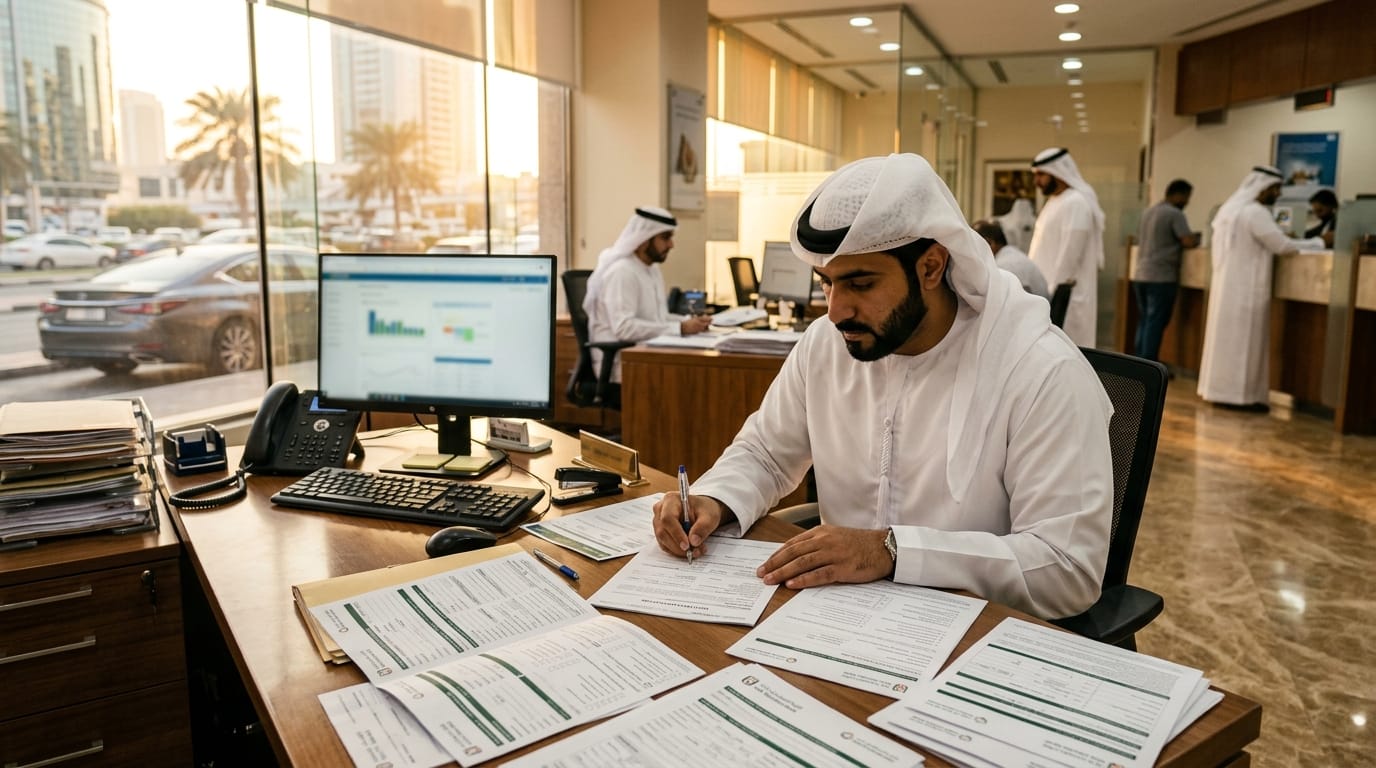
Additional Requirements Freelancers Often Face
| Requirement | Typical Expectation for Freelancers |
|---|---|
| Down payment | Often 20% to 50%, compared to 0% to 20% for some salaried applicants |
| Business history | Generally 1 to 2 years minimum on the trade license or freelance permit |
| Minimum income | Varies by bank, commonly cited around 8,000 to 15,000 AED average monthly credit |
| Documentation | More extensive — invoices, tax records, business bank statements |
| Guarantor | Sometimes requested, particularly for limited business history |
Application Review Timeline
Freelancer Application Timeline
In the illustrative scenario, the full process took close to three weeks from first submission to final offer letter — noticeably longer than the typical one-week turnaround often seen for salaried applicants.
Possible Outcomes
- Approval — full loan amount approved at standard or near-standard terms.
- Conditional approval — approved with a higher down payment, shorter tenure, or added guarantor.
- Request for more documents — bank asks for additional proof of income or clarification on specific deposits.
- Rejection — application declined, usually due to insufficient income consistency or credit history issues.
Why Freelancers Sometimes Receive Higher Interest Rates
Interest rates in vehicle finance are tied to risk assessment. Because freelance income is harder to predict than a fixed salary, banks may price freelance loans slightly higher to offset the added uncertainty. This is not unique to the UAE — it reflects general lending practice across most markets. Outcomes vary significantly based on the applicant’s credit profile, business history, and the specific bank’s internal policy.
Ways Freelancers Can Improve Approval Chances
Practical Checklist Before Applying:
- Keep all freelance income flowing through one main bank account rather than splitting across several
- Maintain at least 6 months of consistent deposit history before applying
- Pay down existing credit card balances to improve utilization ratio
- Avoid opening new BNPL accounts in the months before applying
- Renew your freelance permit or trade license well before expiry
- Consider a larger down payment to reduce the bank’s perceived risk
- Check your AECB report in advance and correct any errors
Mistakes That Commonly Lead to Rejection
| Mistake | Why It Hurts the Application |
|---|---|
| Mixing personal and business income in unclear ways | Bank cannot verify a clean income pattern |
| Applying right after a slow income month | Recent average looks weaker than the real yearly trend |
| Ignoring small unpaid bills | Creates negative AECB marks that are easy to avoid |
| Submitting incomplete bank statements | Triggers delays or automatic rejection |
| Applying to multiple banks at once | Multiple inquiries in a short period can lower the credit score |
What Happens After Approval
Once approved, the process moves into standard vehicle finance steps:
- Signing the loan agreement and reviewing the repayment schedule
- Arranging comprehensive car insurance, which is mandatory for any financed vehicle in the UAE
- Vehicle registration and Mulkiya issuance through RTA or the relevant emirate authority
- Setting up auto-debit for monthly repayments
- The bank holds the vehicle’s registration card as security until the loan is fully settled
What Happens After Rejection
A rejection is not necessarily final. Realistic next steps generally include:
- Requesting the specific reason for rejection, where the bank is willing to share it
- Reviewing and correcting any AECB report errors
- Waiting 3 to 6 months while building a longer, more consistent deposit history
- Reapplying with a larger down payment or with a guarantor
- Considering a different bank’s used car loan program, since approval criteria vary between lenders
Real Costs Freelancers Often Forget
| Cost Item | Typical Range |
|---|---|
| Processing fee | Generally 1% to 1.5% of loan amount |
| Down payment | 20% to 50% of vehicle value |
| Comprehensive insurance (first year) | Typically 3% to 6% of vehicle value |
| Registration and Mulkiya | Generally between 400 and 1,000 AED depending on vehicle type |
| Early settlement fee | Often up to 1% of outstanding balance, subject to UAE Central Bank caps |
| Late payment charge | Varies by bank, typically a fixed fee plus a percentage of the overdue installment |
Freelancer vs Salaried Employee: Side-by-Side Comparison
| Factor | Freelancer | Salaried Employee |
|---|---|---|
| Approval difficulty | Generally higher | Generally lower |
| Documents required | Extensive — license, invoices, longer statement history | Salary certificate, 3 to 6 months statements |
| Typical interest rate | Often slightly higher | Often standard published rate |
| Risk assessment method | Average deposits, business history | Fixed salary verification |
| Flexibility once approved | Similar repayment flexibility | Similar repayment flexibility |
Can Freelancers Buy Used Cars Instead?
Yes, and many freelancers choose this route to reduce both the loan amount and the bank’s risk perception.
Advantages:
- Smaller loan amount, which may improve approval odds
- Lower monthly installment relative to income
- Less depreciation shock compared to a new car
Possible disadvantages:
- Some banks apply stricter age limits on used vehicles eligible for financing
- Requires a thorough pre-purchase inspection to avoid hidden mechanical issues
- Resale value and loan-to-value ratio can be less favorable on older vehicles
Alternative Financing Options
- Islamic finance (Murabaha structures): widely available in the UAE and structured differently from conventional interest-based loans
- Personal savings: avoids financing entirely, though it ties up liquidity
- Larger down payment: reduces the financed amount and often improves approval odds
- Waiting to improve credit profile: sometimes the most practical option if income history is still short
Real Case Studies: Workshop & Market Logs
Example scenario based on recurring UAE market patterns observed among freelance applicants. Names and identifying details are illustrative.
Case 1 — Indian freelance marketing consultant, Dubai: Two years on a freelance permit, average monthly deposits around 14,000 AED. Approved after submitting 12 months of statements and a 30% down payment on a 55,000 AED used Toyota Camry.
Case 2 — British self-employed photographer, Abu Dhabi: One year of trade license history, income fluctuated heavily between 5,000 and 25,000 AED monthly. Initially asked for more documents, eventually approved with a guarantor and a shorter 3-year tenure.
Case 3 — Pakistani independent IT contractor, Sharjah: Strong AECB score but only 5 months of business history. Application was declined; reapplied successfully 7 months later after building a full year of consistent deposits.
The Bottom Line Decision Framework
Lessons Learned From This Scenario
- Freelance car loan approval is achievable but typically requires more preparation than a salaried application
- Income consistency matters more than peak earning months
- A clean AECB report can offset some income volatility concerns
- Down payment size is one of the strongest levers freelancers control
- Rejection is often a timing issue, not a permanent barrier
Final Verdict
Freelancers should apply once they have at least 6 to 12 months of consistent income history, a valid freelance permit or trade license, and a reasonably clean AECB report. Applying earlier than that often leads to delays or rejection. Those most likely to qualify are freelancers with one main stable income stream, low existing debt, and a willingness to offer a larger down payment. Freelancers with very new permits or highly irregular income may be better served waiting a few more months before applying.
Data Sources & Methodology
This article is based on publicly available UAE Central Bank guidance on consumer finance, general AECB credit reporting principles, and commonly observed industry practices among UAE retail banks offering vehicle finance. Specific figures such as down payment percentages and fees are presented as typical ranges, not fixed rules, since individual bank policies differ and change over time.
Relevant official resources:
Market Volatility Notice: All figures, fees, and percentages mentioned in this article are general averages that change with bank policy and market conditions. Readers should verify current rates and requirements directly with their chosen bank before applying.
⚠ Financial & Legal Disclaimer: The information provided in this article is for educational purposes only. Regulations, lending criteria, and insurance terms in the UAE may change over time. Readers should verify information with licensed UAE professionals or official government portals before making financial or legal decisions.
This guide is reviewed periodically as UAE banking regulations, lending practices, and financing requirements evolve.
Frequently Asked Questions
Q: Can a freelancer get a car loan without a salary certificate in the UAE?
Q: How many months of bank statements do freelancers need?
Q: Do freelancers pay higher interest rates on car loans?
Q: Is a guarantor always required for freelancers?
Q: Can gig workers like delivery drivers apply for a car loan?
Q: What down payment should freelancers expect?
Q: Does AECB credit score affect freelance loan approval?
