
Written By: Omar Al-Fayed, Senior Automotive Consultant | Fact-Checked By: Emirates Cars Editorial Team | Last Updated: June 2026 | Category: Finance & Legal
Most expats arriving in the UAE focus on finding an apartment and opening a bank account. Very few think about their credit profile — until the day they walk into a bank to finance a car and get rejected despite earning a decent salary. Understanding how the UAE credit system works is one of the most practical things you can do in your first months here. Car loan basics are important, but your credit score is the foundation everything else is built on. This guide explains what a UAE credit score is, how it directly affects your ability to finance a vehicle, and what you can do — starting today — to build a strong credit profile that unlocks lower profit rates and better loan conditions.
Many expats assume income is the only thing banks look at. It is not. Others assume their credit history from their home country transfers here. It does not. And some believe that because they have never borrowed money in the UAE, they have a clean slate that banks will reward. In reality, having no credit history here is treated almost the same as having a bad one — banks see it as an unknown risk, and unknown risk means either rejection or expensive terms.
By the end of this guide, you will understand the Al Etihad Credit Bureau system, what banks actually check when you apply for a car loan, how to build a strong credit profile in 12 months or less, and how to avoid the mistakes that set expats back by years.
ℹ️ Quick Answer: A UAE credit score ranges from 300 to 900. Scores above 700 typically qualify for competitive car loan profit rates. New expats with no UAE credit history often start at zero and need 6 to 18 months of consistent financial activity to build a profile that lenders treat favorably.
What Is the Al Etihad Credit Bureau?
The Al Etihad Credit Bureau — commonly known as AECB — is the official credit reporting agency of the UAE, established by federal law. Every licensed bank, finance company, and credit provider in the country is required to report your payment behavior to AECB on a regular basis. This means every loan you take, every credit card payment you make or miss, and every financed product you hold gets recorded in a central database that any licensed lender can access when you apply for credit.
Unlike some countries where multiple competing bureaus operate, the UAE has one central bureau. This simplifies the system significantly. Your AECB file is the only credit file that matters here. Banks cannot access your credit history from India, Pakistan, the Philippines, or anywhere else. Your UAE credit journey starts from the day you first take any form of credit in the country.
AECB collects data from banks, finance companies, telecom providers, utility companies, and certain government entities. It generates a credit score — a three-digit number — that summarizes your creditworthiness based on your payment history, outstanding balances, length of credit history, types of credit used, and recent applications for credit.
You can access your own AECB report and score through the official AECB website or the AECB mobile app, available on iOS and Android. The standard credit report has a fee, and the credit score report has a separate fee. Checking your own report does not affect your score — this is called a soft inquiry.
What Is a UAE Credit Score?
The UAE credit score issued by AECB runs on a scale from 300 to 900. A score of 300 represents the highest credit risk, while 900 represents the most favorable credit profile. Most active borrowers in the UAE fall somewhere between 550 and 780.
Here is a general interpretation of score ranges as they relate to vehicle financing:
| Score Range | General Rating | Typical Lending Outcome |
|---|---|---|
| 750 – 900 | Excellent | Strong approval odds, competitive profit rates, flexible terms |
| 680 – 749 | Good | Likely approval, standard to slightly above-market rates |
| 600 – 679 | Fair | Conditional approval, higher profit rates, larger down payment often required |
| 500 – 599 | Weak | Rejection common at most banks, alternative lenders may consider with high down payment |
| 300 – 499 | Poor | Very limited options, specialist financing only, high cost |
| No Score | No History | Treated similarly to weak score by most lenders |
These ranges are general guidelines. Each bank applies its own internal scoring models on top of the AECB score, so two applicants with identical scores may receive different decisions from the same bank depending on other factors like employer category, nationality, salary transfer, and employment duration.
Why Credit Scores Matter for Car Loans in the UAE
A car loan in the UAE — whether conventional or Islamic — involves the lender taking on a risk that you will repay a significant sum over two to five years. The credit score is the fastest and most standardized way for a bank to assess that risk. It affects your application in three specific ways.
Approval or Rejection
The most direct impact is whether your application gets approved at all. Banks in the UAE set internal minimum score thresholds for vehicle financing. Most mainstream banks require a minimum score in the 600 to 650 range for used car financing, and some set higher thresholds for new cars or premium brands. If your score falls below these thresholds, your application is declined regardless of your salary.
Profit Rate Offered
In the UAE, car financing profit rates — whether interest-based or structured as Islamic murabaha — typically range from around 2.5% to 5.5% per annum on flat rate basis, depending on the lender, vehicle type, and applicant profile. A borrower with a score above 750 is far more likely to be offered rates at the lower end of this range. A borrower with a score between 600 and 650 may be offered rates at the upper end, or offered a rate reduction only if they increase their down payment.
Loan Conditions
Beyond the rate itself, your credit score affects the terms attached to your loan. This includes the maximum loan-to-value ratio — how much of the vehicle’s value the bank will finance — the maximum tenure offered, and whether additional security or a guarantor is required. Borrowers with strong profiles often receive 80% financing over five years with minimal documentation. Borrowers with weaker profiles may be offered 60% financing over three years with more extensive requirements.
How UAE Banks Evaluate Car Loan Applications
Banks do not look at credit score in isolation. A car loan application is assessed across multiple dimensions simultaneously. Understanding the full picture helps you prepare a stronger application.
Income Level and Salary Transfer
Most banks require a minimum monthly salary between 5,000 AED and 10,000 AED for vehicle financing. More important than the amount is how you receive it. Applicants with salary transferred directly to the lending bank are typically treated more favorably than those with salary transferred to a different bank. Financing without salary transfer is possible but usually comes with more restrictive conditions.
Debt Burden Ratio
The UAE Central Bank mandates that total monthly loan and credit card obligations cannot exceed 50% of a borrower’s monthly salary. This is called the Debt Burden Ratio (DBR). If your existing commitments already consume 35% of your salary and the new car loan installment would push you to 55%, the bank cannot approve the loan — regardless of your credit score. Many expats with good scores get rejected purely because of DBR limits, not because of creditworthiness.
Employment Stability
Banks categorize employers into tiers — typically A, B, and C — based on company size, financial stability, and reputation. Employees of government entities, large multinationals, and major UAE conglomerates are treated as lower risk. Employees of small or unclassified companies face additional scrutiny. A minimum employment duration of three to six months at the current employer is standard across most lenders.
Residency Status and Visa Type
Expats on valid UAE residence visas are eligible for car financing. The type of visa matters. Employment visa holders are generally treated more favorably than investor or freelance permit holders, though this gap has been narrowing as the banking sector adapts to the UAE’s evolving workforce structure.
Credit Score vs Income: Why Income Alone Is Not Enough
A common misconception among new expats is that earning a good salary guarantees loan approval. This is not how UAE banks operate. Banks have experienced enough defaults from high-earning borrowers with poor payment behavior to understand that income predicts capacity, not willingness, to repay.
An expat earning 25,000 AED per month with a history of late credit card payments, multiple recent loan applications, and a maxed-out credit limit presents a higher risk than an expat earning 12,000 AED with a clean payment record, modest credit utilization, and stable employment. The higher earner may actually face a higher profit rate or additional conditions despite their income advantage.
Banks in the UAE use the credit score precisely because it measures behavior — what you actually did with credit — rather than just capacity.
Credit Score vs Down Payment
A larger down payment reduces the bank’s risk exposure on any vehicle financing deal. Many expats use down payment as a substitute for credit strength, and in some cases this works. A lender may approve an applicant with a fair score — say 620 — if they put down 30% to 40% of the vehicle’s value, rather than the standard 20%.
However, this is not a guaranteed pathway. Banks still need to clear internal score thresholds before considering a case on its individual merits. And if approved, the profit rate offered to someone with a fair score and a large down payment will still typically be higher than the rate offered to someone with a strong score and a standard down payment.
The most cost-effective approach is building your credit score first, then financing with a standard down payment at a favorable rate — rather than compensating for a weak score with additional upfront capital.
How New Expats Start With No Credit History
When you arrive in the UAE with no previous credit activity here, you have what lenders call a “thin file” — a credit report with little or no information. AECB has no payment history to analyze, no pattern of behavior to score, and no evidence of how you handle financial obligations in this market.
Some banks treat a thin file as a zero score. Others may consider factors like nationality, employer, and salary level when dealing with new-to-UAE applicants. But the standard result is that most mainstream car loan applications from new expats with less than six months of UAE credit history are declined or offered with very restrictive conditions.
The solution is straightforward but requires patience: you need to begin building your UAE credit history immediately and systematically from the day you open your bank account.
⚠️ Warning: Do not apply for a car loan within your first three months in the UAE. Even if you earn a strong salary, most banks will decline early applications — and each declined application creates a hard inquiry on your AECB file, which reduces your score and signals desperation to future lenders. Wait, build, then apply.
Building Credit from Day One: The Practical Roadmap
Step 1 — Open a Salary Account at a Major UAE Bank
Your first financial action in the UAE should be opening a current account at a major bank and ensuring your employer transfers your salary directly into it. This establishes your income verification, builds a banking relationship, and makes you eligible for bank products that build credit. Banks track salary regularity, and consistent monthly salary credits are viewed positively when evaluating future credit applications.
Step 2 — Apply for a Secured Credit Card
After one to three months with your salary account, request a secured credit card from your bank. A secured credit card requires you to place a fixed deposit as collateral — typically 2,500 AED to 5,000 AED. The bank issues a card with a credit limit equal to 80% to 100% of your deposit. This is the most reliable first credit product for new expats because approval is nearly guaranteed and the bank reports your payment activity to AECB monthly.
Use the card for small, regular purchases — fuel, groceries, phone bills. Pay the full balance every month before the due date. Never miss a payment. This builds a positive payment history on your AECB file quickly and reliably.
Step 3 — Upgrade to an Unsecured Card After Six Months
After six months of clean payment history on your secured card, request an upgrade to a standard unsecured credit card. Many banks do this automatically. An unsecured card with a higher limit improves your available credit, which — if you maintain low utilization — further improves your score.
Step 4 — Add Utility and Telecom Contracts
AECB reports can include data from Etisalat (now e&) and du telecom contracts, as well as DEWA, ADDC, and SEWA utility payments in some cases. Maintaining these contracts in your name and paying them consistently contributes positively to your credit profile. Always pay utility and telecom bills on time — even small amounts left unpaid can generate black marks on your file.
Fastest Legal Methods to Build UAE Credit
Based on patterns commonly observed across UAE workshop and banking interactions, the following methods tend to accelerate credit profile development most effectively:
- Secured credit card with 100% on-time payments — most consistent and fastest path to positive history
- Small personal loan from your salary bank — if offered after three to six months, a small personal loan with disciplined repayment adds a second credit line and demonstrates you can manage installment debt, not just revolving debt
- Buy Now Pay Later registered services — used carefully and paid on time, these can contribute positively; used carelessly, they add to your DBR and create risk of missed payments
- Telecom contract in your name — low effort, consistent reporting, minimal risk
%%{init: {'theme': 'base', 'themeVariables': {'background': '#f8f9fa', 'textColor': '#1a1a1a', 'primaryColor': '#2c3e50', 'secondaryColor': '#c0392b', 'lineColor': '#1a1a1a'}}}%%
flowchart TD
classDef default fill:#2c3e50,stroke:#1a1a1a,stroke-width:1px,color:#ffffff;
A[Arrive in UAE] --> B[Open Salary Account]
B --> C[Apply for Secured Credit Card]
C --> D[6 Months Clean Payments]
D --> E[Upgrade to Unsecured Card]
E --> F[Add Telecom/Utility Contracts]
F --> G[Consider Small Personal Loan]
G --> H[Score reaches 680-750 range]
H --> I[Apply for Car Loan with Strong Profile]
Common Credit Mistakes New Expats Make
Applying for Multiple Loans or Cards Simultaneously
Every time you formally apply for credit — a card, a loan, a financing product — the lender makes a hard inquiry on your AECB file. Hard inquiries reduce your score slightly and, more importantly, signal to future lenders that you are actively seeking credit from multiple sources. Multiple hard inquiries within a short period is a red flag. Apply for one product at a time, wait for the outcome, and allow time between applications.
Using Maximum Credit Limit Every Month
Credit utilization — the percentage of your available credit that you actually use — is a significant factor in your score. Using 90% of your credit card limit every month signals financial stress to scoring models, even if you pay it off in full. Keep your utilization below 30% of your total available credit across all cards.
Missing Even One Payment
In the UAE credit system, payment history carries substantial weight. A single missed payment — even on a small amount — can drop your score by a meaningful number of points and remain on your file for an extended period. The impact is not just mathematical. Lenders reviewing your report manually will see the missed payment and factor it into their risk assessment beyond what the score itself reflects.
Closing Old Credit Cards
Some expats, when upgrading to a new card, close their old one to simplify their finances. This reduces your total available credit, which increases your utilization ratio and can shorten your average credit history length. Both effects are negative. Unless there is a cost reason to close a card, keep older accounts open with minimal usage.
Ignoring Monthly Statements
Credit card statements in the UAE can include fees, annual charges, and minimum payment requirements that are easy to overlook. Missing a payment because you did not read your statement is treated identically to missing a payment intentionally. Set up automatic minimum payments as a safety net, and review statements monthly.
Credit Utilization: The Detail Most Expats Overlook
Credit utilization ratio is calculated by dividing your total outstanding balances across all credit cards by your total credit limits across those same cards. If you have two cards with combined limits of 20,000 AED and you carry combined balances of 14,000 AED, your utilization is 70% — which is high and will negatively affect your score.
Best practice is to keep utilization below 30% at all times. Some credit-building strategies recommend keeping it below 10% for maximum score impact. This does not mean you cannot spend on your cards — it means you should either pay balances down before the statement date, or request higher credit limits as your profile strengthens to keep the ratio low even as your spending grows.
The True Cost of a Poor Credit Score on Car Financing
The financial difference between a strong credit profile and a weak one on a car loan is larger than most expats realize. Consider a used car financed at 60,000 AED over four years.
| Credit Profile | Estimated Flat Rate | Monthly Payment | Total Cost Over 4 Years | Extra Cost vs Strong Profile |
|---|---|---|---|---|
| Excellent (750+) | 2.5% p.a. | ~1,750 AED | ~84,000 AED | — |
| Good (680–749) | 3.25% p.a. | ~1,863 AED | ~89,400 AED | ~5,400 AED |
| Fair (600–679) | 4.25% p.a. | ~2,013 AED | ~96,600 AED | ~12,600 AED |
| Weak (500–599) | 5.5% p.a. | ~2,200 AED | ~105,600 AED | ~21,600 AED |
These figures are approximate illustrations based on typical market ranges and should be verified with specific lenders for actual rate offers. But the pattern is consistent: a weak credit profile on a single car loan can cost an expat the equivalent of two to three months’ salary in additional financing charges over the loan term. Total car ownership costs add up faster than most expats anticipate, and financing rate is one of the largest controllable variables.
Missed Payments: How Bad Are They Really?
In the UAE credit system, missed payments are categorized by severity and duration. A payment that is 30 days late is less damaging than one that is 60 or 90 days late. A payment that goes to collection or legal action is the most severe outcome and can have lasting effects on your credit file.
| Missed Payment Duration | Typical Score Impact | Approximate Recovery Time |
|---|---|---|
| 30 days late | Moderate score reduction | 12 to 18 months of clean history |
| 60 days late | Significant score reduction | 18 to 24 months |
| 90 days late | Severe score reduction | 24 to 36 months |
| Defaulted / Legal action | Major long-term damage | 3 to 7 years depending on resolution |
These recovery timelines assume you immediately resolve the missed payment and maintain a perfect record afterward. They are not guarantees — each case is assessed individually by lenders.
Personal Loans and Their Effect on Your Credit Profile
A small personal loan taken and repaid cleanly is one of the most effective ways to diversify your credit profile. Scoring models reward borrowers who demonstrate they can handle different types of credit — not just revolving credit card debt, but also installment-based obligations like loans. A personal loan adds a second type of credit to your file and, if repaid consistently, contributes substantially to your payment history.
The risk is straightforward: if you take a personal loan and struggle with repayments, the damage to your score and your DBR is significant. Only take a personal loan if you are certain the monthly installment fits comfortably within your budget without pushing your DBR above 40%.
Auto Loans as a Credit-Building Tool
Ironically, once you qualify for a car loan, repaying it consistently becomes one of the strongest credit-building activities available to you. Auto loans are installment credit — fixed monthly payments over a defined term — and consistent repayment history on an auto loan signals financial discipline to scoring models and future lenders.
Many expats who build their credit to qualify for a first modest car loan find that by the time they complete repayment two to four years later, their score has improved significantly enough to qualify for better terms on their next vehicle. This is the compound benefit of responsible auto financing. Car refinancing options also become available to borrowers with improved credit profiles, potentially allowing you to reduce your rate mid-loan in some situations.
Buy Now Pay Later Services in the UAE
BNPL services — platforms that split purchases into installments — have grown significantly in the UAE market. Some of these services report to AECB, while others do not. For those that do report, timely payments contribute positively to your profile. For those that do not report, your good payment behavior goes unrecognized.
The risk with BNPL is that multiple active BNPL agreements can accumulate quickly and inflate your effective debt burden, even if individual amounts are small. A lender reviewing your file may see five active BNPL obligations as a pattern of stretched finances, even if each payment is small. Use BNPL selectively and only when you can pay with absolute certainty.
How Self-Employed Expats Build Credit
Self-employed expats — freelancers, small business owners, independent contractors — face additional challenges in the UAE banking system. Without a fixed-employer salary transfer, many banks classify them as higher-risk applicants. Some banks simply do not offer car financing to self-employed individuals unless they have been operating for two or more years with documented income through trade license activity and audited accounts.
The credit-building pathway for self-employed expats typically involves:
- Establishing a business current account with a major UAE bank and maintaining it actively for at least 12 months
- Securing a business credit card and using it with consistent, complete repayments
- Building a UAE tax residency certificate if applicable, which strengthens financial documentation
- Accumulating audited financial statements that demonstrate stable or growing income over at least two years
- Working with banks that specifically market to SME owners and have established criteria for this segment
Self-employed car financing is possible in the UAE but requires preparation that salaried applicants do not face. Starting the credit-building process early is especially important for this category.

How Salaried Expats Build Credit Most Efficiently
Salaried expats have the most straightforward path to building UAE credit. The typical progression that tends to produce strong credit scores within 12 to 18 months follows this pattern:
- Month 1 to 3: Open salary account, receive salary, maintain positive balance
- Month 2 to 4: Apply for secured credit card, begin using and repaying monthly
- Month 4 to 6: Add telecom contract in personal name
- Month 6 to 9: Check AECB report, confirm reporting is active, apply for unsecured credit card upgrade if eligible
- Month 9 to 12: Consider small personal loan if DBR allows, continue perfect payment history
- Month 12 to 18: Score commonly reaches 650 to 720 range with clean behavior — sufficient for standard car loan consideration at most banks
Islamic Car Finance and Credit Scores
Islamic car finance in the UAE — typically structured as murabaha, where the bank purchases the vehicle and sells it to you at a marked-up price repaid in installments — operates under the same AECB reporting and credit assessment framework as conventional financing. The ethical and structural difference is in how profit is calculated, not in how the lender assesses your creditworthiness.
Banks offering Islamic products use the same AECB data, the same DBR calculations, and similar internal scoring models. A borrower with a strong credit profile qualifies for competitive murabaha rates. A borrower with a weak profile faces the same barriers they would face with a conventional loan. The practical implications for credit building are identical regardless of whether you prefer Islamic or conventional financing.
How to Obtain Your AECB Credit Report
Checking your own credit report regularly is one of the most important financial habits you can build in the UAE. The process is straightforward:
- Visit www.aecb.gov.ae or download the AECB app from the App Store or Google Play
- Register with your Emirates ID
- Select the report type — standard credit report or credit score report
- Pay the applicable fee
- Download your report immediately after payment
Review your report carefully for any accounts you do not recognize, any payment statuses marked incorrectly, or any hard inquiries you did not authorize. Errors in credit reports are more common than most people expect, and each error can silently drag your score lower without your knowledge.
How to Dispute Errors on Your AECB Report
If you identify an error in your AECB report — an account you did not open, a payment marked late that you made on time, or a balance reported incorrectly — you have the right to raise a dispute. The process involves:
- Gathering evidence of the error — bank statements, payment receipts, transaction records
- Submitting a formal dispute through the AECB website or app under the dispute management section
- AECB contacts the relevant lender and requests verification of the reported data
- The lender has a defined period to respond and either confirm or correct the data
- AECB updates your report if the error is confirmed
This process can take several weeks. If you believe the error is significantly affecting your loan eligibility, inform the lender you are applying with that a dispute is in progress and provide supporting documentation. Some lenders will hold an application pending dispute resolution if the disputed item is the primary obstacle.
Common Credit Report Errors in the UAE
Errors that appear frequently on UAE credit reports include:
- Accounts belonging to someone with a similar name being linked to your file
- Payments recorded as late when they were made on time — often due to bank processing delays
- Closed accounts still showing as open with outstanding balances
- Duplicate entries for the same loan or credit product
- Hard inquiries from lenders you did not approach — possible data entry errors or unauthorized checks
- Accounts from a previous employer-linked benefit that were not properly closed at the time of employment termination
If any of these appear on your report, dispute them immediately. An error that reduces your score by even 30 to 40 points could be the difference between a competitive car loan rate and a conditional approval with a premium rate.
Credit Repair Strategies for Damaged Profiles
If your score is already damaged — from late payments, a default, or excessive debt burden — the repair process is methodical and requires patience. There are no shortcuts. Agencies that claim to “fix your credit score” in the UAE for a fee are typically offering nothing more than what you can do yourself for free.
The core repair strategy:
- Resolve all outstanding missed payments and defaults immediately — even if accounts are old
- Request and review your full AECB report to understand exactly what is affecting you
- Dispute any errors you identify
- Begin a pattern of consistent on-time payments — this is the only sustainable way to improve a score
- Reduce credit card balances to lower your utilization ratio
- Avoid all new credit applications for at least six months while repairing
- Be patient — meaningful score improvement after damage typically takes 12 to 24 months of clean behavior
30-Day Credit Improvement Plan
Within 30 days, you can take the following concrete actions that produce immediate or near-term positive effects:
- Check your AECB report and identify all errors
- Resolve any outstanding missed payments — pay and request written confirmation from the lender
- Pay down credit card balances to below 30% utilization
- Submit disputes for any confirmed errors
- Set up automatic minimum payments on all cards to prevent future misses
- Review your DBR — calculate your current monthly obligations as a percentage of income
90-Day Credit Improvement Plan
Over three months of consistent positive behavior:
- Three consecutive months of on-time payments begin building positive momentum
- Errors disputed in month one may be resolved, with score improvement reflected
- Utilization reduction from month one is now in your scoring history
- If you applied for a secured card in month one, you now have three months of reported positive payment history
- Review your report again and confirm improvements are reflecting accurately
12-Month Credit Building Strategy
At the end of 12 months of disciplined credit behavior, a new expat starting from zero can typically expect to have:
- A functional AECB credit score — no longer a thin file
- At least one credit card with 12 months of clean payment history
- Potentially one additional credit product (telecom, personal loan, or BNPL) adding to profile depth
- A score that falls in the 620 to 720 range depending on starting conditions and specific behaviors
- Eligibility for consideration at several mainstream UAE banks for used car financing
This is a reasonable, achievable outcome. It requires no extraordinary financial skill — only consistency, attention to payment dates, and restraint with new credit applications.
Real Case Studies: Workshop and Market Logs
Case Study 1 — Indian Software Engineer, Dubai
An Indian software engineer earning 18,000 AED monthly arrived in Dubai in early 2024. He opened a salary account at a major UAE bank and applied for a car loan after three months. The application was declined — not because of income, but because of a thin file with no UAE credit history. He then applied for a secured credit card with a 5,000 AED deposit, used it for fuel and groceries monthly, and paid the full balance each month. After 11 months, his AECB score had developed sufficiently to qualify for a used Toyota Camry financed at 49,000 AED over four years at a flat rate in the 3.25% to 3.5% range. Estimated total financing cost savings compared to a high-rate alternative: approximately 8,000 to 11,000 AED over the loan term.
Case Study 2 — Filipino Nurse, Abu Dhabi
A Filipino nurse earning 12,500 AED monthly had been in Abu Dhabi for two years but had only ever used cash. She had a debit card but no credit products of any kind. Her AECB file had no score. When she applied for car financing for a used Nissan Sunny priced at 28,000 AED, she was offered financing but at a rate significantly above the bank’s standard advertised rate — and with a requirement for a 35% down payment rather than the standard 20%. She took the deal because she needed the vehicle. Nissan Sunny ownership costs are manageable on her salary, but the financing terms added approximately 6,000 to 8,000 AED in extra cost compared to what a borrower with 18 months of credit history might have paid. After completing the loan repayment over three years with a clean record, her score is now in a range that would qualify her for significantly better terms on her next vehicle.
Case Study 3 — Egyptian Entrepreneur, Sharjah
An Egyptian business owner in Sharjah running a small logistics operation had a mixed credit profile — a credit card in good standing for two years, but a personal loan that had experienced two late payments during a slow business period 18 months ago. His AECB score was in the 580 to 620 range. When seeking financing for a used Toyota Hilux for business use, he was declined by two banks before a third approved him with a 40% down payment requirement and a rate above market average. He proceeded with the purchase, has maintained a clean record since, and based on typical recovery timelines, his score is likely to reach the 660 to 700 range within the next 12 to 18 months — sufficient for standard financing terms on his next business vehicle. This scenario is based on recurring UAE market patterns commonly observed in workshop and banking consultations.
Scam Prevention: Protecting Your Credit Profile
The UAE’s financial system is well-regulated, but expats remain targets for specific types of fraud that directly affect their credit profiles.
⚠️ Most Dangerous Trap: Identity fraud through Emirates ID theft. If someone obtains your Emirates ID details and opens a credit product in your name — a credit card, a loan, or a financed device — the obligations appear on your AECB file. Missed payments on accounts you never knew existed can destroy a credit profile silently. Check your AECB report at least every six months to catch unauthorized accounts early.
Additional scams that affect credit profiles:
- Fake loan brokers — individuals who charge fees claiming to “fix” your credit score or guarantee loan approvals. No third party can legally manipulate your AECB score. Any promise to do so is fraudulent.
- Vehicle dealers who offer “guaranteed finance” through informal channels — these arrangements often involve personal loan applications at inflated amounts, with the dealer taking the difference. Your name is on the loan; your credit bears the risk.
- Phishing attempts targeting banking credentials — once someone has access to your online banking, they can apply for credit products in your name or trigger transactions that appear as missed payments.
If you suspect unauthorized credit activity on your AECB file, report it immediately to AECB through their official dispute channel and file a report with Dubai Police through the official Dubai Police portal. This guide is reviewed periodically as Dubai Police procedures evolve.
Buyer Persona Matrix: Credit Strategy by Profile
| Expat Profile | Credit Risk Level | Typical Challenges | Recommended First Step |
|---|---|---|---|
| New arrival, employed, no UAE history | Medium — thin file | No AECB score, rejection by most lenders | Secured credit card, wait 9 to 12 months |
| Employed 1+ year, no credit products | Medium — thin file | Income documented but no credit behavior | Secured card immediately, unsecured upgrade in 6 months |
| Self-employed, trade license holder | High — income proof complex | No salary transfer, bank skepticism | Business account + 12 months trading history + credit card |
| Salaried, existing credit, clean record | Low to Medium | DBR may limit loan size | Check DBR, reduce balances, apply when utilization below 30% |
| Salaried, damaged credit history | High | Late payments, defaults on file | Resolve arrears, 12-month repair plan, no new applications |
| High earner, short UAE residency | Medium | Income strong but file thin | Premium bank relationship, secured card, consider 30%+ down payment short term |
The Bottom Line Decision Framework
| Your Situation | Recommended Action |
|---|---|
| Just arrived, need a car now | Buy used car with cash at modest price — build credit first, finance later |
| In UAE under 6 months, have some savings | Open secured card now, wait 9 to 12 months, then apply for finance |
| In UAE 12+ months, no credit products | Apply for credit card immediately — you have lost 12 months of profile building |
| Have credit card, 12 months clean payments | Check AECB score — if above 650, begin car loan comparison across 3 banks |
| Have damaged credit score from past issues | Do not apply for car finance yet — spend 12 months repairing before approaching banks |
| Self-employed, under 2 years in business | Build business account history, explore banks with SME products, expect larger down payment requirement |
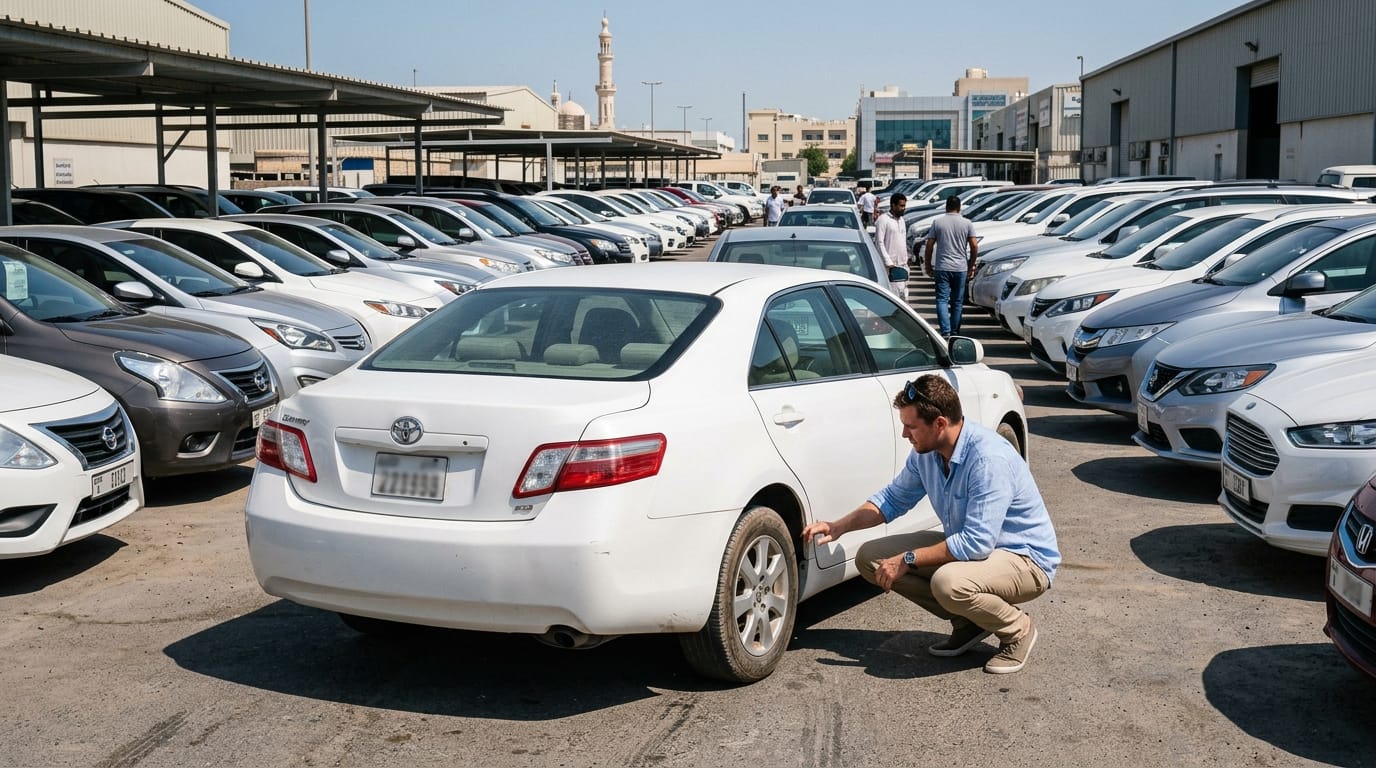
Credit Score Impact on Used vs New Car Financing
Used car financing in the UAE carries additional lender scrutiny beyond the credit score alone. Banks assess the vehicle’s age, mileage, and condition alongside the applicant’s credit profile. Pre-purchase inspection reports that confirm a vehicle’s condition can sometimes support a loan application at the margin. Most banks will not finance vehicles older than 10 years or above 150,000 km at the point of loan origination, regardless of the applicant’s credit quality.
New car financing, by contrast, carries the bank’s confidence in a defined asset value and manufacturer warranty. This typically means lenders are more willing to approve new car loans at slightly thinner credit profiles than they would require for an equivalent used car amount. However, the purchase price is usually higher, meaning the total financing obligation is larger and the DBR impact is greater.
For most expats building credit, a modest used vehicle financed for the first time is the most practical entry point. Best used cars under 30,000 AED represent the range where entry-level financing is most achievable for borrowers with developing credit profiles.
Biggest Myths About UAE Credit Scores
Myth 1: My Home Country Credit Score Transfers
It does not. AECB only holds UAE credit data. Your 15-year clean credit history in India, the UK, or Canada has no bearing on your UAE credit profile. You start fresh.
Myth 2: A High Salary Guarantees Loan Approval
Income affects capacity. Credit score affects risk assessment. Banks require both. High income with poor credit behavior frequently results in rejection or premium pricing.
Myth 3: Checking Your Own Score Damages It
Checking your own AECB report is a soft inquiry and has no effect on your score. Only hard inquiries — from lenders you apply to — affect your score, and only marginally.
Myth 4: Paying Minimum Due Is Fine
Paying the minimum due on your credit card prevents a missed payment being recorded, but it allows your balance to accumulate, increasing utilization and, if maintained long-term, suggesting financial difficulty to scoring models. Pay in full when possible.
Myth 5: Zero Debt Means an Excellent Score
Having no credit activity means no score — a thin file. Banks cannot evaluate an applicant with no data. A borrower with modest debt managed perfectly will almost always qualify for better terms than someone with no credit history at all.
Data Sources and Methodology
The information in this guide is compiled from the following sources and methodologies:
- Official UAE Central Bank regulations on consumer lending, available at www.centralbank.ae
- Al Etihad Credit Bureau official documentation, available at www.aecb.gov.ae
- Published lending criteria from major UAE banks including FAB, Emirates NBD, ADCB, Mashreq, and DIB
- Field observations from automotive finance consultations documented across the Emirates Cars platform
- Workshop and dealership interactions logged across Al Quoz Industrial Area and Sharjah Industrial Area over multiple years
- UAE Consumer Protection framework at www.moec.gov.ae
- Dubai Courts and legal proceedings records pertaining to consumer credit disputes
- RTA vehicle financing guidelines at www.rta.ae
Interest and profit rate ranges cited in this article represent typical market observations and are not guaranteed quotes from any specific lender. Individual rates depend on lender-specific policies, applicant profile, vehicle type, and market conditions at the time of application.
ℹ️ Market Volatility Notice: All profit rates, financing thresholds, DBR limits, and AECB fee amounts referenced in this article are subject to change as UAE banking regulations evolve and market conditions shift. Always verify current figures directly with your chosen lender and through official UAE government portals before making any financial commitment. Emirates Cars updates this guide periodically to reflect material regulatory changes.
⚠ Financial & Legal Disclaimer: The information provided in this article is for educational purposes only. Regulations, lending criteria, and insurance terms in the UAE may change over time. Readers should verify information with licensed UAE professionals or official government portals before making financial or legal decisions.
Frequently Asked Questions
Q: How long does it take to build a UAE credit score from zero?
Q: What is the minimum credit score needed for a car loan in the UAE?
Q: Does applying for a car loan affect my credit score?
Q: Can I get a car loan in the UAE as a self-employed expat?
Q: How does Islamic car finance differ from conventional in terms of credit requirements?
Q: What should I do if I find an error on my AECB credit report?
Q: Is it better to pay cash for a first car in the UAE rather than finance with a weak credit score?
Q: Can inactive credit cards hurt my UAE credit score?
Data Sources Used
- Al Etihad Credit Bureau — Official Portal
- UAE Central Bank — Consumer Finance Regulations
- Roads and Transport Authority — Vehicle Registration and Finance
- Dubai Police — Identity Fraud Reporting
- UAE Ministry of Economy — Consumer Protection
- UAE Government — Banking and Loans Guide
Disclaimer: Emirates Cars is a 100% independent platform. We do not own showrooms, nor are we affiliated with any used car dealerships or garages. Our sole mission is to protect expats from financial fraud in the automotive market.

Thanks for sharing these insights. The information about credit card offers in uae was practical and easy to follow.
Such a beauty full post, I love this post thanks for sharing this wonderful post.
Thank you so much for your support. I was very pleased with your comment.
Really impressed with the user interface here. Everything is easy to navigate and the registration process was a breeze. Highly recommended for anyone looking for a reliable experience.
We are delighted to have you join us.