
Written By: Omar Al-Fayed, Senior Automotive Consultant | Fact-Checked By: Emirates Cars Editorial Team | Last Updated: July 2026 | Category: Finance & Legal
Corporate fleet leasing in the UAE has become a practical alternative to vehicle ownership for companies that want predictable monthly costs, reduced administrative burden, and access to newer vehicles without tying up capital.
If your company is evaluating whether to lease a fleet — or if you’ve signed a lease and now need to manage it — this guide covers the full picture: how leasing works, what it costs, what HR and Finance need to handle, and where companies commonly make expensive mistakes.
For context on broader ownership decisions, lease vs buy comparisons for UAE conditions show that the right answer depends heavily on contract length and vehicle type.
⚠ Financial & Legal Disclaimer: The information provided in this article is for educational purposes only. Regulations, lending criteria, VAT rules, and corporate tax guidance in the UAE may change over time. Readers should verify information with licensed UAE professionals or official government portals before making financial or legal decisions. This guide is reviewed periodically as UAE Federal Tax Authority procedures and corporate tax regulations evolve.
What Is Corporate Fleet Leasing?
Corporate fleet leasing is a formal arrangement where a company contracts with a leasing provider to use a group of vehicles for an agreed period — typically one to five years — in exchange for monthly payments. The company does not own the vehicles. At the end of the lease, vehicles are returned, renewed, or occasionally purchased.
This differs from several related arrangements that are often confused with fleet leasing:
| Arrangement | Who Owns the Vehicle | Typical Duration | Maintenance Included? |
|---|---|---|---|
| Corporate Fleet Lease | Leasing company | 1 to 5 years | Often yes (full or partial) |
| Short-Term Rental | Rental company | Days to weeks | Yes |
| Finance Lease (Hire Purchase) | Transfers to company at end | 2 to 5 years | Usually no |
| Outright Purchase | Company from day one | Indefinite | Company responsibility |
In the UAE market, most corporate fleet arrangements are operating leases — the company uses the vehicle, pays monthly, and returns it. Finance leases (closer to hire purchase) are available but less common for fleets.
How Corporate Fleet Leasing Works in UAE
The process from inquiry to vehicle delivery generally follows these stages:
flowchart TD
    A[1. Needs Assessment] --> B[2. Approach Providers for Quotes]
    B --> C[3. Credit & Document Review]
    C --> D[4. Proposal & Negotiation]
    D --> E[5. Contract Signing]
    E --> F[6. Vehicle Delivery & Setup]
    F --> G[7. Ongoing Fleet Management]
    G --> H[8. End of Contract: Renew, Return, or Buy]
    classDef default fill:#000000,color:#ffffff,stroke:#000000;
- Needs Assessment: The company defines vehicle requirements — types, quantities, mileage estimates, required features.
- Provider Approach: The company approaches one or several leasing companies for quotes. Larger fleets attract better pricing.
- Credit and Document Review: The leasing company assesses the company’s financial standing — trade license, bank statements, possibly financial statements.
- Proposal and Negotiation: The provider submits a proposal covering monthly rate, mileage cap, maintenance package, and contract length.
- Contract Signing: Both parties sign a master fleet agreement plus vehicle-specific schedules.
- Vehicle Delivery: Vehicles are delivered registered, insured, and ready to operate.
- Ongoing Management: The leasing company handles registration renewals; the company manages drivers and usage.
- End of Contract: Vehicles are inspected, returned, and new decisions made — return, renew, or upgrade.
The entire process from first inquiry to vehicle delivery commonly takes two to six weeks depending on fleet size, vehicle availability, and the company’s documentation readiness.
Who Should Consider Fleet Leasing?
Fleet leasing works best for companies with predictable, ongoing vehicle needs. It is less suited to businesses with irregular or highly seasonal requirements.
| Business Type | Why Fleet Leasing Often Makes Sense |
|---|---|
| Sales teams with field reps | Predictable monthly cost per rep, vehicles upgraded on schedule |
| Healthcare and home services | Reliability matters; maintenance handled externally |
| Engineering and construction | Pickups and SUVs on long-term contracts match project durations |
| SMEs without fleet expertise | Outsources registration, maintenance admin, and vehicle sourcing |
| Fast-growing startups | Avoids large capital outlay; fleet size can scale up during contract |
| Logistics and delivery | High-mileage vehicles; full maintenance package reduces downtime |
| Multinational offices | Standardised vehicle policy across team; reporting simplified |
Companies that buy vehicles outright often find that after three years, resale value calculations, maintenance unpredictability, and registration admin consume more management time than anticipated. Fleet leasing converts these variables into a fixed line item.
Fleet Leasing vs Buying Company Vehicles
| Factor | Fleet Leasing | Outright Purchase |
|---|---|---|
| Upfront capital required | Low — first payment and deposit only | High — full purchase price |
| Monthly cost predictability | Fixed monthly payment | Variable — maintenance costs fluctuate |
| Depreciation risk | Carried by leasing company | Carried by the company |
| Vehicle upgrades | At end of contract, straightforward | Requires sale and repurchase |
| Maintenance management | Often included in package | Company arranges independently |
| Accounting treatment | Operating lease: typically off balance sheet (verify with auditor) | Asset on balance sheet with depreciation |
| Exit flexibility | Limited mid-contract; penalties apply | Sell at any time (subject to market) |
| Resale risk | None — returned to lessor | Market-dependent |
| Registration renewals | Usually handled by leasing company | Company responsibility |
| Suitable for | Predictable, ongoing fleet needs | Long-term ownership, stable usage |
💡 Finance Manager Note: For companies subject to UAE Corporate Tax introduced in 2023, the accounting and tax treatment of operating leases versus finance leases differs. Consult a licensed UAE tax advisor before deciding which structure fits your company’s reporting requirements.
Operating Lease vs Finance Lease
These two lease types are often conflated but have meaningfully different financial implications.
An operating lease is essentially a long-term rental. The leasing company retains ownership and the residual value risk. The company pays monthly, uses the vehicle, and returns it. Monthly payments are typically lower because the company is not paying toward full ownership.
A finance lease (sometimes called a hire purchase or financial lease) transfers most of the risks and rewards of ownership to the company during the contract. Payments cover the vehicle’s full value plus financing costs. The company may have the option to purchase the vehicle at the end for a nominal amount.
| Factor | Operating Lease | Finance Lease |
|---|---|---|
| Ownership at end | Returns to leasing company | Option to purchase |
| Monthly payments | Generally lower | Generally higher |
| Depreciation risk | Lessor’s risk | Lessee carries it |
| Balance sheet (verify with auditor) | Often off balance sheet | Usually on balance sheet as asset |
| Best for | Companies wanting cost certainty and no ownership | Companies wanting eventual ownership |
The majority of corporate fleet arrangements in the UAE operate as operating leases. Finance leases are more common for single executive vehicles or specialist equipment.
Short-Term vs Long-Term Fleet Leasing
Short-term leases typically run from one month to eleven months. They carry higher monthly rates but offer flexibility for project-based work, seasonal needs, or companies still determining their vehicle requirements. Some providers require a minimum of five vehicles even for short-term arrangements.
Long-term leases run from one to five years, with three years being the most common in the UAE corporate market. They offer lower monthly rates and more comprehensive maintenance packages. The trade-off is reduced flexibility — early termination typically carries material financial penalties.
A company running a construction project of 18 months duration, for example, would typically be better served by a short-term lease or a rolling monthly arrangement than locking into a three-year contract that extends beyond the project.
Types of Vehicles Companies Lease
UAE leasing providers typically offer the full range of vehicle types under corporate fleet arrangements:
- Sedans — Most common for sales teams and office staff (Toyota Camry, Nissan Altima, Hyundai Sonata)
- SUVs — Field teams, site visits, executive transport (Toyota Land Cruiser, Fortuner, Nissan Patrol)
- Pickups — Construction, logistics, site operations (Toyota Hilux, Nissan Navara)
- Compact sedans and hatchbacks — Delivery, junior staff (Toyota Yaris, Nissan Sunny)
- Vans and minibuses — Staff transport, goods delivery
- Luxury executive vehicles — C-suite and senior management
- Electric and hybrid vehicles — Growing availability; some providers offer EV fleet options
Most providers prefer common Japanese and Korean models for fleet contracts because parts availability in Al Quoz and other major workshop areas keeps maintenance costs predictable. German luxury vehicles are available for executive arrangements but typically carry higher maintenance provisions.
How Many Vehicles Qualify as a Fleet?
There is no official UAE regulatory minimum that defines a “fleet.” In practice, most dedicated corporate leasing providers begin offering fleet pricing and management services at five vehicles. Some providers set their minimum at ten vehicles for full fleet management packages.
Companies with fewer than five vehicles typically access the same leasing products on individual contract terms rather than fleet pricing, which means slightly higher monthly rates and fewer customisation options.
Corporate Fleet Leasing Costs
Monthly lease payments are the most visible cost, but the total cost of a fleet arrangement includes several components that Finance teams need to budget for separately.
| Cost Component | Typically Included in Lease? | Estimated Range (Market Estimate) |
|---|---|---|
| Monthly lease payment | Core contract | AED 1,400 to AED 4,500+ per vehicle depending on type |
| Vehicle registration/renewal | Often included | AED 350 to AED 1,200 per vehicle annually (verify with RTA) |
| Comprehensive insurance | Often included or offered as add-on | Typically 2% to 3.5% of vehicle value annually |
| Scheduled maintenance | In full maintenance packages | Included in premium packages; otherwise AED 800 to AED 2,500 per service |
| Tyre replacement | In some full packages | AED 250 to AED 700 per tyre depending on vehicle |
| Replacement vehicle during repairs | In premium packages | Included or AED 80 to AED 200 per day |
| Salik (toll) charges | Never included — company responsibility | Varies by usage |
| Fuel | Never included | Company responsibility |
| Traffic fines | Never included — driver/company responsibility | Varies |
As a market estimate, a company leasing 10 mid-range sedans on a full maintenance operating lease typically budgets between AED 18,000 and AED 32,000 per month across all vehicles. This range is illustrative — actual pricing depends on vehicle specifications, mileage allowance, contract length, and the company’s negotiating position. For context on related cost structures, real ownership cost breakdowns for Dubai show how quickly vehicle costs accumulate outside of leasing arrangements.
Hidden Costs Companies Often Miss
These are the costs that Finance teams frequently underestimate when signing fleet contracts:
⚠ Excess Mileage Charges: Most contracts specify an annual mileage cap per vehicle — commonly between 30,000 and 60,000 km. Exceeding this triggers per-kilometre charges, typically between AED 0.10 and AED 0.30 per excess kilometre. For a high-mileage driver who exceeds the cap by 15,000 km, this could add AED 1,500 to AED 4,500 per vehicle at lease end — an amount that often surprises Finance teams who approved the contract without checking driver usage patterns.
- Damage charges at return: Normal wear and tear is accepted; damage beyond defined thresholds is charged. Scuffs on bumpers, interior stains, cracked screens, and tyre wear below acceptable depth are common sources of end-of-lease charges. Providers typically define “fair wear and tear” in contract schedules.
- Early termination penalties: Breaking a three-year lease after 18 months commonly triggers a penalty equal to two to four months of remaining payments. This varies significantly by provider and contract terms.
- Contract extension costs: If the company needs vehicles for a further three months after contract end while the new contract is being set up, rolling monthly extensions typically cost 20% to 40% more than the original monthly rate.
- Administration fees: Some providers charge document processing, driver change, and vehicle swap fees that are not highlighted in the main quote.
- Insurance excess (deductible): If the company arranges its own insurance outside the lease package, excess costs after accidents fall to the company. If insurance is bundled, check what the excess is per incident.
How Fleet Leasing Companies Calculate Pricing
Understanding this helps Finance managers assess whether a quote is reasonable.
The monthly payment primarily reflects the vehicle’s projected depreciation over the lease period, plus the leasing company’s financing cost, maintenance cost (if included), and margin. The residual value — what the leasing company expects to sell the vehicle for at contract end — is the most important factor in determining the monthly rate.
A vehicle that holds value well (Toyota Land Cruiser, for example) will have a higher residual value estimate, which means the lessee is only paying for a smaller slice of the vehicle’s total value — resulting in a lower monthly payment relative to purchase price. A vehicle with poor resale value will have a lower residual, meaning higher monthly payments to cover the same depreciation gap.
Mileage directly affects residual value. Higher annual mileage means faster depreciation, which means higher monthly payments. This is why mileage caps matter — and why under-estimating mileage leads to excess charges at contract end.
Typical Lease Terms in UAE
| Parameter | Common Range in UAE Market |
|---|---|
| Contract duration | 12 months to 60 months; 36 months most common |
| Annual mileage allowance per vehicle | 30,000 to 60,000 km; negotiable for high-mileage fleets |
| Renewal options | Typically offered 3 to 6 months before contract end |
| Security deposit | One to three months of total fleet payment; varies by company credit standing |
| Payment schedule | Monthly in advance; some providers offer quarterly |
Documents Companies Usually Need
Documentation requirements vary between leasing providers and depend on company size, credit history, and fleet size requested. The following represent what is commonly requested — not a definitive requirement list, as every provider has its own process:
- Valid UAE Trade License
- Memorandum of Association or Company Articles
- Emirates ID of authorised signatory
- Company bank statements (typically six to twelve months)
- VAT registration certificate (where applicable)
- Audited financial statements (for larger fleets or longer contracts)
- Existing fleet details (if applicable — shows fleet management experience)
Free Zone companies and mainland companies generally follow the same document requirements, though some Free Zone-licensed businesses may face additional questions if vehicle use will extend to mainland operations. Verify this with the specific leasing provider.
Fleet Leasing Approval Process
- Submit fleet inquiry with vehicle types and quantities required
- Provider sends preliminary quote (usually within 2 to 3 business days)
- Company submits documentation package
- Provider conducts credit and documentation review (typically 3 to 10 business days)
- Formal proposal issued with final pricing and contract terms
- Negotiation on terms (mileage caps, maintenance scope, payment schedule)
- Contract signed by authorised company representative
- Security deposit paid
- Vehicle sourcing and preparation (1 to 4 weeks depending on availability)
- Vehicle delivery with inspection documentation
Can Startups Lease Company Vehicles?
Startups with limited operating history face more scrutiny in fleet leasing applications. Leasing companies assess credit risk, and a company with six months of bank history and no audited accounts represents a higher risk than an established business.
Startups may find that providers require a larger security deposit (up to six months of payments), a personal guarantee from the business owner, or a shorter initial contract term as a trial arrangement. Some providers work specifically with startups — it is worth asking directly rather than assuming a standard fleet programme applies.
Fleet Leasing for Free Zone vs Mainland Companies
Both Free Zone and mainland companies can access corporate fleet leasing. The key practical difference is vehicle registration. Vehicles registered to Free Zone companies may require specific attention to whether mainland road use is permitted under the company’s licence structure — this is a matter the company’s own legal or PRO team should confirm, not something the leasing company typically advises on.
Operationally, most leasing providers work with both Free Zone and mainland companies without material difference in pricing or process.
HR Responsibilities in Fleet Leasing
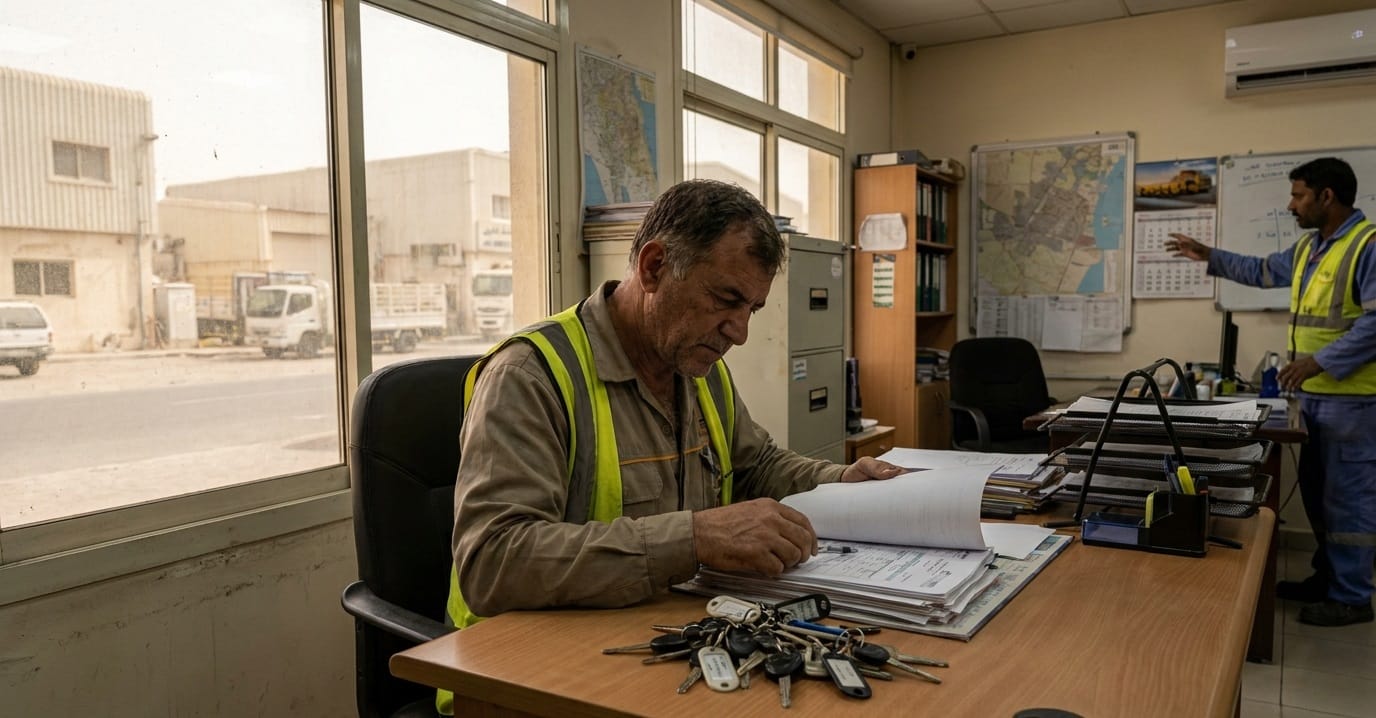
The HR department owns the human side of fleet management. This is frequently underestimated in the initial leasing decision.
Driver Eligibility and Verification
Not every employee automatically qualifies to drive a company vehicle. HR typically needs to:
- Verify valid UAE driving licence for every authorised driver
- Record licence expiry dates and set renewal reminders
- Confirm the employee’s licence covers the vehicle class (sedan, pickup, etc.)
- Maintain a current list of authorised drivers per vehicle
Leasing contracts and insurance policies are typically voided if an unauthorised driver is involved in an accident. This is a liability that HR and Legal need to take seriously.
Vehicle Allocation Policy
HR needs a written vehicle allocation policy that defines:
- Which job grades qualify for which vehicle type
- Whether vehicles are assigned individually or pooled
- Rules for personal use of company vehicles (if any is permitted)
- What happens to the vehicle allocation when an employee resigns or is terminated
- Rules for international travel (UAE company vehicles crossing to Oman, for example)
Misuse and Incident Policy
HR should define consequences for vehicle misuse — exceeding traffic fines, unauthorised passengers, modifications to the vehicle, or using the vehicle outside approved geography. Without a written policy, managing incidents becomes inconsistent and creates legal exposure for the employer.
Finance Department Responsibilities
Finance owns the budget, reporting, and lifecycle planning aspects of the fleet.
Budget and Approval
- Approve the fleet budget as a fixed monthly commitment
- Ensure lease payments are classified correctly in company accounts (verify with auditor whether operating lease or finance lease treatment applies)
- Manage VAT recovery on lease payments (where applicable — consult a UAE-registered tax advisor)
Cost Reporting
- Track cost per vehicle against budget monthly
- Monitor excess mileage risk by reviewing driver usage quarterly
- Account for end-of-lease provisions if significant charges are anticipated
Lifecycle Planning
- Plan contract renewal negotiations 6 months before expiry
- Model the total cost of renewal vs switching provider vs vehicle downsizing
- Track vehicle-level maintenance records (if not in a full maintenance package)
For companies with a growing fleet, understanding fleet depreciation and corporate tax implications in the UAE is essential for Finance teams planning multi-year budgets.
Creating a Company Car Policy
Every company with a leased fleet should have a written company car policy. This protects the company legally and sets clear expectations for employees.
| Policy Section | Key Points to Include |
|---|---|
| Eligibility | Job grades qualifying for each vehicle category |
| Driver authorisation | Who may drive the vehicle; how to add/remove authorised drivers |
| Personal use | Permitted or not; geographical limits; weekend use rules |
| Fuel | Company fuel card, reimbursement process, or personal expense |
| Traffic fines | Driver responsibility; deduction from salary (if legally permitted) |
| Accidents and incidents | Reporting procedure; police report requirements; insurance process |
| Maintenance | Who schedules; what employee must report; prohibited modifications |
| Termination of employment | Vehicle return procedure and timeline; handling of outstanding fines |
| Misuse consequences | Disciplinary procedures for policy violations |
Choosing the Right Fleet Size
Over-leasing is a common and expensive mistake. Companies excited by the per-vehicle discounts available at larger fleet sizes sometimes commit to 20 vehicles when 14 are actually needed. Two unused vehicles at AED 2,000 per month over a three-year contract represents AED 144,000 in unnecessary spend.
Under-leasing creates operational friction — employees sharing vehicles when they should each have one, or resorting to expensive daily rentals to cover gaps.
A practical approach: calculate average vehicle utilisation across the past 12 months, add a 10% to 15% buffer for growth or peaks, and use that as the fleet size. Review annually.
Selecting the Right Leasing Company
The UAE has a number of leasing providers ranging from bank-affiliated fleet companies to independent fleet specialists. The right choice depends on your fleet size, vehicle types, and service expectations.
| Evaluation Criterion | Why It Matters |
|---|---|
| Vehicle availability | Can they supply your required models? Delivery time? |
| Maintenance network | Which workshops handle their fleet? Are they near your operations? |
| Replacement vehicle guarantee | How quickly is a replacement provided during repairs? |
| Online portal and reporting | Can Finance access invoices and usage data digitally? |
| Contract flexibility | Can fleet size be adjusted mid-contract? |
| Insurance handling | Is insurance bundled or separate? Who manages claims? |
| References from similar companies | Can they provide references from clients in your industry? |
| Early termination terms | What are the penalties? Are they negotiable? |
Questions to Ask Before Signing
- What exactly is included in the maintenance package — and what is explicitly excluded?
- What is the excess mileage charge per kilometre?
- What is the fair wear and tear standard — and is it documented in writing?
- What is the process and timeline for replacing a vehicle that is off the road for maintenance?
- What are the early termination penalties — as a specific formula, not just “applicable fees”?
- Who manages insurance claims — the company or the leasing provider?
- How are traffic fines handled — notification, payment, and recovery from drivers?
- Can additional vehicles be added mid-contract, and at what pricing?
- What happens if a specific model is unavailable at delivery — what is the substitution process?
- Is VAT charged on the monthly payment, and can the company recover it?
Maintenance Packages Explained
Most leasing providers offer three service tiers:
Full Maintenance Package: Covers all scheduled servicing, mechanical repairs, tyre replacement (within normal wear conditions), and vehicle cleaning provisions. The company pays a fixed monthly amount and faces minimal surprise costs. Best for companies that want complete cost predictability and have limited internal capacity to manage maintenance logistics.
Partial Maintenance Package: Covers scheduled servicing and some mechanical repairs but excludes tyres, glass, and certain wear items. Monthly payment is lower; the company carries more risk for specific categories. Suitable for companies with some internal fleet management capability.
Pay-As-You-Go (No Maintenance Package): The company pays the leasing monthly rate only and manages all maintenance independently. Lowest monthly cost; highest unpredictability. Typically only practical for companies with their own maintenance infrastructure or for very new, low-mileage fleets where maintenance costs are minimal.
Insurance Options
Fleet insurance in the UAE operates differently from individual vehicle insurance. Companies have two main approaches:
Bundled Insurance (through the leasing company): The leasing company arranges comprehensive insurance for all vehicles and includes the cost in the monthly lease rate. Claims are managed by the leasing company’s insurance team. This simplifies administration significantly.
Company-arranged fleet insurance: The company purchases its own fleet insurance policy directly. This can offer more competitive pricing for large fleets but requires the company’s own administrative capacity to manage claims, renewals, and additions.
Key insurance points Finance teams need to clarify before signing:
- What is the excess (deductible) per incident?
- Is agency repair included or only non-agency?
- Are all drivers automatically covered or only pre-registered drivers?
- What is the process when a driver is at fault in an accident — does the excess double?
- What happens to the lease payment during a vehicle write-off settlement period?
Accident Management During Lease
When a leased vehicle is in an accident, the company’s responsibilities are:
flowchart TD
    A[Accident Occurs] --> B[1. Call Police & Obtain Report]
    B --> C{Notify Within 24 Hours?}
    C -->|Yes| D[2. Inform Leasing Co. & Insurer]
    C -->|No| X[Risk of Claim Rejection/Contract Breach]
    D --> E[3. Vehicle Assessed at Approved Workshop]
    E --> F[4. Replacement Vehicle Arranged]
    F --> G[5. Repair Completed & Vehicle Returned]
    classDef default fill:#000000,color:#ffffff,stroke:#000000;
- Driver calls police immediately for any accident involving damage or injury
- Driver does not admit fault at the scene
- Police report is obtained (mandatory for insurance claims in UAE)
- Company or driver notifies leasing company and insurance provider within the timeframe specified in the contract (often within 24 hours)
- Vehicle is assessed — leasing company or insurer directs it to an approved workshop
- Replacement vehicle is arranged per contract terms
- Repair completed; vehicle returned to driver
The most common failure point is step four. Drivers who don’t report accidents promptly — or who attempt minor repairs without notification — create insurance complications and potential contract breaches. This should be explicit in the company car policy. For a full understanding of the accident process for UAE expats, the road accident expat guide covers the immediate steps in detail.
Fuel Management Options
Fuel is always excluded from lease contracts. Companies manage it through several approaches:
| Method | How It Works | Best For |
|---|---|---|
| Fuel cards | Company-issued cards linked to each vehicle; monthly statement by vehicle | Medium to large fleets; useful for cost tracking |
| Cash allowance | Monthly fuel allowance added to salary | Small fleets or mixed personal/business use |
| Expense reimbursement | Driver submits receipts; Finance reimburses | Low-mileage fleet; occasional use |
| Telematics-linked fuel monitoring | System tracks fuel use by vehicle and compares to distance | Large fleets with misuse concerns |
Telematics and Fleet Tracking
Telematics systems — GPS tracking combined with driving behaviour monitoring — are increasingly common in UAE corporate fleets. They provide real-time vehicle location, mileage tracking, speed monitoring, harsh braking events, and idle time reports.
From a fleet management perspective, telematics data helps Finance track mileage against contract caps, flag drivers who are likely to exceed their allocation, and identify vehicles that are underutilised. From an HR perspective, driving behaviour data can support disciplinary processes when misuse is suspected — but the company needs a clear policy about how this data is used and communicated to employees before deployment.
Some leasing providers include telematics as standard; others offer it as an add-on. Privacy considerations apply — employees should be informed in writing that vehicles are tracked.
Vehicle Replacement During Contract
If a vehicle is written off (total loss) during the lease, the standard process is:
- Insurance settlement is paid to the leasing company (as the vehicle owner)
- The leasing company assesses whether the settlement covers the outstanding lease value
- If there is a gap between the insurance settlement and the lease balance, the company may be liable for this difference — this is sometimes called “gap liability”
- The leasing company may offer a replacement vehicle on a new contract or an extension of the existing contract
Check specifically whether the lease contract includes gap protection. If not, Finance should assess the exposure.
Early Lease Termination
Early termination of a fleet lease contract is one of the most expensive decisions a company can make. Most contracts calculate the penalty as the remaining monthly payments minus a discount, or as a fixed penalty based on the remaining contract term.
Common scenarios where companies find themselves needing to exit early:
- Significant company restructuring or downsizing
- Project ending ahead of schedule
- Driver headcount reduction
- Merger or acquisition affecting the entity
Before signing, Finance should negotiate maximum early termination penalty terms and have them documented as a specific formula in the contract — not a vague reference to “applicable charges.”
Some providers allow novation — transferring the lease to another company — which can be a lower-cost exit in the right circumstances.
End-of-Lease Inspection
At contract end, every vehicle is inspected by the leasing company using a standardised damage assessment process. Companies that are not prepared for this are often surprised by the charges.
Common areas that generate end-of-lease charges:
- Bumper scuffs and scratches beyond the defined size threshold
- Interior staining, tears, or burns
- Tyre tread below minimum acceptable depth
- Missing equipment (spare tyre, floor mats, charging cables for EVs)
- Windscreen chips or cracks
- Alloy wheel damage
Request the provider’s written fair wear and tear guide at the time of contract signing — not at end of contract. Some providers use the BVRLA (British Vehicle Rental and Leasing Association) guidelines as a reference, though UAE providers may have their own standards. Inspect and document each vehicle’s condition six weeks before contract end to allow time to address any items.
Renew, Return or Buy the Vehicles?
| Option | When It Makes Sense | Key Consideration |
|---|---|---|
| Return and sign new lease | Company still needs fleet; current vehicles are aging | New contract pricing may be higher; negotiate well in advance |
| Extend current contract | Short-term uncertainty; new vehicles not yet needed | Monthly rate typically higher than original contract |
| Purchase at end of lease | Vehicle has low mileage; specific model hard to source | Purchase price is predetermined in contract; assess against market value |
| Reduce fleet size on renewal | Business has contracted; some vehicles underutilised | Rightsizing saves cost; plan 6 months ahead |
| Switch to EV fleet | Sustainability commitments; charging infrastructure available | Verify charging provision at company premises and driver homes |
Corporate Fleet Leasing and UAE Corporate Tax
UAE Corporate Tax was introduced in 2023. The treatment of leased vehicles under the corporate tax regime depends on whether the arrangement is classified as an operating lease or a finance lease, and how it is accounted for in the company’s books.
This article does not constitute tax advice. Companies should consult a UAE-registered tax advisor to determine the correct treatment for their specific situation, including whether lease payments are deductible, how the lease is classified under UAE GAAP or IFRS 16, and what documentation the Federal Tax Authority may require.
Accounting Treatment (High-Level)
For companies preparing financial statements under IFRS 16 (which is widely adopted in the UAE), most leases — including operating leases — are recognised on the balance sheet as a right-of-use asset with a corresponding lease liability. This has implications for leverage ratios and loan covenants. Companies should verify with their auditor how IFRS 16 applies to their fleet arrangements and whether any exemptions are available for short-term leases or low-value assets.
For companies using simpler accounting frameworks, operating leases may be treated as off-balance-sheet expenses. The classification matters for how lenders and investors read the financial statements.
Illustrative Field Scenarios: Workshop & Market Patterns
Example scenarios based on recurring UAE market patterns, not actual documented cases.
Scenario 1: SME Sales Team — Sedan Fleet
A technology solutions company with 12 sales representatives based in Dubai and Abu Dhabi leases 12 mid-range sedans on a 36-month operating lease with full maintenance. Monthly cost per vehicle runs between AED 2,000 and AED 2,800 depending on specification. After 18 months, three sales representatives leave the company. The HR manager attempts to return three vehicles early and discovers the early termination clause requires paying 70% of remaining payments — approximately AED 30,000 per vehicle. The lesson: fleet size should reflect confirmed headcount, not headcount projections.
Scenario 2: Construction Contractor — Pickup Fleet
A Sharjah-based contractor leases 20 Toyota Hilux pickups for a three-year infrastructure project. The contract allows 50,000 km annually per vehicle. Project operations run intensively, and seven vehicles exceed 65,000 km by the end of year two. Excess mileage charges accumulate to between AED 1,500 and AED 3,000 per affected vehicle by contract end. A quarterly mileage review — comparing telematics data against the contract cap — would have identified at-risk vehicles early enough to adjust routes or request a mileage cap increase negotiation.
Scenario 3: Healthcare Provider — Mixed Fleet
A Dubai private clinic group leases eight vehicles: four sedans for administrative staff and four SUVs for home visit nurses. Full maintenance is included for sedans; the SUVs are on a partial maintenance package to reduce monthly cost. During the contract, one SUV requires tyre replacement and brake work that falls outside the partial package — adding approximately AED 2,800 in unbudgeted maintenance. Finance had not provisioned for this. The lesson: partial maintenance packages need a separate maintenance reserve, typically estimated at AED 1,500 to AED 3,000 per vehicle per year depending on vehicle age and mileage.

Scam Prevention: Fleet Leasing Fraud Risks
⚠ Fake Leasing Company Deposits: A recurring pattern in the UAE market involves companies that advertise fleet leasing at unusually low monthly rates online. A procurement manager contacts them, is impressed by a polished proposal, and is asked to pay a deposit of AED 15,000 to AED 40,000 to “secure vehicle allocation.” No vehicles are delivered. The “leasing company” is untraceable. Always verify the leasing company’s UAE Trade License directly on the DED portal or relevant emirate’s licensing authority before transferring any funds.
Other fraud risks to monitor:
- Unregistered brokers: Third parties claiming to broker fleet deals but with no direct relationship to any licensed leasing company. Verify directly with the leasing company that the broker is authorised to represent them.
- Misrepresented maintenance packages: Verbal assurances of “full coverage” that are not reflected in the written contract. Never rely on verbal representations — if it is not in the signed contract, it does not exist.
- Fake insurance documents: In rare cases, lessors provide lease packages with fabricated or lapsed insurance certificates. Request the insurance policy directly from the insurance company and verify coverage before vehicles are distributed to drivers.
For context on verifying documents in UAE automotive transactions, fake car documents and verification methods covers the process for confirming legitimacy.
Common Mistakes Companies Make
- Signing without defining mileage needs: Under-estimating annual mileage by even 10,000 km per vehicle creates significant excess charges at scale.
- Choosing the lowest monthly rate without checking maintenance scope: A lower monthly rate with no maintenance package often costs more over the contract period.
- Not defining the company car policy before vehicles arrive: Without a written policy, HR has no framework to manage misuse, accidents, or driver authorisation.
- Assuming the security deposit is returnable without conditions: Damage charges and excess mileage fees are commonly deducted from the security deposit at contract end.
- Signing a fleet contract without Finance reviewing the early termination clause: This is the single most expensive clause in any fleet contract for a business with any uncertainty in headcount or operations.
- Ignoring end-of-lease inspection standards until contract end: By the time vehicles are inspected, it is too late to address cosmetic issues cost-effectively.
Fleet Cost Optimisation Strategies
- Consolidate fleet with one provider: Volume pricing improves with a single provider relationship; splitting across multiple providers reduces negotiating leverage.
- Standardise on common models: Reducing vehicle diversity simplifies driver training, maintenance management, and insurance administration.
- Negotiate mileage allowances that match actual usage: Excess mileage charges are almost always more expensive than negotiating a higher mileage cap upfront.
- Review utilisation quarterly: Identify and redeploy or return underutilised vehicles before excess costs accumulate.
- Use telematics to reduce fuel waste: Idle time and route inefficiency are major fuel cost drivers that telematics can quantify.
- Plan renewals 6 months ahead: Month-to-month contract extensions are typically the most expensive per-vehicle cost in a fleet programme.
For related guidance on cost management in UAE automotive decisions, the cheapest cars to maintain in UAE provides useful benchmarks for vehicle selection decisions within fleet programmes.
The Bottom Line Decision Framework
| Your Situation | Recommended Approach |
|---|---|
| Company needs 10+ vehicles for 3+ years with stable headcount | Operating lease with full maintenance package — standardise on common models |
| Project-based needs of 12 to 18 months | Short-term lease or rolling monthly — avoid long-term contract lock-in |
| High-mileage operations (delivery, field services) | Negotiate mileage cap upfront; full maintenance package essential |
| Executive vehicle only (1 to 3 cars) | Individual finance lease or operating lease; not a fleet programme |
| Company with uncertain headcount trajectory | Smaller committed fleet with an option clause for additions; negotiate light early termination terms |
| Startup with limited operating history | Expect larger deposit requirement; consider starting with fewer vehicles and scaling after 12 months |
| Company wanting eventual vehicle ownership | Finance lease — but verify accounting and tax treatment with your auditor before signing |
Data Sources & Methodology
The market estimates in this article are based on observed UAE fleet leasing market practice, publicly available information from UAE fleet leasing providers, and practical operational knowledge of corporate fleet management in the UAE. No official UAE government statistics on average fleet leasing costs or contract terms have been published as at the time of writing.
Government-related processes referenced in this article — including vehicle registration through RTA, trade licence verification through DED, and UAE Corporate Tax obligations through the Federal Tax Authority — are subject to change. Readers should verify current requirements directly through official portals:
- RTA — Roads and Transport Authority (rta.ae)
- DED — Department of Economy and Tourism Dubai (ded.ae)
- Federal Tax Authority UAE (tax.gov.ae)
- MOHRE — Ministry of Human Resources and Emiratisation (mohre.gov.ae)
💡 Market Volatility Notice: All cost estimates, monthly lease ranges, and fee references in this article reflect market conditions observed during the content review period. Fleet leasing pricing in the UAE changes based on vehicle supply, interest rates, insurance market conditions, and individual provider pricing. Always obtain current quotes directly from licensed UAE leasing providers before making any financial commitment. This article does not constitute a quote, guarantee, or binding estimate of any kind.
Frequently Asked Questions
For broader expat automotive guidance in the UAE, the expat car ownership annual calendar provides a practical 12-month reference for all vehicle-related obligations.
Disclaimer: Emirates Cars is a 100% independent platform. We do not own showrooms, nor are we affiliated with any used car dealerships or garages. Our sole mission is to protect expats from financial fraud in the automotive market.
