Last Updated: Aug 2026 | By Omar Al-Fayed, Senior Automotive Consultant | Fact-Checked By: Emirates Cars Editorial Team | Category: Finance & Legal
A used car ownership calendar uae gives expat owners a practical planning framework — not a fixed maintenance schedule. Insurance renewal, Mulkiya expiry, and registration deadlines depend on your specific vehicle documents, not on a fixed month of the year. This calendar maps recurring checks, seasonal preparation, and budgeting tasks across 12 months so you can overlay your actual expiry dates and service intervals onto a single annual plan.
One principle applies throughout: mileage-based service intervals (oil changes, brake inspections, transmission service) are set by your vehicle manufacturer and are triggered by kilometres driven, not by calendar month. Use your odometer and vehicle handbook to track these — not this calendar. What this calendar covers is everything else: seasonal checks, administrative renewals, and cost planning.
UAE Used Car Ownership Calendar: Monthly Planning Overview
This table is a suggested ownership planning calendar, not a list of mandatory deadlines. Map your actual insurance and Mulkiya expiry dates onto whichever month applies to your vehicle.
| Month | Suggested Planning Task | What to Check | Why It Matters |
|---|---|---|---|
| January | Year-start vehicle review | Service history, mileage vs last service, tyre condition, battery, fluid levels | Establish a condition baseline before the heat cycle begins |
| February | Document audit | Write down your actual insurance expiry date and Mulkiya expiry date — set 30-day reminders | Most expat ownership lapses happen because renewal dates were not tracked |
| March | Tyre condition check | Tread depth, tyre manufacture date (DOT code on sidewall), inflation pressure | Heat accelerates tyre wear — address condition issues before temperatures peak |
| April | AC system check | Cooling output, cabin filter condition, refrigerant level | Diagnosing AC issues in April costs less than emergency repair in July |
| May | Cooling system and battery | Coolant level and colour, radiator condition, battery load test | Heat stress on both systems peaks over summer — address known issues before June |
| June | Fluid levels and warning lights | Engine oil, brake fluid, windscreen washer, any active dashboard warning | Fluid levels should be checked more frequently during high-temperature months |
| July | Tyre pressure and tyre condition | Cold-pressure inflation in shade against door jamb spec, sidewall condition | Hot tarmac and low inflation increase wear and blow-out risk |
| August | AC output and temperature gauge | Cabin cooling consistency, temperature gauge behaviour, any unusual smells | Early warning signs identified in August cost less to fix than breakdowns |
| September | Post-summer review | Battery condition, tyre wear, brake pads, engine oil condition | Heat cycle stress accumulates — September is a natural reset point |
| October | Insurance renewal (if applicable) | Check your policy expiry date — start comparing quotes 30–45 days before expiry | Applies only if your policy expires in this period; adjust to your actual expiry |
| November | Registration and inspection (if applicable) | Mulkiya expiry, outstanding traffic fines, inspection readiness | Adjust to your actual Mulkiya expiry — fines must be cleared before renewal |
| December | Annual cost review | Full-year maintenance spend, service records, upcoming renewal dates for next year | Planning major work before year-end avoids budget surprises in Q1 |
April–June: Preparing a Used Car for UAE Summer
Temperatures in Dubai, Abu Dhabi and Sharjah routinely exceed 40°C from May onward. Preventive checks before summer are cheaper than reactive repairs during it.
AC system: Test cooling output in April before demand peaks. A gradual decline in cooling usually indicates a low refrigerant charge or a clogged cabin filter rather than a compressor fault. Cabin filter replacement typically costs AED 50–150 at independent garages. Refrigerant recharging runs AED 150–300 depending on gas type and workshop. AC not cooling in UAE summer walks through diagnosis in order of likely cost.
Coolant: Check the reservoir level when the engine is cold — it should sit between MIN and MAX. Coolant that appears brown or rusty has degraded and needs replacing. A coolant flush at an independent workshop costs AED 100–200.
Battery: Heat, not cold, is what kills car batteries in the UAE. May is a practical time for a load test before summer stress peaks. If the battery is already 24+ months old and showing slow starts, replace it before July. Battery replacement costs range from AED 180 to AED 550 depending on brand and vehicle type.
Tyres: Check the DOT manufacture date stamped on the sidewall — the last four digits indicate the week and year of manufacture. Tyres showing significant age or visible cracking should be assessed by a qualified tyre shop regardless of remaining tread depth. Follow the tyre manufacturer’s age guidance for your specific tyre brand. Budget tyre options in UAE start around AED 180–220 per tyre for economy sedans.
Wiper blades: UAE UV exposure cracks rubber blades within 12–18 months. Replace them before summer dust storms (shamal). Replacement costs AED 30–80 per blade at auto shops in Al Quoz or Sharjah Industrial Area.
July–September: Monitor Heat, Tyres and Fluids
The goal during this period is early detection. A warning sign investigated early costs far less than a roadside breakdown on Sheikh Zayed Road.
Temperature gauge: Know where your temperature gauge normally sits. If it starts running higher than usual or moves toward the red zone, pull off safely and stop driving. Engine overheating in Dubai explains the immediate steps and typical repair cost ranges.
Tyre pressure: Check inflation in shade when tyres are cold — not after driving. Use the specification printed on your door jamb sticker, not the figure on the tyre sidewall. Any meaningful drop below the manufacturer’s recommended pressure warrants attention.
Warning lights: A dashboard warning appearing during summer should be diagnosed rather than assumed to be heat-related. Common summer warnings include the battery light (charging fault), coolant temperature warning and low tyre pressure indicator. Engine warning light guide UAE explains which require immediate action and which allow driving to a workshop.
Fluid checks: Check engine oil monthly using the dipstick when the engine is cold — not only at service intervals. Brake fluid and windscreen washer fluid should also be topped up as needed during high-temperature months.
Unusual noises or vibrations: A continuous squeal, grinding, or steering pull is not normal driving behaviour. Suspension problems in UAE covers common wear patterns that become more apparent during and after the heat season. When comparing estimates for any major repair, getting a second quote from a qualified workshop in Al Quoz or Sharjah Industrial Area is standard practice.
flowchart TD
    A[Jan: Year-Start Check] --> B[Feb: Document Audit\nWrite down expiry dates]
    B --> C[Mar: Tyre Condition Check]
    C --> D[Apr: AC System Test]
    D --> E[May: Cooling System\n& Battery Load Test]
    E --> F[Jun: Fluid Levels\n& Warning Lights]
    F --> G[Jul: Tyre Pressure\nMonitoring]
    G --> H[Aug: AC Output\n& Temperature Watch]
    H --> I[Sep: Post-Summer\nReview]
    I --> J[30-45 Days Before\nInsurance Expiry:\nCompare Quotes]
    J --> K[30 Days Before\nMulkiya Expiry:\nClear Fines + Inspect]
    K --> L[Dec: Annual\nCost Review]

    classDef default fill:#000000,color:#ffffff,stroke:#000000,font-size:16px,padding:14px;
Insurance and Registration: Timing Is Personal to Your Vehicle
Insurance and Mulkiya renewal do not happen in a fixed month — they happen 30–45 days before your specific policy and registration expiry dates. RTA Dubai allows registration renewal up to 150 days before the Mulkiya expiry date. The only fixed rule: insurance must be valid before registration renewal can be processed.
Insurance renewal: Start comparing quotes 30–45 days before your policy expires. Third-party insurance is the legal minimum in the UAE, but most banks require comprehensive cover on financed vehicles. For a used car valued between AED 25,000–60,000, third-party premiums typically range AED 800–1,400 annually; comprehensive premiums range AED 2,000–4,500 depending on vehicle age, declared value and your claims history. Used car insurance guide UAE covers coverage type decisions by ownership profile.
Traffic fines: Outstanding fines must be cleared before registration renewal is processed. Check your balance via the RTA app (Dubai), Abu Dhabi Police app or MOI UAE app. Fines are linked to the vehicle plate number — verify the balance before assuming a clear record, particularly if you purchased the car used. UAE traffic fines guide explains how to check and pay across all emirates.
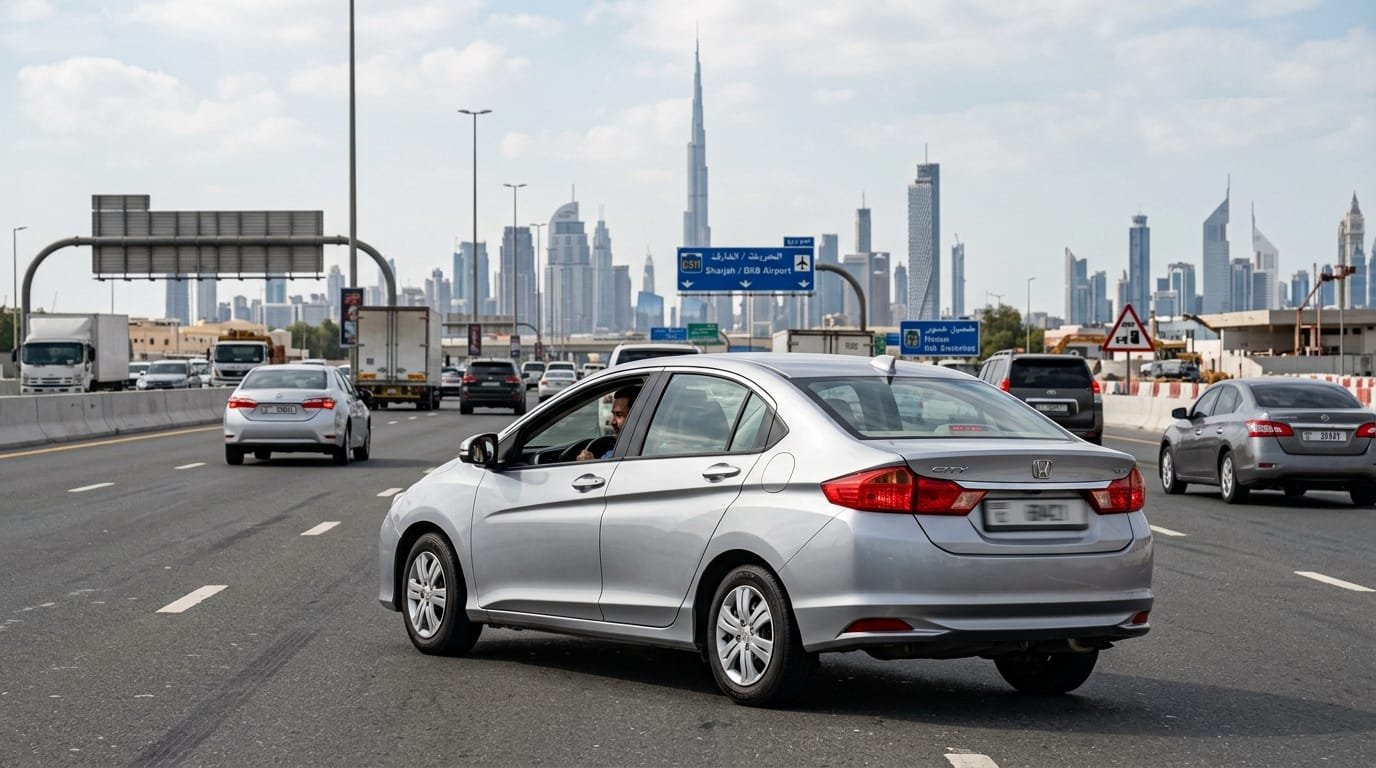
Vehicle inspection: In Dubai, vehicles over 3 years old require an annual RTA technical inspection before registration renewal. Abu Dhabi has its own ADNOC-certified inspection requirement with separate procedures. Budget approximately AED 170 or more for a standard Dubai technical inspection, but confirm the applicable RTA or Tasjeel fee for your specific vehicle and service type, as charges vary. Fix obvious faults — worn tyres, non-functioning lights, brake issues — before presenting the vehicle for inspection. Used car inspection guide UAE details what inspectors check by emirate.
Mulkiya renewal: Dubai registration renewal is processed through Tasjeel or the RTA. Note that RTA provides a grace period for late renewal — late fees apply after the expiry date, with further consequences for extended non-renewal. Abu Dhabi renewals go through TAMM. In all cases: valid insurance, cleared fines and a passed inspection (where required) must be confirmed before renewal. Used car registration guide UAE covers the process by emirate.
Driving without valid insurance in the UAE is a traffic offence carrying a fine and potential vehicle impoundment. More significantly, if you are involved in an accident without valid insurance, personal liability for all damages falls on you — which can reach tens of thousands of AED. Set a phone reminder 30 days before your insurance expiry date. Do not rely on your insurer to contact you.
Monthly Checks Every UAE Car Owner Should Do
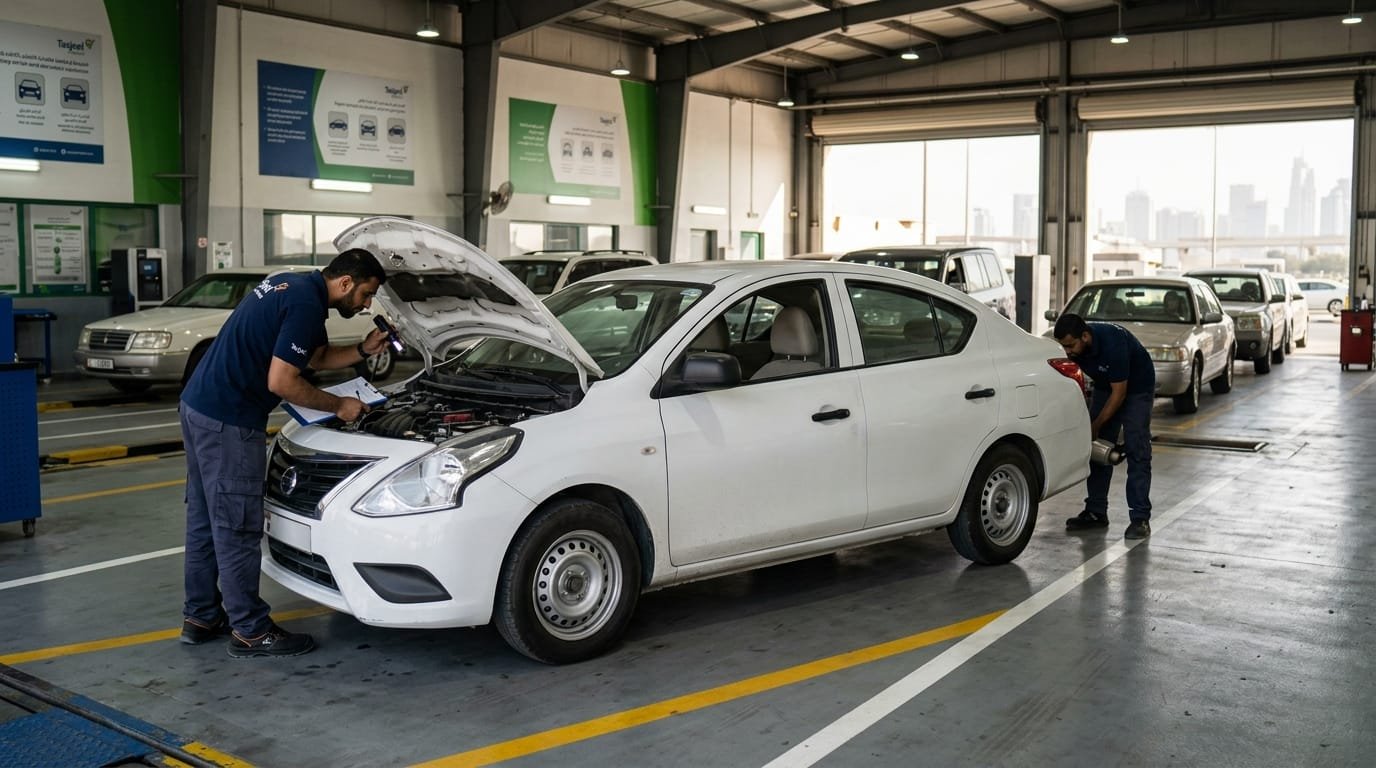
These are owner-level visual checks requiring no tools. They do not replace workshop inspections — they tell you when a workshop visit is needed.
| Check | How to Do It | When to Act |
|---|---|---|
| Tyre pressure and condition | Pressure gauge in shade against door jamb spec; visual sidewall check | Any meaningful drop from manufacturer’s recommended pressure; visible bulge or crack |
| Dashboard warning lights | Note any new lights on ignition | Any new warning light — diagnose before ignoring |
| Engine oil level | Dipstick check with cold engine | Below MIN mark or oil dark and burnt-smelling |
| Fluid leaks under car | Check parking spot for stains | Any oil, coolant (coloured or sweet-smelling) or brake fluid spot |
| All exterior lights | Walk around with ignition on | Any bulb out — a UAE traffic fine applies for non-functioning lights |
| AC cooling output | Note time to cool cabin from ambient temperature | Noticeably longer or warmer output than previous month |
| Unusual noises or vibrations | Listen during acceleration, braking, turning | Any new sound persisting over 2–3 days |
| Mileage tracking | Note odometer reading monthly | Track against manufacturer service interval to anticipate next service |
When a monthly check surfaces a fault requiring workshop attention, finding an honest mechanic in Al Quoz reduces the risk of unnecessary work and inflated labour charges.
Annual Costs to Plan For — Used Car Ownership Calendar UAE
Used car ownership costs fall into three distinct categories. Treating them as a single annual total leads to poor budgeting — some costs recur every year, others occur every few years, and repair costs are unpredictable by nature.
Recurring Annual Costs — these happen every ownership year regardless of vehicle condition:
| Cost Item | Typical UAE Range (AED/year) | Notes |
|---|---|---|
| Insurance (Third-Party) | 800 – 1,400 | Legal minimum; not sufficient if vehicle is financed |
| Insurance (Comprehensive) | 2,000 – 4,500 | Required by most UAE banks for financed vehicles; varies by declared value and claims history |
| Registration / Mulkiya Renewal | Varies by emirate and vehicle type | Dubai base renewal fees apply per RTA schedule; additional charges may apply depending on transaction and vehicle category — confirm current fees at renewal |
| Vehicle Inspection (Dubai, 3+ yr vehicles) | Budget AED 170+ as a starting point | Confirm applicable RTA/Tasjeel fee for your vehicle type; Abu Dhabi has separate requirements |
| Scheduled Servicing (oil, filters) | 400 – 1,200 | Depends on manufacturer interval and vehicle complexity; mileage-driven not calendar-driven |
| Fuel (approx. 1,500 km/month) | 4,800 – 9,600 | UAE petrol prices can change monthly — use current pump prices when calculating your budget |
Periodic Replacement Costs — these recur every few years based on wear and vehicle age:
| Cost Item | Typical Range (AED) | Approximate Frequency |
|---|---|---|
| Tyres (set of 4, economy grade) | 720 – 1,400 | Every 2–4 years depending on mileage, driving pattern and tyre condition |
| Battery replacement | 180 – 550 | Typically every 2–3 years under UAE heat conditions |
| Brake pads (front pair) | 180 – 450 | Every 30,000–60,000 km depending on vehicle and driving style |
Repair Reserve — budget a contingency for unplanned repairs. Older used cars generally need a larger repair reserve because more wear items may be approaching replacement. A practical reserve for a car over 5 years old is AED 1,500–4,000 per year, held separately from recurring costs.
For Salik, parking and full commute-based running costs, annual Salik and parking cost breakdown covers the Dubai-specific figures. For a full monthly cost model, monthly cost of owning a car in Dubai 2026 provides a category-by-category breakdown. Used car ownership cost UAE benchmarks these figures by vehicle type.
Used Car Ownership Risks: What to Verify Before and After Purchase
- Outstanding fines and liabilities at transfer: Before buying a used car, confirm that all outstanding traffic fines, registration requirements and any unresolved liabilities have been cleared so the ownership transfer can be completed cleanly. Check accident and fine history before signing any purchase agreement.
- Tampered service records or odometer: A rolled-back odometer moves the service interval forward on paper, meaning you inherit unpaid maintenance. Odometer fraud verification in UAE explains how to detect rollbacks using RTA records and service history cross-referencing.
- Second estimates for major repairs: For any significant repair — AC compressor, gearbox, cooling system — compare at least two estimates from qualified workshops before approving the work. Trusted mechanics in Al Quoz lists verified independent workshops.
Decision Scenarios: Used Car Ownership Calendar UAE
Decision Scenario: New Expat, First UAE Car, No Prior Ownership History
- If This Sounds Like You: You bought a used car in the past 6 months, you are unsure when insurance or the Mulkiya expires, and the car has not been inspected since purchase.
- The Decision: Whether to manage renewals reactively (wait until a notice arrives) or proactively (map all expiry dates now into a 12-month plan).
- Recommended Action: Locate your Mulkiya and insurance policy this week. Write both expiry dates into a phone calendar with 30-day alerts. Book a basic inspection at a trusted workshop to identify any issues the previous owner passed on.
- Why: A proactive calendar helps reduce avoidable late fees, emergency repairs and missed maintenance — all of which carry higher costs than the checks themselves.
Decision Scenario: Dubai–Sharjah Daily Commuter, High-Mileage Used Car
- If This Sounds Like You: You drive 2,500–3,500 km monthly between Sharjah and Dubai, and your car has exceeded 100,000 km on the odometer.
- The Decision: Whether to follow standard calendar-based service reminders or shift to mileage-based tracking.
- Recommended Action: Track your monthly odometer reading and calculate when the next manufacturer service interval falls. At 2,500–3,500 km per month, you may reach a 10,000 km oil change interval in under four months. Agency vs independent oil change costs compares the real price difference.
- Why: High-mileage vehicles in UAE heat conditions accumulate engine wear faster than lower-mileage urban cars. Extending an oil change interval beyond the manufacturer’s recommendation under these conditions shortens engine life.
Decision Framework: Used Car Ownership Calendar UAE by Profile
| Ownership Profile | Priority Calendar Tasks | First Action |
|---|---|---|
| New expat, first UAE car | Expiry date audit, baseline inspection, service history review | Locate Mulkiya and insurance policy this week and set expiry reminders |
| Dubai–Sharjah daily commuter | Mileage-based oil service, tyre wear, brake pads | Calculate current mileage vs date of last service |
| Older car (7+ years, 120,000+ km) | Battery, cooling system, suspension, timing belt or chain status | Book a comprehensive workshop inspection before summer |
| Financed used car | Comprehensive insurance mandatory; confirm cover type matches loan requirement | Check your loan agreement for insurance requirements and verify current policy type |
| Abu Dhabi resident | TAMM registration, ADNOC inspection, Abu Dhabi Police fine clearance | Confirm inspection centre requirements — they differ from Dubai procedures |
| Sharjah resident, Dubai-registered car | RTA inspection (Dubai), fine clearance across both emirates, insurance timing | Confirm which authority holds your Mulkiya before beginning renewal |
Annual Ownership Checklist
MONTHLY
- Tyre pressure against door jamb spec (in shade, cold tyres)
- Visual tyre inspection — sidewalls, tread wear, no bulges
- Engine oil level via dipstick (cold engine)
- Dashboard warning lights — note any new lights
- Check parking spot for fluid leaks
- All exterior lights functioning
- Odometer reading — track against manufacturer service interval
QUARTERLY
- AC cooling output — time to reach target cabin temperature
- Brake feel — any sponginess, pull or persistent noise under braking
- Windscreen and wiper blade condition
- Under-bonnet check: coolant, brake fluid, windscreen washer levels
- Upcoming mileage-based service interval review
BEFORE SUMMER (April–May)
- AC refrigerant and cabin filter — book service if output has declined
- Battery load test — replace if 24+ months old or showing slow starts
- Coolant level and condition — flush if discoloured or not changed in 2 years
- Tyre age (DOT date on sidewall) — assess condition with a tyre specialist if several years old
- Emergency kit in boot: warning triangle, jump cables, water
30–45 DAYS BEFORE INSURANCE EXPIRY
- Note your actual policy expiry date
- Compare renewal quotes from at least 3 insurers
- Confirm coverage type still matches your needs (third-party vs comprehensive)
- Check if a financed vehicle requires specific coverage per your loan agreement
30 DAYS BEFORE MULKIYA EXPIRY
- Check outstanding traffic fines via RTA app, Abu Dhabi Police app or MOI UAE app
- Confirm vehicle inspection is current or book appointment (Dubai: 3+ year vehicles)
- Prepare required documents: Mulkiya, Emirates ID, insurance certificate
- Complete registration renewal via Tasjeel, TAMM or relevant authority
ANNUALLY (December–January)
- Review total maintenance spend for the year
- Assess vehicle condition — is a major repair likely in the next 12 months?
- Compare current market value against remaining loan balance if financed
- Decide whether to continue ownership, sell or trade — used cars with best resale value UAE 2026 helps benchmark market value
- Set reminders for next year’s insurance expiry, Mulkiya expiry and major service milestones
FAQs: Used Car Ownership Calendar UAE
Emirates Cars Editorial Methodology
This guide combines official UAE government procedures with manufacturer documentation and current UAE market observations.
Official references used where applicable:
- RTA Dubai — Vehicle Registration Renewal
- TAMM Abu Dhabi — Car Registration Services
- UAE Ministry of Interior — Traffic Services
- Tasjeel UAE — Vehicle Testing and Registration
- u.ae — UAE Road Safety and Vehicle Requirements
Disclaimer: Emirates Cars is a 100% independent platform with no affiliation to any dealership, insurer, finance provider or government authority. All content is published for informational purposes only. Costs, fees, regulations and procedures change — verify current figures with the relevant UAE authority or service provider before making financial or legal decisions.
