
Last Updated: June 2026 | By Omar Al-Fayed, Senior Automotive Consultant | Category: Buying & Selling
Every year, thousands of expatriates leave the UAE and face the same question: should you ship your car home or sell it before you go?
The answer depends on your vehicle’s value, your destination country, and the realistic cost of the entire export process.
This guide covers every step — deregistration, export documentation, shipping methods, destination costs, and what to expect after arrival —
so you can make an informed decision before your departure date. For additional context on what legally happens to your vehicle when you exit,
read our UAE vehicle exit overview before proceeding.
⚠ Legal & Financial Disclaimer: The information provided in this article is for educational purposes only. UAE export regulations, customs procedures, shipping costs, and destination country import rules may change over time. Readers should verify all requirements with licensed freight forwarders, UAE Customs, and the relevant embassy or import authority of their destination country before making any decisions.
Should You Ship Your Car or Sell It Before Leaving the UAE?
This is the most important question, and the honest answer is: in most cases, selling in the UAE makes more financial sense.
The UAE used car market is liquid. Buyers are easy to find on Dubizzle and Facebook Marketplace. Toyota and Nissan models especially hold value well and sell quickly — often within days at fair pricing.
Shipping makes financial sense in specific situations only. If your car is worth more in your home country than in the UAE, if it is a rare or collectible model, or if import duties in your destination country are low, the calculation may shift in your favour.
| Factor | Sell in UAE | Ship Abroad |
|---|---|---|
| Vehicle value | Best for common models under 60,000 AED | Better for rare or luxury vehicles above 120,000 AED |
| Time available | Sell in 1 to 4 weeks | Process takes 4 to 12 weeks minimum |
| Destination import duties | Not applicable | Can add 20% to 100%+ to total cost |
| Shipping cost | Zero | 4,000 to 25,000 AED depending on destination |
| Documentation burden | Low — standard transfer | High — multiple government entities involved |
| Best for | Most expats leaving within 30 to 60 days | Collectors, luxury owners, long-term residents |
If you are driving a standard Corolla, Sunny, or Elantra, selling in the UAE will almost always net you more money than shipping and paying import duties abroad.
If your car is a GCC-spec Land Cruiser, a rare modified vehicle, or a luxury European model you personally imported, shipping may be worth examining carefully.
For a practical breakdown of UAE resale values before making this call,
review current resale value data by model to understand what you can realistically expect at the time of sale.
Who Should Consider Shipping a Car From the UAE?
Not every departing expatriate should rule out shipping. Several genuine scenarios exist where it makes practical sense.
- Returning expats with rare or collector vehicles — A modified JDM-spec or a low-production European model may be worth significantly more abroad than in the UAE market.
- Long-term residents relocating permanently — Someone who has lived 10+ years in the UAE may have a vehicle in exceptional condition that would cost more to replace abroad than to ship.
- GCC-to-GCC transfers — Moving from UAE to Saudi Arabia, Qatar, or Oman is logistically simpler, and import duties within the GCC are typically lower or absent for personal vehicles.
- Job relocation with employer support — Some employers cover international vehicle shipping as part of relocation packages, making the cost calculation irrelevant for the employee.
- Luxury vehicle owners — A well-maintained Range Rover or Mercedes-Benz may command a premium in certain markets that exceeds the total shipping and import cost.
- Owners with specific vehicle history — UAE-purchased vehicles are often well-maintained, relatively low-mileage, and garaged in air-conditioned parking. In some markets, this provenance has genuine resale value.
- Diplomatic, military, or employer-sponsored relocations — When the employer or a government entity covers shipping costs as part of a formal relocation package, the financial calculation changes entirely. In these cases, shipping is often the practical default regardless of vehicle value.
How the UAE Car Export Process Works
%%{init: {'theme': 'base', 'themeVariables': {'background': '#f8f9fa', 'textColor': '#1a1a1a', 'primaryColor': '#2c3e50', 'secondaryColor': '#c0392b', 'lineColor': '#1a1a1a'}}}%%
flowchart TD
    classDef default fill:#2c3e50,stroke:#1a1a1a,stroke-width:1px,color:#ffffff;

    A[Initial Step: Clear Active Bank Finance & Loans] --> B(Stage 2: Pay All Outstanding Traffic Fines)
    B --> C(Stage 3: Vehicle RTA Inspection & Deregistration)
    C --> D[Stage 4: Return Plates & Obtain Deregistration Certificate]

    D --> E{Stage 5: Customs Export Declaration}
    E -->|Jebel Ali Dubai Hub| F[Issue Dubai Customs Export Certificate]
    E -->|Khalifa Abu Dhabi Hub| G[Issue Federal Authority Clearance]

    F & G --> H[Final Stage: Deliver Vehicle directly to Port Terminal Gates]
The export process in the UAE involves several sequential steps across different government entities. There is no single counter where you complete everything in one visit.
The general flow runs from clearing financial obligations, to traffic department deregistration, to Customs clearance, to physical port handover.
Allow a minimum of two to three weeks for the administrative portion, not counting shipping time.
The process differs slightly between Dubai, Abu Dhabi, and Sharjah. The entities involved include the Roads and Transport Authority (RTA) in Dubai,
the Abu Dhabi Department of Municipalities and Transport in Abu Dhabi, and UAE Customs for export clearance.
Step 1 – Check Whether Your Vehicle Can Be Exported
Before anything else, confirm your vehicle has no legal restrictions. A car with outstanding fines, an active bank loan, or a police hold cannot be exported until those issues are resolved.
Check the following before starting the export process:
- Outstanding traffic fines — All fines must be paid in full. Check via the RTA app, Dubai Police app, or Abu Dhabi Police portal.
- Active bank loan — If your car is financed, the bank holds the title. You cannot export the vehicle without full loan settlement and a bank clearance letter. This often takes 7 to 21 working days to process.
- Police cases or court orders — Any active case linking the vehicle to a legal matter will block export until the case is resolved.
- Insurance cancellation — Insurance is cancelled during or after deregistration. Do not cancel it before the vehicle is inspected and cleared, as the car must be driven or transported to the port.
- Expiring residency visa — If your visa expires before the process completes, complications may arise. The vehicle must be in your name with valid residency at the time of deregistration.
⚠ Important: Do not book shipping until your vehicle has zero outstanding fines, zero financial holds, and clear status on government portals. Discovering a hold after booking results in storage fees and rescheduling costs at the port.
Step 2 – Close Outstanding Loans and Financial Obligations
If your vehicle is under bank finance, you must obtain a clearance letter from the financing bank before the traffic department will deregister the car.
The standard process for loan settlement:
- Contact the bank’s auto finance department and request a settlement quote. This figure includes the remaining principal plus any early settlement fee (typically 1% of outstanding balance, capped by Central Bank guidelines).
- Transfer the settlement amount. Keep proof of payment.
- Wait for the clearance letter — usually 7 to 21 working days, though some banks process it faster.
- Obtain the original vehicle title (Mulkiya) release from the bank. Some banks hold the original and issue a copy; the original is needed for export.
If your salary has already been transferred out of the UAE account, ensure the payment comes from a verifiable UAE bank account to avoid additional verification steps.
Review how UAE auto financing works for background on what the bank holds and what documents they control.
Step 3 – Deregister the Vehicle
Vehicle deregistration cancels the UAE registration plates and removes the vehicle from UAE roads legally. This step happens at the traffic department or an authorised Tasjeel/ADNOC Inspection centre.
Documents typically required for deregistration:
- Original Emirates ID
- Original passport
- Original Mulkiya (vehicle registration card)
- Bank clearance letter (if previously financed)
- Proof of paid fines (the system usually confirms this automatically)
Once deregistered, you receive a deregistration certificate. The plates are returned. The vehicle technically cannot be driven on UAE roads after this point, so coordinate your transport to the port in advance.
Deregistration fees are generally modest — typically between 50 and 200 AED depending on the emirate and vehicle type. Confirm current fees at your local RTA service centre or via the RTA official website.
Step 4 – Obtain Export Certificate
The export certificate (sometimes called an export permit) is issued by UAE Customs. It confirms the vehicle is being legally exported and allows it to clear the port exit.
In Dubai, export clearance is coordinated through Dubai Customs. In Abu Dhabi, through UAE Federal Customs Authority.
Your freight forwarder or shipping company will typically handle this step on your behalf. If you are managing the process independently, you will need to submit the deregistration certificate, your passport copy, the vehicle invoice or purchase document, and destination details.
Allow 2 to 5 working days for export certificate processing in normal conditions.
Required Documents — Full Checklist
| Document | Purpose | Where to Obtain |
|---|---|---|
| Original Passport | Identity verification at all stages | Your own document |
| Emirates ID | Required for deregistration | Your own document |
| Original Mulkiya (registration card) | Proof of ownership | Previously issued by RTA / DoMT |
| Bank clearance letter | Confirms vehicle is free of finance | Your financing bank |
| Deregistration certificate | Confirms UAE registration cancelled | RTA / Tasjeel on deregistration day |
| Purchase invoice or bill of sale | Required for Customs valuation | Original dealer or private seller receipt |
| Export certificate / permit | Customs clearance for UAE exit | Dubai Customs / Federal Customs Authority |
| Power of attorney | If a freight forwarder acts on your behalf | Notarised through a UAE notary |
| Destination country import documents | Required at receiving port | Destination country embassy or importer |
| Marine insurance certificate | Coverage during sea transit | Issued by shipping company or independent insurer |
💡 Practical Tip: Make certified copies of every document before submitting originals anywhere. Keep one complete set with you, one with a trusted person in the UAE, and one digital backup. Losing original documents during an international move creates significant delays.
🚢 Roll-On Roll-Off (RoRo Shipping)
Best For: Budget-conscious expats exporting standard or common vehicle models.
Operational Profile: The vehicle must be in fully functional running condition. Personal belongings and unmanifested interior items are strictly prohibited by port authorities.
🔒 Secured Steel Container Shipping
Best For: Luxury sports cars, classic collectibles, or long-distance international routes.
Operational Profile: Offers elite protection within a sealed 20ft or 40ft structure. Allows for carefully manifested and locked personal items inside the boot compartment.
Different Ways to Ship a Car From the UAE
Three primary shipping methods exist for international vehicle transport from the UAE. Each has different costs, timelines, and levels of protection.
Container Shipping Explained
Container shipping places your vehicle inside a sealed steel container, either exclusively (sole use) or shared with other cargo (groupage or LCL — Less than Container Load).
| Factor | Details |
|---|---|
| Protection level | Highest — vehicle is sealed, no weather or handling exposure |
| Cost (sole use 20ft) | Approximately 6,000 to 15,000 AED depending on destination |
| Cost (shared container) | Approximately 3,500 to 8,000 AED |
| Personal items allowed | Varies by company and destination — see dedicated section below |
| Best for | Luxury vehicles, classic cars, long-distance routes, high-value cars |
| Loading process | Vehicle is driven onto a flatbed or into the container at the port |
A standard 20-foot container holds one average-sized car. Larger SUVs may require a 40-foot container, which costs more. A shared container (groupage) is cheaper but adds complexity — your vehicle shares space with other consignments, meaning delivery is dependent on other shipments clearing too.
Roll-on Roll-off (RoRo) Shipping
RoRo vessels work like floating car parks. Your vehicle is driven directly onto the ship, secured to the deck, and driven off at the destination port.
| Factor | Details |
|---|---|
| Protection level | Moderate — vehicle is exposed to sea air and elements on deck |
| Cost | Approximately 2,500 to 8,000 AED depending on destination — generally cheaper than container |
| Personal items | Strictly not allowed in most cases |
| Best for | Standard vehicles, budget-conscious shippers, well-maintained common models |
| Vehicle condition requirement | Must be in running condition — non-runners require container or special handling |
RoRo is the most commonly used method for vehicle exports from the UAE because it is significantly cheaper than container shipping. The main UAE ports handling RoRo exports are Jebel Ali Port in Dubai and Khalifa Port in Abu Dhabi.
Air Freight Shipping
Air freight is rarely used for standard vehicles due to prohibitive costs. Shipping a mid-size car by air from Dubai to Europe or North America can cost between 30,000 and 80,000 AED or more — often exceeding the vehicle’s value entirely.
Air freight is occasionally used for ultra-rare collector vehicles where time is critical, or for lightweight, compact vehicles in exceptional circumstances. For most expatriates, it is not a practical option.
Estimated Shipping Costs From UAE by Destination
| Destination | RoRo Estimate (AED) | Container 20ft Estimate (AED) | Transit Time (weeks) |
|---|---|---|---|
| India (Mumbai/JNPT) | 2,500 – 5,000 | 6,000 – 10,000 | 1 – 3 |
| Pakistan (Karachi) | 2,500 – 4,500 | 5,500 – 9,000 | 1 – 2 |
| Bangladesh (Chittagong) | 3,000 – 5,500 | 7,000 – 11,000 | 2 – 4 |
| Philippines (Manila) | 4,500 – 8,000 | 9,000 – 14,000 | 3 – 5 |
| Malaysia (Port Klang) | 4,000 – 7,500 | 8,500 – 13,000 | 2 – 4 |
| Sri Lanka (Colombo) | 2,800 – 5,000 | 6,500 – 10,500 | 1 – 2 |
| Nepal (via Indian port) | 4,000 – 7,000 + inland | 8,000 – 13,000 + inland | 3 – 6 |
| United Kingdom | 6,000 – 11,000 | 11,000 – 18,000 | 4 – 6 |
| United States (East Coast) | 9,000 – 16,000 | 15,000 – 25,000 | 5 – 8 |
| Canada | 9,000 – 17,000 | 15,000 – 25,000 | 5 – 8 |
| Australia | 7,000 – 13,000 | 12,000 – 20,000 | 4 – 6 |
| Saudi Arabia (overland or RoRo) | 1,500 – 3,500 | 3,500 – 7,000 | 1 – 2 |
| Oman (overland or short sea) | 800 – 2,500 | 2,500 – 5,000 | 1 – 5 days |
| Qatar (RoRo or short sea) | 1,200 – 3,000 | 3,000 – 6,000 | 2 – 7 days |
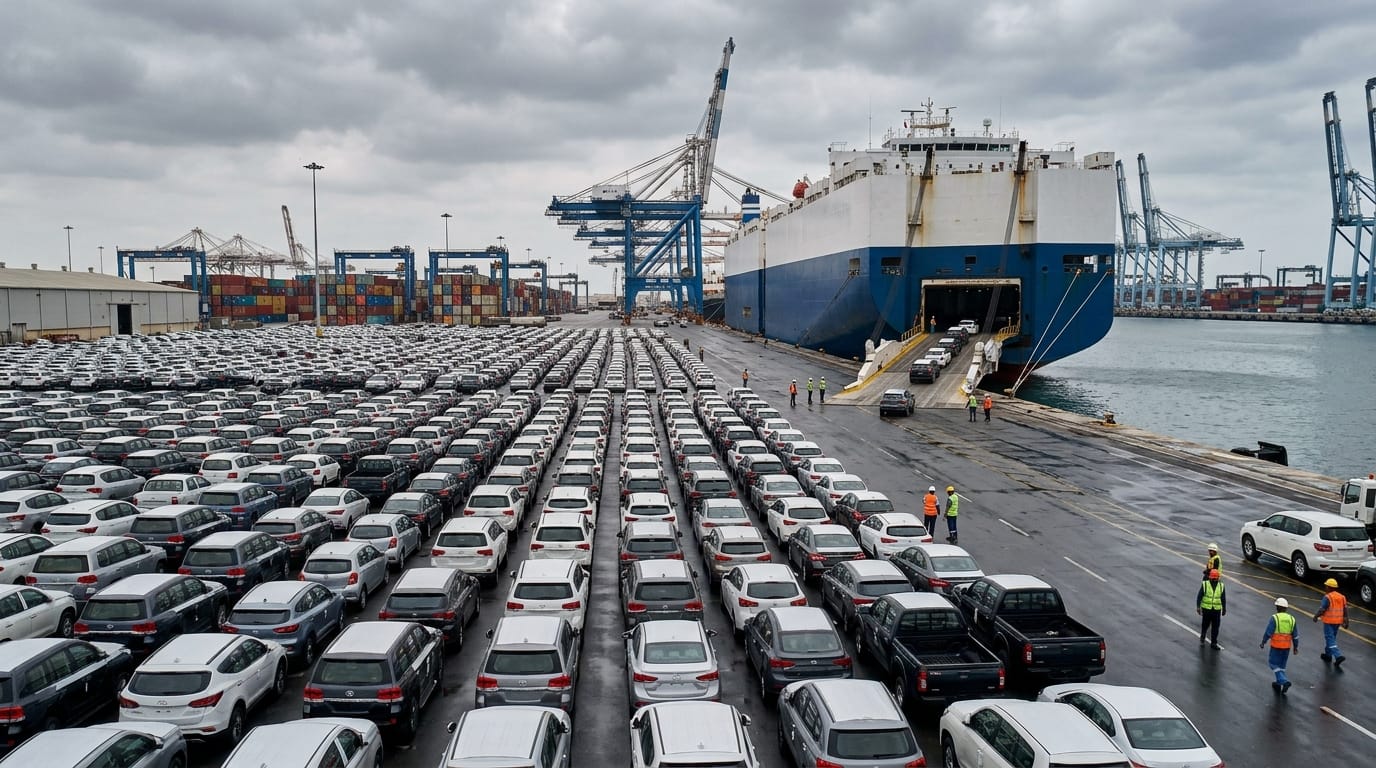
All figures are market estimates based on typical 2025-2026 freight rates for a standard mid-size saloon. Actual quotes from freight forwarders may vary by vehicle dimensions, weight, fuel surcharges, port congestion, and seasonality. Always obtain at least three independent quotes.
What Determines Shipping Cost?
Seven factors typically determine what you actually pay:
- Vehicle dimensions and weight — Oversized or heavy vehicles (large SUVs, pickup trucks) cost more in both RoRo and container shipping.
- Destination port and inland distance — Remote ports and landlocked destinations add cost. Mumbai is cheaper than interior India. Karachi is straightforward; inland Pakistan requires additional trucking.
- Shipping method — RoRo is typically 30% to 50% cheaper than sole-use container shipping.
- Departure port — Jebel Ali is the primary export hub and usually has the best rates and most route options.
- Marine insurance — Optional but recommended. Adds roughly 0.5% to 1.5% of declared vehicle value.
- Port handling charges — These vary and are sometimes quoted separately. Clarify whether your quote is all-inclusive or port-exclusive.
- Season and demand — Rates fluctuate. Shipping during high-demand periods (post-Ramadan, year-end) may cost 10% to 20% more.
Marine Insurance: Is It Worth It?
Marine insurance covers your vehicle against loss or damage during the sea voyage. Standard coverage typically includes:
- Total loss (sinking, fire, structural incident)
- Partial damage from sea water, storm, or collision
- Theft during transit (depending on policy)
What marine insurance typically does NOT cover:
- Pre-existing mechanical damage or defects
- Personal belongings left inside the vehicle
- Minor scratches from loading and unloading
- Damage at the destination port after discharge
Marine insurance typically costs between 0.5% and 1.5% of the declared vehicle value. For a 45,000 AED car, that translates to roughly 225 to 675 AED for the voyage. Given that the most common shipping damage occurs during loading and unloading operations — where Ro-Ro vessels use ramps and container cranes — marine insurance is generally worth obtaining.
Some freight forwarders include basic marine insurance in their quote. Always ask whether it is included, and if so, read the exclusions carefully. Third-party standalone marine insurance through a UAE insurer may offer broader coverage. Also read the deductible (excess) amount before purchasing any policy — a low premium with a high excess may leave you covering most of a damage claim out of pocket.
Can You Ship Personal Items Inside the Car?
This is one of the most common questions departing expats ask, and the answer is: it depends on the shipping company and the destination country, but generally it is either restricted or not recommended.
Container Shipping and Personal Items
Some freight forwarders permit limited personal belongings inside a vehicle being shipped in a sole-use container, provided the items are declared on the packing list and customs manifest. Common restrictions include:
- No food, liquids, or perishables
- No aerosols, flammables, or battery-powered items (for some routes)
- No items with a combined value exceeding a certain threshold (varies by destination country)
- Items must be secured in the boot and not blocking the driver’s area
Even when permitted, personal items placed inside the car during container shipping are typically excluded from marine insurance. If the car is damaged during transit, the insurer covers the vehicle but not the contents.
RoRo Shipping and Personal Items
Most RoRo operators strictly prohibit personal items inside vehicles. The vessel operates with open decks, crew walks through vehicles periodically, and undeclared items create customs complications at the destination port. Port inspectors in many countries open vehicles upon arrival, and undeclared goods can result in the entire shipment being held pending investigation.
Customs Implications
Destination countries treat items inside a shipped vehicle as imported goods. Without a proper packing list and declared value, customs officers may assess duties on undeclared items — sometimes at punitive rates. In some countries (Australia, for example), biosecurity inspectors are particularly strict about organic materials and certain goods found inside imported vehicles.
Practical Recommendations
- Ship the car empty. Ship personal belongings separately via a removal company or checked baggage.
- If your freight forwarder permits limited items, declare everything on the manifest. Do not hide anything.
- Remove all valuables, electronics, and documents from the vehicle before handover at the port.
- Take a full video walkthrough of the vehicle interior immediately before handing it over, timestamped.
Preparing the Vehicle Before Shipping
| Preparation Step | Why It Matters |
|---|---|
| Wash the vehicle thoroughly (interior and exterior) | Many destination countries (especially Australia, New Zealand) require clean vehicles for biosecurity inspection |
| Remove all personal items and valuables | Prevents customs issues and theft risk during long transit |
| Reduce fuel to approximately 1/4 tank | Most ports and shipping companies require low fuel levels for fire safety on the vessel |
| Check and document tyre pressure | Long transit periods can affect tyre pressure; document pre-shipping condition |
| Disable the alarm system | Prevents battery drain and problems during loading/unloading |
| Take photographs of all panels and interior | Essential for any insurance damage claim after arrival |
| Remove all UAE stickers and Salik tags | Not required abroad; some countries flag foreign toll tags at customs |
| Check battery condition | Vehicles may sit for several weeks; a weak battery may fail by arrival |
| Secure loose parts | Antennae, spoilers, and body kits should be secured or removed to prevent damage |
| Disconnect aftermarket GPS trackers if required | Some shipping companies and destination port authorities request removal of active tracking devices before handover — confirm with your forwarder in advance |
| Record odometer reading | Useful documentation for destination country import valuation |
Customs Procedures in the UAE
UAE export customs clearance is generally straightforward for a personal vehicle being exported legitimately by its registered owner. The process involves:
- Submitting the export declaration through your freight forwarder or directly via the Dubai Customs portal
- Paying applicable UAE export fees (typically minimal for personal vehicles — the UAE does not impose significant export taxes on used personal vehicles)
- Physical inspection of the vehicle at the port (may be documentary only for low-risk consignments)
- Receiving export clearance confirmation
Your freight forwarder handles these steps in most cases. If you manage the process independently, the Federal Customs Authority and Dubai Customs both operate service centres at Jebel Ali Port.
Import Rules in the Destination Country
This is where the process becomes significantly more complex, and where most expats underestimate the total cost.
Every country has its own vehicle import regulations. These are not controlled by the UAE in any way.
Common issues that catch expats by surprise:
- Right-hand vs left-hand drive restrictions — Some countries only permit right-hand drive vehicles. The UAE sells predominantly left-hand drive (LHD) vehicles. Importing an LHD vehicle into a right-hand drive country (UK, Australia, India, Pakistan) may be restricted, heavily taxed, or require modification at significant cost.
- Age restrictions — Some countries restrict the import of vehicles over 3, 5, or 10 years old.
- Emissions standards — European countries, Australia, and Canada have strict emissions compliance requirements. GCC-spec vehicles may not meet local emissions standards without modification.
- Type approval — The vehicle must meet the destination country’s type approval (roadworthiness standards). A GCC-spec vehicle may lack required safety or emissions components.
Always verify requirements with the destination country’s vehicle import authority, relevant embassy in the UAE, or a local customs agent in the destination country before shipping.
Read our GCC vs non-GCC spec guide to understand how UAE vehicle specifications differ from international standards.
Taxes, Duties and Import Fees by Region
| Country / Region | Typical Import Duty on Used Cars | Additional Taxes / Fees | Key Restrictions |
|---|---|---|---|
| India | 125% of CIF value (customs, insurance, freight) | GST, IGST, additional duties | Highly restricted for personal imports; requires approval |
| Pakistan | 50% – 100%+ depending on engine size and age | FED, WHT, sales tax | Gift scheme and baggage scheme have specific conditions |
| Bangladesh | Very high — effectively 150%+ for most vehicles | Supplementary duties, VAT | Practically cost-prohibitive for most standard vehicles |
| Philippines | 30% – 100% depending on engine displacement | VAT, excise tax | RHD only; LHD vehicles face significant barriers |
| Malaysia | 30% – 105% | Sales tax, excise duty | Strict conditions for personal import approval |
| United Kingdom | 6.5% on vehicle value | VAT 20%, MOT test cost | Must meet DVLA type approval; LHD permitted but less practical |
| United States | 2.5% (passenger cars) or 25% (light trucks) | EPA/DOT compliance, state registration fees | 25-year exemption for older vehicles; newer GCC-spec may not meet EPA/DOT |
| Canada | 6.1% MFN rate | GST, provincial taxes, RIV fee | Must meet Transport Canada standards; RIV inspection required |
| Australia | 5% on customs value | GST 10%, Luxury Car Tax if applicable | Strict biosecurity; ADR compliance required |
| Saudi Arabia | 5% (GCC common tariff) | VAT 15% | Generally straightforward for GCC-spec vehicles |
| Oman | 5% (GCC common tariff) | Minimal additional charges | Easiest destination — GCC vehicles accepted without major modification |
⚠ India Warning: For most standard vehicles, the import duty and tax burden in India makes shipping financially non-viable. A 30,000 AED Toyota Corolla would attract import duties of approximately 37,500 AED or more, before local registration and compliance costs. Selling in the UAE and buying a car in India is almost always the better option for standard models. Verify current rules with India’s Central Board of Indirect Taxes and Customs.
Can You Ship a Financed Vehicle?
A vehicle with an outstanding loan registered in the UAE cannot be exported without the bank’s explicit written consent and, in most cases, full loan settlement.
Here is why: the bank holds a financial interest in the vehicle and is noted on the UAE registration. UAE Customs will not issue an export certificate for a vehicle flagged as under finance. The deregistration process at the traffic department also typically flags financed vehicles.
In theory, a bank could consent to export while a loan remains outstanding — for instance, if you are continuing loan payments from abroad and the bank accepts international repayment. In practice, UAE banks rarely agree to this arrangement for personal vehicles. The bank’s preference is settlement before export.
If you are considering this route, contact your bank’s auto finance department directly and ask for their export consent policy in writing.
What Happens After the Vehicle Arrives?
- Port arrival notification — Your shipping company or agent notifies you when the vessel arrives at the destination port. You receive an arrival notice with documentation required for release.
- Customs clearance at destination — A local customs agent (or you, if self-clearing) submits import documents, pays duties and taxes, and obtains customs release.
- Port fees and storage — Destination ports charge daily storage fees after a free period (typically 3 to 7 days). If customs clearance is delayed, storage fees accumulate quickly — often equivalent to AED 100 to 400 per day at busy ports.
- Vehicle inspection — Depending on the country, the vehicle undergoes local roadworthiness inspection (MOT in the UK, RIV inspection in Canada, ADR check in Australia).
- Registration — The vehicle is registered in the destination country under your name. This requires local identification, address, and compliance documentation.
Registering the Car in the New Country
Registration requirements vary by country, but common requirements include:
- Proof of ownership (export certificate, original purchase documents, UAE deregistration certificate)
- Customs clearance certificate (proof duties were paid)
- Roadworthiness test certificate
- Local identity document and address
- Local auto insurance policy
In GCC countries (Saudi Arabia, Qatar, Oman), registration is generally simpler because vehicle specifications are standardised across the region. In markets with strict type approval requirements (UK, Australia, USA), the process is more involved and may require modification of certain vehicle components.
Common Problems During International Shipping
| Problem | How Common | Prevention / Resolution |
|---|---|---|
| Minor scratches and paint scuffs | Frequently reported | Pre-document condition; make insurance claim with photographic evidence |
| Delays at destination port | Common — especially at Indian and South Asian ports | Have a local customs agent in the destination country ready before the vessel arrives |
| Missing or incorrect documentation | Common for first-time exporters | Use a professional freight forwarder; verify document list twice |
| Higher import duties than expected | Common for expats who did not research in advance | Obtain written duty estimate from a customs agent in the destination country before shipping |
| Storage fees accumulating at destination port | Common when customs clearance is delayed | Have your destination agent ready; act immediately on arrival notification |
| Vehicle fails local roadworthiness test | Occasional — especially for older vehicles or non-standard specs | Research type approval requirements before shipping; consult destination country authority |
| Currency and payment issues | Occasional — and frequently underestimated | Exchange rate fluctuations between the time you ship and when import duties are assessed can meaningfully change the total cost. A 10% currency movement on a high-duty destination (India, Bangladesh) can translate to thousands of AED difference. Clarify which currency duties are payable in and lock in exchange rates where possible before vessel departure |

Scam Prevention: Protecting Yourself During the Export Process
Vehicle export scams targeting departing expats are not common in the UAE — but they do occur. The higher-risk scenarios involve fraudulent freight forwarders, inflated customs clearing fees, and payment fraud at the port stage.
⚠ Highest Risk: Unlicensed Freight Forwarders An expat in a hurry to leave is a target for operators who collect payment upfront, provide fake tracking numbers, and disappear. Your vehicle either never ships or sits at Jebel Ali Port incurring storage fees with no legitimate shipper. This typically costs between 15,000 and 40,000 AED in total losses including storage, port fees, and re-shipping arrangements.
Practical protection steps:
- Verify licensing — All freight forwarders operating at UAE ports must be licensed. Ask for their trade licence number and verify it on the Dubai Chamber portal.
- Check port operator registration — Legitimate companies are registered with DP World (Jebel Ali) or the relevant Abu Dhabi port authority.
- Get quotes in writing with itemised costs — Verbal quotes are meaningless. Any legitimate forwarder provides a written quotation specifying exactly what is and is not included.
- Pay by bank transfer, not cash — Bank transfer provides a documented trail. Never pay large sums in cash for vehicle shipping.
- Never hand over original documents until the vehicle is at the port — A legitimate forwarder needs certified copies, not originals, for most administrative steps.
- Use a company recommended by colleagues or expat communities — Community recommendations from UAE expat forums (Internations, Facebook expat groups) provide genuine first-hand experience.
Real Case Studies: Workshop and Market Logs
Case 1: Pakistani Engineer Ships His Fortuner to Karachi
A Pakistani structural engineer working in Abu Dhabi for 9 years decided to ship his 2019 Toyota Fortuner GCC when he relocated permanently. The vehicle had 78,000 km and was in excellent condition. UAE resale estimate: approximately 72,000 AED.
He obtained three freight forwarder quotes. The winning quote was 8,200 AED for RoRo from Jebel Ali to Karachi including port handling. Marine insurance added 900 AED. Deregistration and export documentation cost approximately 450 AED in government fees.
Pakistan import duty on the Fortuner: approximately 120% of CIF value — totalling an estimated 45,000 to 55,000 AED in duties and taxes. Total cost to ship and register: approximately 55,000 to 66,000 AED on a vehicle worth roughly 65,000 to 72,000 AED in the Pakistani market.
The financial margin was narrow. He proceeded because the Fortuner’s condition and documentation were exceptional, commanding a premium in his home city.
The vehicle arrived in good condition after 12 days. Customs clearance in Karachi took 3 weeks, with storage fees of approximately 400 AED per day for the delay period — an additional 4,000+ AED. His advice: have your customs agent in the destination country completely ready before the vessel departs the UAE.
Case 2: British Expat Sells Rather Than Ships His BMW 5 Series
A British finance professional in Dubai considered shipping his 2021 BMW 540i to the UK. UAE sale estimate: 195,000 AED. UK equivalent market value: approximately £35,000 to £38,000 (roughly 170,000 to 185,000 AED at prevailing rates).
Total estimated UK import costs: 6.5% duty (approximately 11,000 to 12,000 AED) + 20% UK VAT on the CIF value (approximately 36,000 to 40,000 AED) + DVLA compliance (LHD vehicle complications) + shipping approximately 13,000 AED. Total cost to import: approximately 62,000 AED minimum.
Conclusion: Selling in the UAE for 195,000 AED and buying a UK-spec equivalent in Britain was clearly better. He sold via a reputable Dubai showroom within two weeks. Read our guide on selling your car when leaving UAE for tips on maximising sale value before departure.
Case 3: Filipino Nurse Ships Her Mitsubishi Mirage to Manila
A Filipino nurse in Sharjah wanted to ship her 2018 Mitsubishi Mirage (purchased for 22,000 AED, now worth approximately 16,000 AED in UAE) to her family in Manila.
Philippines import duty: approximately 30% to 40% on CIF value, plus excise tax, plus VAT — effectively 60% to 80% total. The shipping cost alone was approximately 9,000 AED.
At a 70% duty rate on a 16,000 AED car, import costs would reach approximately 11,200 AED, plus 9,000 AED shipping = 20,200 AED to import a car worth 16,000 AED locally. She sold the Mirage in Sharjah instead for 15,500 AED in under two weeks. The correct decision — by a wide margin.
How to Choose a Reliable Shipping Company
| Evaluation Criterion | What to Check |
|---|---|
| UAE trade licence | Verify on Dubai Economy portal or Abu Dhabi ADDED |
| Port registration | Confirm they operate legitimately at Jebel Ali or Khalifa Port |
| Experience with your destination | Ask specifically about routes and frequency to your country |
| Written itemised quotation | Must include port fees, documentation, and all surcharges |
| Marine insurance arrangement | Clarify what is included; review policy terms |
| Communication and tracking | Do they provide vessel name, departure date, and arrival ETA? |
| Reviews and references | Look for verifiable reviews from other expats — not company website testimonials |
| Payment terms | Reputable companies accept bank transfer; avoid cash-only operators |
Getting at least three competing quotations is not optional — it is essential. Rates for the same route can vary by 30% to 50% between operators. Competitive pressure is also useful: presenting a lower quote from a competitor sometimes results in the preferred operator matching or improving their offer.
Common Mistakes Expats Make When Shipping a Vehicle
- Not researching destination import duties before starting — The single most expensive mistake. Many expats ship the vehicle and only discover the import duty total after it arrives, leaving them stuck with a vehicle they cannot afford to clear customs on.
- Leaving personal items in the car — Creates customs complications, potential confiscation, and insurance complications.
- Booking shipping before clearing outstanding fines or loans — Causes last-minute cancellations and deposit losses.
- Not hiring a local customs agent at the destination — Self-clearing at foreign ports is complex. Port storage fees during delays are often more expensive than the agent’s fee.
- Choosing based on price alone — The cheapest forwarder is not always the most reliable. Verify credentials independently.
- Assuming GCC-spec means it is road-legal anywhere — It does not. GCC specification meets UAE and GCC country standards, not European, Australian, or North American standards.
- Not photographing the vehicle before handover — Without pre-handover documentation, proving shipping damage is significantly harder.
- Underestimating the total timeline — Most expats underestimate the process by at least 2 to 3 weeks. If your visa has already expired, complications escalate quickly.
Shipping vs Selling Decision Framework
Use this framework to guide your decision. The numbers are illustrative — you need to substitute your vehicle’s actual value and get real shipping and import duty quotes for your destination.
| Scenario | UAE Sale Value | Ship + Import Cost | Value Abroad | Net Position | Decision |
|---|---|---|---|---|---|
| Toyota Corolla → India | 25,000 AED | ~40,000 AED (duties alone exceed car value) | ~22,000 AED equivalent | -18,000 AED loss on shipping | SELL in UAE |
| Nissan Sunny → Pakistan | 18,000 AED | ~18,000 AED (duties ~80% + shipping) | ~17,000 AED equivalent | Break-even or slight loss | SELL in UAE |
| Toyota Fortuner → Saudi Arabia | 70,000 AED | ~15,000 AED (5% duty + shipping) | ~72,000 AED equivalent | +57,000 AED net | MAY make sense to SHIP |
| BMW 5 Series → UK | 180,000 AED | ~60,000 AED (duty + VAT + compliance) | ~175,000 AED equivalent | +115,000 AED net vs ~180,000 selling | SELL in UAE |
| Toyota Land Cruiser → Oman | 130,000 AED | ~10,000 AED (5% duty + short-haul shipping) | ~130,000 AED equivalent | +120,000 AED net | SHIP — strong case |
All values are illustrative estimates for comparison purposes. Actual figures vary based on vehicle condition, timing, current duty rates, and exchange rates.
As a general rule of thumb: if shipping costs alone (before import duties) exceed approximately 25 to 35% of your vehicle’s current UAE market value, selling locally is often the more economical choice. However, always compare actual destination-country market prices before making a final decision — the same vehicle may command a meaningfully different price abroad depending on local supply and demand.
| Your Situation | Recommended Action | Reason |
|---|---|---|
| Standard mid-range car (Corolla, Sunny, Elantra) going to South Asia | SELL in UAE | Import duties in South Asia make shipping financially counter-productive in most cases |
| Standard car going to Philippines, Malaysia, or Bangladesh | SELL in UAE | Very high import duties plus LHD restrictions make shipping impractical |
| Any car going to another GCC country (Saudi, Oman, Qatar) | CONSIDER SHIPPING | Low GCC duty (5%), straightforward process, vehicle specifications align |
| Luxury or rare vehicle going to Europe or Australia | CALCULATE CAREFULLY first | Duties may be manageable if vehicle value is high enough; compliance costs are significant |
| Any car going to USA or Canada | CALCULATE CAREFULLY first | US/Canada type approval may require vehicle modification that negates the cost benefit |
| Leaving within 30 days | SELL in UAE | Export process realistically takes 3 to 6 weeks minimum — time constraint makes shipping impractical |
| Vehicle under active bank finance | SETTLE and then decide | Cannot export until loan is fully settled and clearance letter obtained |
For most expatriates driving standard Japanese or Korean vehicles, the answer is clear: sell in the UAE and avoid the complexity, cost, and risk of international vehicle shipping.
For GCC-to-GCC moves with a GCC-spec vehicle, the calculation often works in favour of shipping — particularly for higher-value vehicles.
If you are planning your exit and want to maximise the sale price before departure, read our real experience selling in Dubai after two years for practical guidance on timing, pricing, and platform selection.
Data Sources and Methodology
The shipping cost estimates in this article are based on market observations from freight forwarder quotations collected across UAE-based export operators, community-reported costs from UAE expat forums and relocation groups, and published port tariff information.
Import duty figures are sourced from publicly available customs tariff schedules for each destination country; these figures represent general ranges and may not reflect every vehicle’s actual duty classification.
Official references used:
- Roads and Transport Authority (RTA) — Dubai
- Dubai Customs
- UAE Federal Customs Authority
- DP World — Jebel Ali Port
- India Central Board of Indirect Taxes and Customs
- Dubai Chamber of Commerce — Business Verification
💡 Market Volatility Notice: All shipping cost estimates, import duty rates, exchange rate conversions, and port charges mentioned in this article are approximate figures and subject to change. Freight rates fluctuate with fuel prices, vessel availability, and seasonal demand. Import duty rates are set by destination country governments and may be revised without notice. Always obtain current quotes from freight forwarders and confirm duty rates with a licensed customs agent in your destination country before making any financial decisions.
Frequently Asked Questions
Finally, if you are still weighing your options and want to understand the full financial picture of car ownership in the UAE before making your exit decision, our complete cost of car ownership in Dubai guide provides the full monthly breakdown that helps you calculate whether keeping or selling before you leave makes the most sense for your specific situation.
The right decision is not determined by shipping cost alone, but by comparing the total landed cost — shipping, import duties, compliance, and registration — against the vehicle’s realistic market value after arrival. When that comparison is done honestly, the path forward is usually clear.
Disclaimer: Emirates Cars is a 100% independent platform. We do not own showrooms, nor are we affiliated with any used car dealerships or garages. Our sole mission is to protect expats from financial fraud in the automotive market.
