Last Updated: July 2026 | By Omar Al-Fayed, Senior Automotive Consultant | Category: Maintenance & Repairs
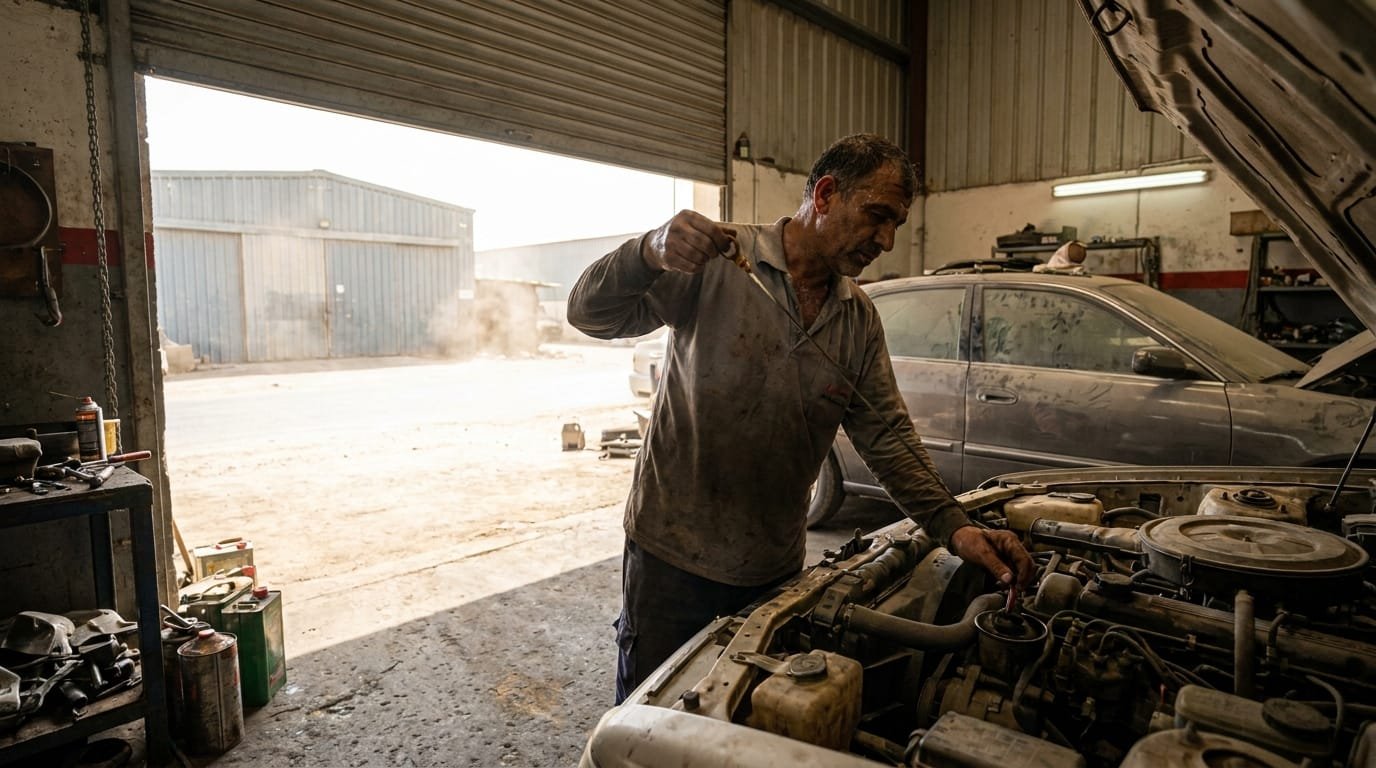
Skipping a scheduled service in UAE summer is not the same as skipping it in a temperate climate. With ambient temperatures regularly reaching 45°C to 48°C and cabin temperatures capable of exceeding 70°C when parked, the mechanical stress placed on every fluid, belt, and component is significantly higher than what most service interval guidelines assume. A 5,000 km oil change delay that causes minimal harm in Europe can, in UAE summer conditions, accelerate engine wear to a point that requires expensive intervention. annual maintenance costs in the UAE are already higher than many expats expect — delayed service pushes those numbers further.
⚠ Maintenance Disclaimer: The information provided in this article is for educational purposes only. Repair cost estimates represent realistic market ranges observed across UAE workshops and are not fixed prices. Always obtain multiple quotes from licensed workshops before authorising any repair work.
What Actually Changes Inside Your Car When Service Is Overdue in Summer
Engine Oil
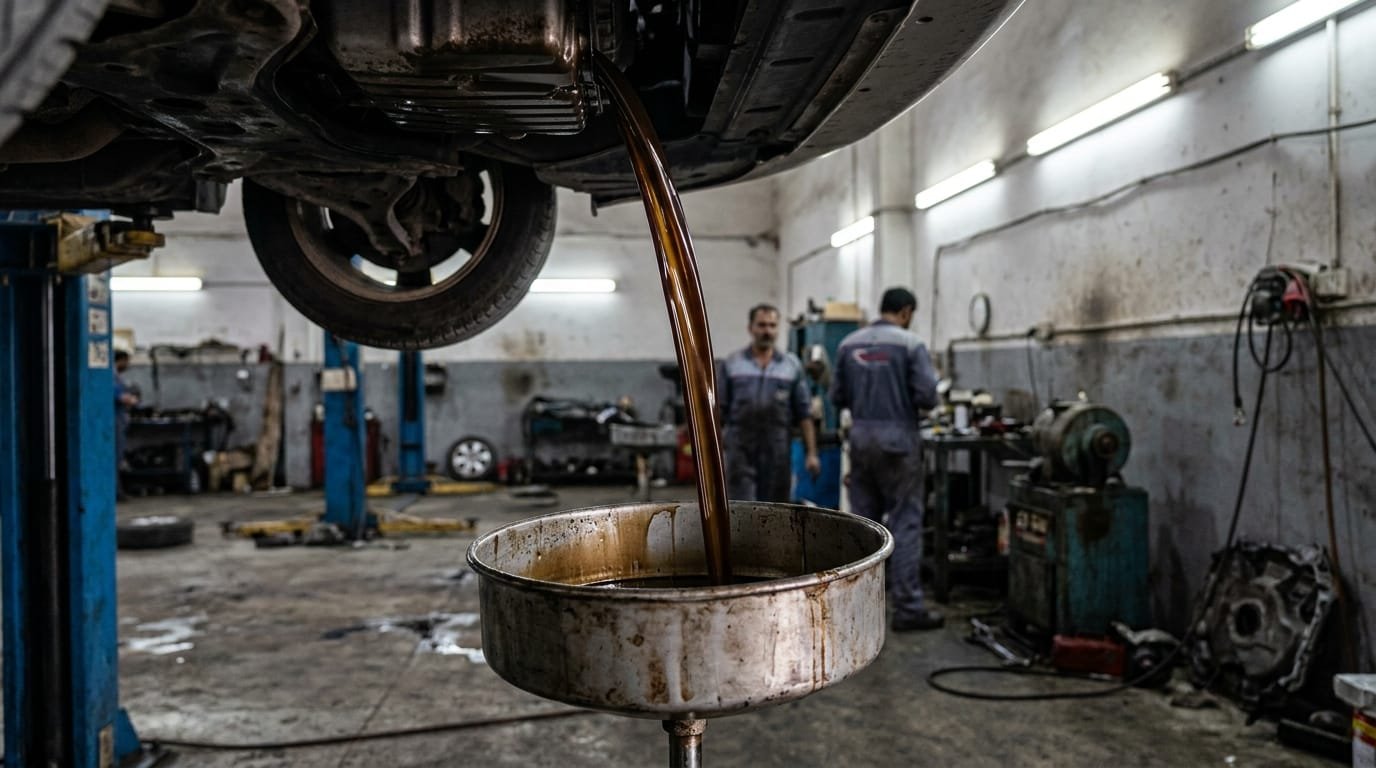
Engine oil degrades faster at high operating temperatures. In UAE summer, an engine running in stop-and-go traffic on Sheikh Zayed Road reaches oil temperatures that thin the lubricant and reduce its protective film strength. At 5,000 km past a due service, oil that should protect metal surfaces is often heavily oxidised, carrying abrasive particulates that score cylinder walls and bearing surfaces. This damage is cumulative and largely invisible until symptoms appear.
UAE Oil Change Intervals: What the Manufacturer Says vs What the Climate Requires
Most manufacturer service manuals are calibrated for temperate climates. In UAE conditions — sustained heat above 45°C, stop-and-go traffic, and dusty air — oil degrades faster than those intervals assume. Multiple workshop sources and lubricant manufacturers consistently recommend reducing standard intervals by approximately 20–30% for UAE summer driving. In practical terms:
- Full-synthetic oil: Manufacturer says 10,000–15,000 km → UAE practical interval commonly cited at 7,500–8,000 km
- Semi-synthetic / synthetic blend: 7,000–8,000 km under UAE conditions
- Conventional mineral oil: 5,000 km or less in summer — not generally recommended for modern engines operating in UAE heat
For viscosity grade, 5W-40 full synthetic is widely recommended for most UAE sedans and SUVs under summer heat. 5W-30 remains suitable for modern fuel-efficient engines where the manufacturer specifies it. Always use your vehicle’s OEM specification as the baseline, then consider shorter intervals based on actual driving conditions.
Coolant
Coolant concentration and condition affect the boiling point of the cooling system. Degraded coolant lowers that threshold. In UAE summer, the margin between a healthy cooling system and one that begins to overheat under traffic conditions is narrow. Coolant that should be changed at 40,000 km but is left to 60,000 km or beyond begins to lose its corrosion inhibitors, attacking aluminium components in the radiator and engine block.
Transmission Fluid
CVT and automatic transmission fluids break down under heat. Vehicles regularly idling in UAE traffic with air conditioning running at maximum load place sustained thermal stress on the transmission. CVT maintenance intervals are particularly unforgiving — many expat buyers discover advanced CVT wear only after skipping two or three fluid changes.
Battery
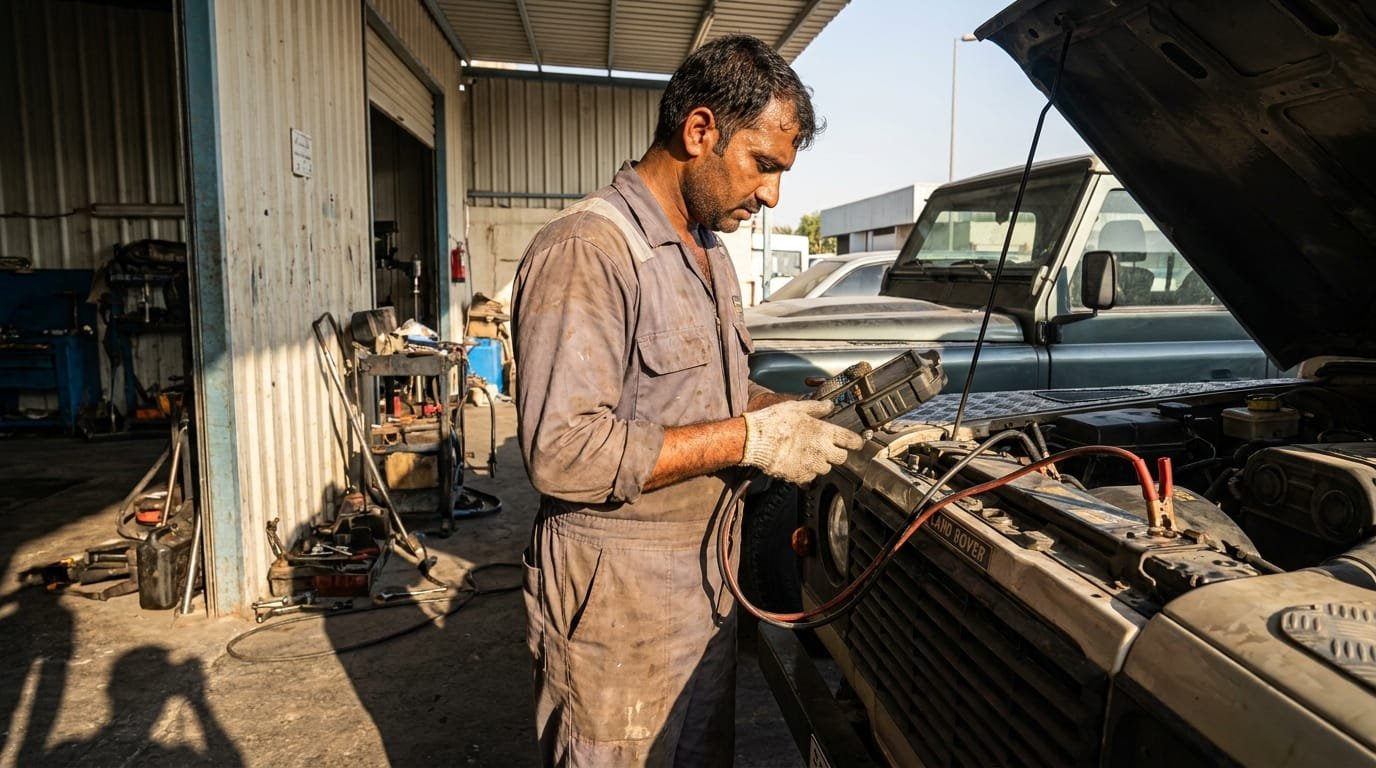
UAE summer is the primary cause of battery failure in the region. Heat accelerates internal chemical reactions, shortening battery life significantly compared to temperate climates. A battery that reads acceptable in January may fail completely by August. Service visits typically include battery health checks that catch degradation before it causes a roadside stop.
Brakes, Air Filters, and Belts
Dust and sand ingestion is continuous in UAE driving conditions. Air filters clog faster than in most other markets, reducing engine efficiency and increasing fuel consumption. Belts and hoses become brittle faster under sustained heat. Brake fluid absorbs moisture over time, lowering its boiling point — a concern on mountain roads in the Northern Emirates or during prolonged braking in traffic.
Which Components Usually Fail First
| Component | Typical Failure Trigger in UAE Summer | Early Warning |
|---|---|---|
| Battery | Heat-accelerated internal degradation | Slow crank, dashboard warning |
| Engine oil | Oxidation, particulate buildup | Engine knock, oil warning light |
| Cooling system | Degraded coolant, blocked radiator | Temperature gauge rising |
| AC compressor | Refrigerant loss, worn clutch | Weak cooling, cycling noise |
| CVT / Auto transmission | Fluid breakdown under sustained heat | Hesitation, hard shifts, slipping |
| Air filter | Sand and dust accumulation | Reduced power, higher fuel use |
| Serpentine belt | Heat-induced cracking | Squealing, visible cracking |
| Tires | Heat accelerates compound degradation | Bulges, uneven wear, vibration |
Warning Signs You Should Never Ignore
These symptoms indicate that delayed maintenance has already caused detectable stress. Each one warrants immediate workshop attention, not deferred action.
| Warning Sign | Likely Cause | Continue Driving? | Urgency |
|---|---|---|---|
| Temperature gauge above midpoint | Cooling system stress | Stop immediately if rising | Same day |
| Oil warning light | Low pressure or oil level | No — stop safely | Immediate |
| Engine knocking sound | Oil starvation or bearing wear | No | Immediate |
| Hard gear shifts / transmission slipping | Fluid degradation | Reduce use — workshop soon | Within 2–3 days |
| Burning smell (not clutch) | Fluid leak on hot engine parts | Stop and inspect | Immediate |
| Weak or inconsistent AC | Refrigerant loss, compressor wear | Yes, but address within a week | Within 1 week |
| Squealing from engine bay | Belt tension or wear | Reduce driving — inspect today | Same day |
| Battery warning light | Alternator or battery failure | Go directly to workshop | Immediate |
🚨 Stop Driving Immediately If: The temperature gauge enters the red zone, the oil warning light activates while driving, you hear metallic knocking from the engine, or you see steam or smoke from the engine bay. Continuing to drive under any of these conditions risks converting a manageable repair into complete engine replacement.
Can You Safely Delay Service by 500 km, 1,000 km, or 3,000 km?
This depends on vehicle age, mileage, oil type, and whether you are driving during peak summer heat. The following is a general guide based on common workshop observations across UAE — not a manufacturer guarantee.
| Delay Beyond Due Date | Risk Level (UAE Summer) | Recommendation |
|---|---|---|
| Up to 500 km | Low for modern vehicles under 80,000 km | Acceptable if oil is full-synthetic and in good condition |
| 500–1,000 km | Moderate — oil degradation accelerating | Book service within the week |
| 1,000–3,000 km | Notable risk — especially for turbocharged or high-mileage vehicles | Service as soon as possible — do not delay further |
| 3,000+ km overdue | High — measurable wear accumulation likely | Full inspection recommended alongside service |
Older vehicles above 120,000 km, turbocharged engines, and vehicles with gaps in their service history should be treated as higher-risk in all categories above. service history gaps are common in UAE used car transactions and significantly increase the risk profile of any delay.
Hidden Damage That May Not Appear Immediately
Some of the most expensive consequences of delayed maintenance develop silently. There is no warning light for accelerated cylinder wall wear. There is no alert for the early stages of transmission clutch pack degradation. By the time symptoms become obvious, the damage has already progressed beyond minor wear.
- Engine bearing wear: Thin or degraded oil fails to maintain the hydrodynamic film that separates moving metal surfaces. This begins microscopic scoring that, over months, accumulates into significant clearance increase and oil pressure loss.
- Cooling system scale buildup: Degraded coolant deposits scale on heat exchange surfaces, reducing cooling efficiency gradually. The system appears functional until ambient temperatures peak and the margin disappears.
- Transmission clutch degradation: CVT and automatic transmissions with degraded fluid show no symptoms in mild conditions. In UAE summer stop-and-go traffic, the additional thermal load reveals the damage earlier than it would elsewhere.
- Accelerated hose and seal deterioration: Rubber components age faster in heat. Coolant hoses, valve cover gaskets, and oil seals that appear intact at a visual check may begin seeping within weeks under peak summer temperatures.
Estimated Repair Cost Comparison: Regular Service vs Delayed Repair
The figures below represent realistic estimated ranges from Al Quoz and Sharjah Industrial Area independent workshops. They are not fixed prices — costs vary by vehicle make, workshop, and extent of damage.
| Scenario | Estimated Cost Range (AED) | Notes |
|---|---|---|
| Regular full service (Japanese/Korean sedan) | 300 – 600 | Oil, filter, inspection, top-ups |
| Battery replacement (after heat failure) | 350 – 700 | Widely available same-day in Al Quoz |
| Coolant flush and radiator service | 250 – 500 | Preventive vs reactive cost similar |
| CVT fluid change (preventive) | 400 – 800 | Varies significantly by model |
| CVT partial repair (delayed service) | 4,000 – 12,000 | Common in high-mileage Nissans, Hondas |
| Engine top-end work (oil starvation) | 2,000 – 6,000 | Valve cover, seals, timing components |
| Engine replacement (severe neglect) | 12,000 – 30,000+ | Used engines available — quality varies; luxury vehicles higher |
| AC compressor replacement | 1,500 – 4,000 | Aftermarket vs OEM price gap is significant |
The pattern is consistent: preventive service costs hundreds. Reactive repair after failure costs thousands. For budget-conscious expats, the real cost of car ownership in UAE becomes significantly harder to manage once deferred maintenance begins compounding.
Vehicles More Sensitive to Missed Maintenance in UAE Summer
Turbocharged Engines
Turbochargers operate at high temperatures and depend entirely on oil quality for lubrication and cooling of the shaft. Degraded oil in a turbocharged engine accelerates bearing wear at a rate substantially higher than in naturally aspirated engines. Missing a service by 2,000 km in a turbocharged vehicle carries considerably more risk than the same delay in a Corolla 1.6.
Vehicles Above 100,000 km
Older, higher-mileage vehicles have reduced tolerance for degraded fluids. Seal wear, increased internal clearances, and accumulated deposits make them more vulnerable to the consequences of any service delay.
CVT-Equipped Models
CVTs are particularly heat-sensitive. Models including the Nissan Sunny, Nissan Tiida, Honda City (1.5L older generation), and Mitsubishi Lancer with CVT all have documented patterns of accelerated wear when fluid changes are missed. Nissan Sunny ownership costs in UAE are generally low — but the CVT is the exception when servicing is neglected.
Luxury and European Vehicles
European vehicles typically have longer manufacturer-specified service intervals but use more complex engine management, more sophisticated cooling systems, and tighter manufacturing tolerances that respond poorly to degraded fluids. Parts availability in UAE is lower than for Japanese models, and repair costs are substantially higher.
Hybrid Vehicles
Hybrids carry two separate cooling systems — one for the combustion engine and one for the hybrid battery pack. Neglecting either can cause expensive repairs. Hybrid battery cooling is particularly important in UAE summer.
How Missed Service Affects Resale Value
Buyers in the UAE used car market — particularly on Dubizzle and through Al Aweer traders — increasingly ask for service records. A vehicle presented without a stamped service book or documented service history typically attracts lower offers. The discount applied varies by vehicle and buyer, but an incomplete service history generally signals higher future maintenance risk to any informed buyer.
Beyond the negotiation impact, a vehicle with documented deferred maintenance that has developed engine or transmission issues will be offered substantially less — or declined entirely by dealerships offering trade-in valuations. Resale value in the UAE market is closely tied to documented maintenance history, particularly for Toyota and Nissan models.
How to Recover If You Have Already Missed Service
If your service is overdue, the following sequence is appropriate:
- Check oil level and condition immediately. If the oil is black, gritty, or below the minimum line, do not drive further — arrange a workshop visit or oil top-up first.
- Check coolant level. If low, top up with the correct coolant type before driving in daytime summer heat.
- Book a full service at a workshop you trust. In Al Quoz Industrial Area and Sharjah Industrial Area, independent specialists familiar with UAE market vehicles are widely available.
- Ask for a written condition report. If service is significantly overdue, request an inspection of belts, hoses, brake fluid, and battery alongside the standard service items.
- Address battery health specifically. If the vehicle is over two years old and has not had a battery test recently, have it load-tested. UAE summer is when marginal batteries fail.
Summer Maintenance Checklist
| Item | Check Interval | What to Look For | Estimated Cost if Neglected |
|---|---|---|---|
| Engine oil level and colour | Monthly in summer | Black colour, below minimum mark | Up to AED 25,000+ (engine) |
| Coolant level | Monthly | Below minimum, discoloured | AED 500–8,000 (radiator/engine) |
| Battery health test | Before summer and at 2 years | Slow crank, low voltage reading | AED 350–700 (replacement) |
| Tire pressure | Weekly — check cold in morning | Under-inflation in heat increases blowout risk | AED 800–2,500 (tire replacement) |
| AC refrigerant level | Annually or when cooling weakens | Warm air from vents, cycling compressor | AED 200–500 (regas) to AED 4,000 (compressor) |
| Air filter | Every 15,000 km or annually | Heavy dust loading, reduced power | AED 150–300 (filter replacement) |
| Brake fluid | Every 2 years regardless of mileage | Brown colour, contamination | AED 150–300 (flush) |
| Serpentine/drive belt | Visual check every service | Cracks, glazing, fraying edges | AED 200–600 (replacement) |
Illustrative Field Scenarios: Workshop & Market Patterns
Example scenarios based on recurring UAE market patterns, not actual documented cases.
Scenario A — Indian Expat, Nissan Sunny, Dubai
An office worker commuting daily from Deira to Business Bay delayed his Sunny’s service by approximately 4,000 km during summer. The CVT began showing hesitation under load after the delay. A workshop inspection in Al Quoz found degraded transmission fluid and early clutch pack wear. Preventive fluid change at the correct interval: approximately AED 500–700. Partial CVT reconditioning at the time of inspection: estimated AED 5,000–7,000. The difference illustrates why CVT service intervals are not advisory but functional.
Scenario B — Filipino Expat, Toyota Corolla, Sharjah
A driver with a 2016 Corolla missed two consecutive oil changes due to work schedule pressure. The engine oil had darkened significantly and dropped below the minimum mark. A full service and engine flush at a Sharjah Industrial Area workshop resolved the issue with no lasting damage — the Corolla’s engine tolerance for moderate neglect is higher than many comparable models. Total cost: approximately AED 600–800 including flush. This outcome is not guaranteed in turbocharged or higher-mileage vehicles.
Scenario C — British Expat, BMW 3 Series, Abu Dhabi
A resident with a 2017 BMW with approximately 95,000 km delayed a scheduled service during summer relocation. The vehicle subsequently developed a coolant leak at a hose junction — a component that had shown no visible deterioration at the previous inspection. Repair at an Abu Dhabi independent specialist: approximately AED 800–1,200. Had the leak progressed to overheating before detection, engine damage could have extended costs substantially. Pre-purchase inspections and timely service visits follow the same logic: early detection is consistently cheaper than reactive repair.
Ownership Scenarios: What Your Situation Changes
If you drive 20 km or less daily: Engine reaches operating temperature and then idles in traffic. Short trips are harder on engines than highway driving — oil does not fully circulate and moisture does not fully evaporate from the crankcase. Service intervals by mileage may understate the actual stress. Consider time-based intervals (every 6 months) regardless of distance.
If you drive 60 km or more daily (Dubai–Sharjah commute): Higher mileage accumulation means you reach service intervals faster. The risk of forgetting or deferring is higher. Set a phone reminder one month before the expected service mileage.
If your contract ends within 12 months: Deferred maintenance reduces the resale price you can achieve. A full, documented service history adds a measurable negotiating advantage when selling your car before leaving UAE.
If you are a delivery or rideshare driver: Your vehicle accumulates mileage at three to four times the rate of a standard commuter. Standard service intervals may need to be shortened. Consult the workshop about appropriate intervals for high-usage operation.
The Bottom Line Decision Framework
| Your Situation | Recommended Action |
|---|---|
| Service overdue by less than 500 km, no warning signs | Book within the week — no immediate risk for most vehicles |
| Service overdue by 500–1,500 km, no warning signs | Book within 2–3 days — do not drive long distances before servicing |
| Service overdue by more than 2,000 km | Service immediately — request full inspection alongside routine work |
| Any warning light active | Do not delay — visit workshop same day |
| Oil warning light or temperature gauge in red | Stop driving now — continued operation risks major damage |
| Turbocharged vehicle, any delay | Higher risk category — service at first available opportunity |
| Vehicle above 100,000 km, any delay | Full inspection recommended at service — belts, hoses, coolant |
| Planning to sell within 6 months | Service now and keep the receipt — documented history adds value |
Data Sources & Methodology
Cost estimates in this article are based on practical market observations across independent workshops in Al Quoz Industrial Area, Sharjah Industrial Area, and Deira. No single official database publishes standardised UAE repair costs — figures represent realistic ranges as observed across the market, not fixed prices. Readers should obtain written quotes from multiple workshops before authorising any significant repair.
For official vehicle inspection requirements, refer to the RTA Vehicle Licensing portal. For consumer protection complaints related to workshop disputes, refer to Dubai Consumer Protection. For Abu Dhabi vehicle matters, refer to the TAMM Abu Dhabi services portal.
ℹ Market Volatility Notice: All cost ranges stated in this article are estimates based on market observations at the time of publication. Workshop prices in the UAE vary by emirate, vehicle make, parts sourcing, and seasonal demand. Always verify current pricing directly with a licensed UAE workshop before authorising any repair. Estimates are provided for planning purposes only.
Frequently Asked Questions
Engine warning light guidance is a useful companion reference if you are seeing dashboard alerts alongside overdue service.
Disclaimer: Emirates Cars is a 100% independent platform. We do not own showrooms, nor are we affiliated with any used car dealerships or garages. Our sole mission is to protect expats from financial fraud in the automotive market.
