Last Updated: June 2026 | By Omar Al-Fayed, Senior Automotive Consultant | Fact-Checked By: Emirates Cars Editorial Team | Category: Driving Rules & Fines
Unpaid traffic fines in the UAE concern many expatriates, especially those planning to travel home or relocate. The short answer: ordinary unpaid traffic fines alone do not automatically trigger a travel ban.
However, when fines escalate into court cases, ignored summons, or criminal traffic offences, travel restrictions become a real possibility.
This guide covers every scenario clearly — so you know exactly where you stand before heading to the airport. If you are also managing traffic fines in the UAE more broadly, that guide covers the full fines system in detail.
⚠ Legal Disclaimer: The information provided in this article is for educational purposes only. UAE legal procedures, court fees, traffic laws, and judicial mandates may change over time. Readers should verify current requirements with a licensed UAE legal consultant or official government portals before taking formal legal action. This guide is reviewed periodically as Dubai Courts and police procedures evolve.
%%{init: {'theme': 'base', 'themeVariables': {'background': '#f8f9fa', 'textColor': '#1a1a1a', 'primaryColor': '#2c3e50', 'secondaryColor': '#c0392b', 'lineColor': '#1a1a1a'}}}%%
flowchart TD
    classDef default fill:#2c3e50,stroke:#1a1a1a,stroke-width:1px,color:#ffffff;
    classDef green fill:#27ae60,stroke:#1a1a1a,stroke-width:1px,color:#ffffff;
    classDef red fill:#c0392b,stroke:#1a1a1a,stroke-width:1px,color:#ffffff;

    A["Do you only have unpaid traffic fines?
(no accidents, no court cases)"]
    A -->|YES| B["Pay fines online via RTA / Dubai Police app"]
    B --> C["No travel ban expected ✓"]
    C --> D["Renew vehicle registration separately"]

    A -->|NO — accident or court involved| E["Was there a court case or summons?"]
    E -->|YES| F["Check Dubai Courts portal
(dc.gov.ae)"]
    F --> G["Contact a UAE-licensed lawyer"]
    G --> H["Verify travel status before airport"]

    E -->|NOT SURE| I["Had a serious accident or injury involved?"]
    I -->|YES| F
    I -->|NO — minor incident only| J["Check police status via Dubai Police app"]
    J --> K["Clear any outstanding fines and travel"]
Can Unpaid Traffic Fines Cause a Travel Ban in the UAE?
This is the most searched question on this topic — and the answer requires a clear distinction.
Standard unpaid traffic fines (speeding tickets, parking violations, signal violations) do not automatically place a travel ban on your record. The UAE traffic system treats these as administrative debts, not criminal matters. You can, in most cases, exit the UAE even with outstanding fines — though your vehicle registration renewal will be blocked until they are cleared.
The situation changes when:
- A traffic offence leads to a court case and you ignore summons or judgments
- The offence involves criminal conduct (reckless driving, drunk driving, hit and run, fatal accidents)
- A civil court judgment is issued against you for damages and remains unpaid
- A creditor (including a government authority) obtains a judicial travel ban through the courts
In those situations, a travel restriction can be placed — and you may not discover it until you reach the immigration counter at the airport.
Understanding Travel Bans in the UAE
A travel ban in the UAE is a legal restriction that prevents a person from leaving the country. There are two distinct types, and confusing them leads to unnecessary panic.
Administrative Travel Restrictions
These are not true “bans” in the criminal sense. They include situations where systems flag an issue at the border — for example, a visa overstay, a labour dispute, or a blocked status in a government database. These are usually resolvable quickly once the underlying issue is settled.
Judicial Travel Bans
These are formal court orders preventing departure. They are issued by UAE courts in connection with:
- Ongoing criminal investigations or prosecutions
- Civil cases where a judge determines the defendant may flee before a judgment is enforced
- Unpaid court-ordered financial judgments (including accident compensation)
- Fraud, cheque bounce cases, or serious contractual disputes
Traffic fines alone rarely reach this stage. But if a traffic accident resulted in injuries or fatalities, and civil or criminal court proceedings follow, a judicial travel ban is a genuine risk.
⚠️ Administrative Restrictions (System Flags)
Trigger: Standard traffic fines, speeding tickets, or parking violations.
Impact: Blocks vehicle registration and driving license renewals completely. It does NOT restrict your international travel or airport border crossings.
🚨 Judicial Travel Bans (Court Orders)
Trigger: Criminal traffic offenses (DUI, fatal accidents), ignored summons, or unpaid civil judgments.
Impact: Formal court mandate that explicitly blocks your departure at the airport immigration counter until legally cleared.
When Can Traffic Fines Lead to Legal Problems?
The path from a traffic fine to a legal problem in the UAE typically follows a pattern. Understanding it helps you intervene early.
Ignored Court Summons
If police refer a serious traffic incident to the Public Prosecution, you will receive a court summons. Many expatriates receive these by SMS or mail and ignore them — sometimes because they did not understand the message, sometimes because they assumed it was routine. Ignoring a court summons in the UAE can result in a judgment being issued in your absence, which then becomes enforceable — including through a travel ban.
Serious Traffic Offences
Certain violations are classified as criminal offences under UAE traffic law, not merely administrative fines. These include:
- Driving under the influence of alcohol or drugs
- Causing a road accident resulting in serious injury
- Causing a road accident resulting in death
- Reckless or dangerous driving at extreme speeds
- Hit and run (leaving the scene of an accident)
- Illegal street racing
For these, the police do not simply issue a fine. The case is referred to the Public Prosecution, which may file criminal charges. During investigation and trial, a travel ban may be imposed to ensure the accused remains in the UAE.
Unpaid Civil Judgments
If a court orders you to pay compensation to another party — for example, after a traffic accident — and you do not pay, the other party can return to court to enforce the judgment. One enforcement tool available to UAE courts is a travel ban.
Difference Between Traffic Fines and Criminal Traffic Offences
| Category | Examples | Handled By | Travel Ban Risk |
|---|---|---|---|
| Administrative Traffic Fine | Speeding, signal jump, parking violation, mobile use while driving | Traffic Police / RTA | Very low — no automatic ban |
| Serious Traffic Violation | Extreme speeding, reckless driving, unlicensed driving | Police + possible court referral | Low to moderate — depends on outcome |
| Criminal Traffic Offence | DUI, hit and run, fatal accident, street racing | Public Prosecution + Courts | High — ban commonly applied during case |
| Unpaid Court Judgment | Compensation ordered after accident, ignored civil ruling | Courts / Enforcement | High — ban can be requested by creditor |
Traffic Violations That May Result in Court Proceedings
Not every serious-sounding violation automatically goes to court. Here is a practical overview of which offences typically lead to prosecution in the UAE.
Dangerous and Reckless Driving
Driving in a manner that endangers other road users — weaving through traffic at high speed, tailgating aggressively, or performing stunts — can be referred to the Public Prosecution if witnessed by police or captured on CCTV. This is distinct from a simple speeding ticket.
Accidents Resulting in Injury
If your vehicle is involved in an accident and another person is injured, a police investigation follows automatically. If the investigation finds you at fault, the case may be forwarded to prosecutors. This is standard procedure, not exceptional.
Accidents Resulting in Death
Fatal accidents are always criminal matters in the UAE. The driver held responsible faces prosecution regardless of how the accident occurred. A travel ban is commonly imposed during these proceedings.
Driving Under the Influence
The UAE has zero tolerance for alcohol while driving. A blood alcohol reading above zero is a criminal offence. Prosecution is automatic upon a positive test.
Hit and Run
Leaving the scene of an accident, particularly where injuries occurred, is a criminal offence. Penalties are significantly higher than for the underlying accident.
Street Racing
Illegal racing on UAE roads is treated seriously. Vehicles may be impounded, licences suspended, and criminal charges filed.
Can Speeding Tickets Alone Cause a Travel Ban?
In the vast majority of cases — no. Unpaid speeding tickets in the UAE are treated as administrative debts. The consequences of not paying them include:
- Vehicle registration renewal blocked
- Licence renewal blocked
- Possible vehicle impoundment if stopped by police
- Doubling of fines after certain grace periods
None of these automatically creates a travel ban. However, if accumulated fines are very large and the authorities choose to pursue them through civil enforcement channels — which is uncommon but not impossible — a court-ordered restriction could theoretically follow. In practice, this is rarely reported for standard speeding fines alone.
If you are contesting a traffic fine in Dubai, doing so formally through official channels is always preferable to ignoring the fine entirely.
Can Black Points Cause Travel Restrictions?
Black points in the UAE traffic system do not directly cause travel bans. They are an administrative tool that affects your driving licence, not your immigration status.
Accumulating 24 black points within a year results in a licence suspension of three months. Further accumulation leads to longer suspensions and eventually may require a driving retest. Your ability to travel is not affected by black points alone.
The misconception arises because people conflate the seriousness of an offence with the type of penalty. A very serious offence may earn both black points and a criminal prosecution — but the travel restriction, if any, comes from the prosecution, not the black points themselves.
| Black Points Total | Consequence | Travel Impact |
|---|---|---|
| Up to 11 | No administrative action yet | None |
| 12 to 23 | Warning — approaching suspension threshold | None |
| 24 | Licence suspended 3 months, vehicle impounded | None |
| Repeated accumulation | Longer suspensions, possible retest requirement | None from points alone |
Can Vehicle Impound Cases Affect Travel?
Vehicle impoundment itself does not create a travel ban. However, situations that lead to impoundment sometimes involve accompanying legal issues that may.
For example: if your vehicle is impounded after a serious accident and there is an ongoing police investigation, you may be asked to remain available for questioning. If you are formally named in a case and the prosecution requests a travel restriction during investigation, that restriction is a legal measure — unrelated to the impoundment itself.
For general guidance on what to do if your car is impounded in the UAE, that article covers the release process step by step.
How UAE Courts Become Involved in Traffic Cases
%%{init: {'theme': 'base', 'themeVariables': {'background': '#f8f9fa', 'textColor': '#1a1a1a', 'primaryColor': '#2c3e50', 'secondaryColor': '#c0392b', 'lineColor': '#1a1a1a'}}}%%
flowchart TD
    classDef default fill:#2c3e50,stroke:#1a1a1a,stroke-width:1px,color:#ffffff;

    A[Serious Incident: DUI / Reckless / Injury] --> B(Stage 1: Traffic Police Accident Report)
    B --> C(Stage 2: Police Referral to Public Prosecution)
    C --> D{Stage 3: Legal Summon Issued via SMS}

    D -->|Action: Attend Hearings & Settle| E[Case Settled via Standard Court Fine]
    D -->|Mistake: Ignore Court Notice| F[Judgment Issued in Absentia]

    F --> G(Stage 4: Civil Compensation Judgment Enforced)
    G --> H[Stage 5: Judicial Travel Ban Flagged at Border]
Understanding the process helps you know when a situation has moved beyond a simple fine.
| Stage | Who Is Involved | What Happens | Typical Duration |
|---|---|---|---|
| Incident | Traffic Police | Accident or violation recorded, report filed | Same day |
| Police Investigation | Traffic Police / CID | Statements taken, evidence collected | Days to weeks |
| Public Prosecution Referral | Public Prosecution | Case reviewed, decision to charge or close | Weeks to months |
| Court Hearing | Criminal or Civil Court | Case heard, judgment issued | Months |
| Judgment Enforcement | Court Enforcement / Police | Fines, compensation, or sentence enforced | Ongoing until settled |
A travel ban, if imposed, is typically applied at the Public Prosecution or Court stage — not by the police during initial investigation (though police may request voluntary cooperation).

How to Check Whether You Have a Travel Ban
If you are uncertain whether a travel ban exists against you, there are several practical ways to check before you reach the airport.
Method 1: ICA Smart Services Portal
The Federal Authority for Identity, Citizenship, Customs and Ports Security (ICA) provides an online portal at smartservices.ica.gov.ae where residents can check their status and residency information.
Method 2: UAE Pass Application
The UAE Pass app, available through government app stores, allows residents to access several government services and check personal legal status in some Emirates.
Method 3: Dubai Police App or Website
For Dubai-related cases, Dubai Police services include an inquiry function for traffic cases. You can check whether you have pending cases or outstanding police matters.
Method 4: Courts Portal
If you believe a civil or criminal case exists, the Dubai Courts portal (dc.gov.ae) allows case status enquiries using your Emirates ID or case number.
Method 5: Legal Consultation
If you have specific concerns — particularly regarding a past accident or received a summons — consulting a UAE-licensed lawyer is the most reliable method. Legal consultations in the UAE typically range from 300 to 1,000 AED for an initial assessment, depending on the consultant and emirate.
🚨 Important: Do not rely on verbal assurances from a friend, employer, or unofficial source. A travel ban that exists in the system will appear at the immigration counter, regardless of what anyone tells you beforehand. If you have any doubt, verify through official channels before booking a flight.
How to Check Outstanding Traffic Fines
This is separate from checking for a travel ban — but equally important before travelling.
Dubai Traffic Fines
Check via the RTA Dubai website (rta.ae) or the Dubai Police app. You will need your plate number or traffic file number.
Abu Dhabi Traffic Fines
Use the TAMM Abu Dhabi portal (tamm.abudhabi) or the Abu Dhabi Police app. Fines issued by Abu Dhabi Police are managed separately from Dubai.
Sharjah and Northern Emirates
Sharjah Police fines can be checked via the Sharjah Police website (sharjahpolice.gov.ae). Ajman, Ras Al Khaimah, Umm Al Quwain, and Fujairah each have their own police portals or service centres.
Ministry of Interior Portal
The UAE Ministry of Interior (moi.gov.ae) provides a unified traffic services section where some cross-emirate enquiries are possible.
💡 Expat Tip: If you have driven in multiple Emirates, check fines in each Emirate separately. A fine issued in Abu Dhabi does not automatically appear on the Dubai Police system, and vice versa. Many expats are surprised by fines they were unaware of when renewing their registration.
How to Pay Traffic Fines
Paying fines before travel is straightforward. Multiple channels exist.
| Payment Method | Available For | Notes |
|---|---|---|
| RTA Dubai Website / App | Dubai fines | Card payment, instant confirmation |
| Dubai Police App | Dubai traffic fines | Also shows black points |
| TAMM Abu Dhabi App | Abu Dhabi fines | Linked to Abu Dhabi Police records |
| Sharjah Police Website | Sharjah fines | Online payment portal available |
| MOI Portal (moi.gov.ae) | Multiple Emirates | Unified access for some services |
| Tasjeel / Wasel Centres | Dubai, some UAE-wide | In-person, cash or card |
| Police Service Centres | All Emirates | In-person, multiple payment options |
| Banks (ATM / branch) | Selected fines | Check your bank’s e-government services |
Some Emirates have offered periodic fine discount campaigns — typically 25% to 50% reductions. These are announced by government agencies and are worth monitoring if you have accumulated significant fines.
What Happens After Paying Outstanding Fines?
Payment confirmation is usually immediate through digital channels. However, system updates across government databases can take 24 to 72 hours in some cases.
For vehicle registration renewal, payment of fines and the renewal itself can often be completed in the same session at a Tasjeel or vehicle testing centre.
If you are paying fines as part of resolving a court case or enforced judgment, the court or relevant authority must confirm receipt and formally close the matter. This process is distinct from simply paying a traffic fine online and may take longer — typically several business days to reflect in all relevant systems.
Always keep payment receipts and confirmation emails. If travelling soon after payment, carry proof of settlement.
How to Remove a Travel Ban
Removing a judicial travel ban requires addressing the underlying cause — not simply paying a fine.
Step 1: Identify the Source
You need to know which court or authority imposed the ban and why. This requires either a legal inquiry through UAE Courts or consultation with a lawyer.
Step 2: Settle the Matter
Depending on the reason:
- If it is an unpaid judgment: pay the full amount owed, plus any enforcement fees
- If it is a criminal case: the court must reach a verdict or the prosecution must withdraw
- If it is a civil dispute: reach a formal settlement approved by the court
Step 3: Obtain Court Confirmation
The court issues a formal order lifting the travel ban. This document is then sent to the relevant immigration or enforcement authority.
Step 4: Verify Removal
Confirm through official channels (ICA portal, immigration enquiry, or lawyer) that the ban is lifted before travelling. System updates may take a few business days.
Legal assistance costs for travel ban resolution typically range between 1,500 and 5,000 AED depending on complexity, though these figures vary significantly by case and legal consultant.
What If the Travel Ban Is Linked to a Court Case?
If the ban exists because a criminal or civil case is ongoing, removing it without resolving the case is generally not possible. The court imposed it to ensure your presence and cooperation during proceedings.
Options in this situation include:
- Attending all scheduled hearings — non-appearance often worsens your position
- Reaching a settlement with the opposing party (especially in civil matters)
- Requesting a temporary travel permit from the court for urgent travel — this is occasionally granted for medical or family emergencies, at the court’s discretion
- Having legal representation manage the case in your absence if permitted by the court
None of these outcomes can be guaranteed. Outcomes vary significantly based on available documentation and how the transaction or incident was handled.
Can You Leave the UAE While a Traffic Case Is Pending?
This depends on the nature and stage of the case:
| Scenario | Ability to Travel |
|---|---|
| Minor accident, police report filed, no injury, no prosecution | Typically possible |
| Injury accident, case under police investigation | Possible but check status — investigation may restrict travel informally |
| Case referred to Public Prosecution | Travel ban may be in place — verify before airport |
| Charged and court hearings scheduled | Travel ban commonly in place |
| Convicted and sentence being served or appealed | Travel ban in place |
| Unpaid civil judgment against you | Creditor may have obtained travel ban — verify |
Airport Immigration Checks
UAE immigration officers at departure gates have access to a centralised database. When your passport is scanned, any travel restrictions associated with your Emirates ID number or passport number will appear.
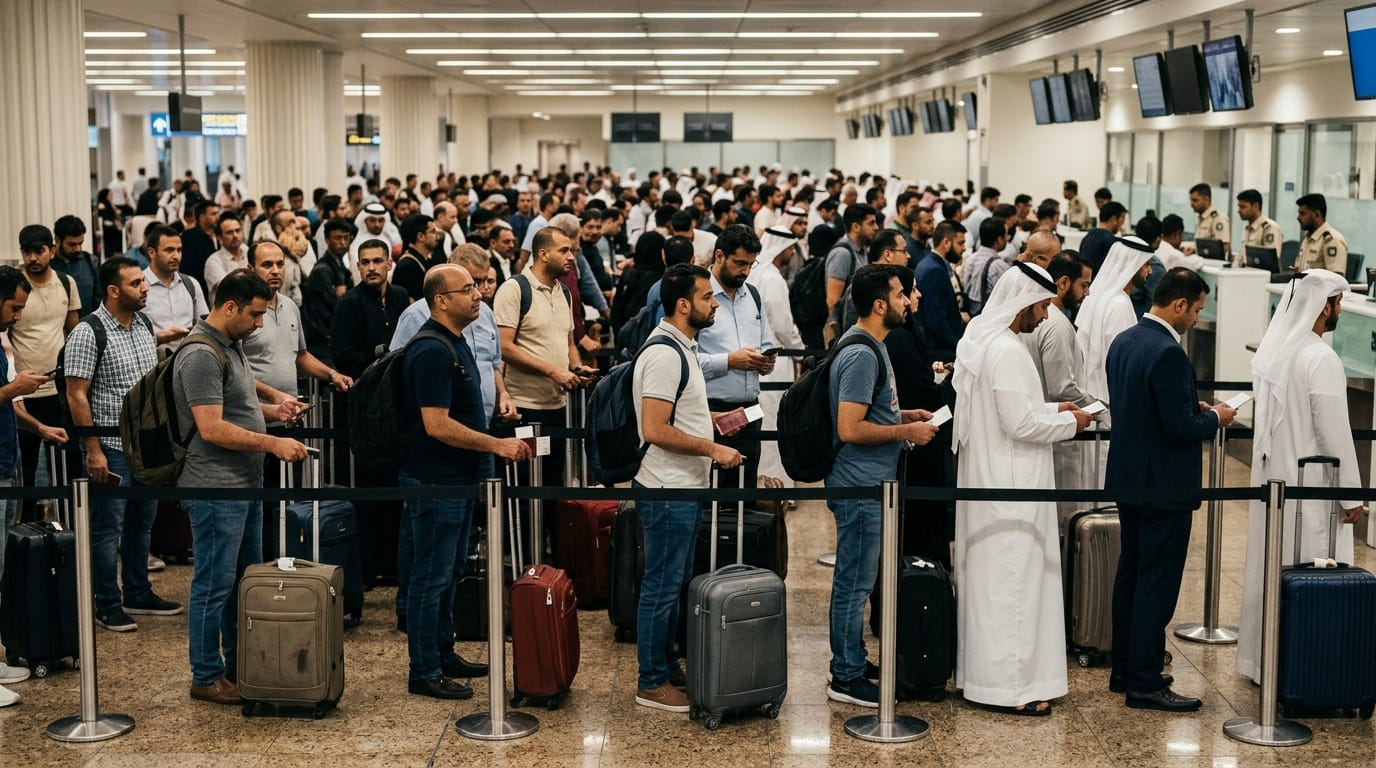
You will not be warned in advance at check-in. The check typically occurs at the immigration control point, after you have already completed airline check-in. If a restriction is found at that stage, you will not be permitted to board, your passport may be held temporarily, and you will be directed to the relevant authority.
This is why checking your status before reaching the airport — not at the departure gate — is the only sensible approach.
Can Residents and Tourists Be Treated Differently?
Practically speaking, yes. UAE residents (visa holders) have Emirates IDs and are more easily traceable through the national system. Traffic fines, court records, and immigration databases are linked to Emirates ID numbers.
Tourists without a UAE residency visa who commit traffic violations may have fines recorded but enforcement is more difficult once they have left the country. However, if a tourist is involved in a serious accident that triggers a police investigation, immigration authorities may flag their passport at the border during the investigation period.
Rental car companies are also responsible for disclosing driver information when fines are issued to their vehicles — the fine is typically transferred to the driver’s record if their details are provided.
What Happens If You Ignore Court Notices?
Ignoring court notices in the UAE is one of the most common and avoidable mistakes expatriates make. The consequences follow a predictable path:
- A summons is sent (by SMS, registered mail, or sometimes through the employer)
- If ignored, a hearing may proceed in your absence (in absentia)
- A judgment is issued against you without your input or defence
- The judgment becomes enforceable — including the option for the winning party to request a travel ban
- You may remain unaware of the judgment until stopped at the airport
In some cases, particularly involving criminal traffic offences, ignoring summons can itself lead to an arrest warrant, which has immediate implications for travel and residence status.
🚨 Scam Warning: Some individuals and unofficial “legal services” claim they can check or clear travel bans for a fee — without going through official UAE channels. These services are unreliable and potentially fraudulent. Only UAE-licensed lawyers and official government portals should be used for any legal status inquiry or travel ban resolution. Never pay cash to an individual claiming to “fix” a travel ban outside of official legal proceedings.
Real Case Studies: Workshop and Market Logs
Case Study 1 — Pakistani Engineer, Dubai, Minor Fines Accumulated
A Pakistani engineer working in Dubai had accumulated traffic fines totalling around 4,800 AED over two years — primarily speeding and signal violations. He was unaware of most of them as the notices went to an old address. When he attempted to renew his vehicle registration at a Tasjeel centre in Al Quoz, the system flagged all outstanding fines and blocked renewal until paid. He paid the full amount, received immediate digital confirmation, and renewed his registration the same day. He was able to travel home the following week without any issues.
Example scenario based on recurring UAE market patterns observed across vehicle registration centres.
Case Study 2 — Filipino Driver, Sharjah, Injury Accident
A Filipino logistics driver was involved in a minor rear-end collision on Emirates Road in Sharjah. The other driver reported whiplash injuries and filed a case with Sharjah Police. A police investigation followed, and the Filipino driver received an SMS summons from the Public Prosecution. He initially assumed it was a standard fine notification and did not respond. A hearing was held in his absence, and a civil compensation judgment between 15,000 and 20,000 AED was issued against him. The other party subsequently applied for a travel ban through the Sharjah Court enforcement department. The driver only discovered the ban when attempting to travel home for a family emergency. Resolution required engaging a Sharjah-licensed lawyer, settling the compensation with a payment plan approved by the court, and waiting approximately three weeks for the ban to be formally lifted in the system.
Documented case type; specific details modified for privacy.
Case Study 3 — British Expat, Abu Dhabi, Serious Speeding
A British professional living in Abu Dhabi was caught driving at significantly above the speed limit on the Abu Dhabi–Dubai highway. The case was classified as a serious traffic violation and referred to Abu Dhabi courts. He received a summons, attended all hearings with a lawyer, and was issued a fine and a short driving ban. Because he engaged with the process fully and settled all penalties before travelling, no travel restriction was imposed. He was able to travel home to the UK two months after the initial incident.
Example scenario based on recurring UAE market patterns observed in Abu Dhabi traffic court records.
Common Myths About Traffic Fines and Travel Bans
| Myth | Reality |
|---|---|
| Any unpaid fine causes an automatic travel ban | Not accurate. Standard administrative fines block registration renewal, not travel |
| Traffic fines automatically become criminal matters | Only when the offence itself is criminal (DUI, fatal accidents, reckless driving) |
| Police stop everyone with unpaid fines at the airport | Airport checks are for judicial travel bans — not unpaid fine lists |
| Ignoring fines for years has no serious consequences | Consequences include blocked registration, licence renewal failure, and potential civil enforcement |
| Paying fines immediately lifts a travel ban | A travel ban requires a separate legal process to lift — payment of fines alone is insufficient if a ban was issued by a court |
| A friend can pay your fines and it removes all problems | Third-party fine payment is possible for standard fines, but court judgments require formal legal settlement |
Common Mistakes Expats Make
- Assuming silence means no problem. Not receiving notices (due to address changes or language barriers) does not prevent proceedings from advancing.
- Conflating different types of travel restrictions. A system block on vehicle registration is not the same as a travel ban.
- Paying fines through unofficial third parties. Always pay through government portals and keep receipts.
- Leaving the UAE immediately after an accident. If a case is opened and you leave without notifying relevant authorities, your legal position worsens considerably.
- Not checking fines across multiple Emirates. Fines from Abu Dhabi do not appear on Dubai systems and vice versa.
- Assuming employer handles everything. Traffic fines on a personal vehicle remain your personal responsibility, even if company-related.
- Ignoring SMS messages from government numbers. Court summons and police notifications frequently arrive by SMS in the UAE.
Documents You May Need
If you are dealing with a court case, travel ban inquiry, or formal legal process, having these documents ready saves significant time:
- Valid passport (original)
- Emirates ID (original and copy)
- UAE driving licence
- Traffic file number (from the police report if an accident occurred)
- Vehicle registration (Mulkiya) — original and copy
- Court case number (if a case has been filed)
- All payment receipts for fines or settlements
- Insurance policy documentation
- Any written correspondence with police, courts, or other parties
How Long Can a Travel Ban Last?
A travel ban remains in place until the court that imposed it formally lifts it. There is no automatic expiry. If an underlying case remains open for years, the ban can remain active for years.
Checking periodically whether a ban has been formally lifted — rather than assuming it has — is advisable after any settlement or case closure.
Can Someone Else Pay Your Traffic Fines?
For standard administrative traffic fines, yes. A third party can pay on your behalf through government portals using your plate number or traffic file number. The payment is recorded against your record regardless of who initiates it.
For court-ordered payments or formal legal settlements, the process is more structured. The payment typically needs to be made through the court’s designated payment system, and a formal receipt from the court is required to confirm closure. A lawyer is usually involved to ensure the payment is correctly recorded and the case formally closed.
How Employers May Be Affected
If you drive a company vehicle, traffic fines are initially issued against the vehicle registration — which is in the company’s name. The company can transfer fines to the driver’s name through police or traffic authority procedures.
Some employers in the UAE have HR policies requiring employees to clear all personal traffic violations before they affect vehicle registration or company operations. Fleet vehicle fines, if left unpaid by the driver, can block the company’s fleet registration renewals.
Regarding business travel: a personal travel ban on an employee does not prevent the company from operating, but it directly prevents that individual from travelling for work purposes.
Tips to Avoid Travel Problems Before Leaving UAE
Practical pre-departure checklist:
| Action | When to Do It | Where |
|---|---|---|
| Check all traffic fines (Dubai, Abu Dhabi, Sharjah separately) | At least 2 weeks before travel | RTA, Dubai Police app, TAMM, Sharjah Police |
| Pay all outstanding fines and obtain receipts | Immediately after check | Government portals / service centres |
| Check for any court cases involving your name or vehicle | If you had any accident or received any summons | Dubai Courts, Abu Dhabi Judicial Department, lawyer |
| Verify residency and visa status | At least 1 month before travel | ICA Smart Services |
| Confirm vehicle registration is valid if driving to airport or border | Before departure | Tasjeel / RTA |
| If any doubt about legal status — consult a lawyer | At least 3 to 4 weeks before travel | UAE-licensed legal consultant |
Insurance vs Legal Action — Understanding the Difference
Many expatriates confuse insurance claims with legal proceedings, which leads to taking the wrong steps after an accident.
| Action | Against Whom | Based On | Typical Outcome |
|---|---|---|---|
| Insurance Claim | Your insurance company | Your policy type (third party or comprehensive) | Vehicle repair, medical cost coverage — subject to policy limits |
| Legal Action (Civil) | The at-fault driver personally | Evidence of fault and damages | Court-ordered compensation — outcomes vary significantly based on evidence |
| Criminal Prosecution | State prosecution of the offender | Criminal offence classification | Fine, jail, deportation, licence cancellation |
Buyers may have legal remedies depending on evidence and the specific circumstances of the transaction or accident. Outcomes vary significantly based on available documentation. For more on navigating legal liability after UAE road accidents, that guide covers the civil and criminal dimensions in detail.
Evidence Checklist
If you are involved in any traffic incident that could lead to legal proceedings, document everything immediately.
| Item | Why It Matters |
|---|---|
| Photos of the accident scene and vehicle damage | Visual evidence of the incident as it occurred |
| Police report number | Official record — required for insurance and court |
| Other driver’s details (licence, Emirates ID, insurance) | Needed for any claim or legal action |
| Witness names and contact details | Supporting evidence for your account |
| Your insurance policy document | Required to file a claim |
| Vehicle registration (Mulkiya) | Proves ownership and registration status |
| Dashcam footage if available | Often the strongest evidence in UAE traffic cases |
| All court summons or notices received | Proof of notification — never discard these |
Process Timeline for Travel Ban Resolution
| Stage | Typical Timeframe |
|---|---|
| Discover you have a travel ban | Day 1 |
| Consult a UAE-licensed lawyer | Day 1 to 3 |
| Identify the source case and court | 1 to 5 business days |
| Settle the underlying matter (payment, negotiation, or hearing) | Days to weeks, depending on complexity |
| Court issues formal ban-lifting order | Several business days after settlement |
| Immigration system updated | 24 to 72 hours after court order |
| Confirm via official channel before travel | Do this before booking departure |
The Bottom Line Decision Framework
| Your Situation | Recommended Action |
|---|---|
| Only unpaid traffic fines — no accidents, no court cases | Pay fines online before travel. No ban expected. Renew registration separately. |
| Had a minor accident, police report filed, no injuries, no summons received | Check RTA and Dubai Police for any pending cases. Confirm insurance settlement. Travel should be possible. |
| Received a court summons at any point — even if old | Consult a UAE lawyer immediately. Do not assume it resolved itself. Verify court status before travel. |
| Involved in an accident with injuries, criminal referral, or hit and run | Engage a UAE lawyer without delay. Attend all hearings. A travel ban may be in place. |
| Leaving the UAE permanently — uncertain about status | Clear all fines, verify no court cases, transfer or sell vehicle properly, confirm residency cancellation process. Budget several weeks. |
| Discovered a travel ban at the airport | Do not argue with immigration. Accept the situation calmly, contact a lawyer, and follow the official resolution process. |
If you are planning to sell your vehicle before leaving, this guide on selling your car when leaving the UAE covers the documentation steps and common pitfalls in detail. For those who have already left and are managing vehicle transfer, understanding what happens to your car when you leave the UAE explains the obligations and consequences clearly.
Data Sources & Methodology
The information in this article is based on publicly available UAE government procedural guidelines, UAE traffic law frameworks, court procedural documentation from Dubai Courts and Abu Dhabi Judicial Department portals, and patterns observed across expatriate legal cases in UAE automotive and traffic contexts.
References used include:
- Roads and Transport Authority Dubai (rta.ae)
- Dubai Police (dubaipolice.gov.ae)
- UAE Ministry of Interior (moi.gov.ae)
- ICA Smart Services (smartservices.ica.gov.ae)
- Dubai Courts (dc.gov.ae)
- TAMM Abu Dhabi (tamm.abudhabi)
- Sharjah Police (sharjahpolice.gov.ae)
- Abu Dhabi Judicial Department (adjd.gov.ae)
💡 Market Volatility Notice: All fees, fine amounts, and procedural timelines mentioned in this article are general estimates based on available information as of the publication date. UAE government fees, traffic fine structures, court fees, and legal costs are subject to change. Verify current figures directly with the relevant UAE authority or a licensed UAE legal consultant before taking any action. Emirates Cars reviews this article periodically as UAE procedures evolve.
Scam Prevention: Unofficial “Travel Ban Clearance” Services
A persistent pattern observed in expatriate communities across Dubai and Sharjah involves individuals or unofficial services claiming to clear travel bans for a cash fee — outside of any formal legal process. These services are not legitimate.
Travel bans in the UAE are judicial or administrative records. They cannot be “cleared” by a middleman paying someone in a government office. The only way to lift a travel ban is through the official legal process: settling the underlying case, obtaining a court order, and having that order transmitted to the relevant immigration authority.
🚨 Avoid: Anyone who offers to check or “remove” your travel ban without involving a licensed UAE lawyer and official court processes. If you pay such a service, you may lose money and still have the ban in place. Use only official government portals or licensed UAE legal professionals.
For guidance on how to handle used car disputes and fraud documentation — which sometimes intersect with legal proceedings — this evidence checklist guide is relevant for anyone managing a formal complaint in the UAE.
Frequently Asked Questions
Final Practical Advice
For most expatriates in the UAE, unpaid traffic fines are an administrative issue, not a legal emergency. Pay them before vehicle registration renewal and they will not affect your travel. The risks change when accidents involve injuries, when criminal conduct is involved, or when court proceedings are ignored.
The consistent pattern observed across expatriate cases in the UAE is this: problems escalate not because of the initial incident, but because of non-engagement. Missing a court summons, ignoring an SMS from the Public Prosecution, or assuming a case has closed without verification — these are the most common reasons expatriates find themselves with unexpected travel restrictions.
Check your fine status periodically — at least before any vehicle registration renewal and before any planned travel. If you have been involved in any accident with injuries, consult a UAE lawyer regardless of how minor the incident seemed. And if you receive any document, SMS, or notification from a government authority or court that you do not fully understand, get it properly translated and assessed before deciding to ignore it.
For those preparing to leave the UAE for good, the complete expat guide to UAE traffic fines covers what needs to be cleared, transferred, or cancelled before departure. Managing these steps properly is the difference between a straightforward exit and a complicated one.
Quick Checklist Before Going to the Airport
- ✔ Check all outstanding traffic fines (Dubai, Abu Dhabi, and Sharjah separately)
- ✔ Pay any fines and save digital payment receipts
- ✔ Check for any pending court cases or summons via Dubai Courts portal
- ✔ Carry your Emirates ID and passport — both originals
- ✔ Verify no police cases are open related to any past accident
- ✔ Confirm travel status via ICA Smart Services or a UAE lawyer if any doubt exists
- ✔ If involved in any accident with injuries — consult a lawyer before travel, not after
- ✔ Ensure your vehicle registration is valid if driving to the airport
💡 Key Takeaway: Most unpaid traffic fines in the UAE do not automatically create a travel ban. Travel restrictions usually arise only when a traffic incident develops into a criminal investigation, a court case, or an unpaid judicial order. Always verify your legal status before international travel if you have ever been involved in a serious road incident.
Disclaimer: Emirates Cars is a 100% independent platform. We do not own showrooms, nor are we affiliated with any used car dealerships or garages. Our sole mission is to protect expats from financial fraud in the automotive market.
