Last Updated: July 2026 | By Omar Al-Fayed, Senior Automotive Consultant | Fact-Checked By: Emirates Cars Editorial Team | Category: Buying & Selling
Every month, expats in the UAE discover — sometimes weeks after signing — that the used car they purchased has a hidden accident history, a rolled-back odometer, or documents that do not match reality. The financial loss typically falls between 5,000 and 30,000 AED depending on the severity, and recovery is rarely straightforward.
This guide explains how scams happen, how to recognize them before you pay, and what practical steps you can take if you have already been affected.
⚠ Legal Disclaimer: The information provided in this article is for educational purposes only. UAE legal procedures, consumer protection processes, and police procedures may change over time. Readers should verify current requirements with a licensed UAE legal consultant or official government portals before taking formal legal action. This guide is reviewed periodically as Dubai Courts and police procedures evolve.
A Realistic Example of a Used Car Scam in the UAE
Example scenario based on recurring UAE market patterns, not an actual documented case.
A Filipino logistics worker in Sharjah finds a 2017 Toyota Corolla on Dubizzle for 28,000 AED — roughly 4,000 AED below similar listings. The seller replies quickly, says he is leaving the country in five days, and offers a short test drive. The car looks clean. The Mulkiya appears genuine. The seller shows a few service receipts from an Al Quoz workshop.
Three weeks later, during a routine check at a Tasjeel center, the inspection technician finds structural frame damage consistent with a significant front-end collision. A CarFax-equivalent check shows the vehicle was involved in an accident in the US before being re-exported. The buyer paid full price for a salvage-title import with a locally repainted body. Total estimated repair or resale loss: between 12,000 and 18,000 AED.
This scenario repeats in variations across Dubai, Sharjah, and Abu Dhabi every week. The details change — the make, the seller story, the platform — but the core mechanics are consistent.
Why Used Car Scams Are Increasing in the UAE
The UAE used car market has grown significantly over the past five years. Online platforms like Dubizzle and Facebook Marketplace allow private sellers to list vehicles with minimal verification. This creates conditions where misrepresentation is easy and accountability is difficult.
Three factors drive the current environment:
- High volume of imported vehicles: Many cars arrive from the US, Canada, and Europe through grey-market channels. Some carry salvage or rebuilt titles that are not disclosed to UAE buyers.
- Fast seller turnover: Expats leaving the country often sell quickly, creating pressure tactics that push buyers to decide fast.
- Limited buyer verification habits: Many buyers, especially newer residents, rely on visual inspection and a short test drive rather than independent technical assessment.
Most Common Used Car Scams in the UAE
Fake or Altered Documents
Sellers present photocopied or digitally edited Mulkiya documents, fake service records, or forged ownership transfer papers. The risk is higher in private sales than through licensed dealers.
Hidden Accident History
Vehicles with previous structural damage are repainted and sold without disclosure. Body filler, mismatched paint, and uneven panel gaps are common indicators, but professional-level repairs can hide these from untrained eyes.
Odometer Rollback
Digital odometers can be reset using OBD tools available in certain workshops. A car showing 60,000 km may have actually covered 160,000 km. Verifying mileage against service records and internal wear patterns is essential.
Cloned VIN Numbers
In rare but documented cases, VIN plates are replaced to make a stolen or salvage vehicle appear legitimate. Always verify the VIN in at least three locations: the dashboard plate, the door frame sticker, and the chassis stamping under the hood.
Fake Deposit Requests
A seller asks for a “holding deposit” — typically 500 to 2,000 AED — to reserve the car while you arrange financing or inspection. Once paid, the seller becomes unreachable.
Stolen Vehicles
Some vehicles in circulation carry legitimate-looking papers but are reported stolen in another emirate or country. Ownership cannot be transferred, and the vehicle may be impounded.
Flood-Damaged Vehicles
After flooding events in the US, Canada, and increasingly in the UAE itself, flood-damaged cars enter the market at discounted prices. Rust in unusual locations, electrical faults, and musty odors often indicate water damage history.
Salvage Import Cars
Vehicles rebuilt after major collisions in North America or Europe are commonly re-exported to the UAE. They are sold as US-spec imports without disclosing the salvage status. Parts availability, safety performance, and resale value are all significantly affected.
🚨 Highest-Risk Trap for Expats: A seller asking for a deposit before an independent inspection is the most common first step in a scam. Never transfer any money — including a “small holding fee” — before a professional inspection is completed and before you have personally verified the VIN and confirmed the Mulkiya is genuine through the RTA or Tasjeel system.
Why Expats Become Easy Targets
New UAE residents often face a combination of factors that increase their vulnerability:
- Unfamiliarity with local vehicle documentation standards
- Time pressure from visa processing or accommodation situations
- Language gaps that make reading fine print difficult
- Lack of established contacts for trusted mechanics or inspection centers
- Tendency to trust a seller who shares the same nationality
- Over-reliance on Tasjeel as a guarantee of vehicle condition (it is not — it tests roadworthiness, not structural or mechanical history)
Early Warning Signs Before Meeting the Seller
| Warning Sign | What It May Indicate |
|---|---|
| Price 15% or more below market average | Hidden defect, urgency to sell, or fraudulent listing |
| Seller refuses to share VIN before meeting | Salvage history or cloned plate concern |
| Only available via WhatsApp, no call | Possible fake identity |
| Listing posted for less than 24 hours but “many buyers interested” | Urgency pressure tactic |
| Seller claims to be leaving the UAE within days | Common exit pressure used across most scam types |
| Photos show showroom-clean car but only exterior shots | Interior or undercarriage issues being hidden |
Warning Signs During Vehicle Inspection
Rushed Inspection
A legitimate seller has no reason to limit your inspection time. If the seller seems impatient, repeatedly checks the time, or schedules the meeting at dusk when lighting is poor, treat this as a signal.
Refusal for Independent Inspection
Any seller who refuses to allow an independent pre-purchase inspection at a neutral workshop should be considered a risk. Reputable sellers encourage this — it speeds up the sale and builds trust.
Inconsistent Answers
Ask the same question twice in different ways (service history, previous owner count, accident history). Inconsistent or evasive answers indicate withheld information.
Pressure to Decide On-Site
“I have two other buyers coming tomorrow” is a line used consistently by sellers who know the car will not survive a proper inspection. Leave if this pressure appears before inspection is complete.
Red Flags in Advertisements
- Mileage listed as “approximately” rather than an exact figure
- Description says “minor accident, fully repaired” without documentation
- No service history mentioned at all
- Photos taken indoors or in poor lighting
- Listing mentions “US spec” or “export model” without explaining import documentation
- Contact number does not have a UAE country code or is listed as “overseas”
Red Flags in Vehicle Pricing
Use the current UAE market price guides as your reference. A 2019 Toyota Corolla in fair condition with GCC spec and a clean history typically sells for between 45,000 and 55,000 AED depending on mileage and emirate. If a listing offers the same car at 35,000 AED with no explanation, the gap represents either a hidden problem or a fraudulent listing.
Prices that are too low are not opportunities — in the UAE used car market, they are almost always signals of an undisclosed issue.
How Fake Documents Are Used
Fake Mulkiya
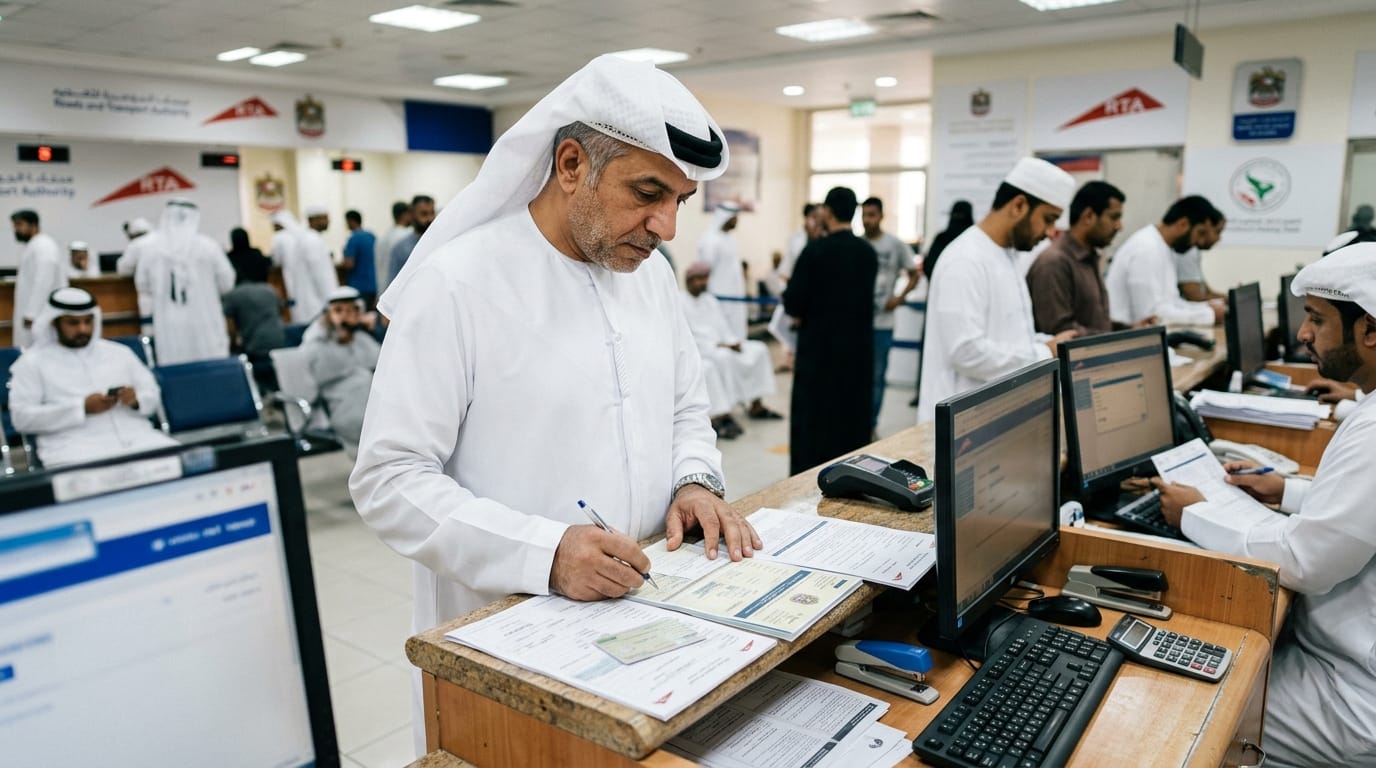
The Mulkiya (vehicle registration card) can be digitally forged. Signs include blurred text, inconsistent font sizes, and mismatched vehicle details. Always verify the Mulkiya directly through the RTA Dubai app or the Abu Dhabi DMT portal before any payment.
Fake Service Books
Printed service books with forged dealership stamps are sold in some wholesale markets. Cross-check service entries against the actual mileage progression — service intervals that show no increase in odometer reading across multiple entries are a clear sign of manipulation.
Fake Invoices
Sellers sometimes present invoices from closed workshops or use real workshop names with invented invoice numbers. Ask for the workshop name, visit or call them independently, and verify the job card number.
How Odometer Fraud Happens
Odometer tampering in the UAE typically uses one of two methods: direct OBD-II port manipulation using commercially available mileage correction tools, or ECU cluster replacement with a lower-reading unit from a donor vehicle.
Detection methods available to buyers:
- Request a Carfax or AutoCheck report if the vehicle was imported from North America
- Check brake and clutch pedal wear against stated mileage
- Inspect tire tread — original tires typically last 40,000 to 60,000 km under UAE conditions
- Ask an independent mechanic to read internal ECU data logs
- Compare service history dates and mileage entries for logical progression
Hidden Accident Scams
Structural damage repairs can be visually masked, but physical evidence typically remains. During inspection, check:
- Panel gaps — uneven spacing indicates panel replacement
- Paint overspray on rubber seals or under-hood areas
- Body filler — use a magnet on body panels; filler areas will not attract it
- Alignment of hood, trunk, and doors
- Undercarriage for bent subframe rails or weld evidence
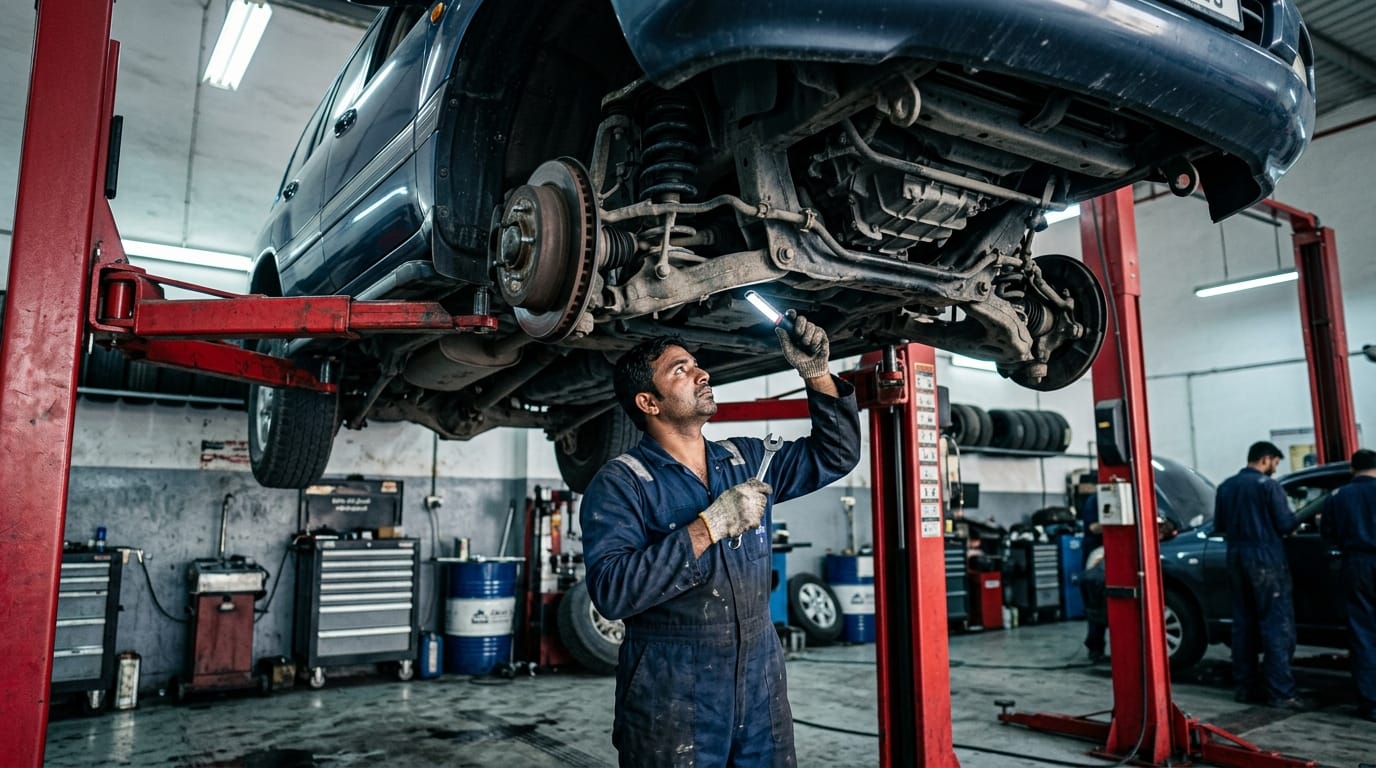
Professional inspection centers in Al Quoz and the Sharjah Industrial Area commonly use lift inspections and paint thickness meters as standard tools. Request both during any pre-purchase inspection.
Flood-Damaged Vehicles
Flood-damaged cars entering the UAE market often originate from post-storm inventory in the US Gulf Coast states or Canada. After the 2024 UAE rains, locally affected vehicles also entered the used market. Signs include:
- Rust on metal clips and brackets inside door panels
- Electrical faults that appear intermittently (windows, central locking, instrument cluster)
- Musty or chemical odor from carpet or HVAC system
- Waterline stains on seatbelt webbing or under the dashboard
- Corroded fuse box contacts
⚠ Note on Flood Cars: Not every vehicle with some water exposure history is unsalvageable. Some vehicles with properly documented repairs, full disclosure from the seller, and an independent inspection may represent a calculated purchase at an appropriate discount — provided the buyer fully understands the ongoing electrical and mechanical risks involved.
Imported Salvage Cars
Salvage-title vehicles are legal to sell in the UAE, but sellers are not consistently required to disclose this status. The key risks include compromised structural safety in secondary impact, difficulty obtaining comprehensive insurance, and significantly lower resale value. Always run a VIN check against US and Canadian title databases if the vehicle has been imported from those markets.
How to Verify Vehicle Documents
| Document | Verification Method |
|---|---|
| Mulkiya (Registration Card) | RTA Dubai app → Vehicle Services → Check Vehicle Details. Abu Dhabi: DMT app or website. |
| VIN | Cross-check dashboard VIN, door sticker, and chassis stamp. Run through Dubai Police stolen vehicle check. |
| Insurance validity | Check insurer name and expiry on Mulkiya — verify with the insurance company directly. |
| Accident history (local) | RTA Dubai traffic history or Abu Dhabi Police portal for accident records. |
| Accident history (imported) | Carfax.com or AutoCheck.com for US/Canada imports using the full VIN. |
How to Verify Accident History
For vehicles with full UAE history, the accident history check through the RTA or Abu Dhabi Police portals provides a report of registered incidents. This covers accidents reported to police and processed through official channels. Private-party incidents settled without police involvement will not appear.
For imported vehicles, a Carfax report using the full 17-digit VIN provides US and Canadian title, accident, and odometer history. The fee is typically between 30 and 50 USD per report and is worth paying before any significant purchase.
How to Verify Service History
Authorized dealer service history can be verified by visiting the official dealership with the VIN and asking service reception to confirm recorded visits. Independent workshop history is harder to verify but can be cross-checked by calling the workshop and providing the plate or VIN number.
If the seller claims regular servicing but cannot produce a single original invoice or job card, the history claim is unverifiable. Factor this into your offer price accordingly.
How to Verify VIN
Check the VIN in three locations:
- Dashboard plate (visible through the windshield, driver’s side)
- Driver’s door frame sticker
- Chassis stamping under the hood on the engine bay firewall
All three must match exactly. Any discrepancy — including a single character — indicates tampering and the vehicle should not be purchased.
Professional Inspection Checklist
flowchart TD
    A[Buyer Identifies Used Car Online] --> B{Pre-Purchase Inspection?}
    B -->|No / Rushed| C[Transfer Funds & Complete RTA Registration]
    B -->|Yes / Professional| D[Run VIN Check & Workshop Diagnosis]
    C --> E[Hidden Fraud / Odometer Rollback Discovered]
    E --> F[Initiate Legal & Consumer Protection Recovery]
    D -->|Faults Found| G[Walk Away / Cancel Transaction]
    D -->|Clean History| H[Safe Secure Purchase Execution]
    classDef default fill:#000000,color:#ffffff,stroke:#000000;
A pre-purchase inspection at a reputable center in Al Quoz or Abu Shagara typically covers:
| Inspection Area | What Inspectors Check |
|---|---|
| Body and paint | Paint thickness meter, panel alignment, filler detection |
| Undercarriage | Frame rails, subframe, suspension components, rust |
| Engine bay | Oil leaks, coolant condition, belt wear, VIN stamping |
| OBD-II scan | Fault codes, mileage ECU reading, transmission data |
| Electrical systems | AC, windows, lighting, instrument cluster |
| Tires and brakes | Tread depth, pad thickness, rotor condition |
| Fluid levels and condition | Engine oil, transmission fluid, brake fluid, coolant |
Cost at independent Al Quoz inspection centers: typically between 200 and 500 AED depending on the scope. This is among the most cost-effective investments in the buying process.
Questions Every Buyer Must Ask
- How many previous owners has this vehicle had?
- Has it ever been involved in an accident, even minor?
- Is it GCC specification or imported from another market?
- Why are you selling it at this price?
- Can I take it to an independent mechanic for inspection before we agree?
- Can you share the full service history documents?
- Are there any existing fines or Salik charges on the vehicle?
- Is the vehicle currently insured and is the insurance transferable?
Documents Every Buyer Should Request
- Original Mulkiya (not a photocopy)
- Seller’s Emirates ID (not just a photo — verify it is current)
- All available service invoices and job cards
- Insurance policy documents
- Any previous inspection reports
- Written confirmation of the purchase price and vehicle details (WhatsApp message is sufficient as evidence)
Safest Payment Methods
| Payment Method | Safety Level | Notes |
|---|---|---|
| Bank transfer simultaneous with ownership transfer | High | Pay only at the point of RTA transfer completion |
| Manager’s cheque / bank draft | High | Traceable and reversible in fraud cases with police involvement |
| Cash | Medium | Untraceable — obtain a signed receipt with seller Emirates ID details |
| Advance deposit via bank transfer | Low | High risk before inspection and verification are complete |
| Cash advance before inspection | Very Low | No recourse if seller disappears |
When You Should Walk Away Immediately
- Seller refuses any independent inspection
- VIN numbers do not match across locations
- Seller requests cash deposit before inspection
- Mulkiya verification shows different owner than the person you are meeting
- Service history documents appear printed rather than original
- Seller becomes aggressive or evasive when asked straightforward questions
- Vehicle has active fines or loan obligations the seller cannot immediately resolve
What If You Already Paid?
flowchart TD
    A[Discover Fraud After Purchase] --> B[Preserve All Evidence & Digital Logs]
    B --> C[Obtain Official Technical Inspection Report]
    C --> D{Is Seller a Licensed Dealer?}
    D -->|Yes| E[File Dispute with Dubai Economy & Tourism DET]
    D -->|No - Private Expat| F[File Official Criminal Complaint at Police Station]
    E --> G{Resolution Achieved?}
    F --> H[Escalate to Dubai Courts Small Claims Track]
    G -->|No| H
    G -->|Yes| I[Financial Recovery & Refund Executed]
    H --> I
    classDef default fill:#000000,color:#ffffff,stroke:#000000;
If you have paid and subsequently discovered misrepresentation, take these steps in order:
- Do not modify or repair the vehicle — preserve it as evidence
- Collect an independent inspection report from a licensed workshop
- Gather all communication with the seller (WhatsApp, SMS, calls)
- Obtain a printed copy of the original Dubizzle or Facebook listing if still live
- Visit the nearest police station and file a report with all documentation
- Contact Dubai Consumer Protection or the relevant emirate’s consumer authority
What Evidence Should You Keep?
ℹ️ Evidence Checklist: Save all of the following from the moment you begin considering a purchase — not only after a problem appears.
| Evidence Type | Why It Matters |
|---|---|
| Screenshots of the original advertisement | Establishes what was represented to you |
| All WhatsApp and SMS conversations | Written record of seller’s claims |
| Payment receipt or bank transfer confirmation | Proves financial transaction |
| Pre-purchase inspection report | Documents what was known at time of purchase |
| Post-purchase independent inspection report | Establishes what was concealed |
| Photo of seller’s Emirates ID | Identity verification for police report |
| VIN photos from all three locations | Confirms vehicle identity consistency |
| Repair invoices after purchase | Quantifies financial harm |
Can Consumer Protection Help?
The UAE consumer protection framework covers automotive fraud cases, particularly where misrepresentation can be documented. In Dubai, the relevant authority is the Dubai Economy and Tourism — Consumer Protection Department. In Abu Dhabi, cases are handled through the Department of Economic Development.
Consumer protection processes generally work best when:
- The seller is a licensed dealer rather than a private individual
- The misrepresentation is documented in writing
- The complaint is filed promptly after discovery
Outcomes vary based on evidence quality and how the transaction was structured. Buyers may have remedies available, but results depend significantly on the specific circumstances.
Can Police Help?
Filing a police report is appropriate when there is evidence of deliberate fraud — forged documents, cloned VINs, or a seller who has clearly misrepresented the vehicle’s condition in writing. The police report creates an official record, which is a prerequisite for most formal complaint processes.
For civil disputes where fraud is unclear, the small claims track through Dubai Courts may be more appropriate than a criminal complaint. A small claims case in Dubai can be initiated with relatively low filing costs and does not require legal representation for straightforward disputes.
Can You Recover Your Money?
Recovery is possible in some cases, but is not guaranteed. Buyers may have legal remedies depending on available evidence and the specific circumstances of the sale. Outcomes vary significantly based on:
- Whether the seller is traceable and still in the UAE
- Whether fraud can be documented rather than suspected
- Whether the transaction involved a licensed dealer (stronger accountability) or a private party
- The quality and completeness of evidence collected
In cases where the seller has left the country, direct financial recovery becomes substantially more difficult.
Realistic Recovery Scenarios
Example scenario based on recurring UAE market patterns, not actual documented cases.
Scenario A — Licensed Dealer Misrepresentation: A Pakistani engineer in Dubai purchases a 2018 Nissan Altima from a licensed dealership in Al Quoz. Post-purchase inspection reveals three replaced panels not disclosed at time of sale. He files a consumer protection complaint with documentary evidence. The dealership, facing license risk, agrees to a partial refund of between 3,000 and 6,000 AED. The process takes four to eight weeks.
Scenario B — Private Seller, Traceable: A Bangladeshi driver in Sharjah purchases a car from a private seller and discovers the odometer has been manipulated. The seller is still in the UAE and traceable. With WhatsApp evidence of the seller’s mileage claims and an OBD report showing ECU discrepancy, a police complaint leads to a negotiated settlement. The process typically takes two to three months.
Scenario C — Private Seller, Already Left Country: A European expat discovers flood damage three months after purchase. The private seller has since left the UAE. With no seller jurisdiction, civil recovery is impractical. The buyer’s loss — between 8,000 and 15,000 AED in repair costs — is not recoverable through normal channels.
Common Buyer Mistakes
- Paying any money before a professional inspection is completed
- Accepting a Tasjeel pass certificate as proof of mechanical condition
- Trusting verbal assurances about service history without documentation
- Rushing the decision because the seller claims urgency
- Buying from a seller who shares your nationality without applying the same scrutiny
- Failing to run a VIN check on imported vehicles before purchasing
- Not photographing the seller’s Emirates ID at time of transaction
Dealer vs Private Seller Scam Risk
| Factor | Licensed Dealer | Private Seller |
|---|---|---|
| Accountability | Higher — trade license at risk | Lower — individual, often untraceable |
| Document fraud risk | Lower — licensed dealers face legal consequences | Higher — no formal oversight |
| Price negotiation | Less flexible but more transparent | More flexible but higher risk |
| Consumer protection recourse | Available through Consumer Protection departments | Limited to police complaint or civil court |
| Inspection permission | Usually permitted | Varies — refusal is a red flag |
| Post-sale recourse | Possible through formal complaint | Difficult, especially if seller leaves UAE |
Used Car Scam Prevention Checklist
| Step | Action |
|---|---|
| Before contacting seller | Compare listing price against market average; check listing age and seller profile history |
| First contact | Request VIN, full service history, and seller’s Emirates ID number before meeting |
| At inspection | Check all three VIN locations; use a magnet on body panels; check for paint overspray |
| Before paying | Verify Mulkiya through RTA app; run VIN check for imports; book independent workshop inspection |
| At payment | Pay only at or after RTA ownership transfer; use traceable payment method |
| After purchase | Keep all documents, receipts, and communications for at least 12 months |
How Experienced Buyers Avoid Fraud
Expats who have purchased multiple vehicles in the UAE develop consistent habits that reduce their exposure:
- They treat the independent inspection as non-negotiable, not optional
- They check the VIN before arranging the meeting, not during it
- They always meet at the vehicle’s registered location, not a neutral car park
- They use the test drive checklist systematically rather than relying on feel alone
- They walk away from urgency pressure without negotiating against themselves
- They contact trusted mechanics in Al Quoz before beginning their search, not after
Before You Transfer Ownership
The ownership transfer process in Dubai requires both parties to be present at an RTA center or approved typing center. Before completing the transfer:
- Confirm there are no outstanding fines or Salik charges (the seller is responsible for clearing these)
- Confirm no loan or bank lien is registered against the vehicle
- Verify insurance is valid or arrange your own policy to begin from transfer date
- Ensure the seller’s Emirates ID is valid — transfers cannot complete with an expired ID
- Keep your copy of the transfer receipt — it is your proof of legal ownership
Illustrative Field Scenarios: Workshop and Market Patterns
Example scenarios based on recurring UAE market patterns, not actual documented cases.
Al Quoz Workshop Pattern — Indian Engineer, Nissan Sunny: A buyer from India purchases a 2016 Nissan Sunny at 22,000 AED from a private seller in Deira. At a routine service two months later, an Al Quoz mechanic finds the transmission fluid has never been changed — the service book entries are present but the fluid condition is consistent with 100,000+ km of use. The stated mileage was 74,000 km. Estimated repair cost: between 1,500 and 4,000 AED depending on whether the CVT requires replacement. Lesson: service book entries can be forged; fluid condition cannot.
Sharjah Industrial Area Pattern — Pakistani Supervisor, Toyota Corolla: A buyer with 18 months left on his UAE contract purchases a 2017 Corolla for what appears to be a fair price. Post-purchase, a structural inspection at a Sharjah Industrial Area workshop identifies a replaced front crossmember — evidence of a significant collision. The vehicle had passed a Tasjeel check. Resale value is estimated at between 6,000 and 10,000 AED below market for a clean-history equivalent.
The Bottom Line Decision Framework
| Your Situation | Recommended Action |
|---|---|
| Price is 15%+ below market with no explanation | Request independent inspection before any discussion of payment |
| Seller refuses inspection or pushes urgency | Walk away — no exceptions |
| Vehicle is an import from the US or Canada | Run a Carfax report using the full VIN before meeting the seller |
| You have already paid and found a problem | Preserve evidence, get an independent inspection report, file a police complaint |
| Seller is a licensed dealer and problem is documented | File a consumer protection complaint — recourse is more accessible than with private sellers |
| Private seller has left the UAE | Options are limited; focus on insurance claim if comprehensive coverage applies |
| You want maximum protection from the start | Use only independent inspection, verify all documents before meeting, never pay a deposit before inspection is complete |
Scam Type vs Recommended Immediate Action
| Scam Type Discovered | First Action to Take |
|---|---|
| Hidden accident history | Book an independent structural inspection immediately — do not repair the vehicle before documenting the damage |
| Fake or altered documents | Verify the Mulkiya directly through the RTA Dubai app or Abu Dhabi DMT portal, then file a police report with the discrepancy documented |
| Odometer rollback | Request an ECU internal mileage scan at a trusted Al Quoz or Sharjah Industrial Area workshop — this produces a printable report as evidence |
| Fake deposit — seller disappeared | Contact your bank immediately with the transfer record, then file a police report — speed matters here as accounts can sometimes be flagged quickly |
| Flood-damaged vehicle | Get a full inspection covering the electrical system, undercarriage, and ECU fault codes before deciding whether to keep or resell the vehicle |
| Stolen vehicle identified post-purchase | Do not attempt to sell or modify the vehicle — contact Dubai Police or the relevant emirate’s police directly with your purchase documents |
Data Sources & Methodology
Information in this article is based on field observations from used car inspections in Al Quoz, Abu Shagara, and the Sharjah Industrial Area, combined with documented complaint patterns reported to UAE consumer protection authorities. Vehicle document verification procedures reference official processes published by the Road and Transport Authority and the Abu Dhabi Department of Municipalities and Transport.
Official sources referenced:
- RTA Dubai — Vehicle Services and Ownership Transfer
- Dubai Police — Stolen Vehicle Check
- Dubai Economy and Tourism — Consumer Protection
- Abu Dhabi Department of Municipalities and Transport
- Carfax — US and Canada Vehicle History Reports
ℹ️ Market Volatility Notice: All price ranges, repair cost estimates, and market averages in this article reflect conditions observed across UAE workshops and platforms at time of publication. Prices in the UAE used car market shift with exchange rates, demand cycles, and import volumes. Always verify current prices directly with sellers, dealers, and workshops before making any purchase decision.
Frequently Asked Questions
If something feels wrong during the buying process, walk away. Another car will always be available, but recovering money after fraud is usually much harder.
Disclaimer: Emirates Cars is a 100% independent platform. We do not own showrooms, nor are we affiliated with any used car dealerships or garages. Our sole mission is to protect expats from financial fraud in the automotive market.

You’re so interesting! I don’t think I’ve truly read through anything like this before.
So wonderful to find another person with original thoughts on this subject matter.
Seriously.. thanks for starting this up. This website is one thing that is required on the web,
someone with a bit of originality!
Thank you so much for your support. I was very pleased with your comment.