
Last Updated: July 2026 | By Omar Al-Fayed, Senior Automotive Consultant | Category: UAE Market News
Short answer: yes, some used Japanese cars in the UAE are genuinely cheaper than comparable Korean models, but this is not a fixed rule. The price gap usually comes from mileage, trim level, accident history, or import origin — not from Japanese cars being inferior.
A high-mileage Toyota Corolla can sell for less than a low-mileage Hyundai Elantra of the same year. Buyers should compare condition and history, not just the badge, before assuming a cheaper Japanese car is automatically the better deal.
Many expats searching Dubizzle or local car marketplaces notice that a used Toyota or Honda can list for less than a similarly aged Hyundai or Kia. This section explains why, and when the opposite is true.
Why Buyers Notice This Price Gap
Price differences between Japanese and Korean used cars in the UAE depend on several factors working together, not one single reason.
- Model year and generation — an outgoing Japanese generation can undercut a newer Korean redesign.
- Mileage — fleet-used Japanese sedans from taxi or rental service often carry higher odometer readings.
- Accident or flood history — undisclosed repair work lowers price regardless of brand.
- Import origin — GCC-spec cars typically hold value better than US-spec or grey-market imports.
- Supply volume — Toyota and Nissan sedans are more common in the UAE resale pool, which increases competition among sellers and can push prices down.
Japanese vs Korean Used Car Market in UAE
Japanese brands (Toyota, Nissan, Honda, Mazda) have a long-established presence in the UAE through fleet, rental, and ride-hailing use, which means higher used-car supply. Korean brands (Hyundai, Kia) have grown their private ownership base significantly over the past decade, supported by generous factory warranties and competitive financing at the point of new purchase. A larger share of Korean used stock tends to come from private owners upgrading their vehicle rather than from fleet turnover, which affects average mileage and condition on the resale market.
Expat tip: a car’s fleet or rental history (common with some Japanese sedans) is not automatically a red flag — but it should lower your expected price and increase your inspection priority on the transmission and suspension.
Why Some Japanese Cars Become Cheaper
The most common reasons a Japanese used car undercuts a Korean equivalent include an older platform generation still on sale, mileage above 120,000 km, a documented accident repair, previous rental or ride-hailing service, non-GCC import origin, or an unpopular trim with fewer factory options. Oversupply of certain models, particularly the Toyota Corolla and Nissan Sunny, also puts consistent downward pressure on asking prices.
⚠ The biggest risk in this price gap: sellers sometimes price a Japanese car “too well” specifically because it has undisclosed flood or major accident damage. A price that is noticeably below the market range for that model and year deserves an independent inspection before any deposit is paid.
When Korean Cars Become More Expensive
Korean used cars can cost more than a comparable Japanese model when the vehicle is a newer import with low mileage, still carries part of its original manufacturer warranty, includes higher factory trim (leather, panoramic sunroof, larger touchscreen), or was financed rather than fleet-operated, keeping mileage and wear lower. Buyers who value warranty coverage and equipment often accept a higher purchase price for these reasons.
Price Comparison: Common Market Examples
The table below reflects a cross-checked market range for popular models around 5–6 years old (roughly 2019–2020), based on active UAE marketplace listings and platform-published averages as of mid-2026. Actual prices vary by trim, condition, and seller type — treat these as Market Estimates, not fixed prices.
| Model (approx. 2019–2020, 5–6 years old) | Typical Price Range (AED) | Notes |
|---|---|---|
| Toyota Corolla | 35,000 – 45,000 | 1–2 year old examples run roughly 50,000–70,000 |
| Honda Civic | 32,000 – 46,000 | Closely tracks Corolla pricing in this age band |
| Toyota Yaris | 30,000 – 35,000 | 1–2 year old examples run roughly 45,000–55,000 |
| Mazda 3 | 26,000 – 40,000 | Wider spread depending on trim and sunroof/leather options |
| Hyundai Elantra | 28,000 – 42,000 | Platform-wide average selling price sits near 30,000–42,000 |
| Hyundai Accent | 19,000 – 30,000 | Entry-level Korean sedan segment |
| Kia Cerato | 24,000 – 37,000 | Wider wear variance at higher mileage |
| Nissan Sunny | 17,000 – 30,000 | Platform-wide average selling price near 28,000 |
Source note: ranges are cross-checked against CarSwitch UAE published price bands and average selling prices for each model, plus general Dubizzle and DubiCars listing activity. Where sources showed a wider spread (for example, Elantra listings ranging from roughly AED 14,000 to over 60,000 depending on year and trim), the table above reflects the typical band for the common 5–6 year old age group rather than the full extremes.
Does a Lower Price Always Mean Lower Quality?
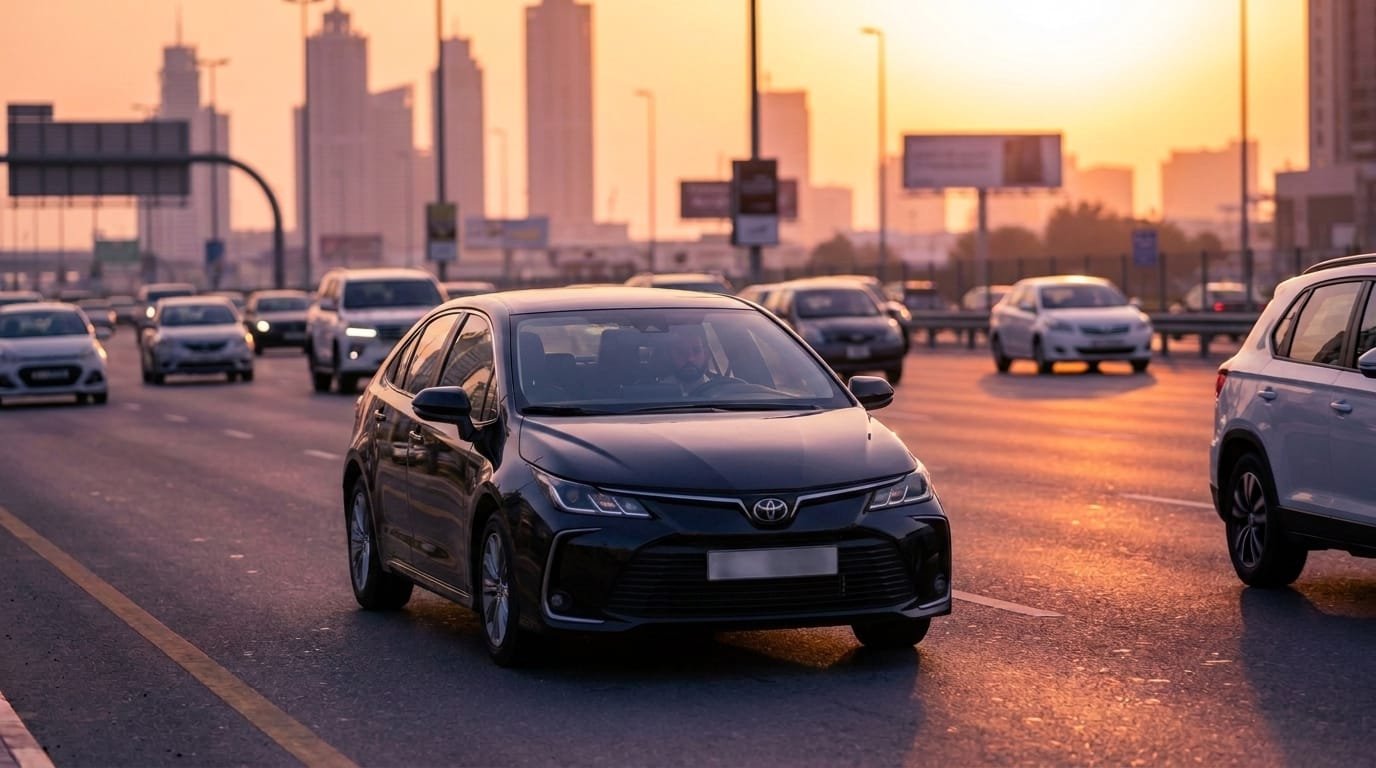
No, when the lower price simply reflects higher mileage, an older trim, or a fleet history that has been properly maintained and disclosed. Yes, when the low price is hiding an unresolved accident, a flood-affected chassis, or a tampered odometer. The price itself does not tell you which situation applies — an independent pre-purchase inspection does.
Reliability and Maintenance Cost Comparison
The table below uses published inspection-based condition data from CarSwitch’s UAE inspection database, which covers thousands of pre-purchase inspections across these models. Percentages reflect the share of inspected cars showing body damage or interior staining, not a defect rate — but they are a useful proxy for typical wear patterns by model.
| Model | Body Damage Found on Inspection | Interior Staining Found | AC Failure Rate (brand-level) |
|---|---|---|---|
| Toyota Corolla | approximately 37% | approximately 39% | Toyota brand-wide approximately 0.8%, the lowest of any major brand |
| Honda Civic | approximately 34% | approximately 41% | Not separately published |
| Toyota Yaris | approximately 31% | approximately 42% | Toyota brand-wide approximately 0.8% |
| Hyundai Accent | approximately 36% | approximately 52% | Roughly double the Toyota brand-wide rate |
| Nissan Sunny | approximately 38% | approximately 50% | Nissan brand-wide approximately 1.7% |
Two consistent patterns across the data: Toyota sedans arrive with meaningfully lower interior staining than the Hyundai and Nissan budget sedans in the same price bracket, and Toyota’s brand-wide AC failure rate runs well below Nissan and Hyundai. CVT-equipped Corolla and Sunny units generally warrant closer transmission attention after roughly 60,000 km, regardless of brand.
Spare Parts Availability
Toyota, Honda, and Nissan parts are widely stocked across Al Quoz Industrial Area and Sharjah Industrial Area, typically available same day without special ordering, for both OEM and aftermarket options. Hyundai and Kia parts are readily available through official dealer networks and a growing number of independent workshops, though aftermarket variety for older Korean models is generally narrower than for Toyota or Nissan equivalents in the same price bracket.
Insurance Differences
Insurance premiums in the UAE are driven mainly by the car’s declared value, repair cost profile, and the driver’s history — not simply by whether the brand is Japanese or Korean. Vehicles with widely available parts (most Japanese models) can sometimes see slightly lower comprehensive premiums because repair estimates are more predictable. This difference is typically modest and varies by insurer, so it should not be the deciding factor on its own.
Resale Value
Published UAE value-retention data after 5 years puts Toyota at approximately 56–57%, Nissan at approximately 53%, Kia at approximately 51–53%, and Hyundai at approximately 51%, with all four ahead of European luxury brands such as BMW and Audi (both around 43%) in the same comparison. Within Toyota’s own lineup, the Yaris retains approximately 59% after 5 years versus the Hyundai Accent’s approximately 54% in the same segment — a useful example of how resale gaps between Japanese and Korean models are usually a matter of a few percentage points, not a dramatic difference. Exceptions exist: a well-optioned, low-mileage Elantra can outsell a neglected, high-mileage Corolla in the same price bracket. See our resale value comparison guide for model-specific detail.
Red Flags Before Buying Any Cheap Japanese Car
| Check | What to Look For | Warning Sign |
|---|---|---|
| Accident history | Panel gaps, paint thickness, chassis rail alignment | Uneven gaps, overspray, ripple in rails |
| Chassis | Underbody rust, weld marks | Fresh welding, mismatched underbody color |
| Engine and transmission | Cold start behavior, CVT shudder, OBD scan | Stored fault codes, hesitation under load |
| Cooling system | Coolant color and smell, radiator condition | Milky residue, sweet burning smell |
| Service history | Stamped booklet or digital service record | Gaps longer than 12 months with no explanation |
| Odometer | Wear on pedals/seat vs displayed mileage | Mismatch between wear and reading — see our odometer fraud guide |
| Flood exposure | Seatbelt retraction, under-carpet moisture, musty smell | Slow retraction, corrosion under seats |
| Import history | Mulkiya origin, specification stickers | US-spec badges without GCC modification proof |
When Paying More Is Actually Smarter
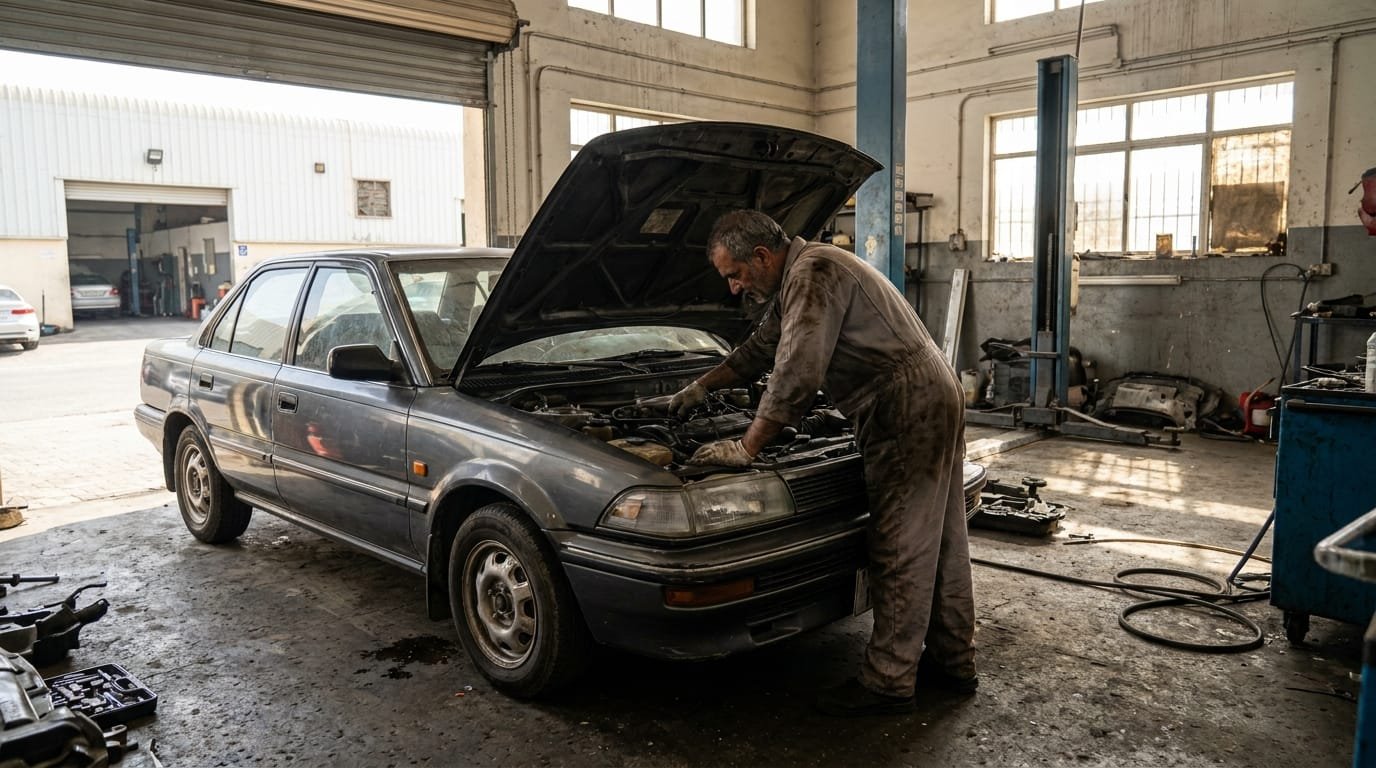
Spending an extra AED 3,000–6,000 upfront is often justified when it buys you a documented single-owner history, remaining factory warranty, lower mileage on a car you plan to keep long-term, or GCC-spec origin over a US-spec import. The savings from a cheaper, higher-risk car frequently disappear the first time a major repair — such as CVT service or suspension work — becomes necessary.
Best Choice by Buyer Type
| If you are… | Consider | Why
|
|---|---|---|
| First-time expat, short stay | Toyota Yaris or Nissan Sunny (cash) | Lower entry price, wide parts network, easy resale |
| Small family | Toyota Corolla or Hyundai Elantra | Balance of space, running cost, and resale |
| Long daily commute | Honda Civic or Mazda 3 | Comfortable highway ride, reasonable fuel economy |
| Very limited budget | Kia Rio or Hyundai Accent (verified history) | Lowest entry cost among the compared models |
| Leaving UAE within 12 months | Toyota model, GCC-spec | Fastest resale, least negotiation pressure |
| Wants remaining warranty | Newer Hyundai/Kia with low mileage | Warranty offsets slightly higher purchase price |
Illustrative Field Scenarios: Workshop & Market Patterns
Example scenario based on recurring UAE market patterns, not an actual documented case.
Scenario 1 — Indian office worker, Dubai: Compared a 2018 Corolla at roughly AED 29,000 with 110,000 km against a 2019 Elantra at roughly AED 33,000 with 55,000 km. Chose the Elantra for lower mileage despite the higher price, reasoning that lower mileage reduced near-term repair risk.
Scenario 2 — Filipino nurse, Sharjah: Found a Nissan Sunny priced noticeably under the market range. An independent inspection in Sharjah Industrial Area found evidence of flood exposure under the carpet. The deal was cancelled before any deposit was paid.
Scenario 3 — Pakistani engineer, Abu Dhabi: Chose a higher-mileage Camry over a lower-mileage Cerato because of wider parts availability and stronger resale expectations before an anticipated relocation in 18 months.
Scam Prevention: Protecting Yourself in This Price Gap
⚠ The most damaging trap in this segment is an unusually low-priced Japanese car marketed as a “quick sale, owner leaving the country.” Sellers use urgency to discourage a proper inspection. Never transfer any deposit before an independent inspection is complete, and never rely on a verbal promise that “everything is fine, no accidents.”
Also verify the test drive checklist items yourself, request the original Mulkiya, and confirm the chassis number matches all paperwork before any payment is made.
The Bottom Line Decision Framework
- Buy the cheaper Japanese car when: the price gap is explained by mileage or an older trim, the service history is documented, and an independent inspection finds no structural or flood issues.
- Choose the Korean alternative when: you want lower mileage, remaining factory warranty, or higher standard equipment, and are willing to pay the difference.
- Walk away regardless of price when: the seller resists an independent inspection, the price is far below the market range with no clear explanation, or the service history has unexplained gaps.
%%{init: {'theme': 'base', 'themeVariables': {'background': '#f8f9fa', 'textColor': '#1a1a1a', 'primaryColor': '#2c3e50', 'secondaryColor': '#c0392b', 'lineColor': '#1a1a1a'}}}%%
xychart-beta
    title "Typical Used Price, Mid-Point Estimate by Model (AED, thousands)"
    x-axis ["Yaris", "Sunny", "Accent", "Elantra", "Corolla", "Cerato", "Civic", "Mazda3"]
    y-axis "AED (thousands)" 0 --> 50
    bar [32, 23, 24, 35, 40, 30, 39, 33]
Data Sources & Methodology
Price ranges above were cross-checked against live UAE marketplace data (Dubizzle, DubiCars, CarSwitch) for comparable model years and mileage bands during the current research pass, and are presented as market ranges rather than fixed prices because listings vary by trim, condition, and seller type. Reliability and condition figures use CarSwitch’s published inspection-database statistics, which report the share of inspected vehicles with body damage or interior staining per model — the largest independently published UAE inspection dataset we could locate for this comparison. Resale retention percentages are sourced from the same inspection database’s published brand-level figures. General vehicle registration and roadworthiness information referenced in this article can be verified directly through the Roads and Transport Authority (RTA) and the UAE Government Portal (u.ae).
Accident and specification verification tools are available through Tasjeel-affiliated services. No single-listing price was used to establish any figure in this article; every range reflects multiple comparable listings or a published platform average.
Market Volatility Notice: all prices, ranges, and cost figures in this article are averages that change with supply, demand, and seasonal listing volume in the UAE. Verify current asking prices directly on active marketplace listings before finalizing any purchase decision.
Frequently Asked Practical Questions
Disclaimer: Emirates Cars is a 100% independent platform. We do not own showrooms, nor are we affiliated with any used car dealerships or garages. Our sole mission is to protect expats from financial fraud in the automotive market.
Continue your research with our Corolla vs Sunny ownership cost breakdown before making a final decision.
