Last Updated: Aug 2026 | By Omar Al-Fayed, Senior Automotive Consultant | Category: Maintenance & Repairs
A used car maintenance schedule UAE owners can actually use depends on three inputs: the manufacturer’s own interval table (found in the owner’s manual), the car’s current mileage and age, and how UAE driving conditions affect that specific vehicle. There is no single universal interval — a 2018 Toyota Corolla with a full service history runs on different timing than a 2015 Nissan Sunny with gaps in its records. The sections below give you a working framework for both.
What to Service and When: Quick Framework
Every used car arrives with two clocks running simultaneously: one counting kilometres and one counting calendar months. Whichever clock reaches its threshold first triggers the next service. For example, if your manufacturer specifies an oil change every 10,000 km or 12 months — and you drive only 6,000 km in a year — the 12-month mark applies.
Your owner’s manual is the single authoritative source for your specific vehicle. If that manual is missing, the manufacturer’s official website or a franchised dealer can provide the correct schedule for your model year and engine variant. The table below is a practical orientation — not a replacement for manufacturer documentation.
| Service Item | Typical Trigger (Mileage or Time — First Applies) | Action |
|---|---|---|
| Engine Oil & Filter | Per OEM spec (commonly 5,000–15,000 km depending on oil type and engine) | Replace |
| Air Filter (Engine) | Inspect every 15,000–20,000 km; replace when clogged or per OEM | Inspect / Replace |
| Cabin Air Filter | Every 12–15,000 km or annually — sooner in dusty UAE conditions | Replace |
| Brake Pads & Discs | Inspect every 20,000 km; replace when worn to minimum thickness | Inspect / Replace |
| Tyres | Check pressure monthly; rotate per OEM; replace at 1.6mm tread or after 5–6 years regardless of tread | Monitor / Replace |
| Battery | Test annually; typical UAE lifespan 2–3 years in sustained heat | Test / Replace |
| Coolant | Every 2 years or 40,000–60,000 km (long-life coolant extends this — check OEM spec) | Inspect / Replace |
| Spark Plugs (petrol) | Copper: ~30,000 km; Iridium/Platinum: 60,000–100,000+ km — OEM spec governs | Replace |
| Transmission Fluid | Conventional auto: every 40,000–60,000 km typically; CVT: check OEM (some say 60,000–100,000 km; some mark “lifetime” — verify before buying used) | Inspect / Replace |
| Brake Fluid | Every 2 years or per OEM | Replace |
| Drive/Serpentine Belt | Inspect every 40,000–60,000 km; replace per OEM or at first sign of cracking | Inspect / Replace |
| Timing Belt (if fitted) | Strictly per OEM (typically 80,000–160,000 km); timing chains are inspected, not scheduled for replacement on fixed intervals | Replace (belt) / Inspect (chain) |
| Power Steering Fluid | Check level every 20,000 km; replace per OEM or if discoloured | Inspect / Replace |
| AC System | Inspect annually before summer; recharge refrigerant only when system performance drops or a leak is confirmed | Inspect / Service when needed |
| Suspension & Steering | Inspect every 20,000–30,000 km or at first sign of noise, vibration, or pull | Inspect |
Used Car Maintenance Schedule by Mileage
Mileage-based triggers assume regular driving. In the UAE, where many residents commute between Sharjah and Dubai daily, annual mileage of 25,000–40,000 km is not unusual — meaning some service items arrive faster than expats from lower-mileage markets expect.
Engine oil and filter intervals depend heavily on oil specification. Conventional mineral oil in an older engine (pre-2010) may require changes around every 5,000 km. Semi-synthetic or full-synthetic oil in a modern engine often extends the interval to 10,000–15,000 km. Always confirm against your owner’s manual — some turbocharged engines specify shorter intervals under severe driving conditions. agency vs. independent oil change explains cost differences clearly.
Brake pads wear faster in stop-start urban traffic than on motorways. A car used primarily on Sheikh Zayed Road at highway speeds will retain pads longer than one spending two hours daily in Dubai–Sharjah bumper-to-bumper conditions. When you hear grinding, squealing that persists after initial braking, or feel brake pedal pulsation — inspect immediately, do not defer.
Transmission fluid deserves specific attention on used CVT vehicles. Some manufacturers mark CVT fluid as “lifetime fill” in their documentation, but independent workshops in Al Quoz commonly recommend a change on high-mileage used cars where the fluid has never been touched. If the previous owner’s records don’t show a CVT fluid change by 80,000–100,000 km, treat it as a priority inspection. gearbox warning signs UAE covers symptoms to watch for.
Timing belts require strict adherence to the manufacturer’s replacement schedule. If you are buying a used car and cannot confirm the timing belt was replaced, obtain the vehicle’s mileage history and compare it against
the OEM interval. A snapped timing belt typically destroys the engine — the repair cost on most four-cylinder engines ranges from AED 8,000 to AED 20,000+. Timing chains do not have a scheduled replacement interval but should be inspected if the engine produces a rattling noise on cold start.
Maintenance Schedule by Time
A car that travels only 8,000 km per year can still develop time-related failures. Fluids oxidise, rubber components harden, and batteries discharge even when mileage accumulates slowly. In the UAE, the combination of heat and humidity accelerates these processes compared to cooler climates.
| Item | Time-Based Risk | Recommended Action |
|---|---|---|
| Engine Oil | Oxidises over 12 months even with low mileage | Change at 12-month mark if mileage interval not reached first |
| Brake Fluid | Absorbs moisture over time; boiling point drops | Replace every 2 years regardless of mileage |
| Coolant | Inhibitors deplete; corrosion risk increases after 2 years on standard coolant | Test annually; replace per OEM time spec |
| Battery | UAE summer heat causes internal plate degradation; lifespan typically 2–3 years | Load-test annually; replace proactively at 2.5–3 years |
| Tyres | Sidewall cracking from UV and heat even when tread remains | Check DOT date code; replace tyres older than 5–6 years regardless of tread depth |
| Drive Belts & Hoses | Rubber hardens and cracks in extreme heat; failure risk increases after 4–5 years | Inspect annually; replace at first sign of cracking or glazing |
| AC System | Seals dry; refrigerant slowly leaks over years of disuse or age | Inspect before each summer; service only when performance drops |
| Cabin Filter | Becomes a source of bacteria and mould in AC systems after 12 months in dusty UAE air | Replace annually at minimum |
Vehicles that sit unused for extended periods — common during summer home visits — develop additional risks: fuel can degrade in the tank over several months, brake components can seize partially, and tyre flat spots can develop under static load. If a car sits for more than 4–6 weeks, check tyre pressure, battery charge, and brake feel before driving normally. UAE car ownership calendar maps these seasonal considerations month by month.
What UAE Driving Conditions Can Change
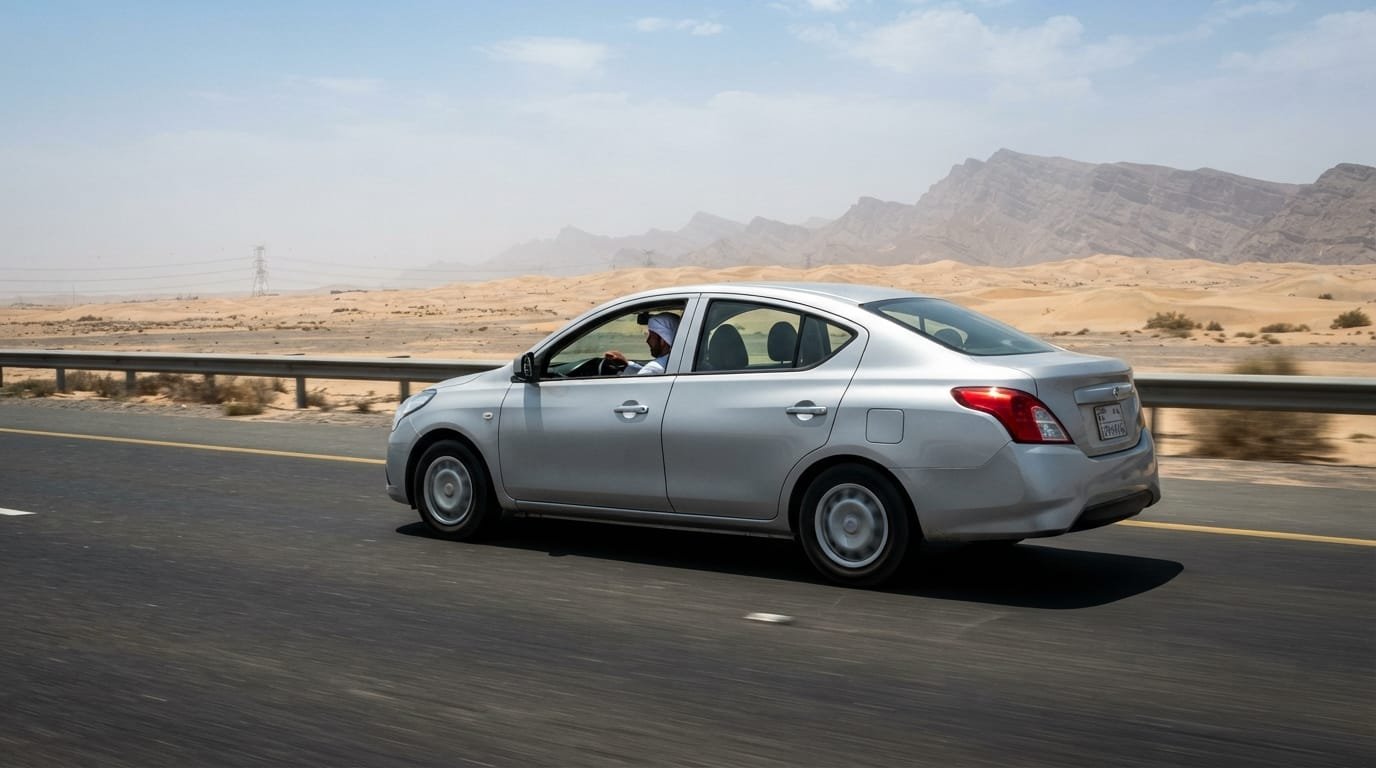
UAE conditions do not automatically shorten every manufacturer-specified interval — but they do change which items deserve closer monitoring between scheduled services.
| UAE Condition | Components Most Affected | Practical Implication |
|---|---|---|
| Sustained ambient heat (40°C+) | Battery, coolant, engine oil, rubber components, tyres | Shorten battery test cycle to annually; inspect rubber annually |
| Fine dust and sand | Engine air filter, cabin filter, brake components | Inspect air filter more frequently during sandstorm season |
| Heavy stop-start traffic (Dubai-Sharjah corridor) | Brake pads, transmission, engine oil, cooling system | Brake inspection at lower mileage points; monitor coolant temp gauge |
| Extended idling | Engine oil, spark plugs, fuel injectors | Idling does not build mileage but burns oil; consider time-based oil changes |
| Repeated short trips under 5 km | Engine oil (incomplete warm-up), battery | Short trips prevent full moisture burn-off in oil; increases contamination rate |
| Constant AC use | AC compressor, drive belt, engine load | Inspect AC belt tension annually; watch for compressor noise on startup |
| Highway driving (Abu Dhabi–Dubai) | Tyres, suspension, fuel system | Check tyre pressure before trips; suspension wear is lower than urban stop-start |
| High annual mileage (30,000+ km/year) | All scheduled items arrive sooner | Track mileage actively; set reminders at OEM trigger points |
If your manufacturer specifies “severe duty” or “severe conditions” intervals in the owner’s manual, UAE urban driving typically qualifies. Some OEMs publish separate severe-duty schedules — check whether yours does before assuming standard intervals apply. skipping service in UAE summer covers the specific risks of deferring maintenance in peak heat months.
Essential Checks Between Services
A service visit every few months cannot substitute for a 10-minute monthly walk-around. These are the items a used-car owner in the UAE can monitor without tools:
- Tyre pressure: Check cold (before driving) monthly. UAE heat causes pressure to fluctuate; under-inflated tyres increase blowout risk on hot asphalt. tyre blowout UAE highway guide
- Engine oil level: Check with dipstick when the engine is cold or after it has sat for 5+ minutes. A drop of more than 1 litre between changes indicates consumption — investigate before the next scheduled service.
- Coolant level: Check the reservoir (never the radiator cap on a hot engine). A consistent drop without visible leaks warrants a pressure test.
- Brake feel: Soft pedal, pulsation, or pulling to one side during braking — stop driving and inspect. Do not defer.
- Battery warning signs: Slow cranking, dashboard voltage warning, or electrical flickering. In UAE summer, a battery can fail within days of showing symptoms.
- Warning lights: A check-engine light does not always mean an emergency, but it should be scanned within a week. A red temperature warning or oil pressure warning means stop immediately. engine warning light UAE guide
- AC performance: A drop in cooling output — not gradual but sudden — often signals refrigerant loss or a compressor issue. AC not cooling UAE summer
- Fluid leaks: Check the parking spot after moving the car. Oil is dark brown/black; coolant is green, pink, or orange; transmission fluid is red; brake fluid is light yellow. Any active leak requires same-week inspection.
- Unusual noises: Grinding on braking, knocking on acceleration, rattling on cold start, or squealing from the belt area — each has a specific diagnostic path. Do not mask noise with radio volume.
Maintenance Priorities for Older Used Cars
When a used car arrives with incomplete service records — common in the UAE private market — the practical approach is a baseline inspection rather than assuming the previous owner followed the schedule. fake service history UAE explains how to identify doctored records.
| Priority Level | Items | Why It Can’t Wait |
|---|---|---|
| Urgent (Safety-Critical) | Brakes (pads, discs, fluid, lines), tyres (tread + age), steering components, timing belt (if interval unconfirmed) | Failure causes accidents or immediate breakdown |
| High (Damage-Prevention) | Engine oil + filter, coolant, transmission fluid, drive/serpentine belt, battery | Neglect causes expensive engine, gearbox, or electrical damage |
| Routine (Scheduled) | Spark plugs, air filter, cabin filter, power steering fluid | Affects performance and fuel efficiency; schedule at next service |
| Monitor (Observation) | Suspension bushings, AC seals, fuel injectors, exhaust condition | No immediate risk; inspect at next service or when symptoms appear |
On cars over 100,000 km with no recorded transmission service, treat a fluid inspection as High priority — not Routine. Transmission rebuilds in Dubai start around AED 4,000–8,000 for automatic units and can reach AED 15,000+ for CVT failures. annual maintenance cost UAE comparison breaks down what owners typically spend by car category.
A car priced attractively at AED 18,000–22,000 may have a timing belt overdue by 40,000 km or a CVT that has never been serviced. Neither is visible on a test drive. Always ask for the service book, verify oil change stickers inside the bonnet, and cross-reference odometer readings against service dates. A missed timing belt replacement costs more than the car’s purchase price to fix on many engines. pre-purchase inspection guide UAE
What to Check Before Buying a Used Car (Maintenance History Focus)
This section covers maintenance records only. For the full mechanical inspection process, pre-purchase inspection Dubai provides a complete checklist.
| Record / Item | What to Look For | Red Flag |
|---|---|---|
| Service Book / Invoices | Consistent service intervals matching the OEM schedule | Gaps of 20,000+ km between oil changes; missing stamps |
| Oil Change Sticker (bonnet) | Date and mileage of last change | Sticker showing 30,000+ km ago; no sticker at all |
| Timing Belt Evidence | Invoice or stamp confirming replacement date and mileage | No record on a high-mileage belt-engine car |
| Transmission Service | Fluid change record; especially on CVT vehicles | “Never done” on a car over 80,000 km |
| Brake History | Pad and disc replacement at reasonable mileage points | Original pads on a 90,000 km car |
| Battery Age | Sticker on battery showing month/year of manufacture | Battery over 3 years old in UAE conditions |
| Cooling System | Any record of coolant flush, thermostat, or radiator work | Original coolant on a 6-year-old car |
| Accident/Repair History | Panel replacement or structural repair noted in records | Body gaps inconsistent with factory spec; fresh paint patches |
check car accident history UAE free explains how to run an official history check before committing to purchase.
How to Keep a Used-Car Maintenance Record
A complete maintenance log increases resale value, simplifies fault diagnosis, and helps you track actual ownership costs. The format does not need to be complex — a spreadsheet or even a physical folder with invoices works.
| Field | What to Record |
|---|---|
| Date | Day/month/year of service |
| Odometer Reading | Exact km at time of service |
| Work Performed | Specific items: “oil + filter change”, “front brake pads replaced”, “cabin filter replaced” |
| Parts Used | Brand and part number where possible (OEM vs. aftermarket) |
| Workshop / Dealer | Name, location (e.g., Al Quoz, Sharjah Industrial Area) |
| Amount Paid (AED) | Total invoice amount |
| Next Service Due | Mileage and/or date trigger for next service |
| Warranty on Parts | Part warranty period and supplier |
When selling, a documented service history — even from independent garages — commands a measurable price premium in the UAE market over an undocumented car of identical specification. real cost of owning a car Dubai shows how maintenance records affect total ownership calculations.
Dealer vs Independent Garage for Routine Maintenance
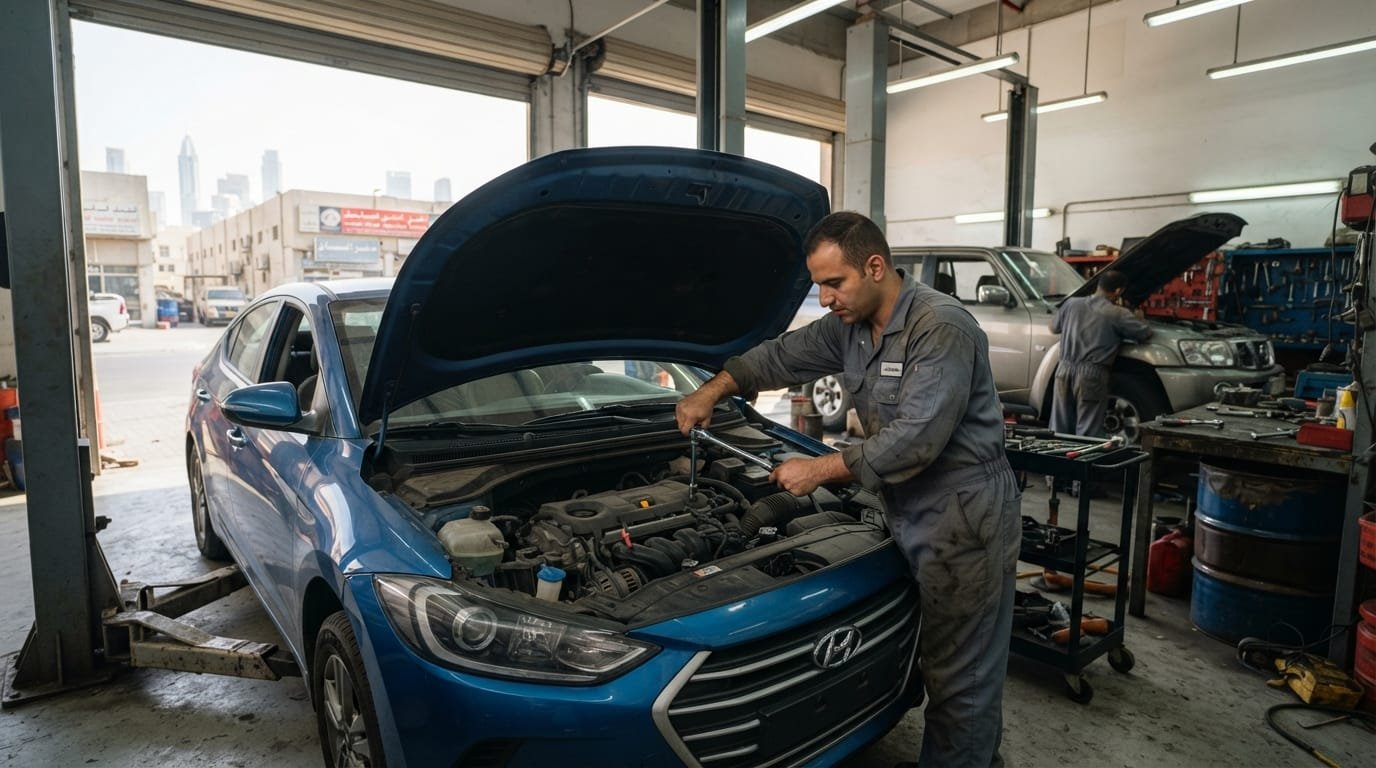
| Factor | Franchised Dealer | Reputable Independent Garage |
|---|---|---|
| Manufacturer Knowledge | Model-specific training and access to technical service bulletins | Variable; experienced workshops cover common models well |
| Warranty Considerations | Required for active manufacturer or dealer warranty; records align with service book | Acceptable for out-of-warranty vehicles; keep invoices as proof |
| Service History Value | Dealer stamps maximise resale perception | Invoices provide documented history; less premium on resale for private buyers |
| Parts | Genuine OEM parts as standard | OEM or quality aftermarket; request OEM if preferred |
| Diagnostic Equipment | Manufacturer-specific diagnostic tools for complex fault reading | Generic OBD tools sufficient for most routine maintenance; may lack model-specific depth |
| Cost Range (routine service) | Generally AED 400–900+ for standard service depending on brand and model | Generally AED 200–550 for equivalent service on the same model |
| When Dealer Makes More Sense | Active warranty; complex electronics; recall work; timing belt on newer engines | — |
| When Independent Makes Sense | — | Out-of-warranty routine maintenance; budget-conscious ownership; well-reviewed workshop |
For Al Quoz workshops specifically, finding an honest mechanic Al Quoz covers how to evaluate independent garages before committing your vehicle.
Used Car Maintenance Schedule UAE: Annual Ownership Calendar
| Period | Priority Actions |
|---|---|
| January – February | Full vehicle inspection after peak summer. Check AC performance recovery. Review annual mileage vs. OEM service triggers. |
| March – April | Pre-summer preparation: battery load test, coolant strength check, AC system inspection, tyre condition and pressure check. |
| May – June | Peak heat onset: verify cooling system is functioning correctly; check all fluid levels; inspect cabin filter if not recently done. |
| July – August | Many expats travel; arrange car storage or periodic running if leaving for 4+ weeks. Check tyre pressure and battery on return. |
| September – October | Post-summer inspection: battery, belts, hoses, tyre sidewall condition after sustained heat exposure. |
| November – December | Ideal period for deferred non-urgent maintenance. Pre-Ramadan service if applicable. Review full-year maintenance log and project next year’s service costs. |
Registration renewal in the UAE requires a vehicle to pass the RTA roadworthiness inspection — but that inspection is not a substitute for scheduled maintenance. UAE car inspection Tasjeel guide explains exactly what the inspection checks and what it does not.
Total Annual Maintenance Cost: UAE Used Car Estimate
| Service Item | Frequency | Estimated Cost (AED) |
|---|---|---|
| Oil & Filter Change | 1–2× per year (mileage-dependent) | 180 – 450 |
| Cabin Air Filter | Annual | 80 – 200 |
| Engine Air Filter | Every 1–2 years | 80 – 180 |
| Tyre Rotation | Every 10,000–15,000 km | 60 – 120 |
| Battery Test / Replacement | Annual test; replacement every 2–3 years | 0 (test) / 250 – 600 (replacement) |
| Brake Pad Inspection | Annual | 50 – 100 (inspection only) |
| Brake Pad Replacement (front) | Every 30,000–50,000 km (varies) | 300 – 700 |
| AC Service / Inspection | Annual pre-summer | 100 – 300 |
| Coolant Check | Annual | 50 – 150 (top-up / flush) |
| General Inspection Labour | Annual | 150 – 350 |
| Estimated Annual Routine Total | AED 1,050 – 3,150 |
These figures represent routine, scheduled maintenance on a mid-segment used car (e.g., Toyota Corolla, Nissan Sunny, Hyundai Elantra) serviced at an independent garage in Dubai or Sharjah. Major items — timing belt replacement, transmission service, new tyre set — sit outside this annual baseline and should be budgeted separately. used car ownership cost UAE provides a full-spectrum cost framework.
Decision Scenarios: Which Maintenance Path Fits Your Situation
Decision Scenario: High-Mileage Commuter Car with Incomplete Records
- If This Sounds Like You: You commute between Sharjah and Dubai daily in a used sedan you purchased privately. The car has 120,000 km and the service history has a 25,000 km gap.
- The Decision: Whether to start maintenance from the last recorded service point or conduct a full baseline service first.
- Recommended Action: Commission a full baseline inspection at a trusted independent workshop. Change oil, check brake fluid, verify timing belt status, inspect transmission fluid, and test battery — regardless of last recorded dates.
- Why: A gap in records means unknown deferred items. Baseline servicing gives you a confirmed starting point and prevents compounding neglect from the previous owner onto your ownership period.
Decision Scenario: Low-Mileage Weekend Car
- If This Sounds Like You: You own a second car used primarily on weekends and during school runs. Annual mileage rarely exceeds 8,000 km. Mileage-based service triggers are never reached.
- The Decision: Whether to follow the mileage schedule or shift to a time-based approach.
- Recommended Action: Apply time-based intervals as the primary trigger — annual oil change, annual battery test, biennial brake fluid change, annual AC inspection.
- Why: Low mileage does not prevent fluid oxidation, battery degradation, or rubber ageing. Waiting for a mileage trigger on a 6,000 km/year car means a 2-year oil change interval on a vehicle that likely needs it annually.
Decision Framework: Maintenance Approach by Owner Profile
| Owner Profile | Primary Trigger | First Priority | Workshop Type |
|---|---|---|---|
| Daily Dubai-Sharjah commuter (25,000+ km/year) | Mileage (intervals hit quickly) | Brakes, oil, tyres | Independent (cost efficiency); dealer for complex faults |
| New expat, first UAE car, under warranty | Manufacturer schedule | Keep all dealer stamps for warranty compliance | Franchised dealer |
| Budget buyer, older used car (100,000+ km) | Both mileage and time | Baseline inspection first; then prioritise safety-critical items | Reputable independent (Al Quoz, Sharjah Industrial) |
| Expat planning to leave UAE in 12–18 months | Time-based minimum | Safety and reliability; avoid over-investment in non-critical items | Independent for routine; check selling car before leaving UAE |
| Family car, Abu Dhabi-Dubai commute | Mileage and time combined | Tyres, brakes, AC, cooling system | Dealer or reputable independent with documented service history |
flowchart TD
    A[Buy Used Car UAE] --> B{Service Records Available?}
    B -- Yes --> C[Match Records to OEM Schedule]
    B -- No --> D[Baseline Inspection First]
    C --> E{Any Gaps in History?}
    E -- Yes --> D
    E -- No --> F[Continue OEM Mileage / Time Schedule]
    D --> G[Safety-Critical Items First\nBrakes · Tyres · Timing Belt]
    G --> H[Damage-Prevention Items\nOil · Coolant · Transmission · Battery]
    H --> I[Routine Scheduled Items\nFilters · Spark Plugs · Fluids]
    I --> F
    F --> J[Monthly Owner Checks\nTyres · Oil · Coolant · Warning Lights]
    J --> K{Symptom Detected?}
    K -- Yes --> L[Professional Inspection\nDo Not Defer Safety Items]
    K -- No --> M[Next OEM Trigger Point\nMileage or Time — First Applies]
    M --> J
    classDef default fill:#000000,color:#ffffff,stroke:#000000,font-size:16px,padding:14px;
FAQs: Used Car Maintenance Schedule UAE
Emirates Cars Editorial Methodology
This guide combines official UAE government information with manufacturer documentation and current UAE market observations.
Official references used where applicable:
- Roads and Transport Authority (RTA) Dubai – Vehicle Services
- Tasjeel UAE – Vehicle Inspection & Registration
- UAE Government Portal – Owning and Registering a Vehicle
- Toyota Owner’s Manual Reference (Corolla 2019 – UAE market interval verification)
- Nissan Global – Maintenance Information
Disclaimer: Emirates Cars is a 100% independent platform. We are not affiliated with any dealership, manufacturer, insurance provider, or government entity. All content is for informational purposes only. Verify current regulations, service requirements, and pricing directly with official UAE authorities and licensed service providers before making decisions.
